

Anansi: The Trickster Spider God of West Africa
Anansi the spider god outwitted sky kings and death itself to give humanity stories. Meet the cunning Akan trickster whose web still stretches across the Atlantic.
Contents
A small spider drops from the ceiling of the sky. Below him, Nyame the Sky God sits on his golden stool, holding every story that has ever existed locked inside a wooden chest. No human being has ever heard one. The spider climbs up his own thread, bows, and asks to buy them all.
Nyame laughs. He names a price that has broken every king before: bring me the python Onini, the hornets of Mmoboro, and the leopard Osebo, alive and without nets. Other rulers have offered gold, armies, entire kingdoms. The spider has none of those things. He has only his mind, a long tongue, and a genius for misdirection.
Anansi, the trickster spider god of West Africa, does not flinch. He walks back into the forest, and the bargaining begins.
Who Is Anansi? Roots in Akan Oral Tradition

The Akan people have told stories about Anansi for centuries across what is now Ghana, Ivory Coast, and neighboring coastal regions of West Africa. The Akan are not a single tribe but a cluster of related groups, including the Ashanti (also spelled Asante), who became one of the most powerful kingdoms in West African history. The Ashanti were also the main carriers of Anansi stories as they spread first across the continent and then, through the transatlantic slave trade, into the Caribbean and the Americas.
In Twi, the language spoken by the Akan, ananse simply means "spider." The creature is small, patient, and often overlooked, which is exactly why Anansi makes such a compelling protagonist. He is never the strongest figure in any room. He wins by noticing what stronger creatures fail to see.
Anansi belongs to a specific and recognizable type in world mythology: the trickster. Tricksters appear on every continent. They upend order, usually for selfish reasons, but they leave something valuable behind. Loki disrupts the Aesir and occasionally saves them. Coyote steals fire and causes chaos in equal measure. Anansi's distinguishing trait is that he is explicitly tied to language. He wins stories. He uses words as traps. His weapons are narrative.
In many Akan versions of the creation tradition, Anansi is the son of Nyame, the Sky God, and Asase Ya, the Earth Goddess. That parentage places him at the junction of heaven and earth, which explains his unusual freedom of movement between the human world and the divine.
The Sky God's Price: How Anansi Won All Stories
The myth of Anansi buying all stories from Nyame is the defining story of this tradition, and its structure deserves close attention because every element is deliberate.
Nyame sets three tasks. Each creature Anansi must capture represents a particular kind of danger: the python Onini is patient and crushing strength, the hornets of Mmoboro are chaotic collective violence, and the leopard Osebo is raw predatory speed. In most retellings, Anansi defeats all three through a shared technique: he gets each creature to believe, on its own terms, that cooperating with him is actually in its interest.
For Onini the python, Anansi stages an argument with his wife about whether Onini is longer than a certain palm branch. He invites the python to be the judge by lying alongside the branch, then ties him to it. The python's pride does the trapping, not Anansi's strength.
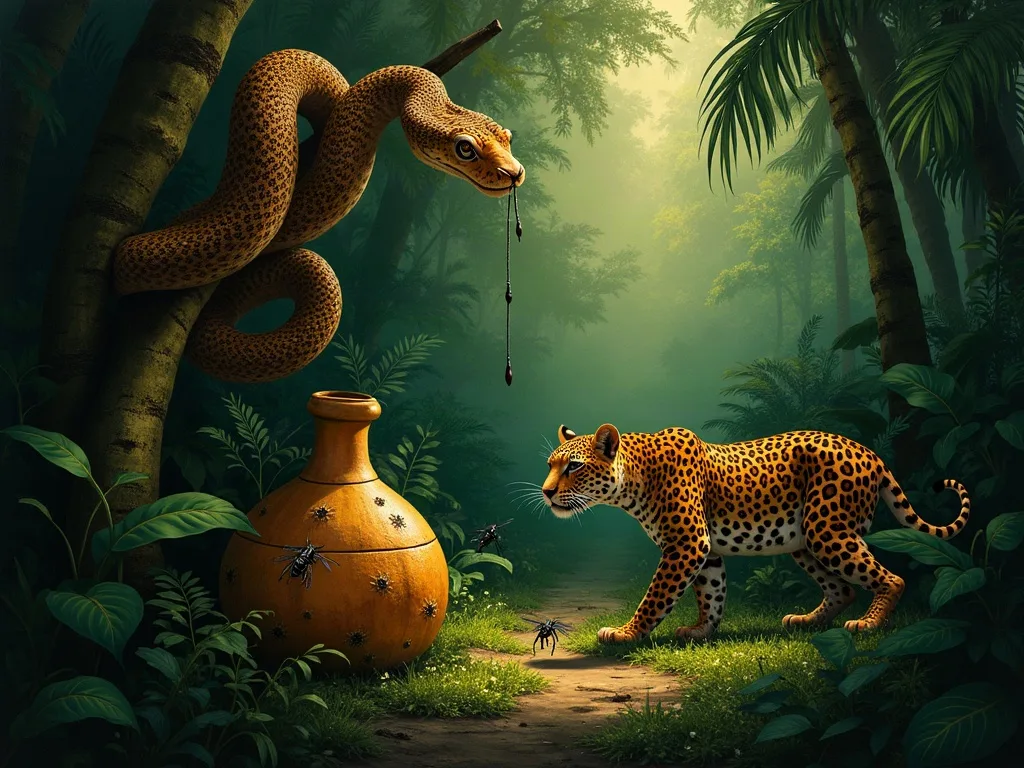
For the hornets of Mmoboro, Anansi pours water over himself, then approaches the swarm claiming it is raining. He gestures to an empty gourd, explains that they should shelter inside it to stay dry, and they do. He seals the gourd.
For Osebo the leopard, Anansi digs a pit, covers it lightly with sticks and leaves, and waits. The leopard falls in, then accepts Anansi's help to climb out, unaware that the help involves being secured in a net.
Each trap is made from the victim's own nature. Onini is vain about his size. The hornets trust rain. Osebo is too proud to wait at the bottom of a pit. Anansi gives Nyame all three, still breathing. Nyame opens the chest.
From that day forward, the stories belong not to the sky, not to kings, but to everyone. Among the Akan, a traditional story is still called Anansesem, which translates directly as "spider story." The label survives into the present day, living proof of Anansi's mythological ownership.
Anansi as a Shape-Shifter: Man, Spider, and God
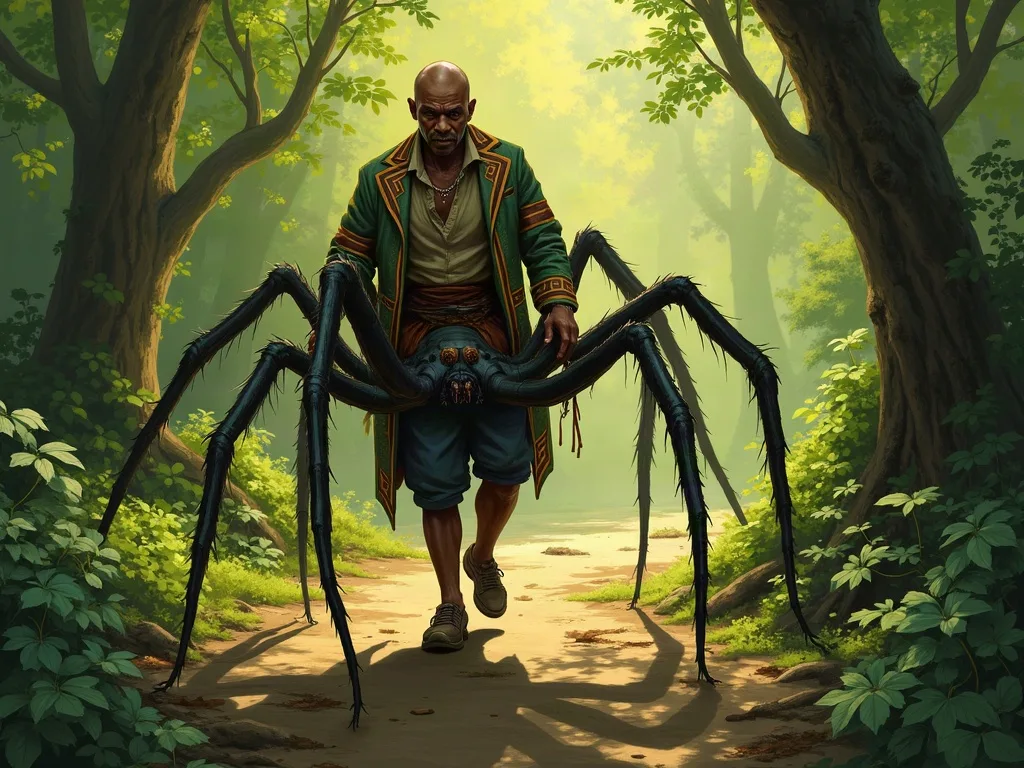
One of the most consistent features of Anansi's mythology is his unstable form. He is a spider. He is also a short, clever man with a bald head, often depicted wearing a coat or hat that represents his trickster persona. In some stories he shifts mid-scene, spinning a web as a man might deal cards, then scuttling across a ceiling when the moment suits him.
This shape-shifting is not mere magical convenience. It carries moral and cosmological weight. Anansi occupies no fixed category. He is not fully divine, not fully human, not fully animal. That in-between status is the source of both his power and his vulnerability. He can approach kings and gods as an equal because he belongs, in some sense, to all three realms at once.
In Ashanti cosmology, spiders hold a specific symbolic position. The spider's web connects points that would otherwise be separate. It is both a home and a trap. It catches what passes through it. Anansi's ownership of stories follows exactly that logic: stories, like webs, are structures that capture truth and hold it long enough for someone to examine it.
Several Akan stories also show Anansi as a father and husband, living in a village with his wife Aso and his sons. These domestic episodes often involve him cheating his neighbors out of food or trying to hoard crops during a famine, only to be caught and humiliated. The trickster who defeats sky gods cannot always manage his own household. That contrast between cosmic power and domestic failure is part of what makes him feel human. He is brilliant and selfish, generous in the myths that matter most, and petty in the ones that hit closest to home.
Anansi Stories as Moral Technology
Akan elders did not tell Anansesem purely for entertainment. The stories functioned, and still function, as a sophisticated system for transmitting values without lecturing.
The typical structure works like this: Anansi schemes, wins, and then loses something. He gets the food but loses the friendship. He outsmarts the lion but humiliates himself in front of his village. The punishment is rarely delivered by an authority figure. It comes from the internal logic of the trick itself folding back on the trickster.
This is pedagogically precise. Children watching or listening learn that cleverness without care for others produces hollow victories. They also learn that the world has its own corrective mechanisms; you do not need a god to punish bad behavior. The web snaps back.
At the same time, the stories validate cunning as a legitimate survival tool. In a social and historical context where West African communities repeatedly faced external domination, Anansi modeled how to resist without direct confrontation. The weak can win. Patience outperforms brute force. A well-placed word can trap a king.
The Middle Passage and Anansi in the African Diaspora
The most remarkable chapter in Anansi's history is not found in any Akan village. It is found in the Caribbean.
When enslaved Akan people, primarily Ashanti, were transported across the Atlantic beginning in the sixteenth century, they carried no possessions. They carried Anansi. His stories survived the Middle Passage in the only way anything can survive that kind of violence: in the mouths of people who refused to let them die.
In Jamaica, Anansi became Anancy. In Suriname and the Dutch Caribbean, he became Anansie. In the United States, his influence seeps into the Br'er Rabbit stories, where a small, quick-witted animal repeatedly defeats larger, slower, more powerful opponents using almost identical techniques to Anansi's: misdirection, flattery, and exploiting the opponent's self-regard. Scholars including Robert Hemenway and Roger Abrahams have documented the transmission lines between West African spider tales and African American trickster folklore.
In Jamaica particularly, the Anancy tradition became something close to a national mythology. Louise Bennett-Coverley, the Jamaican poet and cultural icon who went by "Miss Lou," performed Anancy stories throughout her career and described them as one of the foundations of Jamaican identity. The stories were not just entertainment; they were a framework for understanding power and resistance under colonial rule.
Neil Gaiman's 2005 novel American Gods and his 2005 companion novel Anansi Boys brought the character to a global audience. Gaiman's Anansi appears as a West African man in a yellow plaid suit, full of laughter and danger in equal measure, which captures something real about how the tradition handles the character: charming right up to the moment you realize you are already in his web.
Anansi and Death: The Story of Hate-to-Be-Contradicted
Not all Anansi stories are about cosmic bargains. Some are quiet, dark, and strange in the way the best folk tales always are.
One story, widely circulated across Akan communities, features a demon or spirit called Hate-to-Be-Contradicted. This creature lives in the bush and kills anyone who disagrees with it. Anansi encounters it and is told something demonstrably false. Every traveler before him has agreed rather than die. Anansi does not agree. He argues. Then, when the creature lunges, Anansi is already somewhere else: up a thread, across a branch, six feet above the demon's reaching hands.
The story encodes a specific kind of courage. Anansi does not have the strength to fight the demon directly. But he will not lie. He contradicts it, runs, contradicts it again, runs again, until the creature exhausts itself in pursuit and Anansi escapes. The lesson is not that truth-telling is safe. The lesson is that truth-telling and agility together can defeat a force that lies and brute strength cannot.
This story pattern, where Anansi wins not because he is invulnerable but because he keeps moving and keeps speaking, appears in dozens of variants across West Africa and the Caribbean. It is one of the reasons the spider, of all animals, became the carrier of this tradition. A spider does not fight. It repositions. It waits. It reweaves.
Anansi and the Akan Pantheon
Anansi exists inside a larger Akan spiritual framework, and understanding his position within it adds depth to the individual stories.
At the top of Akan cosmology sits Nyame (sometimes spelled Nyame or Onyankopon), the supreme sky deity, the creator and sustainer of the universe. Nyame is distant and all-knowing, approached through prayer and libation rather than direct conversation, except, notably, by Anansi. That Anansi can walk up to Nyame and negotiate is itself a theological statement about the trickster's exceptional status.
Asase Ya, the earth goddess and Anansi's mother in some versions, represents the physical world, farming, fertility, and truth. She has no formal priests or temples in traditional Akan religion, but she receives offerings every Thursday, the day the Akan consider sacred to her. Her connection to Anansi places him literally between the sky father and the earth mother: the figure who bridges above and below.
The Akan also recognize the Obosom, lesser divine beings associated with rivers, forests, and specific places. Anansi moves through their territories freely. He is subject to their rules and often breaks them, but never suffers permanent consequences, because his divine parentage gives him a protection ordinary humans lack.
This cosmological position, god-born, earth-walking, sky-permitted, explains why Anansi can steal, cheat, and trick without becoming a villain. He is playing a role the cosmos has assigned him: the necessary disruptor, the one who makes sure power does not calcify into permanent tyranny.
Cross-Cultural Echoes: Tricksters Who Own the Word
Anansi's role as owner of stories has striking parallels in other traditions, and the comparison illuminates what makes the Akan version distinctive.
Hermes, the Greek messenger god, is also a trickster and also connected to language, communication, and the movement of information between realms. Like Anansi, he is born between worlds: son of Zeus but perpetually outside the Olympian hierarchy, messenger rather than ruler. Both figures steal or bargain for things that belong to higher powers and distribute them to mortals.
Thoth, the Egyptian god of writing and wisdom, holds a related role: he is the keeper of sacred knowledge, the scribe who records cosmic events. But Thoth is primarily a preserver, while Anansi is a redistributor. Thoth guards knowledge; Anansi makes sure it circulates.
The Yoruba trickster Eshu (also called Elegba or Legba) is perhaps the closest parallel within Africa. Eshu stands at crossroads, controls communication between humans and the Orisha (divine beings), and delights in misdirection. Like Anansi, Eshu is not evil but genuinely dangerous when ignored or disrespected. Both figures demand acknowledgment before they will let a story pass.
What separates Anansi from all of these is the explicit act of purchasing narrative itself. No other trickster in the world's mythological record makes stories the object of their most defining quest. That specificity is Akan. It reflects a culture in which the oral story is not casual entertainment but a form of sacred property, something with value, something that can be owned, sold, and, crucially, shared.
Frequently asked questions about Anansi the Spider God
Frequently asked questions
What does the name Anansi mean, and where does it come from?
Anansi comes from ananse, the Twi word for "spider." Twi is the primary language of the Akan people of present-day Ghana and Ivory Coast. The name has no mythological prefix or honorific in most oral traditions; the spider's name and the creature's name are identical, which reinforces the tight bond between the animal and the divine figure.
Is Anansi a god or a spirit? How do the Akan classify him?
Anansi resists easy classification, which is itself a feature of his mythology. In Akan cosmology he is the son of Nyame, the supreme sky god, which gives him divine parentage. But he walks the earth, lives in villages, tricks humans, and faces ordinary consequences for his failures. He is perhaps best described as a culture hero with divine status: a figure who operates between the human and the divine and who earns his position through action rather than simply inheriting it.
How did Anansi stories survive the transatlantic slave trade?
Enslaved Akan people, primarily from Ashanti territories, carried Anansi stories orally across the Atlantic. With no written form, the stories lived in memory and in the act of retelling. In Jamaica the tradition became the Anancy story cycle, still performed and celebrated today. Scholars such as Roger Abrahams and Robert Hemenway have traced the structural and thematic connections between West African Anansi tales and African American and Caribbean trickster traditions, including the Br'er Rabbit cycle.
What is an Anansesem?
An Anansesem (plural Anansesem) is the Akan term for a traditional spider story. The word literally means "Anansi's words" or "spider story" in Twi. It is still used in Ghana today as a generic term for folk tale, which shows the depth of Anansi's identification with storytelling itself. In many communities, a formal call-and-response opening signals the start of an Anansesem, creating a ritual frame around the performance.
Did Anansi ever lose? What happens when the trickster fails?
Yes, frequently. Akan oral tradition is careful not to make Anansi invincible. In many domestic stories he loses food, friendships, and dignity through his own greed or overreach. These failure stories serve a specific function: they show that cleverness without ethics produces hollow outcomes. The same audience that watched Anansi defeat sky gods also watched him get publicly humiliated by a tortoise or cheated by his own wife. The combination keeps the character believable and morally instructive.
Which modern works feature Anansi?
The most widely read modern version is Neil Gaiman's 2005 novel Anansi Boys, which depicts Anansi as a West African man in a yellow plaid suit whose sons inherit different fragments of his power. Gaiman's American Gods (2001) also features Anansi prominently. In film and television, the character appears in multiple animated series for children. Kwame Alexander's poetry and the broader Afrofuturist literary movement have also engaged seriously with the Anansi tradition as a framework for discussing Black identity, diaspora, and resistance.
Anansi in the Twenty-First Century: A Living Mythology
Mythology that only survives in scholarly archives is not really surviving. Anansi is not in an archive. He is in classrooms in Accra and Kingston, in graphic novels published in Lagos and London, in animation studios in Los Angeles, and in the lyrics of Caribbean carnival songs.
In Ghana, the government has used Anansi imagery in literacy campaigns, banking on the spider's association with storytelling to encourage reading. In Jamaica, the Anancy Festival celebrates the tradition annually with performances, art, and storytelling competitions. The festival is not nostalgic. Performers adapt the stories to comment on current politics, economic inequality, and the relationship between Jamaica and its colonial past. Anansi's adaptability is the point.
The reason this tradition endures is the same reason it survived the Middle Passage: it is useful. A myth that shows how the smallest, most overlooked figure can win through intelligence and patience is not a museum piece. It is a survival manual. Every generation facing a form of power that cannot be confronted head-on finds Anansi waiting at the edge of the forest with a long thread and a question.
The spider does not fight the leopard. He asks the leopard a question the leopard cannot resist answering. Then the web closes, and the story begins again.
Free 25-page sample
Want the whole story?
Take the first 25 pages free. If it pulls you in, the full edition is yours as an instant PDF download, with a paperback on Amazon for selected titles.
African
The African Mythology Book: Yoruba Orishas, Anansi, Mami Wata, and the Sacred Stories of Sub-Saharan Africa
From the Yoruba Pantheon to the Spider's Web
Eleven chapters on the gods, heroes, and spirits of Africa south of the Sahara: Eshu, Shango, Oshun, Anansi, Mami Wata, Nyame, the Dogon Nommo, and Unkulunkulu, drawn from oral tradition and ethnographic record.
More from African
All articles
African
Ifa Divination: Sacred Oracle of the Yoruba
Ifa divination is the oral oracle system of the Yoruba people of West Africa, used for over a thousand years to read destiny and guide human life. Learn how the babalawo (priests) cast sacred palm nuts to access divine wisdom.

African
Sundiata Keita: The Lion King of Mali
Born crippled and scorned, Sundiata Keita transformed himself into the warrior-king who forged the Mali Empire. His rise from exile to power changed West African history forever.

African
The Separation of Earth and Sky: A Pan-African Myth
Across Africa, from the Congo to the Sahel, Earth and Sky once lay tangled together. Learn how their separation shaped creation, split existence into realms, and continues to echo in ritual and belief across the continent.
African
Eshu: The Trickster Messenger of the Orisha
Eshu walks the boundary between worlds, carrying words between gods and humans, blessing and cursing with equal power. The trickster orisha rewrites the rules of divinity itself.