

Eshu: The Trickster Messenger of the Orisha
Eshu walks the boundary between worlds, carrying words between gods and humans, blessing and cursing with equal power. The trickster orisha rewrites the rules of divinity itself.
Contents
Eshu appears at the crossroads with a walking staff in one hand and mischief in both eyes. He is not the figure you approach with prayer alone; you approach him with respect, a gift, and the knowledge that he keeps the gate between worlds. In Yoruba tradition, Eshu (also called Elegba or Elegbara) is neither wholly good nor evil. He is the orisha who makes communication possible and impossible in the same breath, the divine messenger whose humor can heal or wound, the keeper of boundaries who reminds mortals and gods alike that nothing moves without his permission.
The Yoruba people of West Africa understand something about divinity that many traditions take centuries to grasp: the most powerful gods are not the ones who stay in heaven. They are the ones who live in the spaces between, who speak both languages, who can laugh at themselves and at you. Eshu embodies that principle completely. He is neither saint nor demon but something far more alive: a force of cosmic disruption that keeps the universe from calcifying into meaningless order.
The Origins of Eshu: Keeper of Thresholds
In the Yoruba cosmology, the world was not always as it is. At the beginning, the orisha descended from heaven to create the earth. Orisanla, the sculptor god, shaped the land. Yemoja, the mother of waters, filled the rivers and oceans. But nothing happened smoothly. Nothing moved without friction. Eshu arrived not as an afterthought but as a necessity. He was present from the first moment of creation, standing at the line between order and chaos.
Some traditions say Eshu was created as small as a pebble, so that he could pass through any space, see into any hidden corner. Others say he was always present, even before the other orisha, because change itself cannot be created; it simply is. The point is not which version is literally true but what both tell us: Eshu's role predates any single god's power. He is the condition that allows power to move.
In Yoruba understanding, Eshu exists at every threshold. The doorway to your home belongs to him. The crossroads where two paths meet is his altar. The moment when you speak a word and it travels from your mouth to another's ear; he guards that passage. He is the orisha of boundaries, transitions, and the dangerous work of translation. When a hunter enters the forest, he leaves offerings for Eshu first, because the hunter's safe return depends on the orisha's goodwill. When a ruler sends a messenger between cities, both cities make offerings to Eshu, because a single word misdelivered can start a war.
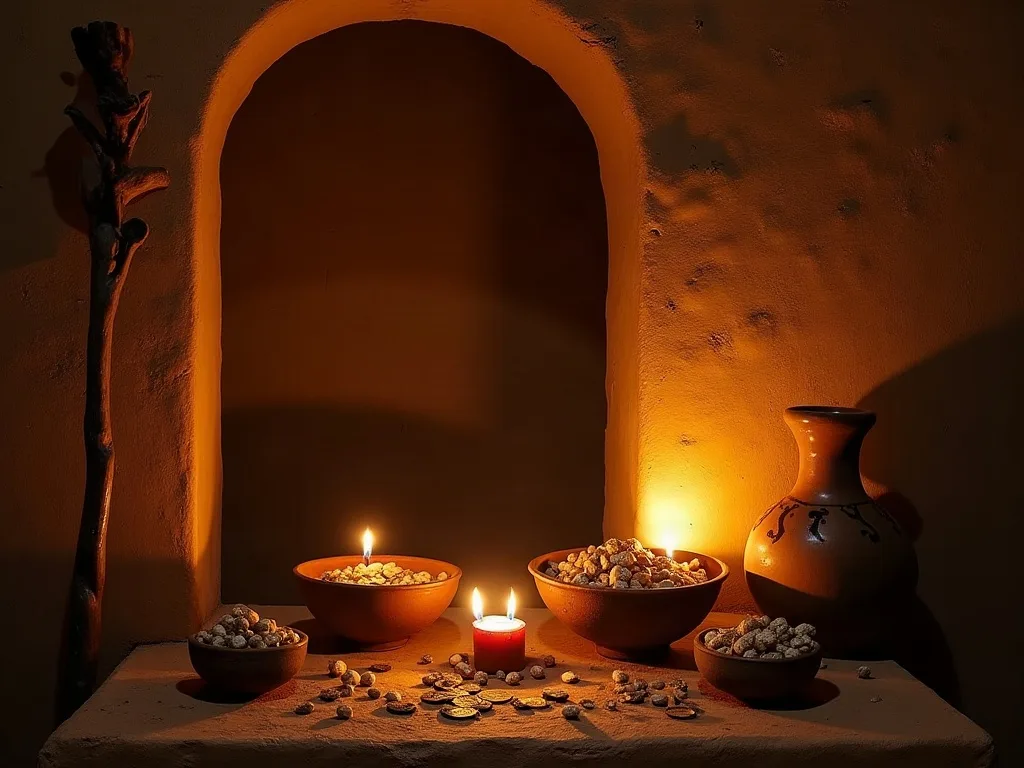
The Yoruba do not pray to Eshu for clarity. They pray to him for safe passage. They do not expect him to be predictable. Instead, they approach him with prepared gifts, usually small coins, kola nuts, or palm wine. These are not bribes in the Western sense. They are conversations with a force that demands acknowledgment. You cannot ignore the boundary-keeper and expect to cross safely.
Eshu the Divine Messenger: Words, Paths, and Misunderstandings
Eshu's primary role is to carry messages between the orisha and between the orisha and humans. But he does not simply deliver words like a postman drops mail. He carries meaning itself, and meaning is unstable. A word spoken in joy can arrive as an insult. A plea for help can land as a threat. Eshu understands this instability intimately because he lives in it.
One of the most famous stories about Eshu's nature involves a farmer, a farmer's two friends, and a stunning transformation. Eshu walked through a field where two friends worked on opposite sides, separated by a path. Eshu wore a cap that was red on one side and white on the other, and a coat that was blue on the left and yellow on the right. As he passed between the friends, one saw a man in red and white; the other saw a man in yellow and blue. Later, the friends argued bitterly about what had passed their field. One insisted red and white; the other swore yellow and blue. The argument escalated into an accusation of lying. Finally, the farmer, furious at the disruption to his work, raised a machete to settle the matter.
Eshu stopped him and revealed the truth: both men had seen exactly what passed. He simply moved between them, showing each a different face. The lesson is not that Eshu is a liar. It is that perspective is not stable. Truth is not always singular. The same event, witnessed from two different positions, can be two different truths. Eshu does not create this instability; he simply moves through it and reminds us it exists.
This is why Eshu is dangerous and necessary at once. Every human community depends on communication, but communication is inherently uncertain. Words travel, they change, they arrive transformed. Eshu is the god of that gap between intention and arrival, between what is said and what is heard. He is the god of gossip, rumor, and also of divine prophecy. The prophet who speaks for the orisha must first pass through Eshu's threshold. The diviner who reads the future (usually through casting palm nuts or bone, a practice called Ifa) must first make peace with Eshu, because every reading depends on his permission for knowledge to move from the unseen world into human sight.
Eshu and the Yoruba System of Divination
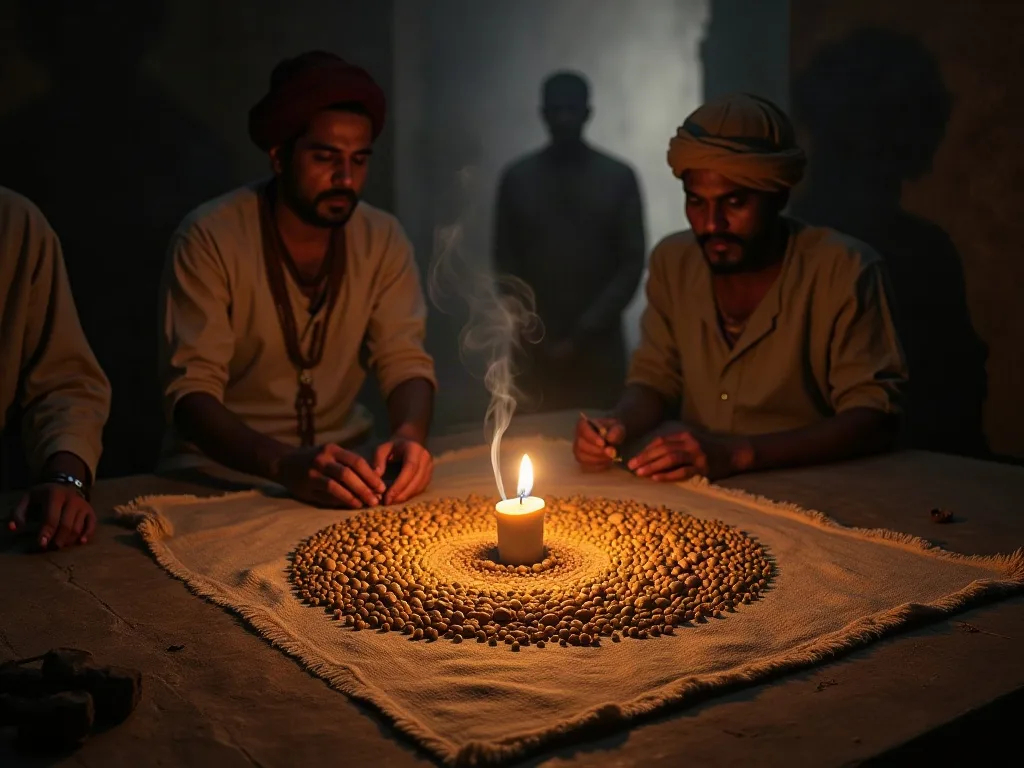
In the Yoruba tradition, Ifa divination is the highest form of wisdom. It is an ancient system of interpretation, preserved in a vast library of poetic verses called Odu Ifa. When a person consults the Babalao (the Ifa priest), the priest casts sixteen palm nuts or, in modern practice, a chain, and the pattern that falls reveals one or more Odu. Each Odu is associated with verses, stories, sacrifices, and teachings relevant to the seeker's situation.
But here is the essential truth: none of this works without Eshu. The priest must first make an offering to Eshu, must first secure his blessing, because Eshu controls whether knowledge will be revealed or obscured. An Odu cast without Eshu's permission is like a letter written but never sent. The message simply does not arrive. This is not superstition; it is metaphysical realism about how information moves. Eshu is the necessary intermediary between the seen and unseen, the known and the knowable.
In some Odu Ifa verses, Eshu appears as a trickster who tests the seeker's character. He poses as a stranger, a beggar, or an enemy, to see if the person will act with integrity when no reward is visible. Pass the test, and his protection opens doors. Fail, and his obstruction closes them. He is less interested in morality (in the sense of objective right and wrong) and more interested in authenticity. Do you act the same way in shadow as in daylight? Do you keep your word to the powerless as you do to the powerful? Eshu will know, because he stands at every threshold you cross.
Eshu and the Trickster's Sacred Function
In world mythology, tricksters appear in nearly every tradition. Anansi the spider in West African folklore, Coyote in Native American traditions, Loki in Norse mythology. But Eshu is not quite like any of them. He is not a lower being who stumbles into sacred knowledge through luck or theft. He is not a marginal figure tolerated by the "real" gods. He is central. He is indispensable. The entire cosmic order depends on his function.
Eshu's tricks are not simple pranks. They are cosmic interventions. He creates situations that force growth. He disrupts stagnation. He tests people and gods alike. In one story, Eshu convinces two rich, longtime friends to argue so fiercely that they nearly destroy each other. When the damage is done, Eshu reveals himself and the friends realize that their friendship had calcified into habit. They never truly spoke to each other anymore. Eshu's trick forced them to see that. It was painful, but it was necessary. Without his intervention, they would have drifted further apart without ever knowing it.
This is the sacred function of the trickster in many wisdom traditions: to unmask illusion. To expose the gap between what we claim to be and what we are. To remind us that the rules are not as solid as we believe. A culture without a trickster god tends to become rigid, convinced of its own infallibility. A culture that venerates the trickster understands that every order contains its own contradiction, and that facing that contradiction is where growth happens.

Eshu is also a god of crossroads, and crossroads are symbolically loaded with meaning in African, African diaspora, and Atlantic world traditions. A crossroads is where paths diverge. Where one road splits into many. Where past and future meet. Where boundaries blur. Eshu stands there, staff in hand, and asks: which way will you go? He does not tell you. He simply reminds you that you must choose, and that every choice forecloses other possibilities. He is the god of consequence.
Eshu in the African Diaspora: Elegba, Legba, and Exu
When the Atlantic slave trade forcibly dispersed millions of West African people across the Americas, their spiritual traditions came with them. The Yoruba orisha survived in diaspora, transformed by the trauma of enslavement and the demands of a hostile new environment. But Eshu survived in a particular way. He became even more central to survival itself.
In Haiti, Eshu became Legba, the gatekeeper of all spiritual communication. In Cuba and throughout the Spanish Caribbean, he became Elegba. In Brazil, where he fused with the Portuguese trickster spirit of European folklore, he became Exu. In all these forms, he retained his core function: he opens or closes the way. He is the first spirit honored in Haitian Vodou ceremonies. He is the gatekeeper in Santeria and other syncretic African-diaspora religions that emerged in the Americas.
In the Brazilian tradition particularly, Exu took on additional dimensions. He became associated with roads, cities, and urban spaces. He became a spirit of sex, desire, and transgression. Not in a moralistic sense, but in the sense that he moves through boundaries that other spirits will not touch. This reflects a deeper truth about Eshu across all his manifestations: he is the god of liminality, of the between-spaces, of everything that exists in transition or does not fit neatly into categories.
The survival of Eshu in the diaspora is theologically significant. Under slavery and colonialism, African diasporic peoples needed a god who understood disruption, who could navigate impossible systems, who refused to submit to hierarchies imposed from outside. Eshu was that god. He taught that the master's rules were not the only rules. That there were ways through the cracks. That trickery, when wielded with intelligence, could be a form of resistance and even spirituality.
In the work of scholars like Henry Louis Gates Jr., Eshu appears as a foundational figure for understanding African American literature and culture itself. The tradition of signifying in African American speech and art is a direct inheritance from Eshu's way of speaking and moving through the world: saying one thing while meaning another, creating layers of meaning that only certain people will understand, using language as a tool of both communion and protection.
Eshu's Relationship to Other Orisha
Eshu does not exist in isolation. He exists in constant, often fraught relationship with the other orisha. His most complex relationship is with Orunmila, the orisha of wisdom and divination, who presides over Ifa. Orunmila is the keeper of cosmic knowledge. But even Orunmila's knowledge cannot move without Eshu's consent. This creates a paradox: the wisest god depends on the trickster.
In some narratives, Eshu and Orunmila are allies. In others, they are rivals. In the most sophisticated versions, they are both, simultaneously. Orunmila knows the future, but Eshu controls whether that knowledge reaches the present. Orunmila can read the cosmic pattern, but Eshu can disrupt it, force it into unexpected shapes. Neither is complete without the other. Order without disruption calcifies. Disruption without order becomes pure chaos.
Eshu's relationship with Shango, the orisha of thunder and justice, is similarly complex. Shango is powerful, direct, and often aggressive. Eshu is subtle, indirect, and teaches through misdirection. Shango punishes the obvious wrongdoer. Eshu reveals that the person who appears innocent might be more culpable than they know. Together, they teach a complete lesson about justice: it is not always obvious, and it often arrives not as thunder but as quiet rearrangement.
With Oshun, the orisha of love and beauty, Eshu's role is more clearly supportive. Oshun is sweetness, pleasure, and the power of attraction. But nothing is attracted without Eshu to open the path. No lover finds another without Eshu standing at the threshold. Oshun's rivers flow, but Eshu determines which banks the water touches.
The Trickster's Deeper Teaching: Change as Sacred
To understand Eshu fully, we must move beyond the idea of the trickster as merely one who deceives or disrupts. Eshu is a theologian of change itself. He teaches that reality is not static. That the cosmos is not a perfect machine that, once wound up, runs eternally without variation. That change is not a departure from the divine order but the divine order itself.
In Yoruba philosophy, the concept of ase refers to the vital force that allows things to happen. It is the power of growth, change, transformation, and presence. Every orisha possesses ase. But Eshu possesses ase in its purest form: the power of possibility itself. He is the god of what has not yet become what it will be. He is the god of potential, not just actual.
This is why Eshu must never be static in his representations or offerings. He is never satisfied. He always demands more. An offering made to Eshu today will not suffice tomorrow. He always asks: what next? He always pushes: go further. A Yoruba person venerating Eshu understands that stagnation is the opposite of spirituality. To honor Eshu is to commit to the principle of perpetual becoming.
In the Atlantic world, this theology of change took on particular power. For enslaved people, for colonized people, for everyone pushed to the margins, Eshu's teaching was radical: the world that exists now does not have to be the world that will exist. The rules that constrain you can be rewritten. The way that appears closed can be opened. Not through prayer alone, not through submission, but through intelligence, wit, and the willingness to move through the world in unexpected ways.
Eshu and the Boundary Between Worlds
Perhaps Eshu's most profound function is his role as the guardian of the boundary between the living world and the world of the ancestors, the orishas, and the spirit realm. This boundary is not impermeable. It is crossed constantly. A prayer must cross it. A blessing must cross it. The knowledge that a diviner reveals must cross it. But nothing crosses without Eshu.
This means that Eshu is, in a sense, the god of all spiritual practice. Whether one consults an oracle, pours libations to the ancestors, or offers sacrifice to an orisha, that practice depends on Eshu to carry the intention across the threshold. He is the one who makes it possible for the physical world and the spirit world to touch.
In some traditions, Eshu is said to take a portion of every offering made to any orisha. This is not a theft. It is a payment for his essential service. He is the infrastructure of the spirit world, and all sacred commerce depends on him. Many houses that honor the orisha will maintain a specific shrine to Eshu, often at a corner, a doorway, or an entrance, exactly where movement between spaces occurs.
The contemporary scholar Babatunde Lawal has written extensively about how Eshu is represented in Yoruba art and how those representations changed under the pressure of colonialism and missionary Christianity. European missionaries often identified Eshu with the Christian devil, in part because they did not understand his function. To them, a god of boundaries and disruption looked like a force of evil. But the Yoruba understood what the missionaries did not: that a force does not have to be ordered or obedient to be sacred. The most sacred forces are sometimes the most disruptive.
The Paradox of Eshu: Chaos and Communion
At the deepest level, Eshu embodies a paradox that many Western religions have struggled to articulate: how can the divine be both orderly and chaotic, both maintaining the cosmos and disrupting it, both destructive and creative at once? The answer that Eshu teaches is that these are not opposites. They are the same force viewed from different angles.
A forest fire is destructive to the trees it burns. It is also creative, because the seeds of certain trees will only germinate after fire has passed. An argument between friends can destroy intimacy. It can also create new understanding. A trickster's prank can humiliate you. It can also teach you something about yourself you needed to know. Eshu is the god who understands that creation and destruction are not separate divine functions but aspects of a single force.
This is why Eshu appears in divination as both blessing and warning. The same Odu Ifa verse that promises success can also warn of hidden danger. The same trickster god who opens paths can also close them. Whether Eshu's action is a blessing or a curse often depends entirely on your perspective and your willingness to learn. He is not arbitrary; he simply operates according to a logic that is deeper than human preference.
Frequently asked questions about Eshu, the trickster orisha
Frequently asked questions
Why must Eshu always be honored first, before any other orisha?
Because Eshu controls all passages between worlds. Without his permission and blessing, offerings to other orisha will not be received. He is the threshold keeper, and nothing crosses a threshold without his consent. Honoring him first ensures safe passage for all subsequent spiritual work.
Is Eshu good or evil, or is he beyond morality altogether?
Eshu operates according to a logic that transcends good and evil as humans typically define them. He is amoral in the sense that his primary function is not to reward virtue or punish vice, but to test authenticity and enforce consequence. He will aid the virtuous and the wicked equally, depending on how you approach him and what you deserve. His morality is cosmic, not human.
How did Eshu survive the trauma of the Atlantic slave trade and the diaspora?
Eshu became even more central in diaspora religions. In Haiti, Brazil, and Cuba, he was honored as Legba, Exu, and Elegba, the spirits who could navigate impossible systems and open closed ways. For enslaved and colonized people, his trickster wisdom offered a theology of resistance and transformation. He proved himself indispensable to survival.
What is the connection between Eshu and the African American tradition of signifying?
Signifying is a rhetorical tradition where surface meaning and deeper meaning diverge. Only those with the knowledge to recognize the pattern understand the true message. This is exactly how Eshu communicates: through layers, misdirection, and the gap between what is said and what is meant. Scholar Henry Louis Gates Jr. identified Eshu as the theological and philosophical ancestor of this literary tradition.
Can Eshu be offended, and if so, what happens?
Yes. Eshu notices everything and forgets nothing. If neglected, disrespected, or approached carelessly, he can withdraw his protection and close the very paths he usually opens. An offended Eshu does not punish like Shango; he simply makes communication impossible, relationships difficult, and movement blocked. Restoration requires genuine acknowledgment and appropriate offering.
What is the relationship between Eshu and Ifa divination?
Ifa is the divination system through which cosmic knowledge is revealed, but Eshu must first grant permission for that knowledge to cross from the spirit realm into human consciousness. The Ifa priest makes an offering to Eshu before any reading. Without Eshu's consent, the oracle is silent.
Eshu in Modernity: The Trickster's Enduring Relevance
In the twenty-first century, Eshu's significance has not diminished. If anything, it has become clearer. In a world of rapid change, shifting information, and boundaries constantly being redrawn, Eshu's theology makes more sense than ever. He is the god for an age when certainty is illusory and adaptation is survival.
Contemporary artists, writers, and scholars continue to invoke Eshu's model. Poet Audre Lorde wrote about the power of the erotic, which she connected to Eshu's refusal of neat categories. Filmmaker Julie Dash, in her masterwork "Daughters of the Dust," invoked Eshu's disruptive power to create a film that refuses linear narrative and traditional time. The film itself moves like Eshu: appearing to go one direction while actually going another, revealing multiple truths at once, asking the viewer to hold contradictions.
In contemporary African diaspora spirituality, Eshu has returned from the margins to the center. People honoring Orisha tradition, Vodou, and other African-rooted religions recognize in Eshu a god for the present moment. A god who teaches that the world we inherited was made by human hands and therefore can be remade. A god who laughs at those who believe their power is permanent. A god who stands at every threshold and reminds us that we are always at a choice point.
The deepest teaching Eshu offers is this: the universe is not finished. The story is not over. The rules are not eternal. As long as there is change, there is Eshu. As long as there are boundaries, there is the possibility of crossing them. As long as there is communication between the living and the dead, between the human and the divine, between what is and what might be, Eshu stands at the threshold, staff in hand, watching, waiting, ready to open or close the way according to laws far deeper than human intention.
That is why the Yoruba approach Eshu with respect. Not because he is kind. Not because he is safe. But because he is absolutely, irreducibly real.
Free 25-page sample
Want the whole story?
Take the first 25 pages free. If it pulls you in, the full edition is yours as an instant PDF download, with a paperback on Amazon for selected titles.
African
The African Mythology Book: Yoruba Orishas, Anansi, Mami Wata, and the Sacred Stories of Sub-Saharan Africa
From the Yoruba Pantheon to the Spider's Web
Eleven chapters on the gods, heroes, and spirits of Africa south of the Sahara: Eshu, Shango, Oshun, Anansi, Mami Wata, Nyame, the Dogon Nommo, and Unkulunkulu, drawn from oral tradition and ethnographic record.
More from African
All articles
African
Ifa Divination: Sacred Oracle of the Yoruba
Ifa divination is the oral oracle system of the Yoruba people of West Africa, used for over a thousand years to read destiny and guide human life. Learn how the babalawo (priests) cast sacred palm nuts to access divine wisdom.

African
Sundiata Keita: The Lion King of Mali
Born crippled and scorned, Sundiata Keita transformed himself into the warrior-king who forged the Mali Empire. His rise from exile to power changed West African history forever.

African
The Separation of Earth and Sky: A Pan-African Myth
Across Africa, from the Congo to the Sahel, Earth and Sky once lay tangled together. Learn how their separation shaped creation, split existence into realms, and continues to echo in ritual and belief across the continent.

African
The Dogon Creation Myth: Nommo and the Cosmic Egg
The Dogon people of Mali preserve one of Africa's most intricate creation stories: how the universe began in a cosmic egg, split by the voice of Nommo, and how order emerged from primordial chaos through rhythm and sacrifice.