

The Separation of Earth and Sky: A Pan-African Myth
Across Africa, from the Congo to the Sahel, Earth and Sky once lay tangled together. Learn how their separation shaped creation, split existence into realms, and continues to echo in ritual and belief across the continent.
Contents
The Moment When Worlds Divided
In the beginning, Earth and Sky were locked together, inseparable as lovers. No light pierced the darkness between them. No air moved. The world breathed with the rhythm of two bodies pressed against each other, and nothing could grow, nothing could move, nothing could become. This was not peace. This was constraint.
Across the African continent, from the dense forests of the Congo Basin to the savannas of East Africa, from the Yoruba lands of West Africa to the Khoisan peoples of the south, a strikingly similar story repeats. The separation of Earth and Sky is one of the most widespread creation myths on the continent, a narrative that explains not just how the world began, but why existence itself requires distance, space, and the constant interplay between above and below.
This myth does more than describe a moment in the distant past. It answers a fundamental question: why must there be boundaries between realms? Why is creation itself an act of splitting, of differentiation? The answer lies in understanding that separation, in African cosmology, is not loss. It is the necessary condition for life, for creativity, for the dance between opposing forces that keeps the world turning.
The Yoruba Version: Obatala's Task
Among the Yoruba people of West Africa, the story begins with Obatala, the Sky deity responsible for form and creation. In the Yoruba cosmos, Obatala holds dominion over the pure realm above, the place of origin and divine order. Earth, by contrast, is the realm of manifestation, of flesh, of the material world that will soon teem with life.
At the beginning, Obatala commanded the separation. The cosmological logic is precise: Sky must retreat upward to create space. Without this withdrawal, there can be no field for creation to occur. Obatala's act was not violent but deliberate. He lifted Sky, pulled it upward, and held it at a distance from Earth. This opening, this gap, became the space where human life could exist.
The Yoruba tradition describes this space with intimate detail. The separation created air itself, the ase, the life force that flows between realms. Once Earth and Sky no longer touched, rain could fall. Wind could blow. Birds could fly. Light could penetrate. The universe, suddenly, had texture and movement and the possibility of becoming something other than what it had been in the darkness of union.
In some Yoruba tellings, Orunmila, the orisha of wisdom and divinity's connection to humanity, witnesses this separation and understands its meaning immediately. He sees that creation requires distance. The gods must be far enough away to let humanity act, yet close enough to hear prayers and send guidance. This balance, this precise spacing between Sky and Earth, becomes the template for all relationship, all exchange, all prayer in Yoruba culture.

The Bantu Cosmology: Nyambe Withdraws
Move south and east, into the vast Bantu-speaking regions that stretch across central and southern Africa, and the myth transforms while keeping its core. Here, the supreme creator deity is often called Nyambe, or variations of that name like Nkulu or Modimo. Nyambe is not merely a sky god but the source of all existence, the ultimate creator who initially dwelled closer to humans in a world undifferentiated from the heavens.
In Bantu accounts, notably recorded among the peoples of the Congo Basin, Nyambe and the first humans lived together on Earth, sharing the same space, the same reality. But humans, restless and dissatisfied, began to anger Nyambe with their constant demands and petty complaints. Some accounts say humans were too curious, always asking questions, always wanting more. Others speak of human greed or disrespect.
The separation becomes, in this telling, both an act of creation and an act of withdrawal. Nyambe, weary of proximity to humanity, ascended into the sky. The deity pulled back not violently but with the finality of a parent leaving a child to learn its own lessons. Once Nyambe had risen beyond Earth, the connection between divine and human realms became mediated. Spirits and ancestors became the bridges. Prayer became necessary because distance was now real.
This version carries a poignant subtext: separation is not pure order but also loss. The first humans experienced genuine grief when their creator withdrew. Yet that withdrawal is also necessary. It allows humanity autonomy. It creates the space for human agency, for moral choice, for the development of culture and society. The myth thus explains why the gods are present but distant, why they must be approached through ritual, why the relationship between Earth and Sky is one of longing and reach rather than simple coexistence.
The Egyptian Parallel: Shu Holds Up the Sky
The myth of Earth and Sky separation has deep roots in ancient Egypt, though the Egyptian version developed in the context of the Nile's rhythms and the specific cosmology of the pharaonic world. Here, Shu, the god of air, light, and the space between things, performs the role similar to African sky separators. Shu is the breath, the gap, the invisible force that holds worlds apart.
In the Egyptian creation narrative recorded in the Pyramid Texts and later mythology, Geb, the Earth god, lies beneath Nut, the Sky goddess. They are locked together. Shu, recognizing that creation requires them to separate, positions himself between them and pushes upward. Shu becomes the air, the void, the precious distance that allows life to emerge in the narrow strip between Earth and Sky where humans and other beings exist.
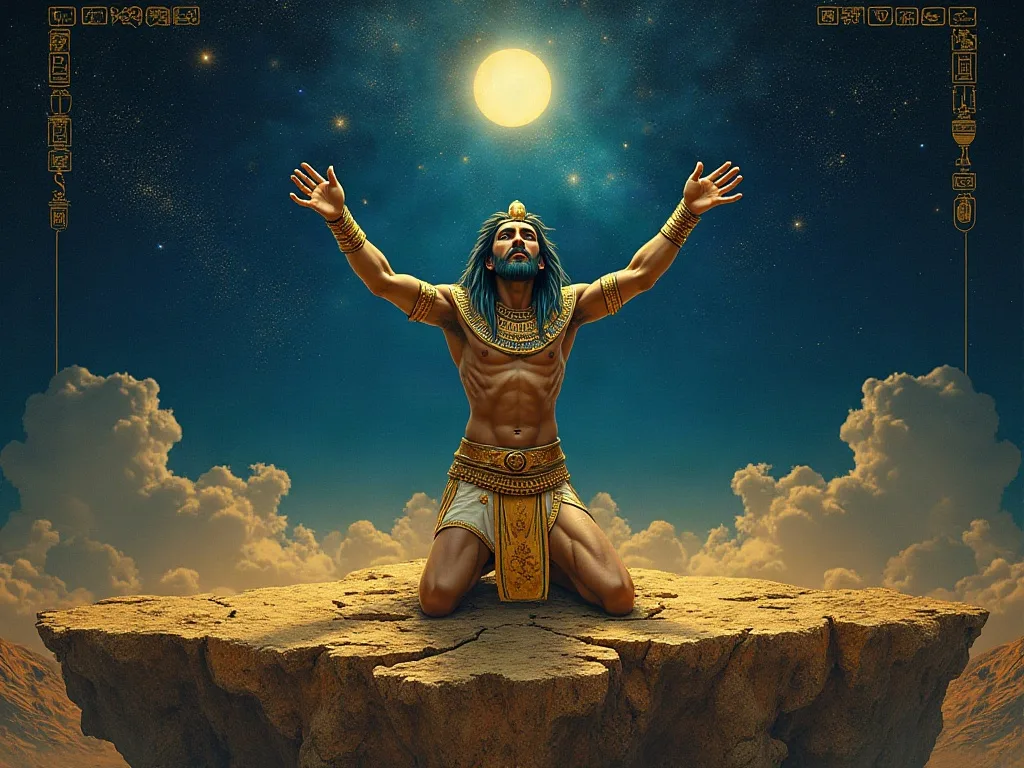
The Egyptian image is striking: Shu, shown as a kneeling figure or as air itself, eternally holds Nut above Geb. His task is ceaseless. Should he weaken, should he rest, the two primordial forces would collapse back together and creation would unwind. This reveals a theme woven through African cosmic thought: separation is not a single act in the past but an ongoing maintenance. The world requires constant force, constant renewal, constant holding-apart to persist.
While the Egyptian version develops in a distinct cultural and religious context, its core resonates with the pan-African pattern. Separation creates the necessary conditions for existence. A force (whether divine will, a deity's action, or the god of space itself) must actively maintain that separation. Without this maintenance, entropy would collapse the cosmos back into undifferentiation.
The East African Testament: Ngai and the Kikuyu
Among the Kikuyu people of Kenya, the supreme creator is Ngai, who dwells on sacred Mount Kenya, the highest point of the visible world where Earth meets Sky. In Kikuyu cosmology, Earth and Sky were once merged, and Ngai, desiring to create the visible world and its peoples, enacted their separation.
The Kikuyu account emphasizes Ngai's purposefulness. The separation was not incidental but central to divine intent. By pulling Earth and Sky apart, Ngai created multiple zones of existence. The forests, the rivers, the fields, and the settlements of humans all emerged in the gap. Ngai's presence remained strongest at the highest places (especially Mount Kenya), where Sky and Earth remained closest, but the distance itself allowed the lower worlds to develop their own vitality.
This version adds another dimension to the myth's meaning: the separation creates hierarchy and correspondence. What exists in the upper realm (in Sky, among the gods and spirits) has its echo and its agent in the lower realm (Earth, among humans and animals). Prayer, ritual, and correct action are ways of maintaining harmony between these realms, of acknowledging the separation while bridging it through devotion and understanding.
The Khoisan Contemplation: /Kaggen's Separation
In the oral traditions of the Khoisan peoples of southern Africa, the trickster figure /Kaggen (also known as the Mantis) features prominently in creation narratives. While the Khoisan corpus is less uniformly documented than other African mythologies (due to colonial disruption and the historical dominance of non-Khoisan recordkeeping), the surviving accounts describe /Kaggen's role in ordering the cosmos.
In some tellings, /Kaggen must separate the realms to undo an initial chaos or to ensure that each realm has its proper inhabitants and laws. The separation is an act of wisdom, a recognition that distinct domains require distinct rules. Once Sky and Earth are separate, the rain can fall appropriately, the sun can traverse the sky without scorching the earth perpetually, and the various beings (spirits, humans, animals, plants) can coexist according to their nature.
Common Threads Across the Continent
Despite the geographical spread and the distinct cultural contexts, the pan-African separation myth shares unmistakable patterns.
First, the separation is deliberate, initiated by a supreme or high deity (Obatala, Nyambe, Shu, Ngai, /Kaggen, or similar figures). It is not an accident but an act of will and creation.
Second, separation itself is generative. The gap, the distance, the space between Earth and Sky is not empty. It is the space where life emerges. Air, light, rain, wind, and all the forces that sustain creation flow through this opening. Many traditions personify this gap itself as a divine force (Shu in Egypt, the ase in Yoruba thought), acknowledging that what appears empty is actually alive.
Third, the separation often carries ambivalence. It is necessary but also involves loss or withdrawal. The original unity is broken, sometimes because humans provoked the deity, sometimes because the deity deliberately chose distance to allow human autonomy. This ambivalence prevents the myth from being a simple triumphalist narrative of creation. It acknowledges that existence has a cost: the loss of original proximity to the divine.
Fourth, the separation is not final in the sense of being past. It must be maintained. Ritual, prayer, correct behavior, and the recognition of boundaries keep Earth and Sky appropriately separate and functional. African cosmology typically envisions an active, ongoing relationship between realms rather than a static separation.
Fifth, the myth explains social and spiritual hierarchies. Sky is the realm of order, of the divine, of what is eternal. Earth is the realm of manifestation, of change, of what is mortal and material. Yet both are necessary. Both are valued. The separation does not establish a dualism of good and evil, spirit and matter, but rather two complementary modes of existence.
Symbolic and Ritual Dimensions
The myth does not remain abstract. It shapes ritual practice, spiritual understanding, and the material arrangement of sacred space across African cultures.
In Yoruba shrines, altars are often arranged to reflect the vertical cosmos. The orishas (divine beings) are positioned above or in elevated spaces, while offerings to them are placed at ground level. This spatial arrangement enacts the separation, placing the worshipper in the middle zone where communication can occur.
Among the Kikuyu and other East African peoples, sacred groves and mountains serve as zones where the distance between Earth and Sky is minimized. Mount Kenya is not merely a peak; it is a thin place, a location where prayers are believed to travel more directly to the realm of Ngai. Likewise, groves set apart for ritual contain trees that metaphorically link earth to sky, their roots in soil and their branches reaching upward.
In southern African traditions, the Khoisan cosmos is maintained through the actions of healers and shamans who traverse the separation through trance and spiritual knowledge. The healer, by entering an altered state, can move between Earth and Sky in a controlled way, bringing back messages, healing, or wisdom. This reinforces the idea that the separation is real but not impermeable; it can be crossed by those with proper knowledge and authority.
Scholarly Interpretations and Debates
Scholars of African religions have long recognized the separation myth as one of the continent's most coherent cosmological patterns. The ethnographer Placide Tempels, in his study of Bantu philosophy, emphasized that African cosmology is fundamentally dynamic, based on the flow of vital force between realms. The separation of Earth and Sky is the necessary structure through which this force can move and be regulated.
John S. Mbiti, in his foundational work on African religions, noted that the withdrawal of the supreme deity (Nyambe, Modimo, Mwene Nyanga, etc.) after creation is a pan-African theme that often correlates with the physical separation of realms. Mbiti argued that this pattern reflects African understanding of hierarchy and distance not as alienation but as the precondition for order.
More recently, scholars like Knut Holbraad and Inge Boer have emphasized that African cosmologies are fundamentally spatial and relational. The separation of Earth and Sky is not merely a mythological narrative but a way of thinking about how power, knowledge, and agency flow through the world. The myth encodes lessons about boundaries, respect, exchange, and the proper maintenance of relationships.
One ongoing scholarly debate concerns the origins of the myth. Is it a genuinely pan-African pattern, or did it spread through trade, migration, and cultural contact? The sheer geographical reach (from West Africa to the Khoisan south, from the Congo to East Africa) and the presence of the myth in cultures with limited documented contact suggests deep antiquity. Yet the specific forms vary in ways that suggest local development as well as shared heritage. The most plausible explanation is that the myth emerges from universal patterns in how humans think about creation and separation but has been elaborated and refined by African cultures into its current, remarkably consistent form.
The Myth in Modern African Spirituality and Art
The separation myth remains live in contemporary African spiritual practice, theology, and arts. In modern African Christianity and Islam, the myth often coexists with monotheistic doctrines, providing a cosmological framework that shapes how believers understand God's relationship to the world. The withdrawal of Nyambe or Ngai resonates with the transcendence of the Christian or Islamic God; the need for mediation (through saints, ancestors, prophets) reflects the reality of separation.
African diaspora religions, including Vodou, Candomblé, and Santería, preserve and transform the myth. In these traditions, the separation of realms is fundamental to understanding how the loa (spirits), orishas, and saints relate to the human world. Ritual serves to bridge the separation, to bring down divine power into the human realm in controlled and sacred ways.
Contemporary African artists and writers draw on the myth as well. The Kenyan author Ngũgĩ wa Thiong'o and others have woven cosmological imagery of Earth and Sky into their work, using the myth as a framework for exploring colonialism, postcolonial identity, and spiritual resilience. The image of separation and reunion, of realms in relationship, has become a metaphor for understanding Africa's own position in relation to the world.

What Does the Myth Teach About the Nature of Creation?
At its core, the separation of Earth and Sky carries a sophisticated philosophical message about creation itself. It teaches that creation is not the emergence of something from absolute nothingness, but rather the differentiation of an undifferentiated whole. The universe does not begin in void but in unity; creation consists in making that unity productive by introducing distance and relationship.
This is subtly different from creation narratives in which a creator makes the world from raw materials or from their own substance. Here, the world is made livable through the act of separation. The gap, the space, becomes as important as the two realms themselves. This emphasis on relationship, on the space between things, marks a distinctive African contribution to world mythological thought.
The myth also teaches about the cost of creation. Something is lost when Earth and Sky separate: the original closeness, the immediacy of divine presence. Yet this loss is necessary. The distance allows humans to be human, to make choices, to develop culture and society. It allows the Earth realm to have its own integrity and becoming. This is not a myth that celebrates a distant, transcendent God indifferent to creation, but rather one that understands separation as a loving act, even when that separation brings grief.
The Ongoing Conversation: Earth and Sky in Contemporary African Thought
Today, environmental crisis and climate change have given the myth new relevance. When rains fail or floods devastate, when the balance between Earth and Sky appears to be breaking down, the myth reminds believers that these realms are in active relationship. Many African communities interpret ecological disruption not merely as a scientific or economic problem but as a sign that the proper separation and communication between Earth and Sky has been disrupted by human action (often by those who do not respect traditional cosmology).
The myth also speaks to contemporary African theology and philosophy. Thinkers like Beatrice Mtetwa and Daneel Mtetwa have explored how traditional African cosmologies, including the separation myth, can inform contemporary ecological ethics and spirituality. The idea that Earth and Sky must be maintained in proper relationship, that human action affects this relationship, that ritual and respectful behavior are necessary to keep the cosmos in balance, offers resources for thinking about sustainable living and spiritual resilience in the modern world.
African diaspora communities, faced with displacement and the challenge of maintaining identity across continents, have also found meaning in the myth. The separation of realms mirrors the separation of peoples across space. Yet the myth also insists that separation need not mean severance. Even when Earth and Sky are far apart, the flow between them continues. Rain falls. Prayer rises. Connection persists. This message has offered spiritual sustenance to communities navigating diaspora and distance.
Frequently asked questions
Is the separation of Earth and Sky myth found in all African cultures?
The myth is widespread across Africa and appears in most major cultural and linguistic groups, but it is not universal. However, it is common enough among peoples from West Africa to East Africa to southern Africa, and among both Bantu and non-Bantu speakers, that scholars recognize it as a pan-African pattern. Some cultures emphasize the myth more heavily in their creation narratives than others.
Why did the African cultures develop this myth independently if it appears in so many places?
The myth likely arises from universal patterns in how humans conceptualize creation, order, and the separation of realms. However, the specific elaborations vary, and the myth has also spread through trade, migration, and cultural contact over centuries. The most likely explanation is that both independent emergence and cultural diffusion contributed to its widespread presence.
Is the separation of Earth and Sky myth found only in Africa, or does it appear elsewhere in the world?
Similar myths appear in other traditions, including ancient Mesopotamian, Egyptian (which also influenced Africa), and Polynesian cosmologies. However, the particular emphasis and the specific configurations in African versions are distinctive. The focus on the ongoing maintenance of separation, the role of high deities in creating space for human autonomy, and the emphasis on ritual and respect for boundaries are characteristically African developments of the theme.
How does the separation myth relate to African concepts of ancestors and spirits?
The separation of Earth and Sky creates a cosmological framework in which ancestors and spirits occupy an intermediate zone between the divine realm (Sky) and the human realm (Earth). Ancestors can mediate between these realms, and honoring ancestors through ritual is one way of maintaining proper relationship between Earth and Sky. This makes ancestor veneration not a separate practice but integral to the cosmos's functioning.
Do modern African churches and mosques accept the separation myth, or do they reject it?
Many modern African Christian and Muslim communities hold the myth alongside their adopted religions. The mythological framework often coexists with monotheistic theology. The withdrawal of Nyambe or Ngai is sometimes reinterpreted as the transcendence of God, and the need for mediation is understood through the lens of saints or prophets. However, some churches actively discourage adherence to traditional myths, viewing them as incompatible with orthodoxy. The relationship is thus complex and varies by denomination and community.
The Myth's Endurance in an Age of Displacement and Connection
Today's world is one of unprecedented displacement and virtual connection. Migrants carry the myth across oceans. Digital networks collapse distance while increasing the psychological sense of separation. In this context, the African separation myth offers something of lasting value: a framework for understanding that difference and distance need not mean disconnection, that realms can be distinct and still be in deep relationship, that maintaining proper boundaries and respect is the condition for life and flourishing, not an obstacle to it.
The myth also reminds us that creation is not a distant past event but an ongoing work. The universe, in African cosmological thought, is not winding down toward entropy. It is constantly maintained, constantly renewed through ritual, through prayer, through the proper observance of boundaries and relationships. In a time of environmental crisis and social fragmentation, this vision of creation as requiring constant, mindful maintenance offers an alternative to the Western industrial assumption that nature exists to be exploited and that human progress requires transcending limits.
The separation of Earth and Sky is ultimately a myth about relationship, about the space where life happens, about the necessity of distance for freedom, and about the ongoing work of keeping the world whole. Across Africa, in thousands of communities and spiritual traditions, this myth continues to shape how people understand their place in the cosmos, how they pray, how they relate to the visible and invisible worlds, and why the gap between Earth and Sky is not emptiness but the most fertile space in creation.
Free 25-page sample
Want the whole story?
Take the first 25 pages free. If it pulls you in, the full edition is yours as an instant PDF download, with a paperback on Amazon for selected titles.
African
The African Mythology Book: Yoruba Orishas, Anansi, Mami Wata, and the Sacred Stories of Sub-Saharan Africa
From the Yoruba Pantheon to the Spider's Web
Eleven chapters on the gods, heroes, and spirits of Africa south of the Sahara: Eshu, Shango, Oshun, Anansi, Mami Wata, Nyame, the Dogon Nommo, and Unkulunkulu, drawn from oral tradition and ethnographic record.
More from African
All articles
African
Ifa Divination: Sacred Oracle of the Yoruba
Ifa divination is the oral oracle system of the Yoruba people of West Africa, used for over a thousand years to read destiny and guide human life. Learn how the babalawo (priests) cast sacred palm nuts to access divine wisdom.

African
Sundiata Keita: The Lion King of Mali
Born crippled and scorned, Sundiata Keita transformed himself into the warrior-king who forged the Mali Empire. His rise from exile to power changed West African history forever.
African
Eshu: The Trickster Messenger of the Orisha
Eshu walks the boundary between worlds, carrying words between gods and humans, blessing and cursing with equal power. The trickster orisha rewrites the rules of divinity itself.

African
The Dogon Creation Myth: Nommo and the Cosmic Egg
The Dogon people of Mali preserve one of Africa's most intricate creation stories: how the universe began in a cosmic egg, split by the voice of Nommo, and how order emerged from primordial chaos through rhythm and sacrifice.