

Ifa Divination: Sacred Oracle of the Yoruba
Ifa divination is the oral oracle system of the Yoruba people of West Africa, used for over a thousand years to read destiny and guide human life. Learn how the babalawo (priests) cast sacred palm nuts to access divine wisdom.
Contents
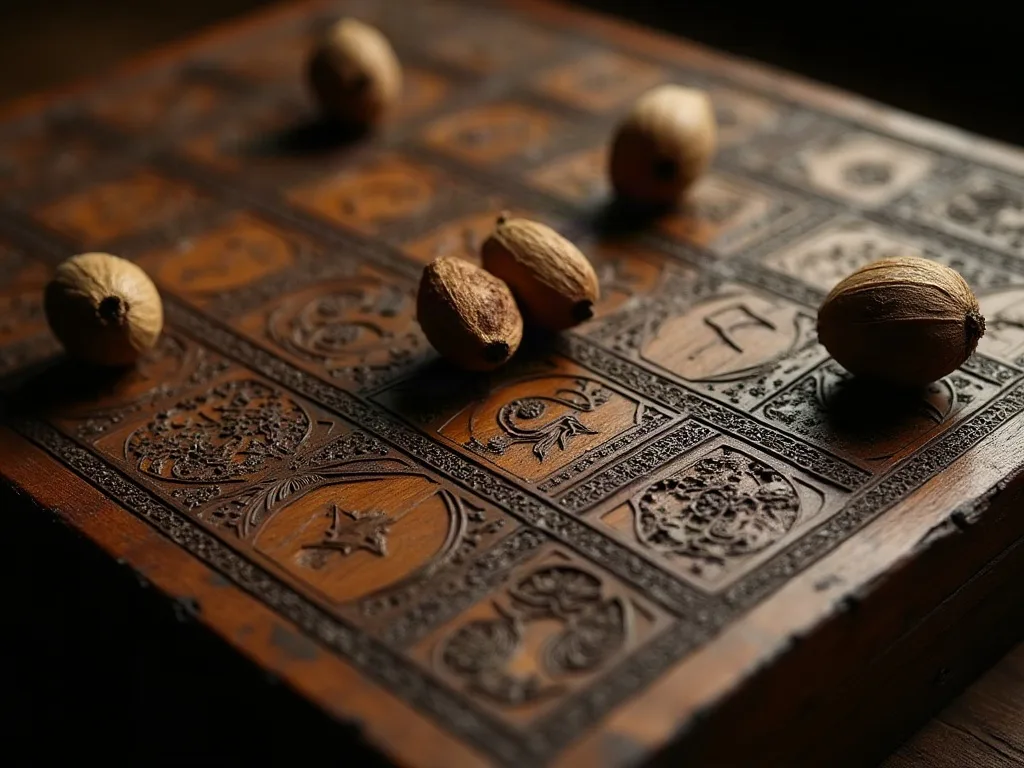
The babalawo holds the sacred palm nuts. His hands move in silence, then scatter them across the wooden board, the opele, marked with sixteen squares. Each fall speaks. Each pattern holds a message from the other side. This is Ifa divination: a system of reading fate that has guided Yoruba life in West Africa for more than a millennium.
The oracle speaks not in words but in odu, ancient verses that live inside the priest's memory. When the nuts fall in a particular arrangement, one of 256 possible configurations emerges. The babalawo knows them all. He has spent years learning not just which pattern means what, but how to feel the layers beneath the surface, how to match the cosmic pattern to the human question.
This is not magic. It is knowledge coded into ritual. Every answer lies somewhere in the odu, waiting to be recognized.
The Orisha and the Birth of Ifa
The Yoruba pantheon includes many orisha, deities embodied in natural forces and human qualities. But Ifa itself is not quite an orisha. It is something older and stranger: a system of knowledge revealed by the supreme deity, Olorun (also called Olodumare), the source of all existence. The Yoruba recognize Orunmila as the orisha who embodies Ifa wisdom and guides the babalawo's hand.
According to Yoruba cosmology, Orunmila walked the earth in primordial time. He witnessed the creation of humans and the foundation of cosmic law. His knowledge encompasses every possible outcome, every twist of fate that might befall a person. When the Yoruba people needed a way to access that knowledge, Orunmila gave them the system of signs and verses we call Ifa.
The odu themselves are said to be the original sacred narratives. Each one carries a story, a warning, a teaching, or a prescription. When a priest recites them, he is not inventing but remembering; not prophesying but reading a pattern that already exists in the fabric of things.
How the Divination Works: The Cast and the Pattern
A typical Ifa consultation begins when someone approaches a babalawo with a question. It might be about love, business, health, or the proper way forward in a decision. The priest does not answer immediately. Instead, he prepares his tools.
The most common method uses sixteen palm nuts, called ikin, or a chain called the opele (made from eight half-shells of a sacred nut, joined by cord). When the babalawo casts the ikin onto the board, they fall in a configuration of eight pairs. Some stand upright, some fall flat. This creates a binary code: upright as 1, flat as 0. The result is an eight-digit pattern.
Do this twice, and you have sixteen digits. This generates one of the 256 odu, the fundamental units of Ifa knowledge.
Each odu has a name. Some of the most widely known include Eji-Ogbe, the first; Oyeku-Meji, the second; Iwori-Meji, the third. The names themselves carry weight. When a babalawo announces which odu has appeared, an experienced querent knows they are about to hear a specific body of wisdom, a specific lens through which their question will be examined.
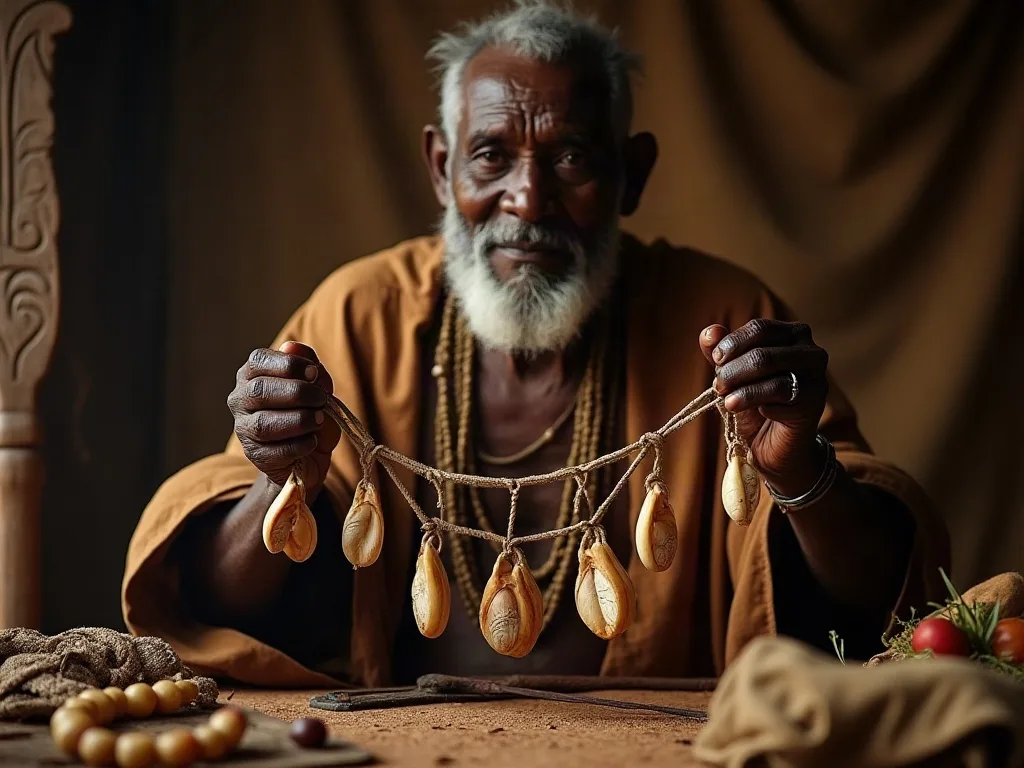
The babalawo's role is not to invent but to match. He knows the odu that has appeared. He now recites or selects from his vast repository of verses, stories, and teachings associated with that odu. These verses, called ese, explain what the pattern means. Some ese are prescriptive: "If you see this sign, you must make an offering to Shango" (the orisha of thunder and justice). Others are diagnostic: "This sign reveals an ancestor who is not at rest." Others are simply narrative, stories that mirror the querent's situation so clearly that the truth becomes undeniable.
A skilled babalawo does not simply rattle off verses. He listens to the querent's initial question, watches their face, feels the gravity of the moment. He then selects from among the many ese available to that odu the ones that speak most directly to this person's circumstance. The divination becomes a conversation between seen and unseen, between human need and cosmic pattern.
The 256 Odu and the Corpus of Knowledge
The completeness of Ifa's system is staggering. Two hundred fifty-six odu means 256 primary archetypal patterns, each subdivided into multiple ese (verses or narratives). A fully trained babalawo may carry thousands of these in memory.
The odu are organized hierarchically. The most fundamental are the sixteen Meji (meaning "double" or "pair"), which consist of one pattern repeated twice. Eji-Ogbe is the first, seen as the most auspicious; Oyeku-Meji carries weight and gravity. These serve as the core. The remaining 240 are combinations, each one yielding a unique configuration of meaning.
What makes Ifa profound is that this is not arbitrary symbolism. The Yoruba understand each odu as a node in a vast network of cause and effect, spiritual truth, and human nature. To study Ifa is to study Yoruba epistemology, cosmology, and ethics all at once. Every verse contains embedded teaching: about family, about work, about the proper relationship between the living and the dead, about how to appease the orisha, about how to live in balance with destiny.
The Babalawo: Priest, Healer, and Keeper of Memory
A babalawo is not simply someone who performs divination. The title means "father of secrets." A true babalawo spends years, often decades, learning the system. The training is partly formal, with specific rituals and instruction from an elder priest, and partly through lived experience: reading clients, testing predictions, refining interpretations.
Different lineages and regions of Yorubaland have their own emphases. Some babalawo specialize in healing (iyamaborere). Others focus on the relationship between divination and herbal medicine. Still others are primarily counselors and spiritual advisors. The most respected practitioners can read the odu not only for individuals but for communities, for families, for the entire Yoruba nation in times of crisis.
The babalawo must also understand the relationship between Ifa and the other orisha. While Orunmila is associated with Ifa, a complete diviner knows when to recommend offerings to Oshun (orisha of fertility and desire), to Shango, to Yemaja (mother of the sea), to Elegba (the trickster spirit of the crossroads), and to countless others. Ifa is the system of reading; the orisha are the powers that must be engaged to transform understanding into action.
The Verses: Healing, Warning, and Cosmic Order
The ese are the living blood of Ifa. These verses are recited in Yoruba, though some have been written down and translated. They are not poems in the modern Western sense; they are dense, often enigmatic, packed with layers. A single verse might contain a story, a prescription, a moral lesson, and a hidden reference to another orisha or mythological event.
Here is the texture of what a ese contains: a babalawo might recite a story about how a person in ancient times faced a problem similar to the querent's, what offerings they made, how the problem was resolved. Or he might recite a warning: "He who refuses to honor his mother will eat bitter bread." Or he might speak directly to the spiritual forces: "I call upon Orunmila to soften the heart of the opposition. I call upon Elegba to clear the path." The ese serves multiple functions at once: it diagnoses, prescribes, educates, and invokes.
For someone suffering from illness, the verse might recommend not only an herbal remedy but also an offering, a prayer, and a change in behavior. For someone facing a business decision, it might reveal hidden obstacles, the right timing, or the need to reconcile with someone from the past. The odu does not give yes or no. It illuminates the full context.
Ifa in the Diaspora: Survival and Evolution
When Yoruba people were enslaved and forcibly transported to the Caribbean, Brazil, and North America, they carried Ifa with them in memory. The system survived in secret, passed orally from elder to younger, hidden beneath the surface of colonial life. It evolved, too. In Cuba, Ifa merged with Catholicism and Spanish traditions to become Santeria. In Brazil, it became part of Candomble. In the United States and other diasporic communities, it has become Lukumi and other syncretic forms.
This diaspora did not weaken Ifa; in some ways, it strengthened its appeal. As the Yoruba tradition spread globally through diaspora communities and later through scholarly and spiritual interest, Ifa became a living practice not only in West Africa but throughout the world. Today, there are trained babalawo in London, New York, Toronto, and throughout Europe and the Americas, as well as in Yorubaland itself.
Yet the diaspora also created challenge. Outside the original context, some aspects of Ifa practice became commercialized or simplified. Some practitioners claiming authority lack the depth of training. Some versions of the system have been adapted to fit other cosmologies or stripped of their connection to the orisha and the Yoruba world entirely. At the same time, the diaspora has created opportunity for genuine scholarship and cross-cultural understanding. Scholars from many backgrounds now study Ifa seriously, and lineages of authentic transmission have been maintained alongside new practice.
Ifa and Destiny: The Paradox of Knowledge
One of the deepest questions about Ifa is also one of the most practical: if Ifa reveals your destiny, can you change it? The Yoruba understanding resolves this paradox elegantly. Destiny is not a wall you will inevitably hit. It is more like a road map of probabilities and influences currently in motion. When you consult Ifa, you learn what forces are acting on you and what choices are truly available. With that knowledge, you can make a wiser choice. You can make an offering to shift the influence of one orisha. You can avoid a path that would lead to suffering. You can align yourself with the cosmic forces at work.
In this sense, Ifa divination is not fatalism but liberation. It is information. The more you know about the currents flowing beneath the surface of events, the more agency you have to navigate them wisely.
This understanding also explains why Ifa is not a one-time consultation but an ongoing practice. A person might return to the babalawo yearly, at a crossroads, or in times of crisis. Each consultation adds layers to their understanding of their own nature and their place in the world. Over a lifetime, a devoted practitioner of Ifa develops an intimate knowledge of their own inner patterns and how they interact with cosmic forces. The odu become a mirror and a compass.
Ifa in Contemporary Scholarship and Spiritual Practice
In recent decades, Ifa has begun to receive serious scholarly attention. Anthropologists, historians, and religious scholars have documented the system, interviewed practitioners, and traced its history. Books and articles by scholars like John Mason, Babatunde Lawal, and others have made detailed knowledge of Ifa available to a wider audience.
At the same time, Ifa has experienced a renaissance among Yoruba people themselves. After colonial suppression and the pressures of Christianization and Islamization, there has been a deliberate movement to revive and honor traditional Yoruba religion and practice. In Nigeria, Yorubaland, and throughout the diaspora, people have returned to Ifa not as a curiosity but as a vital spiritual path. Organizations like the International Council for Ifa Religion have been established to maintain standards, support practitioners, and preserve the authentic transmission of knowledge.
This revival also involves new questions. How does Ifa relate to contemporary issues: climate change, political conflict, gender and sexuality? How can a system that emerged from a specific historical and cultural context speak to modern life? Practitioners are actively engaging these questions, interpreting the odu in ways that honor the tradition while speaking to current reality.
Ifa and Other Divination Systems
The world contains many divination systems: the I Ching of ancient China, the runes of the Norse, tarot, astrology. Each emerges from a particular culture and cosmology. What distinguishes Ifa is its integration with a living religious tradition, its emphasis on memory and oral transmission, and its grounding in the relationship between humans and the orisha.
Unlike some divination systems that claim to be universal, Ifa remains rooted in Yoruba culture and Yoruba understanding of the cosmos. This is not a limitation; it is a strength. The system works because it is embedded in a coherent worldview. The babalawo does not stand apart from the culture; he is the culture's keeper of knowledge and counselor to its people.
That said, there are interesting parallels. Like the I Ching, Ifa uses a binary system to generate a vast number of permutations. Like tarot, Ifa offers multiple layers of meaning and invites interpretation. Like the runes, Ifa is connected to a whole pantheon of spiritual beings and a mythology that extends back into deep time.
Frequently Asked Questions About Ifa Divination
Frequently asked questions
What is the difference between Ifa and Santeria or Candomble?
Ifa is the original Yoruba divination and spiritual system. Santeria, Candomble, and similar practices are New World syntheses that emerged when Yoruba people encountered European Catholicism and other traditions in the Caribbean, Brazil, and the Americas. They incorporate Ifa but also blend it with Catholic saints, indigenous American practices, and local traditions. All three honor the orisha and use divination, but Ifa in its pure form remains the Yoruba system as practiced in West Africa and by diaspora communities committed to preserving the original transmission.
Can anyone learn Ifa divination, or must you be Yoruba?
The question of initiation and authenticity is living and contested. Traditionally, becoming a babalawo required initiation into a lineage, often within family. Today, some practitioners accept students from any background and argue that spiritual knowledge is universal. Others maintain that initiation into an authentic lineage, with a recognized elder, is essential. The most respected practitioners tend to emphasize both: openness to sincere students, but rigorous training, respect for Yoruba culture, and accountability to a tradition. If you wish to study Ifa seriously, seek out a recognized babalawo or Ifa organization with clear lineage and community standing.
Is Ifa used for medical or psychiatric treatment?
Ifa is used as spiritual counseling and guidance, not as a replacement for medical or psychiatric care. Many babalawo are also skilled in herbal medicine and healing practice, and in Yorubaland these fields overlap. However, a responsible practitioner will recognize the limits of their practice and refer someone with serious illness or mental health concerns to appropriate medical professionals. The best approach is integrative: spiritual guidance alongside conventional care, each addressing its own domain.
How do the 256 odu relate to personality types or character archetypes?
Each odu does carry archetypal qualities and can illuminate aspects of personality and character. Some practitioners have created systems that map the odu onto the tarot's Major Arcana or other archetypal frameworks. However, Ifa itself does not reduce to personality typing. The odu are dynamic patterns that describe situations, forces, and possibilities, not fixed character types. A person's relationship to the odu evolves throughout their life as circumstances change.
What is the relationship between Orunmila and other orisha in Ifa practice?
Orunmila is associated with Ifa itself and is often invoked at the beginning of divination. However, Ifa readings frequently recommend actions related to other orisha: offerings to Shango for justice, to Oshun for blessing, to Elegba for smooth paths, and so on. The babalawo understands how the different orisha work together in the cosmic order and matches prescriptions to the specific need. Orunmila is the guide to wisdom; the other orisha are the powers that act upon the material world.
Why do babalawo keep the odu in memory rather than writing them all down?
Oral transmission is core to Ifa's integrity and power. When a practitioner memorizes the verses, the odu live inside them; they become part of the person's body and spirit. This creates a direct link between the babalawo and the tradition. It also ensures that the system cannot be reduced to a book to be consulted mechanically; instead, each reading is an act of living interpretation, guided by the babalawo's experience and intuition. That said, scholars and some practitioners have written down major collections of odu and ese, creating valuable records while preserving the oral tradition's primacy.
Ifa Today: Living Oracle in a Changing World
The practice of Ifa continues to evolve. In Nigeria and throughout West Africa, Ifa remains woven into daily life. Major decisions in business, politics, and community life are sometimes guided by consultation with a babalawo. At the same time, globalization, urbanization, and education have shifted the relationship between Yoruba people and traditional practice. Ifa is no longer monolithic; different communities and practitioners maintain different emphases and interpretations.
In the diaspora, Ifa has become a source of spiritual and cultural identity, a way for people of African descent to reconnect with ancestral knowledge and resist the ongoing impacts of colonialism and displacement. It is also increasingly studied as a sophisticated philosophical and epistemological system in its own right, worthy of academic attention alongside other world traditions.
The deepest challenge and opportunity for Ifa today is the same one it has always faced: how to remain true to its origins while remaining alive and responsive to the present moment. The odu are ancient, yet they speak to contemporary struggles. The babalawo must honor the memory of thousands of practitioners who came before while helping people navigate a world their ancestors could not have imagined.
This is the gift and the burden of an ancient wisdom: to live in conversation with both the past and the future, letting each inform and reshape the other.
Free 25-page sample
Want the whole story?
Take the first 25 pages free. If it pulls you in, the full edition is yours as an instant PDF download, with a paperback on Amazon for selected titles.
African
The African Mythology Book: Yoruba Orishas, Anansi, Mami Wata, and the Sacred Stories of Sub-Saharan Africa
From the Yoruba Pantheon to the Spider's Web
Eleven chapters on the gods, heroes, and spirits of Africa south of the Sahara: Eshu, Shango, Oshun, Anansi, Mami Wata, Nyame, the Dogon Nommo, and Unkulunkulu, drawn from oral tradition and ethnographic record.
More from African
All articles
African
Sundiata Keita: The Lion King of Mali
Born crippled and scorned, Sundiata Keita transformed himself into the warrior-king who forged the Mali Empire. His rise from exile to power changed West African history forever.

African
The Separation of Earth and Sky: A Pan-African Myth
Across Africa, from the Congo to the Sahel, Earth and Sky once lay tangled together. Learn how their separation shaped creation, split existence into realms, and continues to echo in ritual and belief across the continent.

African
Eshu: The Trickster Messenger of the Orisha
Eshu walks the boundary between worlds, carrying words between gods and humans, blessing and cursing with equal power. The trickster orisha rewrites the rules of divinity itself.

African
The Dogon Creation Myth: Nommo and the Cosmic Egg
The Dogon people of Mali preserve one of Africa's most intricate creation stories: how the universe began in a cosmic egg, split by the voice of Nommo, and how order emerged from primordial chaos through rhythm and sacrifice.