
The Dogon Creation Myth: Nommo and the Cosmic Egg
The Dogon people of Mali preserve one of Africa's most intricate creation stories: how the universe began in a cosmic egg, split by the voice of Nommo, and how order emerged from primordial chaos through rhythm and sacrifice.
Contents
The Universe Begins in Silence and Seed
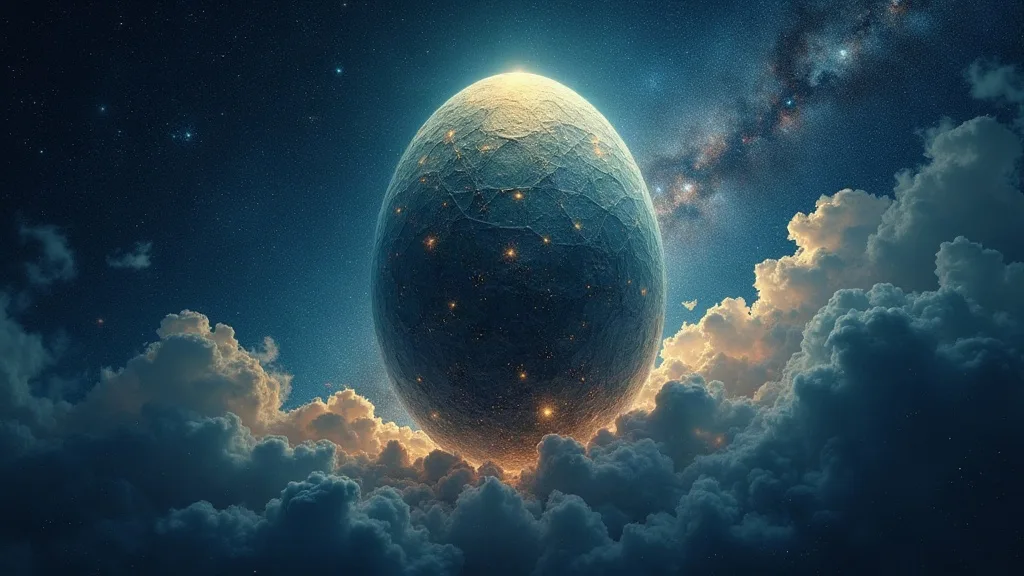
In the beginning, there was the cosmic egg. Not a shell floating in void, but the totality itself: potential, silence, mathematics coiled inside emptiness. The Dogon people of Mali, who have preserved this creation story for centuries through oral transmission and sacred knowledge passed only to initiated men, describe Amma (the supreme creator) generating all existence from this single, perfect sphere.
Before sound, before motion, before light, there was only order waiting to happen. Inside the egg lay everything: geometry, rhythm, breath, the seeds of sacrifice that would make the universe move. The Dogon understood the cosmos as something that had to be broken open to become real. Not destroyed, but cracked; not chaos unleashed, but potential released into form.
The creation story you are about to read comes from the Dogon creation myth as recorded through the oral traditions of the Dogon people, particularly preserved in the knowledge systems of the Awa (the Dogon initiation society) and later documented by ethnographers like Marcel Griaule in conversations with Dogon elders. This is not a simple tale of making; it is a blueprint for how the Dogon understood language, number, sex, death, and the rhythm that keeps everything from falling back into chaos.
Amma and the Cosmic Egg: The First Sound
Amma, the supreme being, was not a god in the human sense. He did not walk or think the way we do. Instead, he was the total force that animated everything. To bring the universe into being, Amma had to transform; he had to move, vibrate, become the first word. The Dogon describe this moment not as creation from nothing, but as the ordering of potential through sound.
The cosmic egg contained pairs of everything: male and female principles, light and dark, wet and dry. These pairs were not at war; they were locked in a dance that had not yet begun to move. Amma, through his will, set the egg spinning. This spinning generated vibration, and vibration became speech. In the Dogon system, speech is not mere noise; it is the force that brings form into being. To speak something is to make it real.
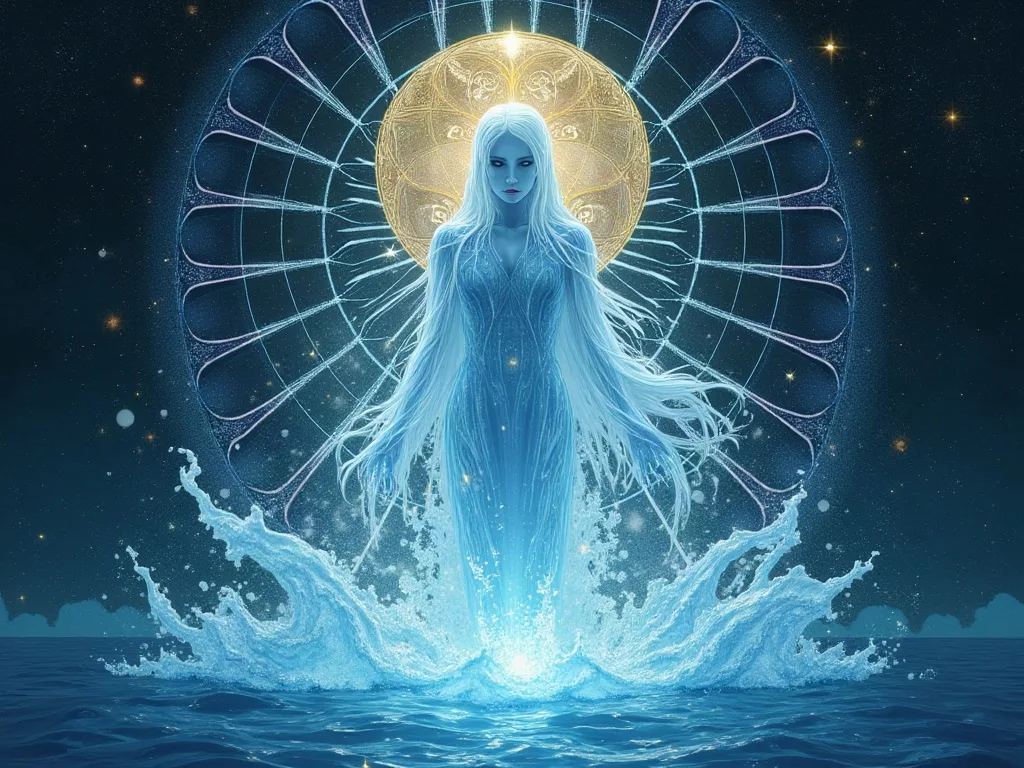
As the egg spun, it began to crack. But this was no accident or disaster. The cracking was necessary. Inside the shell, Amma's children stirred. The most important of these was Nommo, a being of water, speech, and cosmic order. Nommo was not one; he was four: a divine duality and its reflection, the sacred number that opens all possibility. The Dogon call this set the Nommo Anammona (the perfect pair).
The cracking of the cosmic egg released these forces into space. Space itself was born from this breaking; it became the field where order and chaos would forever dance. The vibrations that cracked the egg did not disappear; they became the pulse that runs through every living thing. Your heartbeat carries it. Your breath carries it. This is why the Dogon see rhythm as sacred and why sacrifice, which requires breath and motion, is the way humans stay aligned with the creation that happened in that first instant.
Nommo: The Divine Twin and Master of Speech
Nommo emerges as the central figure in Dogon cosmology. He is the primordial water being, the master of language, the guardian of order, and the firstborn of Amma. In many tellings, he is understood as a divine human being, a mediator between Amma and the world that would come after the egg cracked. He was born from Amma's own substance, and he carried within him the knowledge of how everything should work.
Nommo is described as inhabiting water. Water, for the Dogon, is not merely H2O; it is the principle of life-giving force, the medium through which all things flow and communicate. When Nommo speaks, the water moves. When the water moves, it carries language to every living thing. Fish, birds, plants, humans, all receive Nommo's teaching encoded in the ripples of streams and the moisture in the air.
The Dogon record that Nommo had a specific mission: to teach the humans who would eventually come into being. But before that, he had to order the chaos that poured out of the broken egg. Using his voice, his knowledge of number and geometry, and his own body as a bridge between the divine and the material, Nommo organized the first waters, the first light, the first boundaries between things.
There is a profound paradox at the heart of Nommo's role. He is both creator's son and creator himself. He both receives Amma's word and becomes a word-maker. The Dogon see this not as contradiction but as the necessary pattern: creation flows through steps, like a river flowing through channels. Nommo represents the first step after Amma, and all that follows flows through Nommo's speech and order.
The Dogon also understand Nommo as a sacrifice. In some tellings, Nommo's own body becomes the principle of life and growth in the world. His body becomes the rain, the rivers, the blood of sacrifice that keeps the world in motion. This is not a one-time event; it is continuous. Every rain, every birth, every death carries Nommo's presence, his sacrifice, his teaching.
The Breaking and the First Disorder
Not everything that came from the cosmic egg was order. The Dogon creation story, like many African cosmologies, does not imagine creation as a smooth, inevitable process. There was resistance, rebellion, and accident.
Among the beings released from the egg was Ogo (also called Yurugu), a figure of cunning, rebellion, and chaos. Ogo was supposed to be part of a proper pair, balanced and complementary, but he moved too fast. He fell from the cosmic plane into the earth before the proper order was established. This was the first disorder, the first misalignment. Ogo's fall scattered things; his landing shattered the perfection of the plan.
Ogo carries within him the capacity for disorder, but also for cunning knowledge. He is not wholly evil in the Dogon system; rather, he represents the principle that things do not always go as intended. He embodies the unpredictable, the sideways step, the very human impulse to rebel against order. Because Ogo fell out of place, death entered the world. Because Ogo's landing was chaotic, suffering entered the world. But also, because Ogo exists, humans have free will. We are, in a way, Ogo's children as much as Nommo's children.
This is where the Dogon creation story diverges sharply from narratives that see creation as harmony achieved once and then maintained. For the Dogon, order is always being maintained against the pull of disorder. Creation is not a single event in the past; it is an ongoing process. Every ritual, every sacrifice, every act of speech is a re-creation, a reordering, a holding-back of the chaos that Ogo represents.
When humans came into being, they inherited this task. We are not passive recipients of creation; we are its ongoing caretakers. Through ritual, through sacrifice, through the careful use of words and numbers, we keep the cosmic egg's breaking from becoming a total unmaking.
The Dogon Cosmos: Numbers, Water, and Regeneration
The Dogon creation myth is inseparable from the Dogon understanding of how the universe is structured. The cosmology is mathematical and precise in ways that fascinated anthropologists. The Dogon divide the universe into regions, each with its own nature and its own relationship to the original creation.
The upper region belongs to Amma and Nommo. Here, stars and planets follow their paths. The Dogon tracked the movements of Sirius, the brightest star, with remarkable precision centuries before European astronomy developed telescopes. They knew that Sirius had a companion star (Sirius B) that is invisible to the naked eye and did not become visible to modern astronomy until the 1800s. How they knew this remains debated among scholars; what matters here is that their cosmology was grounded in careful observation and a conviction that the heavens reflected the principles of creation.
The middle region is the world of humans, plants, animals, and water. This is the realm where Nommo's speech is most active, where the breaking of the cosmic egg continues to reverberate. Here, the Dogon built their culture on principles of balance and flow. Water, for instance, was sacred not as symbol alone but as substance; the Dogon's agricultural life and rituals were calibrated to water's movement and seasons.
The lower region is the realm of the ancestors and of Ogo. It is not hell in the Christian sense, but it is the realm of unknowing, of dissolution, of the dead. Yet even here, Nommo's influence extends. The ancestors communicate through water, through ritual, through the proper speaking of names. Death is not a severance but a transition, a flowing into a different part of the universe that Amma created.
This three-part cosmos is itself an expression of the cosmic egg's structure. The Dogon number system privileges four, two, and three; everything is organized by doubling and division. The egg splits into two, those two split into two again, yielding four. Four is the number of Nommo's fullness. The Dogon also work with the number three, which represents the first balance after asymmetry.
Sacrifice and the Continuation of Creation
For the Dogon, sacrifice is not punishment or appeasement in the sense of trying to calm an angry god. Rather, sacrifice is recognition. It is the human acknowledgment that creation cost something, and that maintaining creation costs something ongoing. Every act of sacrifice is a re-participation in the moment the cosmic egg broke.
The most important Dogon ritual is the Dama, a funeral ceremony that can last for days and involves elaborate masked dances, the speaking of names, and offerings. During the Dama, the community gathers to ensure that a dead person's spirit is properly guided to the realm of ancestors, and that the boundary between the living and the dead remains intact. This is not morbid preoccupation; it is ongoing creation-work. Without the Dama, the Dogon believe, disorder seeps in. The dead become lost, and their confusion infects the living.
Sacrificial offerings, usually of millet or animals, accompany these rituals. The Dogon pour libations of water and milk onto the earth. Water, again, is the medium of Nommo, the signal that the living acknowledge their ongoing relationship with the force that broke the cosmic egg and continues to sustain all things. To sacrifice is to say: "We remember. We are part of this. We will continue the work."
The Dogon word for this participation is kyne, which encompasses harmony, balance, and alignment. When you perform a ritual, you achieve kyne. When you speak truthfully, you maintain kyne. When you give what is needed to the earth and ancestors, you preserve kyne. The Dogon creation myth is not a story you tell once and put aside; it is a template for how to live.
The Cosmic Egg in African and Global Cosmologies
The cosmic egg appears in creation stories far beyond the Dogon. From the Egyptian Bennu bird emerging from the primordial waters, to the Hindu Hiranyagarbha (the golden egg), to the Chinese Pan Gu breaking from chaos, the image of a cosmic seed that cracks to birth the world seems to reflect deep patterns in human imagination and physics.
The Dogon version has its own specificity. Unlike some cosmic egg stories, the Dogon egg is not merely material; it contains consciousness, intention, and speech. It is Amma's body and mind. When it breaks, the universe does not emerge by accident or mechanical force; it emerges through the will of a being who has organized all potential into a singular, perfect form and then released it.
The Dogon cosmic egg also differs in that it leaves behind a legacy of necessary disorder. Many creation stories imagine a moment of perfect order followed by decline. The Dogon imagine a moment of perfect order interrupted by rebellion, leading to a cosmos in which creation and entropy are always in motion, always in negotiation. This is, in a sense, a more realistic and less comforting vision than stories of a fall from grace. There is no golden age to return to; there is only the ongoing work of maintaining order.
Scholars have noted that the Dogon cosmology, with its emphasis on number, geometry, and astronomical precision, reflects a sophisticated philosophical system that was not fully appreciated by early European anthropologists. For decades, the Dogon were portrayed as simple pastoralists with a simple religion. The depth of their mathematical knowledge and their systematic understanding of the cosmos have only become apparent through patient scholarship and, most importantly, by taking Dogon knowledge-keepers seriously as thinkers, not mere subjects of study.
Nommo's Children: The First Humans and the Gift of Speech
After the cosmic egg broke and the universe took its initial form, Nommo turned his attention to what would become humanity. The Dogon account of how humans came into being is embedded in a larger story of how different peoples came to the Dogon lands.
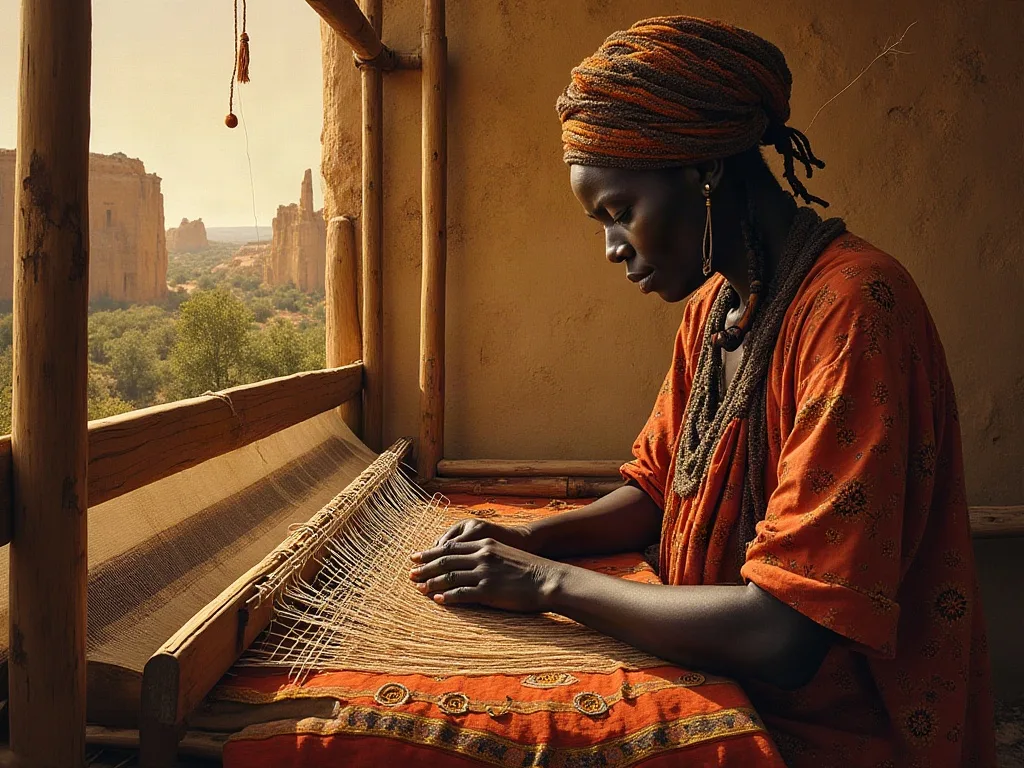
Nommo, in his role as mediator and teacher, brought knowledge to the first humans. This knowledge was not abstract doctrine but concrete skill: the ability to speak truly, the knowledge of numbers, the understanding of how to plant and harvest, the ritual forms that would keep them aligned with creation. Nommo also brought the gift of cloth-making; the Dogon are renowned weavers, and weaving is seen as a form of speech, a way of organizing chaos into pattern.
The Dogon account also includes the arrival of smiths (the Forgemasters), who brought the technology of metalworking. Smiths in Dogon society are not mere technicians; they are a distinct group, sometimes feared and respected, because they work with fire and transformation. They, too, carry Nommo's knowledge, but applied to the world of metal and making rather than speech and ritual.
Humans, in the Dogon understanding, are not Amma's sole creation; they are Nommo's creation, the result of Nommo's descent into the world and his union with a woman of the earth. This makes humans both divine and material, both orderly and chaotic, both carriers of Nommo's speech and vulnerable to Ogo's cunning. We are built from this contradiction.
Modern Encounters and the Question of Interpretation
The Dogon creation myth became famous in Western scholarship largely through Marcel Griaule's work, beginning in the 1930s. Griaule spent decades with the Dogon, learning their language and, eventually, being initiated into some of the sacred knowledge normally reserved for initiated men. His books, particularly "Conversations with Ogotemmêli," presented a Dogon cosmology of stunning complexity.
Griaule's work was transformative but also complicated. Later scholars, including Griaule's own students, have debated how much of what Griaule recorded reflects Dogon belief as it existed before his arrival, and how much reflects Griaule's own interpretations, his interests in Surrealism and European esotericism, and the inevitable dynamics of an outsider learning an oral tradition. Some scholars have suggested that Griaule's emphasis on mathematical precision and symbolic depth may have been amplified by his own intellectual preoccupations.
This does not mean that Griaule's work is false or useless. Rather, it means that encounter between cultures is never transparent. What we have in Griaule's records is not a pure window into Dogon thought but a translation, an interpretation, a conversation that took place in specific historical circumstances. Later Dogon scholars and thinkers have continued to articulate their own traditions, sometimes confirming Griaule, sometimes correcting or recontextualizing his findings.
The important point is that the Dogon creation myth is not a static artifact locked in the past. It is a living tradition, evolving as the Dogon themselves navigate modernity. The myth continues to inform how Dogon people understand themselves, their relationship to the land, and their place in the world. The symbolic and ritual practices continue, adapted but recognizable.
For those outside the Dogon tradition, the creation myth offers a way of thinking about order and chaos, creation and maintenance, the power of speech, and the relationship between the material and the spiritual that is both ancient and urgently contemporary.
Frequently asked questions about the Dogon creation myth?
Frequently asked questions
What is the Awa, and why does the Dogon creation myth matter to it?
The Awa is the Dogon initiation society, a men's group that preserves sacred knowledge, masks, and rituals. The creation myth is the theological foundation of the Awa; understanding Nommo, Amma, and the breaking of the cosmic egg is essential to participating in the society's rituals and understanding one's place in the cosmos. The Awa's masked dances during the Dama ceremony are, in a sense, the creation story enacted in movement.
Is the Dogon cosmic egg creation myth unique to the Dogon, or do other African peoples have similar stories?
The cosmic egg motif appears in African cosmologies beyond the Dogon, though with different emphases and details. Other African peoples have creation stories involving primordial waters, divine speakers, and the emergence of order from potential. The Dogon version is distinctive for its mathematical precision, its emphasis on rhythm and speech, and its integration of human society into the ongoing work of creation. Each African tradition reflects its own environment, history, and philosophical concerns.
How did the Dogon know about Sirius B, the companion star invisible to the naked eye?
This question sparked decades of speculation. The Dogon did possess precise astronomical knowledge, as recorded by Griaule. Whether they observed Sirius B directly through some lost optical technology, received knowledge from external sources, or developed sophisticated mathematical inference remains debated. What is certain is that the Dogon's cosmology was grounded in observation and mathematics, and that African knowledge systems were far more sophisticated than European scholars initially credited.
Is Ogo a demon or evil force in the Dogon creation myth?
Ogo is better understood as a principle of disorder and cunning rather than evil in a moral sense. He represents what goes wrong, what falls out of place, what rebels against order. In some ways, Ogo is necessary; without him, there would be no free will, no risk, no genuine choice. His presence in the cosmos means that creation is always unfinished, always at risk, always requiring human participation to maintain. The Dogon see dealing with Ogo's legacy as part of the human condition, not as a problem to solve once and for all.
What role does water play in the Dogon creation myth and cosmology?
Water is the medium through which Nommo acts and speaks. It is not merely a substance but a principle of life, communication, and continuity. Rain is Nommo's gift and teaching. Rivers carry ancestral presence. Libations of water are offerings that acknowledge Nommo's ongoing sustenance of the world. In Dogon life, water is sacred, and rituals involving water are acts of alignment with the original creation and its continuation.
How does the Dogon creation myth compare to Christian creation accounts?
The Dogon creation myth emphasizes ongoing creation and human participation in maintaining the cosmos, whereas Christian Genesis emphasizes a single divine act followed by human stewardship. The Dogon cosmology also includes figures like Ogo who represent disorder within creation itself, whereas Christian theology traditionally locates disorder outside creation (as Satan or sin). Additionally, the Dogon myth understands the dead and ancestors as present and influential, whereas Christian theology typically sees the afterlife as separate. Both are sophisticated systems; they reflect different assumptions about time, divinity, and human nature.
The Unfinished Creation: Why the Myth Endures
The Dogon creation myth offers something that many origin stories do not: a vision of creation as ongoing, incomplete, and dependent on human participation. The cosmic egg broke, Nommo spoke, order emerged, but the work is not finished. Every breath, every ritual, every word carries the echo of that first breaking and the responsibility to keep chaos from collapsing the universe back into silence.
This vision has profound consequences for how the Dogon understand themselves and their world. They are not passive observers of a creation that happened long ago; they are active participants in a creation that continues to unfold. When a Dogon person speaks truthfully, when they perform ritual correctly, when they give proper honor to the dead and the ancestors, they are creating the world. They are answering the call that Nommo issued at the moment the cosmic egg cracked.
In an age of planetary instability, ecological disruption, and the erosion of traditional knowledge systems, the Dogon insistence that creation is ongoing, that order requires constant maintenance, and that humans are responsible participants in cosmic balance sounds both ancient and urgently contemporary. The myth does not offer a solution to modern crises, but it offers a way of thinking: that we are not separate from the universe, but woven into its fabric, and that what we do matters not just for ourselves but for the continuation of the whole.
The Dogon continue to inhabit the Bandiagara Escarpment in Mali, a landscape of dramatic cliffs and hidden valleys that seems itself like a cosmic geography. There, in villages built into the stone, the creation story is still told, still lived, still danced in mask and ceremony. The world that Nommo ordered when the cosmic egg cracked still turns, still speaks, still listens for the human words that keep it in motion.
Free 25-page sample
Want the whole story?
Take the first 25 pages free. If it pulls you in, the full edition is yours as an instant PDF download, with a paperback on Amazon for selected titles.
African
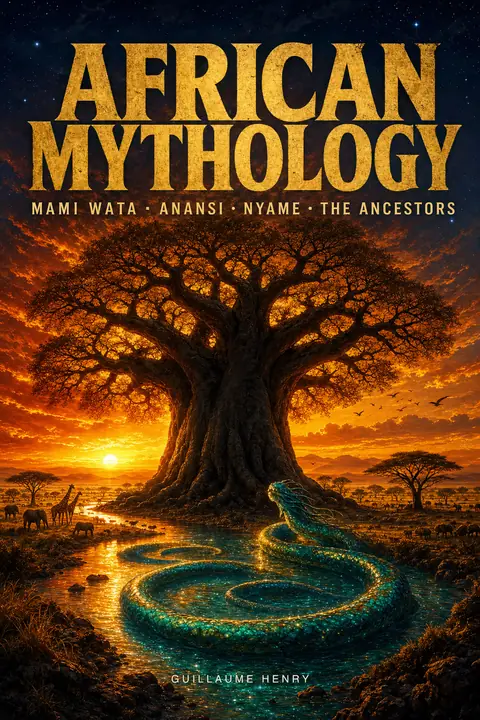
The African Mythology Book: Yoruba Orishas, Anansi, Mami Wata, and the Sacred Stories of Sub-Saharan Africa
From the Yoruba Pantheon to the Spider's Web
Eleven chapters on the gods, heroes, and spirits of Africa south of the Sahara: Eshu, Shango, Oshun, Anansi, Mami Wata, Nyame, the Dogon Nommo, and Unkulunkulu, drawn from oral tradition and ethnographic record.
More from African
All articles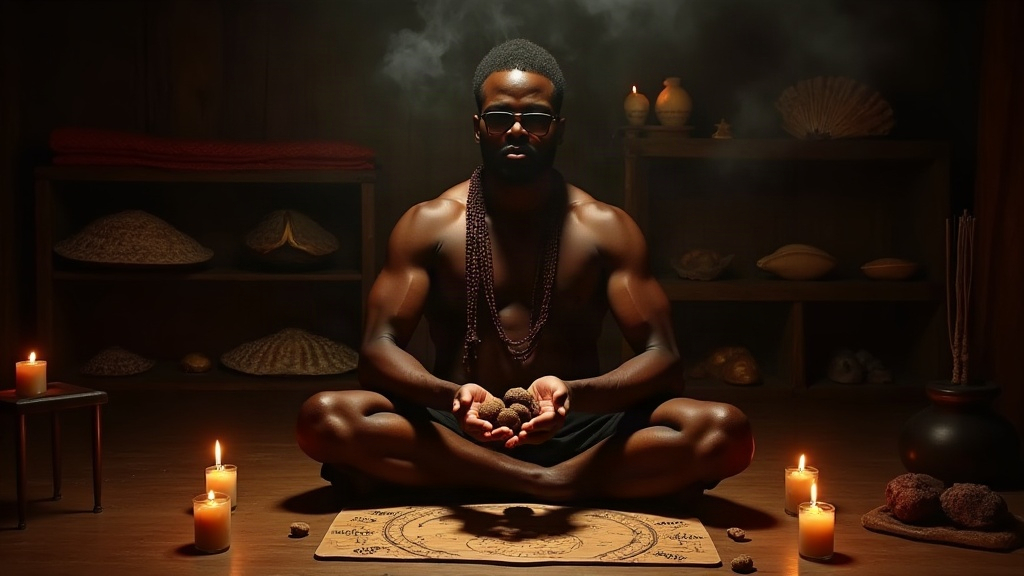
African
Ifa Divination: Sacred Oracle of the Yoruba
Ifa divination is the oral oracle system of the Yoruba people of West Africa, used for over a thousand years to read destiny and guide human life. Learn how the babalawo (priests) cast sacred palm nuts to access divine wisdom.

African
Sundiata Keita: The Lion King of Mali
Born crippled and scorned, Sundiata Keita transformed himself into the warrior-king who forged the Mali Empire. His rise from exile to power changed West African history forever.
African
The Separation of Earth and Sky: A Pan-African Myth
Across Africa, from the Congo to the Sahel, Earth and Sky once lay tangled together. Learn how their separation shaped creation, split existence into realms, and continues to echo in ritual and belief across the continent.
African
Eshu: The Trickster Messenger of the Orisha
Eshu walks the boundary between worlds, carrying words between gods and humans, blessing and cursing with equal power. The trickster orisha rewrites the rules of divinity itself.