
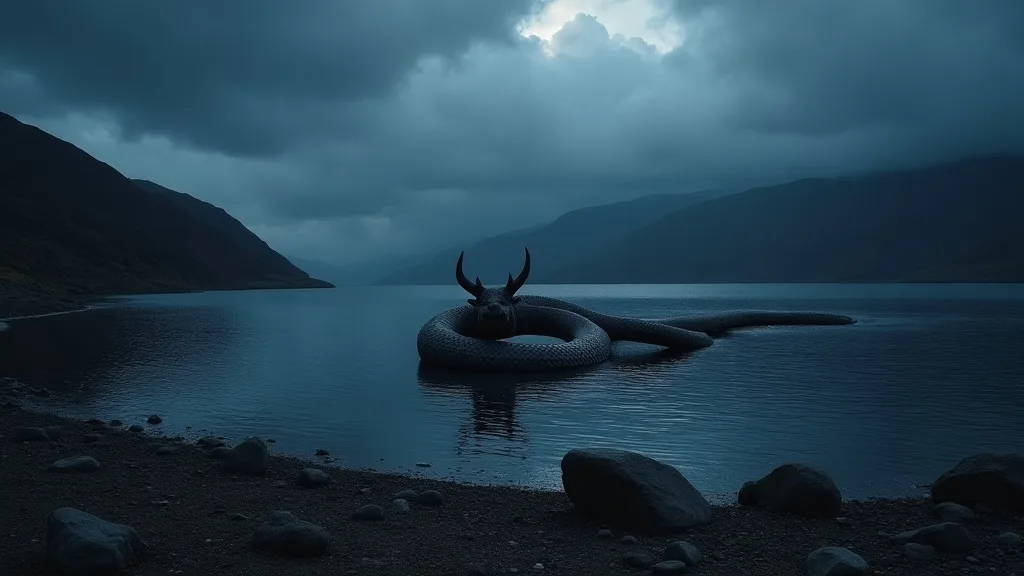
The Vishaps: Dragon Spirits of Armenian Folklore
The Vishaps are among the oldest supernatural beings in Armenian tradition: colossal dragon spirits tied to water, storms, and primordial chaos. Their story stretches from Bronze Age stone monuments to medieval epics still recited today.
Contents
The mountain lake shimmers at noon under an Armenian summer sky. Nothing moves on its surface. Then the water darkens from below, and something immense begins to rise. Ancient herders who camped near Lake Sevan knew better than to linger. They had a name for what lived in the deep: Vishap.
The Vishaps: Dragon Spirits of Armenian Folklore occupy a category all their own. They are neither the fire-breathing wyrms of medieval European romance nor the benevolent celestial serpents of East Asian tradition. They are older than both, born from a mountain people's long reckoning with storms that come without warning, rivers that flood in spring and vanish by August, and the deep cold of volcanic lakes no one has ever fully mapped. The Vishaps are raw, ancient, and genuinely dangerous, and their fingerprints are pressed into Armenian soil, language, and stone in ways that survive to the present day.
What follows is the full story: where the Vishaps came from, what they look like, what they want, how heroes tried to kill them, and why a culture surrounded by towering peaks would come to see dragons not only as enemies but as something closer to weather itself.
Vishapakars: When Dragons Were Carved in Stone
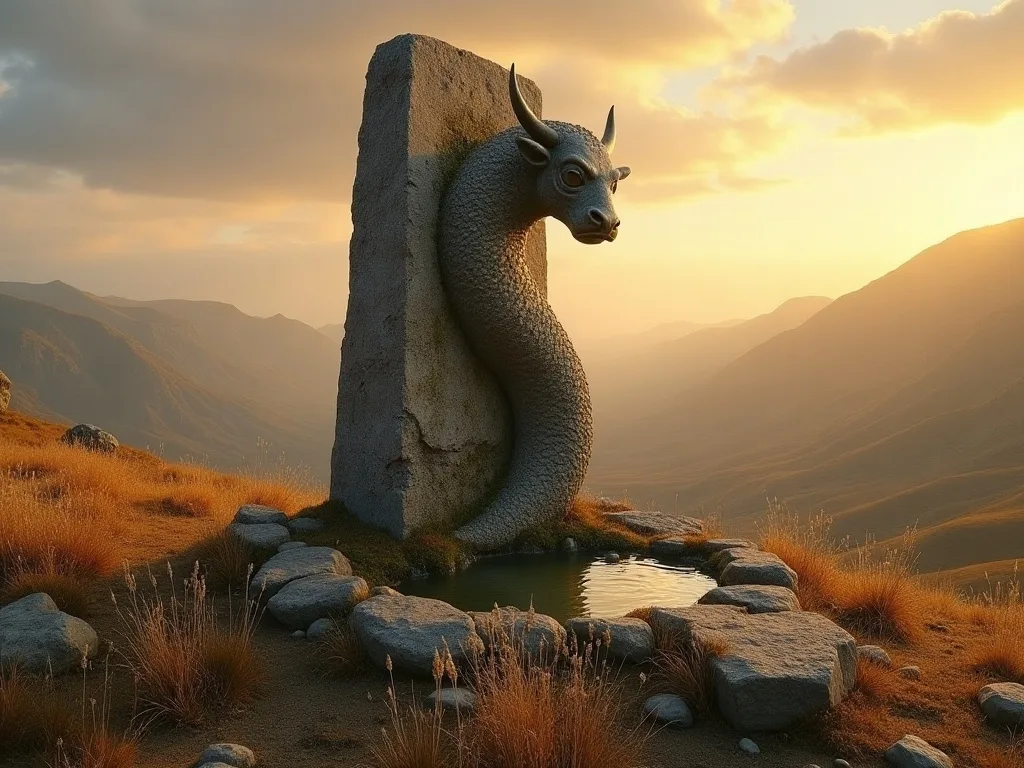
The first thing to understand about the Vishaps is that they left physical evidence. Across the Armenian highlands, archaeologists have found more than a hundred vishapakars (Armenian: վիշապաքարեր), a compound word meaning simply "dragon stones." These are tall basalt monoliths, sometimes reaching four or five meters in height, carved during the Bronze Age and erected near mountain springs, rivers, and lake shores.
Their shape is unmistakable: an elongated fish or serpentine body, often with the head of a bull overlaid at the top, sometimes with a hide spread open like a flayed skin. Water pours from their mouths in the carved reliefs. The majority have been found on the slopes of Mount Aragats, Armenia's highest peak, and near Lake Sevan.
Scholars including Armen Petrosyan and Artak Movsisyan have argued that these stones served as markers of sacred water sources, places where the Vishap's power concentrated. The fish-serpent body suggests a creature of rivers and lakes; the bull attributes connect it to the storm and the thundering sky. That combination, water below and storm above, defines the Vishap throughout its entire mythological life.
The vishapakars are not decorative. They are negotiations. Whoever raised them was acknowledging that something immense already owned the spring, and they were trying to make peace with it.
What a Vishap Actually Looks Like
Armenian textual sources, from the 5th-century chronicles through medieval manuscripts, describe the Vishap in several overlapping ways. The creature is consistently enormous. Size is its first and most important quality: a Vishap that could wrap its coils around a mountain is not unusual in these stories.
The body is serpentine, though limbs appear in some accounts. Several sources describe the Vishap as capable of taking the form of a great fish when it lives in water, swelling to fill an entire lake. When it rises into the sky, it transforms into a coiling storm-snake, black against the clouds, breathing cold mist rather than fire.
This detail matters. Armenian Vishaps do not breathe fire. They breathe water, storm, and cold. They belong to a mountain climate where the deadliest weather is not heat but the sudden storm that drops temperatures twenty degrees and drives hail the size of plums into ripening wheat fields. The Vishap is essentially the personification of that kind of catastrophe.
Some accounts give the Vishap wings. Others describe it as finned. The inconsistency is not a flaw in the tradition; it reflects the way storm systems themselves are shapeless and inconsistent, filling whatever form the sky offers them.
Medieval Armenian manuscripts, particularly those preserved in the Matenadaran (the great manuscript repository in Yerevan), include miniature illustrations of Vishap-like creatures that blend fish, serpent, and bird attributes into a single impossible body. These images match no single animal. They are composites, exactly the way a storm is a composite of wind, rain, and electricity.
The Vishap's Kingdom: Mountains, Lakes, and the Sky
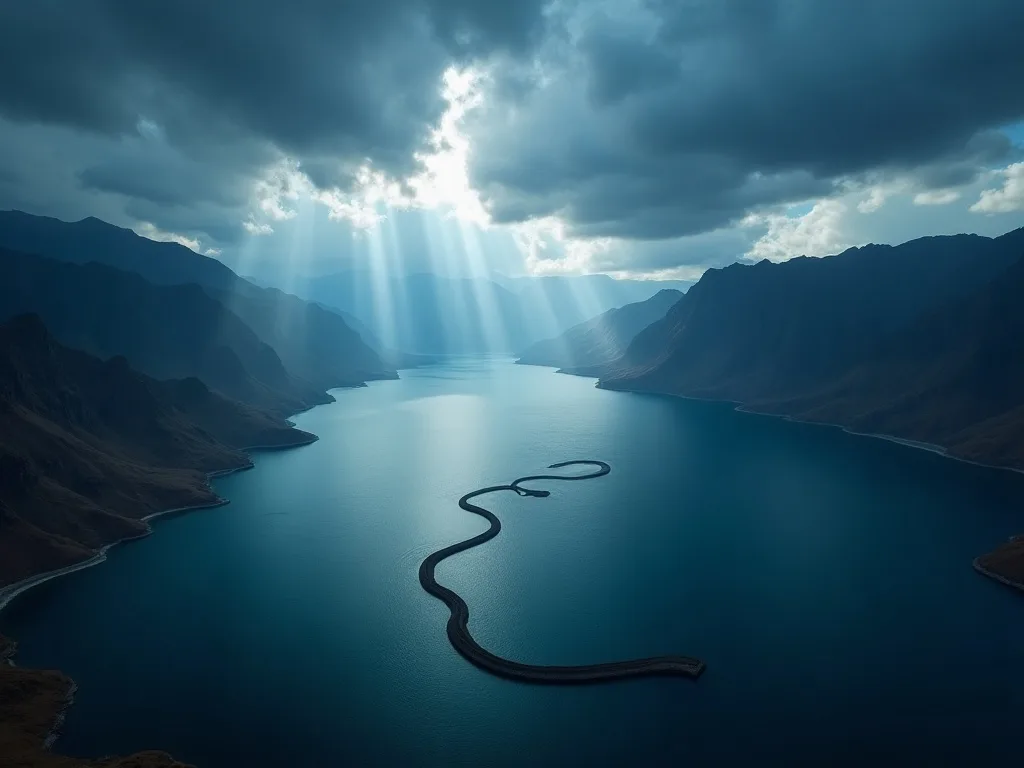
The Vishap's geography is specific. These creatures are not spread evenly across the landscape. They concentrate at thresholds: the line where a river disappears underground, the place where a spring erupts from bare rock, the shoreline of a volcanic lake, the pass in a mountain range where the wind comes from a different direction on each side.
Lake Sevan, sitting at 1,900 meters above sea level in what is now central Armenia, appears again and again in stories about Vishaps. It is the largest lake in the Caucasus, deep enough that its bottom has never been fully charted by ancient methods, cold enough in winter that it freezes at the edges. This is exactly the kind of place a Vishap would choose: vast, dark, ruled by weather that rolls in from the mountains with almost no warning.
Mount Ararat, sacred to Armenian identity even though it now sits inside Turkey, was also understood as Vishap territory. The Armenian epic cycle called the Dastakert (preserved in fragments and references) describes the slopes of Ararat as home to Vishaps that guard hidden water sources. To tap those springs, a hero had to either defeat the creature or bargain with it, and the outcome was never guaranteed.
There is also a sky dimension. Several Armenian legends describe Vishaps as rising from mountain lakes during summer storms, carried upward by the wind, then falling back as rain or hail when their strength gives out. This is not metaphor in the original telling. The Vishap genuinely travels between the underwater world, the mountain world, and the storm clouds. It is a creature of vertical movement in a landscape where altitude changes everything.
Vahagn the Dragon-Reaper: Armenia's Great Vishap Slayer
No account of the Vishaps is complete without Vahagn, the Armenian god of fire, storms, and war, who carries the specific title Vishapakagh, meaning "Dragon-Reaper" or "He Who Tears Out Dragons."
Movses Khorenatsi preserves what he describes as an ancient song, possibly of pre-Christian origin, about Vahagn's birth. In the song, heaven and earth were in labor, and the crimson sea also travailed. From the sea rose a reed, from the reed rose smoke, from the smoke rose flame, and from that flame a young man with hair of fire and beard of flame, his eyes being suns. This is Vahagn, born from the meeting point of water, air, and fire.
Vahagn's purpose, almost his entire mythological function, is to hunt and kill Vishaps. He is described pulling them from their lakes, tearing them apart with his hands, dragging their bodies across the sky. The Milky Way in Armenian folk astronomy was called Goghi Chanaparh, the "Straw Thief's Way," and connected to Vahagn in some accounts, but older traditions link the streak of the galaxy to the path Vahagn dragged a slain Vishap across the heavens.
The relationship between Vahagn and the Vishaps encodes a cosmological argument: fire beats water, light beats storm, the agricultural order of the settled Armenian plateau beats the chaotic power of the untamed mountain lakes. But the victory is never permanent. Vahagn slays specific Vishaps; he does not end the species. New ones rise from new storms, new lakes fill and deepen, and the dragon-reaper must go out again.
Read more about Vahagn, the fire god who hunts dragons, in the Armenian mythology tradition
Vishaps in the Oral Tradition: The Hayreni Songs and Folk Tales
Beyond the formal epics, the Vishap lives in Armenian oral tradition with remarkable tenacity. The hayreni (literally "of the homeland") lyric poems collected by 19th-century ethnographers like Ghazaros Aghayan document Vishap encounters in the voice of ordinary farmers and shepherds, not heroes.
In these accounts, the Vishap is less a monster to be slain and more a force to be navigated. A shepherd who camps near the wrong spring wakes to find his flock gone, pulled into the water overnight. A bride traveling to her wedding crosses a bridge over a Vishap's river and must throw her gold bracelet into the current as payment. A village that loses water in summer discovers a Vishap has coiled around the mountain spring and must send a young man to negotiate, not fight.
This is a different kind of Vishap from Vahagn's enemy. This one is territorial rather than purely malevolent. It does not attack without reason; it defends what it considers its own. Water is its property. People who use water owe something in return.
That logic has a practical agricultural root. In a highland environment where the difference between enough water and drought is the difference between survival and famine, the idea that water has an owner, a being who can withhold or grant it, makes immediate sense. The Vishap is partly a story about irrigation rights dressed in scales.
Dragon Stones and Cosmic Waters: The Vishap's Cosmological Role
The Vishap is not merely a monster story. Across Armenian mythological thinking, it functions as one half of a fundamental cosmic pair: the dragon that holds water against the fire that releases it.
Comparative mythologist Calvert Watkins, in his landmark 1995 study How to Kill a Dragon, identified the Armenian Vishap tradition as part of a wider Indo-European pattern in which a dragon controls cosmic waters and a thunder god must free them. The Sanskrit Vritra, slain by Indra, holds exactly this role in Vedic cosmology. The Norse Jormungandr encircles the ocean. The Hittite Illuyanka blocks the rivers.
The Armenian Vishap fits this template but adds a highland-specific texture. Because Armenia sits on one of the most seismically and volcanically active regions of the ancient Near East, the chaos that the Vishap embodies is not abstract. Earthquakes do release underground water. Volcanic activity does cause lakes to suddenly flood. The story of a great serpent coiling around a water source and being expelled by a fiery hero maps closely onto real geophysical events that the inhabitants of the Armenian plateau would have witnessed repeatedly.
This is one reason the vishapakars are placed specifically at springs. They are not just ritual markers. They are records: here is a place where the underground world broke through, where the Vishap made itself known, where something was done to address it.
The Survival of the Vishap Through Christianity and Beyond
Armenia adopted Christianity as its official religion in 301 AD, becoming the first country in the world to do so. The Church brought with it a new cosmology in which the dragon became unambiguously Satan's creature, a symbol of sin and chaos defeated by God's order.
The Vishap did not disappear. It changed address.
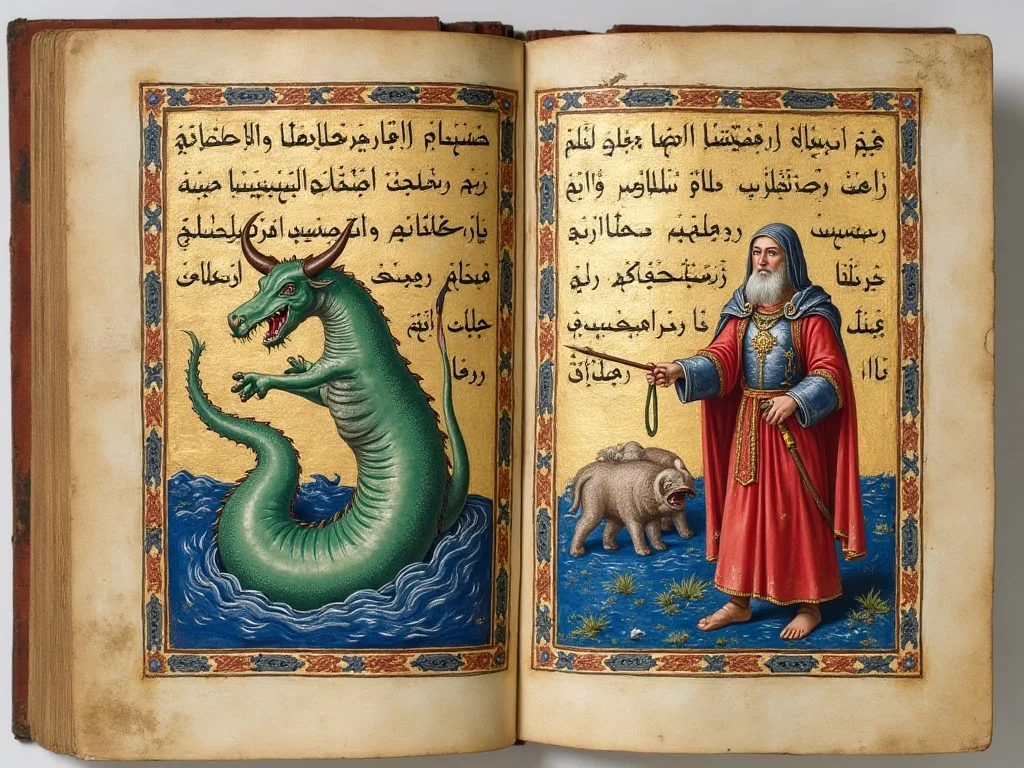
In Armenian Christian iconography, the archangel Gabriel and Saint George (borrowed from Byzantine tradition) take on the Vishap-slaying function that Vahagn once held. The dragon beneath their lances is identifiable: long, coiling, emerging from water, with the same composite attributes as the pre-Christian Vishap. The new theology required that the dragon be purely evil, but the image underneath the theology is continuous with what came before.
Medieval Armenian manuscripts from the 13th and 14th centuries, particularly those produced in the scriptoria of Gladzor and Tatev monasteries, show dragon illustrations that blend the vishap's water-serpent form with the Christian concept of the Leviathan. The scribes were educated men who knew their biblical sources; they were also Armenians who grew up hearing vishap stories, and the two traditions fused at the level of the image even when the text insisted on their difference.
Armenian folk belief, recorded by ethnographers well into the 20th century, maintained the older idea that Vishaps still live in mountain lakes and control the rain. During droughts, some communities performed rituals near springs and lakeshores that the Church officially frowned upon. The priest might bless the water; the village elder might quietly leave an offering at the spot the old people called the Vishap's threshold. Both things happened, often on the same afternoon.
Comparison: Vishap and Vritra
Armenian Vishap
- Controls mountain lakes, springs, and storm clouds
- Serpentine body, sometimes with bull or fish attributes
- Slain by Vahagn, the fire-and-storm god
- Physically located in the Armenian highland landscape
- Survives in folk belief as territorial water spirit
- Documented in stone carvings from c. 2000-1500 BC
Vedic Vritra
- Blocks the cosmic rivers, causing universal drought
- Described as serpentine or cloud-like in the Rigveda
- Slain by Indra, wielder of the thunderbolt
- Located in a cosmic rather than geographical space
- Survives in later Hinduism as a cautionary figure
- First attested in the Rigveda, c. 1500-1200 BC
The parallel is close enough to be structural, not coincidental. Both figures are parts of the same ancient Indo-European narrative: the dragon holds the waters, the storm champion kills the dragon, the waters flow and life resumes. The Armenian version is the highland version, shaped by the specific geography of a plateau ringed by volcanoes and cut through by rivers that behave as unpredictably as the Vishap itself.
Frequently Asked Questions About the Vishaps
Frequently asked questions
Are Vishaps the same as European dragons?
Not quite. European dragons in the medieval tradition are primarily associated with fire, treasure-hoarding, and the corruption of order. Armenian Vishaps are water creatures first: they live in lakes and rivers, control rainfall and storms, and breathe cold mist rather than fire. The physical form overlaps, especially the serpentine body, but the elemental allegiance is almost the opposite. The closest European parallel would be the Norse Nidhogg or the Slavic Zmey, both of whom have strong water and underworld connections alongside their destructive qualities.
What evidence exists for the Vishap tradition before written records?
The vishapakars, the carved basalt monoliths found across the Armenian highlands, provide the clearest pre-literary evidence. More than a hundred of these stones have been catalogued, with the majority dated to the Bronze Age, roughly 2000 to 1500 BC. They are found near springs, rivers, and mountain lakes, and their fish-serpent-bull imagery is consistent with the Vishap as described in later textual sources. Armen Petrosyan's archaeological studies have connected the stone imagery to water ritual and territorial marking.
How does Vahagn relate to similar gods in other mythologies?
Vahagn, the Dragon-Reaper, belongs to a class of Indo-European thunder gods who slay water-hoarding serpents. The closest parallels are Vedic Indra slaying Vritra, Norse Thor battling Jormungandr, and Hittite storm god Teshub defeating Illuyanka. Calvert Watkins analyzed these as variants of a single inherited mythological formula in How to Kill a Dragon (1995). Vahagn is the Armenian branch of that tradition, but he carries local specifics: his birth from water and fire simultaneously, his title Vishapakagh, and his connection to agricultural water management on the Armenian plateau.
Did belief in Vishaps survive after Armenia converted to Christianity in 301 AD?
Yes, and in layered ways. Officially, the Armenian Apostolic Church absorbed the Vishap into the Christian framework as a symbol of Satan and sin, replaced by dragon-slaying saints. Practically, folk belief in Vishaps as living water spirits persisted in rural communities well into the 20th century, documented by ethnographers like Ervand Lalayan and later by Soviet-era folklorists. Rituals near mountain springs and lakes occasionally preserved older attitudes toward water spirits even while framed in Christian language. The image of the dragon in Armenian Christian manuscript art is also visually continuous with the pre-Christian Vishap, suggesting the scribes themselves were navigating both traditions.
Are there any famous Armenian stories where a hero bargains with a Vishap rather than kills one?
Yes. The oral folk tradition collected in the 19th century includes several accounts where negotiation replaces combat. In one story type, a community plagued by drought sends a representative to speak with the Vishap controlling the local spring; the representative offers gifts, and the water returns. In another, a young man agrees to give the Vishap his future firstborn child in exchange for water during a famine, creating a story pattern similar to Rumpelstiltskin traditions in European folklore. The epic of Mher in the Armenian heroic cycle also involves complex relationships with dragon-like beings that are not purely adversarial.
Where can I see actual Vishap stone carvings today?
Several vishapakars are on display in the History Museum of Armenia in Yerevan. Others remain in situ on the slopes of Mount Aragats, particularly near the archaeological site of Metsamor. The Erebuni Museum in Yerevan and various regional museums also hold examples. The stones at Metsamor are among the most impressive, still standing near the ancient Bronze Age settlement where they were originally erected, which allows visitors to understand the landscape context that shaped the Vishap tradition.
The Vishap in Modern Armenian Culture and Unresolved Debates
The Vishap has not gone quiet. In contemporary Armenia, the word vishap appears in everything from the names of rock bands to craft beer labels to national sports team branding, a pattern familiar from the way the Norse dragon has been claimed by Scandinavian commercial identity. The dragon stone imagery, the silhouette of the elongated serpent carved in basalt, has become a kind of national glyph.
Scholarly debate, however, still turns on fundamental questions. The first is chronology: do the vishapakars pre-date Indo-European arrival in the Armenian highlands, suggesting an indigenous substrate tradition that was later merged with the Indo-European storm-dragon combat narrative? Or are they already the product of that merger? Petrosyan argues for an early indigenous layer. Others, including Martirosyan in his etymological studies of Armenian, point out that the word vishap itself has a possible Iranian cognate in wišap, connected to vish (poison), which would place it firmly in the Indo-Iranian linguistic world and push the origin of the myth eastward.
The second debate concerns gender. Most vishap references treat the creature as implicitly male, because the primary frame is combat with a male hero. But some folk tales, particularly from the Syunik region of southeastern Armenia, describe a female Vishap who acts as a protector of women and children near a specific lake, dangerous to men who approach her water but helpful to women in labor who ask her for aid. This suggests a pre-heroic layer in which the Vishap was a complex water deity with both protective and destructive faces, before the combat narrative flattened it into a pure antagonist.
These questions will not be resolved quickly. The Armenian highlands are still being excavated, and new vishapakars are still being found. Each stone adds data but also new puzzles. The Vishap is a creature that keeps arriving, like a storm over Sevan: you think you understand it, and then the water darkens again from below.
The Armenian tradition connects outward in every direction: to the Vedic world, to the Hittite and Hurrian mythologies of ancient Anatolia, to the Zoroastrian cosmology of neighboring Iran, to the Greek Typhon who was himself a great serpentine challenger to divine order. The Vishap stands at the center of all those threads, a mountain creature with a global story, carved in basalt and waiting in the deep water.
Free 25-page sample
Want the whole story?
Take the first 25 pages free. If it pulls you in, the full edition is yours as an instant PDF download, with a paperback on Amazon for selected titles.
Armenian
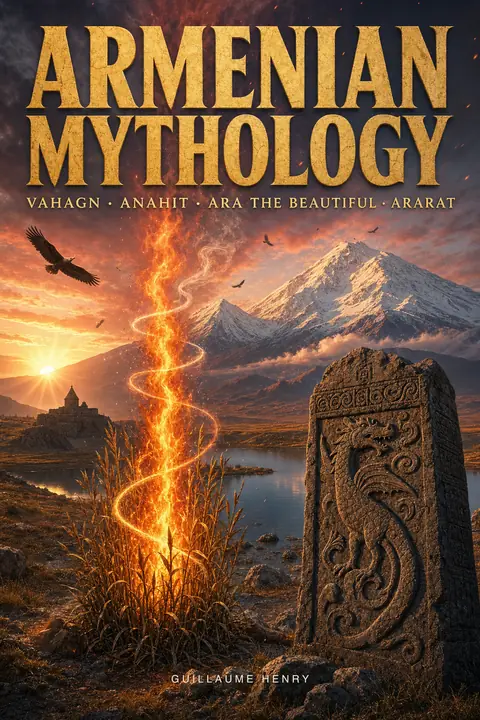
The Armenian Mythology Book: Vahagn, Anahit, Aramazd and the Sacred Stories of the Caucasus Before Christ
Gods of Fire, Bronze, and the Forgotten Kingdom of Urartu
The pre-Christian gods of Armenia: Vahagn the dragon-slayer, Anahit the mother goddess, and the syncretic pantheon that merged Urartian, Persian, and Greek traditions before vanishing in 301 CE.
More from Armenian
All articles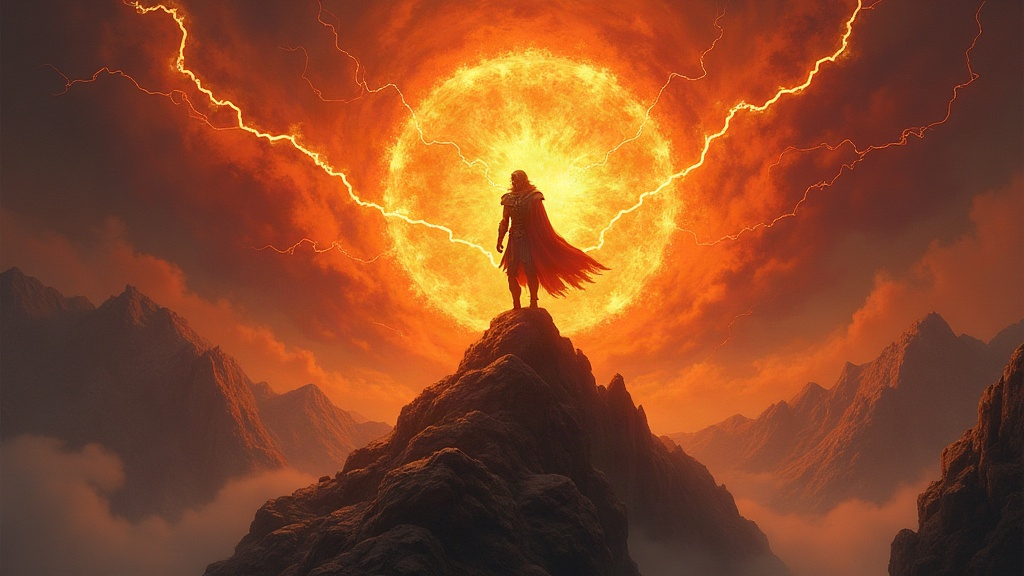
Armenian
Vahagn: Armenian God of Fire, Thunder, and War
Vahagn roars through the red dawn, the Armenian god of fire, thunder, and war whose bronze-voiced hymns echo in the oldest Christian prayers. Discover the warrior deity who conquered chaos, shaped Armenia's spiritual identity, and survived conquest itself.
Armenian
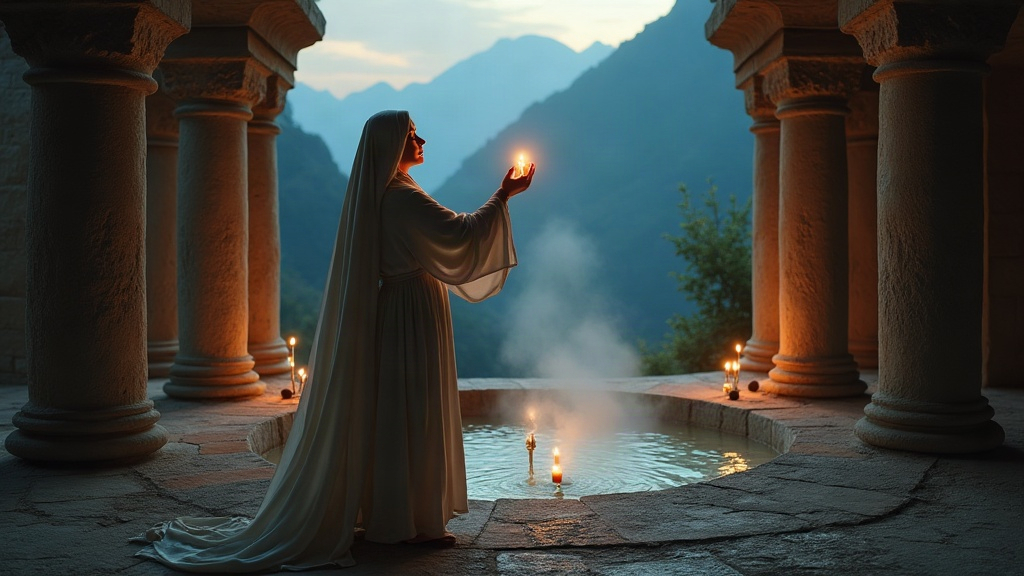
Anahit: The Great Mother Goddess of Armenia
Anahit ruled Armenia's spiritual world for millennia as the Great Mother, keeper of waters, fertility, and wisdom. Discover how she shaped an entire civilization's understanding of divine power.

Armenian
Aramazd: The Creator God and Father of All
Aramazd stands at the foundation of Armenian myth as the supreme creator, the father from whom all life and divinity flow. Discover how this ancient god shaped the cosmos and why he vanished from Armenia's religious life after the conversion to Christianity.

Armenian
Hayk and Bel: The Founding Myth of Armenia
The story of Hayk's rebellion against the tyrant Bel explains how Armenia was born. A warrior's defiance, a nation's origin, and a line of kings that would rule for centuries.