

Hayk and Bel: The Founding Myth of Armenia
The story of Hayk's rebellion against the tyrant Bel explains how Armenia was born. A warrior's defiance, a nation's origin, and a line of kings that would rule for centuries.
Contents
A warrior stands on the slopes of a high mountain, his army gathered behind him. Below, the tyrannical Bel commands the known world and demands submission from all peoples. Hayk, descended from the ancient patriarch Noah himself, refuses to bow. He raises his bow. This moment, rendered across centuries of Armenian texts and folk memory, marks the instant Armenia became itself.
Hayk and Bel are the two pillars of Armenian national identity. One is the eponymous ancestor whose name literally becomes the word for "Armenia" itself (Hayastan in Armenian means "land of Hayk"). The other is the oppressor whose defeat sets a nation free. Their conflict echoes through every layer of Armenian culture, from scholarly histories written in the 5th century to patriotic songs sung today.
The story belongs to a family of founding myths. It operates on multiple levels at once: as literal history (some scholars argue there is a genuine historical kernel), as sacred legend, as a statement about Armenian character, and as a claim about Armenian sovereignty. Understanding Hayk and Bel means understanding how a people narrate themselves into existence.
The Genealogy of Hayk
To grasp who Hayk was, you must first understand where Armenian tradition places him in the world's family tree. According to the ancient Armenian historian Moses of Khorene, writing in the 5th century AD, Hayk was the great-great-grandson of Japheth, one of Noah's three sons. This lineage mattered. It positioned Armenia inside the Abrahamic narrative, claiming descent from the same biblical stock as the Greeks and the Hebrews.
From Japheth came Gomer, from Gomer came Torgom (also spelled Togarmah or Torgom in different manuscript traditions), and from Torgom came Hayk. Moses of Khorene places Hayk's birth around 2108 BC, though modern scholars view this date as symbolic rather than accurate. What matters is the claim: Hayk was an ancient patriarch, a founder, a man whose blood carried the weight of Noah's covenant.
The genealogy served a practical purpose. In the ancient Near East, claiming descent from Noah or another primordial figure was a way of asserting legitimacy and dignity. It said: we are not upstart barbarians; we stand among the oldest peoples on earth. Armenian tradition seized this claim and held it tight. To be Armenian was to descend from Hayk, who descended from Noah. That unbroken chain connected every Armenian, from kings to farmers, to the deep past.
Hayk himself is described in the tradition as a man of prodigious strength and military skill. Some accounts call him a giant. He carried a bow of such power that arrows shot from it could fell entire squadrons. He was, in essence, the ideal of the warrior founder: fierce, noble, unconquerable by ordinary means. His very name would become the root of Hay (Armenian), Hayreniq (fatherland), Hayastan (Armenia). The man and the nation fused into a single word.
The Tyrant Bel and the Demand for Submission
Who was Bel? The question is more tangled than it first appears. Bel is a Mesopotamian deity, the supreme god of Babylon. In Mesopotamian religion, Bel (also known as Marduk) was the king of the gods, the creator, the upholder of order. But in the Armenian founding myth, Bel is not a god to be worshipped in temples. He is a tyrant, a ruler of the earthly world, a man who has gathered the peoples of the known world under his heel.
Some scholars believe Bel in this context refers to Nimrod, the legendary builder of Babylon mentioned in the Bible and in Islamic tradition. Others see him as a composite figure, a symbol of Mesopotamian imperial power rather than a specific historical person. The Armenian tradition, however, treats him as real: a king whose power stretched across the ancient world and who demanded that all peoples, including Hayk's people, submit to his authority and abandon their native gods.
The demand for submission was absolute. Bel commanded that all nations worship him as supreme, renounce their ancestral deities, and pay tribute. He had the military power to enforce this edict. Kings who resisted were crushed. Peoples who held to their old gods faced devastation. For the Armenians to survive as a distinct people, they would have to choose: surrender their identity or fight.
This is where Hayk enters as a figure of moral clarity. He represents not merely military valor but the refusal to be erased. The myth draws a sharp line between tyranny and freedom, between the imposition of foreign rule and the preservation of native culture. It is, at its heart, a myth about sovereignty and the cost of maintaining it. You can read a parallel refusal in the myths of Vahagn the dragon-slayer, who embodies the same Armenian instinct to fight rather than kneel.
The Battle and Hayk's Victory
The accounts of the actual battle vary across sources, but the core narrative is consistent. Hayk gathered his people and marched against Bel's forces. The armies met in pitched combat. The classical Armenian sources describe Hayk as employing superior tactics, his archers and spearmen moving with discipline while Bel's larger forces, despite their numerical advantage, fell into disorder.
Hayk himself faced Bel in single combat. Here the myth deepens into something almost superhuman. Some versions say Hayk's arrow pierced Bel's heart from an impossibly great distance. Others describe a hand-to-hand struggle where Hayk's strength and cunning prevailed. The outcome, however, never wavers: Bel fell. Hayk stood victorious.
With Bel's death came liberation. The peoples that Bel had subjugated were freed from his tyranny. But for Armenia specifically, the victory carried a special weight. Hayk had not merely won a battle; he had won the right to exist as a people, to worship the gods of his ancestors, to pass down his name and his laws to his children. The victory sanctified the land itself. The highlands where Hayk ruled became known as Hayastan, the land bearing his name forever.
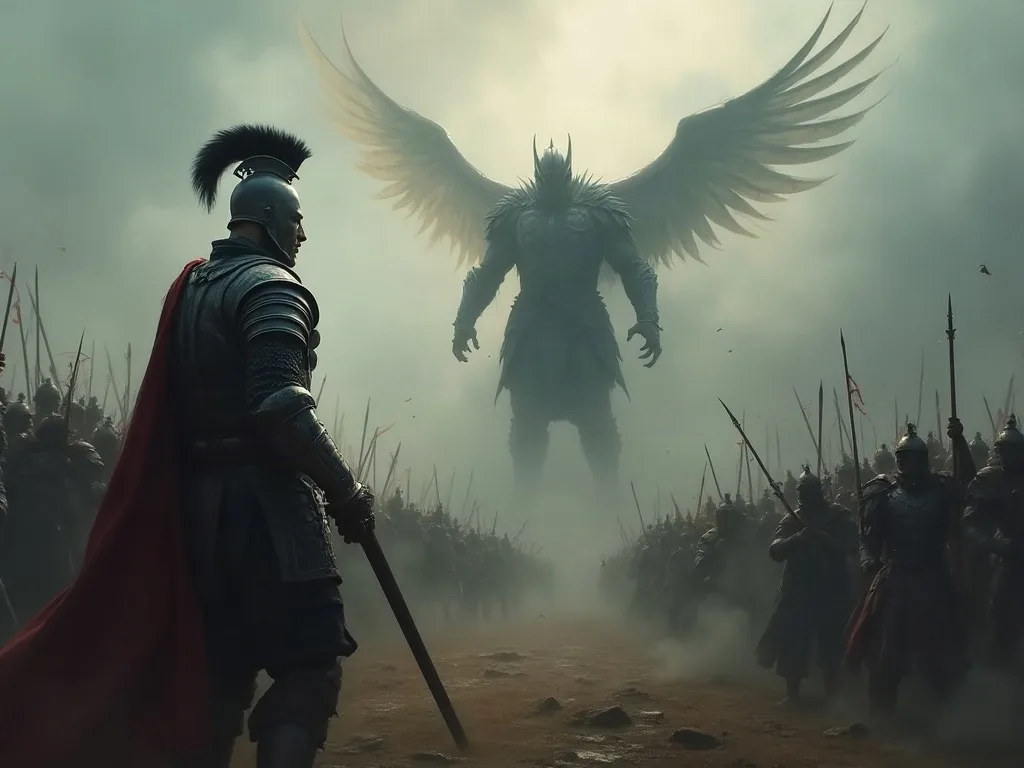
The aftermath of the battle established Hayk as a king and patriarch. He settled his people in the mountainous region between the Black Sea and the Caspian, a landscape that would become the heartland of Armenian civilization. He founded a dynasty. His descendants would rule Armenia for centuries. According to Moses of Khorene, Hayk had a son named Aramais, who fathered Ara the Beautiful, whose own descendants would establish the Arsacid dynasty, one of the most powerful ruling houses of the ancient world. You can trace that lineage further in the legend of Ara the Beautiful and Semiramis.
This genealogical claim is crucial. It meant that every Armenian king who followed could trace his lineage back through Ara to Hayk himself. Every king, in a sense, was Hayk reborn, continuing his work of defending Armenian freedom and dignity. The myth became not just a story of origins but a charter for kingship.
The Theological Dimension: Gods and Resistance
Beneath the military narrative lies a theological claim. Hayk's resistance was not merely political; it was religious. He refused to abandon the ancestral gods of Armenia in favor of Bel's imposed order. This resonates with later Armenian history, particularly the adoption of Christianity in the 4th century AD, when Armenia became the first officially Christian nation. But even before Christianity, the myth establishes the principle: Armenian faith and Armenian identity are inseparable.
Some scholars see in the Hayk and Bel story echoes of other ancient Near Eastern resistance myths. The themes appear in Hittite literature, in Ugaritic texts, in the much later Islamic tradition: the hero who refuses subjugation, the tyrant whose overreach brings his downfall, the people who claim their land by right of struggle and bloodline. The Armenian version is distinctive, however, in its emphasis on Hayk as a man chosen by his people to be their champion, not imposed upon them as a foreign king.

The figure of Vahagn, sometimes called the Armenian Ares, also appears in some versions of the founding narrative. Vahagn is the god of war, thunder, and courage. Some traditions hold that Vahagn appeared to Hayk before the battle, granting him divine favor. Others suggest that Hayk himself was partly divine, or that his victory was interpreted as a sign of Vahagn's blessing upon Armenia. This conflation of human hero with divine sanction was common in ancient mythologies; it elevated Hayk beyond mere mortal status without making him a god outright.
Historical Kernels and Scholarly Debate
How much of Hayk and Bel is history? The question has occupied Armenian scholars for centuries. Moses of Khorene, writing in the 5th century, presents the myth as factual narrative. But modern historians, while respecting the tradition's cultural weight, approach it with skepticism about specific claims.
The historical Hayk (if there was one) likely lived in the Bronze Age, perhaps around 1500-1200 BC, when Indo-European peoples were migrating into the Caucasus and the Armenian plateau. Some scholars identify Hayk with the Hayasa, a people mentioned in Hittite documents from the 16th century BC. Others view him as a composite figure, a legendary ancestor constructed from memories of many real warrior-leaders. The battle with Bel, if it occurred, might reflect a genuine conflict between incoming Armenian tribes and established Mesopotamian powers, particularly the Hurrians or early Mittani kingdoms.
What is certain is that the Armenians did settle the highlands of what is now eastern Turkey and the South Caucasus. They did develop a distinct language, culture, and national identity. The name Hay for the people and Hayastan for the land is genuinely ancient. Whether Hayk was a single historical person or a mythological distillation of tribal memory, he served as the focal point for this national consciousness.
The scholarly consensus today treats Hayk and Bel as legend with possible historical echoes rather than as verified fact. It also acknowledges that the myth is not mere fantasy. It encodes real truths about Armenian origins, about conflict and migration in the ancient Caucasus, and about the Armenians' determination to remain themselves in a world of imperial powers. The myth's truth lies in what it reveals about Armenian identity, not necessarily in literal accuracy.
The Legacy of the Founding Myth
For Armenians, Hayk and Bel became the template through which later history was understood. When the Seleucid or Parthian empires threatened Armenian independence, kings invoked Hayk's example. When Christianity arrived in the 4th century and Armenia adopted it officially (with Saint Gregory the Illuminator as the crucial figure), the story of Hayk offered continuity. Here was a precedent for a people choosing their own faith against external pressure. The myth provided moral courage for resistance.
The story also shaped how Armenians understood their national character. To be Armenian, the myth suggested, was to value freedom above submission, to resist tyranny even against overwhelming odds, to remember your ancestors and your land. These themes appear and reappear across Armenian literature, from the medieval chronicles to modern poetry. When Armenian revolutionaries in the 19th and 20th centuries fought against Ottoman and Russian imperial rule, they drew upon the Hayk and Bel narrative for inspiration.
In modern Armenia, Hayk remains a foundational symbol. The older Armenian calendar month Nawasardi is often referenced through Hayk's legacy. The Day of Hayk is observed. His image appears in art, in sculpture, in educational materials. Every Armenian child learns the story. The names Hayk, Ara, Aramais continue to be given to boys. The myth has not faded into archaeological obscurity; it remains a living part of Armenian culture.
The name Armenia itself (Hayastan in Armenian) is a permanent memorial to this founding moment. Every time the word is spoken, Hayk's victory is remembered. The land still carries the founder's name. In that sense, the myth achieved what all foundation myths aim for: it made the people and the place one thing, inseparable and eternal.
Hayk and Bel in Armenian Sacred Writing
The most authoritative ancient source for the Hayk and Bel myth is Moses of Khorene's History of the Armenians, written in the 5th century AD. Moses, an Armenian historian and theologian, drew on earlier oral traditions, lost Armenian chronicles, and possibly Greek sources. His account is remarkably detailed. He describes Hayk's genealogy from Noah, his birth, his youth, his military preparations, and his decisive victory over Bel and Bel's son Barr.
Moses was not a naive chronicler simply reporting folklore. He was aware of alternative chronologies and sources. He occasionally notes where accounts disagree. Yet he committed himself to the Hayk narrative as the founding charter of Armenia. Later Armenian historians, including Agathangelos and Faustus of Byzantium, acknowledged Moses as authoritative and built their own histories upon his framework.
The myth also appears in Armenian liturgical tradition. The Armenian Apostolic Church, the national church of Armenia, incorporates references to Hayk in theological contexts. His victory is framed as a prefiguring of later Armenian resistance to forced conversion, particularly the heroic defense against Zoroastrianism in the Sassanid period and the triumph of Christianity in 301 AD under Saint Gregory the Illuminator.
Later Armenian poets and scholars elaborated the myth. Khachatur Abughamrents, a 13th-century Armenian theologian and poet, wrote verses celebrating Hayk. In the 17th and 18th centuries, during periods of Ottoman and Persian rule, patriotic Armenian writers returned to Hayk as a symbol of unconquerable national spirit. The myth proved endlessly adaptable, serving each generation as a mirror of their own struggles. For a comparison with how another small ancient people used a founding hero to assert sovereignty, see the myth of Urartu's divine kings.
Hayk and Bel in Comparative Mythology
The Hayk and Bel myth does not stand alone in the landscape of ancient Near Eastern mythology. It shares deep structural similarities with other founding narratives and resistance myths. The Mesopotamian Enuma Elish describes the young god Marduk (another name for Bel) defeating Tiamat, the primordial chaos monster, and establishing order. But in the Armenian myth, the dynamic is inverted: Bel is the tyrant, and the hero who opposes him is the one who restores true order.
The story also echoes the biblical narrative of Moses leading the Hebrew people out of slavery in Egypt. Both involve a charismatic leader, an oppressive empire, a dramatic liberation, and the founding of a nation. The parallels are not exact, but the mythological structure is recognizable: tyranny, resistance, victory, and the establishment of a homeland.
In Greek mythology, echoes appear in the Titanomachy, the war between the Olympian gods and the older Titans. Here too, a younger challenger (Zeus) defeats an older power structure (Cronus and the Titans) and establishes a new order. The Armenian myth inverts this pattern slightly: Hayk is presented as the older tradition, the representative of ancestral continuity, and Bel as the interloper, the false new order that must be overthrown so that true order can be restored. You can explore a similar inversion in the Hittite myth of the Storm God versus Illuyanka.
The motif of the tyrannical despot demanding universal submission also appears in the Babylonian Atrahasis myth and in various Hittite texts. It reflects a real historical experience: the empires of the ancient Near East did demand tribute and submission from subordinate peoples. The myth transforms this historical reality into a narrative of resistance and vindication.
What distinguishes the Hayk and Bel story is its explicit connection to national identity and territorial claim. The myth does not merely celebrate a military victory; it establishes the principle that Armenians have a right to their land, their gods, and their way of life. That right is sealed by bloodline (descent from Noah through Hayk) and by military victory. No external power can legitimately erase Armenia.
Frequently asked questions about Hayk and Bel: The Founding Myth of Armenia
Frequently asked questions
Was Hayk a real historical person?
Scholars debate this. Some identify Hayk with the Hayasa people mentioned in Hittite texts from around 1500 BC. Others view him as a legendary ancestor constructed from memories of multiple tribal leaders. The historical evidence does not confirm a single individual named Hayk, but the myth may encode real Bronze Age migrations into the Armenian plateau. What is clear is that Armenia as a people and a place emerged from the interactions of Indo-European groups with established Near Eastern powers in this period.
Who was Bel in the myth, and did he worship himself as a god?
Bel is a Mesopotamian deity, but in the Armenian founding myth he is depicted as a tyrant king rather than as a god demanding divine worship in temples. Some scholars identify him with Nimrod or with mythological memories of Mesopotamian imperial expansion. The myth presents him as demanding universal submission and the abandonment of native gods, which reflects real historical conflicts between empires and subordinate peoples over religious and cultural authority.
Does the Hayk and Bel myth connect to Christianity, and if so, how?
The myth predates Christianity by over a thousand years, but Armenian Christian tradition later adapted it as a precedent for resistance to religious coercion. When Armenia adopted Christianity officially in 301 AD under Saint Gregory the Illuminator, theologians drew parallels between Hayk's refusal to abandon ancestral gods and Armenia's refusal to abandon Christianity when faced with Zoroastrian pressure. The myth became a symbol of Armenian spiritual independence.
Why is Hayk's name the source of the word for Armenia?
In Armenian tradition, the land takes its name from its founder. Armenia is Hayastan (land of Hayk), and the people are Hay (Hayk's people). This naming convention, common in ancient Near Eastern cultures, serves to bind founder, people, and territory into a single enduring unit. Every utterance of the nation's name becomes a memorial to the founding hero and his victory.
What does Moses of Khorene tell us about Hayk and Bel that other sources don't?
Moses of Khorene, writing in the 5th century AD, provides the most detailed surviving account of the Hayk and Bel myth. He traces Hayk's genealogy from Noah through Japheth and offers specific details about Hayk's appearance, strength, and military tactics. Moses also connects the myth to the later Arsacid dynasty, suggesting that all Armenian kings were descendants of Hayk. While modern scholars recognize Moses as drawing on earlier traditions rather than eyewitness sources, his version has defined how the myth has been understood for over 1500 years.
Myth, National Memory, and the Long Shadow of a Founding Hero
The persistence of the Hayk and Bel myth in Armenian culture raises a profound question about the relationship between history and identity. Is the myth true because it happened, or does it remain true because Armenians have continuously chosen to see themselves through its lens?
The answer may be both. The myth encodes real historical experiences: the arrival of Indo-European peoples in the Armenian highlands, their conflicts with established powers, their determination to maintain a distinct culture and language despite pressure to assimilate or submit. Whether there was a single warrior-king named Hayk or whether Hayk is a legendary distillation of many leaders, the underlying narrative reflects genuine historical processes.
It helps to place Hayk in the wider chronology of ancient Near Eastern founder-figures. The Mesopotamian king Sargon of Akkad built the world's first known empire around 2334 BC, and his legend was already circulating when Hayk's story was first crystallizing. The Sumerian king-lists stretch back to before the flood, offering divine monarchs who reigned for tens of thousands of years. Egyptian tradition traced its first pharaoh, Menes, to around 3100 BC. Against this backdrop, Moses of Khorene's date of 2108 BC for Hayk's birth was a deliberate claim: it placed Armenia's founding ancestor inside the same ancient horizon as the oldest civilizations, not as a latecomer but as a peer. The difference is telling. Sargon is remembered as a conqueror who built an empire from nothing; Hayk is remembered as a man who rejected empire to preserve his people's freedom. Those two archetypes, builder-of-empires versus defender-of-homeland, still structure how nations tell their founding stories today.
But the myth also operates at a deeper level. It is a statement about what it means to be Armenian. It says: we are old, descended from Noah, connected to the deep past. We are free, having won that freedom through our own courage and blood. We are rooted here, in this land that bears our founder's name. We resist tyranny and the erasure of our identity. These are truths about Armenian character and Armenian consciousness that matter more than questions of literal historical accuracy.
In that sense, Hayk and Bel remain alive precisely because Armenians continue to treat the myth as revelatory. Each generation reads in it what their own time requires: medieval Armenians saw Hayk as a model for Christian kingship; modern Armenians facing genocide and displacement saw in him a symbol of indestructible national will. The 19th-century poet Ghevond Alishan celebrated Hayk as the embodiment of Armenian dignity precisely when Ottoman imperial pressure was at its most severe. The myth survives because it is generative, capable of speaking to new circumstances while remaining rooted in ancient tradition.
The founding myth of Armenia thus stands as a bridge between past and present. Hayk's victory over Bel happened (in some sense) at the beginning of recorded Armenian history. It also happens now, every time an Armenian speaks the name of their homeland, every time the story is told to a child, every time Armenia insists upon its sovereignty and its right to exist. The myth is not finished; it is continuously being lived. That is what separates a living myth from a museum artifact: it still has work to do.
Free 25-page sample
Want the whole story?
Take the first 25 pages free. If it pulls you in, the full edition is yours as an instant PDF download, with a paperback on Amazon for selected titles.
Armenian
The Armenian Mythology Book: Vahagn, Anahit, Aramazd and the Sacred Stories of the Caucasus Before Christ
Gods of Fire, Bronze, and the Forgotten Kingdom of Urartu
The pre-Christian gods of Armenia: Vahagn the dragon-slayer, Anahit the mother goddess, and the syncretic pantheon that merged Urartian, Persian, and Greek traditions before vanishing in 301 CE.
More from Armenian
All articles
Armenian
Vahagn: Armenian God of Fire, Thunder, and War
Vahagn roars through the red dawn, the Armenian god of fire, thunder, and war whose bronze-voiced hymns echo in the oldest Christian prayers. Discover the warrior deity who conquered chaos, shaped Armenia's spiritual identity, and survived conquest itself.

Armenian
Anahit: The Great Mother Goddess of Armenia
Anahit ruled Armenia's spiritual world for millennia as the Great Mother, keeper of waters, fertility, and wisdom. Discover how she shaped an entire civilization's understanding of divine power.

Armenian
Aramazd: The Creator God and Father of All
Aramazd stands at the foundation of Armenian myth as the supreme creator, the father from whom all life and divinity flow. Discover how this ancient god shaped the cosmos and why he vanished from Armenia's religious life after the conversion to Christianity.

Armenian
Ara the Beautiful: The Dying God of Armenian Legend
Ara the Beautiful is the hero at the heart of Armenian myth, a radiant king slain in an impossible conflict, whose death shapes the moral landscape of his people. A god-man whose blood sanctifies the land and whose loss echoes through time.