

Anahit: The Great Mother Goddess of Armenia
Anahit ruled Armenia's spiritual world for millennia as the Great Mother, keeper of waters, fertility, and wisdom. Discover how she shaped an entire civilization's understanding of divine power.
Contents
In the mountains of ancient Armenia, a goddess watched over springs that never ran dry and wombs that never closed. Her name was Anahit, and for more than a thousand years she held the devotion of every person from shepherd to king. When Armenians spoke of abundance, healing, and the life-force itself, they spoke in her language. Even when Christianity arrived and tried to erase her, temples built in her honor were simply rededicated to the Virgin Mary. Some stones, it seems, refuse to forget.
Anahit: The Great Mother Goddess of Armenia was not a local spirit bound to one valley or one season. She was woven into the fabric of Armenian civilization so deeply that to understand her is to understand how the Armenian people saw the sacred itself. She embodied contradictions that made her powerful: she was warrior and nurturer, virgin and mother, distant and intimately present. The ancient texts tell us she stood at the threshold between the visible and invisible worlds, granting fertility to the land and prophecy to those who sought it.
The Origins and Names of the Armenian Mother
The name Anahit itself carries weight. Scholars have traced it back through layers of linguistic history to the Avestan (ancient Persian sacred language) Anaitis, connected to the root meaning "untamed" or "immaculate." The Zoroastrian faith, which influenced Armenia's spiritual thinking for centuries, knew a figure called Anahita, associated with waters and abundance. But the Armenians made her entirely their own. They called her Anahit, sometimes Anat in older inscriptions, and she became something far grander than a mere borrowing from Persia: she was the axis around which Armenian religious life revolved.
Ancient Armenian historians like Agathangelos (who wrote in the fourth century CE) and later Movses Khorenatsi preserved fragments of her worship. What emerges is not one single narrative but a figure understood through multiple roles. She was the keeper of waters (springs, rivers, and rains all fell under her dominion), the mother of fertility (animals, crops, children all depended on her blessing), and the oracle of wisdom (those who sought knowledge came to her temples to receive visions). She held dominion over prophecy in ways that made her almost priestess-like, standing between the human and divine realms.
The temple dedicated to Anahit in Eriza (located in the Armavir region) was one of the most sacred sites in the ancient Armenian world. Pilgrims traveled from distant lands to present offerings and seek her counsel. The priestesses who served in her temples were not merely ceremonial figures; they held real spiritual authority and wielded influence that extended into political and social life. That detail matters: a goddess whose priestesses held power was a goddess whose worship shaped how women moved through society.
The Divine Role: Waters, Fertility, and Protection
Goddesses who govern water are almost always goddesses of life itself. Water does not simply nourish; it cleanses, it restores, it carries away what is broken. Anahit commanded all waters in Armenia: the Araxes River, the springs in high valleys, the rains that fell on terraced fields. When a spring stopped flowing, Armenians understood it not as a geological accident but as a moment of divine displeasure. When rain came after drought, it was Anahit who had opened her heart.
Connected to this role was her power over fertility. She blessed the flocks that multiplied on mountainsides. She opened the bodies of women so that children could come forth. This was not abstract or poetic; Armenians prayed to her when conception was hoped for, when a pregnant woman neared her time, when a newborn's first breath came. She was present at the threshold moments when life entered or left the world. That made her not marginal to Armenian existence but central to it.
Travelers' accounts and surviving inscriptions describe rituals where women seeking children would present themselves at temples of Anahit, offering blood sacrifices (animals, not human), wine, and precious metals. Some sources hint at ecstatic rites where priestesses in altered states would pronounce prophecies understood as her direct voice. The boundary between priestess and goddess grew thin in those moments. Whether that was literal divine possession or skilled theatrical performance, the effect was the same: Anahit became active, present, speaking.
The protective aspect of Anahit extended beyond the personal to the political. Armenian kings placed themselves under her patronage, understanding her as the guarantor of their right to rule and the security of their people. When conflict came, they would sacrifice to her not in desperation but in the certainty that her warrior nature would rise to defend them. Some sources describe her as carrying a bow and arrows (like Artemis in the Greek world), suggesting that her benevolence had edges.

The Architecture of Her Worship: Temples and Priestesses
The temple system devoted to Anahit was more sophisticated than a simple shrine. Major sanctuaries existed across Armenia, each one a center of pilgrimage, oracle, and community life. The temple at Eriza stood out even among these for its architectural grandeur and the influence of its priestesses. These were not anonymous women; some left their names in history. They trained for years, learning astronomy (which informed the Armenian calendar), herbal medicine (the healing arts belonged to Anahit), and the techniques of prophecy.
The priestesses maintained the sacred fires that never went out. They interpreted dreams brought to them by the desperate and hopeful. They performed rituals tied to the agricultural cycle: blessing the seeds at planting, making offerings of first fruits at harvest. They witnessed marriages and naming ceremonies, lending Anahit's authority to the transitions that bound communities together. In a world where most women had little public voice, these priestesses wielded real spiritual and social power.
Worshippers approaching a temple of Anahit would bring offerings. Wine and honey flowed like water during festivals. Animals were sacrificed, their meat distributed among the poor (a practice that ensured the goddess's generosity reached those who had little). Pilgrims gave coins and precious objects; the temples grew wealthy, and that wealth did not disappear into priestly pockets but funded hospitals, roads, and the support of widows. Anahit's worship was woven into the actual functioning of Armenian society.
The priesthood kept a calendar tied to her cycles. The spring festival, when waters rushed down from melting snows and the earth came alive again, was her season of maximum celebration. At this time, the barriers between the sacred and ordinary world grew thin. People wore masks and special clothing; the normal rules relaxed; priestesses made prophecies of such power that they shaped decisions about war, marriage, and commerce for the year ahead.

Anahit and Other Armenian Divinities
Anahit did not stand alone in the Armenian pantheon. She existed in relationship with other powerful figures, most notably Vahagn, the thunder god and bringer of victory, and Astghik, goddess of love and spring. The Armenian mythological system was more complex than simple equivalencies: gods and goddesses interacted, their powers overlapping and complementing.
Vahagn was often called her son, and the relationship between mother and warrior son echoed across Armenian religious art and poetry. Some sources suggest that Anahit and Vahagn shared temples, their cults linked in ritual calendars. When Armenians sought divine protection in war, they called on both: Vahagn for the fury and strength of battle, Anahit for the wisdom to choose when to fight and the healing of wounds after.
The figure of Astghik as goddess of beauty and love sometimes competed with Anahit for devotional attention, but more often the two operated in complementary spheres. Astghik drew young women seeking romance and passion; Anahit called to mothers, priestesses, and those seeking deeper forms of knowledge and power. Rather than rivals, they were two faces of the divine feminine, each ruling her domain.
Over centuries, as Greek and Persian influence flowed into Armenia, there were moments of attempted syncretism. Some Armenians tried to identify Anahit with Aphrodite or the Persian Anahita. These efforts never fully took hold. Anahit remained stubbornly herself, speaking through her priestesses in Aramaic and Armenian, bound to Armenian mountains and streams, loyal to no foreign narrative.
The Persistence of Anahit: What Survived When Christianity Arrived
The fourth century CE brought a turning point. Saint Gregory the Illuminator preached Christianity throughout Armenia, and by 301 CE, Armenia became the first nation to adopt Christianity as its official religion. What happened to Anahit? The literal temples were destroyed, their priestesses silenced, their sacrifices forbidden.
What actually survived was stranger and more profound. Many temples dedicated to Anahit were converted into churches dedicated to the Virgin Mary. The sacred springs that Anahit had guarded remained sacred; they were simply rededicated to saints. The rituals women performed to seek fertility were not abandoned but transformed; they now asked the Virgin for intercession instead of Anahit directly. The priestesses did not all disappear but sometimes became abbesses and nuns, maintaining their authority under a new religious framework.
Scholars studying Armenian folk Christianity have found layers of Anahit faith buried under centuries of Christian practice. Certain healing springs are still called by names that echo her; certain women-centered rituals preserve rhythms that feel more ancient than Christian. It is as if Anahit did not leave but changed clothes, waiting under a different name for those who knew how to listen for her.
What We Know and What We Lost
One of the cruelest aspects of Anahit's history is how much was deliberately erased. Christian authorities worked systematically to destroy records of her worship. That fragmentation makes her difficult to study. We know her name, her approximate role, the locations of her temples. We have scattered references in works by Armenian and Greek historians. But we do not have her myths in the form that the Iliad gives us Homer's gods or the Enuma Elish gives us Marduk.
This absence shapes how we understand her. We know her through function and reverence rather than narrative. We know her through what people did in her name rather than through stories she herself embodies. It is as if we are reading a portrait where half the face remains in shadow.
What survives most vividly is the evidence that Anahit mattered. The archaeological record shows the scale and splendor of temples built in her name. Historical texts confirm the political power wielded by her priestesses. Travelers' accounts describe crowds of pilgrims making journeys to her shrines. The fact that so much effort was required to suppress her suggests how deep her roots ran.
The Scholarly Debate: Who Was Anahit, Really?
Modern scholars have proposed multiple interpretations of Anahit, and no single reading captures her entirely. Some argue she was originally a local Armenian fertility goddess who became syncretized with Persian Anahita. Others suggest the reverse: that she derived from Persian sources but became so thoroughly adopted by Armenians that she transformed into something entirely Armenian. Still others see her as evidence of an older Anatolian goddess figure that multiple cultures drew upon.
The linguistic evidence points toward Persian roots, but the religious practice was unmistakably Armenian. What matters for understanding her is not where she came from originally but that Armenians made her theirs. They elaborated her symbolism, they invested her with their particular understanding of the sacred, they let her priestesses speak with authority, and they built a civilization partly around her rhythms and demands.
Contemporary Armenian scholars have reclaimed her as a figure of cultural pride and spiritual continuity. She represents a moment when Armenia had its own religious system, its own priesthood, its own cosmology. She is a bridge to an older Armenia, before empires constantly redrawn its borders. That reclamation is itself a form of history, though it is history shaped by modern needs and identities as much as ancient fact.
Anahit in Modern Armenia and Beyond
Today, Anahit appears in Armenian literature, art, and spiritual practice as a symbol of continuity and pride. Poets invoke her name. Artists paint her (often as a tall, serene woman with water flowing from her hands or her robes). Some contemporary Armenian spiritual practitioners work to revive pre-Christian worship, and Anahit features prominently in those efforts, understood as a keeper of authentic Armenian identity.
She has also begun to appear in comparative mythology work and academic circles, where scholars recognize her as one of the great goddesses of the ancient Near East whose story has been partially lost to history. Her recovery is ongoing, scholar by scholar, text fragment by text fragment.
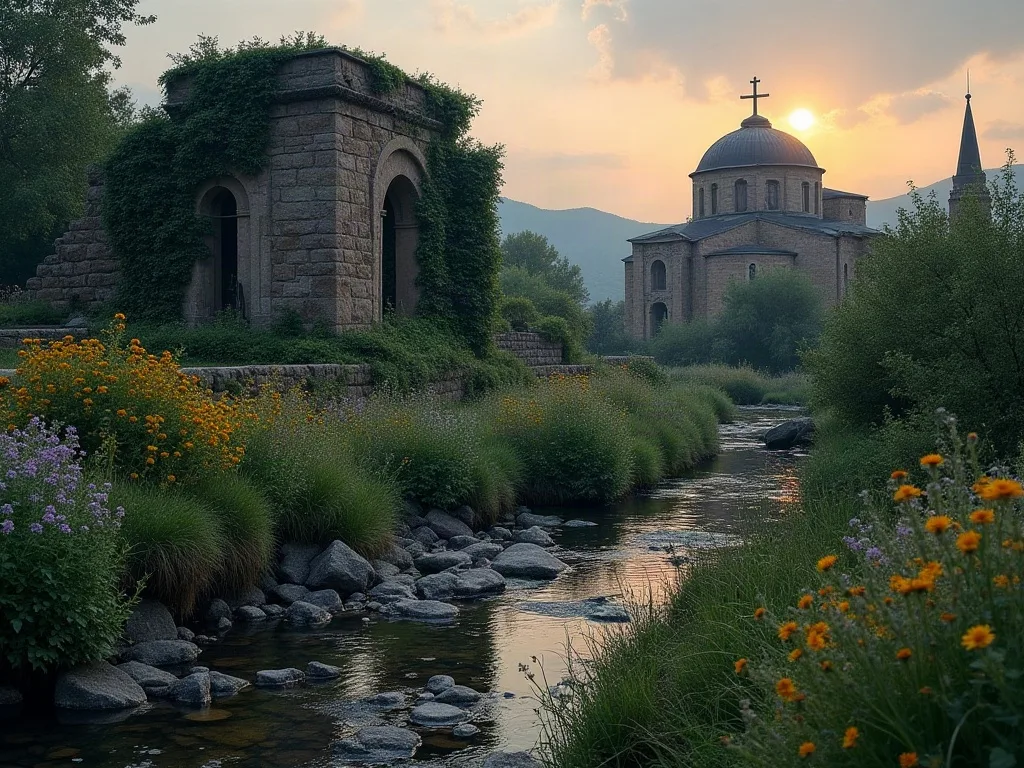
The personal experience of visiting an Armenian pilgrimage site today often involves standing at a spring that was sacred two thousand years ago, in a place where Anahit's priestesses once came to prophecy. The building above it is now a church. But the water flows unchanged, and something of the ancient devotion seems to linger. That layering of history is perhaps the truest testament to her power: she could not be erased entirely because she was woven too tightly into the landscape and the bodies of the people who lived there.
Frequently asked questions about Anahit
Frequently asked questions
Was Anahit the same goddess as the Persian Anahita?
Both names descend from similar roots, and Persian Zoroastrianism did influence Armenian religion. But Armenians transformed what they received. While Persian Anahita was associated with waters and fertility in her tradition, Armenian Anahit developed a distinctive priesthood, distinct ritual calendar, and distinct theological role that made her a separate divine figure in practice, even if she shared genealogical roots with her Persian counterpart.
What happened to Anahit's worship when Armenia converted to Christianity?
Her temples were officially destroyed and her rituals banned, but her veneration did not simply vanish. Many of her sacred sites were converted into Christian churches dedicated to the Virgin Mary and saints. Folk practices tied to fertility, healing, and prophecy persisted in disguised forms. Some scholars argue she survived as a kind of hidden current running beneath Armenian Christian practice, remembered in certain healing springs and women-centered rituals.
Did Anahit have priestesses who actually wielded political power?
Yes. Historical and archaeological evidence confirms that priestesses serving in her major temples, particularly at Eriza, held significant social and political authority. They made prophecies that influenced decisions about war, marriage, and commerce. Their training in astronomy and medicine gave them knowledge that was valuable and rare, and they were consulted by kings and commoners alike.
Why do we know less about Anahit than about other ancient goddesses?
Armenia's location between empires meant its cultural records were repeatedly conquered, destroyed, and rewritten. The deliberate suppression of her worship by Christian authorities destroyed most temple records and mythological texts. Unlike Greece or Egypt, whose mythologies were preserved in widely-copied literary texts, Armenian religious knowledge was often transmitted orally through priestesses and temple communities, making it more vulnerable to erasure.
How did water connect to Anahit's role as a goddess?
In Armenian belief, water was not merely physical but sacred. Anahit commanded all waters: springs, rivers, and rain. Because water sustains and cleanses life, her dominion over it made her a keeper of vitality itself. Pilgrims came to her temples to be healed by sacred springs, and the success or failure of harvests depended on whether she sent adequate rain. Her waters were understood as extensions of her blessing and her power.
Anahit's Echoes: Recognition in Modern Scholarship and Spirituality
The twenty-first century has brought renewed attention to Anahit: The Great Mother Goddess of Armenia as scholars and practitioners work to recover what colonialism, conquest, and religious conversion tried to suppress. She stands alongside other great mother goddesses of antiquity, figures like Cybele of Anatolia and Demeter of Greece, as evidence of cultures that understood the divine feminine not as subordinate but as sovereign.
Her story matters because it reveals how power worked differently in the ancient Armenian world. It matters because it shows that priesthood and prophecy could belong to women. It matters because it demonstrates that even when conquest and conversion destroy the official record, the sacred landscape itself refuses to forget. The spring flows where Anahit's priestess stood two thousand years ago and prayed for rain. The mountain where her temple stood still holds the shape of that building in memory, even if stone was replaced by stone and prayer changed its words.
To study Anahit is to study resilience, both hers and that of the Armenian people who kept something of her alive even when the authorities forbade it. She is a reminder that the divine does not obey borders or empires, and that sometimes the most important histories are the ones that survive not in books but in stone, water, and the stubborn hearts of those who refuse to forget.
Free 25-page sample
Want the whole story?
Take the first 25 pages free. If it pulls you in, the full edition is yours as an instant PDF download, with a paperback on Amazon for selected titles.

Armenian
The Armenian Mythology Book: Vahagn, Anahit, Aramazd and the Sacred Stories of the Caucasus Before Christ
Gods of Fire, Bronze, and the Forgotten Kingdom of Urartu
The pre-Christian gods of Armenia: Vahagn the dragon-slayer, Anahit the mother goddess, and the syncretic pantheon that merged Urartian, Persian, and Greek traditions before vanishing in 301 CE.
More from Armenian
All articles
Armenian
Vahagn: Armenian God of Fire, Thunder, and War
Vahagn roars through the red dawn, the Armenian god of fire, thunder, and war whose bronze-voiced hymns echo in the oldest Christian prayers. Discover the warrior deity who conquered chaos, shaped Armenia's spiritual identity, and survived conquest itself.

Armenian
Aramazd: The Creator God and Father of All
Aramazd stands at the foundation of Armenian myth as the supreme creator, the father from whom all life and divinity flow. Discover how this ancient god shaped the cosmos and why he vanished from Armenia's religious life after the conversion to Christianity.

Armenian
Hayk and Bel: The Founding Myth of Armenia
The story of Hayk's rebellion against the tyrant Bel explains how Armenia was born. A warrior's defiance, a nation's origin, and a line of kings that would rule for centuries.

Armenian
Ara the Beautiful: The Dying God of Armenian Legend
Ara the Beautiful is the hero at the heart of Armenian myth, a radiant king slain in an impossible conflict, whose death shapes the moral landscape of his people. A god-man whose blood sanctifies the land and whose loss echoes through time.