
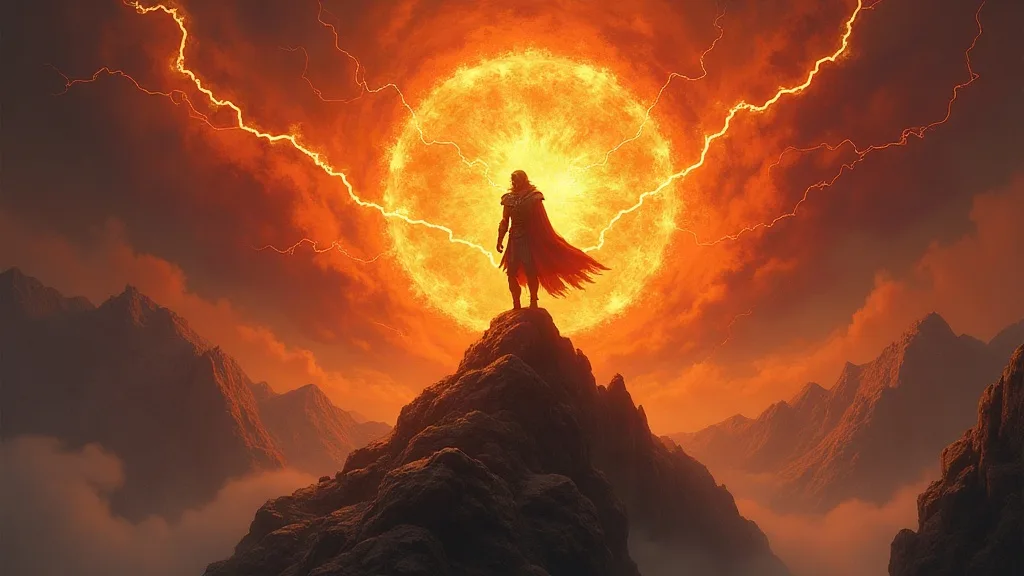
Vahagn: Armenian God of Fire, Thunder, and War
Vahagn roars through the red dawn, the Armenian god of fire, thunder, and war whose bronze-voiced hymns echo in the oldest Christian prayers. Discover the warrior deity who conquered chaos, shaped Armenia's spiritual identity, and survived conquest itself.
Contents
The sky tears open. A war-cry shatters the dark. From the sea, from the mountains, from the crimson dawn itself, Vahagn emerges: bronze-voiced, golden-haired, burning. He is not born in silence. The Avestanic texts speak of him as the warrior who breaks chains, who rises when chaos threatens, whose roar shakes the earth. This is the god Armenia knew long before Christianity arrived, the deity whose name still carries the thunder of ancient fire in every syllable.
Vahagn is ancient. Older than Rome's legions. Older than the Silk Road merchants who would trade beneath his sky. His story belongs to a time when Armenia stood alone between empires, when mountains were sacred, and when a people needed a god of thunder and war to match their own fierce spirit.
Birth from the Red Dawn: The Avestanic Origins
The oldest Armenian hymn to Vahagn is called the Vahagn Hymn, written down by the Armenian historian Movses Khorenatsi in the 5th century, though the prayer itself may date back centuries before Christianity. It opens with one of mythology's most striking scenes: a birth that is also a battle, a god emerging from primordial chaos itself.
"Brave Vahagn was born from the red dawn, from the sky, from the earth," the hymn intones. He rises first as a sound: a war-cry, ayour, that makes the mountains shudder. His appearance is terrifying: golden hair like a flame, eyes blazing, a voice of bronze. The prayer does not say he was cradled gently. Instead, it declares that he appeared on the horizon "girded for war," ready to conquer from the moment his eyes opened.
The Avestanic roots of Vahagn are deeply tangled with Zoroastrianism, the ancient Persian faith that shaped much of the Near East's religious imagination. Armenian scholars see echoes of Ahura Mazda's warrior aspects in Vahagn, and traces of Verethragna, the Avestan god of victory. But Vahagn is not a copy. He is an Armenian god, adapted to Armenian soil, to the high plateaus and fierce winters where Armenia's people made their stand.
His birth is mythologically similar to that of Mithras, the Persian deity worshipped across the empire. Both emerge from cosmic struggle. Both are born at dawn. Both are warrior gods who symbolize the triumph of order over chaos. Yet Vahagn remains specifically Armenian: his roar is Armenian thunder, his fire the fire that burned on Armenian altars.
The Cosmic Battle: Vahagn as Chaos-Conqueror
Vahagn does not rule a peaceful kingdom. His existence is defined by conflict, by the endless struggle between order and the forces of dissolution. In Armenian cosmology, as in many Indo-European traditions, the world is not a finished thing but a constant battle between creation and entropy.
The Vahagn Hymn names his adversaries obliquely. There are demons, devas, called by names we can only partially guess: Azdak, perhaps, the serpent; the forces of thirst and hunger that devour the innocent. The hymn speaks of Vahagn "slaying the serpent," of him "routing the devas," language that echoes across the ancient Near East: the storm god Baal defeating the sea-chaos Mot, the Mesopotamian Marduk subduing Tiamat.
What makes Vahagn distinct is his role as a protector of human settlement. He does not retreat to a distant Olympus after his cosmic battles. Instead, he hovers above Armenia, watching over the harvests, the herds, the warriors who defend the mountain passes. The thunder that announces him is both terrible and protective: it warns of danger, it brings rain to the parched earth, it clears the sky of demons.
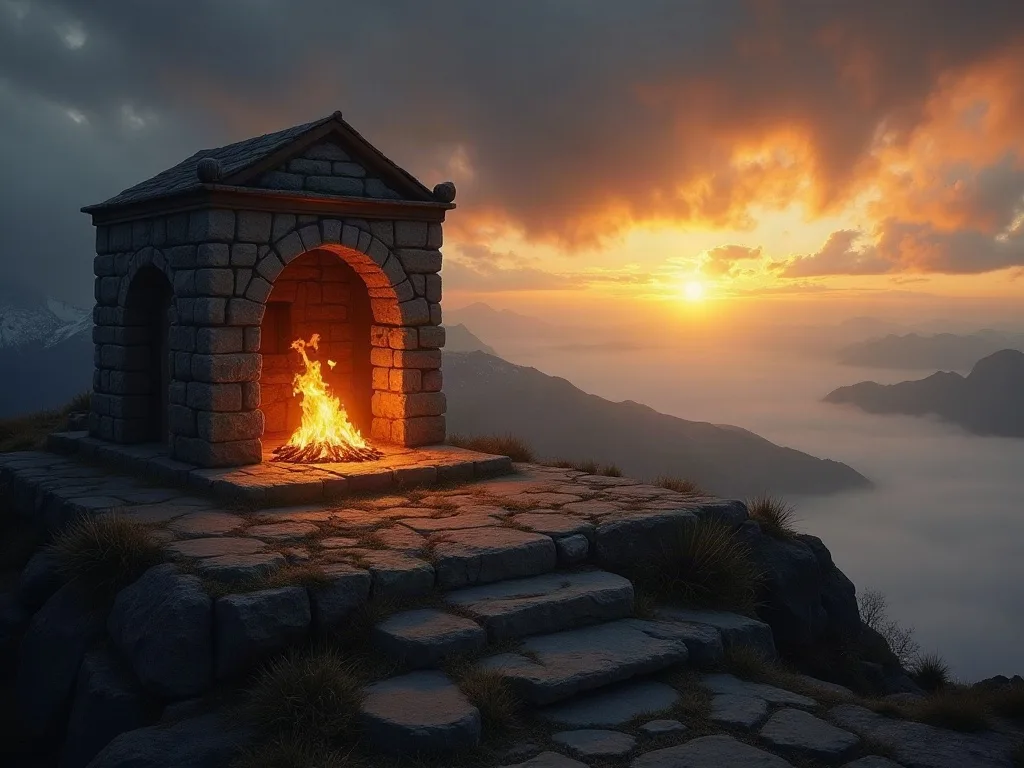
Armenian warriors invoked Vahagn before battle. The historian Khorenatsi records that in times of crisis, priests would ritually cry out the god's name, asking him to ride down from the mountains and strike the enemy with lightning. It was not merely metaphorical: in a warrior culture, the god's strength was believed to flow into the fighter's arm. To call Vahagn was to become, in some mystical sense, Vahagn.
Fire and Thunder: The Domains of a Mountain God
Vahagn rules three essential forces: fire, thunder, and war. These are not separate portfolios but expressions of the same fundamental energy: the fierce, purifying, destructive power that reshapes the world.
His connection to fire is primal. In Armenian ritual, fire was not merely a practical tool but a sacred presence. Zoroastrian practice, which influenced Armenian practice deeply, held that fire was the visible manifestation of divine truth. Vahagn's fire burns away impurity. It warms the hearth. It lights the way in darkness. The ancient Armenians maintained eternal flames in their temples, perpetual fires that were believed to carry Vahagn's blessing into the community.
Thunder belongs to him absolutely. The rumble that shakes the valleys, the lightning that cracks the sky, these are Vahagn's weapons and his voice. In a mountainous land where sudden storms can appear in minutes, where lightning strikes are both feared and revered, a thunder god was not an exotic luxury but a necessity of spiritual life. When thunder rolled across the high plateaus, every Armenian heard their god speaking.
War rounds the trinity. But Vahagn is not a war god in the sense of Ares, the Greek deity of pure bloodlust. He is a war god of protection, of victory against overwhelming odds. When Armenia faced the armies of Rome, Parthia, or later Persia, Vahagn was invoked as the patron of the underdog, the god who had already won the impossible cosmic battle and could grant that same victory to his people.
The Armenian god of fire, thunder, and war was therefore not three different beings but one unified force: the energy that conquers chaos, that sustains human civilization, that protects the vulnerable. This made Vahagn far more than a warrior deity. He was a civilizing force.
Vahagn and the Zoroastrian Inheritance
Armenia's relationship with Zoroastrianism is complicated and profound. The fire temples, the emphasis on cosmic struggle between good and evil, the idea of a divine champion who defeats chaos: all of these came north from Persia into the Armenian highlands.
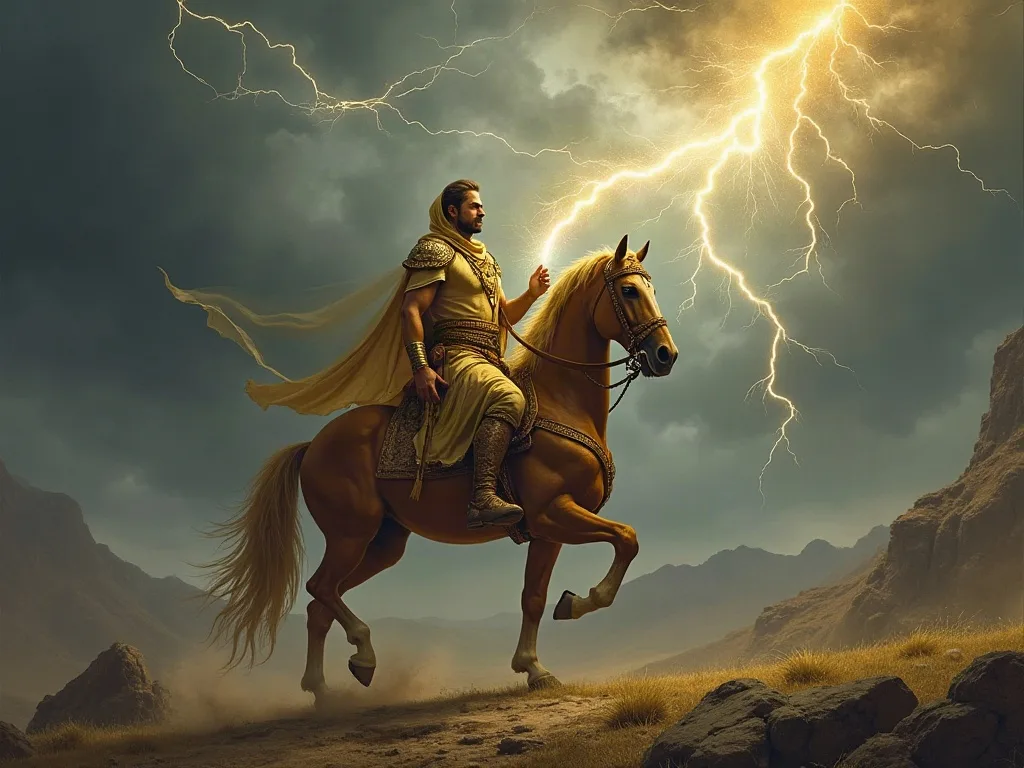
Vahagn is often interpreted as Armenia's answer to Verethragna, the Avestan yazata (divine being) of victory. The Avesta, the Zoroastrian scriptures, describe Verethragna as a warrior who takes many forms: a boar, a bull, a golden-horned camel, a warrior with a golden sword. Vahagn, too, is sometimes depicted as a shape-shifter, though Armenian sources are less explicit about his animal forms than their Persian counterparts.
What Armenia absorbed from Zoroastrianism and made distinctly its own was the concept of the warrior god as cosmic principle. Mazdeism taught that history is a battlefield between Ahura Mazda and Ahriman, light and darkness, and that every human choice matters in that struggle. Vahagn embodies this principle for Armenia. He is not distant. He is engaged. He needs his people as much as they need him, because the battle against chaos is never truly won.
The Vahagn tradition remained powerful even after Christianity's arrival in 301 CE. Armenian Christians did not entirely abandon their old god; they transformed him. Some scholars suggest that Vahagn's attributes were absorbed into the Christian warrior saints, especially St. Gregory of Illuminators and later St. George. The thunder god did not die; he was baptized.
The Mythic Contests: Vahagn and the Dragons
One of the most persistent myths attached to Vahagn concerns his battle with dragons, particularly the azdahak, a serpentine chaos-being found across Persian, Armenian, and later Caucasian folklore. These are not mere monsters but cosmic forces, beings that represent entropy, plague, and the sea-chaos that threatened to swallow the ordered world.
The Vahagn Hymn references these conflicts in cryptic language: "Brave Vahagn slew the dragon." Armenian later traditions expanded this into full narrative: Vahagn pursued the serpent across the mountains, struck it with lightning, cast it into the sea. Each victory renewed the world.
What is interesting about Vahagn's dragon-slaying is that it is repetitive. Unlike the Greek Heracles or even Zeus, who defeat monsters once and for all, Vahagn must continually renew his struggle. The dragon always threatens to return. The chaos is never permanently vanquished. This reflects a more realistic view of human civilization: the battle is eternal, and vigilance is the price of survival.
Some Armenian historians connect Vahagn's dragons to the great serpent of Mesopotamian myth, related to Tiamat. Others see echoes of the Indo-European storm god pattern, where a deity of thunder defeats a water-dragon or chaos-serpent. The pattern is real, the sources are real, and Vahagn's place in this ancient narrative chain is secure.
Worship and Ritual in Ancient Armenia
Before Christianity transformed the religious landscape, Vahagn was honored in temples throughout Armenia. These were not elaborate classical structures but sacred sites often built on mountain peaks, where the god was believed to be closest to earth.
Priests called magus (from which the Greek "magus" and English "magic" derive) tended these temples. They maintained the eternal flames, performed rituals tied to the agricultural and military calendar, and interpreted omens through thunder and lightning. The appearance of a sudden storm, the direction of a lightning bolt, the color of the fire: all were messages from Vahagn to those who knew how to listen.
The festival of Nawasard, the Armenian new year, originally fell in spring and was deeply connected to Vahagn. The festival marked the return of fire to the world, the renewal of vegetation, and the renewal of the cosmic struggle against chaos. Warriors would gather, oaths were sworn, and the god's strength was invoked for the coming year.
Sacrifices to Vahagn were real but not necessarily bloody. The Vahagn Hymn does not describe animal sacrifice but rather cries of praise, the raising of voices in unison, the lighting of fires. Some sources suggest that in later periods, the practice became less physical and more spiritual: the sacrifice was one's courage, one's commitment to the fight against chaos, one's willingness to embody the god's warrior spirit.
The Syncretism: From Pagan God to Christian Saint
When Armenia became the first Christian nation (traditionally dated to 301 CE with the conversion of King Tiridates III), the religious landscape did not simply replace one god with another. Instead, a complex syncretism occurred, where old powers were renamed, recontextualized, and integrated into Christian theology.
Vahagn did not disappear. Instead, scholars argue, his attributes merged into the veneration of St. George, the warrior saint. St. George, too, is a dragon-slayer. St. George, too, is associated with spring and renewal. St. George, too, is invoked by warriors before battle. The thunder god had become the soldier saint, but the deep structure of faith, a warrior protector who conquers chaos on behalf of his people, remained intact.
The syncretism is not unique to Armenia. Across Europe, pagan gods were Christianized, their festivals reinterpreted, their symbolism absorbed into the new faith. But the Armenian case is particularly coherent. Vahagn's mythology provided a template for understanding Christian martyrdom and holy war that felt natural to the Armenian experience. The god who had always fought chaos now fought Satan. The eternal flame in the temple became the eternal light before the altar.
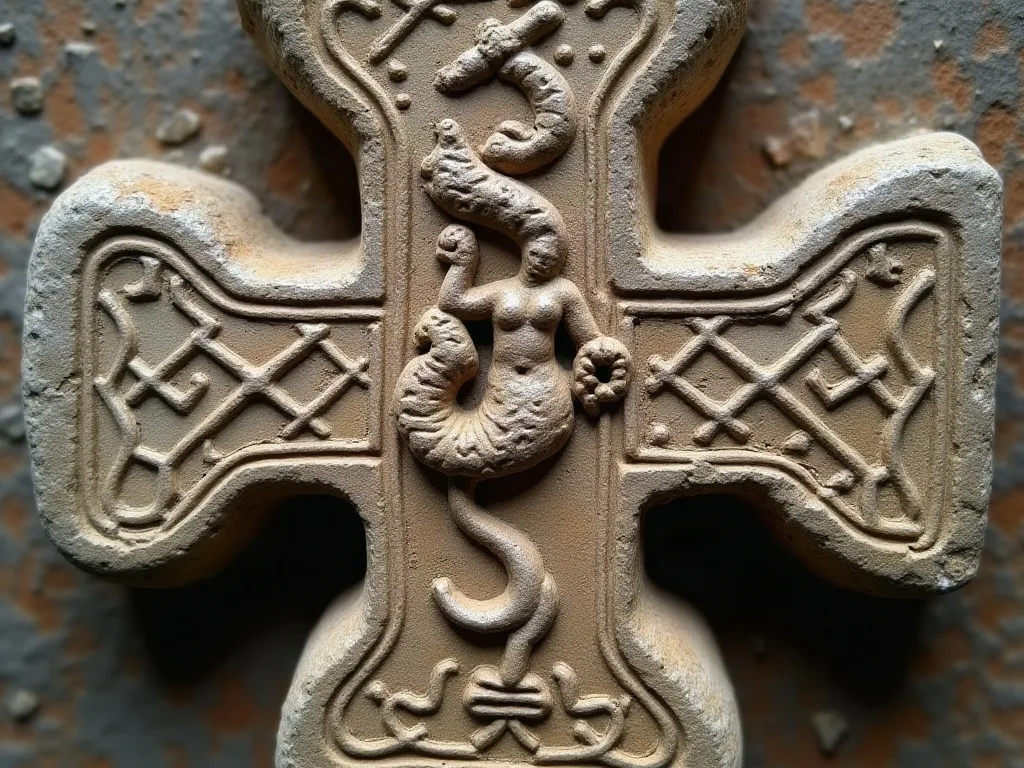
By the 5th century, as the Armenian church developed its own distinctive theology and liturgy, Vahagn's presence in popular practice remained even as official doctrine shifted entirely to Christian frameworks. The Vahagn Hymn itself was preserved, quoted in historical texts, and kept alive in oral tradition. Armenian Christians never quite forgot their old god; they transformed him instead into something that satisfied both pagan and Christian sensibilities.
Vahagn in Comparative Mythology
Vahagn occupies a compelling position in the broader Indo-European pantheon. His role echoes figures across multiple traditions: the storm gods, the cosmic warriors, the beings who stand at the boundary between order and chaos.
The closest parallels are to Indra, the Hindu king of gods who defeats the serpent Vritra and brings rain. Both gods are associated with thunder, rain, and war. Both defeat dragons or serpents. Both are invoked by warriors. The linguistic connection is real: scholars have traced an Indo-European root that connects Indra, the Greek Zeus, the Roman Jupiter, and potentially Vahagn to a common ancestor deity.
Vahagn also shares traits with Baal, the storm god of the Levantine peoples. Both bring rain essential to survival. Both are warriors. Both defeat chaos-serpents. The Vahagn Hymn may even contain echoes of Levantine battle poetry, suggesting cultural exchange across the Near East.
What distinguishes Vahagn is his integration into a specifically Armenian landscape and psyche. He is not a sky god distant from humanity. He is a god of the mountains, the high places, the refuge where Armenia's people made their stand. His fire is the fire of the hearth as much as the fire of the cosmos. His war is both the eternal struggle against chaos and the very real, very present struggle of a small nation against larger empires.
Vahagn and Armenian Identity
For modern Armenia, Vahagn remains a potent symbol. The god who emerged from the red dawn, who conquered chaos, who never abandoned his people even when empires threatened: this is a figure that resonates deeply with Armenian historical experience.
Armenia has been invaded, conquered, divided, and threatened with extinction countless times. Yet it survived. The ancient myths associated this survival not with luck but with divine protection, with the continuing presence of a god who fought for his people. The thunder that roared above the Armenian mountains was Vahagn, present, active, engaged.
The recovery of the Vahagn Hymn in the 19th and 20th centuries, as Armenia reasserted its cultural identity against Ottoman and Russian imperial domination, became an act of spiritual resistance. By reclaiming the old hymn, by studying the pre-Christian traditions, Armenians were asserting that their culture had roots deeper than any empire could reach, that their spiritual identity predated Christianity itself.
Today, Vahagn appears in Armenian literature, art, and popular culture as a symbol of resilience and national pride. He is invoked in nationalist contexts, yes, but also in spiritual contexts where people seek connection to an ancient, authentic Armenian self. The god of fire and thunder has become, in modern use, a god of cultural survival.
The Scholarship and the Mysteries
What we know of Vahagn comes from fragments: the Vahagn Hymn as quoted by Khorenatsi, passing references in other historians, the linguistic connections to Zoroastrian and Indo-European deities, and the evidence of his worship embedded in later Christian practice.
What we do not know is vast. The full corpus of Vahagn myths, if such a thing ever existed in coherent form, has been lost. We do not have an Armenian equivalent to the Norse Eddas or the Greek Iliad, a comprehensive mythological text that laid out the adventures of the gods in detail. Instead, we have shadows, echoes, scholarly inference.
This incompleteness is itself part of Vahagn's story. His cult was absorbed into Christianity. His temples were transformed into churches. His myths were not fully written down before cultural change rendered them archaic. Yet he survived anyway. The Vahagn Hymn endured, oral traditions persisted, and the god remained present in the Armenian consciousness even when official religion had moved on.
Modern scholars, particularly Armenian historians and mythologists, continue to study Vahagn in the context of Zoroastrianism, Indo-European religion, and Armenian cultural history. The work is careful, evidence-based, and tentative: scholars are honest about what cannot be known with certainty. Yet the coherence of the evidence is striking. Vahagn emerges not as a vague mythological figure but as a real, specific god with a clear role in a clear historical tradition.
Vahagn Beyond Ancient Armenia
The mythology of Vahagn did not vanish after Christianization. It transformed, migrated, and echoed through subsequent traditions.
In later Armenian literature, elements of Vahagn appear in tales of warriors and heroes, beings who fight with divine fury and triumph against overwhelming odds. The medieval Armenian epic tradition, though heavily Christian, retained vestiges of the old mythology, creating a hybrid space where pagan and Christian heroism could coexist.
In the Caucasus more broadly, Vahagn's thunder-god role influenced other regional deities and folklore. The Georgian Amirani, the Circassian gods, and other Caucasian divine figures share structural similarities with Vahagn: warrior gods, mountain gods, beings who stand between order and chaos. Whether these are direct descendants, independent parallel developments, or cases of historical influence, is a matter of ongoing scholarly debate.
Even in modern Armenia, Vahagn's presence is felt. The name itself appears in contemporary literature and art as a symbol of Armenian strength and continuity. The Vahagn Hymn is performed and sung, its archaic beauty appreciated anew by each generation. The god has become a bridge between ancient and modern Armenia, proof that the culture has survived not by forgetting its past but by treasuring it.
Frequently asked questions about Vahagn
Frequently asked questions
What does the name Vahagn mean?
The etymology is debated among scholars. Some connect it to Avestan roots suggesting "victory" or "triumph." Others link it to terms meaning "roar" or "sound." The Vahagn Hymn itself emphasizes his war-cry, his bronze voice, suggesting that his name may carry the sense of a being whose very nature is to announce himself, to command attention through sheer sonic force.
How does Vahagn compare to Indra, the Hindu thunder god?
Both are Indo-European warrior deities associated with thunder, rain, and war. Both defeat serpents or dragons (Indra defeats Vritra). Both are invoked by warriors. The linguistic and mythological parallels suggest a common source in the ancestral Indo-European religion. However, Vahagn developed in specifically Armenian contexts, shaped by Zoroastrianism and Armenian mountainous geography, making him distinct from Indra even as he shares fundamental traits.
Did Armenians continue to worship Vahagn after converting to Christianity?
Not openly or officially, but his attributes and functions were absorbed into the Christian saint-warrior cult, particularly the veneration of St. George. The Vahagn Hymn was preserved as a historical and cultural artifact. In rural areas, folk practices may have retained elements of the old god's mythology for centuries. The transition was syncretism rather than complete erasure: Vahagn did not die but changed form.
What is the Vahagn Hymn, and how old is it really?
The Vahagn Hymn is a prayer to Vahagn that describes his birth and role as a cosmic warrior. The historian Movses Khorenatsi recorded it in the 5th century, but the hymn itself may be much older, possibly composed during Armenia's pre-Christian period. The exact date is uncertain, but the content and style suggest it preserves genuinely ancient religious material, making it one of the oldest direct Armenian prayers we possess.
Why is Vahagn less well-known than gods like Zeus or Indra?
Vahagn was worshipped in Armenia, a relatively small nation that was often under foreign domination. The myths were not committed to writing in a comprehensive way like the Greek Iliad or the Hindu Vedas. When Christianity arrived, official religious texts shifted, and Vahagn myths were not systematically preserved as sacred literature. However, modern scholarship and cultural recovery efforts have brought Vahagn back into wider recognition as an important figure in Indo-European and Near Eastern mythology.
The Enduring Fire: Vahagn in Contemporary Armenia
The thunder still echoes. When storms roll across the Armenian highlands, when lightning cracks the sky above Mount Ararat, something in the Armenian collective memory stirs. The god who was born from the red dawn, who roared his way into existence, who conquered chaos and promised his people that he would never cease their protection: that god is still present in the Armenian consciousness.
Contemporary Armenia has not forgotten Vahagn. Writers invoke him as a symbol of national resistance and cultural pride. Artists paint his image: golden-haired, bronze-voiced, surrounded by flame and storm. The Vahagn Hymn, once preserved only in historical texts, is now performed as a sacred piece, with composers adapting it for modern audiences. The ancient prayer has become contemporary art, a living link to a spiritual tradition older than Christianity itself.
This recovery is not sentimental nostalgia. It is an assertion of continuity, a claim that Armenian identity runs deeper than any empire's borders, any religion's dominion. Vahagn represents the Armenia that existed before Rome, before Persia, before the Islamic conquests: an Armenia that was itself, that had its own gods, its own myths, its own fierce and luminous spirit. That Armenia may be archaeologically distant, but it is not spiritually dead. Through Vahagn, through the thunder and the fire, it speaks still.
The Armenian god of fire, thunder, and war remains what he has always been: not a figure in a museum, but a living presence in Armenian cultural memory. The red dawn that birthed him rises still above Armenia's mountains, and the thunder that announces him still shakes the earth. The chaos he fought still threatens, in new forms and new ages. And the god who conquered it once remains, in the hearts of his people, ready to do so again.
Free 25-page sample
Want the whole story?
Take the first 25 pages free. If it pulls you in, the full edition is yours as an instant PDF download, with a paperback on Amazon for selected titles.
Armenian
The Armenian Mythology Book: Vahagn, Anahit, Aramazd and the Sacred Stories of the Caucasus Before Christ
Gods of Fire, Bronze, and the Forgotten Kingdom of Urartu
The pre-Christian gods of Armenia: Vahagn the dragon-slayer, Anahit the mother goddess, and the syncretic pantheon that merged Urartian, Persian, and Greek traditions before vanishing in 301 CE.
More from Armenian
All articles
Armenian
Anahit: The Great Mother Goddess of Armenia
Anahit ruled Armenia's spiritual world for millennia as the Great Mother, keeper of waters, fertility, and wisdom. Discover how she shaped an entire civilization's understanding of divine power.

Armenian
Aramazd: The Creator God and Father of All
Aramazd stands at the foundation of Armenian myth as the supreme creator, the father from whom all life and divinity flow. Discover how this ancient god shaped the cosmos and why he vanished from Armenia's religious life after the conversion to Christianity.

Armenian
Hayk and Bel: The Founding Myth of Armenia
The story of Hayk's rebellion against the tyrant Bel explains how Armenia was born. A warrior's defiance, a nation's origin, and a line of kings that would rule for centuries.
Armenian
Ara the Beautiful: The Dying God of Armenian Legend
Ara the Beautiful is the hero at the heart of Armenian myth, a radiant king slain in an impossible conflict, whose death shapes the moral landscape of his people. A god-man whose blood sanctifies the land and whose loss echoes through time.