
Trndez: The Fire Festival of Purification
Trndez is Armenia's ancient fire festival, where couples leap through sacred flames to burn away the old year. Discover its pagan roots, Christian reinvention, and living ritual.
Contents
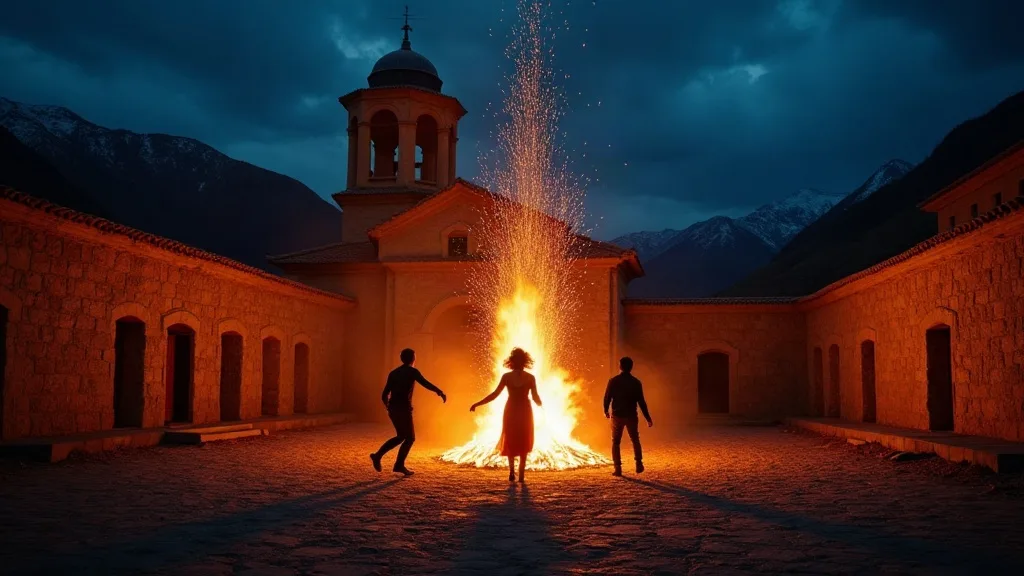
Every February, fires are lit in the courtyards of Armenian churches, and young couples run toward the flames. They leap. Sparks rise. The crowd calls out. This is Trndez: The Fire Festival of Purification, one of the oldest continuous ritual celebrations in the Armenian calendar, and one of the few places on earth where you can watch a pre-Christian fire cult and a Christian feast happening in the exact same gesture.
The name itself tells you something. Trndez (also written Derendez or Tiarnendaraj in its ecclesiastical form) comes from the Armenian words meaning "before the Lord's door," a phrase that anchors the festival precisely on the threshold between old and new, sacred and profane. The flames are not decoration. They are the point.
What survives in this celebration is a long negotiation between two worlds: the fire-centered cosmology of ancient Armenia and the calendar of the Armenian Apostolic Church. Neither fully won. The result is something richer than either could have produced alone.
Fire Before the Church: Armenia's Pagan Fire Traditions
Long before the Armenian kingdom converted to Christianity in 301 AD, fire held a central place in Armenian religious life. The ancient Armenians worshipped a pantheon that drew from Iranian, Urartian, and native Anatolian sources. Vahagn, the dragon-slaying god of fire and war, was among the most venerated. His birth hymn, one of the oldest fragments of Armenian poetry ever recorded, describes him born from fire and reed, a god who embodied the raw, generative power of flame.
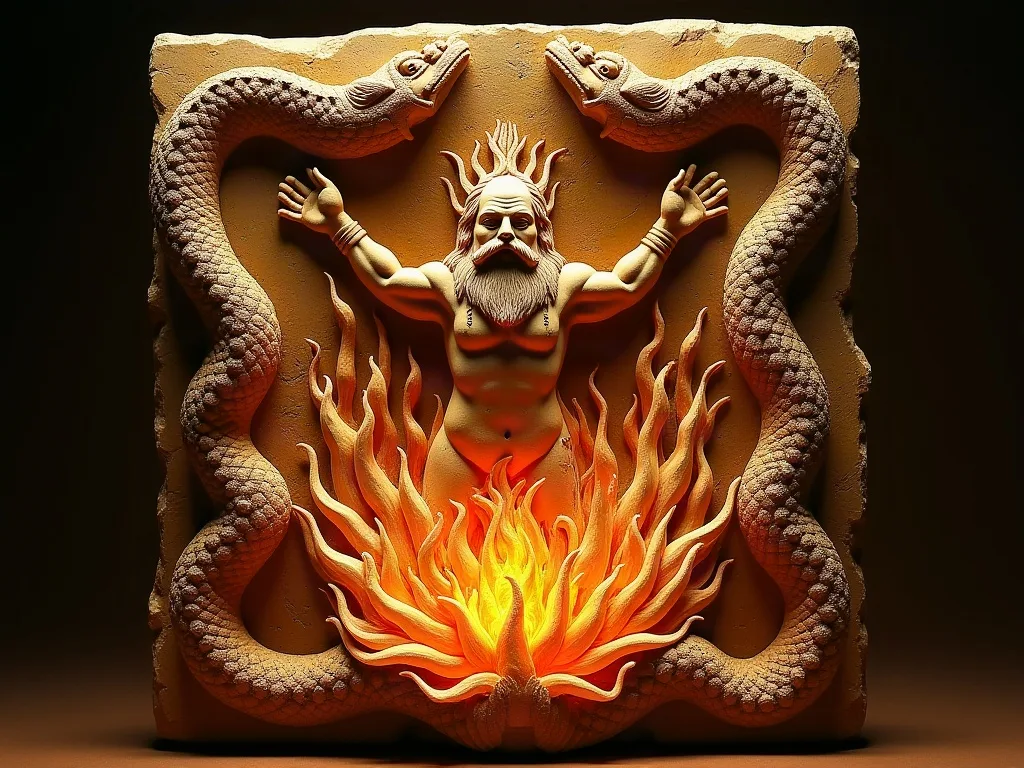
The historian Movses Khorenatsi (Moses of Khoren), writing in the fifth century AD in his "History of Armenia," preserves echoes of fire cult practices that predate his own era by centuries. He records songs and rituals tied to the hearth and to seasonal transition, suggesting a deep pattern of fire ceremonies marking the turn of winter toward spring.
The Iranian Zoroastrian tradition, which had significant influence in Armenia for long periods, added another layer. In Zoroastrianism, fire is the visible symbol of Asha, truth and cosmic order. Sacred fires were tended in temples and treated as living presences. Armenians absorbed and adapted this reverence, folding it into a native understanding of fire as protector, purifier, and source of new life.
The pre-Christian festival that Trndez likely descends from was connected to the agricultural cycle. February in the Armenian highlands marks the very first loosening of winter's grip. The old festivals burned the dead matter of the past season, and the act of passing through or leaping over fire was understood as a physical way to shed the contamination of the cold, dark months.
How the Church Rewrote the Calendar
The Armenian Apostolic Church, established in the early fourth century, faced a familiar missionary challenge: communities with centuries of fire ritual practice were not going to simply stop building bonfires in February. The Church's solution was elegant and pragmatic.
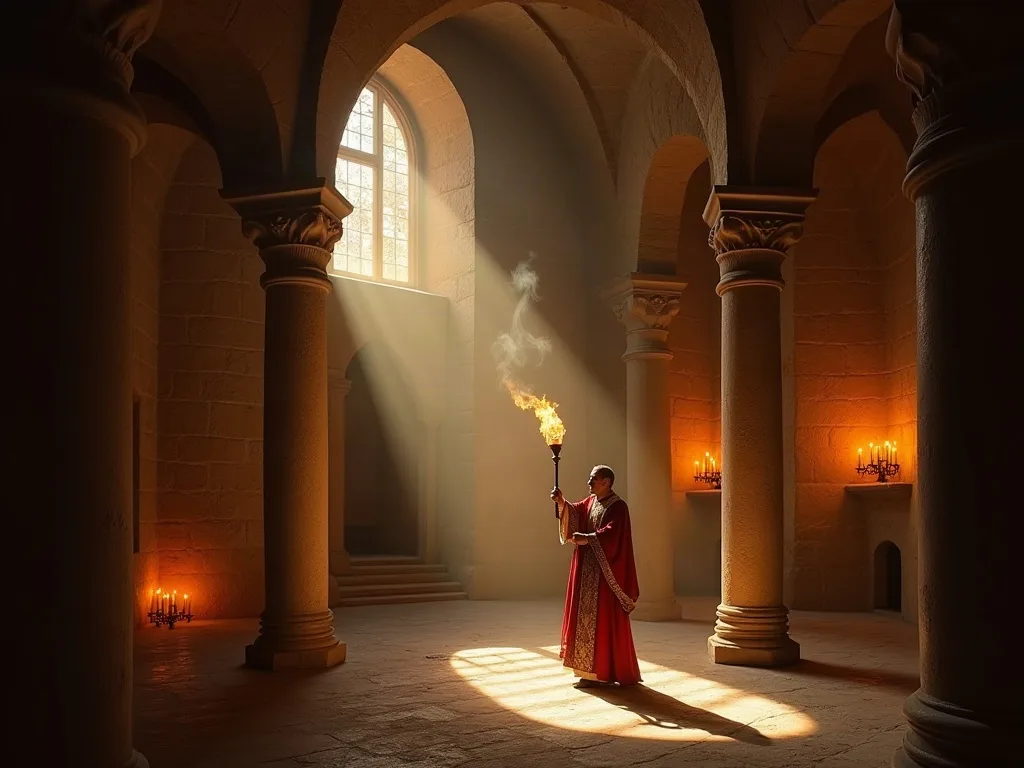
The feast of Tiarnendaraj, meaning "the Coming of the Lord," commemorates the Presentation of Jesus in the Temple at Jerusalem, as described in the Gospel of Luke. Joseph and Mary brought the infant Jesus to the Temple forty days after Christmas, following the Jewish law of purification. In the Western Christian calendar, this date became Candlemas, celebrated with blessed candles. In the Armenian tradition, it became something far more dramatic.
The Church placed this feast on the exact date when the old fire festival burned. It kept the fire. It transformed the meaning. The flames that once honored Vahagn or called on ancient spirits of renewal were now understood as the light that Simeon the Elder, a prophet in the Temple, called "a light to enlighten the nations" when he held the infant Jesus in his arms. The purification of the old year became the purification of Mary after childbirth. The same leap through the same fire. A different story carried in the bones of it.
Explore the broader tradition of Armenian mythology to understand how this pattern of layered belief runs through the entire Armenian mythological record.
The Ritual in Detail: What Happens at Trndez
The ceremony today typically unfolds in the courtyard of an Armenian Apostolic church, though it also takes place in Armenian communities worldwide, from Yerevan to Los Angeles to Beirut. The priest leads a blessing. A large bonfire is built and lit, often using wood that has been prepared specifically for the occasion.
Then comes the leap.
Newlywed couples are the traditional protagonists. In the weeks before Trndez, recently married couples are expected to attend and jump together over the fire. This is not a casual participation. Leaping through the fire together is understood as an act of communal consecration for the new marriage, a burning-away of ill fortune before the couple's shared life properly begins.
The symbolism stacks up carefully:
- The fire destroys disease and bad luck carried from the previous year.
- The leap is a threshold act: the couple passes from one state of life into another.
- The ashes left by the bonfire are considered sacred, and some communities collect them for use in the fields as a blessing on the coming harvest.
- Unmarried young people also leap, expressing hope for marriage in the coming year.
- Children run around the fire (rather than leaping through it), absorbing its protective warmth.
The smoke matters too. People pass their children through the smoke, or hold clothing in it, believing the fire's purifying action moves through the air itself. The body is exposed to the flame's influence not only by jumping but by proximity, by breath, by touch of the heated air.
Trndez Across the Armenian Diaspora
The Armenian Genocide of 1915-1923 scattered Armenian communities across the globe. In one of the most striking examples of cultural resilience anywhere, Trndez traveled with them. Armenian churches in the United States, France, Lebanon, Syria, Argentina, and Australia all observe the festival, each community adapting the logistics while preserving the core ritual.
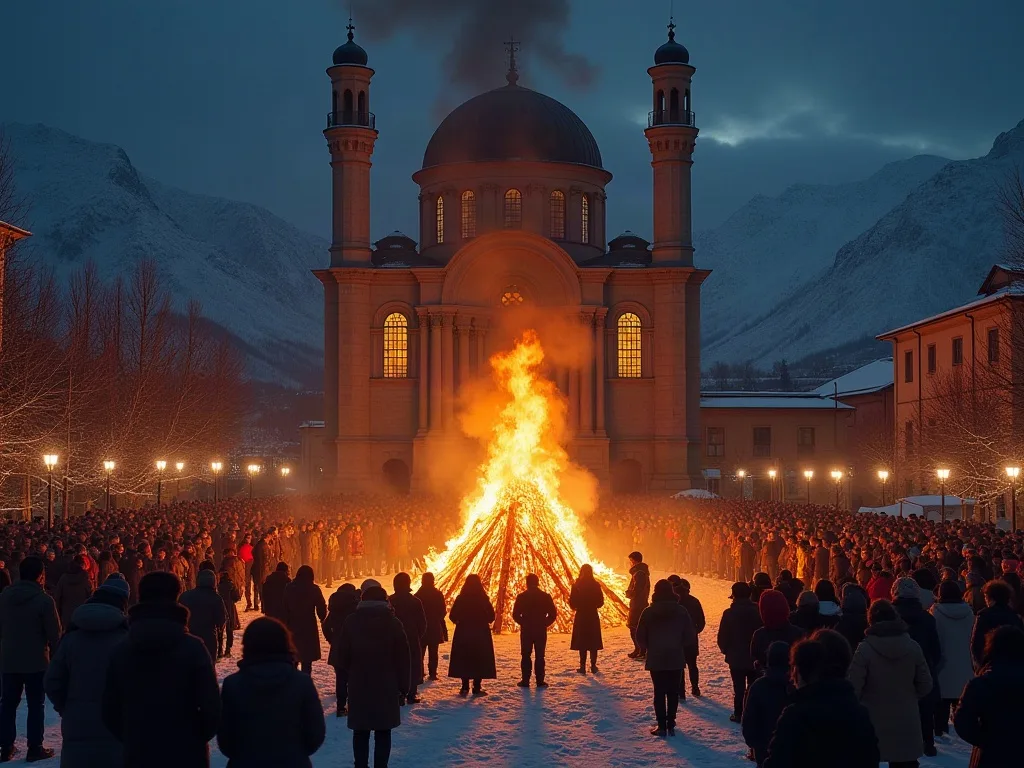
In Yerevan, the modern capital of the Republic of Armenia, Trndez has experienced a significant revival since Armenian independence in 1991. State television covers the celebrations at Etchmiadzin, the seat of the Armenian Apostolic Church and one of the oldest cathedrals in the world, built in the early fourth century. The Catholicos, the supreme head of the Armenian Church, presides in ceremonial vestments as the bonfire burns in the courtyard.
The diaspora version often takes on an added emotional weight. For communities that lost their ancestral lands, performing a fire ritual that their grandparents performed in eastern Anatolia or the Caucasus is not simply a religious act. It is a geographical claim, a way of saying: this practice belongs to us, and we carry it wherever we are.
In Lebanon's Armenian communities, particularly in Bourj Hammoud, a neighborhood sometimes called "Little Armenia," Trndez bonfires draw large crowds. Photographs from the 1960s and 1970s show children in winter coats clustered around courtyard fires in ways nearly identical to photographs taken in Etchmiadzin today. The ritual image persists.
Vahagn, Fire, and the Oldest Armenian Poem
No article on Trndez can pass by Vahagn without pausing. He is not a minor figure. In the fragments preserved by Khorenatsi, his birth song reads:
"In travail were heaven and earth, in travail too the purple sea; the travail held in the sea the small red reed. Through the hollow of the reed came forth smoke, through the hollow of the reed came forth flame, and out of the flame a youth ran forth."
This birth-from-fire image is not metaphorical decoration. Vahagn is flame made sentient, a god whose very existence depends on combustion. His name connects to the Sanskrit Vrtrahan, the slayer of the dragon Vrtra, linking him to the Vedic god Indra, the great storm warrior of the Rigveda. The shared Indo-European root runs very deep.
When Armenian families leap through the Trndez bonfire, they are not thinking about Vahagn. But the fire they leap through was once his. The Church renamed the act. The fire remained.
This is how mythology survives: not by winning arguments but by being present when the kindling is lit.
Seasonal Timing: Why February Matters
Trndez lands forty days after the Armenian Christmas. That arithmetic is ecclesiastical, tied to the Gospel of Luke's account of the Presentation. But the underlying seasonality is much older.
In the Armenian highlands, February marks the first credible hint of spring. The ground is still frozen. Snow still sits on the Aragats massif. But the days are visibly longer than at the solstice, and the angle of the sun has shifted enough to be felt. Every ancient agricultural society in the northern hemisphere built a ritual around this exact moment: the Romans had Lupercalia (February 13-15), the Celts had Imbolc (February 1-2), the Zoroastrians had their own spring-fire ceremonies.
These are not accidents of calendar synchronization. They reflect a shared human perception: that mid-February is when the world begins to turn again, when fire is needed most to accelerate the thaw, to encourage the sun, to mark that the worst is over. Trndez: The Fire Festival of Purification inhabits this same planetary slot, and its timing is as much a response to the Armenian mountain winter as it is to any theological calculation.
The forty-day count also appears elsewhere in Armenian Christian practice, where it often marks a transition or testing period. The symmetry between the Gospel narrative and the agricultural calendar was not lost on the medieval Armenian clergy who formalized the feast. They were skilled at finding these harmonics.
Comparative Echoes: Fire Festivals Across the Ancient World
Trndez does not stand alone. Across Eurasia, fire festivals in late winter or early spring share a remarkably consistent grammar:
| Festival | Culture | Date | Fire's Role |
|---|---|---|---|
| Trndez | Armenian | Feb 13-14 | Purification, marriage blessing |
| Candlemas | Western Christian | Feb 2 | Sacred candles, light of Christ |
| Imbolc | Celtic | Feb 1-2 | Hearth fires, Brigid's flame |
| Lupercalia | Roman | Feb 13-15 | Fertility, boundary purification |
| Holi | Hindu | March (full moon) | Burning of Holika, triumph of good |
| Shab-e Chahar Shanbe Suri | Iranian | Last Wednesday before Nowruz | Leaping over fire to absorb its strength |
The Iranian Chahar Shanbe Suri is the closest structural parallel to Trndez. Both involve fire built in the open, both involve leaping through or over the flames, and both occur in the weeks before the spring equinox. The Iranian formula spoken during the leap ("give me your red color, take my yellow pallor") captures the same exchange that the Armenian ritual enacts: the fire takes the illness, the weakness, the old year, and returns energy, color, and health.
The Norse tradition of Baldr's funeral pyre offers a starker comparison, where fire ends a divine life rather than renewing a human one. But the underlying grammar of fire as transformer, as the element that moves things from one state to another, is the same across all these traditions.
Trndez in Modern Armenia: Revival, Tourism, and Living Belief
After decades of Soviet suppression, during which public religious observance was discouraged, Trndez returned to Armenian public life with some force after 1991. The revival was not purely religious. It carried a weight of national identity, a signal that Armenia's pre-Soviet traditions had not been extinguished, only banked like coals.
Today Trndez is covered in mainstream Armenian media as both a religious feast and a cultural event. Travel agencies market it to visitors. The Etchmiadzin ceremony in particular draws pilgrims and tourists from across the world. In 2026, observers expecting to attend should look for events at Etchmiadzin Cathedral beginning in the early evening of February 13, with the lighting of the bonfire following the blessing service.
The tension between sacred and tourist-facing is real. Some Armenian clergy have expressed concern that the festival's meaning gets flattened when it is presented as spectacle. But others point out that the same tension existed when the Church first absorbed the pagan fire ritual: meaning has always been contested at Trndez. The fire burns regardless.
Young couples in Yerevan today leap over the Trndez fire in jeans and parkas. Grandparents watch from plastic chairs. Phones are raised for photographs. The sparks still rise. Something passes between the couple and the flame, and whether that something is Vahagn's blessing, the grace of the Presentation feast, or simply the shared experience of a very old gesture, it is not nothing. It is, in its way, precisely the point.
Frequently asked questions about Trndez
Frequently asked questions
What does the name Trndez actually mean?
The word Trndez derives from Armenian roots meaning "before the Lord's door," positioning the festival on a threshold between states. Its ecclesiastical name, Tiarnendaraj, carries the same spatial image: standing at the entrance to the divine presence. Linguists also note that older forms of the name may connect to pre-Christian fire cult terminology, though the exact etymology is still debated among Armenian scholars.
Why do newlywed couples leap through the fire?
The leap is the central purification act. For newly married couples, it functions as a rite of passage: the fire burns away any lingering ill fortune or spiritual impurity that might shadow the new marriage. By leaping together, the couple enacts their unity before the community and before the sacred flame. The tradition likely predates Christianity and was absorbed into the feast's meaning rather than invented by the Church.
Is Trndez still practiced today, and where?
Yes, actively. The main ceremony takes place at Etchmiadzin Cathedral in Armenia, presided over by the Catholicos of All Armenians, typically on the evening of February 13. Armenian Apostolic churches in Lebanon, France, the United States, Argentina, and Australia all hold their own Trndez celebrations, making it one of the widest-reaching Armenian cultural observances in the diaspora. In Yerevan, community events beyond Etchmiadzin also take place in various neighborhoods.
What is the connection between Trndez and the pagan god Vahagn?
Vahagn was the ancient Armenian god of fire and dragon-slaying, whose birth hymn describes him emerging from flames. Pre-Christian Armenian fire festivals in late winter were associated with fire deities like Vahagn. When the Armenian Apostolic Church established Tiarnendaraj on the same date, it kept the fire ritual but reframed it around the Gospel account of the Presentation of Jesus at the Temple. Vahagn is not invoked in modern ceremonies, but the fire that burns at Trndez stands in a direct line of cultural descent from his cult.
How does Trndez differ from the Western Christian feast of Candlemas?
Both Candlemas (February 2 in the Western calendar) and Trndez (Tiarnendaraj, February 13-14 in the Armenian calendar) commemorate the Presentation of Jesus at the Temple, but the date differs because the Armenian Church celebrates Christmas on January 6 rather than December 25. More strikingly, Candlemas centers on blessed candles carried in procession, while Trndez centers on a large outdoor bonfire and the physical act of leaping through it. The two festivals share a theological origin but developed very different ritual vocabularies.
What primary sources mention the ancient Armenian fire traditions behind Trndez?
Movses Khorenatsi's "History of Armenia" (fifth century AD) is the most important early source, preserving fragments of fire-related hymns and ritual descriptions. The birth hymn of Vahagn is the oldest surviving piece of Armenian poetry and describes fire as a generative divine principle. Later medieval Armenian chroniclers and hagiographers reference the integration of fire customs into the Christian calendar, though they rarely name the pre-Christian originals explicitly. Modern scholarship by scholars such as Mardiros Ananikian in "Mythology of All Races: Armenian" (1925) maps the pre-Christian layers in detail.
What the Flames Carry Forward: Trndez and Living Mythology
Mythology does not die cleanly. It migrates. It changes its name. It keeps the fire.
Trndez is one of the clearest examples anywhere of what historians of religion call "Christianization from below," the process by which pre-Christian ritual forms survive inside a new religious structure because the community performing them would not let them go. The Armenian Church did not eliminate the bonfire. It blessed it. In doing so, it created a vessel that could carry both meanings simultaneously, the light of Christ and the heat of Vahagn, without requiring anyone to choose.
For scholars of comparative religion, Trndez is a rare gift: a living ritual that shows the full sedimentary depth of Armenian culture in a single evening of fire and leaping and smoke. For the couples who jump, it is something more immediate: a moment when the past year burns away, when the cold releases its grip, when the body moves through danger and arrives on the other side, warm and unharmed.
The fire is lit every February 13. It has been lit for longer than anyone can reliably trace. Some things in mythology are not relics. They are ongoing arguments with the dark.
Free 25-page sample
Want the whole story?
Take the first 25 pages free. If it pulls you in, the full edition is yours as an instant PDF download, with a paperback on Amazon for selected titles.
Armenian
The Armenian Mythology Book: Vahagn, Anahit, Aramazd and the Sacred Stories of the Caucasus Before Christ
Gods of Fire, Bronze, and the Forgotten Kingdom of Urartu
The pre-Christian gods of Armenia: Vahagn the dragon-slayer, Anahit the mother goddess, and the syncretic pantheon that merged Urartian, Persian, and Greek traditions before vanishing in 301 CE.
More from Armenian
All articles
Armenian
Vahagn: Armenian God of Fire, Thunder, and War
Vahagn roars through the red dawn, the Armenian god of fire, thunder, and war whose bronze-voiced hymns echo in the oldest Christian prayers. Discover the warrior deity who conquered chaos, shaped Armenia's spiritual identity, and survived conquest itself.
Armenian
Anahit: The Great Mother Goddess of Armenia
Anahit ruled Armenia's spiritual world for millennia as the Great Mother, keeper of waters, fertility, and wisdom. Discover how she shaped an entire civilization's understanding of divine power.

Armenian
Aramazd: The Creator God and Father of All
Aramazd stands at the foundation of Armenian myth as the supreme creator, the father from whom all life and divinity flow. Discover how this ancient god shaped the cosmos and why he vanished from Armenia's religious life after the conversion to Christianity.

Armenian
Hayk and Bel: The Founding Myth of Armenia
The story of Hayk's rebellion against the tyrant Bel explains how Armenia was born. A warrior's defiance, a nation's origin, and a line of kings that would rule for centuries.