

Ara the Beautiful: The Dying God of Armenian Legend
Ara the Beautiful is the hero at the heart of Armenian myth, a radiant king slain in an impossible conflict, whose death shapes the moral landscape of his people. A god-man whose blood sanctifies the land and whose loss echoes through time.
Contents
A young king rides toward certain death. His beauty is so radiant that the queen of the opposing army sees him from across the battlefield and abandons her war. Too late. He falls. Blood spills into the earth. For the Armenian people, this moment matters as much as creation itself. This is Ara the Beautiful, the hero whose death becomes the doorway to resurrection, whose sacrifice transforms blood into sacred geography, and whose legend speaks to something deeper than any ordinary king's tale.
Ara lives in the oldest layers of Armenian memory. His story travels through Greek historians who recorded what Armenians told them, through medieval Armenian sources that preserved sacred narrative, through the land itself. To understand Ara is to understand how Armenians saw their place in the cosmos: as a people chosen by blood, defined by loss, and made holy through the death of their most radiant son.
The Beauty That Breaks Nations
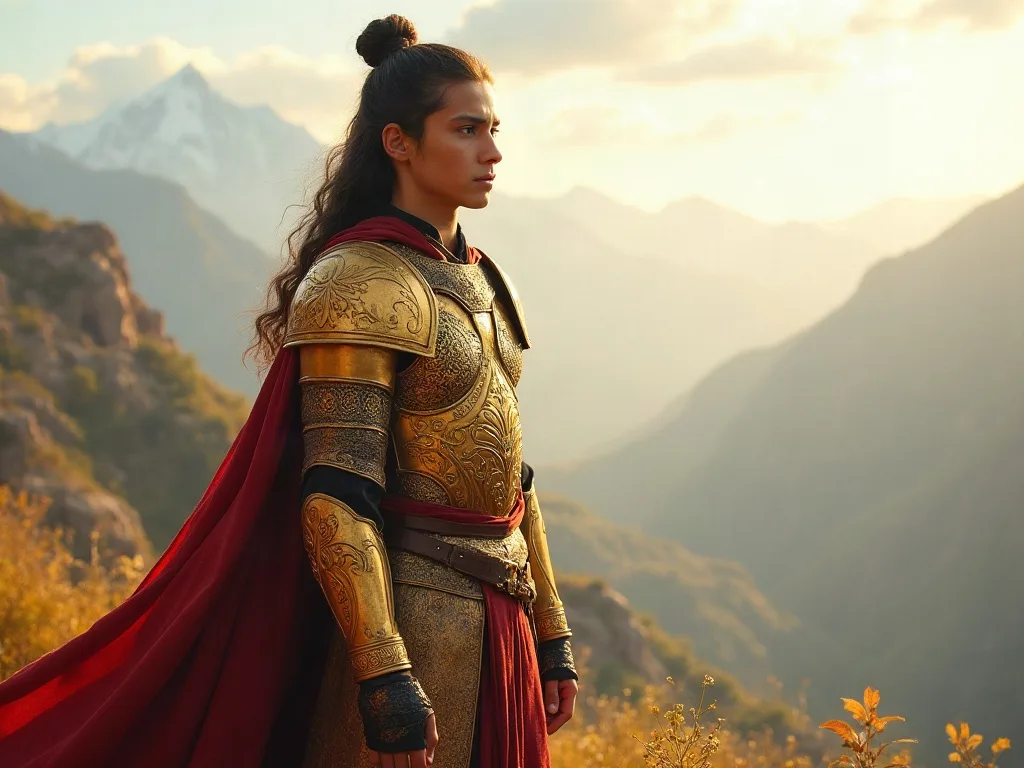
In the tradition, Ara the Beautiful is not merely a king. He is what the Armenians called a radiant man, lustr in Old Armenian, a being so luminous that he stands apart from ordinary mortality. The chronicle writers describe him as perfect in every proportion, so glorious in presence that enemies who saw him face to face often fell without raising a weapon. His light was not metaphor alone. It was a kind of terrible excess, a brightness that the world could barely contain.
The Armenian sources place Ara as a warrior-king who rules in a time of great power and expansion. He consolidates the Armenic peoples, builds fortifications, gathers the scattered tribes. He is not a deity in the full sense of the older pantheon. Rather, he is a threshold figure, a man touched by the divine fire of his land, the kind of hero who the Greeks would have called a demi-god. Yet the Armenians see him differently: not as half-god descended from on high, but as a man in whom the sacred has already become flesh.
His reign flourishes. The lands under his rule grow rich. Warriors serve him. Other kings fear him. And then, the turning point: he becomes so beautiful, so dangerous in his perfection, that beauty itself becomes his enemy.
The Queen Who Desired What She Could Not Have
Across the borders of Ara's realm sits Semiramis (sometimes called Shamiram in Armenian tradition), the great queen of Babylon. She rules with a will equal to Ara's own. She has heard of this radiant king. She sends emissaries. She sends gifts. She sends proposals. Ara refuses all of them. He will not be swayed. He will not leave his kingdom. He will not bend.
Semiramis becomes obsessed. In some versions, she falls in love with the image of him, the reports of his beauty. In others, she sees him once and cannot recover from what her eyes perceived. The desire transforms her from a queen into something more dangerous: a woman who cannot accept refusal. She assembles her armies. She marches on Ara's realm not to conquer it, but to possess him. The conquest is secondary to the claiming.
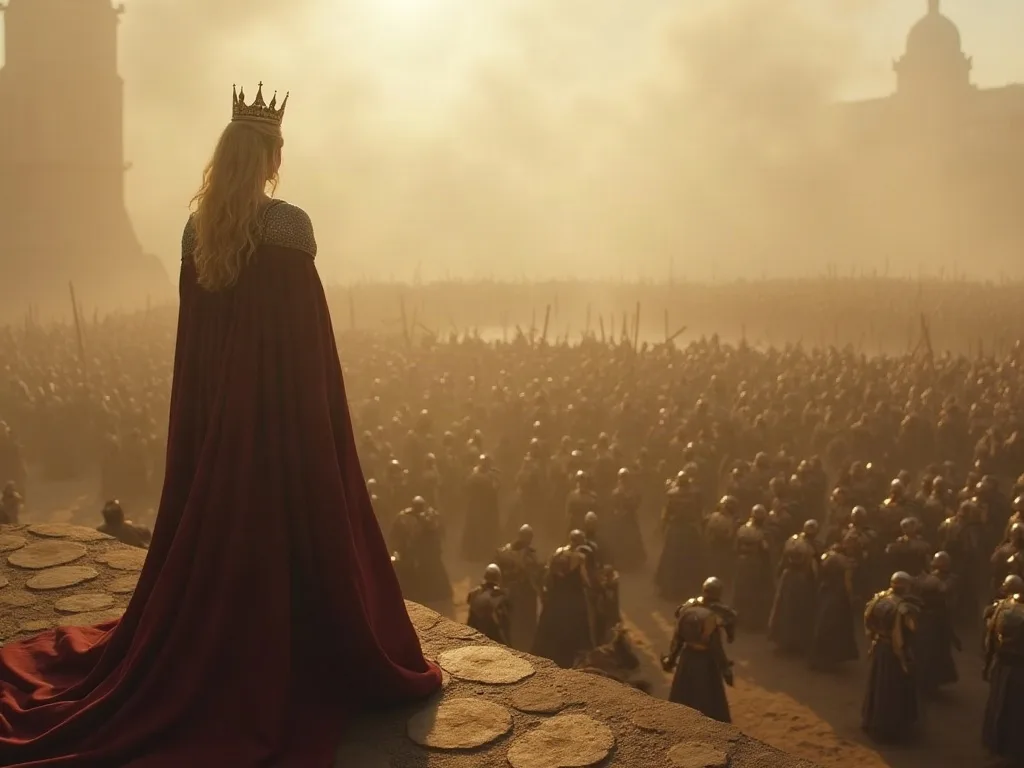
When the armies meet, Ara's forces are formidable. The battle rages. But Semiramis, watching from her high place, suddenly sees him: Ara the Beautiful, moving through the carnage like a shaft of light. Something breaks in her then. She orders her generals to cease the bombardment, to hold the assault. Not for mercy. For capture.
In the chaos of the shifting battle, Ara falls. The sources disagree on how. One tells that he was wounded by an arrow. Another says he was thrown from his horse. A third suggests the ground itself opened and took him. What matters is this: he dies on the field. His blood soaks into Armenian earth. And Semiramis, having destroyed the only thing she ever truly wanted, is left with nothing but his corpse and the ruin of her obsession.
The Resurrection That Never Was
This is where Ara the Beautiful becomes something more than a fallen king. Semiramis, desperate, refuses to accept his death. She summons the greatest magicians of Babylon. She commands them to restore him to life. The sources vary on what happens next. Some say she brings him back as a ghost or shadow, not truly living. Others insist that for a moment, a brief impossible moment, he truly wakes. He speaks her name. He looks at her with the radiance of his eyes, as if to ask: why?
Then he dies again. This time, it is irreversible.
The Armenian sources embed in this second death something profound. Ara cannot return to the world as he was because the world has broken something in him that resurrection alone cannot mend. Or perhaps he chooses not to return, understanding that his beauty, his refusal, his blood poured out, means something holier than living would allow. The god-man recognizes that his purpose is not survival but transformation.
Some versions say Semiramis, grief-stricken and mad, takes her own life. Others claim she founds a dynasty built on the memory of her obsession, an entire civilization of monuments to a love that killed its object. What all versions share is the sense that Ara's death does not end the story. It opens it.
Ara as the Sacred Victim
In the deeper currents of Armenian tradition, Ara the Beautiful functions like the dying gods of other ancient cultures. The ancient Mesopotamians mourned the death of Dumuzi each year. The Anatolians wept for Attis. The Greeks watched Dionysus torn apart and reborn. Yet Ara occupies a unique place. He does not cycle through death and rebirth in seasonal rhythm. His death is singular, irreversible, and transformative in a way that suggests something closer to Christian sacrifice than to pagan fertility cycles.
Armenian scholars have long debated whether Ara reflects older Indo-European myth, Mesopotamian influence, or genuinely local tradition. The truth is likely braided. The Indo-European warrior-king, the Mesopotamian dying-god archetype, and the distinctly Armenian obsession with blood-sanctified land have woven themselves together into something unmistakably Armenian.
Ara's death has no resurrection because resurrection would diminish what his blood has accomplished. Once poured out, once soaked into Armenian soil, it cannot be recalled. It becomes a permanent transformation. The land itself is made holy by this sacrifice. Future generations will walk on ground that has received his blood. They will build cities and sanctuaries on this sacred earth. The people will be, in a sense, his children, born from the marriage of his radiance and the dark earth that received him.
This idea appears in Christian Armenia as well, where Ara sometimes becomes a prefiguration of Christ, the beautiful god-man whose blood redeems the land and whose death cannot be undone. The medieval Armenian church incorporated Ara into the sacred history of the nation, seeing in him an earlier shadow of the redemptive narrative. Whether this was literary invention or preservation of deeper continuity is a question scholars still debate.

The Geography of Loss
The Armenian landscape itself becomes the body of Ara the Beautiful after his death. Rivers are said to flow where his blood fell. Mountains rise from the ground that held him. Place names echo his legend. The land becomes a kind of living monument, a geography written in loss.
This is not metaphorical in the Armenian imagination. It is literal sacred geography. To know Armenia is to know the places where Ara fell, where his blood sanctified, where the god-man's body was finally laid to rest. Pilgrims and poets traveled to these sites not merely to remember, but to touch the very earth that had received something divine.
Some medieval Armenian sources place his tomb at a specific sanctuary. Others describe a valley that bears his name, where the quality of light at dawn is said to recall the radiance he bore in life. These localized traditions show how completely Ara the Beautiful became woven into Armenian place consciousness. He was not just a hero whose story was told; he was a presence that could be visited, a reality still accessible through sacred geography.
The historian Movses Khorenatsi, the most important chronicler of Armenian history writing in the 5th century AD, records Ara's story with a kind of solemn certainty that treats it as historical fact woven into myth. For him, Ara was a real king, a real death, a real transformation. The line between history and sacred narrative was not one that Armenian tradition felt obliged to draw with clarity. What mattered was the truth of the transformation, not the literal accuracy of the dates.
Ara and the Death-God Archetype
Ara the Beautiful shares DNA with figures across the ancient world, yet his particular inflection is distinctly Armenian. Compare him to other dying gods, and the differences become clear.
Dumuzi, the Mesopotamian deity, cycles through death and resurrection tied to agricultural seasons. His return is guaranteed; his death is temporary. Ara does not return. His death breaks the cycle. This suggests an older, more austere theological vision, one that sees loss as irreversible and sacred, not as a hiatus before restoration.
Attis, the Phrygian god mourned each spring, is sometimes castrated, sometimes dies and revives. His worshippers wail and celebrate in strict seasonal rhythm. Ara's grief has no season. It is permanent. The mourning for him does not conclude in celebration. It is a wound that time itself cannot heal, only honor.
Dionysus, the Greek god torn to pieces by the Titans, sometimes dies and revives. But Ara's death seems to bar the possibility of return. Where Dionysian tradition allows for cyclical return, Armenian tradition insists on singular, irreversible loss. This places Ara closer to the Christian martyr tradition than to pagan renewal cycles.
What unites all these figures is the sense that divinity expresses itself through death, that the sacred is not preserved in life but poured out as offering. Ara belongs to this ancient family of sacrifice-gods. Yet his particularity, his refusal to return, marks him as something new: a god who accepts finality as part of his divinity, whose power lies not in overcoming death but in transforming it into something sacred for a nation.
Semiramis: The Queen of Desire and Destruction
To understand Ara fully, we must also reckon with the queen who loved him to death. Semiramis is herself a legendary figure of profound power. In Mesopotamian and Greek sources, she is recorded as a queen of Babylon, an architect, a warrior, a builder of the hanging gardens. Yet in the Ara legend, she becomes something else: the agent of beautiful destruction, the woman whose very desire brings down the most radiant being on earth.
The Armenian tradition portrays her with a kind of tragic honesty. She is not evil. She is not malicious in the simple sense. She is a sovereign of will and desire who cannot conceive of refusal. When Ara will not come to her, when he will not choose her, she experiences this as a cosmic wrong that must be corrected. Her armies are the instrument of her need, and Ara's death is the terrible logic of her obsession played out to its conclusion.
Some later sources suggest she was testing him, or that her attack was political rather than personal. But the older versions, the ones that ring truest to the emotional core of the myth, see Semiramis as a figure driven by a desire so absolute that it destroys what it loves. She becomes a kind of inverse mirror to Ara: where he is constancy, refusal, and radiance, she is change, demand, and darkness. Their collision produces something that neither of them could produce alone: sacred death.
Ara in Armenian Christianity
The medieval Armenian church, having absorbed centuries of pre-Christian Armenian tradition, did something remarkable with Ara the Beautiful. Rather than erase him or treat him as a pagan aberration, the church integrated him into Armenian sacred history. Ara became a prefiguration of Christ, a god-man whose blood sanctified the land just as Christ's blood sanctified the world.
This was not accidental. The idea of a radiant, beautiful victim whose death redeems a people resonated deeply with Christian theology. Armenian Christianity, distinct from both Greek and Latin traditions, developed its own unique perspective on redemption, martyrdom, and sacred death. Ara fit naturally into this framework.
Some scholars suggest that Ara's legend influenced Armenian Christian theology as much as Christian theology reshaped the Ara legend. The emphasis on blood sacrifice, on irreversible transformation, on a death that sanctifies rather than merely dies, appears in both traditions. Whether one influenced the other or they simply recognized kindred truth is a question that may never be finally answered.
What is certain is this: for medieval Armenians, Ara was not a pagan superstition to be discarded. He was a deeper layer of truth about how divinity enters the world and how sacrifice works. He belonged to Armenian sacred history not despite being a pre-Christian figure, but because his story spoke to something eternal about Armenia itself.
The Legacy of Radiance and Loss
Ara the Beautiful does not appear frequently in modern Armenian culture in the way, say, Heracles appears in Greek culture or Rama in Hindu culture. Yet his imprint is everywhere in Armenian consciousness. The idea that Armenia was chosen through blood sacrifice, that the nation itself was born from a god-man's death, that beauty and loss are inseparable, these ideas trace back to Ara.
Armenian literature of the medieval and early modern periods returned repeatedly to the image of the beautiful victim, the radiant one who falls. The poet Gregory of Narek, one of the greatest voices in Armenian literature, wrote of divine beauty descending into suffering and loss. It is impossible to read his work without hearing echoes of Ara.
Modern Armenian writers have returned to Ara as well, sometimes explicitly, sometimes as an unconscious presence. The sense of a nation defined by suffering, by a sacred wound that cannot be healed but only honored, appears throughout Armenian literature from the medieval period to the present day. This consciousness, shaped partly by the actual historical suffering of the Armenian people, also draws on deeper mythological roots. Ara the Beautiful is part of Armenia's story of itself, a story of radiance and loss, of blood spilled for transformation.
The 20th-century genocide of the Armenian people gave terrible new resonance to the Ara legend. Hundreds of thousands of Armenians killed, scattered, but the nation and culture enduring. The pattern of Ara the Beautiful seemed to many to repeat itself in history: a beautiful people, an irresistible destruction, a death that paradoxically preserved and made permanent what it seemed to destroy.
Frequently asked questions about Ara the Beautiful
Frequently asked questions
Was Ara the Beautiful a real historical king or purely mythological?
The sources are ambiguous, which is intentional. Movses Khorenatsi, the primary Armenian historian, writes about Ara as historical fact, placing him in a chronological sequence. Modern scholars cannot confirm his existence from outside sources, but this does not prove he was invented. Armenian tradition itself does not sharply distinguish between history and sacred narrative. The truth Armenians cared about was spiritual and cultural, not archaeological. Whether a historical king named Ara existed, his legend became more important than any fact.
What is the connection between Ara and the Christian Christ in Armenian theology?
Medieval Armenian theologians saw Ara as a prefiguration of Christ, a god-man whose blood redeemed and sanctified the land. Both stories involve a radiant victim, both emphasize irreversible sacrifice, both connect death to transformation. Whether Ara influenced Christian theology or Christianity reshaped the Ara legend, they became deeply interwoven in Armenian consciousness. Some scholars argue that Ara represents a genuinely local Armenian theological idea about how divinity expresses itself through blood sacrifice.
Did Ara actually come back to life after Semiramis summoned the magicians?
The sources conflict. Some say he briefly returned as a ghost or shadow. Others claim a true but momentary resurrection, after which he died finally and irreversibly. The most important version, theologically, is the one where resurrection itself is impossible or rejected. Ara's power lies not in overcoming death but in making his death sacred and permanent. The refusal of resurrection is part of what makes him divine.
Are there other ancient myths like Ara's story about a beautiful god-man who dies?
Yes. Dumuzi in Mesopotamian tradition, Attis in Phrygian tradition, Dionysus in Greek tradition, and Christ in Christian tradition all involve dying gods. Yet Ara is distinct because his death does not cycle or restore. It is singular and irreversible. This places him closer to the Christian martyr tradition than to pagan renewal cycles. Some scholars see Ara as reflecting very old Indo-European patterns, while others emphasize unique Armenian theological development.
Where is Ara's tomb, and is it a real place Armenians visit today?
Medieval Armenian sources place his tomb at various sanctuaries, and some modern Armenian tradition identifies specific locations. However, no archaeological site has been definitively confirmed as Ara's tomb. For Armenians, the geographical specificity matters less than the spiritual truth: Armenia itself is the body of Ara the Beautiful. Every place where his blood fell becomes sacred. This sacred geography is not less real for being spiritual rather than archaeological.
Ara's Silence and What It Teaches
The most striking aspect of Ara the Beautiful is what he does not do. He does not fight back against Semiramis's love. He does not curse her. He does not return as a vengeful ghost. He accepts his death with an almost terrible grace. His radiance does not rage. It simply ceases.
This silence is profound. In a world of gods who demand temples and sacrifices, who return to punish their enemies, who cycle eternally through death and rebirth, Ara the Beautiful accepts finality. His power lies in the acceptance, not the resistance. This is a theological vision that sees the sacred not as force that overcomes opposition but as presence that allows itself to be poured out.
Armenian tradition preserved in Ara a very particular idea about how divinity works in the world. Not through dominance or eternal cycling, but through sacrifice that is accepted, through beauty that knows it cannot survive the world's touch, through death that sanctifies rather than ends. For a people who would face extraordinary historical suffering, this mythology offered not false hope of resurrection but something harder and stranger: the sanctification of loss itself, the idea that what is most beautiful may be most called to die, and that in dying, it becomes permanent in a way living things never can.
This is the legacy of Ara the Beautiful: not a promise that suffering will be reversed, but a myth that makes suffering sacred. Not a god who will save Armenia from harm, but a god who shows that harm itself, accepted and endured, becomes transformation. The radiant one falls. His blood sanctifies the earth. And the people who remember him live forever in the light of what he was and in the reality of what his death accomplished.
Free 25-page sample
Want the whole story?
Take the first 25 pages free. If it pulls you in, the full edition is yours as an instant PDF download, with a paperback on Amazon for selected titles.
Armenian
The Armenian Mythology Book: Vahagn, Anahit, Aramazd and the Sacred Stories of the Caucasus Before Christ
Gods of Fire, Bronze, and the Forgotten Kingdom of Urartu
The pre-Christian gods of Armenia: Vahagn the dragon-slayer, Anahit the mother goddess, and the syncretic pantheon that merged Urartian, Persian, and Greek traditions before vanishing in 301 CE.
More from Armenian
All articles
Armenian
Vahagn: Armenian God of Fire, Thunder, and War
Vahagn roars through the red dawn, the Armenian god of fire, thunder, and war whose bronze-voiced hymns echo in the oldest Christian prayers. Discover the warrior deity who conquered chaos, shaped Armenia's spiritual identity, and survived conquest itself.
Armenian
Anahit: The Great Mother Goddess of Armenia
Anahit ruled Armenia's spiritual world for millennia as the Great Mother, keeper of waters, fertility, and wisdom. Discover how she shaped an entire civilization's understanding of divine power.

Armenian
Aramazd: The Creator God and Father of All
Aramazd stands at the foundation of Armenian myth as the supreme creator, the father from whom all life and divinity flow. Discover how this ancient god shaped the cosmos and why he vanished from Armenia's religious life after the conversion to Christianity.

Armenian
Hayk and Bel: The Founding Myth of Armenia
The story of Hayk's rebellion against the tyrant Bel explains how Armenia was born. A warrior's defiance, a nation's origin, and a line of kings that would rule for centuries.