
Mihr: The Armenian God of the Sun and Oaths
Mihr stands as one of Armenia's most enduring divine figures, embodying the sun's life-giving power and the sacred bonds of oaths and covenant. His worship reveals how one ancient faith wove loyalty, light, and divine justice into a single sacred symbol.
Contents
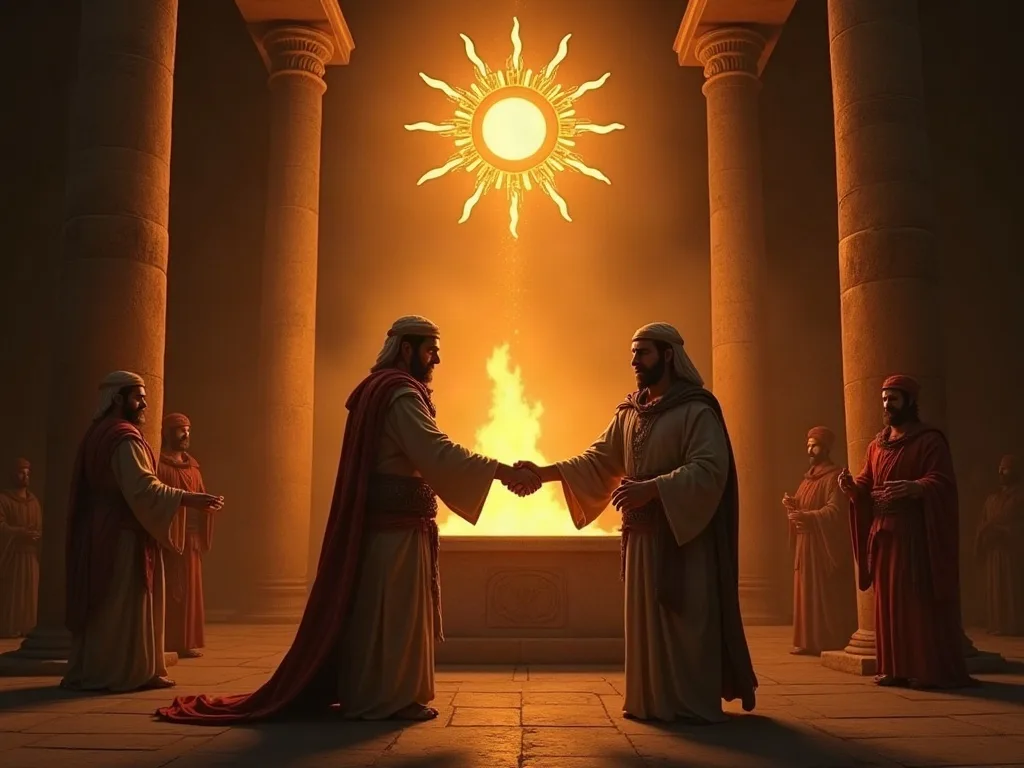
A shaft of sunlight cuts through the mountains of ancient Armenia. Below, two merchants clasp hands and swear before the altar. They invoke Mihr, and in that moment, the promise becomes unbreakable. The god who watches from the sky does not forget. This is where Mihr, the Armenian god of the sun and oaths, lived in the hearts of his people: not as a distant heavenly ruler, but as the witness to every sacred word, the judge of every broken bond.
Mihr belongs to a family of Armenian gods whose names echo through 3,000 years of history. His worship shaped contracts, sanctified marriages, and marked the passage of seasons. He was the sun that rose each morning and the invisible power that held society together. To understand Mihr is to see how one ancient people married astronomy, ethics, and divinity into a single burning flame.
Origins and the Indo-European Heritage of Mihr
The name Mihr does not belong to Armenia alone. It travels backward through the millennia, westward into Persia, where the Zoroastrians knew him as Mithra, and eastward into India, where the Vedas speak of Mitra. Mihr himself is a living fossil of Indo-European religion, a god whose worship journeyed with the ancient peoples who migrated from the Central Asian steppes into the lands around them.
The Zoroastrian Mithra and the Armenian Mihr are close cousins. Zoroastrianism, the state religion of Persia, deeply influenced Armenian spiritual thought, especially after the Parthian and Sassanid empires pressed their influence on the region. Yet the Armenians did not simply import Mithra wholesale. They adapted him, gave him new stories, wove him into their own mythology alongside native deities like Anahit and Vahagn.
Some scholars argue that Mihr's roots reach even deeper, into the Proto-Indo-European sky-father tradition. The association with oaths, in particular, connects him to ancient legal and social rituals that predate even the Vedas. In those earliest times, the sun itself was the ultimate witness. Nothing could hide from its gaze. A man who swore falsely before the sun invited cosmic punishment. Over centuries, this principle crystallized into a god: Mihr, the sun that sees all, the keeper of covenants.
The Armenian priests and warriors who served Mihr understood this lineage. They belonged to an empire straddling routes between the Mediterranean, Mesopotamia, and Central Asia. Their religion reflected that crossroads: Eastern gods, yes, but filtered through their own culture, their own needs, their own land.
The Sun God's Character and Divine Domains
In Armenian belief, Mihr was not merely the physical sun. He was the principle of light, the enemy of darkness and deception. His most sacred domain was the oath, the covenant, the promise made before witnesses. When an Armenian swore by Mihr, he invoked not just a powerful god, but a cosmic force that could not be fooled, bribed, or escaped.
Mihr's authority extended into several realms:
- Oaths and contracts : Every binding agreement fell under his watch. Merchants swore by Mihr before sealing deals. Warriors invoked him before treaties. The god's presence made the promise real in a way that mere words could not.
- Solar cycles and harvest : As the sun, Mihr governed the seasons, the ripening of crops, the health of herds. His daily journey across the sky marked time itself.
- Justice and cosmic order : Light dispels shadow. Truth dispels lies. In this way, Mihr was a force of cosmic justice. He could not tolerate false oaths; they violated the fundamental order he embodied.
- Strength and vitality : The sun's warmth gives life. Warriors prayed to Mihr for strength in battle. The ill prayed for his healing rays.
The Armenians celebrated Mihr with festivals that aligned the god's mythological calendar to their practical needs. One feast day honored the sun's power at key moments in the agricultural year. Priests kept eternal flames burning in his temples, living symbols of the sun that never truly dies.
Mihr in Armenian Mythology and Ritual
The surviving Armenian sources tell us less about Mihr's mythological narratives than we might wish. Much was lost when Armenia converted to Christianity in the early 4th century CE, a conversion that effectively ended the state worship of the ancient gods. Yet fragments survive, preserved in place names, surviving temple dedications, and the accounts of later scholars.
One of the most important temples to Mihr stood in the region of Armavir, in the heart of ancient Armenia. The temple itself may not survive in visible form, but its location and reputation reveal how central he was to Armenian religious practice. Near the shrine, priests performed rituals to mark seasonal transitions and to sanctify oaths.
The worship of Mihr involved fire. This is crucial. The eternal flame in his temple was not merely decorative. It represented the sun itself, brought down to earth, made accessible to human prayer. When a supplicant came before the flame, they came before Mihr's actual presence. This practice shows clear influence from Zoroastrian fire worship, yet the Armenians made it distinctly their own, embedding it into their unique religious landscape.
Oaths sworn in Mihr's temples carried a weight that no other oath could match. The violator risked not just social shame or legal punishment, but divine retribution. A false oath sworn before Mihr's flame was believed to invite illness, misfortune, or death. The god's attention, once fixed upon a perjurer, could not be escaped. This made Mihr a powerful social force: his mere name kept promises honest.
Mihr and the Broader Armenian Pantheon
Mihr did not stand alone in the Armenian divine cosmos. He existed alongside other gods, each with specific domains and stories. Anahit, the goddess of fertility and wisdom, received worship that in some ways rivaled Mihr's. The warrior-god Vahagn commanded fierce devotion, especially among the nobility and the military.
Yet Mihr held a unique position. Where Vahagn represented the heroic, passionate side of divine power, Mihr embodied the rational, ordering principle. Where Anahit gave abundance, Mihr gave structure and truth. Together, the gods formed a balanced system: creation and order, passion and reason, feminine and masculine principles all held in cosmic equilibrium.
This balance is visible in how different social groups honored the gods. Warriors naturally favored Vahagn. Women and farmers often turned to Anahit for blessing and protection. But Mihr belonged to everyone. The merchant, the judge, the king, the peasant entering into contract: all needed Mihr's witness. In this way, he was the most universally invoked deity in the Armenian religious system.
Mihr's Syncretism with Persian and Zoroastrian Traditions
The history of Mihr's worship in Armenia is inseparable from the long interaction between Armenian and Persian cultures. When the Parthian Empire ruled Mesopotamia and Persia (from roughly 250 BCE onward), and later when the Sassanid Persians held the region, Armenian elites adopted many Persian religious practices. This did not erase Mihr; it transformed him.
The Zoroastrian Mithra was already an ancient god when Armenian priests encountered him in Persian form. In Zoroastrianism, Mithra is one of the yazatas, divine beings created by Ahura Mazda (the supreme god). He is the guardian of oaths and contracts, the protector of cattle, the judge of souls at death. The parallels to the Armenian Mihr are striking and not coincidental.
Some scholars propose that the Zoroastrian influx actually strengthened the Armenian Mihr's reputation. The Zoroastrian tradition brought new theological elaboration, new ritual complexity, new mythological depth. It provided a prestigious model for how to understand the sun god. Yet the Armenians did not become mere copies of their Persian neighbors. They adapted. They selected elements that resonated with their own spiritual inheritance and left others behind.
This process of selective syncretism is common in the ancient world. A god from one tradition meets a god from another, and the peoples sharing the border begin to see them as the same being, or as close variants. Sometimes a god genuinely absorbs traits from his counterpart. Sometimes the two continue to coexist, honored separately yet understood as related.
In Mihr's case, the interaction with Mithra seems to have been collaborative rather than competitive. The Armenian tradition retained its integrity while absorbing new prestige and theological sophistication from its neighbor.
Temples, Priests, and the Rituals of Mihr
The organized worship of Mihr in Armenia followed patterns visible across the ancient Near East. Priests trained in sacred knowledge guarded his temples. These were not merely places of prayer, but centers of legal authority and economic power. A temple to Mihr might hold the records of oaths sworn before it. Disputes over contracts could be brought before the priests for judgment, on the understanding that the god himself would ensure true judgment.
The Temple of Armavir, mentioned in historical texts, appears to have been one of the major sanctuaries. It stood in a region sacred to several Armenian gods. The location itself carried spiritual weight: high ground, visible from a distance, a place where the sun's rays seemed most direct and powerful.
Worship at these temples involved several elements:
- Fire rituals : The eternal flame burned continuously, tended by priests. Supplicants might approach the flame to make offerings or to swear oaths.
- Seasonal festivals : Key moments in the solar year (solstices, equinoxes) called for special ceremonies, often involving sacrifices of animals and gifts of the first fruits.
- Individual devotions : People came privately to make vows, seek blessings, or invoke Mihr's justice in disputes.
The priests of Mihr wielded considerable social authority. They interpreted the god's will, maintained the records of sworn oaths, and served as arbiters in disputes. A priest of Mihr was a keeper of truth, expected to be beyond corruption or self-interest. The station required both theological learning and a reputation for integrity.
Mihr's Decline and the Christian Transition
The conversion of Armenia to Christianity in 301 CE, under King Tiridates III, marked a turning point for Mihr and the entire pantheon of Armenian gods. This was no gradual shift. It was, in official terms, sudden and total. The old temples were closed or repurposed. The eternal flames were extinguished. The priests of Mihr and the other gods lost their institutional power.
Yet the transformation was not as complete as the new Christian authorities might have wished. Older gods do not vanish simply because a decree commands it. Mihr retreated from official worship but did not disappear from the landscape of Armenian spirituality. Place names preserved his memory. Folklore kept fragments of old stories alive. In villages far from the capital, the traditions persisted in modified forms, sometimes absorbed into Christian practice.
Some scholars have suggested that Mihr's qualities were partially absorbed into Christian figures. The sun imagery, the association with justice and truth, the role as witness and judge: these resonate with aspects of Christ or with the archangels in Christian tradition. It is tempting to draw direct lines, yet the evidence remains fragmentary. What is clear is that Christianity's rise displaced Mihr from his position as a state god, yet the memory of him endured in the Armenian cultural consciousness.
The classical Armenian sources, written after Christianity had taken root, describe the old gods with a mixture of respect and dismissal. The 5th-century historian Agathangelos, writing the official history of Armenia's conversion, mentions the temples and gods as a matter of record, neither dwelling on them nor entirely erasing them. This balanced tone suggests that even as the new faith consolidates power, the old traditions retained enough cultural weight to deserve acknowledgment.
Mihr in Comparative Indo-European Context
To understand Mihr fully, it helps to see him among his Indo-European relatives. The Vedic Mitra, the Zoroastrian Mithra, and the Armenian Mihr are not identical, yet they share a common ancestor in the religion of the ancient Indo-European peoples. Each tradition adapted the ancient god to its own needs and worldview.
The Vedic Mitra is one of the Adityas, the solar deities. He is associated with oaths, contracts, and the daytime sky. He is paired with Varuna, who rules the night and the cosmic order. Together, they form complementary halves of divine authority: Mitra the friendly, contractual side; Varuna the terrible, punishing side.
In Zoroastrianism, Mithra becomes more elaborate. He is a yazata, a divine being who serves Ahura Mazda. His role as protector of oaths and cattle is central. Mithra is also, in some Zoroastrian texts, a figure who assists in the judgment of souls, standing between the earth and the spiritual realm. The religion grants him considerable theological importance and assigns him specific cosmic functions.
The Armenian Mihr, though less extensively documented in surviving texts, appears to occupy a middle ground. He retains the oath-keeping function from the Indo-European heritage. He maintains a strong association with the sun and with light. Yet he is also distinctly Armenian, adapted to Armenian social structures and embedded in an Armenian mythological landscape. He does not have the elaborate theological apparatus that Zoroastrianism gave to Mithra, yet he commands deep veneration and serves as a unifying principle in Armenian society.
This comparative view reveals something important: the ancient religions were not static, unchanging systems. They evolved. Gods migrated, merged, transformed. The same divine name could take on subtly different meanings in different cultures. Mihr's story is the story of how one ancient principle of divine authority, justice, and solar power took multiple forms as it traveled through different peoples and different times.
The Worship of Mihr in Daily Life and Law
For ordinary Armenians, Mihr was not an abstract theological concept. He was present in daily life, woven into the moral fabric of society. When a man made a promise, he felt Mihr's presence. When he contemplated breaking his word, he felt the weight of the god's judgment.
This had profound social effects. In a world without modern legal institutions, without written contracts that could be enforced by state power, the threat of divine retribution provided a powerful incentive for honesty. A man might fear the loss of his reputation or economic ruin if he broke a contract. But he also feared Mihr's judgment. The god could reach into his life, bring illness, disaster, death. This belief made oaths work. It made commerce possible. It made society cohere.
The role of Mihr in Armenian law reflects this reality. Disputes over contracts could be brought before a priest of Mihr or before a judge who invoked Mihr's name. The defendant might be required to swear an oath before the god, betting his life and livelihood on the truth of his words. A man confident in his honesty might accept such an oath. A man who knew he was lying would be terrified. The very existence of this practice shaped behavior.
Marriages were solemnized before Mihr. A couple's vows were not merely personal promises; they were covenants witnessed by a god who would enforce them. This lent marriage a sacred character and a social weight. Divorce was not a casual matter; it was a violation of a sacred oath, risking the displeasure of a god.
Mihr's Solar Symbolism and Cosmic Significance
The Armenians understood the sun not as a distant, indifferent object of natural philosophy, but as a living divine presence. Mihr, as the sun god, embodied principles that resonated through the entire cosmos. His daily journey across the sky was not mere astronomy; it was the unfolding of a sacred drama.
In this worldview, the sun's rising brings hope and possibility. Its setting brings uncertainty and shadow. The eternal fire in Mihr's temples, burning night and day, represented the sun's perpetual victory over darkness. It was a promise that each dawn was guaranteed, that the pattern of day and night would continue, that order would not dissolve into chaos.
This symbolism carried moral and spiritual weight. Just as the sun reveals all things, exposing what was hidden in darkness, so Mihr reveals truth and exposes falsehood. Just as the sun's warmth gives life, so the god's blessing provides vitality and strength. Just as the sun follows a regular, predictable path across the heavens, so Mihr represents the cosmic order, the law that governs both nature and human society.
The Armenian understanding of Mihr as a solar deity thus integrated natural observation with theological meaning. The god was real because the sun was real. His power was evident to anyone who had experienced his warmth or depended on his cycle for survival. Yet his significance transcended mere physics. He was a principle of order, truth, and divine justice made visible in the sky.
Scholarly Debates and the Sources Problem
The study of Mihr in Armenian religion faces a significant challenge: the loss of primary sources. Most of what we know comes from later accounts, from fragmentary references, from place names and temple dedications. No extensive Armenian theological text on Mihr survives from the pre-Christian period comparable to, say, the Zoroastrian Avesta or the Vedic hymns.
This has led scholars to reconstruct Armenian religion partly through comparison with neighboring traditions. The parallels between the Armenian Mihr and the Zoroastrian Mithra are so clear that many scholars assume significant cultural transfer. Yet the degree of transfer, and the extent to which Mihr was distinctly Armenian versus simply an adopted Persian god, remains debated.
Some scholars emphasize the indigenous Armenian roots of Mihr, arguing that he was an ancient Armenian deity later elaborated through contact with Zoroastrianism. Others see him primarily as an Armenian adaptation of the Persian Mithra, integrated into an existing Armenian pantheon. The evidence allows for both interpretations, and the truth likely contains elements of each.
The Christian sources, while providing historical context for the conversion, do not give us detailed theological information about Mihr himself. They tell us that he was worshipped, that temples stood in his honor, that he was one of the major gods. But they do not describe his mythology in detail or explain precisely how Armenian theology understood him.
This gap in the record is frustrating for scholars but also revealing. It tells us that much of Armenian religious life was transmitted orally, through priests and storytellers. The gods lived in memory, in ritual practice, in the collective consciousness of the people. When the external structure of worship collapsed with the coming of Christianity, that oral tradition fragmented. Some survived in folk practice; much was lost.
Mihr's Legacy in Later Armenian Culture
Though official worship of Mihr ended with Christianity's triumph, his influence persisted in subtle forms. The name itself remained alive in Armenian culture. "Mihr" became a personal name, given to boys in the hope that they would inherit some of the god's qualities. An Armenian man named Mihr was thought to carry a portion of the divine sun-god's nature.
The very concept of an oath, sworn before witnesses and carrying divine weight, persisted in Armenian Christian society. The form changed; oaths were now sworn before Christ or the saints rather than before Mihr. Yet the underlying principle remained: promises made before the divine were binding, enforceable through divine judgment. In this way, Mihr's legacy was absorbed into Christian practice.
Some scholars have detected echoes of Mihr in Armenian folk religion and in regional traditions that persisted into modern times. Certain holy sites that were once associated with the sun god were rededicated to saints, yet retained some of the spiritual resonance of the older tradition. A spring associated with healing light, for instance, might become a shrine to Saint John yet continue to draw pilgrims seeking the same kind of blessing.
The study of Mihr thus extends beyond the classical period into a longer arc of cultural history. The god himself, as a figure of official state worship, vanished in the 4th century. Yet the principles he embodied, the social functions his cult served, and the resonance of his name in Armenian consciousness persisted. In this way, Mihr remained a living presence in Armenian culture long after his temples were closed.
Frequently asked questions about Mihr, the Armenian god of the sun and oaths
Frequently asked questions
Was Mihr the same god as the Zoroastrian Mithra?
Mihr and Mithra were closely related but not identical. Both derive from an ancient Indo-European solar deity, and they share the domains of oaths and justice. The Zoroastrian Mithra influenced Armenian worship of Mihr, particularly after Persian imperial power reached Armenia. However, the Armenians adapted Mihr to their own cultural and religious context, giving him a distinct character within the Armenian pantheon. He was neither a direct copy of Mithra nor entirely separate from him; rather, he was an Armenian god shaped partly by knowledge of the Persian tradition.
What happened to Mihr's worship when Armenia converted to Christianity?
Mihr's official, state-sponsored worship ended abruptly after Armenia's conversion to Christianity in 301 CE. His temples were closed or repurposed, and the priesthood lost institutional power. However, the god did not vanish entirely from Armenian consciousness. His name persisted as a personal name, and the concepts he embodied (the sacred oath, the cosmic witness) were absorbed into Christian practice. In some folk traditions and regional practices, echoes of his worship may have survived in modified forms, but these are difficult to document with certainty.
How did Mihr function in Armenian law and society?
Mihr played a crucial role as a divine enforcer of oaths and contracts. In a society without modern legal institutions, the god's authority made promises binding. A person who swore a false oath before Mihr risked divine punishment, typically understood as illness, misfortune, or death. This belief made commerce possible and marriages sacred. Disputes could be brought before a priest of Mihr, who would judge the case with the understanding that the god himself would ensure just judgment. In this way, Mihr was not merely a religious figure but a social institution.
What primary sources tell us about Mihr?
Direct primary sources on Mihr are limited. Most information comes from later historical accounts (such as those of Agathangelos, the 5th-century Armenian historian), fragmentary temple dedications, place names, and comparative study of related traditions like the Zoroastrian Mithra and the Vedic Mitra. Much of Armenian religious knowledge was preserved orally through priests and was not recorded in the texts that survive to the modern era. This gap in documentation reflects how the Christian conversion disrupted the transmission of older religious traditions.
Did Mihr have a mythology, or was he primarily a god of daily practice?
The surviving sources suggest that Mihr was primarily a god of social function and cosmic order rather than the subject of elaborate mythological narratives comparable to those of Greek gods. His essence lay in his role as the sun, the witness to oaths, and the enforcer of truth. We have fragmentary references to temples and rituals but no surviving extended myths. This does not mean such myths did not exist; it means they were lost when the oral traditions of the pre-Christian priesthood were disrupted.
Mihr's Place in the History of Religious Syncretism
The story of Mihr illuminates one of the great themes in the history of religion: how gods migrate, merge, and transform as peoples meet and exchange ideas. Mihr is not unique in this journey. Gods from the Mediterranean traveled north into Europe. Gods from Mesopotamia spread east into India. Religious ideas flowed along trade routes and through the conquests of empires.
What makes Mihr's story particularly valuable is how it reveals the mechanics of this process. We see an ancient Indo-European principle of divine authority, present in multiple traditions, adapted independently yet also influenced by cross-cultural contact. We see how a god can remain recognizable across different societies while taking on locally specific characteristics. We see how the loss of direct sources forces us to reconstruct the past through comparison and inference.
For modern students of religion, Mihr offers a lesson in humility. We know much less about the pre-Christian religions of the ancient world than we might wish. Much has been lost. Yet from the fragments that remain, from the names in place names, from the echoes in later traditions, from the comparative study of related faiths, we can reconstruct something real and meaningful. The god may be gone from active worship, but the principles he embodied remain relevant: the power of witness, the sanctity of the sworn word, the association between light and truth.
In our own age of contracts, corporate oaths, and legal systems that attempt to enforce promise-keeping through human mechanisms, Mihr reminds us of an older understanding: that some bonds are sacred, that truth matters beyond mere enforceability, that we are always watched by something greater than ourselves. Whether we understand that watching force as a god, as conscience, or as cosmic law, the principle endures.
Free 25-page sample
Want the whole story?
Take the first 25 pages free. If it pulls you in, the full edition is yours as an instant PDF download, with a paperback on Amazon for selected titles.
Armenian
The Armenian Mythology Book: Vahagn, Anahit, Aramazd and the Sacred Stories of the Caucasus Before Christ
Gods of Fire, Bronze, and the Forgotten Kingdom of Urartu
The pre-Christian gods of Armenia: Vahagn the dragon-slayer, Anahit the mother goddess, and the syncretic pantheon that merged Urartian, Persian, and Greek traditions before vanishing in 301 CE.
More from Armenian
All articles
Armenian
Vahagn: Armenian God of Fire, Thunder, and War
Vahagn roars through the red dawn, the Armenian god of fire, thunder, and war whose bronze-voiced hymns echo in the oldest Christian prayers. Discover the warrior deity who conquered chaos, shaped Armenia's spiritual identity, and survived conquest itself.
Armenian
Anahit: The Great Mother Goddess of Armenia
Anahit ruled Armenia's spiritual world for millennia as the Great Mother, keeper of waters, fertility, and wisdom. Discover how she shaped an entire civilization's understanding of divine power.

Armenian
Aramazd: The Creator God and Father of All
Aramazd stands at the foundation of Armenian myth as the supreme creator, the father from whom all life and divinity flow. Discover how this ancient god shaped the cosmos and why he vanished from Armenia's religious life after the conversion to Christianity.

Armenian
Hayk and Bel: The Founding Myth of Armenia
The story of Hayk's rebellion against the tyrant Bel explains how Armenia was born. A warrior's defiance, a nation's origin, and a line of kings that would rule for centuries.