
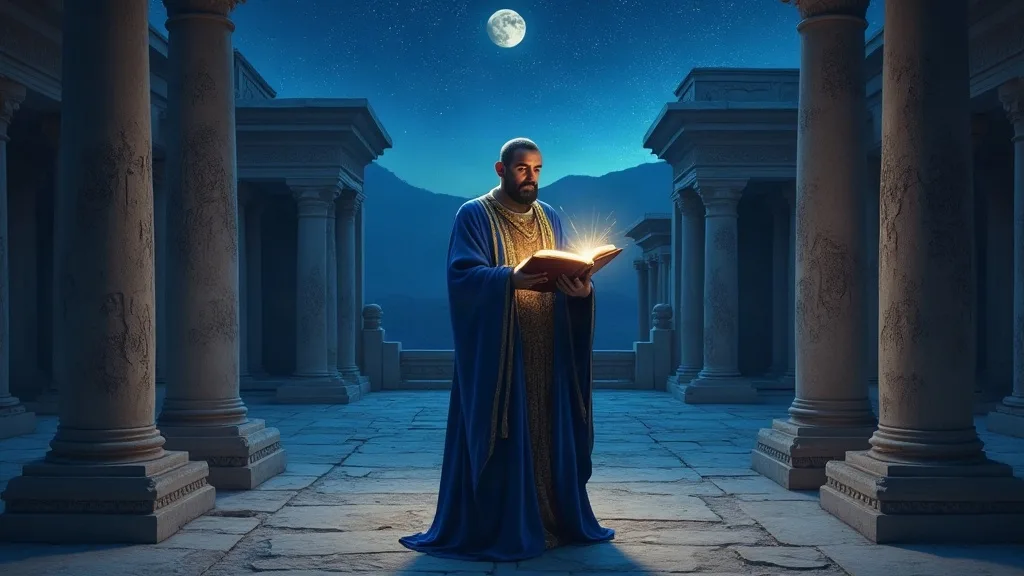
Tir: The Scribe God of Wisdom and Dreams
Tir ruled the Armenian pantheon as scribe of fate, messenger of the sun, and lord of dreams. Uncover the myths, temples, and lasting legacy of this singular god.
Contents
The night arrives, and somewhere in ancient Armenia a sleeper stirs. A presence enters through the dream's threshold, silent as a stylus pressing into clay. This figure does not roar or wage war. He writes. Every deed performed under the sun has already been recorded in his ledger, and now, in the soft dark of sleep, he delivers his messages: prophecy, warning, counsel. Morning comes. The dreamer wakes with knowledge they did not own the night before.
That visitor is Tir: the Scribe God of Wisdom and Dreams, the most intellectually charged deity in the pre-Christian Armenian pantheon. He held the reed pen while others held the spear, and the Armenians understood that the pen's reach could be longer. Fate could not escape his record. The sun god's will could not circulate without his voice. Dreams could not carry meaning without his hand to shape them.
He is among the least discussed Armenian gods in popular mythology today, which is exactly why he deserves the closest attention. Every thread you pull on Tir connects to something larger: astrology, literature, law, the afterlife, and the deep cultural crosscurrents that made ancient Armenia one of the ancient world's most richly layered civilizations.
Who Tir Was: The Scribe at the Court of Aramazd
In the hierarchy of the Armenian gods, Aramazd stood at the summit, the father of the gods, whose name derives from the Iranian Ahura Mazda. Every divine bureaucracy needs a record-keeper, and Aramazd had Tir. The scholar Movses Khorenatsi, writing his "History of Armenia" in the fifth century AD, describes Tir as the secretary and scribe of Aramazd, the one entrusted with recording human souls and their deeds.
The word Tir itself connects to Iranian linguistic roots related to an arrow or a written mark; some scholars link it to Tishtrya, the Zoroastrian star deity associated with the star Sirius, rain, and celestial order. Whether or not Tir and Tishtrya share a single origin or merely a phonetic kinship remains debated, but the overlap in their cosmic administrative functions is hard to ignore. Both figures orbit celestial authority; both operate as intermediaries between a high god and the mortal world.
Tir kept the book of human fates. Every birth, every death, every moral act was entered into his ledger. This made him something like a combination of the Egyptian Thoth and the Zoroastrian Sraosha, yet distinctly Armenian in character: less juridical than Sraosha, less mystical than Thoth, and more intimately tied to the literary and scribal culture that Armenian civilization prized so highly.
Tir as Messenger of the Sun
Aramazd was the supreme divine father, but the sun god Mihr (sometimes rendered Mher, cognate with the Iranian Mithra) also commanded reverence in Armenian ritual life. Tir served as the messenger carrying decrees between these two layers of divine authority. He moved between heaven and earth, between the solar realm and the human world below it.
This messenger role placed Tir in a category ancient cultures recognized immediately: the divine herald who crosses boundaries. The Greeks had Hermes, Rome had Mercury, and Armenia had Tir. The comparison is not merely decorative. Movses Khorenatsi himself acknowledged that the Armenians identified Tir with the Greco-Roman Apollon and with Mercury when they encountered the classical world, seeing in those figures the same scribal, prophetic, and messenger qualities their own god embodied.
The alignment with Apollo is especially suggestive. Apollo was the Greek god of prophecy, poetry, and light; Tir channeled the sun's authority, presided over wisdom, and sent prophetic dreams. The Armenians who made that identification in the Hellenistic period were not naively borrowing a foreign concept. They recognized a structural parallel between two genuine cultural needs: every civilization near a solar cult seems to produce a mediating god of knowledge who translates divine light into human understanding.
The Temple at Artashat and the Living Cult
Tir was not only a theological abstraction. He had temples, priests, and festivals. The most significant cult site dedicated to him stood near Artashat, the Artaxiad capital founded around 189 BC on the confluence of the Araxes and Metsamor rivers. The Greek geographer Strabo described Artashat as a splendid city; its sacred precincts housed cults of multiple gods, and Tir's temple was among the prominent ones.
Movses Khorenatsi records that the temple of Tir at Artashat drew pilgrims who came specifically for dream incubation, the practice of sleeping inside a sacred precinct in the hope of receiving a prophetic dream sent by the god. This practice was ancient and widespread: the Greeks did it at the temples of Asklepios, the Egyptians at the sanctuaries of Serapis. That Armenia had its own formalized version tied to Tir tells us this was a fully developed theological system, not a folk superstition.
The priests who managed dream interpretation at Tir's sanctuary were probably specialists in oniromancy, the systematic reading of dream symbols. Armenian priestly knowledge in this period drew on Zoroastrian, Babylonian, and Hellenistic traditions; Tir's temple may have been something like a learned institution where scribal and interpretive arts were transmitted alongside ritual practice.

Dreams, Prophecy, and the Logic of Tir's Night Work
Why would the god of writing also govern dreams? The answer makes complete sense once you think about what writing and dreaming share. Both are systems of encoding meaning. A written text carries information across distance and time; a dream carries information across the boundary between divine knowledge and human consciousness. Tir, as the divine scribe, was the master of meaningful marks, and a dream was simply a mark inscribed not on clay or papyrus but on the sleeping mind.
The Armenian sources describe Tir arriving at the bedside of the sleeper and reading from his great book. In some accounts he does not show benign visions only; he also reveals the record of the soul's actions, confronting the sleeper with what has been written. This makes him a figure of moral weight, not just comfort. To encounter Tir in a dream was to meet the accountant of your own life.
This dual function, comfort and confrontation, is what separates Tir from a simple messenger deity. He carried both good news and reckoning. A general who dreamed of Tir before a battle might receive strategic insight. A person who had acted badly might receive a nightmare that doubled as a moral ledger being opened in their face.
The Armenian scribe god's domain over prophetic dreams placed him at the center of a practice that shaped real decisions: kings consulted dream-interpreters, military campaigns waited on omens, dynastic marriages could hinge on a vision received in a sacred precinct. Tir's temple was, in a very practical sense, a place where political and personal decisions were made.
Tir and the Written Word: Patron of Scribes and Learning
One of the most concrete aspects of Tir's cult was his direct patronage of scribes, intellectuals, and the act of writing itself. This was not a metaphorical association. Educated Armenians in the pre-Christian period would have invoked Tir when beginning a written text, much as medieval European scholars invoked patron saints before copying manuscripts.
The scribal arts in Armenia were tied to the royal administration, to law-writing, and to the recording of religious texts. A deity who governed all three made Tir one of the most functionally important gods for the literate class. Merchants recording contracts, priests composing hymns, royal secretaries drafting decrees: all of them worked under his invisible authority.
This also explains why the conversion of Armenia to Christianity in 301 AD (making it the first nation to adopt Christianity as a state religion) required such careful management of Tir's legacy. You cannot simply erase a god who is identified with literacy itself in a culture that prizes written tradition. The Christian scribes who came after had to reframe, not destroy, the value system that Tir represented.
Armenian mythology provides a rich case study in how a sophisticated polytheist culture negotiated its own transformation. Tir's attributes did not vanish with the old temples; they migrated into new forms.
Connections Across the Ancient World: Tir in Comparative Context
Tir's profile invites comparison with several other ancient scribal deities, and each comparison teaches something specific.
Thoth (Egyptian): Like Tir, Thoth was the divine scribe who recorded human deeds and was present at the judgment of the soul. The Egyptian Thoth carried the was scepter and the palette of a scribe; Tir carried his celestial ledger. Both presided over knowledge as a divine force, not merely a human skill. The key difference is that Thoth had a far more elaborate mythological biography (the eye of Ra, the lunar cycle, the invention of hieroglyphs), while Tir's mythology, as preserved in surviving Armenian sources, is leaner, more administrative, more focused on his function than on his adventures.
Hermes/Mercury (Greek/Roman): The Armenians themselves made this link. Hermes was also a psychopomp, a guide of souls between worlds, and a messenger who crossed boundaries. Tir's role as a night visitor who crosses from the divine to the human realm echoes this psychopomp function, though Armenian sources do not describe him as a guide of the dead in the same systematic way.
Nabu (Babylonian): Nabu was the Mesopotamian god of wisdom and writing, patron of scribes, keeper of the Tablet of Destiny. His influence radiated outward through the ancient Near East, and Armenia, which sat at the crossroads of Mesopotamian, Iranian, and Hellenistic civilizations, almost certainly absorbed elements of his symbolic vocabulary. The scribal-deity model may ultimately trace through Tir back to Nabu and the Babylonian intellectual tradition that shaped so much of ancient Near Eastern religion.
Tir (Armenian)
- Divine scribe who records human deeds
- Messenger of the sun god Aramazd
- Sends prophetic dreams to sleeping mortals
- Patron of scribes and the literate class
- Cult centered at Artashat; dream incubation practiced at his temple
- Preserved in Armenian sources primarily through Movses Khorenatsi
Thoth (Egyptian)
- Divine scribe who records deeds at the judgment of the soul
- Associated with Thoth-lunar cycle and the eye of Ra
- Governs magic, writing, and secret knowledge
- Patron of scribes, healers, and scholars
- Cult centered at Hermopolis; elaborate mythology in the Book of the Dead
- Preserved across thousands of papyri, temple inscriptions, and funerary texts

The Fate Book: What Tir's Ledger Meant for Armenian Views on Destiny
The image of Tir keeping a great book of human fates is theologically rich. It presupposes that fate is not random and not simply decreed moment to moment by divine whim. Fate, in this framework, is recorded. It has the quality of text: it can be consulted, read, and delivered as a message.
This is close to the Zoroastrian concept of the heavenly book but inflected through Armenian cultural priorities. The Armenians of the Artaxiad and early Arsacid periods (roughly 189 BC to 428 AD) were sophisticated readers of multiple philosophical traditions: Iranian dualism, Greek philosophy, and later Syriac Christianity. Tir's ledger fits into a broader regional theology in which cosmic order is maintained through written, knowable law, rather than through arbitrary supernatural intervention.
The practical result for ordinary Armenians was a sense that the universe was comprehensible in principle. If fate was recorded, it could in theory be read. Dream interpretation was one technology for reading it. The temple of Tir was therefore not a place of supplication to an unpredictable force; it was more like a consultation with the cosmic record itself, mediated by a god who was, above all, literate.
After the Temples: Tir's Survival in Christian Armenia
When Gregory the Illuminator converted King Tiridates III and dismantled the old Armenian sanctuaries at the beginning of the fourth century AD, the temple of Tir at Artashat was among those demolished. The physical cult ended. But the intellectual and symbolic energy that Tir represented had no easy exit from Armenian culture.
The invention of the Armenian alphabet by Mesrop Mashtots in 405 AD is one of the pivotal events in Armenian history. Mashtots created a uniquely fitted script for the Armenian language, and the culture that produced him had spent centuries venerating a god of writing and scribal excellence. There is no direct causal line between Tir and Mashtots, but there is a cultural continuity: a civilization that made literacy sacred in its theology would eventually produce a man who treated the creation of an alphabet as a near-religious act.
Armenian scribal culture after 405 AD became one of the richest in the medieval world. The monastic scriptoria of Gladzor, Tatev, and Sanahin produced illuminated manuscripts of extraordinary quality. The colophons (the notes scribes added at the end of manuscripts) often describe the act of writing as a spiritual practice. Tir's shadow falls across all of it, not as a named presence but as a cultural reflex: the idea that writing is sacred work deserves to be done with care and reverence.
The old god's name also survived in Armenian place names and personal names across the centuries, which is one of the quiet ways that pre-Christian sacred geography persists long after the rituals that created it have ended.
Frequently Asked Questions About Tir, the Armenian God of Wisdom and Dreams
Frequently asked questions
What are the primary sources for Tir in Armenian mythology?
The main written source is Movses Khorenatsi's "History of Armenia," composed in the fifth century AD. Khorenatsi describes Tir as the scribe and secretary of the supreme god Aramazd and identifies him with the Greco-Roman Apollo and Mercury. Additional contextual evidence comes from the work of Agathangelos, who wrote about the destruction of pagan temples in early Christian Armenia, including those connected to the old gods. Archaeological evidence from the Artashat region supplements these textual records.
How did Tir's role as a dream-sender work in Armenian religious practice?
Dream incubation at Tir's temple near Artashat was a formal religious practice in which pilgrims slept inside or near the sacred precinct to receive prophetic dreams. The belief was that Tir would arrive during sleep, read from his book of fates, and deliver visions carrying guidance or warning. Priests trained in dream interpretation would then help the dreamer understand what had been shown. This system placed Tir at the intersection of theology, psychology, and political counsel.
Is Tir related to the Zoroastrian deity Tishtrya?
Many scholars note the phonetic and functional overlap between Tir and the Zoroastrian star deity Tishtrya, associated with Sirius and celestial governance. Both figures hold messenger and administrative functions within their respective divine hierarchies. Armenia absorbed deep Iranian religious influence, particularly during the Arsacid dynasty, so a shared genealogy is plausible. However, Armenian Tir developed a specifically scribal and dream-sending identity that distinguishes him from the rain and star mythology centered on Tishtrya. The relationship is best described as a shared ancestor rather than identity.
Why did Tir matter more than other Armenian gods to the literate class?
Because he was the patron of the act of writing itself. In a court administration that depended on written records, law, and diplomatic correspondence, Tir's blessing was professionally relevant, not just spiritually comforting. Scribes, royal secretaries, and priests composing sacred texts all worked within a conceptual framework in which their craft was divinely sanctioned by Tir. This made him practically indispensable to the educated elite, even if the agrarian majority may have honored other gods more directly tied to harvest, rain, or warfare.
Did Tir survive in any form after Christianity became the Armenian state religion?
Not as a named cult. His temples were destroyed in the early fourth century AD, and his formal worship ended. However, the cultural values he embodied, literacy as sacred, writing as a form of cosmic participation, dream interpretation as a tool for navigating fate, persisted in Armenian Christian culture. The reverence for manuscript production in Armenian monasteries and the quasi-spiritual language Armenian scribes used in their colophons reflect a civilization that never fully shed the belief that writing is a holy act.
Tir's Unresolved Questions and Why They Still Matter
Scholars still debate several aspects of Tir's identity. The precise relationship between Tir and the Iranian Tishtrya remains contested; the textual overlap is suggestive but the mythological profiles diverge enough that a clean derivation is hard to prove. Whether Tir had a consort or a family within the Armenian divine hierarchy is not clear from surviving sources. And the extent of his cult, whether it spread beyond Artashat to other Armenian cities or remained concentrated at one prestige temple, is not fully documented.
These gaps are partly a product of the radical rupture that came with Christianization. Unlike Greece or Rome, where the literary tradition continued in new forms and preserved enormous amounts of pre-Christian material, Armenia's conversion was relatively swift and institutionally thorough. The sources that survive do so largely because Christian scholars like Movses Khorenatsi had an antiquarian interest in recording what had existed before them, not because pagan scribes continued their work.
This irony carries its own message. We know about Tir, the god of writing, because Christian writers preserved his memory in writing. The scribal tradition he patronized outlived him, changed hands, and ended up keeping his name in the record. For a deity whose defining attribute was the imperishable written word, there is something fitting in that.
The comparative mythologist reading across Armenian, Iranian, Mesopotamian, and Greek traditions will find in Tir a genuinely productive node: a figure whose functional profile illuminates how ancient cultures conceptualized knowledge, fate, and communication between the divine and human worlds. He is not a peripheral curiosity. He is the kind of god who, once you understand him properly, makes other scribal deities across the ancient world slightly more legible too.
Free 25-page sample
Want the whole story?
Take the first 25 pages free. If it pulls you in, the full edition is yours as an instant PDF download, with a paperback on Amazon for selected titles.
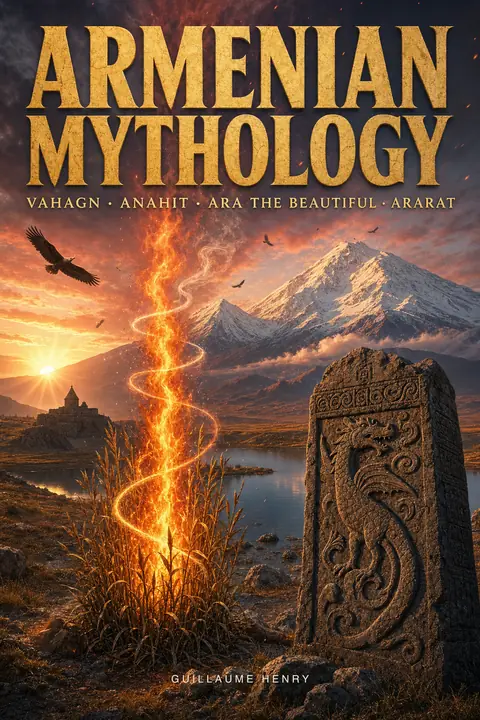
Armenian
The Armenian Mythology Book: Vahagn, Anahit, Aramazd and the Sacred Stories of the Caucasus Before Christ
Gods of Fire, Bronze, and the Forgotten Kingdom of Urartu
The pre-Christian gods of Armenia: Vahagn the dragon-slayer, Anahit the mother goddess, and the syncretic pantheon that merged Urartian, Persian, and Greek traditions before vanishing in 301 CE.
More from Armenian
All articles
Armenian
Vahagn: Armenian God of Fire, Thunder, and War
Vahagn roars through the red dawn, the Armenian god of fire, thunder, and war whose bronze-voiced hymns echo in the oldest Christian prayers. Discover the warrior deity who conquered chaos, shaped Armenia's spiritual identity, and survived conquest itself.

Armenian
Anahit: The Great Mother Goddess of Armenia
Anahit ruled Armenia's spiritual world for millennia as the Great Mother, keeper of waters, fertility, and wisdom. Discover how she shaped an entire civilization's understanding of divine power.

Armenian
Aramazd: The Creator God and Father of All
Aramazd stands at the foundation of Armenian myth as the supreme creator, the father from whom all life and divinity flow. Discover how this ancient god shaped the cosmos and why he vanished from Armenia's religious life after the conversion to Christianity.

Armenian
Hayk and Bel: The Founding Myth of Armenia
The story of Hayk's rebellion against the tyrant Bel explains how Armenia was born. A warrior's defiance, a nation's origin, and a line of kings that would rule for centuries.