
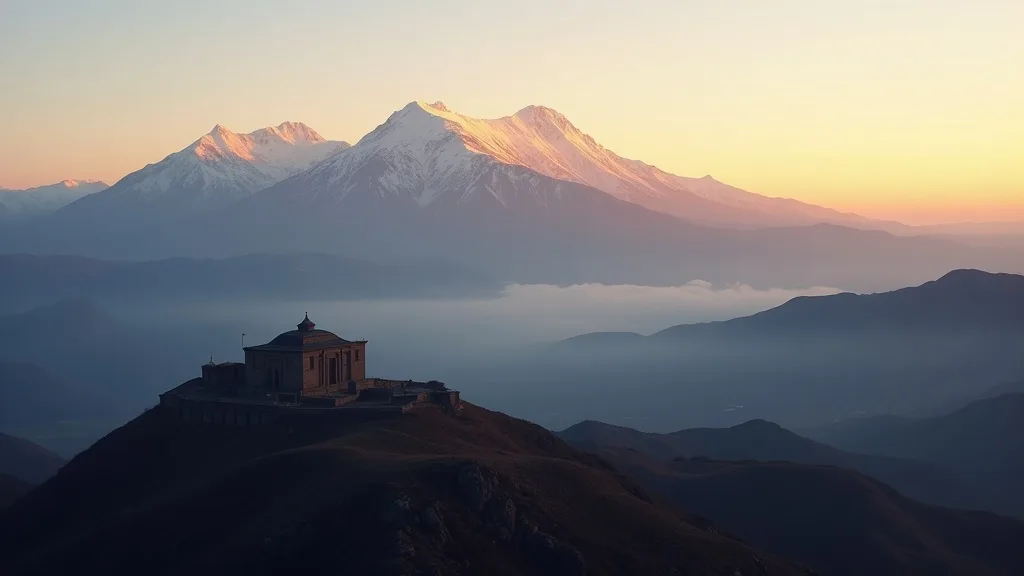
Mount Ararat: Sacred Mountain and Cosmic Axis
Mount Ararat rises from the Armenian plateau like a world-pillar frozen in basalt and ice. For millennia, Armenians have read its twin peaks as the axis around which heaven, earth, and identity turn.
Contents
Snow locks the summit for most of the year, and on clear mornings the cone catches the first light while the valleys beneath it are still dark. Travelers crossing the Ararat plain have described a peculiar optical effect: the mountain seems to float above the horizon, unmoored from the earth, its glacier a white flame suspended between sky and soil. That image is not poetic license. It is, in many ways, the theological argument that Armenian tradition has been making for three thousand years.
Mount Ararat stands at 5,137 meters above sea level, a dormant stratovolcano whose twin summits, Greater Ararat (Masis in Armenian) and Lesser Ararat (Sis), dominate the skyline of the modern Armenian capital Yerevan from roughly 40 kilometers away. The mountain sits today inside Turkish territory, formally separated from the Republic of Armenia by the Aras River, a political border that dates to the 1921 Treaty of Kars. Yet no Armenian mind has ever conceded it. The mountain appears on the Armenian coat of arms, it anchors the country's origin stories, and it gives its name to the country's finest brandy. Displacement from a sacred center is itself a defining part of the tradition's power.
The Name Before the Name: Urartu, Masis, and Linguistic Deep Time
The plateau that bears the mountain has been inhabited since at least the Neolithic period. Excavations at Metsamor, a site visible from the Ararat plain, reveal continuous occupation stretching back to the fifth millennium BCE. The people of Urartu, who built their fortress capital Tushpa on the shores of Lake Van, left cuneiform inscriptions that mention the sacred geography of the region without naming the peak directly. Their successors, the proto-Armenian tribes that absorbed and transformed the Urartian cultural legacy, carried the name Masis forward.
The etymology of Masis remains disputed. One strand of scholarship connects it to an Old Iranian root meaning "great" (cognate with maz- in Avestan), which would make it simply "the Great One." Another strand points toward a substrate language, perhaps Hurrian, in which the syllable carried a different semantic weight. What is not disputed is that the name functioned as a proper noun of supreme geographical and spiritual authority long before Greek or Hebrew writers encountered the peak.
The Greek geographer Strabo, writing in the first century BCE, described the Armenian highland as a plateau ringed by formidable peaks, though he did not single out Ararat by any name we can confidently identify. It was Armenian historiography, crystallized in the fifth-century works of Moses of Khoren (Movses Khorenatsi), that first systematically tied the mountain's names, its legends, and the Armenian national genealogy into a single narrative.
Noah's Ark and the Mountain as World-Navel
The identification of Ararat with the resting place of Noah's Ark is not a late Christian interpolation. It flows from a much older pattern of thought: mountains as the point where heaven and earth briefly touched, where cosmic waters receded, where the first dry land emerged from the primordial flood.
Genesis 8:4 states that "the ark came to rest on the mountains of Ararat," using the plural, which originally referred to the broader kingdom of Urartu rather than a single peak. Early Christian exegetes, among them Josephus (citing the Babylonian chronicler Berossus) and later the Armenian catholicos, progressively narrowed the landing site to Greater Ararat. By the medieval period, the identification was absolute: the summit held the wooden remains of the vessel, preserved by eternal ice, and Armenian monasteries ringed the mountain's lower slopes partly to anchor that claim in sacred architecture.

The theological weight of this identification cannot be overstated. If the ark rested on Ararat, then Ararat is the omphalos, the navel of the post-diluvian world. Every people on earth descends from a family that stepped off a gangplank onto its slopes. The mountain is not merely Armenian. It is the origin point of all human history, and Armenians happen to live in its shadow, a cosmological argument for cultural centrality that generations of Armenian writers, artists, and priests have exploited with considerable sophistication.
The Armenian historian Faustus of Byzantium (Pawstos Buzand), writing in the fourth or fifth century CE, records the story of Saint Jacob of Mtsbin, who attempted multiple ascents of the summit to retrieve a piece of the ark. Each time, he fell asleep on the slope and woke at the base. An angel finally appeared and told him the summit was not for human feet, but gave him a plank of the ark as consolation. This legend does several things at once: it confirms the relic's presence, it sacralizes the inaccessibility of the peak (making the mountain itself a kind of negative holy of holies), and it positions the church as the legitimate custodian of the substitute relic.
The Dragon of the Deep and Pre-Christian Strata
Armenian mythology did not begin with the ark. Long before Christianity reached the Caucasus in 301 CE, the mountain occupied a place in a much older cosmological schema. The pre-Christian Armenians worshipped a pantheon that included Aramazd, the sky-father adapted from Ahura Mazda, and Astghik, the goddess of water and fertility who was associated with springs flowing from the mountain's glacial melt.
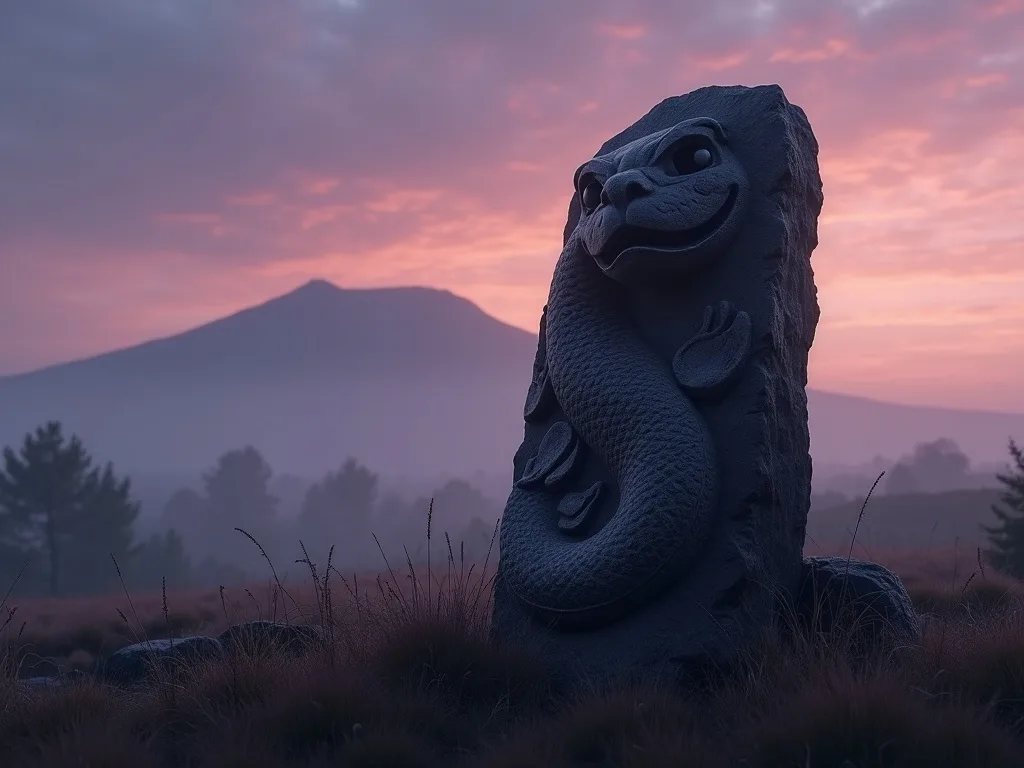
The dragon-serpent figure known as Vishap is central to pre-Christian Armenian sacred geography. Vishapner (the plural) were enormous serpents or dragons believed to inhabit lakes, rivers, and the deep water sources beneath mountains. Archaeological evidence for the vishap cult is striking: carved stone stelae in the shape of fish or serpent-dragons, some standing over three meters tall, have been found across the Armenian highland, with several excavated on the slopes of Mount Ararat itself. These vishapakars (dragon stones) date from the second millennium BCE and represent one of the oldest layers of Armenian religious practice.
The cosmic logic is straightforward: the mountain channels water from the sky (snow, rain) down into the rivers and springs below. Something must govern that vertical flow. The vishap occupied the deep, the watery underworld, while the sky gods occupied the height. The mountain was the contested middle ground, the pillar connecting both realms. This structure is not unique to Armenian tradition; it appears in ancient Mesopotamian, Indo-Iranian, and Anatolian religion. But the Armenian plateau preserved it in unusually concrete, archaeological form.
Haik, the Giant-Slayer, and the Founding Myth of the Armenian Nation
The most important founding narrative in Armenian tradition places the ancestor hero Haik at the foot of Ararat. According to Moses of Khoren's History of Armenia (fifth century CE, drawing on much older oral sources), Haik was a giant and a skilled archer, a descendant of Noah's son Japheth, who fled the tyranny of the Babylonian titan Bel (a euhemerized Baal or Enlil figure) and led his clan northward to the land that would bear his name: Hayastan (literally "the land of Haik," the Armenian name for Armenia).
Bel pursued him. The two forces met in battle near Lake Van, and Haik killed Bel with a single arrow. The arrow, in some tellings, was three-feathered and fired from a great composite bow, the kind the Armenian mounted archers would later make famous in antiquity. Haik's victory established the Armenian homeland, and the mountain at its heart served as the landscape-marker of divine sanction for that settlement.
The myth maps onto real geography with precision. The route from Mesopotamia to the Armenian plateau, passing through the Ararat plain, is the actual corridor of migration and invasion that armies, traders, and peoples used for millennia. Haik's story is not allegory in any thin sense. It is the mythological encoding of a genuinely contested geography.
The name Hay (Haik's shortened form, used by Armenians to refer to themselves to this day) and the name of the country Hayastan both derive from this founding figure. Ararat stands as the backdrop of this origin scene, the mountain in whose shadow the first Armenian identity was forged in blood and archery.
Read more about the origins of the Armenian pantheon and its Indo-Iranian connections
Cosmic Axis: The Mountain as Pillar Between Worlds
The concept of the axis mundi, the cosmic axis that connects underworld, earth-surface, and sky, appears across virtually every mythological tradition with mountains in its landscape. Ararat is the Armenian instance of this near-universal structure, but it carries specific features that distinguish it from, say, Mount Olympus or Mount Meru.
First, Ararat's axis is explicitly temporal as well as spatial. The mountain is not just where the vertical worlds meet; it is where time restarted. The ark narrative makes the peak a hinge-point in cosmic history, the moment when flood-time gave way to ordinary time. The mountain holds that threshold open in permanent geological form.
Second, the twin-peak structure of Ararat, Greater and Lesser, generated a dualistic symbolism that fed into Armenian cosmological thought. Greater Ararat (Masis) was associated with the masculine, the sky, and divine transcendence. Lesser Ararat (Sis) was associated with the feminine, the earth, and approachable sacrality. Medieval Armenian pilgrims circled both peaks in a ritual perambulation that traced the marriage of heaven and earth.
Third, the mountain's visibility. Unlike many sacred peaks hidden in remote ranges, Ararat is visible from an enormous inhabited plain. Yerevan, Vagharshapat (Etchmiadzin), and a dozen major Armenian cities all face it directly. This means the cosmic axis is not a matter of pilgrimage to a remote site; it is the constant backdrop of ordinary life. The mountain watches. That perpetual visibility made Ararat function as a kind of open-air temple, a permanent orientation device for an entire civilization.
Etchmiadzin and the Sacred Landscape Around the Mountain
The relationship between Mount Ararat and the Armenian Apostolic Church crystallized at Etchmiadzin, the cathedral city 20 kilometers north of the mountain's base. According to tradition, the catholicos Gregory the Illuminator received a vision in 301 CE in which Jesus Christ descended from heaven and struck the earth with a golden hammer at the spot where the cathedral should be built. The name Etchmiadzin means "the place where the Only-Begotten descended." The mountain is the frame for that descent.
The physical arrangement is deliberate. Etchmiadzin's main altar faces east, toward the rising sun and toward Ararat. The cathedral's sacred geography assumes that the mountain is the permanent backdrop of divine activity, the guarantor that the vision was genuine and the location correct. Relics held in the cathedral treasury include fragments claimed to be from Noah's Ark, a direct material link between the church's authority and the mountain's cosmological role.
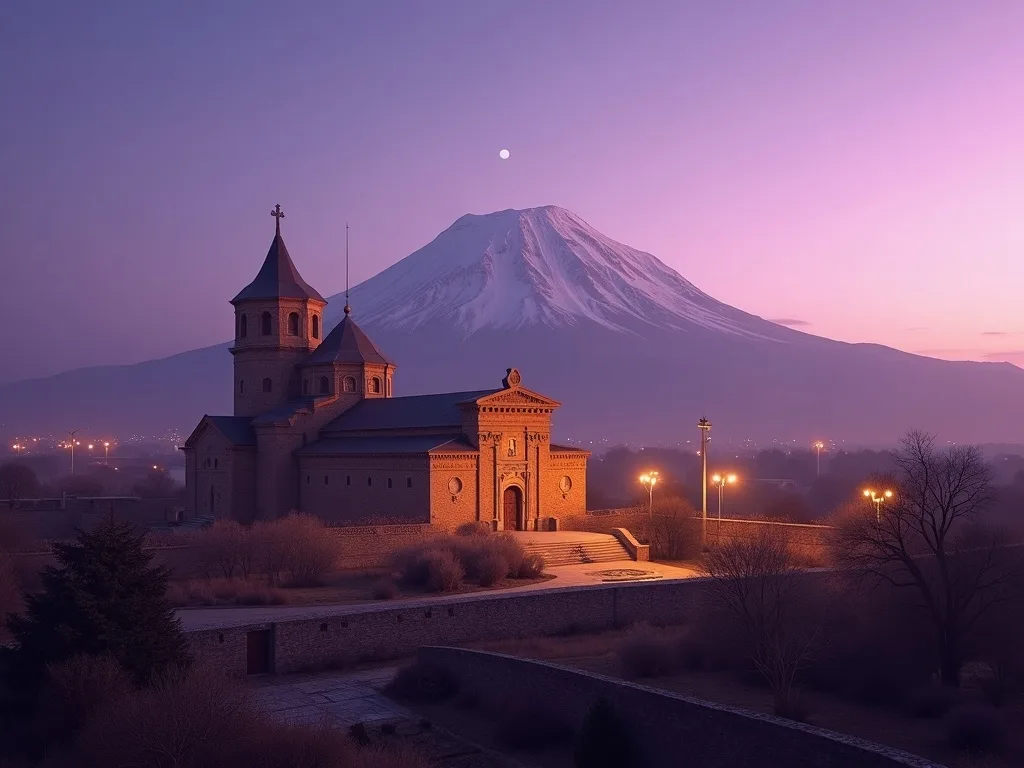
The monastery of Khor Virap, built on the site where Gregory the Illuminator was imprisoned for thirteen years before converting King Tiridates III, sits at the nearest point of the Armenian plain to Ararat's base. Photographs taken from Khor Virap, with the monastery's stark walls in the foreground and the twin peaks behind, have become iconic representations of Armenian cultural identity. The composition is not accidental. The church chose this location partly because the mountain's presence transformed every liturgical act performed there into a cosmologically anchored event.
Ararat in Armenian Poetry, Art, and Modern Identity
The Armenian literary tradition does not treat Ararat as background scenery. The nineteenth-century poet Khachatur Abovian, whose 1858 novel Wounds of Armenia is considered the founding text of modern Armenian literature, opened his work with an address to Masis so charged with grief and longing that it reads as a theological lament. After the 1915 Genocide and the loss of the ancestral homeland, Ararat became the organizing symbol of dispossession: a mountain you could see from Yerevan on clear days but could not visit, could not climb, could not pray at directly.
The painter Martiros Saryan returned to Ararat obsessively through the twentieth century, rendering it in flattened color fields that owe something to Persian miniature and something to Post-Impressionism, always keeping the mountain's presence as the stabilizing element in landscapes of radical political instability. The Armenian Genocide Memorial in Yerevan, the Tsitsernakaberd complex, is oriented so that its eternal flame and the mountain's cone occupy the same sightline. Grief and geography merge in the architectural gesture.
Contemporary Armenian writers in the diaspora, from Los Angeles to Beirut to Paris, return to the mountain as a cognitive anchor. The writer Atom Egoyan has spoken about Ararat in relation to his 2002 film of the same name, where the mountain functions as a site of contested memory and unresolved historical trauma. The sacred axis is not merely spatial in the modern usage; it is also temporal, a point around which the catastrophe of 1915 and the hope of cultural survival organize themselves.
The presence of Ararat on the national coat of arms prompted a 1965 complaint from Turkey to the Soviet Union: why does a Soviet Republic display a symbol from Turkish territory? The Soviet premier Anastas Mikoyan, himself of Armenian descent, reportedly replied: "You have a moon on your flag. The moon is not in Turkey either." The anecdote, possibly apocryphal, illustrates something real about the mountain's status. It belongs to Armenian cosmology in a way that transcends property law.
The Mountain Between Two Traditions: Armenian and Kurdish Sacred Claims
The slopes of Ararat have also held sacred meaning for the Kurdish and Turkish-speaking populations who have lived around it. The Kurds refer to the peak as Çiyayê Agirî, "the Mountain of Fire," a name that preserves the volcanic memory of the mountain's eruptive history (its last major eruption was in 1840, which destroyed the Armenian village of Akori and the monastery of St. Jacob on its slopes). The fire-mountain motif in Kurdish oral tradition parallels, without being identical to, the Armenian axis-mundi conception.
The 1840 eruption is archaeologically and historically significant. It destroyed physical infrastructure that had anchored the Christian sacred landscape for over a millennium, including the monastery where the ark-plank relic was kept. The destruction was interpreted by Armenian clergy as a divine warning; by secular observers, it was a reminder that the mountain's sacrality rested on geological instability. A cosmic axis built on a stratovolcano is, in the deepest sense, a sacred thing that can erupt.
Armenian Tradition
Ararat as the landing place of Noah's ark: the mountain is the origin point of post-diluvian humanity, making it the navel of the renewed world. The Georgian and Armenian churches competed over which slope held the primary relic.
Mesopotamian Tradition
The Babylonian flood hero Utnapishtim (in the Epic of Gilgamesh) lands his vessel on Mount Nimush (or Nisir), located in the Zagros range further east. The mountain of survival is geographically mobile across Mesopotamian sources, reflecting competing regional claims to flood-mountain status.
Frequently Asked Questions About Mount Ararat in Armenian Mythology
Frequently asked questions
Why is Mount Ararat called Masis in Armenian rather than Ararat?
The name Masis predates the biblical designation "Ararat" in Armenian usage and likely derives from a pre-Indo-European substrate language of the Anatolian or Caucasian plateau, possibly carrying the sense of "the great one." The biblical name Ararat, used in Genesis and by Hebrew writers, derives from Urartu, the Iron Age kingdom (860-590 BCE) that controlled the plateau. Armenians preserved the older local name Masis for Greater Ararat and use "Ararat" primarily in contexts shaped by biblical or international usage.
Is the search for Noah's Ark on Mount Ararat based on Armenian tradition or later Christian speculation?
The identification began in Armenian and Syriac Christian sources of the early centuries CE and was systematized by Armenian historians including Faustus of Byzantium. It was not a late medieval European invention. The monastery of St. Jacob on Ararat's slopes housed a claimed relic of the ark (a wooden plank) for centuries. Modern expeditions searching for the ark on the summit, beginning in earnest in the nineteenth century, draw on this long tradition but have found no verified archaeological evidence.
What are vishap stones and how do they connect to Mount Ararat?
Vishapakars (dragon stones) are carved basalt stelae, often fish-shaped or serpentine, dating from roughly the second millennium BCE. They were erected near water sources, high pastures, and mountain slopes across the Armenian highland. Several have been found on Ararat's slopes. They represent the vishap, a draconic water-spirit believed to inhabit the deep sources of rivers and springs. The stones likely marked boundaries between human and supernatural territory and may have functioned in ritual contexts connected to rain-making or agricultural fertility.
Why does Mount Ararat appear on Armenia's coat of arms even though it is in Turkey?
Armenia's coat of arms was established by the First Republic of Armenia in 1918 and adopted with modifications by the Third Republic in 1991. Ararat is included because it is the central symbol of Armenian cultural identity, historical homeland, and mythological origin, not because it represents current territorial sovereignty. Turkey has objected to this usage, but Armenia maintains that a national symbol reflects civilizational heritage, not contemporary borders.
How does Ararat function as a cosmic axis compared to other sacred mountains in world mythology?
Most axis-mundi mountains function as vertical connectors between underworld, earth, and sky. Ararat shares that structure but adds a temporal dimension unique to its role in the Noah narrative: it is the point where cosmic time restarted after the flood. This makes it not just a spatial axis but a chronological one, a mountain that marks the boundary between primordial time and historical time. This dual function, spatial and temporal, gives Armenian sacred cosmology a distinctive character within the broader comparative framework of mountain mythology.
What happened to the monasteries on Mount Ararat's slopes?
The primary monastic complex on Ararat's lower slopes was the Monastery of St. Jacob (Surb Hakob), built on the site where the angel reportedly appeared to Jacob of Mtsbin. The 1840 eruption and associated earthquake destroyed both the monastery and the village of Akori near its base, killing hundreds. The monastery was partially rebuilt but destroyed again during the nineteenth-century conflicts. The 1915 Genocide and subsequent population transfers eliminated the Armenian communities that had maintained the sacred landscape for centuries. Today no Armenian monastery functions on the mountain's slopes.
The Unresolved Mountain: Ararat Between Memory and Geology
There is a particular quality to sacred sites that remain physically inaccessible to the people who hold them sacred. The inaccessibility does not diminish the sacrality. It intensifies it, sometimes catastrophically. Ararat, visible from Yerevan on roughly two hundred clear days per year, has operated under this condition for over a century. The mountain has become, in the post-Genocide Armenian imagination, a figure not only of origin but of perpetual witness.
Armenian geologists have noted that the dormant volcano last showed seismic activity in the nineteenth century and remains technically capable of future eruption. The geological fact carries mythological resonance: the cosmic axis is not a dead pillar but a sleeping one. The vishap may yet move in the deep. The mountain's ice-cap has receded measurably over the twentieth and twenty-first centuries, a loss that Armenian environmental writers have tied explicitly to the loss of the sacred landscape, reading glacial retreat as a kind of ongoing desecration.
Scholarly work by scholars including James Russell (Harvard) and Hrach Martirosyan has deepened the understanding of pre-Christian Armenian religion and the mountain's role within it, recovering strands of the vishap cult, the pre-Christian calendar system, and the relationship between the Iranian religious substrate and the indigenous Caucasian layers. This work suggests that what Armenian tradition preserved around Ararat is not one mythology but a palimpsest: Urartian, proto-Armenian, Zoroastrian, and Christian layers written one over another on the same landscape.
The mountain absorbs all of it. The snow on the summit does not distinguish between the prayers of medieval monks, the laments of Genocide survivors, and the calculations of volcanologists. It holds every human meaning projected onto it with the same impassive permanence that makes sacred mountains sacred in the first place: they were here before us, and they will remain after.
Free 25-page sample
Want the whole story?
Take the first 25 pages free. If it pulls you in, the full edition is yours as an instant PDF download, with a paperback on Amazon for selected titles.
Armenian
The Armenian Mythology Book: Vahagn, Anahit, Aramazd and the Sacred Stories of the Caucasus Before Christ
Gods of Fire, Bronze, and the Forgotten Kingdom of Urartu
The pre-Christian gods of Armenia: Vahagn the dragon-slayer, Anahit the mother goddess, and the syncretic pantheon that merged Urartian, Persian, and Greek traditions before vanishing in 301 CE.
More from Armenian
All articles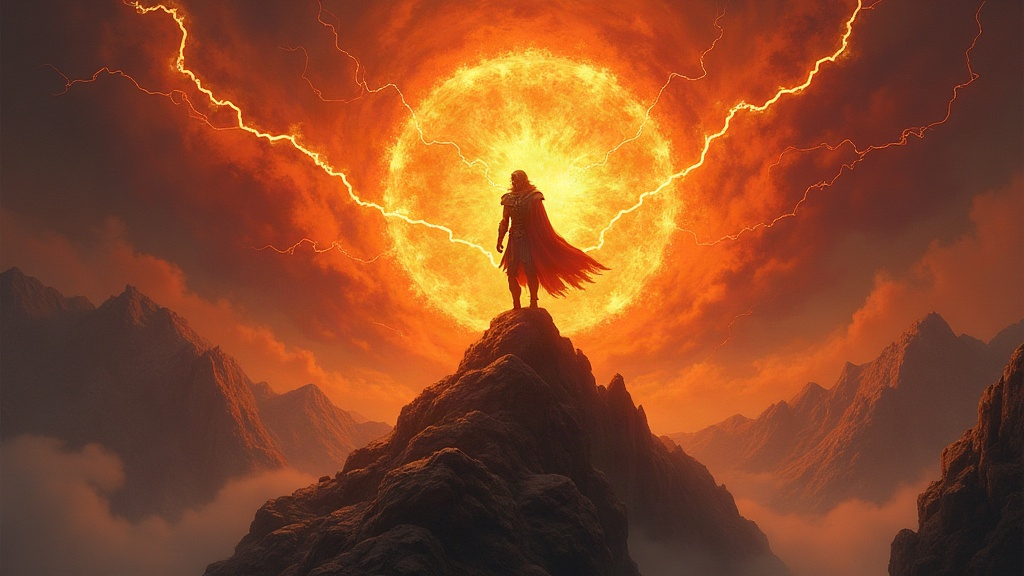
Armenian
Vahagn: Armenian God of Fire, Thunder, and War
Vahagn roars through the red dawn, the Armenian god of fire, thunder, and war whose bronze-voiced hymns echo in the oldest Christian prayers. Discover the warrior deity who conquered chaos, shaped Armenia's spiritual identity, and survived conquest itself.
Armenian
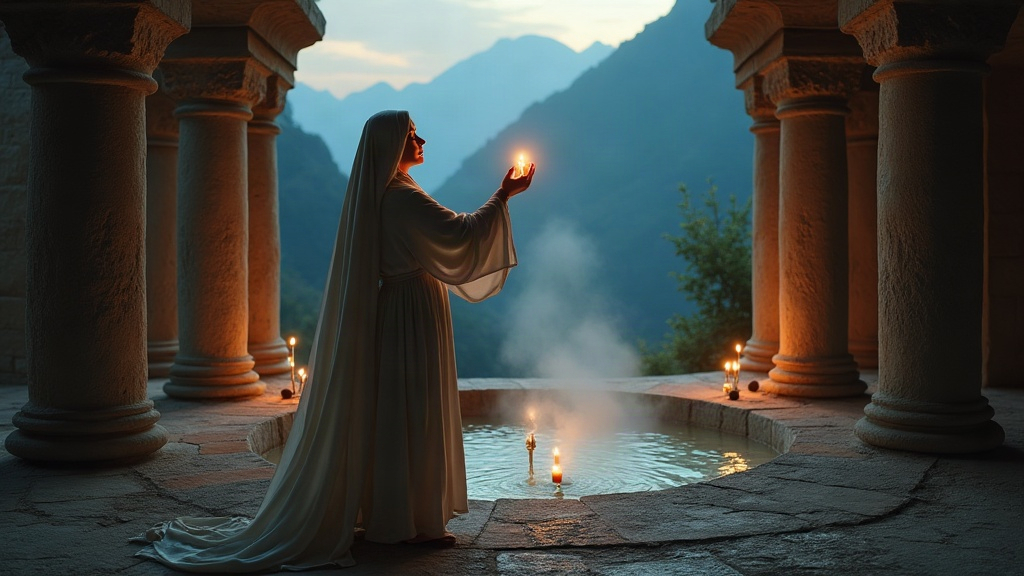
Anahit: The Great Mother Goddess of Armenia
Anahit ruled Armenia's spiritual world for millennia as the Great Mother, keeper of waters, fertility, and wisdom. Discover how she shaped an entire civilization's understanding of divine power.

Armenian
Aramazd: The Creator God and Father of All
Aramazd stands at the foundation of Armenian myth as the supreme creator, the father from whom all life and divinity flow. Discover how this ancient god shaped the cosmos and why he vanished from Armenia's religious life after the conversion to Christianity.

Armenian
Hayk and Bel: The Founding Myth of Armenia
The story of Hayk's rebellion against the tyrant Bel explains how Armenia was born. A warrior's defiance, a nation's origin, and a line of kings that would rule for centuries.