
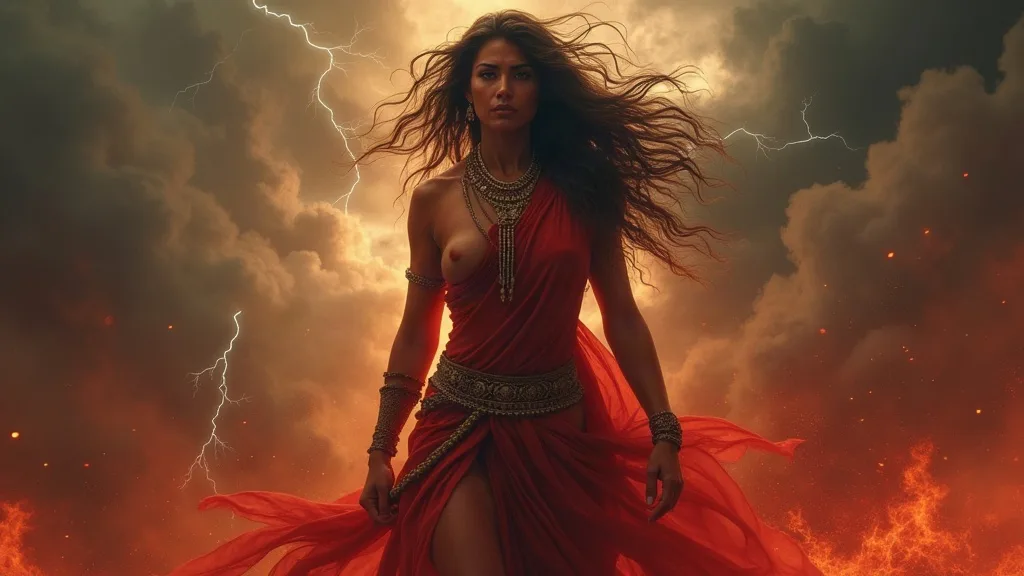
Anat: The Warrior Goddess of Love and Battle
Anat stands alone in Canaanite myth: a goddess who commands bloodshed and desire with equal fury. Explore the warrior deity who protected kings, seduced gods, and defied every boundary of her world.
Contents
Blood and wine run together on Anat's hands. She wades through battlefields, exulting in slaughter, her feet sliding in the gore of her enemies. Then, in the next breath, she is beauty incarnate, demanding tribute and love from gods far greater than herself. No other figure in the Canaanite pantheon holds such contradiction: the virgin warrior, the goddess of both carnage and desire, the one who answers to no man and bows to no restraint.
The Canaanite peoples, who inhabited the Levantine coast and interior plateaus from roughly 1500 to 300 BCE, worshipped a complicated array of deities. We know them through fragments: inscriptions on stone, references in Biblical Hebrew texts, and above all through the Ugaritic texts, a collection of clay tablets discovered at the Syrian coastal city of Ugarit in 1928. Those tablets preserve myths in a language close to Hebrew, written in a simple alphabetic script. In those myths, Anat emerges not as a peripheral figure but as a force of nature, raw and purposeful, the daughter of El (the father god) and a key player in the survival of the Canaanite cosmos itself.
Origins and Divine Lineage
Anat belongs to the highest tier of the Canaanite divine family. The Ugaritic texts call her the daughter of El, the aged sky god and ultimate authority of the pantheon. Her mother, in most accounts, is Athirat (also called Asherah), the mother goddess and consort of El. This parentage grants Anat both legitimacy and autonomy: she is a princess of heaven, yet her actions suggest someone utterly unconcerned with court protocol.
Her brother, or sometimes her lover (Canaanite mythology allows both interpretations simultaneously), is Baal, the storm god and vegetation deity. Their relationship forms one of the emotional cores of Canaanite myth. Baal is the dynamic force of storm and fertility, but Anat surpasses him in sheer will. When Baal is threatened, she moves mountains to protect him. When he dies and descends into the underworld, she alone pursues him into death's domain.
The Ugaritic texts give her titles that accumulate like war-trophies: "Virgin Anat," "Anat the Pure," "Anat the Daughter of El," and most strikingly, "Anat Qaniyatu," which scholars translate as "Anat the Wise" or "Anat the Glorious." Her epithet betulat means "virgin", not in the sense of sexual inexperience (the texts make clear she is sexually active), but as a marker of independence, a woman who belongs to no man and submits to no husband's authority. This distinction mattered in cultures where women typically gained identity through marriage. Anat's virginity was her autonomy.

The Warrior Unbounded
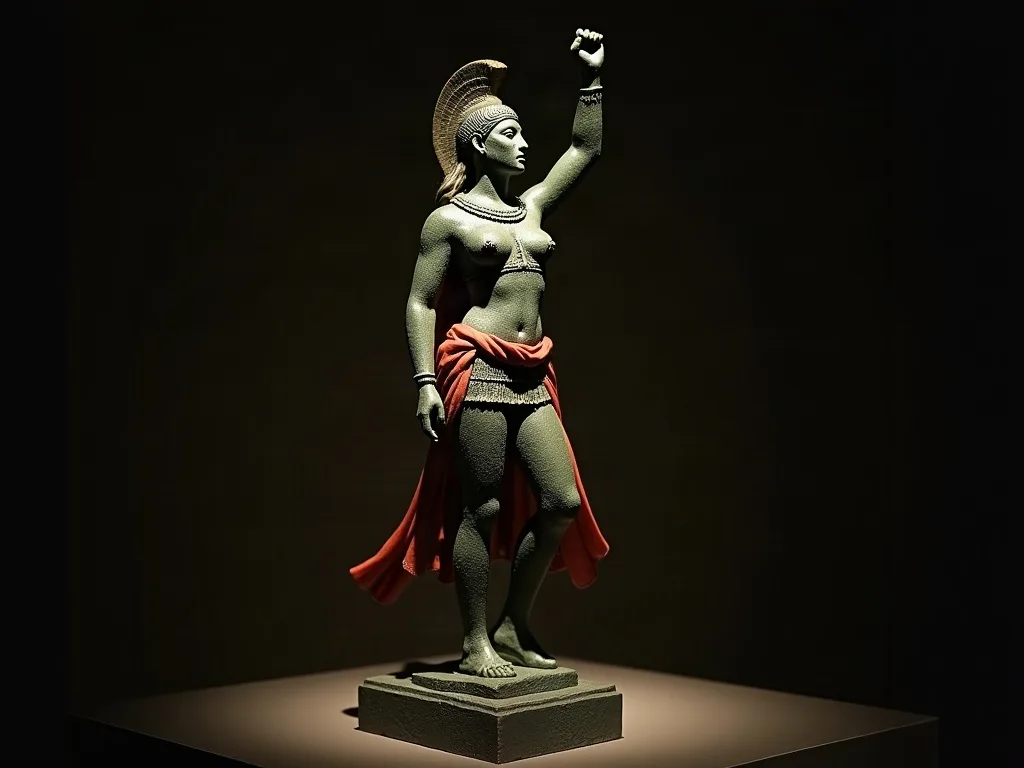
What sets Anat apart is not merely her willingness to fight, but her ecstasy in violence. The Ugaritic texts preserve a passage of breathtaking brutality. Anat descends into the world of humans, and there she wages war on a scale that blurs the line between combat and massacre:
"Anat smites the peoples; Anat slaughters mankind. With her blood she washes her hands, with gore she bathes her hips. For she plunges her knees in the blood of soldiers, her loins in the gore of warriors."
This is not the measured heroism of a martial deity like Athena. This is uncontrolled, almost orgasmic violence. She sweeps across battlefields, laughing, painting herself in blood like a lover in perfume. The Ugaritic scribes do not present this as an aberration or a flaw to be corrected. They describe it as her nature, her power, her proof of divinity.
In one narrative, Anat carries out a commission for El or the broader pantheon. The myth is fragmentary, Ugaritic literature survives in pieces, but the core action is unmistakable: she hunts down a figure called Yamm (the Sea) or another cosmic threat, and she defeats it with a violence so complete that the victory becomes mythological truth. Her enemies do not merely lose; they cease to exist.
This ferocity earned her a role as protector of the Canaanite king. Royal inscriptions from Phoenician and later Canaanite dynasties invoke Anat's blessing for conquest and dominion. Kings pray to her before battle. She grants victory not through wisdom or cunning but through the sheer force of her will and the fear she generates in those who oppose her. To invoke Anat was to claim access to an animal fury that transcended human limits.
Love and Desire Unfiltered
The same texts that portray Anat as a gore-soaked killer also present her as a figure of erotic magnetism and surprising vulnerability. In one famous passage, she falls in love with Aqhat, a mortal prince gifted with extraordinary power. The texts are explicit: she desires him sexually and will use any means to have him. When Aqhat refuses her (a transgression of cosmic protocol; you do not reject a goddess), Anat's response is lethal. She recruits a supernatural assassin to kill him, then mourns him afterward with a grief so intense it borders on madness.
This is not love as tenderness or devotion. It is love as appetite, as the assertion of will, as the demand to be matched and fulfilled. Anat wants what she wants, and the universe is expected to bend. When it doesn't, she will break it.
Her relationship with Baal is similarly charged. The texts hint at both sexual intimacy and a kind of protective frenzy. When Baal faces his enemies, Anat is his fiercest advocate. She rallies other deities on his behalf. When he is defeated and descends into the underworld (a pattern that echoes across Mediterranean and Near Eastern mythologies), Anat grieves, searches, and ultimately ensures his resurrection. Her love is not patient or modest. It is volcanic.
In some contexts, Anat appears as a courtesan or lover to divine princes, offering her body as a tool of power and connection. In others, she is a virgin warrior rejecting all suitors. These are not contradictions in the Canaanite worldview. They are facets of the same divine complexity. A goddess need not be consistent across all moments. She can be desire and rejection, nurture and slaughter, in the same day.
The Cosmic Drama and Baal's Resurrection
The narrative heart of Canaanite mythology involves the struggle between Baal and the forces of chaos and death. The Ugaritic Cycle of Baal is our primary source, and Anat is woven through it as both motive and agent.
In one major sequence, Baal is challenged by Mot, the god of death and the underworld. Mot is not evil in a moral sense; he is the necessary principle of dissolution, hunger, and the grave. But his hunger is absolute. Baal is dragged into Mot's realm, defeated, swallowed. With Baal's absence, the earth withers. Rains cease. The world enters a kind of winter.
Anat's response is instantaneous and unconditional. She goes to her father, El, and demands Baal's rescue. When El is indifferent or unmoved, she proceeds anyway. She finds Mot, confronts him, and in some versions actually defeats him in combat. The text fragments here, but the implication is clear: Anat forces Mot to release Baal, or at least to accept Baal's partial return to the world. The cycle of death and rebirth depends on her willingness to breach the boundary between the living and the dead.
This myth served a deeply practical function in Canaanite religious life. The annual cycle of seasons, the return of rain after drought, the renewal of crops after harvest, these were lived as a cosmic drama enacted by the gods. Anat's yearly rescue of Baal was the myth that explained why the world did not simply die. Spring came not because of meteorology but because a goddess loved fiercely enough to defy death itself.
Anat in Worship and Royal Ideology
Archaeological evidence and inscriptions show that Anat was worshipped widely across the Levantine coast and interior. She had temples. She received offerings. Priests and priestesses served her cult. Kings inscribed her name alongside their own, claiming her protection and favor.
In Phoenician and later Punic culture (as Canaanite civilization evolved and expanded), Anat merged with other warrior and love goddesses. In Egypt, where Phoenician traders and settlers maintained a presence, she was sometimes identified with Sekhmet, the fierce lioness goddess of plague and warfare. In Greek contexts, she bore similarities to Athena (the warrior goddess) and Aphrodite (the love goddess), though Anat unified these roles in ways that Greeks saw as requiring separate divinities.
The inscription of Egyptian Pharaoh Amenhotep III (14th century BCE) mentions Anat as a protective deity for chariots and soldiers. Ramesses II invoked her in battle. This suggests that Anat's cult extended beyond Canaanite proper into the wider sphere of ancient Near Eastern religion. She was a portable deity, a force that transcended borders.
In Canaanite royal ideology specifically, kings were often called the "sons of Anat" or said to sit in Anat's favor. The king's military success was read as evidence of her blessing. His virility and potency were enhanced by her recognition. This created a mutually reinforcing system: the goddess's reputation for power was maintained through the king's martial triumphs; the king's legitimacy rested on her invisible favor.
Complexity and the Dual Nature of Divine Power
Modern scholarship on Anat has moved away from simple categorizations. Early 20th-century scholars sometimes treated her as a "fertility goddess" (a catch-all category for any powerful female deity in non-European religions). Later work recognized her as far more specific: a warrior goddess whose sexuality and desire were expressions of power, not subordinate to a mothering or nurturing identity.
The Ugaritic texts do not ask us to reconcile her violence and her sensuality. They ask us to recognize them as unified. Both stem from the same divine energy: the absolute assertion of will, the refusal to be bound by convention, the demand that the world conform to her desires. When she kills, she kills with the same kind of intensity and pleasure that she brings to seduction. She is not merciful in either domain.
This complexity makes Anat difficult to fit into later monotheistic religious frameworks. When the Bible emerges from the Hebrew-speaking peoples of Canaan, it struggles against and absorbs Canaanite religion simultaneously. Anat vanishes from the biblical text almost entirely, suppressed, absorbed, denied, perhaps because her refusal to submit, to soften, to accept limits posed a theological problem for a tradition that was developing concepts of divine law and masculine authority.
Yet echoes persist. Some scholars see her influence in figures like Miriam, the prophetess sister of Moses, or in the violent deeds of Deborah and Jael in the Book of Judges. Deborah sings victory songs after battle; Jael drives a tent peg through the skull of an enemy general. These are Canaanite-style acts, the direct assertion of divine will through female agency and ferocity. The biblical authors who recorded these stories may have inherited more from Anat than they were willing to acknowledge.
Anat's Afterlife in Literature and Religion
When Greek colonists and traders encountered Canaanite religion, they attempted to map it onto their own pantheon. Anat was sometimes identified with Athena (warrior aspects) and sometimes with Aphrodite (desire aspects), but neither equation fully held. Greek religion had separated the functions of war and sexuality into distinct deities. Anat's refusal to be divided was foreign to Greek thought.
In later Gnostic and apocryphal texts, which drew heavily on Middle Eastern religious traditions, female divine figures of power and ambiguity appear. Scholars debate whether these represent a direct continuation of Anat-worship or simply a similar mythological impulse: the need to imagine divine femininity as something more complex and dangerous than passive motherhood.
In modern fiction and fantasy, Anat has appeared as a character or influence in works that explore warrior women and the problem of female power in patriarchal contexts. Authors who wish to imagine a goddess unconcerned with pleasing men, capable of ferocity, and erotically autonomous have sometimes drawn on Canaanite sources, even if the historical Anat remains obscure to general audiences.
The historical suppression of Anat in Western tradition is itself instructive. A goddess who combined violence and sexuality, who answered to no man, who used her body as a weapon and her weapons as an extension of her body, such a figure posed obvious problems for later patriarchal religions. It was easier to forget her than to explain her or accommodate her. Yet the Ugaritic tablets ensure she cannot be entirely erased. She remains, carved in clay, uncompromising.
Frequently asked questions about Anat the Canaanite Warrior Goddess
Frequently asked questions
What are the Ugaritic texts, and why do we know Anat mainly through them?
The Ugaritic texts are clay tablets discovered in 1928 at the ancient Syrian city of Ugarit. They contain myths, religious procedures, and correspondence written in Ugaritic, a language closely related to Hebrew. They date to around 1400-1200 BCE. Because Canaanite civilization was later absorbed and suppressed by surrounding powers, these texts are our best primary source for Canaanite religion. Biblical Hebrew texts mention Canaanite gods occasionally, but often in a dismissive or polemical context. The Ugaritic tablets give us the myths in their own voice, before later traditions rewrote or erased them.
Was Anat's virginity the same as being a maiden with no sexual experience?
No. The Ugaritic texts make clear that Anat was sexually active. Her "virginity" (betulat) was a status marker meaning she was not married and did not belong to any man. It was her independence, not her inexperience. Modern translations sometimes blur this, but Canaanite culture distinguished between social virginity (unmarried status, personal autonomy) and physical virginity (sexual inexperience). Anat held the former, not necessarily the latter. This distinction allowed her to be both a lover and a warrior without contradiction.
How did Anat influence later religions, particularly Judaism and Christianity?
Direct evidence of Anat-worship in later Jewish practice is sparse. Biblical authors were actively suppressing Canaanite religion as they consolidated Hebrew monotheism. However, scholars argue that certain biblical figures (like the judge Deborah, or the prophetess Miriam) embody Anat-like qualities: direct access to divine will, military prowess, and a refusal to defer to male authority. The Greek world sometimes identified Anat with Athena and Aphrodite, splitting her unified role. In Gnostic and apocryphal texts, female divine figures of power and ambiguity (like Sophia) may echo Anat's legacy, though the connection is debated among scholars.
Did Anat have a priesthood and formal temples like other Canaanite gods?
Yes. Inscriptions and archaeological evidence show that Anat had temples, priests, and organized cults across the Levantine coast. Worshippers made offerings to her, particularly before battles or hunts. Kings invoked her name in inscriptions seeking her blessing. Her cult persisted into the Phoenician and Punic periods (after Ugarit's decline), and she was worshipped as far as Egypt and Cyprus, where Phoenician merchants and settlers maintained a presence. Her exact role in daily worship (whether her priesthood performed fertility rites, war-magic, or other functions) remains partly obscure due to the fragmented nature of our sources.
What is the relationship between Anat and the biblical figure Asherah?
Asherah (also called Athirat in Ugaritic) was Anat's mother in Canaanite mythology, the mother goddess and consort of El. In biblical polemics, Asherah appears as a false goddess whose worship the Israelites must reject. Archaeological evidence shows that Asherah-worship was actually widespread among Hebrew-speaking peoples until the later monarchy. Anat herself barely appears in the biblical text, possibly because her association with warfare and uncontrolled sexuality made her even more threatening to Hebrew monotheistic ideology than Asherah. The two goddesses represent different aspects of female divinity: Asherah as mother and source of life; Anat as warrior, lover, and agent of will.
Why is Anat obscure today compared to Greek or Egyptian gods?
Canaanite civilization was absorbed, conquered, and later erased by successive empires and the rise of monotheistic religions. Biblical Hebrew texts, which were preserved and canonized, actively suppressed Canaanite deities in favor of Yahweh. Egyptian and Greek gods survived because their cultures produced extensive written records that were preserved and later studied by later civilizations. Canaanite religion left fewer monumental records and no continuous literary tradition. The Ugaritic tablets were only rediscovered in the 20th century. Modern readers know Isis and Athena far better than Anat not because the latter was less important in her own time, but because her world left fewer traces that survived to the modern era.
The Unresolved Goddess in a Changing World
Anat presents a puzzle for anyone seeking tidy categories. She refuses them. A warrior who loves fiercely. A virgin who is sexually active. A daughter who defies her father. A divine being who bathes in blood and laughs with genuine pleasure. The Ugaritic authors who preserved her myths did not attempt to reconcile these contradictions. They simply affirmed them as true.
This refusal to be simplified may be her deepest power. In a mythological landscape full of specialized deities (storm gods, grain goddesses, underworld judges), Anat stands alone as a figure of raw, undifferentiated divine force. She is not a symbolic abstraction. She is a presence, a will, a body in motion. When later religions came to value consistency, hierarchy, and male authority, Anat's mythological complexity became a liability. She had to be suppressed or forgotten.
Yet the Ugaritic clay tablets ensure her survival. Scholars continue to excavate new fragments, refine translations, and discover new dimensions in texts that were sealed away three thousand years ago. Each generation finds something new in Anat because she contains multitudes. She is what the warrior goddess might be if no one had ever taught her to be ashamed of her violence or apologize for her desire. She is what the love goddess might be if no one had ever told her to be soft. In a world increasingly interested in the complexity of female power, Anat's ancient voice grows more, not less, audible.
Read the full book
Want the whole story?
The complete edition is an instant PDF download here, with a paperback on Amazon for selected titles.
Canaanite
The Canaanite Mythology Book: Baal, El, Anat, and the Gods of the Ancient Levant
Baal, El, Anat, and the Gods of the Levant
The gods the Hebrew Bible warned against, recovered from the clay tablets of Ugarit: El the patriarch, Baal the storm-rider, Anat the war goddess, and Mot the lord of death. The mythology behind the Bible’s great rival.
More from Canaanite
All articles
Canaanite
El: The Father of Gods in Canaanite Religion
El ruled the Canaanite pantheon as the ancient king of gods, a weathered father whose name meant simply "god." Discover how this Syrian deity shaped Near Eastern belief for a thousand years before fading from memory.

Canaanite
Asherah: The Queen of Heaven and Consort of El
Asherah ruled the Canaanite pantheon as the Queen of Heaven, the consort of El, and the mother of seventy gods. Discover how this ancient goddess shaped Levantine belief and why her worship scandalized biblical writers.

Canaanite
Mot: The God of Death and the Underworld in Canaanite Myth
Mot rules the Canaanite underworld with an insatiable hunger, devouring all things mortal. Explore how this ancient god of death embodied fear, finality, and the cosmic struggle between life and extinction.

Canaanite
Yamm: The Sea God and Chaos Monster of Canaanite Myth
Yamm rules the Canaanite cosmos as both divine sovereign and terrifying chaos force. Discover how this turbulent sea god challenged the gods themselves and shaped the earliest Near Eastern creation myths.