

Asherah: The Queen of Heaven and Consort of El
Asherah ruled the Canaanite pantheon as the Queen of Heaven, the consort of El, and the mother of seventy gods. Discover how this ancient goddess shaped Levantine belief and why her worship scandalized biblical writers.
Contents
She rose from the sea foam, clothed in light. Long before the prophets condemned her, long before her name was scratched from temple walls, Asherah: The Queen of Heaven and Consort of El commanded the heavens and the earth across the Levant. In the Iron Age Canaanite world (roughly 1200-586 BCE), she stood at the center of the divine family, the greatest goddess the people knew, worshipped from household shrines to grand temples. El, the sky father, ruled from his mountain throne, but Asherah held the authority that mattered most: she was the mother of the gods, the counselor of kings, and the listening ear to human prayer.
The story of Asherah is the story of a goddess almost erased. Centuries of iconoclasm, deliberate deletion by rival faiths, and scholarly neglect nearly obliterated her from history. Yet archaeology and ancient texts have recovered her presence: she walks through the Ugaritic texts (clay tablets from a Syrian port city), appears in later Phoenician records, and left her mark so deep on early Israelite practice that biblical reformers felt compelled to smash her sacred poles and denounce her worshippers. To understand Asherah is to understand a vanished world where the feminine divine held cosmic power.
The Queen's Origins: From the Primordial Waters
The Canaanites believed creation began not with a void but with intention. From the infinite salt waters came El (also called Ilu in some dialects), the father god, aged and wise. He was not a young, violent storm king like Baal. El stood apart, dwelling in a tent at the source of two rivers, a figure of counsel and authority. With him arose Asherah, sometimes called Athirat in the Ugaritic language, and the name itself may derive from a root meaning "to walk" or "to go", suggesting a goddess of movement, pathway, and journeying.
The ancient Ugaritic texts preserved on clay tablets discovered in the 1920s at the city of Ras Shamra (modern Syria) paint a portrait of her cosmic role. She bore seventy gods to El, making her not only his consort but the generator of the divine family itself. This was no quiet partnership. Asherah possessed her own counsel, her own authority. She negotiated with other gods, interceded for mortals, and sat at El's right hand not as a decoration but as a co-sovereign of the cosmos.
One Ugaritic text, the Baal Cycle, depicts her walking through the divine assembly with confidence. She is addressed with titles of immense respect: "Holy Asherah," "Lady Asherah of the Sea" (emphasizing her connection to primordial waters and fertility), and "Mother of the Gods." These were not ornamental names. They reflected real power in the Canaanite religious imagination.
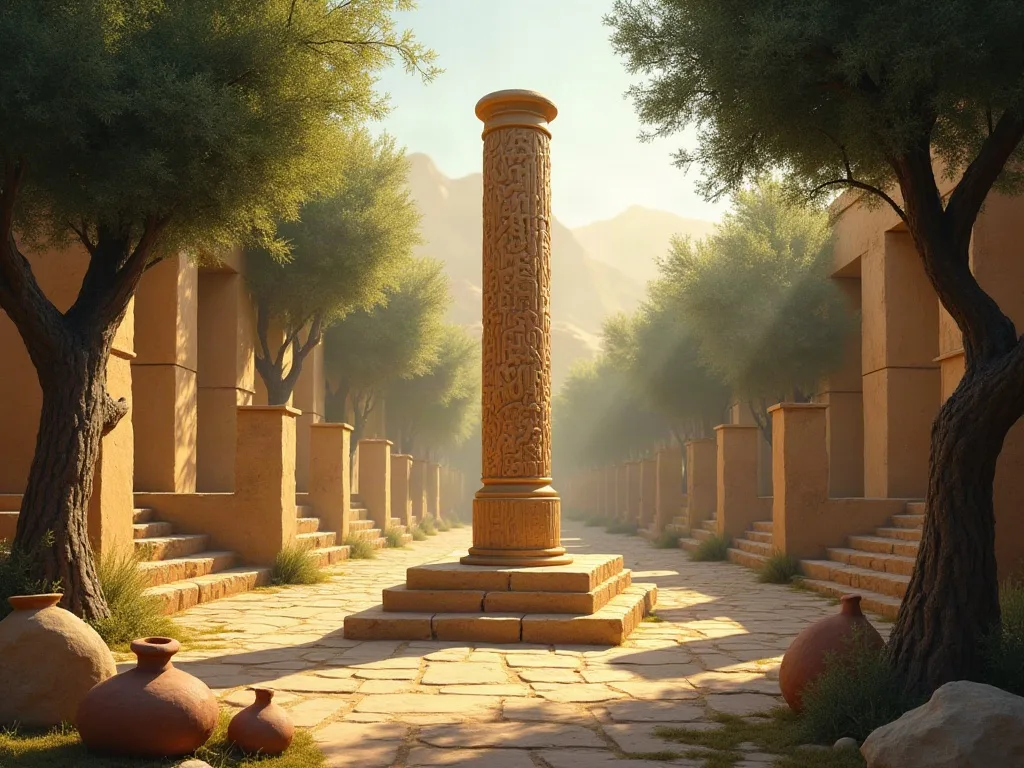
Sacred Poles and Household Worship
Walk into a Canaanite home or sanctuary in the late Iron Age, and you would likely encounter a carved wooden pole, a sacred pole called an asherah (lowercase, as the object was named after the goddess). These were not crude sticks. Some stood tall in public temples; others graced private homes. They were often carved with geometric patterns, sometimes topped with leaves or branches, and always understood as the goddess's physical presence or her symbol.
These poles served a practical purpose in ancient Levantine religion: they represented Asherah as the divine woman, fertility itself, the connection between earth and sky. To carve one, to plant one, to pour libations before it, was to invite the Queen of Heaven's blessing into your life. A household with an asherah pole hoped for abundant crops, healthy children, and the goddess's protection.
The poles became so common, so embedded in daily practice, that they persisted even after political and religious changes tried to stamp them out. Archaeological digs across ancient Judah, Israel, and surrounding regions have uncovered evidence of asherah poles in sanctuaries, homes, and even corners of temple courtyards. In some places, they coexisted uneasily with worship of Yahweh, the God of Israel, suggesting a long period of religious negotiation rather than clean replacement.
This household focus reveals something crucial: Asherah: The Queen of Heaven and Consort of El was not remote. She was intimate. People spoke to her directly. A mother praying for her child's health called on Asherah. A farmer hoping for rain addressed the Queen of Heaven. Unlike El, who sat distant and judgmental, Asherah was accessible, personal, maternal.
The Divine Family and Her Role in the Pantheon
In the Canaanite pantheon recovered from Ugaritic texts, the gods formed a family structure not unlike human society. At the head sat El, the aged patriarch. Asherah occupied the role of the matriarch, the eldest woman, the mother of gods and humanity alike. Below them came their children, most notably Baal, the storm god and agricultural deity, whose struggle against the chaos serpent Mot drove the central mythological drama.
Yet Asherah's position was complex. She did not simply obey El. Ugaritic texts show her advocating, interceding, even traveling to other gods to broker divine agreements. When Baal sought recognition and power, Asherah had to be persuaded or appeased. When El made decisions that affected the cosmos, Asherah sometimes affirmed them, sometimes questioned them. She was an equal in the sacred marriage, not a subordinate.
Her relationship with Baal reveals layers of devotion. Some texts call her Baal's mother (linking her to fertility and agricultural abundance), while others describe her protecting him in times of crisis. She fed gods at her table, provided counsel, and acted as a mediator between the volatile younger gods and the more remote El. In many ways, she held the divine family together.
This authority extended to her relationship with humanity. Asherah was understood as the divine mother of kings, legitimizing their rule. A Canaanite or early Israelite king's authority rested partly on her favor. Inscriptions and votive objects suggest that rulers consulted her will, offered her gifts, and claimed her patronage. Her blessing was power.
El
Distant sky father; judge and lawgiver; rarely directly invoked; symbolized authority and order; dwelt in cosmic remoteness; consulted for ultimate judgment.
Asherah
Intimate mother figure; accessible to prayer; widely invoked in daily life; symbolized abundance, protection, and intercession; present in household and sanctuary; listened to human need.
The Biblical Erasure and Her Hidden Persistence
The story of Asherah becomes tragic when it collides with the world of ancient Israel. The Bible mentions her dozens of times, almost always with condemnation. The Hebrew name appears as Asherah (sometimes plural, Asherim), and biblical writers speak of her worship as a corruption, a foreign intrusion that led Israelites away from the true God, Yahweh.
This language was not neutral reporting; it was theology written as history. Later biblical reformers, especially during the reigns of Hezekiah (late 8th century BCE) and Josiah (late 7th century BCE), actively destroyed asherah poles, smashed carved images, and purged sanctuaries. The book of 2 Kings records Josiah's zealous demolition: "He removed the sacred pole from the house of the Lord... and burned it at the Wadi Kidron." The Deuteronomistic historians (the editors who shaped the history books of the Hebrew Bible) saw Asherah worship as a sign of national sin, the reason for exile and disaster.
Yet the biblical texts themselves betray how deep her roots ran. She appears so often, in so many contexts, that even hostile sources could not erase her. References to Asherah poles appear in connection with major sanctuaries, royal centers, and ordinary homes. The Kuntillet Ajrud inscriptions, written on pottery sherds found in the Sinai desert around the 9th or 8th century BCE, mention "Asherah" alongside Yahweh, suggesting a period when Yahweh and Asherah worship coexisted without the stark opposition later theology imposed.
Some scholars now argue that in the earliest Israelite religion, Asherah may have been understood as Yahweh's consort, playing a role functionally similar to the one she held with El in the broader Canaanite world. If so, the biblical erasure was not a simple expulsion of a foreign god, but rather a radical theological restructuring that stripped the divine from feminine presence and concentrated all power in a masculine, monotheistic deity.
This erasure was so successful that for centuries, Asherah nearly vanished from Western knowledge. It took 20th-century archaeology and the decipherment of Ugaritic texts to recover her. Today, her story stands as a testament to how political and religious power shapes memory itself.
Asherah in the Broader Levantine World
The Canaanites did not worship alone. Trade, migration, and cultural exchange wove their religious world into a larger tapestry. Asherah's influence spread. In Phoenician colonies across the Mediterranean (Carthage, Cyprus, northern Africa), she was worshipped as Astarte, a name used more broadly for the goddess of fertility and sexuality. In Egypt, Asherah was known and sometimes depicted in temple reliefs. In Aramaic cultures of the interior, she was venerated with local variations.
This widespread presence underscores a central truth: Asherah: The Queen of Heaven and Consort of El was not a minor regional deity. She represented a cluster of universal divine functions that every agricultural society needed: fertility, motherhood, protection, intercession with fate. Different peoples called her different names, emphasized different aspects of her character, but the core goddess endured.
The cult of the Queen of Heaven persisted even into the aftermath of Mesopotamian conquest and exile. The book of Jeremiah, written during or after the Babylonian exile (586 BCE onward), contains a remarkable passage. The prophet denounces women who make cakes for "the queen of heaven" and pour out drink offerings to her. These women defend their devotion fiercely, insisting that the queen of heaven has protected them and their families. The prophet rages at their stubbornness, but his very anger confirms that Asherah worship survived the destruction of the temple and the exile, hidden in the practices of ordinary people, especially women.
Symbols, Sacred Spaces, and Ritual Practice
Asherah was invoked in specific ways, with specific objects and gestures. The sacred pole, carved and planted, was one symbol. But others existed. Doves were sacred to her (later absorbed into the symbol system of Aphrodite and other fertility goddesses). Sacred groves, especially groves of oak or other trees, were spaces where her presence concentrated. To walk into such a grove was to enter her domain.
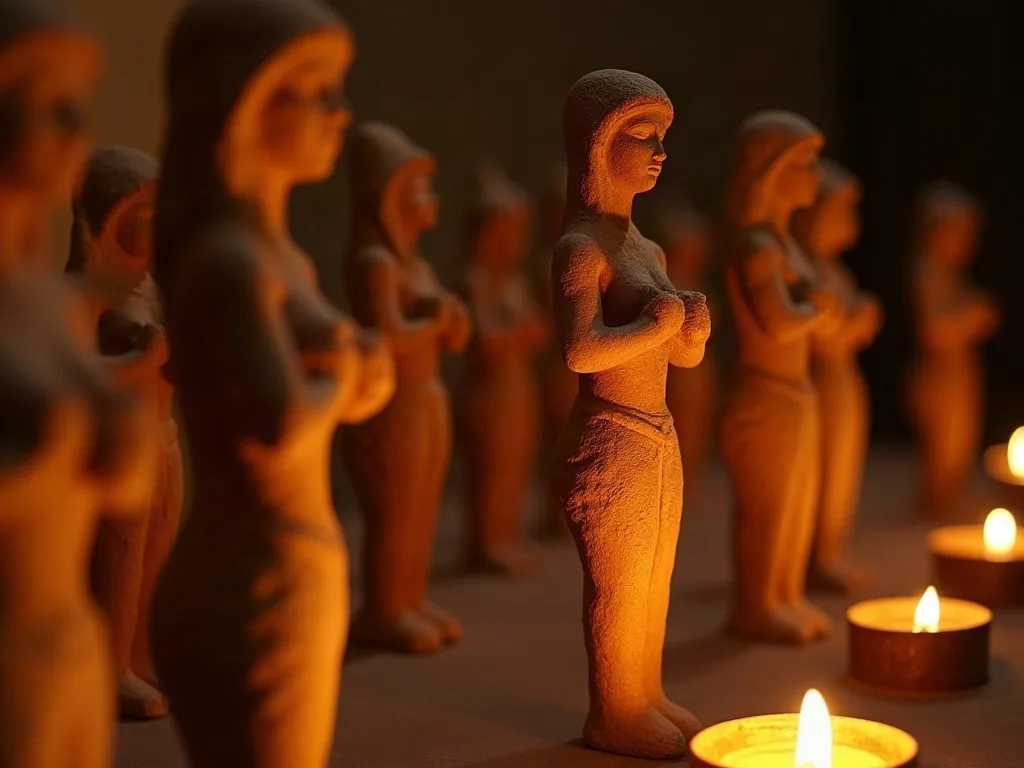
Votive objects provide another window into worship. Pilgrims and worshippers left small figurines, often of women with exaggerated breasts or with hands pressed to the belly, at her sanctuaries. These were not crude fertility charms but serious religious expressions: a prayer for fertility, health, safe childbirth, or abundance. A mother might leave a votive at Asherah's shrine to thank the goddess for a child's survival through illness.
Rituals involving Asherah likely included libations (pouring of liquid offerings, often wine or oil), singing, and spoken prayer. The biblical denunciations mention feasting associated with her worship, suggesting communal meals, celebration, and social cohesion around her shrine. This was popular religion, the kind that bound communities together, that made the sacred present in ordinary life.
Her feast days were likely tied to agricultural cycles. Spring fertility ceremonies, harvest celebrations, and perhaps lunar phases marked occasions when the Queen of Heaven was especially invoked. Women probably played a central ritual role, as the biblical texts suggest, making cakes and libations, speaking prayers, and organizing communal worship. If so, Asherah worship provided a space where women's voices held religious authority, something largely absent from the male-dominated priesthoods that emerged in later temple religion.
Scholarly Debates and Modern Recovery
For much of modern history, Asherah was nearly invisible in academic study. 19th- and early 20th-century scholars, working primarily from biblical texts, treated her as a marginal foreign contamination in Israelite religion. The recovery of Ugaritic texts in the 1920s began to change that. Scholars like W.F. Albright and later Saul M. Olyan reexamined the evidence and recognized Asherah as a major goddess in Canaanite religion, not a fringe deity.
Debate continues on several points. Did Asherah function as Yahweh's consort in early Israelite belief, as the Kuntillet Ajrud evidence might suggest? Or was she always experienced as separate, alien, a vestigial Canaanite holdover? How much of Asherah worship persisted covertly in Jewish practice even after the temple's destruction, flowing into later folk religion? Did Asherah's eventual disappearance from organized Judaism influence the development of later concepts like Sophia (divine wisdom, often feminine) in Kabbalah and mysticism?
Some scholars note that the biblical condemnations of Asherah were often directed at women practitioners, suggesting that her worship was sustained especially through female religious initiative. Others argue that the suppression of Asherah was politically motivated, tied to centralizing royal power and the assertion of exclusive male divine authority.
The latest archaeological work continues to refine the picture. Inscriptions from Judean sites, careful analysis of pottery and votive deposits, and new reading of ancient texts keep adding detail. What emerges is a portrait of a goddess so woven into Levantine life that even systematic suppression could not entirely erase her.
Asherah's Echo in Later Tradition
Though her name vanished from organized religion, Asherah's symbolic presence echoed forward. In Jewish mysticism, the Shekinah, often understood as the feminine presence of God, may carry traces of Asherah's role as divine mediator and intercessor. In Christianity, the veneration of Mary, the mother of Jesus, inherited some of Asherah's function: a compassionate feminine divine presence, accessible to prayer, believed to intercede with the distant father-god.
In Islamic tradition, the Quran explicitly rejects the Meccan goddesses and mentions the pre-Islamic Arabian worship of divine feminine figures, implicitly referencing a world like Asherah's. Though Islam rejected polytheism and any consort to God, the cultural memory of such goddesses persisted in folklore and women's folk practice across the Muslim world.
The recovery of Asherah in modern consciousness is recent and partial. Feminist scholars and archaeologists have led much of the work, recovering not just a goddess but a suppressed history of women's religious authority and feminine divine presence in the ancient world. For some, Asherah represents a lost world where the sacred was understood as balanced, as requiring both masculine and feminine principles. For others, she is simply a fascinating historical figure, a window into how ancient Levantine peoples made meaning.
What remains certain is this: for nearly two thousand years, the Queen of Heaven was nearly forgotten. Now, slowly, she is remembered.
Frequently asked questions about Asherah, the Canaanite Queen of Heaven?
Frequently asked questions
What does the name 'Asherah' mean?
The meaning is debated, but scholars generally agree the name derives from a Semitic root related to movement, pathway, or journey. Some interpret it as "she who walks" or "the walker," suggesting a goddess who moves between worlds, delivering the will of the divine to mortals and bearing prayers back to the gods.
How was Asherah worshipped in daily life?
Ordinary people worshipped Asherah through household sacred poles (carvings planted in homes and yards), votive offerings left at her shrines, libations of wine or oil, and prayer. Women played a central role, making ritual cakes, singing songs, and speaking prayers. She was invoked for fertility, healthy children, protection, and blessing. Her worship was intimate and local, embedded in family and community life.
Did Asherah worship survive the biblical prohibition?
Yes, for a long time. The book of Jeremiah, written after the Babylonian destruction of Jerusalem in 586 BCE, records worshippers still making cakes and libations to "the queen of heaven," suggesting the practice persisted underground for centuries despite official condemnation. She remained especially present in women's folk religion and household practice.
How do scholars know about Asherah if the Bible speaks against her?
The discovery and decipherment of Ugaritic texts in the 1920s gave us direct evidence of Canaanite religion. Inscriptions, votive objects, archaeological remains of shrines, and references in Egyptian and other foreign sources all provide information independent of the Bible's hostile account. Modern scholarship has recovered Asherah as a central, not marginal, figure in Canaanite religion.
Was Asherah the same goddess as Aphrodite or Astarte?
Not exactly, though there is overlap. Asherah was the Canaanite Queen of Heaven and consort of El. In Phoenician tradition (which was closely related to Canaanite), she was sometimes called Astarte and associated more explicitly with sexuality and war. Greek colonizers identified her with Aphrodite. These are not the same goddess, but they shared some functions and worshippers moved between the traditions, blending them.
What primary sources tell us about Asherah?
The main sources are the Ugaritic texts (clay tablets from the ancient city of Ras Shamra in Syria, dating to roughly 1400-1200 BCE), the Kuntillet Ajrud inscriptions (pottery sherds with religious writing from the Sinai, 9th-8th century BCE), the Hebrew Bible (which condemns her worship), Egyptian temple reliefs, and archaeological evidence of shrines and votive objects across the Levant.
The Queen of Heaven in Memory and Modernity
Asherah: The Queen of Heaven and Consort of El has become a symbol in modern times, though not always in ways the ancient Canaanites would recognize. Feminist theologians and scholars have reclaimed her as evidence that monotheism was not always masculine, that the sacred once encompassed the feminine as an equal power. Others see in her story a cautionary tale about religious suppression and the fragility of memory. Still others simply find in her worship a window onto a more ecologically embedded, community-centered form of religiosity.
Archaeological work continues. New sites are excavated, old finds are reexamined with fresh questions, and the recovery of Asherah is ongoing. Each new inscription, each newly analyzed artifact, adds texture to our understanding of who she was and what she meant to the people who prayed to her.
What strikes most powerfully about Asherah is the violence of her erasure. Not a gradual fading, but an active, deliberate suppression. Sacred poles smashed, images defaced, her name struck from official records, her worshippers condemned. It took archaeology and the accident of ancient texts surviving in obscure places to bring her back. In a sense, this recovery itself is part of her story: a goddess who, like the land she blessed, proved impossible to entirely destroy.
Read the full book
Want the whole story?
The complete edition is an instant PDF download here, with a paperback on Amazon for selected titles.
Canaanite
The Canaanite Mythology Book: Baal, El, Anat, and the Gods of the Ancient Levant
Baal, El, Anat, and the Gods of the Levant
The gods the Hebrew Bible warned against, recovered from the clay tablets of Ugarit: El the patriarch, Baal the storm-rider, Anat the war goddess, and Mot the lord of death. The mythology behind the Bible’s great rival.
More from Canaanite
All articles
Canaanite
El: The Father of Gods in Canaanite Religion
El ruled the Canaanite pantheon as the ancient king of gods, a weathered father whose name meant simply "god." Discover how this Syrian deity shaped Near Eastern belief for a thousand years before fading from memory.

Canaanite
Mot: The God of Death and the Underworld in Canaanite Myth
Mot rules the Canaanite underworld with an insatiable hunger, devouring all things mortal. Explore how this ancient god of death embodied fear, finality, and the cosmic struggle between life and extinction.

Canaanite
Anat: The Warrior Goddess of Love and Battle
Anat stands alone in Canaanite myth: a goddess who commands bloodshed and desire with equal fury. Explore the warrior deity who protected kings, seduced gods, and defied every boundary of her world.

Canaanite
Yamm: The Sea God and Chaos Monster of Canaanite Myth
Yamm rules the Canaanite cosmos as both divine sovereign and terrifying chaos force. Discover how this turbulent sea god challenged the gods themselves and shaped the earliest Near Eastern creation myths.