
Amma: The Supreme Creator God of the Dogon
Before the first star, before the first word, Amma held the universe folded inside himself. Meet the supreme creator god of the Dogon people of Mali, and the cosmic egg that became everything.
Contents
Before the first star, there was silence. Not empty silence, but a silence full of potential, coiled tight like a seed. Inside that silence, the Dogon say, Amma held the entire universe pressed into his body. He was not sitting somewhere, waiting. He was the somewhere. He was the egg, the void, and the will to fill it.
This is where Dogon cosmology begins: not with a war between gods, not with a monster slain, but with a single supreme being choosing to open himself up and let reality spill out. Amma: the Supreme Creator God of the Dogon is one of the most philosophically intricate creator figures in all of African mythology, and his story comes from a tradition that has astonished anthropologists, astronomers, and scholars of religion alike.
The Dogon people live primarily on and around the Bandiagara Escarpment in present-day Mali, a dramatic cliff face stretching roughly 150 kilometers across the West African Sahel. Their oral literature, ritual life, and sacred cosmology were recorded in remarkable detail by the French anthropologist Marcel Griaule and his colleague Germaine Dieterlen, above all through Griaule's long conversations with the Dogon elder Ogotemmêli in 1946, published as "Conversations with Ogotemmêli" in 1948. That text remains the single richest primary source for understanding Amma and the creation he set in motion.
Amma and the Cosmic Egg: How Everything Began

The Dogon describe the original state of the universe as aduno tal, the egg of the world. Amma himself was this egg, compressed into a shape the Dogon liken to a grain of fonio, a tiny millet seed cultivated across the Sahel for thousands of years. The choice of that image is deliberate. Fonio is one of the smallest grains a Dogon farmer holds in his palm, yet it feeds a family. Amma, compressed into that infinitesimal point, held everything that would ever exist.
Inside this primordial egg, Amma began to vibrate. Griaule and Dieterlen record that the Dogon describe this vibration using the concept of kize uzi, the seed of the kize star system, an internal stirring that preceded any outward act. This is not metaphor dressed up as cosmology. For the Dogon, vibration, word, and creation are literally the same event at different stages.
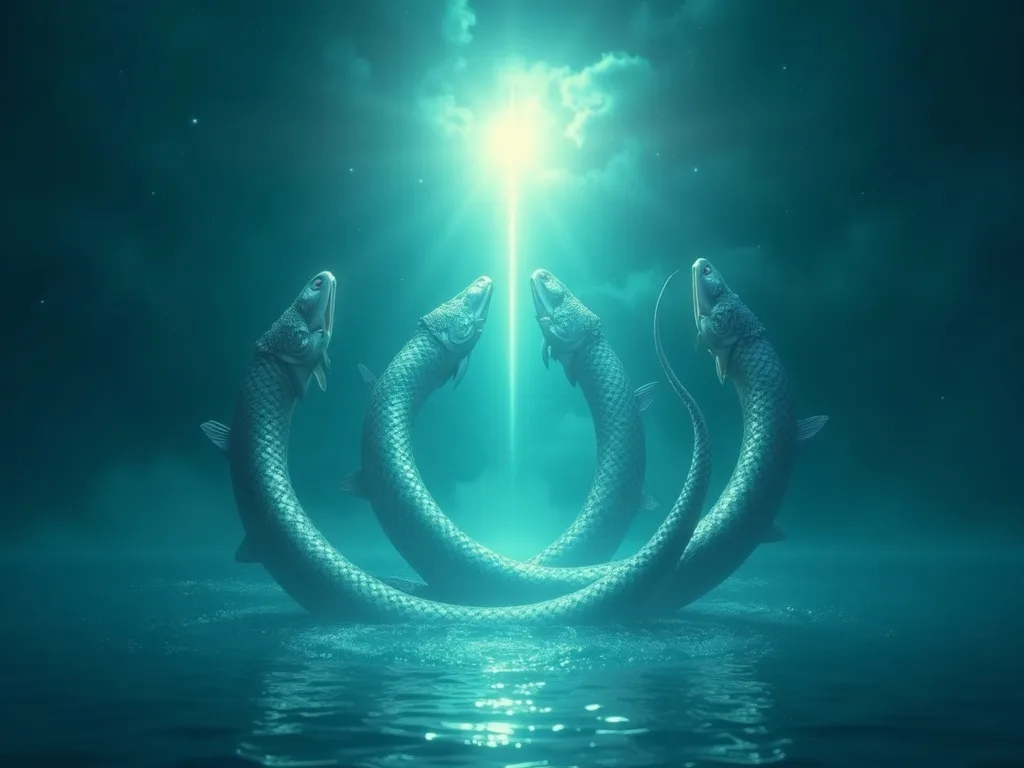
When the moment of opening came, Amma did not speak a command from outside. He released his own internal structure. The first thing that emerged was the Nummo (sometimes spelled Nommo), a pair of twin beings who carried the divine blueprint of creation within their bodies. They were at once fish-like and serpentine, born from Amma's seed mixed with the primordial waters that Amma himself contained. The Nummo are amphibious mediators: part divine, part material, the first bridge between Amma's pure intent and the world we can touch.
This emphasis on twins is not accidental. The Dogon view twinness as the ideal state of being. Pairs represent wholeness, balance, the complete unit of creation. Amma originally intended everything to be born in twin pairs. The disruption of that plan is the source of much of what goes wrong in the cosmos afterward.
The Flawed First Act: Amma and the Earth
The creation of the earth is where things get complicated, and deliberately so. The Dogon tradition is not interested in a flawless origin story. It is interested in the truth, including the truth of imperfection.
Amma, the great egg, threw a lump of clay into space. This clay became the Earth, a female being. Amma moved toward the Earth to complete the act of creation through union, but found that the Earth's termite mound (her clitoris, in Griaule's translation of Ogotemmêli's words) blocked the path. Amma removed the termite mound. The union that followed was incomplete, out of order, and produced not the intended Nummo twins but a single, solitary being: Ogo (also called Yurugu in some variant traditions).
Ogo was born alone. He was restless, unfinished, and rebellious. He tore a piece of his own placenta and fled the cosmic egg, using it as an ark to wander the incomplete creation. His rebellion was also a kind of tragedy: he wanted to return to Amma, to reunite with the twin he should have had, but could never fully do so. The Dogon identify Ogo with the pale fox, Vulpes pallida, a real animal that lives in the Sahel and whose tracks the Dogon read as a form of divination. Ogo's chaotic footprints across the sand still carry meaning.
The second union between Amma and the Earth was complete, and from it came the Nummo twins as originally intended. Amma then sacrificed one of the Nummo to consecrate the earth and purify the damage that Ogo had caused, scattering the Nummo's body across the world as the first act of agricultural and spiritual ordering.
The Nummo and the First Word: Amma's Speech Made Flesh
The Nummo are inseparable from Amma. They are his plan, his voice, his craft. Where Amma is the origin and the absolute, the Nummo are the process, the ongoing act of making and meaning.
Griaule records Ogotemmêli explaining that the Nummo gave humanity the first Word, called so, which was more than language. It was technique, order, and the weaving of the world into coherence. The Nummo taught the first ancestor humans how to weave, and weaving was itself a form of speech: the loom's shuttle moved like a tongue, crossing threads the way words cross silence. Every piece of cloth made on a Dogon loom is, in this sense, a small act of repeating Amma's original creation.
This gives Dogon craft a deeply theological charge. A blacksmith, a weaver, a farmer planting fonio: all of them are repeating Amma's initial gesture. The sacred and the daily are not separate categories. They are the same category, looked at from different distances.
The Nummo also introduced the second Word, a more complex system of signs and sounds that allowed for fuller human communication. Griaule and Dieterlen documented an elaborate system of Dogon signs and symbols (recorded in their 1965 work "Le Renard Pâle," translated as "The Pale Fox") that they believed mapped directly onto this cosmological grammar. The scholarly debate about how literally to read these claims is ongoing, but the Dogon cosmological system itself, whatever its relationship to astronomical observation, is internally coherent and philosophically deep.
Amma's Altar and the Living Ritual Presence
Amma is not only a figure in an ancient story. He remains a living center of Dogon spiritual practice.
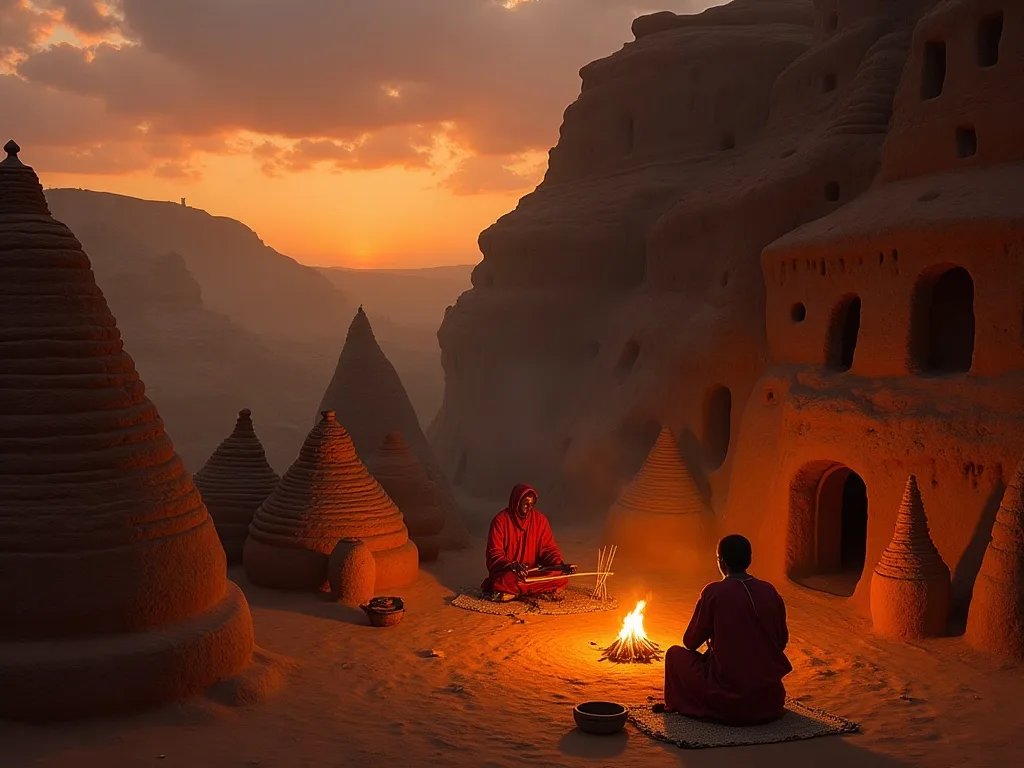
Every Dogon village has an Amma altar, typically a conical clay form built on a raised platform, pointing upward toward the sky. This shape echoes the cosmic egg, the compressed point from which everything came. Sacrifices of grain, oil, and animal blood are offered to Amma at key moments: planting, harvest, death, birth, and the great Sigui ceremony that the Dogon hold roughly every sixty years, tied to the rising of the star system the Dogon call Sirius (though the precise astronomical claims made by some Western writers remain contested among scholars).
The Hogon, the Dogon spiritual leader and eldest man of a lineage, is the primary keeper of Amma's rites. He holds a staff that represents Amma's creative power, and his role is partly to embody the continuity between the living community and the original act of creation. His authority is not political in the Western sense; it is cosmological. He stands at the place where Amma's creation continues to unfold.
Amma Across the Dogon World: Regional Variations
The Dogon are not a monolithic group. Several hundred thousand people live across the Bandiagara Escarpment and the surrounding plains, organized into distinct clans and dialect groups. The version of Amma's mythology recorded by Griaule and Dieterlen came primarily from the Ogol villages and from Ogotemmêli's lineage-specific knowledge. Other Dogon communities hold their own versions, sometimes with significant differences.
In some regional traditions, Amma's name appears as Amma Serou, the "high Amma," distinguishing the supreme creator from his various emanations and aspects. In others, the Nummo are described not as twins but as a group of eight primordial ancestors, the Nommo Anagonno, each corresponding to a different human lineage and a different type of grain. The core logic remains: Amma is the source, and what comes from Amma carries his ordering principle within it.
Genevieve Calame-Griaule, daughter of Marcel Griaule and a linguist who spent decades with the Dogon, documented in "Words and the Dogon World" (1986) how Amma's creative act shapes even the grammar and phonology of Dogon speech. The way words are formed, the relationship between vowel sounds and life-force, all of it traces back to Amma's original vibration. Language is not a tool the Dogon invented. It is something Amma exhaled.
Amma and the Stars: Sirius, the Nommo, and a Famous Controversy
No discussion of Amma: the Supreme Creator God of the Dogon would be complete without addressing the Sirius controversy, one of the most debated episodes in the history of anthropology and popular mythology.
In the 1970s, the American author Robert Temple published "The Sirius Mystery" (1976), arguing that the Dogon possessed detailed astronomical knowledge of the Sirius star system, including the existence of Sirius B, a white dwarf companion star invisible to the naked eye and only confirmed by Western astronomy in 1862. Temple claimed the Dogon could only have this knowledge through contact with an extraterrestrial civilization.
The scholarly response was measured and largely skeptical. The anthropologist Walter van Beek, who conducted his own extensive fieldwork with the Dogon in the 1990s, found that most Dogon people he spoke with had no detailed knowledge of Sirius as a star system and that the specific astronomical details Griaule recorded were not widely shared. Van Beek's findings, published in "Revisiting the Dogon" in the journal "Current Anthropology" in 1991, suggested that Griaule may have been working with a very small number of informants and that some of the cosmological detail may reflect a shared interpretive elaboration between Griaule and his Dogon collaborators.
This debate has not settled. Some scholars defend Griaule's work; others call for more careful sourcing. What it does not change is the genuine depth and originality of Dogon cosmology, with or without astronomical precision. Amma does not need to be an extraterrestrial message to be a profound creator figure. The philosophy stands on its own.
Amma's Place in the Wider African Creator Tradition
Amma shares structural features with creator figures across sub-Saharan Africa, and tracing those parallels opens up a larger picture of how African peoples have thought about the origin of existence.
The Yoruba supreme being Olodumare similarly stands above all other deities as the ultimate source and sustainer of the cosmos, with intermediate divine figures (the Orisha) doing the work of ongoing creation and ordering, much as the Nummo do for Amma. Both traditions separate the supreme creator from the day-to-day life of the gods, placing the highest principle at a remove that is almost philosophical: too fundamental to be "personal" in a simple sense, but never absent.
The Akan concept of Nyame, the sky god of the Ashanti and other Akan peoples of present-day Ghana, shares Amma's quality of being self-existent and unmade. In both cases, the supreme being contains the seeds of reality before releasing them, and the material world is a kind of outward unfolding of what was always, already, inside.
What makes Amma distinctive is the Dogon insistence on process. Amma is not simply a god who creates and then withdraws. The Dogon see Amma's creative act as ongoing, continuing through every ritual performance, every spoken word, every planted seed. Creation is not past tense. It is the present tense of the universe.
Amma's Echo in Modernity: Art, Literature, and New Attention
The Dogon and their cosmology have attracted sustained attention from artists, writers, and thinkers outside West Africa since the mid-twentieth century.
The Malian sculptor and painter Amadou Hampâté Bâ (1900-1991), one of the great voices of African oral tradition, repeatedly emphasized the depth of Sahelian cosmological thought in his writings and speeches at UNESCO, arguing that the death of an African elder was "a library burning." While Bâ worked primarily with Fulani and broader Sahelian traditions, his framing applies with full force to the living keepers of Amma's story.
Contemporary Malian artists, including painters from the Mopti region near the Escarpment, have drawn on Dogon iconography, including the layered concentric circles that represent Amma's egg, in work shown at international galleries. The Dogon mask tradition, particularly the Kanaga mask, with its cross-shaped superstructure representing the link between sky and earth, Amma and his creation, has influenced visual artists across the African diaspora and beyond.
In the broader landscape of world mythology, Amma: the Supreme Creator God of the Dogon sits comfortably alongside Brahma in the Hindu tradition, who also "thinks" reality into existence from an original unity, and alongside the Ein Sof of Kabbalistic Jewish mysticism, the infinite ground of being that contracts to allow the world to emerge. These are not the same concept, but they speak to a recurring human intuition: that what is most real is not a person, a place, or a thing, but the source from which all persons, places, and things unfold.
Frequently asked questions about Amma, the Dogon Creator God
Frequently asked questions
Who are the Dogon people, and where do they live?
The Dogon are an ethnic group of approximately 400,000 to 800,000 people living primarily on and around the Bandiagara Escarpment in Mali, West Africa. The Escarpment is a UNESCO World Heritage Site recognized for both its natural landscape and its cultural importance. The Dogon have maintained distinct religious, architectural, and ceremonial traditions for centuries, with their villages carved into cliff faces that served as natural defenses against historical slave raids.
What is the primary source for Dogon mythology about Amma?
The richest single source is Marcel Griaule's "Conversations with Ogotemmêli" (1948), based on thirty days of conversations with a blind Dogon elder named Ogotemmêli in 1946. Griaule and Germaine Dieterlen later produced "The Pale Fox" (Le Renard Pâle, 1965), a far more detailed and complex cosmological record. Genevieve Calame-Griaule's "Words and the Dogon World" (1986) extends the analysis into language and everyday life. These works are debated in their methods, but they remain the foundational texts for any study of Amma.
What are the Nummo or Nommo, and how do they relate to Amma?
The Nummo (also spelled Nommo) are the first beings Amma created: twin, fish-serpent figures who carry his divine blueprint. They are both his children and his tools for ongoing creation. The Nummo gave humanity the first Word, taught weaving as a form of speech, and served as the mediating principle between Amma's absolute nature and the imperfect material world. One Nummo twin was sacrificed by Amma to purify the earth after Ogo's disruption, and the scattered pieces of that body seeded the first agricultural and spiritual order.
Is the Dogon astronomical knowledge about Sirius real?
This is one of the most debated questions in African studies. Marcel Griaule claimed the Dogon had detailed knowledge of Sirius B, a white dwarf invisible to the naked eye. Anthropologist Walter van Beek's independent fieldwork in the 1990s found that most Dogon people he interviewed did not share this specific knowledge, raising questions about the scope of Griaule's sources. The consensus in academic anthropology is cautious: the astronomical claims may reflect a very specialized esoteric knowledge held by few initiates, or may involve some interpretive collaboration between Griaule and his informants. The Dogon cosmological system itself is genuinely deep and original, independent of any astronomical claims.
How is Amma worshipped in Dogon communities today?
Amma is honored through altar offerings, communal ceremonies, and the great Sigui ceremony held approximately every sixty years. The Amma altar, a conical clay structure, is present in every Dogon village. The Hogon, the senior spiritual leader of a lineage, leads the principal rites. Daily life, including farming, weaving, and speech itself, is understood as a continuation of Amma's creation, so worship is not confined to formal ceremonies. It is woven into ordinary acts.
How does Amma compare to other African supreme creator gods?
Like the Yoruba Olodumare and the Akan Nyame, Amma is a self-existent supreme being who stands above the intermediate divine figures that handle day-to-day cosmic business. What distinguishes Amma is the Dogon emphasis on vibration and word as the mechanism of creation, and the sustained philosophical attention given to imperfection and process. Where some African supreme creators are relatively distant, Amma's creative act is described as continuous, present in every ritual repetition and every spoken word.
Amma and the Unfinished Universe: An Open Question
The Dogon do not believe creation is finished. Amma opened the cosmic egg, the Nummo organized its contents, and humanity received the Word, but the universe is still being woven. Each Sigui ceremony is a renewal, not a commemoration. Each altar offering is a small correction of Ogo's disorder. Each weaving shuttle crossing the loom is a syllable in a sentence that has not yet reached its period.
This is perhaps the most striking thing about Amma as a creator figure: he does not look back at what he made and call it good, in the style of the Genesis narrative, and walk away. He remains implicated in it. The world's imperfection is his own; the ongoing effort to make it right belongs to both the divine and the human. The Dogon do not draw a clean line between what Amma does and what people do. They draw a single line, running from the primordial egg through the body of the Nummo, through the first ancestor, through the Hogon holding his staff, through the farmer pressing a fonio seed into dry Sahelian soil.
Scholars like Luc de Heusch, who analyzed Dogon myth in comparative perspective alongside Central African traditions, noted that this insistence on the incompleteness of creation gives the Dogon ritual system its urgency. Ceremony is not optional decoration. It is structural maintenance. Without it, the universe drifts further from Amma's original intent.
That is a cosmology worth sitting with. Not because it is exotic, and not because it might encode secrets about distant stars, but because it takes seriously something that many creation myths sidestep: the world as it is, right now, is a work in progress. The creator is not done. The question Amma's story leaves open is whether the rest of us are doing our part.
Free 25-page sample
Want the whole story?
Take the first 25 pages free. If it pulls you in, the full edition is yours as an instant PDF download, with a paperback on Amazon for selected titles.
Dogon
The Dogon Mythology Book: Amma, the Nommo, and the Mystery of Sirius
Amma, the Nommo, and Sirius
The cosmology of a people who carved their villages into a cliff in Mali, and who, some claim, knew of an invisible companion star to Sirius. The creator Amma, the amphibious Nommo, the cosmic egg, and one of anthropology’s great controversies.
More from Dogon
All articles
Dogon
The Nommo: Ancestral Water Spirits and Culture Heroes of the Dogon
The Nommo are the Dogon people's ancestral water spirits who brought civilization, language, and moral order to humanity. Descended from the sky god Amma, they shaped the world through sacrifice and remain central to Dogon ritual, art, and identity today.
Dogon
The Dogon Mask Tradition: Kanaga, Sirige, and Ritual Performance
The Dogon people of Mali have preserved one of Africa's most intricate mask traditions for centuries. Kanaga and Sirige masks embody cosmology, death, and the animate power of wood in ceremonies that bind the living to ancestors.
Dogon
The Binu Shrines: Sacred Altars to Ancestral Spirits in Dogon Tradition
The Binu Shrines are sacred wooden altars where the Dogon people of Mali honor their ancestors and the primordial water spirits that shaped their world. Built into cliff dwellings and family homes, these shrines connect the living to the dead through ritual, offering, and careful ceremonial action.
Dogon
The Dama Funeral Rites: Guiding the Dead to Ancestorhood
The Dama is the Dogon people's most sacred ceremony, a multi-stage funeral rite that transforms the dead into protective ancestors. Masked dancers, secret societies, and months of ritual guide the soul through the spirit world while honoring the body's return to earth.