
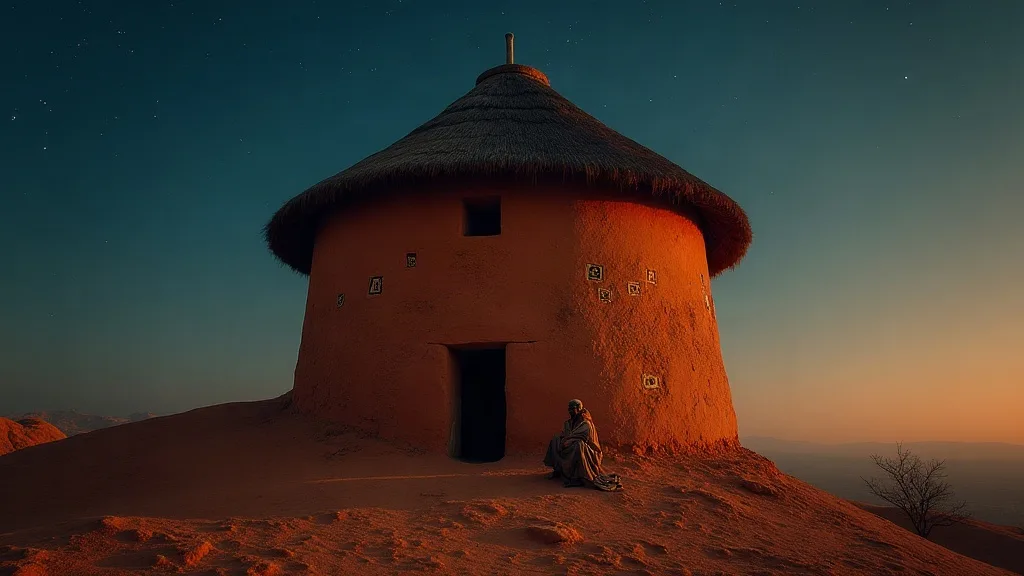
The Granary of Amma: Cosmic Architecture and Symbolism
The Granary of Amma is the Dogon universe in miniature: a clay storage vessel that maps creation, time, and the human body onto a single sacred structure. Understand it, and Dogon cosmology clicks into place.
Contents
The roof is circular. The base is square. Between them, the entire cosmos fits inside a clay granary no taller than a man.
For the Dogon people of the Bandiagara Escarpment in present-day Mali, the granary is never just a place to keep millet. Every dimension, every opening, every interior chamber carries a meaning that runs from the smallest grain of seed to the structure of the universe itself. The object sits at the absolute center of Dogon cosmological thought: a model of creation, a map of the body, a clock counting out the rhythms of the world.
The Granary of Amma is the name given to this cosmic template. Amma is the supreme creator god of Dogon belief, the single, self-existing force who shaped the universe from a seed the size of a grain of millet. What Amma created, the granary re-enacts. To build one is to repeat the act of creation. To store grain in one is to keep the world alive.
Amma and the First Seed: Where the Granary Begins
Before the granary can be understood, Amma himself must be placed on the map.
Dogon oral tradition, recorded in extraordinary depth by the French anthropologist Marcel Griaule during fieldwork from 1931 onward and published with Germaine Dieterlen in "Le Renard Pale" (1965, translated as "The Pale Fox"), describes Amma as an egg-shaped being who contained all potential existence before anything else was. Inside that primordial egg, Amma compressed four fundamental elements: earth, water, air, and fire. He spun them, vibrated them, and the universe unfolded outward in expanding spirals.
The very first thing Amma made was not a planet or a star. It was a seed: a tiny, perfectly coiled grain called the po pilu, or "the smallest thing." Inside that seed, folded like a blueprint, was the pattern for all life. When Amma cast the seed outward, it stretched into the structure that Dogon cosmology calls the granary.
This is not a poetic flourish. Griaule's key informant, the elder Ogotemmeli, spent thirty-three days in 1946 explaining the system to Griaule in meticulous detail. The account, published in Griaule's "Dieu d'Eau" (1948, translated as "Conversations with Ogotemmeli"), makes clear that the granary is a precise diagram. Every measurement carries intent. Every surface carries correspondence.
The Shape That Holds Everything: Geometry as Theology
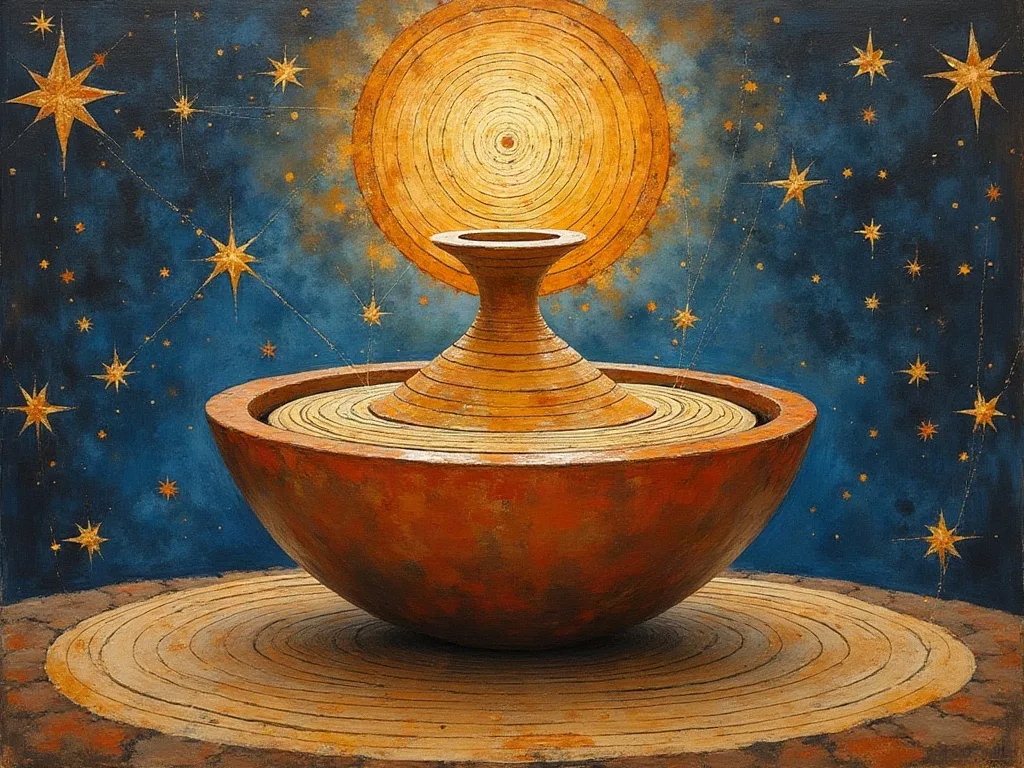
The granary's most striking feature is its geometry. The roof is a circle. The base is a square. That transition from four corners to no corners is not an accident of pottery craft. It is a deliberate cosmological statement.
In Dogon thought, the circle belongs to Amma. It is the shape of the primordial egg, the shape of the sun, the shape of completion without beginning or end. The square belongs to the earth and to human time: four cardinal directions, four seasons, four elements. The granary, moving from square base to circular top, enacts the movement of earthly matter toward divine wholeness.
Ogotemmeli told Griaule that the granary stands on four legs, one at each corner of the square base. Each leg represents a cardinal direction. The earth is oriented. The universe is oriented. When a Dogon man or woman orients a granary correctly during construction, pointing its door toward a specific direction, they are re-aligning their household with the axis of creation.
The door of the granary always faces north in the ideal cosmological model. North is the direction of Nommo, the primordial pair of water spirits who are among the most important figures in Dogon belief. The Nommo arrived from the sky in an ark. They brought moisture, language, weaving, and the ordered world with them. Their direction is the direction of life-giving water, and the granary's door opens toward them.
The Eight Compartments: Ancestors Made Spatial
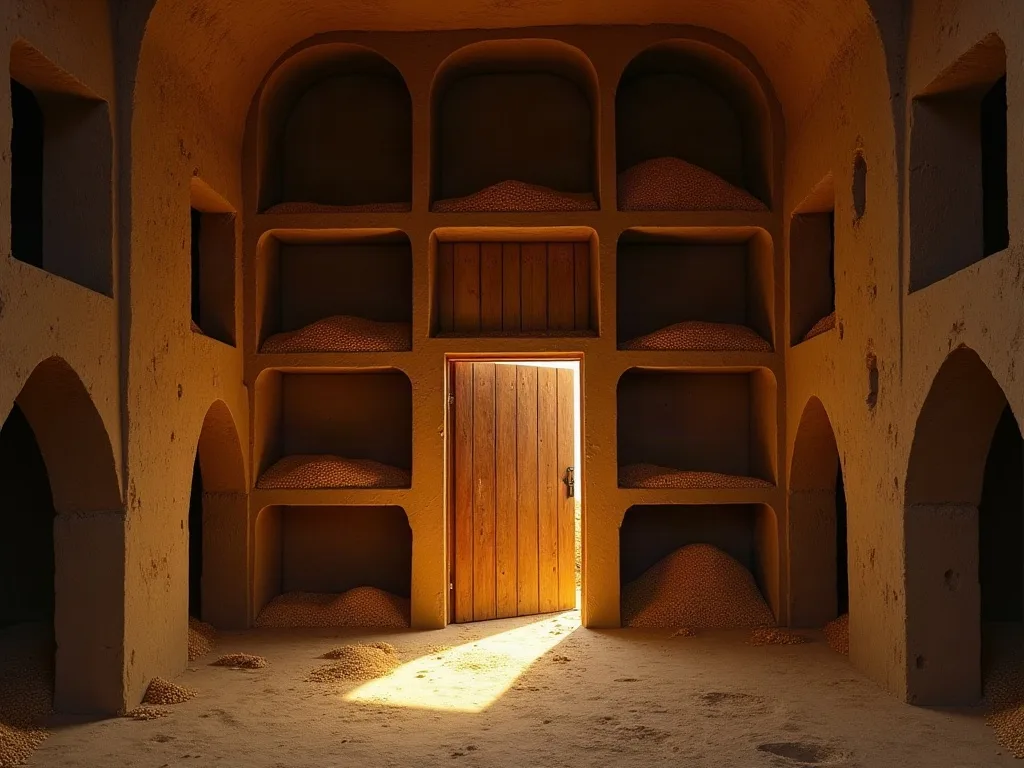
Inside the granary, eight internal compartments ring the central space. Four on the ground floor, four above. These eight chambers are not storage categories organized by grain type, though grain does fill them. They are the eight Dogon ancestors, the primordial beings who descended to earth in the celestial ark and became the progenitors of all Dogon clans.
Ogotemmeli describes the eight ancestors as emerging in pairs: four male, four female. The granary mirrors that pairing in its two levels. The lower four chambers belong to the male principle, associated with the earth, solidity, and agricultural labor. The upper four belong to the female principle, associated with the sky, moisture, and fertility. The grain moves upward as it is processed, mirroring the spiritual movement from earth toward heaven.
The central pillar that runs through both levels is the axis of the world. It is the Nommo themselves, holding the structure together. Without that pillar, the granary collapses. Without the Nommo, the cosmos collapses. The architecture does not illustrate the myth. The architecture is the myth, made solid.
The Granary as Human Body
One of the most striking claims in the Dogon system is that the granary is also a map of the human body.
Ogotemmeli explained this correspondence directly to Griaule. The circular roof corresponds to the head. The cylindrical neck below the roof corresponds to the throat. The broad body of the granary corresponds to the chest and torso. The four legs at the base correspond to the limbs. When a Dogon person climbs a granary to take grain from the top, they are, in a precise technical sense, entering a cosmic body.
The eight chambers inside correspond to eight organs: stomach, liver, lungs, small intestine, and four others identified with specific functions of digestion and reproduction. The grain stored inside those chambers is not passive cargo. It is actively identified with the vital substances those organs process: blood, bile, breath, seed.
This body-granary correspondence has a practical consequence. When a granary is damaged, the ritual response is not simply repair. It is healing. Specific prayers address specific chambers as if addressing sick organs. The Dogon understanding of medicine and the Dogon understanding of cosmic architecture are, at this level, the same discipline.
Sirius, the Nommo, and the Cosmic Calendar
The granary is also a clock. It counts in years, seasons, and great astronomical cycles.
Dogon cosmology assigns enormous importance to the star Sirius, the brightest star in the night sky. Griaule and Dieterlen documented that Dogon oral tradition identifies Sirius not as a single star but as a system: a bright star called Sigi tolo paired with a small, dense, invisible companion called Po tolo. Po tolo translates as "the star of the smallest seed," naming it after the same primordial po pilu grain from which Amma created the universe.
The orbit of this invisible companion around Sirius was said to take fifty years. This fifty-year period is the length of a major Dogon ceremony called the Sigui, held to renew the world and honor the descent of the Nommo. Griaule and Dieterlen's documentation of this knowledge, published in 1950, predates the widespread public awareness of Sirius B (the white dwarf companion of Sirius) that followed later astronomical attention.
The granary participates in this calendar. During the Sigui ceremony, granaries are rebuilt, repainted, and reoriented. The act of reconstruction is a re-enactment of Amma's original construction of the universe. The community of the living restates the cosmos. The world is made again.
Nommo spirits in West African tradition appear throughout this cycle as the guarantors of moisture, language, and renewal. Their presence in the granary's architecture is constant: the central pillar, the north-facing door, the upper four chambers.
The Fox in the Granary: Disorder as Necessary Force
Not everything inside the granary is orderly. Dogon tradition includes a troubling figure called Ogo (sometimes called Yurugu, the Pale Fox), Amma's first, incomplete creation.
Amma made Ogo before the universe was fully formed, and Ogo acted prematurely. He broke out of his own egg before his twin soul was ready. He descended to earth before the world was finished. He brought disorder, dryness, and the unpredictable. In the form of the pale fox, he runs across the desert, reads the future in the sand, and disturbs every neat system.
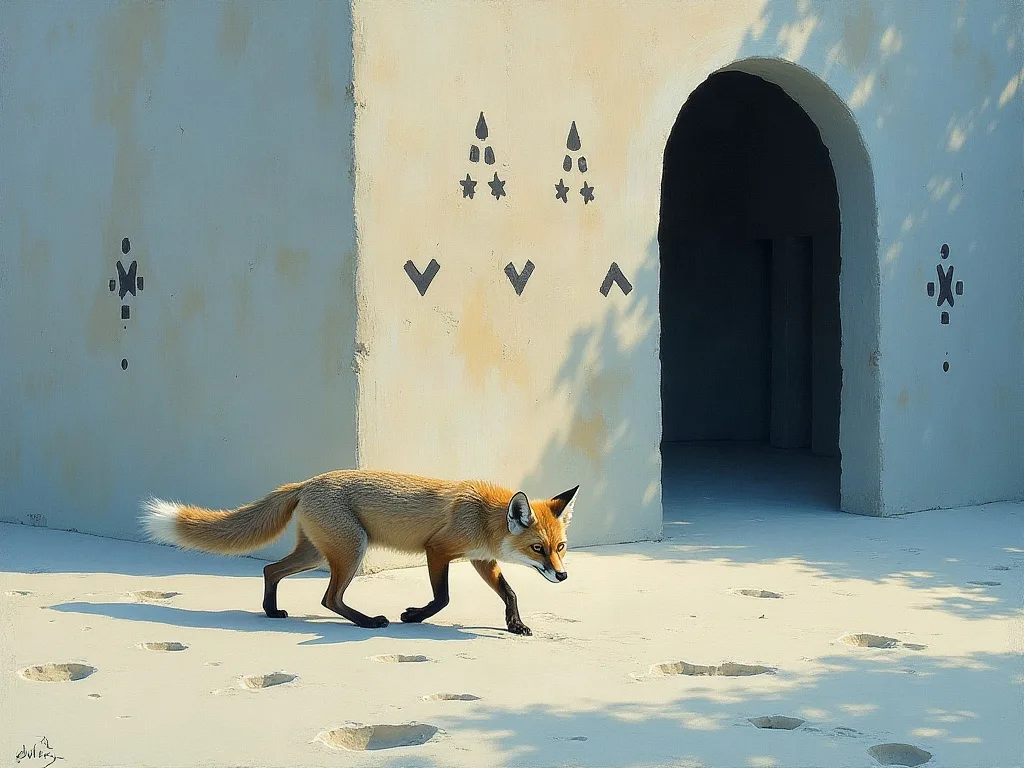
The fox enters the granary. Dogon divination practice involves spreading sand or grain on the ground near a granary in the evening and reading the fox's tracks in the morning. The fox, moving through the sacred space of the granary's shadow, becomes an oracle. The disorder Ogo carries is not simply evil. It is the randomness that makes divination possible: if everything were perfectly ordered, nothing could be predicted, because nothing would change.
The granary holds both the Nommo's order and Ogo's disorder. The eight perfect chambers and the fox's chaotic track in the sand both belong to the same structure. Dogon cosmology insists on this double presence. A cosmos without Ogo would be static. A cosmos without the granary's geometry would be unintelligible.
Dogon Material Culture: Building the Granary in Practice
The actual construction of a Dogon granary in the Bandiagara cliff villages follows specifications that mirror the cosmic template, adjusted for terrain and materials.
Traditional Dogon granaries are built from banco, a sun-dried mud brick mixed with straw and sometimes dung for binding. The exterior is smooth-plastered and often painted with geometric symbols: zigzag lines representing water and the Nommo's serpentine movement, triangles representing the male and female principles, and dotted patterns representing stars.
The door is a carved wooden rectangle, rarely more than forty centimeters high, forcing anyone who enters to bow. That bowing is not architectural pragmatism. It is a gesture of respect to the ancestors inside.
The granary sits on stones raised above the ground to protect its contents from moisture and termites. Those stones are positioned at the four corners, the four legs that hold the cosmic structure above the chaos of the earth. The threshold between the stone feet and the earth is itself a boundary, a line where the ordered interior meets the disordered exterior.
Griaule notes that no two granaries are identical in practice, because no two Dogon families carry exactly the same ancestral lineage or the same ritual obligations. The cosmic template is universal. The local execution is always particular. The granary is both a universal diagram and a family archive.
Cross-Cultural Parallels: Sacred Architecture Elsewhere
The Granary of Amma does not stand alone in the history of sacred architecture. Other traditions have built the cosmos into their structures with comparable precision.
The Hindu vastu shastra, a body of architectural doctrine codified in texts like the Manasara (compiled between the 5th and 7th centuries CE), divides the floor plan of a building into a grid of eighty-one squares, each assigned to a deity, a direction, and a cosmological force. The center square, called the brahmasthana, belongs to Brahma, the creator. Brahma in Hindu cosmology occupies the same structural position that Amma's pillar occupies in the Dogon granary: the center that holds everything in place.
The Aztec New Fire ceremony, held every fifty-two years when the Pleiades crossed the zenith, similarly rebuilt the world in a calendrical act of cosmic renewal. The number fifty-two and the Dogon's fifty years are not identical, but the logic is shared: the human community must periodically re-enact creation or the world will stop.
Closer geographically, the great Yoruba city of Ife, in present-day Nigeria, was laid out according to cosmological principles that assigned cardinal directions to specific orishas, the divine forces of Yoruba religion. Yoruba religious tradition treats the city as a sacred body in exactly the way the Dogon treat the granary. The building is a being.
None of these parallels diminish the Dogon system. They place it inside a broader human project: the attempt to make the invisible visible by building it out of stone, mud, and wood.
Frequently Asked Questions About the Granary of Amma
Frequently asked questions
Who documented the Dogon granary's cosmological meaning, and how reliable are those sources?
Marcel Griaule and Germaine Dieterlen are the primary academic sources. Griaule worked among the Dogon from 1931 to his death in 1956. His main informant was Ogotemmeli, an elder hunter who spent thirty-three days in 1946 sharing an elaborate cosmological system. "Conversations with Ogotemmeli" (1948) and "The Pale Fox" (1965) are the foundational texts. Scholars including Walter van Beek have since questioned whether Griaule's approach shaped his informants' responses and whether the cosmological system he recorded reflects widespread Dogon belief or a specialist priestly tradition. The debate is ongoing. Most scholars accept that the cosmological system is real and internally consistent while noting that not every Dogon community holds every detail.
What is the connection between the Dogon granary and the star Sirius?
Griaule and Dieterlen documented in 1950 that Dogon tradition described Sirius as a binary system with a small, dense, invisible companion orbiting it every fifty years. This companion, called Po tolo, shares its name with the primordial creation seed. The fifty-year orbit aligns with the Sigui ceremony, during which granaries are ritually rebuilt. The granary's construction is thus tied to a specific astronomical cycle. The source of this astronomical knowledge remains debated: some researchers argue it reflects genuine pre-colonial observation, others suggest contact with Europeans who knew of Sirius B after its description in 1844.
What role does the Pale Fox play in relation to the granary?
Ogo, the Pale Fox, is Amma's first and incomplete creation. He broke out of his cosmic egg prematurely and brought disorder to the world. In practice, Dogon diviners spread sand near a granary at night and read the traces the fox leaves by morning. The granary becomes a divination board precisely because Ogo's chaotic energy passes through its space. His disorder is not simply negative: it is the unpredictability that makes futures readable. Without Ogo, the granary would be a sealed, static symbol. With him, it becomes a living interface between the ordered cosmos and the contingent world.
How does the granary relate to the Dogon understanding of the human body?
Ogotemmeli explained to Griaule that the granary's parts correspond to human organs: the circular roof to the head, the cylindrical neck to the throat, the body of the structure to the torso and chest, the four legs to the limbs. The eight interior chambers correspond to eight internal organs. Grain stored in those chambers is functionally identified with the vital substances those organs process. This means that storing, protecting, and distributing grain is simultaneously a medical act: maintaining the granary is maintaining the body of the community.
Is the Dogon granary still built according to these cosmological principles today?
Banco granaries remain in use across the Bandiagara Escarpment, and many Dogon families still follow traditional construction orientations and ritual practices. However, the degree to which the full cosmological system described by Griaule informs everyday construction varies between communities. Tourism, Islam, and Christianity have all influenced Dogon material culture since the mid-20th century. Ethnographic studies from the 1990s and 2000s by researchers like van Beek document a more diverse, less uniform set of practices than Griaule's totalizing account suggested.
What is the significance of the number eight in Dogon cosmology?
Eight is the number of the primordial Dogon ancestors, the eight beings who descended in the celestial ark and became the progenitors of all clans. The eight chambers of the granary map onto those eight ancestors. Dogon numerology associates eight with completion: the fourth even number, the number after seven (which is male, odd, incomplete) and before nine (which exceeds completeness). Amma used eight seeds in his first creative act, and the universe was structured around eight fundamental vibrations. The granary's eight compartments are a compressed cosmogony: the entire origin story encoded in the interior divisions of a clay vessel.
The Granary's Afterlife: Modern Scholarship and Living Symbol
The Dogon granary entered global intellectual history partly through the wrong door.
In 1976, the American author Robert Temple published "The Sirius Mystery," arguing that the Dogon's apparent knowledge of Sirius B proved contact with extraterrestrial beings. The book sold widely and attached the Dogon cosmological system to the alien-civilization genre of popular writing. Serious anthropologists and astronomers rejected Temple's thesis. His reading of Griaule's sources was selective, and his astronomical claims were imprecise. The "mystery" he identified dissolved under scrutiny.
What remained after the noise settled was something more interesting: a genuine cosmological system of extraordinary depth, whose central symbol, the granary, organizes knowledge about creation, the body, the calendar, the ancestors, and the structure of matter into a single built object. No other tradition known in the anthropological literature uses a granary quite this way.
Contemporary Dogon studies have broadened significantly since Griaule. Researchers including Adame Ba Konaré, Mamadou Diawara, and the collaborative work published through the Point Sud research center in Bamako have documented Dogon intellectual life on its own terms, without Griaule's tendency to present the system as a fixed, timeless whole. The granary, in this more recent scholarship, appears as something dynamic: rebuilt, reinterpreted, and renegotiated by each generation.
That dynamism is perhaps the granary's most important quality. The Dogon cosmos is not a museum piece. The mud is still mixed. The carved wooden door still requires a bow. The fox still walks across the sand before dawn, leaving marks that must be read before the sun rises and erases them. The world still needs to be rebuilt, one grain at a time, one granary at a time, according to a pattern that Amma laid down before anything else existed.
Free 25-page sample
Want the whole story?
Take the first 25 pages free. If it pulls you in, the full edition is yours as an instant PDF download, with a paperback on Amazon for selected titles.
Dogon
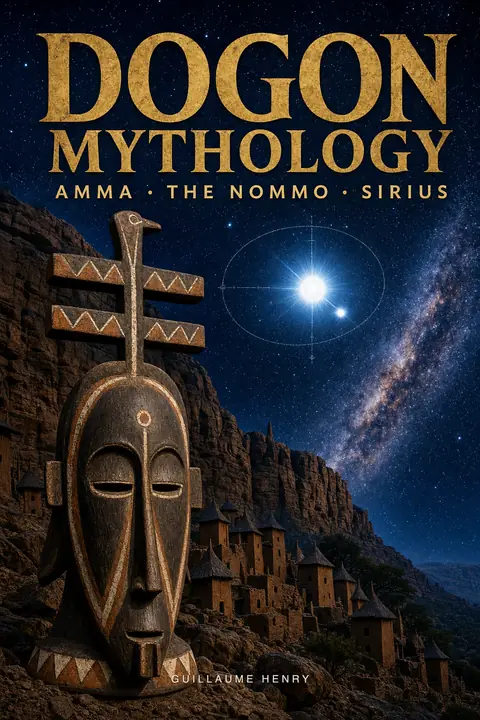
The Dogon Mythology Book: Amma, the Nommo, and the Mystery of Sirius
Amma, the Nommo, and Sirius
The cosmology of a people who carved their villages into a cliff in Mali, and who, some claim, knew of an invisible companion star to Sirius. The creator Amma, the amphibious Nommo, the cosmic egg, and one of anthropology’s great controversies.
More from Dogon
All articles
Dogon
The Nommo: Ancestral Water Spirits and Culture Heroes of the Dogon
The Nommo are the Dogon people's ancestral water spirits who brought civilization, language, and moral order to humanity. Descended from the sky god Amma, they shaped the world through sacrifice and remain central to Dogon ritual, art, and identity today.
Dogon
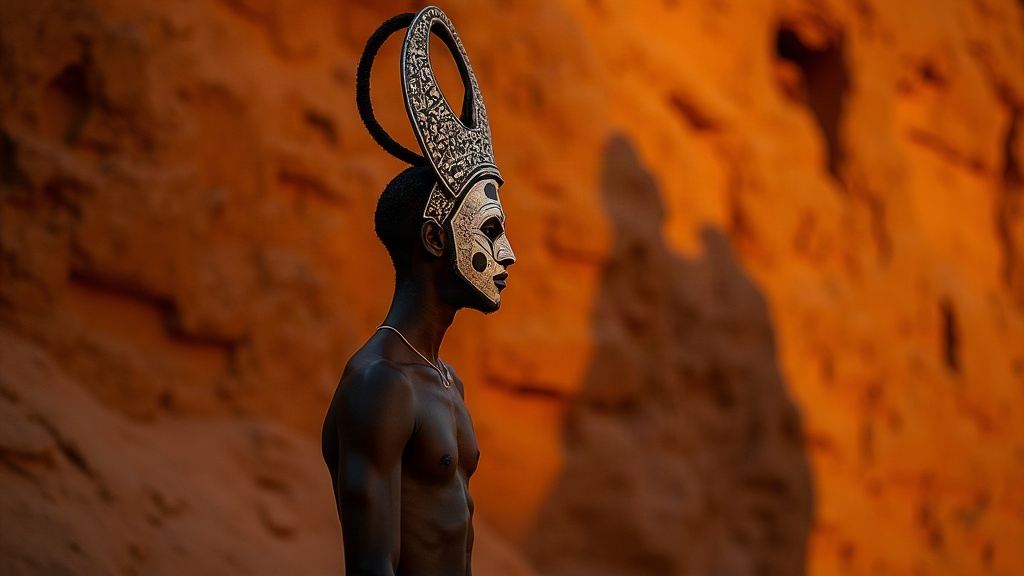
The Dogon Mask Tradition: Kanaga, Sirige, and Ritual Performance
The Dogon people of Mali have preserved one of Africa's most intricate mask traditions for centuries. Kanaga and Sirige masks embody cosmology, death, and the animate power of wood in ceremonies that bind the living to ancestors.
Dogon
The Binu Shrines: Sacred Altars to Ancestral Spirits in Dogon Tradition
The Binu Shrines are sacred wooden altars where the Dogon people of Mali honor their ancestors and the primordial water spirits that shaped their world. Built into cliff dwellings and family homes, these shrines connect the living to the dead through ritual, offering, and careful ceremonial action.
Dogon
The Dama Funeral Rites: Guiding the Dead to Ancestorhood
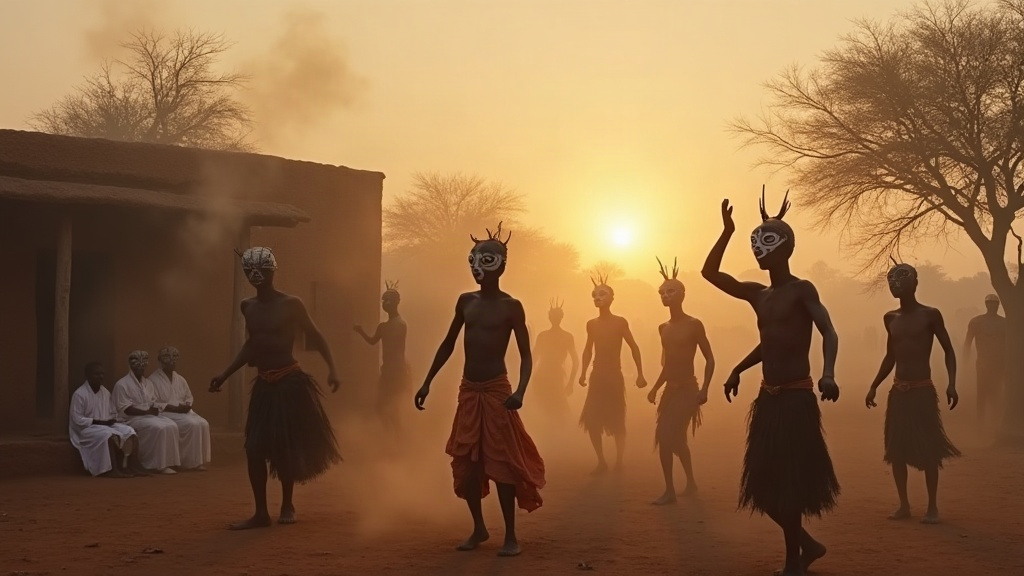
The Dama is the Dogon people's most sacred ceremony, a multi-stage funeral rite that transforms the dead into protective ancestors. Masked dancers, secret societies, and months of ritual guide the soul through the spirit world while honoring the body's return to earth.