
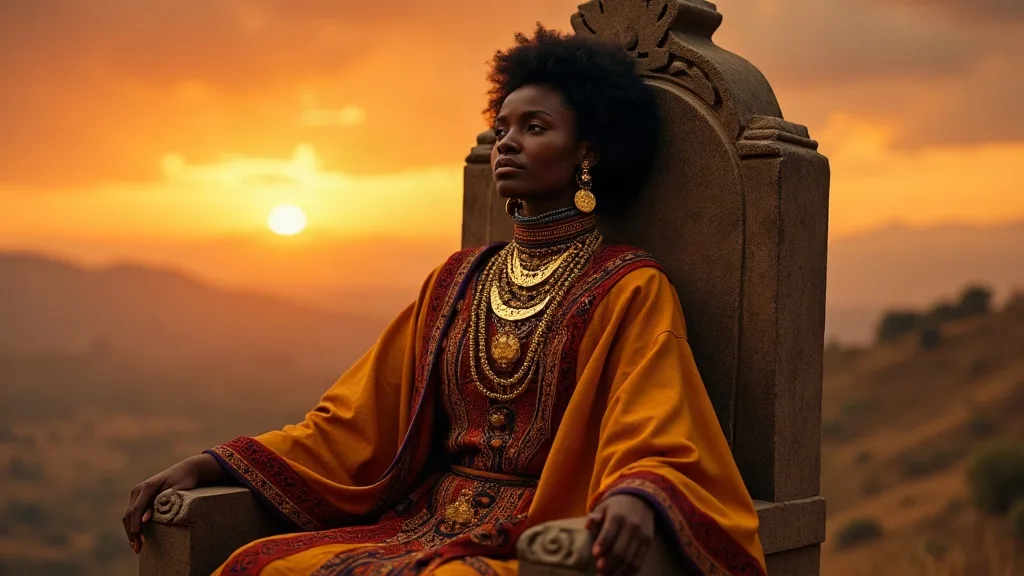
Makeda, Queen of Sheba: Ethiopia's Legendary Monarch
Makeda, Queen of Sheba, built an empire on wisdom and crossed a desert to challenge a king. Her story shaped three world religions and still anchors Ethiopian identity today.
Contents
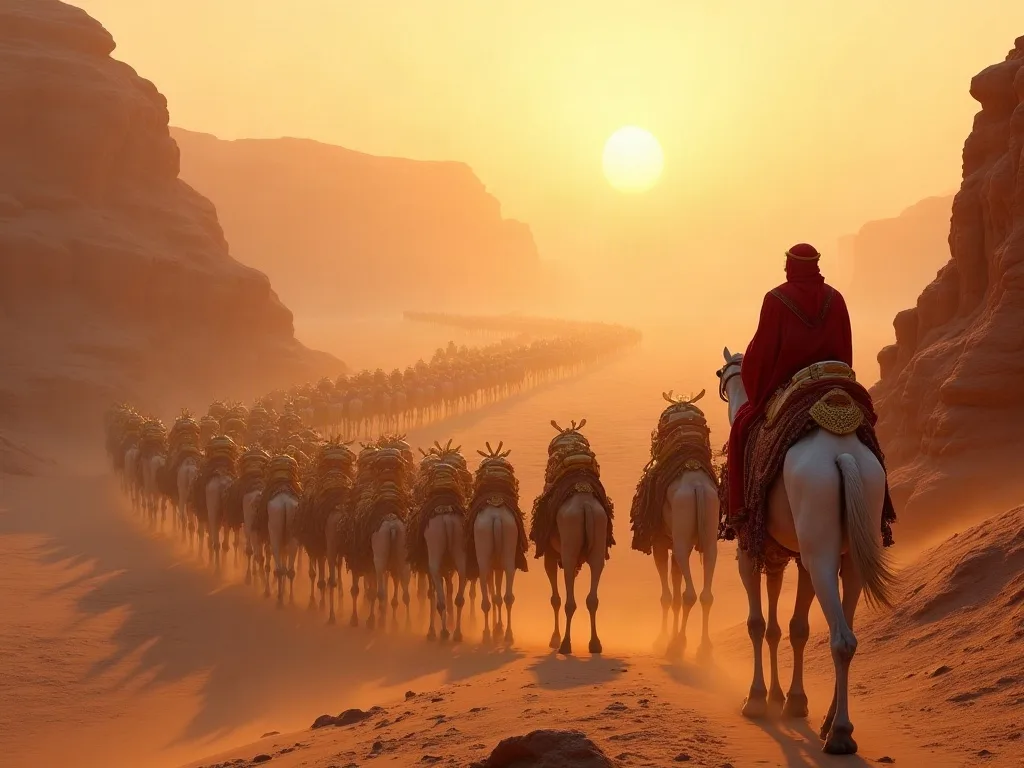
The caravans left before dawn. Hundreds of camels, laden with gold and spices and rare resins, moved south through the Negev dust while the stars were still out. At the head of the procession rode a queen who had traveled over a thousand miles to test a man she had only heard of in rumors. Her name, in the Ge'ez language of ancient Ethiopia, was Makeda. The world would remember her as the Queen of Sheba.
She arrived at the court of Solomon bearing gifts that made Jerusalem stop and stare. Then she asked him questions. Riddles, puzzles, impossible problems. The Kebra Nagast, the great Ethiopian royal chronicle compiled in the fourteenth century but drawing on traditions centuries older, records that Solomon answered every one. Makeda sat across from the wisest king on earth, and she matched him. That moment of equals recognizing each other is the heart of one of the oldest royal legends alive.
Her story runs through the Hebrew Bible, the Quran, the Talmud, Ethiopian Orthodox scripture, and the oral traditions of Yemen, Eritrea, and East Africa. No single figure in African mythology commands as wide a stage.
Makeda in the Kebra Nagast: The Ethiopian Account
The Ethiopian tradition is the richest, the most detailed, and the most emotionally alive version of the Queen of Sheba's story. It begins not with a queen but with a merchant named Tamrin, who trades regularly in Jerusalem and returns home speaking of nothing but the extraordinary wisdom of King Solomon.
Makeda, ruling from her capital at Aksum in the northern Ethiopian highlands, hears Tamrin's reports and decides she must see this king herself. The Kebra Nagast describes her departure with a generosity of detail rare in ancient chronicles: 797 camels, mules beyond counting, wagons, servants, and enough treasure to impress even a king whose mines produced gold by the ton.
Solomon receives her at Jerusalem and, for several months, teaches her everything she asks. The text frames this as an intellectual courtship: Makeda soaks up knowledge of law, astronomy, governance, and theology. Then comes the famous night.
Solomon asks Makeda to share his table at a great feast, and she agrees on one condition: she will take nothing from his house without his permission. He agrees, but adds a condition of his own. She must take nothing of his without asking. Makeda laughs: she is a queen, she does not steal. That night, food salted and spiced and rich enough to make the throat ache for water, Makeda wakes in darkness. She reaches for a cup of water beside her bed.
Solomon appears. She has taken what is his, he says. Water is the most precious thing in his house. The price of breaking her oath is a night at his side.
The Kebra Nagast treats this episode with a care modern readers sometimes miss. Makeda does not protest or weep. She sees the bargain clearly and accepts it. Nine months after leaving Jerusalem, she gives birth to a son. She names him Bayna-Lehkem, "Son of the Wise Man." The world will know him as Menelik I.
Solomon's Son and the Ark of the Covenant
The story of Makeda is also the story of what her son carries home. Menelik grows up in Aksum knowing who his father is. At age twenty-two, he travels to Jerusalem to meet Solomon, who recognizes the boy instantly and weeps. Solomon begs Menelik to stay and inherit his throne. Menelik refuses. Ethiopia is his home. His mother's kingdom is his inheritance.
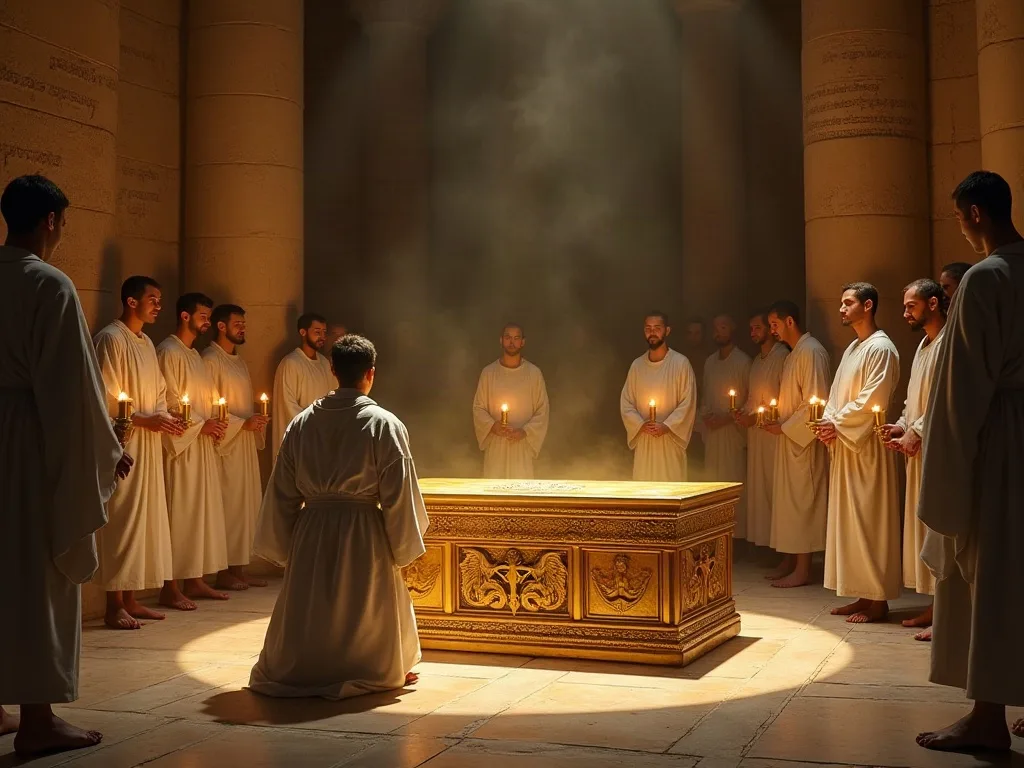
Solomon accepts this and sends Menelik back with a retinue of sons of Jerusalem's leading priests. But on the night before departure, those young men make a decision that changes world history: they steal the Ark of the Covenant, the gold-covered chest that held the tablets of Moses, and replace it with a replica. Menelik, the Kebra Nagast insists, does not know this until the caravan is already in Egypt. By then, God himself has confirmed the transfer. The Ark wanted to go to Ethiopia.
This is not a minor detail in Ethiopian Orthodox theology. The Kebra Nagast argues, explicitly and at length, that the covenant between God and Israel was transferred to Ethiopia the moment the Ark arrived in Aksum. The Ethiopian church still claims the Ark rests in the Chapel of the Tablet in Aksum, cared for by a single monk who never leaves the compound. No outsider has seen it. No photograph exists. The claim is taken seriously enough that the Ethiopian government protects the chapel with armed guards.
Makeda's legacy is therefore not just a love story. It is a theological argument about divine election, a claim that Ethiopia stands at the center of God's plan. Every Ethiopian emperor until 1974 legitimized his rule by tracing his bloodline to her and Menelik.
Bilqis: The Queen of Sheba in the Quran and Islamic Tradition
The Quran names her Bilqis in later Islamic commentary, though the text itself never uses her name. Surah 27 (An-Naml, "The Ants") tells her story in forty-five verses. A hoopoe bird, serving as Solomon's messenger, discovers a great queen who rules a realm of astonishing wealth but worships the sun instead of God.
Solomon sends a letter demanding she submit to his God. Her advisors urge war. She chooses negotiation: she will send gifts and judge Solomon by how he receives them. Solomon sends the gifts back, unimpressed. She decides to come herself.
Before she arrives, Solomon asks his court who can bring her throne from her capital to Jerusalem. A djinn offers to carry it before the session ends. A man "who had knowledge of the Book" claims he can do it in the blink of an eye. He does. When Bilqis arrives, Solomon shows her the throne and asks if it looks familiar. She says it looks like hers, but different. Then he leads her to a palace with a floor of polished glass so clear she lifts her skirt thinking it is water, baring her ankles to the court.
Islamic commentators read this moment in several ways. Some see it as Solomon gently humbling a proud queen. Others see it as the Queen proving her wit: she understands the illusion instantly. She converts at the end of the surah, declaring submission to God alongside Solomon. The Quran presents her conversion as genuine and total, framing Bilqis as one of the most perceptive rulers in human history.
In Yemeni tradition, Bilqis ruled from the city of Marib, the ancient Sabaean capital where a great dam irrigated the desert. The ruins of Marib still stand in present-day Yemen, and the Mahram Bilqis, the Temple of the Moon God Almaqah near Marib, is locally called the "Temple of Bilqis." Arab genealogies claim she was Sabaean rather than Ethiopian, though both traditions may preserve a memory of the same historical queen, or the same trade queen whose network stretched from the Red Sea coast to the Nile.
The Biblical Sheba: Power, Riddles, and a Kingdom Without a Name
The Hebrew Bible's account, in 1 Kings 10 and 2 Chronicles 9, is the shortest of the three main versions: 13 verses in Kings. It does not name the queen. It says she heard of Solomon's fame "for the name of the Lord" and came to test him with hard questions. She brought gold, spices, and precious stones in a caravan of extraordinary size.
Solomon answered everything she asked. Nothing was hidden from him. She stood before his palace, his court, the food on his tables, the clothes of his servants, the burnt offerings at his temple, and "there was no more spirit in her." The Hebrew phrase conveys something like stunned breathlessness: she had not believed the reports, and now she saw that the half had not been told.
She praises him at length, gives him 120 talents of gold (a talent weighed roughly 34 kilograms, which places the gift at around four metric tons), and trades spices and precious stones. Solomon gives her "all her desire, whatever she asked." She returns to her own land.
The biblical text never specifies where that land is. Sheba appears elsewhere in the Bible as a grandson of Noah through Ham, and as a region associated with incense trade and wealth. Most modern scholars place it in southern Arabia, in what is now Yemen, with a possible extension into the Ethiopian highlands across the Red Sea strait known as the Bab-el-Mandeb.
The Ark of the Covenant in Ethiopian tradition is directly entangled with the Queen of Sheba's bloodline. Removing Makeda from the story leaves Menelik without a mother and the Ark without a reason to travel south.
The Historical Kingdom of Sheba: Saba and the Sabaean State
Archaeology has been kinder to Sheba than to most legendary kingdoms. The Sabaean state in what is now Yemen flourished from roughly the tenth century BC through the fourth century CE. Its capital at Marib controlled the frankincense routes, and its rulers bore the title mukarrib, priest-kings who combined religious and political authority.
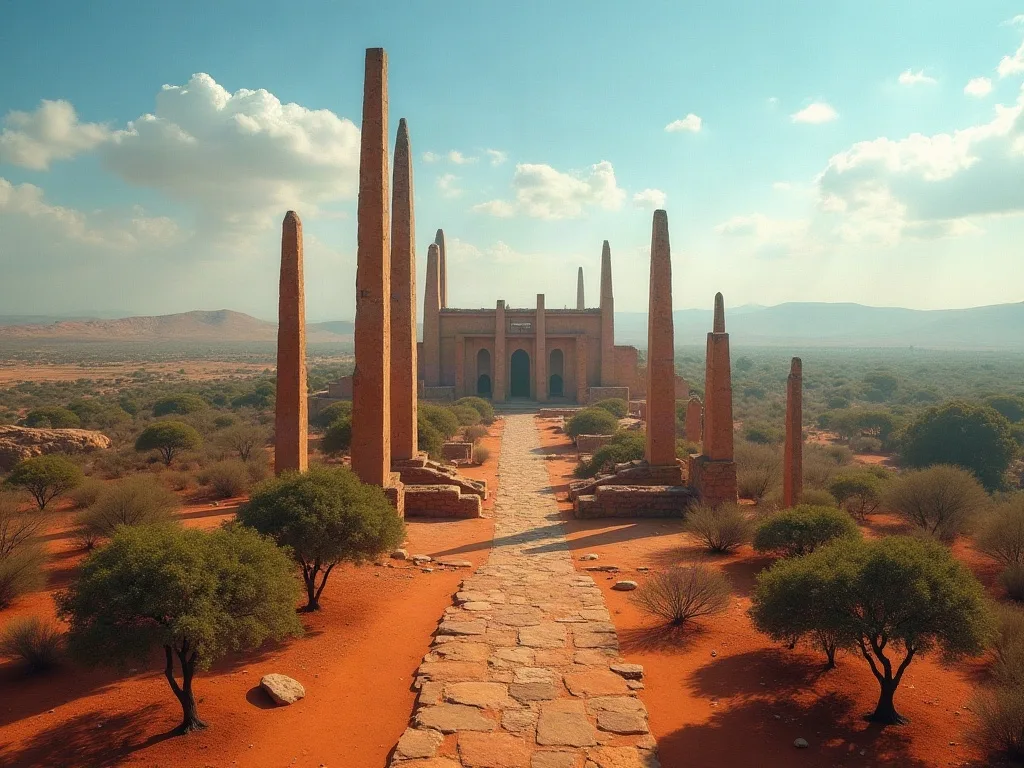
The Sabaean script, an ancestor of the Ge'ez alphabet still used in Ethiopian Orthodox liturgy, spread across the Red Sea into northern Ethiopia around 500 BC. Aksum, which would later become Ethiopia's greatest ancient city, shows clear Sabaean architectural and linguistic influence in its earliest layers.
This cross-sea connection is why the debate about whether Sheba was Arabian or African misses the point. The ancient Sabaean world straddled both coasts. A queen who traded between Marib and the Ethiopian highlands would have commanded territory on both sides of the Red Sea. Aksum, the city Makeda is said to have ruled from, became the capital of one of the ancient world's four great powers alongside Rome, Persia, and China, according to the third-century Persian prophet Mani.
Ethiopian archaeologists have also pointed to the pre-Aksumite site of Yeha, forty-five kilometers east of Aksum, where a temple dating to around 700 BC survives largely intact. Some scholars argue Yeha was the political center Makeda might have ruled. The dates align with the probable reign of Solomon in the tenth century BC, though the gap requires explanation: the Yeha temple may have been built a century or two after any historical Queen of Sheba.
Makeda in Ethiopian Orthodox Faith and Royal Identity
Makeda, Queen of Sheba did not remain a legend. She became constitutional law. The Ethiopian Orthodox Tewahedo Church, one of the oldest Christian churches on earth, ordained in the fourteenth century that no person could claim the Ethiopian throne without proving descent from her and Solomon through Menelik. This principle, codified in the Fetha Nagast (Law of Kings), made Makeda the single root of legitimate Ethiopian sovereignty.
Every Solomonic emperor used her name as a touchstone. Haile Selassie, who ruled from 1930 to 1974, included "Conquering Lion of the Tribe of Judah" in his official titles, a direct reference to the Solomonic line that began with Makeda's night with Solomon. When Jamaican Rastafari theology elevated Haile Selassie to messianic status in the twentieth century, Makeda traveled with him: she became the ancestral mother of a global spiritual movement, her story sung in reggae and read in Caribbean churches thousands of miles from the highland city where the Kebra Nagast was first copied.
Ethiopian women have claimed her differently. In Orthodox hagiography, Makeda's conversion to Solomon's God is the central drama: a great queen choosing truth over tradition. In Ethiopian feminist writing from the twentieth century onward, her choice to travel alone to Jerusalem, to ask unanswerable questions, to negotiate rather than wage war, marks her as a prototype of female intellectual authority in a region that has not always honored it.
Riddles, Wisdom, and the Test of a Queen
The riddle contest between Makeda and Solomon appears in its most elaborate form not in the Bible or the Kebra Nagast but in the Midrash ha-Gadol, a medieval Jewish compilation of rabbinic commentary. There, the Queen arrives with a group of children dressed as girls and boys, and asks Solomon to tell which is which. He sprinkles water from a fountain: the real girls splash their faces delicately, the boys splash roughly. She brings hard and soft nuts. He guesses their contents correctly.
The riddles themselves vary by version, but the pattern is always the same: the Queen brings problems she believes no one can solve, and Solomon sees through each one. What is extraordinary in the Ethiopian reading is that Makeda's asking is treated as equally impressive as Solomon's answering. She is not a student. She is a peer testing a peer. The Kebra Nagast says she returned to Aksum having learned wisdom "like water poured from one vessel into another." Both vessels are full at the end.
This detail separates the Ethiopian account from how later European tradition handled the Queen of Sheba. In medieval Christian allegory, she became a symbol of the Church coming to Christ, or of Gentile wisdom recognizing Jewish truth. Her own agency, her own kingdom, her own intelligence faded. Ethiopia never lost those things. Makeda in Ethiopian tradition is always a queen first, a seeker second, never a satellite of Solomon's story.
Makeda's Legacy Across Three Religions
Few figures in world mythology anchor three major religious traditions simultaneously. Menelik I, her son, is the link: his legitimacy requires a Jewish king as father and an African queen as mother, and his story requires both traditions to hold his parentage as real.
For Ethiopian Orthodox Christians, Makeda is the founder-queen of a Christian empire, even though she lived before Christianity. The Kebra Nagast explains this through prophecy: her journey to Solomon, and the Ark's journey to Aksum, were preparations for a nation that would receive the Gospel before almost anyone else. Ethiopia formally adopted Christianity in the fourth century CE under Emperor Ezana, but the Kebra Nagast reads that conversion as the culmination of a plan set in motion when Makeda left Aksum in her caravan.
For Muslim readers, Bilqis is one of the Quran's great examples of a ruler who chooses truth over pride. Her conversion is not described as a humiliation but as an act of courage: she saw what was real and acted on it. Ibn Kathir, the fourteenth-century Islamic scholar, dedicated considerable commentary to her wisdom, noting that her diplomatic instinct ("she preferred negotiation to battle") was itself proof of divine guidance.
For Jewish readers, the Queen of Sheba appears in the Targum Sheni, an Aramaic expansion of the Book of Esther, and in the Talmud's Bava Batra, where she is associated with wisdom traditions from the south. Some kabbalistic readings connect the Queen to the figure of the Shekhinah, the divine feminine presence, traveling to meet its reflection in Solomon's God-given insight.
Frequently Asked Questions About Makeda, Queen of Sheba
Frequently asked questions
Is Makeda, Queen of Sheba a historical figure or a myth?
The honest answer is that no contemporary document from the tenth century BC names her or confirms her visit to Jerusalem. The Sabaean kingdom she is associated with is historically documented, and a powerful queen of the incense-trading regions of southern Arabia or northern Ethiopia is plausible for the period. Most historians treat her as a legendary figure built around a real political and commercial relationship between the ancient Near East and the Red Sea kingdoms. The Ethiopian tradition, enshrined in the Kebra Nagast, treats her as fully historical.
What does the name Makeda mean?
The etymology is debated. One interpretation links the name to a Ge'ez root meaning "greatness" or "beauty." Another connects it to a southern Arabian name form. The Kebra Nagast gives her full name as Makeda, while Islamic tradition calls her Bilqis, a name whose origin is also disputed: some Arabic scholars link it to a root meaning "she who rules" or connect it to an ancient South Arabian proper name from Sabaean inscriptions.
What is the Kebra Nagast, and how reliable is it as a source?
The Kebra Nagast, meaning "Glory of Kings" in Ge'ez, is an Ethiopian royal chronicle compiled around 1314 CE by the monk Yeshaq of Aksum. It draws on older Coptic, Arabic, and Ethiopic texts. As a historical source for tenth-century BC events it is not reliable in an empirical sense. As a document of Ethiopian theology, royal ideology, and national identity, it is one of the most important texts in African literature. Scholars like Edward Ullendorff and David Hubbard have analyzed it carefully, distinguishing its legendary core from its genuine historical data about Aksumite culture.
Do Ethiopians still venerate Makeda today?
Yes, actively. The Ethiopian Orthodox Tewahedo Church honors her as a proto-Christian queen who prepared her nation for the Gospel. Her story is taught in Ethiopian schools as foundational national history. Rastafari theology, which spread from Jamaica across the world through the twentieth century, regards Makeda as a sacred ancestral mother whose bloodline runs through Haile Selassie to the global community of believers. She appears in contemporary Ethiopian art, literature, music, and political rhetoric with striking regularity.
Was the Kingdom of Sheba in Africa or Arabia?
The ancient Sabaean state was centered in what is now Yemen, with its capital at Marib. However, Sabaean culture, script, and trade networks extended across the Red Sea into the Ethiopian and Eritrean highlands by at least 500 BC. Ethiopian tradition places Makeda's capital at Aksum, while Yemeni and Arab tradition places Bilqis at Marib. Most modern scholars believe the question is a false binary: the ancient world of the Red Sea was interconnected enough that a queen whose authority stretched across both coasts is historically plausible.
Why is the Ark of the Covenant connected to the Queen of Sheba's story?
In the Kebra Nagast, the transfer of the Ark from Jerusalem to Aksum is the theological climax of the narrative. Menelik, the son Makeda conceived with Solomon, brings the Ark back to Ethiopia when he returns home after meeting his father. The text argues this transfer was divinely ordained, signaling that God's covenant passed from Israel to Ethiopia. The Ethiopian Orthodox Church maintains to this day that the authentic Ark of the Covenant rests in the Chapel of the Tablet in Aksum, though no independent verification has been permitted.
Makeda in Modern Art, Literature, and Living Tradition
The Queen of Sheba never became a museum piece. She kept moving.
In 1875, the French composer Charles Gounod premiered his opera La Reine de Saba, drawing on the European Romantic image of an exotic queen dazzled by Solomon's court. That version kept her largely passive, a spectator of male genius. Ethiopian artists of the twentieth century pushed back hard. Writers like Haddis Alemayehu and scholars like Getatchew Haile re-centered Makeda as an active political agent, a ruler who chose her journey, chose her alliance with Solomon, and chose to build a dynasty rather than a romance.
Reggae culture gave her a global second life. Bob Marley's "Iron Lion Zion," the Abyssinians, Burning Spear: the Rastafari musical tradition wove Makeda into lyrics heard on every continent. For Rastafari believers, she is literally the ancestral grandmother of the elect, the source of the bloodline that runs to Haile Selassie and outward.
In 2019, the Smithsonian's National Museum of African Art mounted an exhibition examining the visual legacy of the Queen of Sheba across Ethiopian, Islamic, and European iconography. Across the twelve centuries of images on display, one pattern held: the cultures that gave Makeda power and agency in their texts also painted her standing upright, dressed in royal clothing, looking directly at the viewer. The cultures that reduced her to allegory painted her kneeling.
Ethiopia, in every period examined, painted her standing.
The Kebra Nagast ends with Menelik returning to Aksum with the Ark, and Makeda receiving her son. The kingdom continues. The covenant is secured. But the last image the text lingers on is not the Ark, not Menelik, not Solomon's Jerusalem. It is Makeda on her throne, in her city, in her land. A queen who crossed a desert to ask hard questions, and came home with the answers.
Read the full book
Want the whole story?
The complete edition is an instant PDF download here, with a paperback on Amazon for selected titles.
Ethiopian
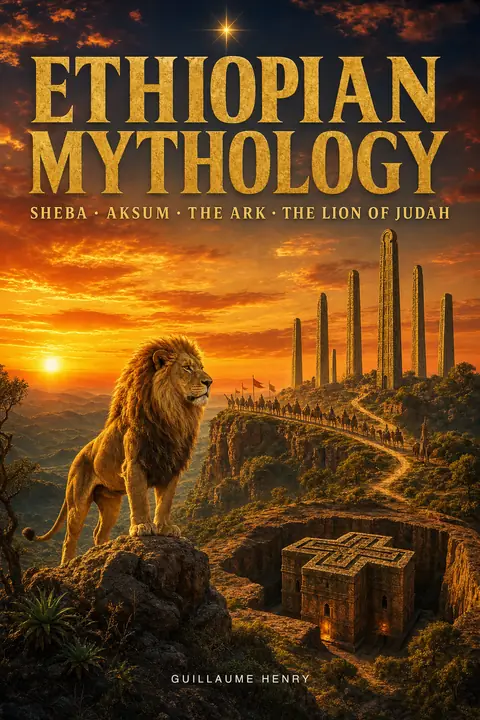
The Ethiopian Mythology Book: The Queen of Sheba, the Ark of the Covenant, and the Sacred Legends of Aksum
The Queen of Sheba, the Ark of the Covenant, and the Kingdom of Aksum
The sacred legends of Ethiopia, the one African kingdom never conquered: the Queen of Sheba and her journey to King Solomon, the Ark of the Covenant said to rest at Aksum, Waaqa the sky-god of the Oromo, and the saint-kings who carved the churches of Lalibela. Drawn from the Kebra Nagast and the living oral tradition.
More from Ethiopian
All articles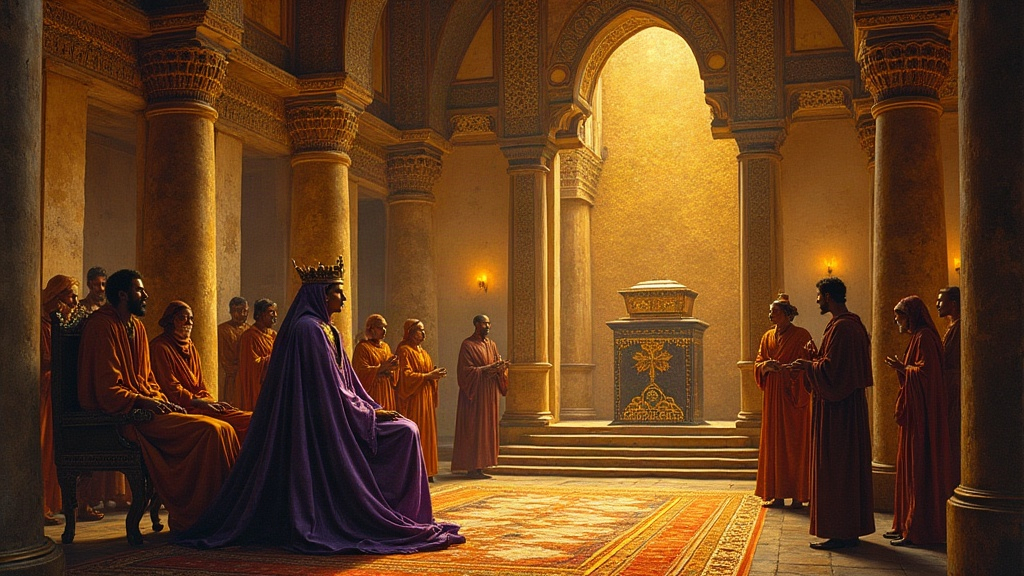
Ethiopian
The Kebra Nagast: Ethiopia's Sacred National Epic
The Kebra Nagast, Ethiopia's greatest literary and spiritual treasure, tells how the Queen of Sheba bore Solomon's son and founded a dynasty that would claim descent from Israel's king. Discover the epic that shaped an empire's identity and survives as living scripture today.
Ethiopian
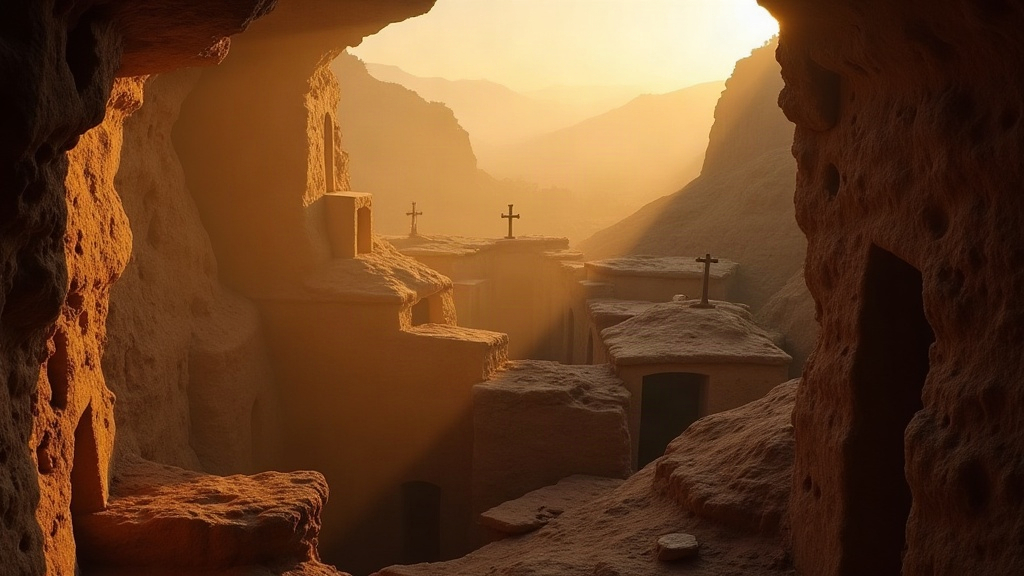
Lalibela: The Rock-Hewn Churches and King's Vision
Discover how King Lalibela carved twelve churches from solid rock in Ethiopia's highlands, creating a sacred landscape that blends ancient Christian devotion with legendary ambition. A journey to Jerusalem without leaving home.

Ethiopian
Atete: Oromo Goddess of Fertility and Femininity
Atete embodies the generative power at the heart of Oromo spirituality. This goddess shapes the cycles of birth, growth, and renewal across the Ethiopian highlands and pastoralist cultures of the Horn of Africa.

Ethiopian
The Nine Saints: Founders of Ethiopian Monasticism
Nine Syrian monks arrived in Ethiopia in the 5th century and transformed its spiritual landscape. Discover how the Nine Saints founded Ethiopian monasticism, shaping the Tewahedo Church and a monastic tradition that endures today.