

Atete: Oromo Goddess of Fertility and Femininity
Atete embodies the generative power at the heart of Oromo spirituality. This goddess shapes the cycles of birth, growth, and renewal across the Ethiopian highlands and pastoralist cultures of the Horn of Africa.
Contents
Atete takes form where the rains arrive and the earth wakes. She moves through the seasons as the Oromo people have moved through them for centuries: a presence felt in the ripening grain, the swelling belly, the child's first cry. She is not distant or abstract. She lives in the body of women, in the body of the land itself.
The Oromo people, who inhabit Ethiopia, Kenya, and parts of Somalia, have maintained one of Africa's most resilient spiritual traditions. Within this world, Atete: Oromo Goddess of Fertility and Femininity stands as a cornerstone of devotion. She is invoked by women seeking pregnancy, by families planting crops, by communities entering seasons of abundance or scarcity. To understand her is to glimpse how African societies have long woven together the sacred and the seasonal, the body and the cosmos.
Origins in the Oromo Spiritual Universe
The Oromo people trace their roots to pastoralist cultures of the Ethiopian highlands and the Horn of Africa. Their spiritual system did not arrive as a single doctrine imposed from outside. Instead, it grew from the land itself, from the rhythms of herding, farming, and survival in a region where rain determines life and death.
Atete emerges in this context as a manifestation of Waaqa, the supreme creative force known to the Oromo as the sky god, the giver of all things. Waaqa is distant and transcendent, but Atete channels Waaqa's generative power into the world of immediate human experience. She is the intermediary between the infinite and the intimate.
The earliest recorded mentions of Atete appear in ethnographic accounts from the 19th and 20th centuries, when European and Arab scholars began documenting Oromo religion in detail. Scholars like Asmarom Getnet and later researchers studying Oromo cosmology noted that Atete was called upon during rites of passage, harvest festivals, and healing ceremonies. She was not confined to a temple or priesthood. She lived in the practices of ordinary women and men, spoken to in prayer, remembered in custom, invoked through ritual action.

Unlike monotheistic traditions that developed formal hierarchies of angels or saints, the Oromo spiritual cosmos maintained a more fluid relationship with divine forces. Atete belongs to a category of powers called ayyaanaa, spiritual essences or attributes that channel the will of Waaqa into specific domains. Fertility, abundance, healing, and the protection of children all fall within her sphere. She is not a goddess distant and alone, but one among a constellation of sacred forces that Oromo communities knew how to address and honor.
The Cycles of Life: Atete and the Seasons
Atete's power is inseparable from the passage of time. The Oromo calendar is not abstract; it is rooted in observation of the stars, the rains, and the growth of cattle and crops. Atete as Oromo Goddess of Fertility and Femininity anchors the entire calendar in the body.
The rainy season is her season. When the sky breaks and water falls, the Oromo say Atete is present. The land drinks, seeds germinate, women's wombs quicken. Rituals conducted at the start of the planting season call upon Atete to bless the seeds and the fields. Older women who have passed childbearing age often lead these ceremonies, their bodies a map of seasons survived, their wisdom a key to approaching the goddess.
Fertility in Oromo thought is not only about pregnancy. It encompasses the flourishing of all living things. A woman who tends her garden carefully, who keeps her household fed, who raises children with wisdom is said to embody Atete's blessing. A man who tends his herds with skill, who breeds cattle carefully and manages pasture sustainably, also participates in her abundance. Atete's gifts extend beyond human reproduction into every form of generative work.
The menstrual cycle, too, fell within Atete's realm. Unlike traditions that saw women's bodies as polluting or shameful, Oromo custom recognized the menstrual cycle as a sacred rhythm aligned with the moon and the cosmic order. Young women entering menarche were brought by elder women to receive Atete's acknowledgment. This was not a moment of shame but of welcome into the full power of womanhood.

Childbirth was perhaps the most direct encounter with Atete. The Oromo midwife, typically an experienced woman of high standing in the community, was believed to serve as a conduit for Atete's protective presence during labor. The songs sung during labor, the herbs administered, the prayers whispered all invoked Atete's steadying hand. A successful birth, especially the birth of a healthy child, was read as Atete's blessing upon that family and upon the mother's body as a vessel of sacred power.
Atete in Ritual and Daily Devotion
Devotion to Atete was lived, not merely believed. It manifested in practices so woven into daily life that they were barely separated from "religion" as Westerners understood the term.
Women would pour libations of milk or honey at sacred groves where Atete was said to gather. A woman preparing for marriage would offer prayers to Atete, asking for fertility and the strength to build a household. Before planting, families would approach a shrine, often simply a marked tree or a patch of earth, to request Atete's blessing on the seeds. These were not grand ceremonies requiring priests. They were intimate conversations with a power that lived close at hand.
The Gada system, which organizes Oromo society into age-grades with ritual responsibilities, included ceremonies honoring Atete at key transitions. When young men were initiated into warrior status, there were parallel rites for young women entering reproductive adulthood, overseen by priestesses or respected elders who spoke on behalf of Atete. These ceremonies were not theatrical spectacles but serious undertakings in which the person's entire social identity was reforged in the presence of the community and the sacred.
In times of drought, when rain failed and the land became barren, special appeals were made to Atete. If a woman was barren, the community would perform rituals asking Atete to restore the woman's capacity. These were not punitive. They were rooted in compassion and a belief that Atete could restore what had been lost. Similarly, if a woman suffered miscarriage or child loss, Atete was invoked to heal the wound and to open the path to conception again.
Gender, Power, and Sacred Authority
One of the most striking features of Atete's tradition is how it positioned women as bearers of sacred knowledge and authority. This did not mean a matriarchal overthrow of male power. Oromo society, like many pastoralist cultures, maintained gender roles and male leadership in public spheres. But in matters of fertility, healing, and the body's sacred cycles, women held recognized spiritual authority.
The priestesses or wise women who mediated between Atete and the community often held positions of genuine influence. Their knowledge of herbs, childbirth, and ritual was valued as a form of spiritual expertise. Young women and older women alike approached them for counsel and blessing. This created a lineage of female spiritual power that ran parallel to the male-dominated political and military structures of Oromo society.
Atete's presence, then, was also a statement about female knowledge and female bodies as sacred domains. A woman's capacity to conceive, carry, and birth life was recognized as something precious, something worthy of ritual honor and community support. This did not erase patriarchy or inequality, but it created spaces where women's bodies and minds were recognized as sacred and powerful.
Atete and the Broader African Theological Context
To understand Atete, it helps to glimpse her within the broader landscape of African goddesses and feminine divine powers. Across sub-Saharan Africa, goddesses of fertility and the earth have held central positions in spiritual systems. The Yoruba have Oshun, goddess of rivers and sensuality. The Zulu honor feminine divine presences within their understanding of ancestral power and cosmic order. The Akan peoples of Ghana maintain reverence for Asase Yaa, the earth mother.
What binds these traditions is a recognition that fertility and creation are not incidental to the spiritual universe. They are central. The capacity to generate life, to nurture growth, to maintain the household and the community are understood as sacred activities reflecting divine will. This stands in striking contrast to some theological systems that locate the sacred primarily in transcendence, otherworldliness, and the rejection of the body and reproduction as distractions from spiritual truth.
The Oromo tradition, with Atete at its heart, asserts something different: the sacred lives in the body, in the seasons, in the intimate acts of care and generation. This is not a "lower" form of spirituality. It is spirituality rooted in the actual conditions of human life.

Atete's Encounter with Other Traditions
The history of the Horn of Africa is a history of encounters and contestations between different religious systems. Christianity arrived in Ethiopia in the 4th century. Islam spread across the Horn from the 7th century onward. The Oromo people, initially pastoralists who moved across territories where these religions held power, eventually saw significant numbers of their own people convert to Christianity and Islam over centuries.
Yet Atete did not disappear. Instead, she was often absorbed or reinterpreted. In some Christian contexts, prayers to Atete merged with devotion to Mary, the mother of Jesus, or to female saints understood as intercessors. In Islamic contexts, references to Atete became more muted in public discourse, though among Oromo Muslim women, older prayer traditions and invocations sometimes maintained echoes of Atete under new names or in private practice.
This syncretism was not necessarily a corruption of "pure" Oromo tradition. Religions do not exist in sealed containers. They live and change as people navigate multiple identities. Some Oromo women and men maintained explicit devotion to Atete alongside Islamic or Christian faith. Others experienced these traditions as compatible or complementary. Still others eventually replaced older practices entirely with newer religious frameworks.
What is clear is that the colonization of Africa and the imposition of Christian and Islamic institutions as markers of "civilization" created pressure to dismiss Oromo spiritual practices as pagan or primitive. Atete, along with many African divine presences, was marginalized in the public religious sphere, relegated to "tradition" or "folklore" rather than recognized as a living spiritual reality.
Modern Recovery and Scholarly Recognition
In recent decades, Oromo intellectuals and scholars have undertaken serious work to document and recover their own spiritual heritage. This has not been a simple return to a imagined pure past. Rather, it has been a deliberate reclamation of knowledge and practice that colonialism and religious conversion campaigns had pushed to the margins.
Scholars like Asmarom Getnet, Ulrich Braukämper, and more recently Oromo-centered researchers have written ethnographically and historically about the Gada system, Waaqa worship, and the role of figures like Atete. Academic journals and books dedicated to African religions have begun to give serious attention to Oromo cosmology, moving past earlier dismissals.
At the same time, Oromo communities themselves have worked to maintain and transmit knowledge of Atete and related practices. Families pass down stories and rituals through oral tradition, especially among elder women who remember older ways. Some communities have created shrine spaces and organized ceremonies that explicitly honor Atete and Oromo spiritual heritage, often in dialogue with modern Oromo identity and political movements.
This recovery is not antiquarian. It is a living process. Oromo women and men today navigate multiple identities: as Muslims or Christians, as modern educated professionals, as people connected to traditional community life. Within that navigation, some choose to honor Atete, to invoke her in moments of fertility, healing, or seasonal transition. Others engage her memory as part of cultural heritage without active devotional practice. All these engagements are valid expressions of how Atete continues to live in Oromo consciousness.
Atete and Feminist Scholarship
Feminist scholars of African religions have found in figures like Atete important resources for thinking about how societies can honor women's bodies and creative power as sacred. Scholars like Oyeronke Oyewumi, who has written about Yoruba gender categories, and Sylvia Federici, who has traced the history of reproductive labor and spiritual devaluation, point out that the dismissal of fertility goddesses and women's reproductive and nurturing work as less sacred than male-dominated priesthoods or transcendent spirituality is itself a historical choice, not an eternal truth.
Atete's tradition offers a different model. Within it, women's bodies and women's work are recognized as sacred. This does not solve all problems of gender equality or hierarchy, but it creates conceptual space for recognizing women as bearers of sacred knowledge and power. For contemporary Oromo women and for scholars interested in alternatives to both patriarchal religious systems and secular feminism, Atete represents a resource: a way of imagining a spiritual universe in which the capacity to generate and nurture life is honored as central to cosmic order.
Frequently asked questions about Atete
Frequently asked questions
Was Atete worshipped only by women?
No. While women held particular authority in Atete's rituals and approached her especially at moments of fertility, pregnancy, and birth, men also invoked her. Families collectively made offerings at the start of planting season. Men involved in agriculture or concerned with the health and fertility of their families participated in ceremonies honoring Atete. She was a communal power, not confined to women only, though women's relationship to her was more direct and frequent.
How is Atete connected to Waaqa, the Oromo supreme being?
Waaqa is the transcendent, all-encompassing creative force in Oromo theology. Atete is one manifestation of Waaqa's generative power, channeling divine abundance into the specific domains of fertility, childbirth, healing, and the cycles of growth. She is not a separate deity opposed to Waaqa but an intermediary through which Waaqa's will becomes tangible in the world.
What happened to Atete worship after Ethiopia became Christian?
Christianity's expansion in Ethiopia led to official pressure to abandon pre-Christian practices. However, Atete devotion persisted in multiple forms. Some Oromo Christians incorporated Atete-like invocations into prayers to Mary or female saints. In communities less integrated into the Christian hierarchy, Atete rituals continued, sometimes in syncretistic forms. The tradition has never disappeared entirely, though its public visibility diminished under religious and colonial pressures.
Is Atete still honored today?
Yes, though in varied and complex ways. Some Oromo communities, especially in rural areas and among elder women, maintain explicit devotional practices honoring Atete. Others engage her through cultural memory and identity. Contemporary Oromo scholars and activists have worked to recover and document Atete worship as part of cultural reclamation and as an alternative model for understanding gender, spirituality, and the sacred body.
How does Atete compare to other African fertility goddesses?
Like the Yoruba Oshun or the Akan Asase Yaa, Atete represents a tradition in which women's reproductive power and generative creativity are recognized as sacred and central to cosmic order. What distinguishes her is the particular way she is embedded in Oromo pastoral and agricultural life cycles, the role of elder women as her priestesses, and her integration into the Gada system and age-grade rituals.
What is the primary source material for knowledge about Atete?
Atete is known primarily through oral tradition passed down by Oromo families and communities, especially through elder women. Ethnographic accounts by scholars like Asmarom Getnet and Ulrich Braukämper have documented Atete practices. Academic journals on African religions have published research on Oromo spirituality. Unlike myths recorded in written texts like the Edda or Mahabharata, Atete's story lives mainly in practice and oral transmission, which means understanding her requires listening to living communities.
The Unfinished Theology of Atete
One of the most vital aspects of Atete's tradition is something that often escapes notice: it is not finished. Atete theology and practice are not frozen artifacts but living, evolving frameworks through which Oromo communities make sense of fertility, gender, power, and the sacred.
Contemporary Oromo women and men are actively engaged in thinking through how Atete speaks to modern questions. What does it mean to honor Atete in a world of contraception and reproductive choice? How can reverence for women's generative capacity be maintained while also affirming women's right to pursue careers, education, and paths beyond motherhood? How does Atete speak to questions of environmental degradation, when the rains fail not due to spiritual imbalance but to climate change?
These are not questions that undermine Atete's power. They are invitations to deepen it. They show that Atete is not a relic of a dead past but a living presence asking new questions. In that ongoing conversation between communities and the sacred powers they honor lies the true vitality of African spirituality.
Read the full book
Want the whole story?
The complete edition is an instant PDF download here, with a paperback on Amazon for selected titles.
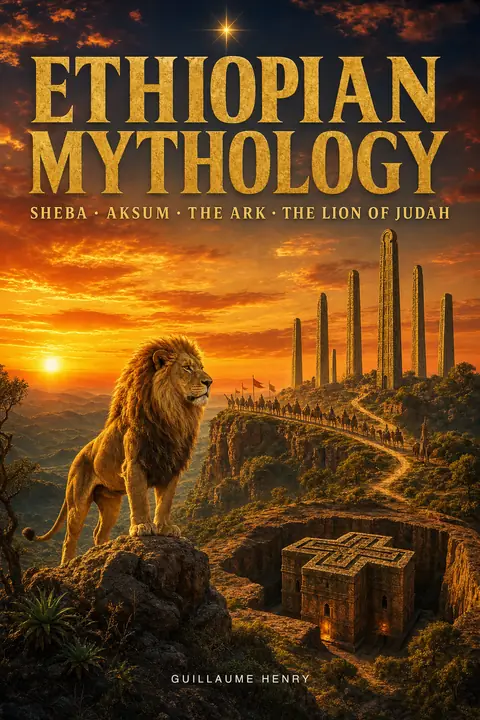
Ethiopian
The Ethiopian Mythology Book: The Queen of Sheba, the Ark of the Covenant, and the Sacred Legends of Aksum
The Queen of Sheba, the Ark of the Covenant, and the Kingdom of Aksum
The sacred legends of Ethiopia, the one African kingdom never conquered: the Queen of Sheba and her journey to King Solomon, the Ark of the Covenant said to rest at Aksum, Waaqa the sky-god of the Oromo, and the saint-kings who carved the churches of Lalibela. Drawn from the Kebra Nagast and the living oral tradition.
More from Ethiopian
All articles
Ethiopian
The Kebra Nagast: Ethiopia's Sacred National Epic
The Kebra Nagast, Ethiopia's greatest literary and spiritual treasure, tells how the Queen of Sheba bore Solomon's son and founded a dynasty that would claim descent from Israel's king. Discover the epic that shaped an empire's identity and survives as living scripture today.
Ethiopian
Lalibela: The Rock-Hewn Churches and King's Vision
Discover how King Lalibela carved twelve churches from solid rock in Ethiopia's highlands, creating a sacred landscape that blends ancient Christian devotion with legendary ambition. A journey to Jerusalem without leaving home.
Ethiopian
The Nine Saints: Founders of Ethiopian Monasticism
Nine Syrian monks arrived in Ethiopia in the 5th century and transformed its spiritual landscape. Discover how the Nine Saints founded Ethiopian monasticism, shaping the Tewahedo Church and a monastic tradition that endures today.
Ethiopian
Timkat: The Epiphany Festival and Ark Processions
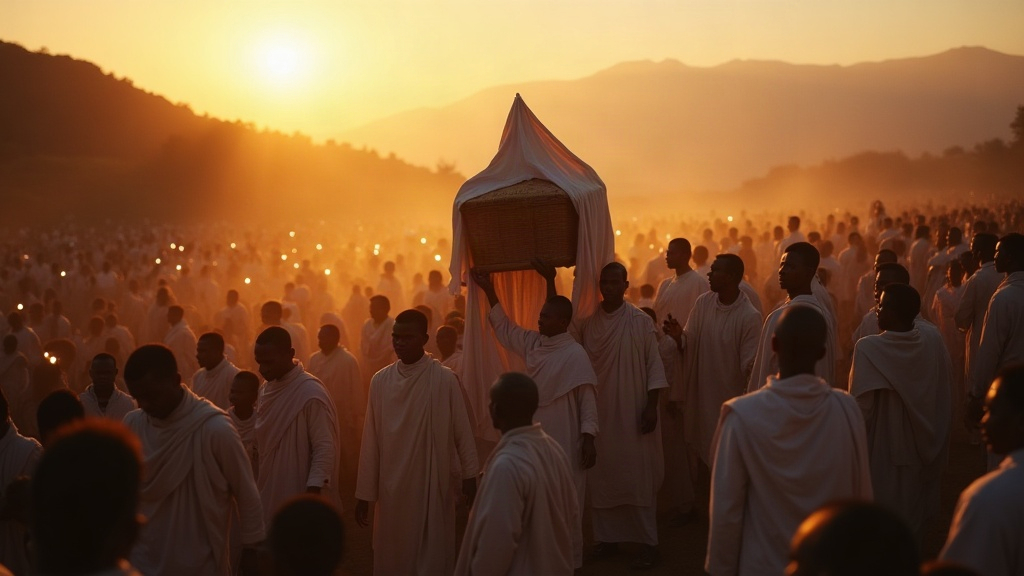
Timkat celebrates Christ's baptism through Ethiopia's most sacred ritual: the parading of the Ark of the Covenant. This ancient festival weaves Old Testament reverence, water blessings, and centuries of royal ceremony into a living theology that still shapes Ethiopian Christianity today.