
The Kebra Nagast: Ethiopia's Sacred National Epic
The Kebra Nagast, Ethiopia's greatest literary and spiritual treasure, tells how the Queen of Sheba bore Solomon's son and founded a dynasty that would claim descent from Israel's king. Discover the epic that shaped an empire's identity and survives as living scripture today.
Contents
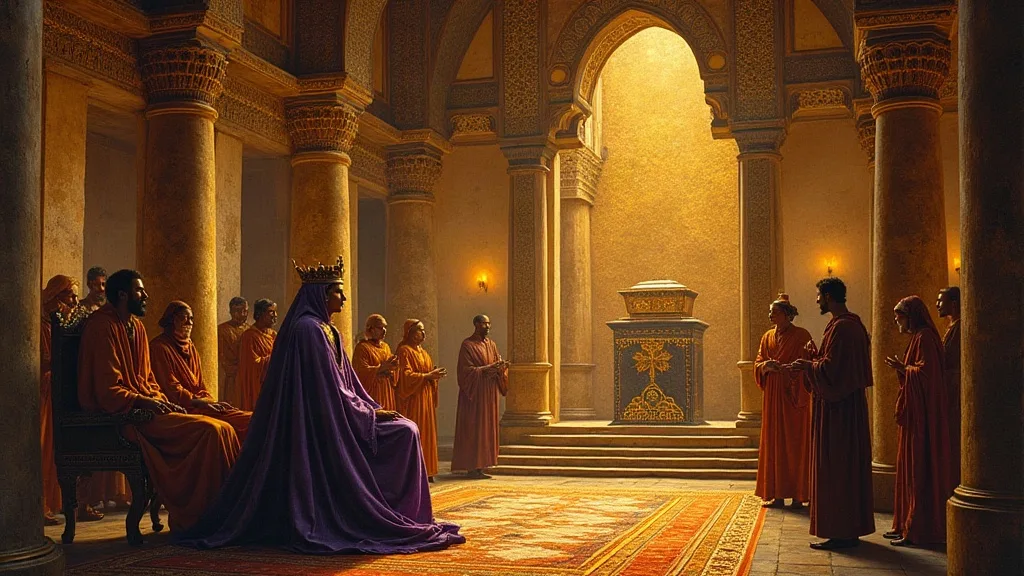
In the 13th century, a monk in Ethiopia wrote down a story that had been passed mouth to mouth for a thousand years: how the Queen of Sheba journeyed to Jerusalem, lay with King Solomon, and returned pregnant with a son. That child, Menelik I, became the founder of Ethiopia's royal house and carried away the Ark of the Covenant itself. This narrative, the Kebra Nagast (meaning "Glory of the Kings"), transformed from legend into the cornerstone of Ethiopian Christian identity and political sovereignty.
The Kebra Nagast is not merely a book. For Ethiopians, it functions as national constitution, theological text, and proof of descent from the line of David. When emperors were crowned, they swore by its contents. When armies marched to war, commanders invoked its authority. Even today, the Ethiopian Orthodox Tewahedo Church treats it as scripture, second only to the Bible itself. No other African literary work has held such political and spiritual weight for so long.
The Story at the Heart of Empire
The Kebra Nagast opens not in Ethiopia but in Jerusalem, where King Solomon stands at the height of his power. Solomon has heard rumors of a magnificent queen ruling in the South, in a land called Sheba (a region modern scholars place in what is now Yemen and parts of Ethiopia). Intrigued, Solomon sends messengers commanding her to visit him and acknowledge his authority as the wisest king on Earth.
The Queen of Sheba (called Makeda in the Ethiopian version, though the Bible and Quran offer different accounts) initially resists. She rules her own kingdom. Why should she bow to a distant king? Yet her advisors persuade her that refusing would shame her. She sets forth with a magnificent caravan: traders, soldiers, and seventy camels bearing gold, spices, and gifts.
When Makeda arrives in Jerusalem, Solomon tests her wisdom with riddles. The text delights in these contests: "What is a mother yet no mother? What bears fruit yet bears no fruit?" Makeda answers each one, and Solomon is captivated. The two become lovers, and when Makeda grows heavy with child, Solomon realizes what has happened. He arranges the marriage and they conceive a son, whom she names Menelik.
After his birth, Makeda returns to Ethiopia with her son. As Menelik grows, he hears tales of his father's glory and longs to meet him. At twenty, he leaves for Jerusalem. Solomon receives him with joy, appoints him heir to his throne, and loads him with treasure. But Menelik longs for his mother and homeland. He makes preparations to return home, and in a move the Kebra Nagast portrays as divinely ordained, the high priest's son and other young Israelites slip the Ark of the Covenant into Menelik's baggage.
The Ark's journey south becomes the narrative's climax. The text describes how the Ark itself approved this transfer, how it burned away any false successors, and how it found its true home in Ethiopia. Menelik established his capital at Aksum and founded a dynasty that would endure until 1974. Every Ethiopian emperor claimed descent from this union of Solomon and Sheba, and held the Ark's presence on Ethiopian soil as proof of God's favor.
Origins: When Oral Tradition Became Scripture
The core narrative of the Kebra Nagast did not spring from the mind of a single author in the 13th century. Instead, that monk (or scribal circle; we do not know exactly who composed it) was weaving together threads that had been spoken and sung for centuries.
The marriage of Solomon and the Queen of Sheba appears in the Hebrew Bible (1 Kings 10), in the Quran (Sura 27), and in Jewish and Islamic commentary traditions stretching back centuries. But in those texts, the relationship is diplomatic, tinged with sexual innuendo but never explicitly consummated, and no child is mentioned. The Ethiopians transformed these hints into a full genealogy.
Why? Because by the 13th century, when the Kebra Nagast was written down, Ethiopia had already embraced Christianity and had been a Christian state for nearly a thousand years (since the 4th century conversion under King Ezana). Ethiopian Christians read the Bible's mention of Sheba and saw themselves reflected in it. If the Queen of Sheba had come to Solomon and her realm lay to the south, then perhaps her kingdom was Ethiopia. If Israel held the promises of God, and if Ethiopia was linked by blood to David's line, then Ethiopia too was chosen.
The epic's anonymous author (or authors; scholars debate whether it was a single composition or a layered text) was not inventing falsehoods. He was making a profound theological claim: that God's covenant had extended beyond Israel's borders, into Africa, and that the Ark itself had migrated to guard a new Christian kingdom. This was not history in the modern sense, but it was truth in the ancient sense: a narrative that encoded spiritual reality and political legitimacy.
The text's oldest surviving copy dates to the 14th century, written in Ge'ez, the ancient language of Ethiopia (still the liturgical language of the Ethiopian church today). But Ge'ez itself is an ancient language, used in writing for over two millennia, and the legends embedded in the Kebra Nagast are far older than their written form.
The Ark of the Covenant: Ethiopia's Greatest Treasure
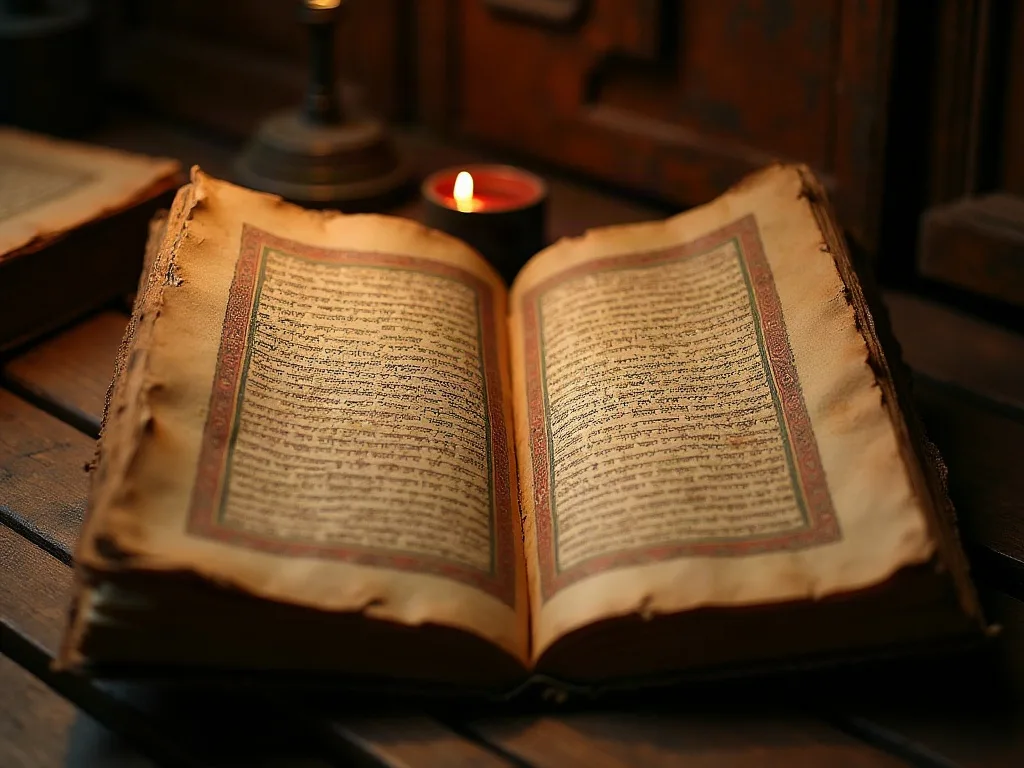
The Kebra Nagast does more than tell a romantic tale. It answers a question that had haunted Jewish and Christian imagination for centuries: where is the Ark of the Covenant? After the Babylonians destroyed Jerusalem's Temple in 586 BCE, the Ark vanished from history. Jewish tradition spoke of hidden chambers beneath the Temple where it might rest. Christian legends scattered it across the world. The Kebra Nagast offered a definitive answer: it is in Ethiopia.
According to the epic, when Menelik prepared to leave Jerusalem, the high priest's son Azariah placed the Ark in Menelik's caravan without the knowledge of King Solomon himself. The Ark approved this transfer through miraculous signs. When Menelik's party reached the Red Sea crossing and other groups tried to intercept the treasure, the Ark's presence caused the sea to swallow them. The Ark had chosen its new home.
This claim has never been conclusively proven or disproven. No modern archaeologist has opened the sanctuary where Ethiopia's Orthodox Church keeps the Ark (in Aksum, in a chapel guarded by monks). But for Ethiopians, this uncertainty mattered less than the narrative's power. The Ark's presence in Ethiopia meant that when David's line ended in Judah, it continued in Africa. When Jerusalem fell, the God of Israel had already transplanted His covenant to a distant, faithful kingdom.
The Kebra Nagast thus served a political purpose that cannot be overstated. When European colonial powers invaded Africa in the 19th century, they assumed African kingdoms were pagan and therefore vulnerable. Ethiopia, guided by the Kebra Nagast and led by emperors who claimed Solomonic descent, stood apart. These rulers cited the epic to assert that their kingdom was not newly "discovered" by Europe but was one of the world's oldest continuous Christian nations, with genealogical links to King David himself. This spiritual armor helped Ethiopia resist Italian conquest at the Battle of Adwa (1896), the only African nation to defeat a European army in that era.
The Literary Architecture of Power
The Kebra Nagast is not a simple love story or adventure. It is a carefully constructed theological and political document, written in a style that blends narrative, genealogy, biblical commentary, and proclamation.
The text opens with prologues establishing its authority. It claims to have been translated from Arabic, though scholars believe the Arabic version itself was adapted from an earlier Coptic or Ge'ez original. This layering of claimed sources gave the work credibility in an age when texts were valued partly for their antiquity and cross-cultural prestige.
The body of the epic interweaves multiple voices. Solomon speaks directly to his courtiers. Makeda argues with her advisors. Menelik marvels at his father's wisdom. Angels and divine voices interrupt the narrative to confirm that events unfold according to God's will. This polyphony gives the text a dramatic quality: readers hear competing perspectives before the author's intended interpretation emerges.
The genealogies embedded in the Kebra Nagast are equally important to the story. The text carefully traces the line from Adam through Noah, Abraham, David, Solomon, and finally Menelik. By doing so, it places Ethiopian rulers within the main current of biblical history, not as an exotic footnote but as direct heirs to the promise God made to Abraham: "In your seed shall all nations be blessed."
The epic also incorporates legal and administrative material. It includes a list of the 125 judges appointed by Menelik to govern Ethiopia, complete with their names and jurisdictions. This was not pure fiction; it was written in a form that an ancient king might actually have used to organize his realm. By dressing the narrative in the garments of official record, the author gave it the weight of historical documentation.
The Queen of Sheba: From Legend to Literary Icon
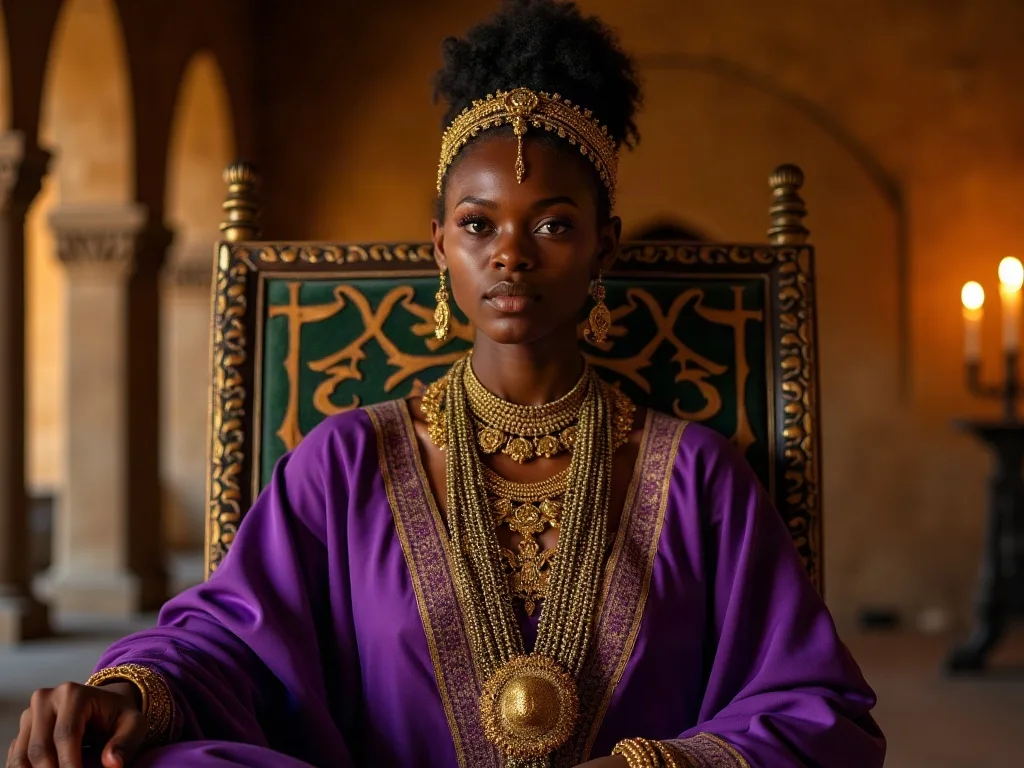
One of the Kebra Nagast's greatest achievements is its portrait of Makeda, the Queen of Sheba. In earlier sources (the Bible, the Quran, Josephus), she is admirable but briefly sketched. The Ethiopian epic transforms her into a protagonist with agency, intelligence, and spiritual growth.
When Solomon first summons her, Makeda is not a subordinate waiting to obey. She is an independent ruler who must be convinced by her council that attending Solomon's court will not demean her. She brings her own treasures and her own retinue. When tested by riddles, she matches Solomon's wit. And crucially, she converts to the true faith through encounter with Solomon's wisdom and the God behind it.
The Kebra Nagast portrays her pregnancy and return to Ethiopia not as shame but as triumph. She carries within her the seed of David and returns to her kingdom as the mother of a new dynasty that will carry the covenant of Israel to Africa. Her son will surpass his father in spiritual understanding and will become the instrument through which God's plan extends to the ends of the Earth.
This portrait mattered deeply to Ethiopian women, who saw in Makeda a model of a powerful woman who negotiated with kings as equals. Even today, in Ethiopian culture, women invoke Makeda's example when asserting their right to education and authority.
Competing Versions and Scholarly Debates
The Kebra Nagast did not emerge in a vacuum. Similar stories circulated throughout the medieval Mediterranean and Middle East. The Quran mentions Solomon and the Queen of Sheba in Sura 27, though with significant differences: in the Islamic version, the Queen's throne is transported by a jinn, and she acknowledges Allah's power without becoming Solomon's lover. Jewish and Christian commentaries elaborated on the biblical account, adding details the scriptures themselves omit.
Scholars have debated whether the Kebra Nagast was influenced by Islamic sources, specifically the tafsir (Quranic commentary) traditions. Some argue that the Ethiopian epic drew from earlier Coptic or even South Arabian sources. Others contend that the core story is genuinely Ethiopian, rooted in folk memory of actual trade relationships and diplomatic contacts between the ancient kingdoms of Aksum and Judea.
The historical Queen of Sheba, if she existed as a historical person, likely ruled in the Arabian Peninsula (possibly modern Yemen or southern Arabia) around the 10th century BCE. The ancient Sabean kingdom left inscriptions and archaeological evidence. But whether this historical figure ever met Solomon, whether she bore him a child, whether she converted to monotheism, all these remain matters of tradition, not demonstrated history.
What matters for understanding the Kebra Nagast is not whether these events literally occurred, but why Ethiopians believed them and what they meant. The epic answered profound questions: Who are we? Where do we come from? Why does God favor our kingdom? What is our place in the world? In that sense, the Kebra Nagast is not less true for being legendary; it is a different kind of truth, one that shapes identity and meaning.
The Sacred Text in Living Tradition
The Kebra Nagast occupies a unique position in Ethiopian Christianity. It is not part of the biblical canon in the same way the Gospels are, yet it is treated as scripture. The Ethiopian Orthodox Tewahedo Church includes it in formal liturgies and reads from it on festival days. Priests study it alongside the Bible. When a child is born into an Orthodox family, parents may invoke Makeda's example as a blessing.
For centuries, copies of the Kebra Nagast were maintained in monasteries, carefully recopied by hand to preserve them. Monasteries such as Tana Kirkos (on an island in Lake Tana) and Aksumite Abba Pantelewon were custodians of the text. Monks memorized passages and taught them to students. The epic became embedded not just in written form but in the living memory of the church.
The relationship between the Kebra Nagast and Ethiopian emperors was especially intimate. When emperors were crowned, the ceremony often included readings from the epic. Emperors commissioned new copies, decorated with illuminations, as acts of piety and demonstrations of power. Emperor Haile Selassie (who reigned 1930-1974) presented copies of the Kebra Nagast as diplomatic gifts to world leaders, asserting Ethiopia's ancient Christian civilization in international forums.
Remarkably, the Kebra Nagast even shaped Ethiopian Rastafarian theology. Rastafarians, a movement that emerged in Jamaica in the 1930s, revered Haile Selassie as the returned Christ and the fulfillment of biblical prophecy. They drew directly on the Kebra Nagast's claim that Haile Selassie was descended from Solomon and the Queen of Sheba, making him a figure of cosmic significance. Though mainstream Ethiopian Christianity distanced itself from Rastafarianism, the shared reverence for the Kebra Nagast created an unexpected bridge between Ethiopian Orthodoxy and a global diaspora movement.
The Text's Journey to the Modern World
For centuries, the Kebra Nagast remained largely unknown outside Ethiopia. Western scholars encountered it only gradually, as copies reached European museums and archives in the 19th and 20th centuries. The first European translation appeared in German (by August Dillmann in 1853), followed by English translations (Wallis Budge in 1932, Miguel Astor in 1998). These translations introduced the epic to global audiences for the first time.
The modern reception of the Kebra Nagast in the West has been complex. Some readers treat it as a historical document, hunting for evidence that Solomon and the Queen of Sheba actually married and that the Ark is truly in Ethiopia. Others read it as a literary masterpiece, analyzing its narrative structure and theological sophistication. Still others view it primarily as a political text, understanding how Ethiopian rulers weaponized its claims of Solomonic descent to resist colonialism.
Scholars have worked to establish the text's composition date and authorship more precisely. Most evidence points to the 13th century (around 1280-1320), during the reign of Emperor Yekuno Amlak, who claimed to restore the Solomonic line after a period of Zagwe dynasty rule. Some scholars argue that the epic was composed deliberately to legitimize Yekuno Amlak's claim to restore what he presented as the rightful dynasty. Others suggest it reflects older oral traditions that were finally written down at this moment.
The Kebra Nagast was not translated into vernacular Amharic until the 20th century, which meant that for centuries, it remained the province of the educated clergy and nobility who could read Ge'ez. This exclusivity added to its mystique and power; the common people knew the stories through sermons and retellings, but the full text was something sacred and hidden.
Today, the Kebra Nagast is more accessible than ever. Scholarly editions with critical apparatus have been published. English translations are freely available online. Universities worldwide teach the epic in courses on African literature, biblical studies, and medieval history. Yet familiarity has not diminished its spiritual authority in Ethiopia. If anything, the global conversation about the epic has reinforced Ethiopian pride in possessing one of the world's greatest literary and spiritual treasures.
Echoes in African and Diaspora Literature
The Kebra Nagast has influenced not only Ethiopian culture but African and Caribbean literature and thought more broadly. Writers have engaged with the epic to assert African agency and intellectual sophistication at moments when the world denied both.
The Rastafarian movement, mentioned above, drew explicitly on the epic's genealogy to claim Haile Selassie as a messianic figure. Though this interpretation would have startled medieval monks, it testified to the epic's flexibility and power across centuries and continents. The Kebra Nagast provided Rastafarians with a genealogical and spiritual framework for constructing an African-centered Christianity that centered Black sovereignty.
Contemporary African writers have reimagined the story of the Queen of Sheba. Nuruddin Farah, the Somali novelist, drew on the legend in his works exploring East African identity and diaspora. The Ethiopian-American author Dinaw Mengestu has engaged with Solomonic mythology in exploring what it means to inherit the burden and beauty of an ancient civilization while navigating modern displacement.
The epic has also attracted scholars and writers interested in recovering African women's voices. Makeda emerges from these retellings not merely as a biblical curiosity but as a powerful woman who negotiated cross-cultural alliance, bore a child who founded an empire, and became an ancestor revered across continents and centuries. Feminist scholars have reclaimed her as a figure of agency and intelligence, resisting reductive readings that would make her merely Solomon's conquest or conquest's reward.
The Ark's Resting Place: Myth, Spirituality, and Mystery
The Kebra Nagast's claim about the Ark of the Covenant has haunted Western imagination for centuries. Indiana Jones aside, serious archaeologists and historians have pursued the question. Where is the Ark? Did it really travel to Ethiopia?
The historical evidence is slim. No archaeological excavation has uncovered the Ark or definitive traces of it. What we know is that after the Babylonian destruction of the Temple in 586 BCE, the biblical and historical record falls silent on the Ark's whereabouts. Jewish and Christian tradition held that it was hidden by the high priest Jeremiah before the destruction, but no location was ever proven.
The Ethiopian claim, enshrined in the Kebra Nagast, is that the Ark came south with Menelik I. The Ethiopian Orthodox Church maintains a chapel in Aksum housing what it identifies as the Ark, but the sanctuary is strictly closed to outside visitors and scholars. Only a designated guardian (the Abuna) may enter the innermost chamber. This secrecy has only deepened the mystique.
Some scholars suggest that the Kebra Nagast's account of the Ark reflects genuine historical memory of an ancient trade route and possible contact between Judean and Arabian/Ethiopian kingdoms in the first millennium BCE. Others argue it is pure legend, crafted in the medieval period to enhance Ethiopian prestige. What cannot be disputed is that the belief in the Ark's presence shaped Ethiopian history and identity for over a thousand years.
For believers in the Ethiopian Orthodox Church, the question of historical proof is secondary. The Ark's presence in Ethiopia is an article of faith, confirmed by the church's spiritual authority and the consensus of tradition. This distinction between historical truth (what can be archaeologically verified) and spiritual truth (what a community believes and lives by) is central to understanding the Kebra Nagast itself.
Frequently asked questions about the Kebra Nagast
Frequently asked questions
Who wrote the Kebra Nagast, and when was it composed?
The author is unknown; scholars believe it was written down by monks or a scribal circle in Ethiopia between 1280 and 1320 CE, during the reign of Emperor Yekuno Amlak. The text likely weaves together much older oral traditions that had circulated for centuries. The oldest surviving manuscript dates to the 14th century, written in Ge'ez, the classical language of Ethiopia.
Is the story of Solomon and the Queen of Sheba in the Bible?
Yes, 1 Kings 10 and 2 Chronicles 9 describe the Queen of Sheba's visit to Solomon. However, the biblical account does not explicitly mention a romantic relationship or a child. The Quran also mentions both figures in Sura 27, with significant differences in the narrative. The Kebra Nagast transforms these biblical hints into a full genealogy and love story, making it a creative elaboration rather than a direct biblical narrative.
Does the Ark of the Covenant really rest in Ethiopia?
This remains unproven by modern archaeology. The Ethiopian Orthodox Church maintains that the Ark is housed in a chapel in Aksum, but the sanctuary has never been opened to independent examination. Many scholars view the Kebra Nagast's claim as legend crafted to establish Ethiopian prestige and spiritual authority. For the Ethiopian church and faithful, the Ark's presence is an article of faith grounded in centuries of tradition.
How did the Kebra Nagast shape Ethiopian political history?
The epic served as the ideological foundation for Ethiopian emperors' claims to legitimacy. Every subsequent Solomonic dynasty ruler cited descent from Menelik I as proof of divine favor. This genealogical claim was crucial when Ethiopia faced Italian invasion in the 1890s; Emperor Menelik II invoked Solomonic ancestry and the epic's spiritual authority to rally his people to victory at Adwa, making Ethiopia the only African nation to defeat a European colonial power in that era.
Is the Kebra Nagast still read and revered in Ethiopia today?
Yes, absolutely. The Ethiopian Orthodox Tewahedo Church includes the epic in its liturgical calendar and reads passages during festivals. It is studied in seminaries alongside scripture. Beyond the church, the epic remains central to Ethiopian national identity and pride. Modern Ethiopian scholars, writers, and intellectuals continue to engage with it, and it has also influenced diaspora communities and even global movements like Rastafarianism.
A Living Monument to Divine Favor
The Kebra Nagast endures because it answers questions that go deeper than history. It asks: Who are we? Where do we belong in the great story of human civilization? What gives us the right to rule ourselves? For Ethiopians, the epic's answer is clear and sovereign: you are the children of David, chosen by God, guardians of the Ark itself, and your kingdom stands in an unbroken line from the patriarchs of Israel to this present day.
This is why the epic has survived in living practice, not merely in museum collections. When a monk in Aksum or Addis Ababa reads from the Kebra Nagast today, he is not performing archaeology or historical scholarship. He is enacting a present-day identity, affirming a people's place in sacred time. The Kebra Nagast is scripture because Ethiopia's Christian community treats it as such, and that living reverence is itself a kind of historical truth.
The epic's power lies also in its refusal to diminish Africa. At a moment when European and Mediterranean powers dominated global narratives, the Kebra Nagast placed an African woman at the center of a genealogy of kings, made an African kingdom the resting place of the holiest object in biblical tradition, and asserted that God's covenant had extended south, into Africa, and remained there. This was not defensive or reactive; it was a confident assertion of spiritual and political authority.
The story of Makeda and Menelik, the journey of the Ark, the founding of the Solomonic dynasty, all these have inspired countless retellings, adaptations, and scholarly inquiries. Each generation reads the Kebra Nagast anew, finding in it fresh meaning while respecting its ancient authority. That capacity to speak across centuries without losing its voice is the mark of a truly great work.
Read the full book
Want the whole story?
The complete edition is an instant PDF download here, with a paperback on Amazon for selected titles.
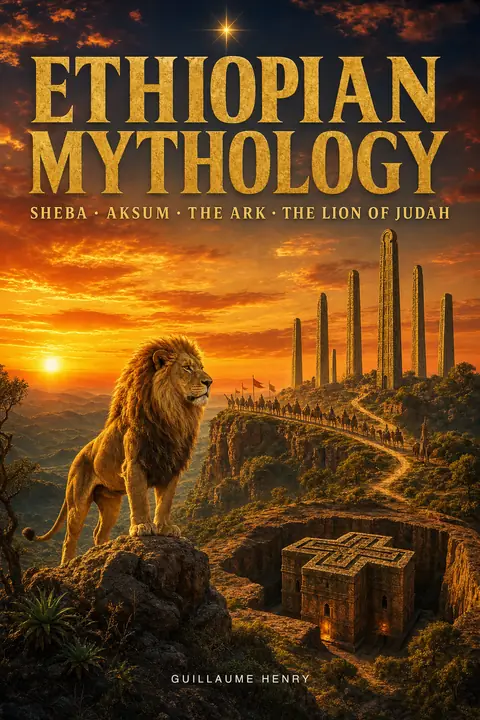
Ethiopian
The Ethiopian Mythology Book: The Queen of Sheba, the Ark of the Covenant, and the Sacred Legends of Aksum
The Queen of Sheba, the Ark of the Covenant, and the Kingdom of Aksum
The sacred legends of Ethiopia, the one African kingdom never conquered: the Queen of Sheba and her journey to King Solomon, the Ark of the Covenant said to rest at Aksum, Waaqa the sky-god of the Oromo, and the saint-kings who carved the churches of Lalibela. Drawn from the Kebra Nagast and the living oral tradition.
More from Ethiopian
All articles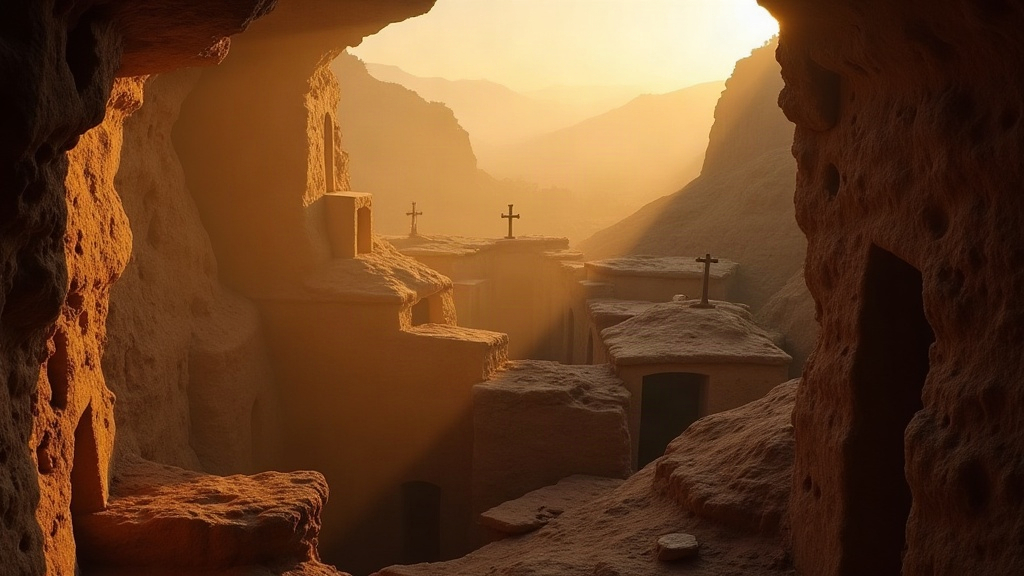
Ethiopian
Lalibela: The Rock-Hewn Churches and King's Vision
Discover how King Lalibela carved twelve churches from solid rock in Ethiopia's highlands, creating a sacred landscape that blends ancient Christian devotion with legendary ambition. A journey to Jerusalem without leaving home.

Ethiopian
Atete: Oromo Goddess of Fertility and Femininity
Atete embodies the generative power at the heart of Oromo spirituality. This goddess shapes the cycles of birth, growth, and renewal across the Ethiopian highlands and pastoralist cultures of the Horn of Africa.

Ethiopian
The Nine Saints: Founders of Ethiopian Monasticism
Nine Syrian monks arrived in Ethiopia in the 5th century and transformed its spiritual landscape. Discover how the Nine Saints founded Ethiopian monasticism, shaping the Tewahedo Church and a monastic tradition that endures today.
Ethiopian
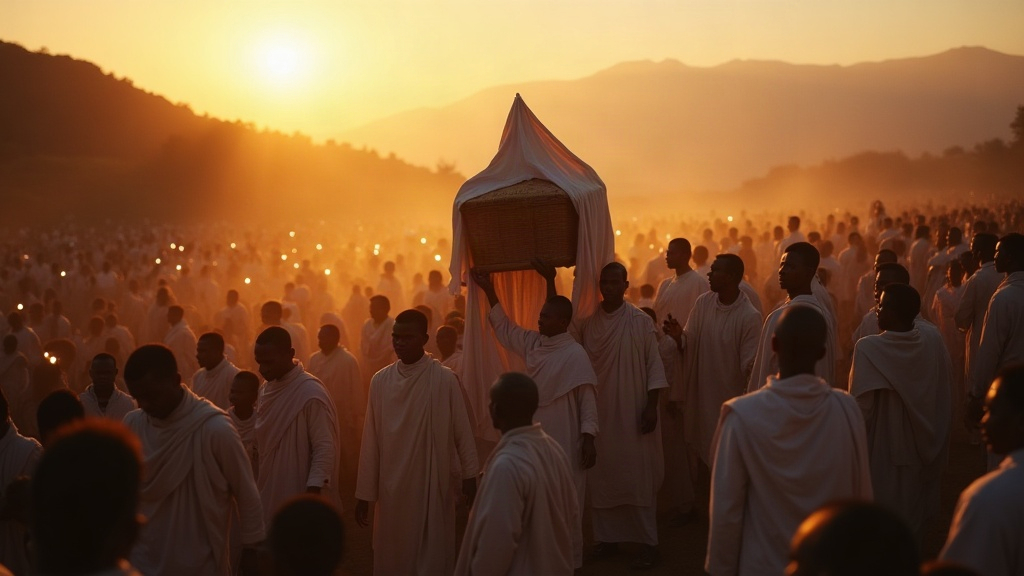
Timkat: The Epiphany Festival and Ark Processions
Timkat celebrates Christ's baptism through Ethiopia's most sacred ritual: the parading of the Ark of the Covenant. This ancient festival weaves Old Testament reverence, water blessings, and centuries of royal ceremony into a living theology that still shapes Ethiopian Christianity today.