
Waaq: The Supreme Sky God of Cushitic Peoples
Waaq ruled the sky long before Islam reshaped the Horn of Africa. Learn how this ancient Cushitic creator god shaped Oromo and Somali faith, ritual, and identity across millennia.
Contents
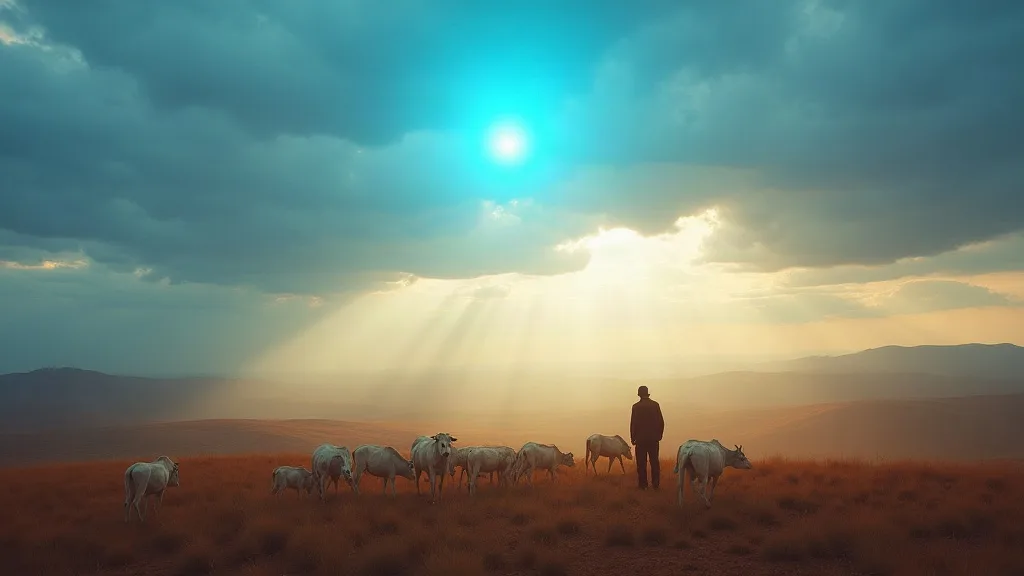
The sky above the Horn of Africa is enormous. It presses down on the plateaus of Ethiopia and Somalia like a second earth, blue and absolute, carrying rain or withholding it. For the Cushitic peoples who have lived under that sky for thousands of years, its vastness was never empty. It was occupied. It was Waaq.
Waaq (also spelled Waq, Waq-Waq, or Waaqa in Oromo spelling) is the supreme creator deity of the Cushitic-speaking peoples, a linguistic and cultural family that includes the Oromo, Somali, Afar, Hadiya, Sidama, and several dozen other groups across the Horn of Africa. He is not a deity of storms or war in the way that Zeus or Thor tend to dominate their pantheons. Waaq is sky itself, made conscious, made moral, made present. He precedes every other spiritual force in the tradition, and in many communities his name has never stopped being spoken, even after centuries of Islamic influence layered over the older cosmology.
What follows is the story of that sky, and the deity who fills it.
Who the Cushitic Peoples Are, and Why Waaq Matters
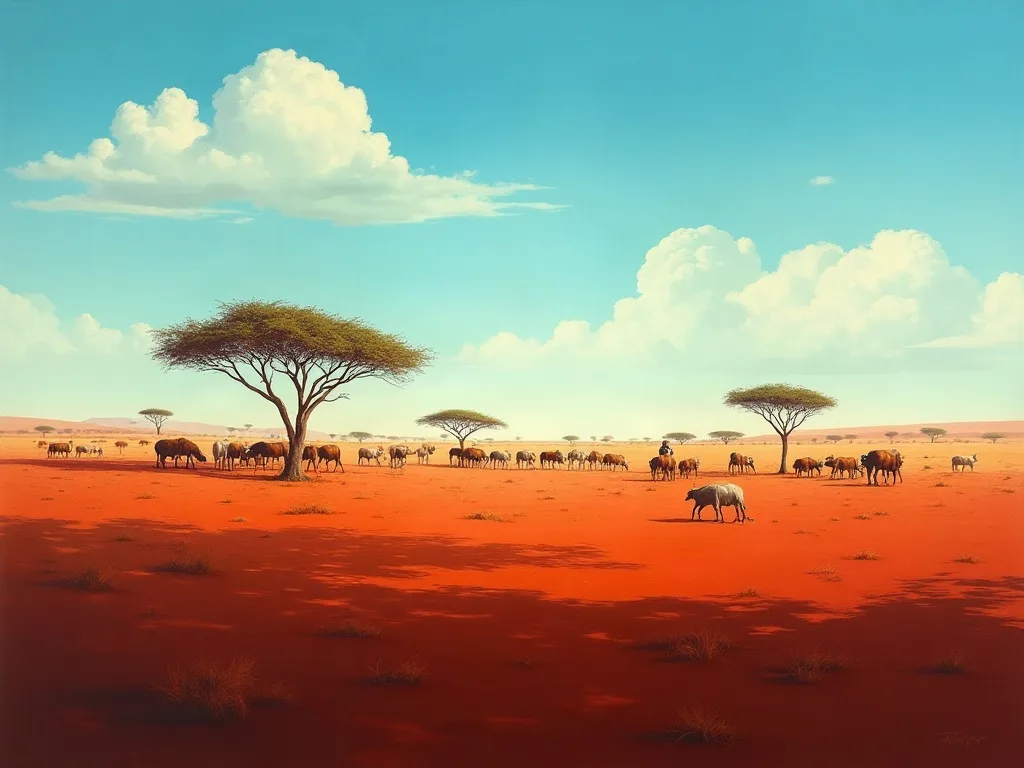
Before exploring the deity, it helps to place the people. The Cushitic peoples form a major branch of the Afroasiatic language family. Linguists classify languages like Oromo (spoken by roughly 40 million people), Somali (around 25 million speakers), Afar, Sidama, and Hadiya all within this group. Their ancestral homeland is broadly the Horn of Africa, meaning present-day Ethiopia, Somalia, Eritrea, Djibouti, and parts of Kenya.
These are not a single ethnic group, but a cluster of communities who share deep linguistic roots and, underneath layers of later religious change, a remarkably coherent spiritual framework. At the center of that framework sits Waaq.
The scholarly record on Cushitic religion is thin compared to, say, Greek or Norse material. There are no epics, no equivalent of a Theogony (Hesiod's Greek poem that maps divine genealogy), no priestly archives that survived intact. What exists is oral tradition, ethnographic fieldwork, comparative linguistics, and fragments preserved by travelers. Historians like Enrico Cerulli, who researched Somali culture in the early twentieth century, and anthropologists like Lambert Bartels, who studied Oromo religion in the 1980s, produced some of the most detailed records available. Their work, along with oral testimonies collected by Ethiopian scholars, forms the primary evidence base.
What that evidence tells us is consistent: across dozens of distinct Cushitic communities, Waaq stands alone as the original, self-existing, uncreated creator.
The Nature of Waaq: Sky, Life, and the Moral Order
Waaq is not an abstract philosophical concept. He acts. He creates. He rewards and punishes. He is personal in the sense that people address him directly in prayer, blessing, and curse.
Among the Oromo, the most numerous Cushitic people, Waaq is the source of all life. The Oromo word for this is Uumaa, creation, and Waaq is its author. He created the earth, water, plants, animals, and human beings. He did not create through violence or conflict (no battle with a sea-monster, no dismembered giant). He created through will and breath, a quiet, sovereign act. The early twentieth-century missionary and linguist Martial de Salviac, writing about Oromo religion before mass Islamisation of many groups, recorded that Waaq was conceived as entirely good: he neither desires evil nor causes suffering directly.
That last point is important. For many Cushitic communities, Waaq does not send disease, drought, or death as punishment in the way an angry deity might. Instead, a moral order called Safuu (in Oromo) governs right behavior, a kind of natural ethical law that Waaq authored but which now runs somewhat independently, like a law of physics. When Safuu is violated, imbalance follows, not because Waaq retaliates, but because the order of things is disrupted. This makes Waaq simultaneously sovereign and serene, more like a first principle than a feudal lord.
Among the Somali, the deity is called Eebe or Waaq interchangeably. Pre-Islamic Somali oral poetry, some fragments of which survive, frequently invokes Waaq as the giver of rain, children, and livestock. The Somali scholar Bogumil Jewsiewicki noted that even after Islamisation, the word Waaq persisted in Somali oaths and blessings, occasionally interchangeable with Allah, a sign of how deeply the concept is embedded in the language.
Waaq and the Creation of Humanity
The creation stories attached to Waaq vary across communities, but several themes appear with striking regularity.
In Oromo tradition, Waaq created the first human beings from clay or earth, breathing life into them, a motif that echoes across many world traditions but carries its own specific texture here. Waaq then placed the first humans in a landscape of abundance. The critical narrative element is not paradise but order: Waaq gave human beings Safuu, the moral code, as part of their original nature. They were not morally innocent in the way of Eden's Adam; they already knew the difference between right and wrong because Waaq built that knowledge into them.
A widespread oral tradition among the Oromo describes an early time when humans and Waaq communicated directly. The sky was lower, close enough to touch. Humans could speak to Waaq without intermediary. Then, through human carelessness or pride (the specific transgression varies by telling), the sky was pushed up to its current height, and direct communication ended. This story functions as an etiological myth: it explains the distance between humans and the divine, the reason prayer is needed at all, and the origin of ritual specialists who can bridge that gap.
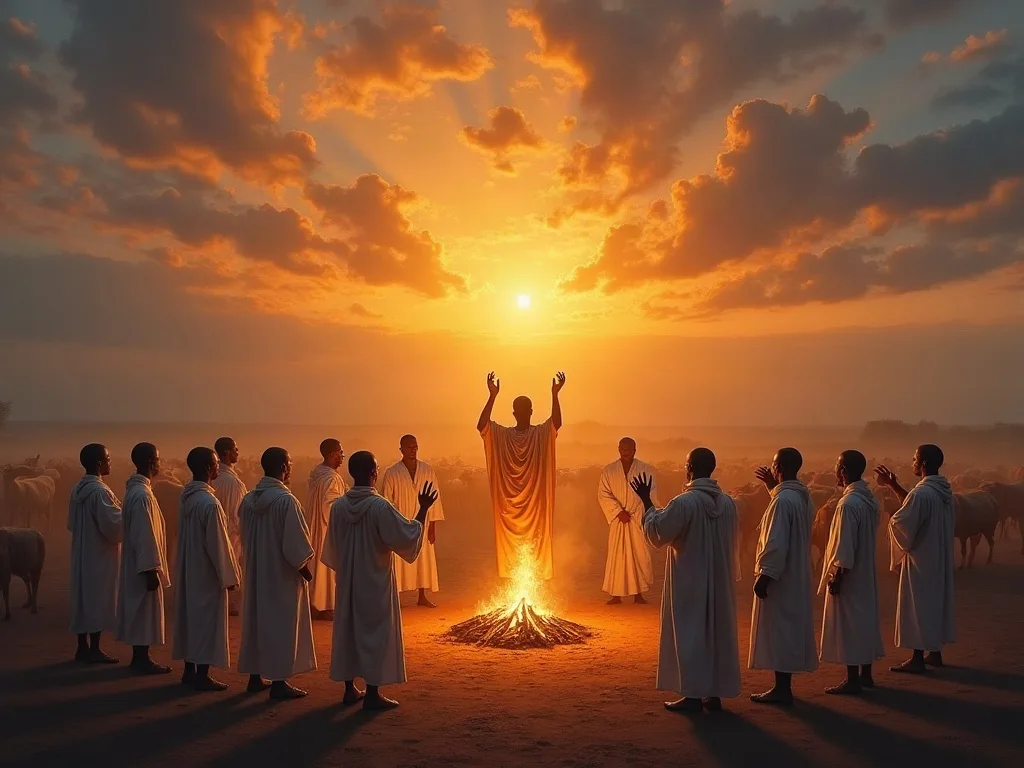
The Borana Oromo, a pastoralist group in southern Ethiopia and northern Kenya whose traditional religion (Waaqa worship) survived Islamic conversion more intact than many other groups, preserve detailed ceremonial structures built around maintaining the relationship with Waaq. The qaalluu (a hereditary ritual specialist, sometimes translated as "priest") acts as a mediator between the community and Waaq, particularly at moments of crisis: drought, epidemic, social conflict.
The Qaalluu: Waaq's Voice on Earth
Among the Borana and other Oromo groups, the qaalluu institution is one of the most studied elements of Cushitic religion. Lambert Bartels' 1983 study Oromo Religion remains the most thorough ethnographic account, and it describes the qaalluu not as a shaman in the Siberian sense, nor as a priest in the Christian sense, but as something in between: a person through whom Waaq's will is discerned and communicated.
The qaalluu leads major ceremonies tied to the Gada system, a remarkable Oromo social and political structure in which age-grades rotate through leadership roles on an eight-year cycle. The Gada system was inscribed on UNESCO's list of Intangible Cultural Heritage in 2016, giving it international recognition as a living practice. Waaq worship and the Gada cycle are inseparable: every major Gada ceremony involves prayers, cattle sacrifice, and blessing in the name of Waaq.
Crucially, the qaalluu does not control Waaq or compel him. The role is interpretive, not coercive. A qaalluu speaks for Waaq the way a judge might interpret a constitution: with authority derived from the source, but not identical to it.
Waaq Across Cushitic Traditions: Variation and Unity
One of the more striking aspects of Waaq scholarship is the consistency of the core concept across geographically and culturally distinct groups.
Among the Afar people of northeastern Ethiopia and Djibouti, the sky deity is called Waq and carries the same identification with sky, rain, and moral order. Afar oral literature collected by ethnographers in the 1970s shows Waq invoked at the start of weddings, funerals, and cattle raids, framing every significant human act within a divine witness.
The Hadiya and Sidama peoples of southern Ethiopia, though many converted to Christianity or Islam in the twentieth century, preserve ritual language and blessing formulas that still call on Waaq or cognate names. Linguists use this persistence as evidence for the deep pre-Christian, pre-Islamic substrate of Cushitic religious culture.
Compare this to Aten, the Egyptian solar disc briefly elevated to sole deity under Pharaoh Akhenaten around 1350 BC. Both Aten and Waaq represent a move toward a single sky-source of divine authority, but Waaq was never imposed by royal decree; he emerged from the ground up, from pastoral communities reading rain and drought as signs of cosmic will.
Waaq (Cushitic)
Waaq is the sky itself, conceived as a conscious moral order. He created through will, demands ethical behavior (Safuu), and communicates through ritual specialists (qaalluu). He is serene rather than wrathful, present in rain and blue sky equally. His worship is embedded in the Gada cycle of communal life.
Ngai (East African Nilotic)
Ngai, worshipped by the Maasai, Kikuyu, and other Nilotic peoples, similarly occupies the sky and sends rain. However, Ngai is also associated with specific sacred mountains (Mount Kenya, the Ngong Hills) as earthly anchors. The relationship with Ngai is more individual and less tied to a formal communal age-grade structure.
Rain, Cattle, and the Living Prayer
For pastoral communities, rain is not a luxury. It is the boundary between life and death. Grass grows when rain comes; cattle survive; children eat. This is the material reality that gives Waaq his urgency.
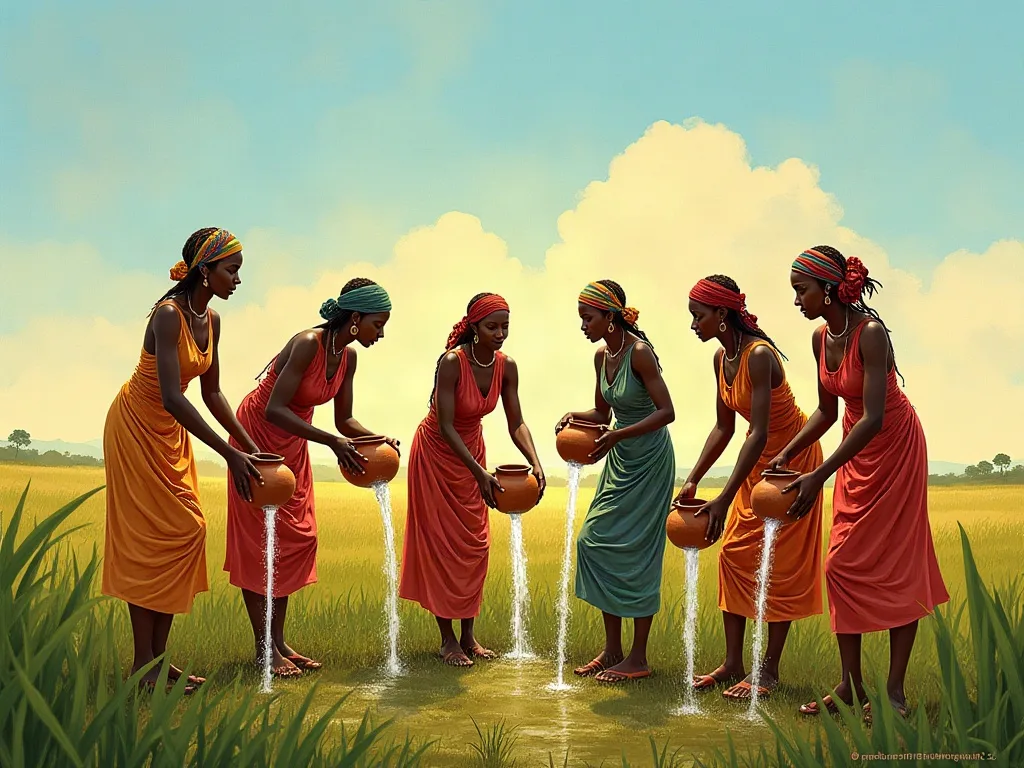
Among the Borana Oromo, the great communal prayer ceremony called Ateetee (sometimes spelled Aadaa Ateetee) involves women gathering to pray collectively to Waaq for rain, fertility, and the wellbeing of the community. The Ateetee ceremony is specifically a women's ritual space, one of the few in Cushitic tradition where women hold primary ceremonial authority. They sing, pour water, and call on Waaq and on the spirits of the land. Scholars like Getnet Bekele have argued that Ateetee preserves some of the oldest layers of Cushitic religious practice, predating even the qaalluu institution.
Cattle sacrifice is the primary ritual offering to Waaq. The act is not theatrical slaughter; it follows strict protocols. The animal must be healthy, the prayer must be spoken correctly, and the community must be present. Meat is shared, not hoarded. The sacrifice reconnects the community to Waaq and to each other simultaneously, a social and spiritual act folded into one.
The color of offerings matters, too. White animals, particularly white cattle and white sheep, are preferred in prayers to Waaq. White carries the symbolic weight of purity, light, and sky. Dark animals tend to be associated with the spirits of the earth and the dead. This color symbolism is consistent across multiple Cushitic groups and echoes similar patterns found in ancient Egyptian sacred practices.
Waaq and the Spirits: Ayana and Qaallu
Waaq does not operate entirely alone in the Cushitic spiritual universe. He works alongside, or perhaps through, a class of spirits called Ayana (singular) or Ayyana in Oromo. These are not independent deities; they function more like divine qualities or energies that Waaq distributes among living things. Every person is born with an Ayana, a kind of spiritual double or tutelary force assigned at birth. A person's luck, character, and destiny are shaped by their Ayana.
This idea has clear parallels with the Roman concept of the genius (a personal divine spirit attending each individual) and with the Yoruba concept of ori (the personal deity of the head, which determines one's fate). These parallels do not suggest borrowing; they suggest that independent human communities across different eras arrived at similar ways of imagining how a supreme deity relates to individual lives without micromanaging every moment.
When someone suffers persistent misfortune, Oromo tradition may diagnose the problem as an imbalance or withdrawal of Ayana, not Waaq's personal anger. Ritual specialists, including the qaalluu and sometimes female mediums called qaallicha, work to restore the connection. This therapeutic dimension of Waaq worship is one reason it survived so long alongside Islam; it addressed personal suffering in a direct, embodied way. The qaallicha in particular occupies a striking position: a woman who speaks for a sky whose worshippers are mostly pastoralist men, threading together community need and divine will in a single ceremony.
The Persistence of Waaq Under Islam and Christianity
The Oromo, Somali, and Afar peoples are today predominantly Muslim. Many Oromo in the north and some in the south are Christian, belonging to the Ethiopian Orthodox Church. The formal adoption of these world religions happened over centuries, accelerating between the sixteenth and twentieth centuries. It was rarely simple replacement.
In most communities, Waaq did not simply vanish. He blended. In Somali Islam, the old invocations to Waaq survived in poetry and oral blessing, often sitting comfortably beside Quranic phrases. Somali poet Raage Ugaas, writing in the eighteenth century, used Waaq and Allah within the same lines without apparent contradiction. In Oromo communities that converted to Ethiopian Orthodox Christianity, the name Waaq sometimes became a local name for the Christian God, Waaq serving as the vernacular translation of God rather than being displaced by it.
This pattern, where an older deity's name becomes the vernacular word for the new religion's supreme being, is one of the most common outcomes in religious history. It happened with Germanic Gott absorbing the Christian Deus, and with many indigenous American communities reinterpreting Christian concepts through older frameworks. In the Horn of Africa, it meant that Waaq's conceptual core, sky, rain, moral order, creator sovereignty, never fully left the language.
Among the Borana, whose relative geographic isolation protected traditional practices longer than many groups, Waaqa worship remained largely intact into the late twentieth century. Fieldwork by the anthropologist Asmarom Legesse, particularly his landmark 1973 study Gada: Three Approaches to the Study of African Society, documents a fully functioning ritual system centered on Waaq at a time when ethnographers were already treating Cushitic religion as historical rather than living.
The Gada system and its Waaq-centered ceremonies were not relics. They were operating social technology, as alive as any parliament.
Waaq in Modern Oromo Identity
Something changed in the late twentieth and early twenty-first century. As Oromo political movements grew, first in Ethiopia and then in diaspora communities worldwide, Waaq re-emerged not just as a religious figure but as a cultural symbol of Oromo identity.
Oromo activists and scholars began reclaiming Waaqa worship, sometimes called Waaqeffanna (literally "belief in Waaq"), as a marker of authentic Oromo heritage. Waaqeffanna is now officially recognized in Ethiopia as a religion with its own practitioners, separate from Islam and Christianity, and Oromo communities in the diaspora have established Waaqeffanna religious organizations in Europe, North America, and Australia.
This is not nostalgia. For many Oromo, reclaiming Waaq is inseparable from reclaiming land rights, language rights, and political self-determination. The sky deity of the plateaus has become part of a living argument about who the Oromo are and who they have the right to be. When a Borana elder pours water and calls Waaq's name at dawn, he is performing an act that is simultaneously ancient and radical.
Frequently Asked Questions About Waaq, Supreme Deity of the Cushitic Peoples
Frequently asked questions
Is Waaq the same as Allah in Oromo and Somali Islam?
Not exactly, though the two have been layered together over centuries. For many Muslim Oromo and Somali speakers, the word Waaq or Waaqa became the vernacular equivalent of Allah, the same way Germanic tribes used their word for "deity" to translate the Christian Deus. But in traditional Cushitic religion, Waaq predates Islamic theology and carries distinct characteristics, including the identification with sky itself and the moral framework of Safuu, that are not features of Islamic doctrine.
What primary sources describe Waaq?
There is no single ancient text equivalent to the Vedas or the Eddas. The evidence comes from oral tradition recorded by ethnographers, traveler accounts (including medieval Arab geographers who noted the sky-deity worship of Horn of Africa peoples), and linguistic analysis of Cushitic languages. Lambert Bartels' Oromo Religion (1983) and Asmarom Legesse's Gada (1973) are the most cited scholarly sources. More recently, Ethiopian scholars like Mohammed Hassen have contributed historical research on Oromo religious identity.
How does Waaq compare to other African sky deities?
Waaq belongs to a broad pattern of sky-creator deities found across sub-Saharan Africa: Ngai among the Maasai and Kikuyu, Nyame among the Akan, Mulungu among the Yao. All are conceived as sky-dwelling, generally good, somewhat remote creators who authored moral order but do not intervene in daily life as readily as lesser spirits do. What distinguishes Waaq is the elaborate institutional structure built around his worship, especially the qaalluu system and the Gada cycle, which have no direct parallel in the other traditions.
What is Waaqeffanna, and is it still practiced?
Waaqeffanna is the formal name for traditional Oromo religion centered on Waaq worship. The word means roughly "the act of following Waaq." It is practiced today, particularly among Borana Oromo communities in southern Ethiopia and northern Kenya, and by diaspora communities who have revived traditional practices as part of cultural reclamation. The Ethiopian government officially recognized Waaqeffanna as a distinct religion in the early 2000s. UNESCO's 2016 inscription of the Gada system on its Intangible Cultural Heritage list helped give international visibility to the tradition's living continuity.
Why is there so little written mythology about Waaq compared to Greek or Norse figures?
The Cushitic peoples are primarily oral cultures. Their sacred knowledge, creation accounts, prayers, and ritual formulas were transmitted through memory and ceremony rather than inscribed texts. The colonial period (late nineteenth to mid-twentieth century) disrupted oral transmission in many communities, and the scholars who might have recorded those traditions most thoroughly were often missionaries or administrators with limited access or interest. The result is a partially reconstructed picture. What survives, though fragmentary, is internally consistent enough that scholars feel confident in the core outline of Waaq's nature and role.
Are there sacred sites associated with Waaq?
Unlike Ngai, who is anchored to specific mountains, Waaq is not typically bound to a single geographic location, because the sky itself is his body. However, certain hilltops, springs, and ancient trees function as liminal spaces where Waaq's presence is felt more keenly, and the Borana Oromo conduct major ceremonies at specific outdoor gathering grounds. Rock art sites in Ethiopia and Somalia depicting cattle and celestial symbols are sometimes associated by researchers with early Waaq veneration, though the attribution remains debated.
Waaq in Scholarly Debate: How Old Is the Sky Deity?
One open question in the study of Cushitic religion is just how ancient the concept of Waaq really is. Comparative linguists have reconstructed a Proto-Cushitic vocabulary that includes a root word for sky or sky-deity, suggesting the concept predates the dispersal of Cushitic peoples from their ancestral homeland, which most linguists place in the Ethiopian plateau region around 5,000 to 7,000 years ago. If correct, that would make Waaq one of the oldest continuously held deity-concepts in human religious history.
Archaeologists working in the Horn of Africa have identified rock art at sites such as Laas Geel in Somalia and the Hargeisa rock shelter complex, as well as cave paintings in the Omo Valley region of southern Ethiopia, depicting cattle, human figures, and celestial symbols that some researchers associate with early Cushitic religion. The dating ranges from roughly 3,000 to 7,000 years old, and the connection to Waaq specifically cannot be proven with certainty. But the visual vocabulary of sky, cattle, and community resonates strikingly with what ethnographers recorded much later in living tradition.
The deeper challenge for scholars is the absence of an indigenous writing system in early Cushitic culture. Ethiopian Ge'ez script, the ancient writing system used for Amharic and Tigrinya religious texts, belongs to a different linguistic family (Semitic) and does not preserve Cushitic religious material from antiquity. The first extended written accounts of Waaq come from Arabic sources in the medieval period, then from Portuguese Jesuit missionaries in the sixteenth century, who treated Cushitic religion as paganism to be overcome rather than a system worth documenting carefully.
What modern scholarship has done is work backward: using linguistic reconstruction, oral testimony, and the extraordinary living continuity of Borana Oromo practice to fill in a picture that written history left almost blank. The result is incomplete, but what it shows is a deity with genuine depth: morally sophisticated, cosmologically coherent, and embedded in a social system, the Gada cycle, that is itself one of the more remarkable political structures Africa has produced.
Scholars like Girma Demeke have more recently argued that the Proto-Cushitic root *waq- connects not only to the concept of sky but to a broader idea of luminous, life-giving space, which would place Waaq in a linguistic family with other African sky-words in ways that suggest very ancient continental exchange of religious ideas rather than independent invention. The debate is unresolved, but it points toward a Waaq who is not merely a local phenomenon but a node in a much older network of African spiritual thought, one that connects to Nilotic and Nilo-Saharan cosmologies in ways scholars are only beginning to map.
Waaq has not finished speaking. The sky above the Horn of Africa is still enormous. And it is still occupied.
Read the full book
Want the whole story?
The complete edition is an instant PDF download here, with a paperback on Amazon for selected titles.
Ethiopian
The Ethiopian Mythology Book: The Queen of Sheba, the Ark of the Covenant, and the Sacred Legends of Aksum
The Queen of Sheba, the Ark of the Covenant, and the Kingdom of Aksum
The sacred legends of Ethiopia, the one African kingdom never conquered: the Queen of Sheba and her journey to King Solomon, the Ark of the Covenant said to rest at Aksum, Waaqa the sky-god of the Oromo, and the saint-kings who carved the churches of Lalibela. Drawn from the Kebra Nagast and the living oral tradition.
More from Ethiopian
All articles
Ethiopian
The Kebra Nagast: Ethiopia's Sacred National Epic
The Kebra Nagast, Ethiopia's greatest literary and spiritual treasure, tells how the Queen of Sheba bore Solomon's son and founded a dynasty that would claim descent from Israel's king. Discover the epic that shaped an empire's identity and survives as living scripture today.
Ethiopian
Lalibela: The Rock-Hewn Churches and King's Vision
Discover how King Lalibela carved twelve churches from solid rock in Ethiopia's highlands, creating a sacred landscape that blends ancient Christian devotion with legendary ambition. A journey to Jerusalem without leaving home.

Ethiopian
Atete: Oromo Goddess of Fertility and Femininity
Atete embodies the generative power at the heart of Oromo spirituality. This goddess shapes the cycles of birth, growth, and renewal across the Ethiopian highlands and pastoralist cultures of the Horn of Africa.
Ethiopian
The Nine Saints: Founders of Ethiopian Monasticism
Nine Syrian monks arrived in Ethiopia in the 5th century and transformed its spiritual landscape. Discover how the Nine Saints founded Ethiopian monasticism, shaping the Tewahedo Church and a monastic tradition that endures today.