
The Amesha Spentas: The Holy Immortals of Zoroastrianism
The Amesha Spentas are the six divine beings who embody Ahura Mazda's virtues in Zoroastrianism, each governing a sacred realm from fire to cattle. Discover how these Holy Immortals shaped Persian theology and still guide followers today.
Contents
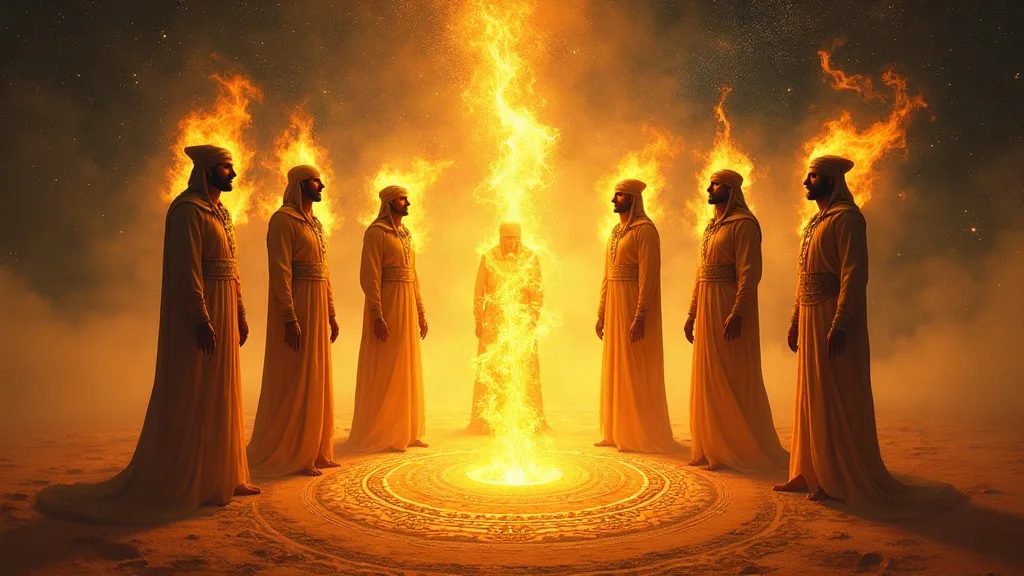
In the ancient Persian worldview, the divine realm was not a solitary throne but a council of radiance. At the side of Ahura Mazda, the supreme creator of Zoroastrianism, stood six immortal beings of such power and perfection that they became inseparable from the very fabric of existence itself. These are the Amesha Spentas: the Holy Immortals, the Bounteous Immortals, the radiant principles through which the universe maintains its order and goodness.
The Amesha Spentas are not gods in the sense of independent deities with their own ambitions. Rather, they are emanations of Ahura Mazda's own essence, each embodying a cardinal virtue. Together with Ahura Mazda himself, they form the core of Zoroastrian theology, a tradition that emerged among the Persian plateau between 1500 and 600 BCE and profoundly shaped the religious imagination of the ancient world. Their influence reaches beyond the Avesta, the sacred Persian texts of Zoroastrianism, into Christianity, Judaism, Islam, and Buddhism, wherever the concept of cosmic order battling chaos took root.
The Six Holy Immortals: Names and Essential Qualities
The six Amesha Spentas appear in the Avesta, the oldest and most sacred layer of Zoroastrian scripture. Each bears a name in Avestan, the ancient Persian dialect in which the Avesta was composed, and each carries dominion over a fundamental aspect of creation:
Vohu Manah (Good Mind, Good Purpose) governs the realm of useful animals, especially cattle. He represents the mind that thinks rightly, the wisdom that guides productive work, and the gift of beneficial intention. In Zoroastrian cosmology, cattle are not mere livestock; they embody prosperity and sustenance itself.
Asha Vahishta (Best Righteousness, Best Truth) presides over fire in all its forms. Fire is the most sacred element in Zoroastrianism, a symbol of divine purity and truth. Asha Vahishta embodies the cosmic principle of order and rightness that opposes chaos and falsehood. This is the Immortal closest to the worshipper's hearth.
Spenta Armaiti (Bounteous Devotion, Wise Piety) rules over the earth and all growing things. She is associated with the fertile soil, the maternal force of nature, and humble submission to divine will. Spenta Armaiti is often understood as feminine in gender, the only female Amesha Spenta in most Avestan sources, representing the nurturing and yielding aspects of goodness.
Khshathra Vairya (Desirable Dominion, Divine Strength) commands the sky, the metals, and the principle of rightful authority. This Immortal embodies power used justly, sovereignty without tyranny, and the strength to resist evil.
Haurvatat (Wholeness, Health) oversees water in all its forms and represents integrity, healing, and the whole made perfect. The name itself suggests healing and making complete.
Ameretat (Immortality, Long Life) presides over plants and represents perpetual life, growth without end, and the rejuvenation that sustains existence. This is the Immortal of abundance and continuity.
Together, these six stand in eternal attendance upon Ahura Mazda, forming the heptad (group of seven) that constitutes the divine hierarchy at the top of Zoroastrian faith. The seventh is Ahura Mazda himself, who contains and transcends all six.
How the Amesha Spentas Emerged in Persian Theology
The roots of Zoroastrianism are debated among scholars. The prophet Zoroaster himself may have lived anywhere between 1500 and 600 BCE on the Iranian plateau; even ancient sources disagreed on his dates. Yet the vision he brought was radical: a cosmos ordered not by competing gods but by a single supreme creator, Ahura Mazda, opposed by a destructive spirit called Angra Mainyu (the Destructive Spirit). Everything in existence takes sides in this cosmic struggle.
The Amesha Spentas emerged as a theological solution to a profound problem. If Ahura Mazda is truly supreme and all-good, how can evil exist? How can the creator relate to the material world without becoming corrupted? The answer was the Amesha Spentas. They are divine emanations, aspects of Ahura Mazda's nature projected outward to sustain and govern the seven domains of creation: mind (cattle), fire, earth, sky/metal, water, plants, and humanity itself. They are not separate from Ahura Mazda, yet they are not Ahura Mazda entirely. They mediate between the transcendent source and the mortal realm.
In older, more mystical layers of the Avesta, the Amesha Spentas are invoked almost as if they might be approached directly. A worshipper might perform a ritual honoring Asha Vahishta and feel the presence of divine righteousness. Over time, especially after the Hellenistic conquest and the rise of the Sassanid Persian Empire (224-651 CE), theological commentary on the Avesta grew more elaborate. Priests began to construct elaborate correspondences: Vohu Manah with the east and the metal copper; Asha Vahishta with the south and the metal gold; and so on.
The Living World: How the Amesha Spentas Govern Creation
In Zoroastrian thought, the universe is not abstract. It is built of concrete materials: earth, water, fire, plants, animals, and human beings. Each domain has a guardian, a sacred being dwelling within it.
When a Zoroastrian sees a fire, that fire is not merely combustion. It is the presence of Asha Vahishta, the righteousness of Ahura Mazda made visible in heat and light. This is why Zoroastrian temples center on an eternal flame, why worshippers may not pollute fire with corpses or unclean substances. To dishonor fire is to dishonor Asha Vahishta directly.
When a herdsman tends cattle, he participates in the work of Vohu Manah. The cattle themselves, in Zoroastrian thought, have a spiritual nature; they belong to the good creation and deserve treatment with respect. To mistreat an animal is to work against Vohu Manah and thus to aid the forces of darkness.
The earth itself is the body of Spenta Armaiti. She is sometimes understood as the earth mother, a nurturing presence beneath the feet. Agricultural work, tending gardens, ensuring that the land flourishes is religious practice. Pollution of the earth, careless destruction of plants, is a sin against Spenta Armaiti.
Water belongs to Haurvatat. Wells, springs, and rivers are sacred. In the Sassanid era, water vessels were often inscribed with the names of the Amesha Spentas to sanctify their use. Ritual ablutions in water were understood as participation in Haurvatat's power of purification.
The sky and the mineral realm answer to Khshathra Vairya. Metals are seen as the bones of the earth, precious and worthy of reverence. Rightful rule, just authority, and the courage to defend good are all expressions of Khshathra Vairya in the realm of human affairs.
Finally, Ameretat governs all plants, fruits, and grain. Nourishment from the plant world is understood as a gift of immortality, a perpetual renewal of life itself.
The Bridge Between Heaven and Earth
One of the most elegant aspects of Zoroastrian theology is how the Amesha Spentas serve as a bridge between the transcendent and the material. Ahura Mazda is too pure, too vast, too absolute to touch the physical world directly without risk of corruption. So the Amesha Spentas descend, in a sense, to act as intermediaries.
This structure bears fascinating similarities to other religious systems. In Hindu theology, the Adityas function somewhat similarly, as divine principles sustaining the cosmos. In Gnostic Christianity, which borrowed heavily from Zoroastrian thought, the pleroma (the fullness of the divine) is divided into emanations. The influence is not mere coincidence; when Alexander the Great conquered Persia and Greek thought encountered Zoroastrianism directly, the ideas mingled.
The Amesha Spentas are also not immutable or static. They fight. They struggle. In the mythic narrative, they confront the demons of Angra Mainyu, the destructive spirit. Spenta Mainyu, the Holy Spirit (sometimes understood as the creative aspect of Ahura Mazda itself), wages war against Angra Mainyu's forces. The Amesha Spentas are warriors in this cosmic battle, not detached philosophers.
Sacred Feasts and the Worship of the Amesha Spentas
The Zoroastrian religious calendar reflects the centrality of the Amesha Spentas in devotional life. The year was divided into six periods called gahanbars (seasonal festivals), each dedicated to one of the Amesha Spentas. These were times of communal celebration, feasting, and spiritual renewal.
The Maidyoizem festival, for example, honored Vohu Manah and fell in the spring. Herds were blessed, and thanks were given for animal prosperity. The Maidyoshema festival, in midsummer, celebrated Spenta Armaiti and the fertility of crops. These were not abstract theological observances but lived, embodied practices that tied the annual cycle to spiritual truth.
A Zoroastrian worshipper did not merely believe in the Amesha Spentas; they encountered them in the seasons, in the work of their hands, in the fire of the home and the hearth. A farmer tending fields was communing with Spenta Armaiti. A blacksmith working metal was allied with Khshathra Vairya. A healer treating illness with water and plants was invoking both Haurvatat and Ameretat.
In the Sassanid period, from roughly the 3rd century CE onward, a more elaborate mythology developed around the Amesha Spentas. Each was said to have a fravashi (a heavenly counterpart or prototype) and to preside over a spiritual paradise called a wakan. The theology became more systematized, more hierarchical. Yet the core remained: these are the principles through which goodness manifests.
Transformation and Legacy: From Ancient Persia to the Modern World
After the Islamic conquest of Persia in the 7th century CE, Zoroastrianism was displaced as the state religion. Many adherents migrated to India, where they became known as Parsis, and many remained in Persia in smaller communities. The teaching of the Amesha Spentas never vanished. It remained at the heart of Parsi faith and in the remnant Zoroastrian communities of Iran.
The Amesha Spentas influenced how other religions conceived of divine attributes. The Archangels of Christianity and Islam bear a structural similarity to the Amesha Spentas: they are divine servants, emanations of God's will, governing specific domains (Michael presides over war, Gabriel over messages, and so on). This is likely not coincidence. Early Christian theologians encountered Zoroastrian thought through Persian-Jewish and Persian-Christian communities. Concepts flowed back and forth.
Today, Zoroastrian communities in India, Iran, and diaspora continue to honor the Amesha Spentas. The principles they embody, pure and timeless, speak across centuries: the goodness of mind, the truth of righteousness, the bounty of earth, the power of rightful rule, the wholeness of health, and the perpetuity of life. These are not forgotten relics but living spiritual realities for those who walk the path of the Good Religion, as Zoroastrians call their faith.
The Amesha Spentas also appear in modern academic study of comparative religion and mythology. Scholars investigating the origins of monotheism, the evolution of angelology, or the Persian roots of Western thought inevitably encounter these six immortals. They represent a sophisticated theological solution to one of religion's perennial puzzles: how to conceive of the infinite in relation to the finite, the transcendent in relation to the material.
The Inner Virtues: Psychology Meets Cosmology
One of the deepest layers of Zoroastrian teaching holds that the Amesha Spentas are not only cosmic principles but also inner spiritual virtues. The worshipper is not merely subject to them from without; the virtues they represent can be cultivated from within.
To develop good mind, good purpose, right thinking is to nurture Vohu Manah within the soul. To pursue truth and righteousness is to align oneself with Asha Vahishta. To tend the earth with reverence and to be humble and devoted is to embody Spenta Armaiti. To exercise rightful power and courage is to channel Khshathra Vairya. To seek wholeness and healing is to invoke Haurvatat. To nurture growth and renewal is to live in the spirit of Ameretat.
This inner dimension gives Zoroastrianism a psychological depth. The religion is not passive submission to distant powers but an active cultivation of virtue. The Amesha Spentas are both external cosmic forces and internal spiritual capacities. A human being, through effort and grace, can become a vessel for these Immortals' presence.
This teaching resonates across cultures. The Platonic Forms (abstract ideals of virtue that transcend the material world) have a similar structure. The cardinal virtues of medieval Christianity (Prudence, Fortitude, Temperance, Justice) echo the Amesha Spentas' function. The concept appears across human religious and philosophical thought: the idea that goodness is not merely a rule imposed from outside but a principle that can be internalized and embodied.
Scholars, Texts, and the Mystery of Transmission
The primary sources for the Amesha Spentas are contained in the Avesta, particularly in the Ahunavaiti Gatha, the most ancient hymns attributed to Zoroaster himself. These passages are written in an even more archaic form of Avestan than the rest of the text, suggesting they are very old, perhaps composed orally before being written down.
The Gathas are notoriously difficult to translate and interpret. Scholars debate whether Zoroaster himself taught the doctrine of the Amesha Spentas in the form later codified, or whether this theological crystallization happened after his time. Some scholars propose that the Amesha Spentas began as abstract principles or virtues and were personified later. Others argue they were always understood as distinct but not separate divine beings.
The medieval Persian commentarial tradition, represented in texts like the Dinkard and the Bundahishn, develops the Amesha Spentas theology further. These texts, written in Middle Persian or Pahlavi, interpret and elaborate on the Avestan teachings. They organize the cosmos into seven categories corresponding to the seven principals (Ahura Mazda plus the six Amesha Spentas), and they assign each Immortal a host of attributes, protective beings, and cosmic correspondences.
Modern scholarship has brought new tools to these ancient texts. Comparative linguistics has illuminated the Avestan language and its Indo-European roots. Archaeological discoveries have provided context for Zoroastrianism's development on the Iranian plateau. Yet the Avesta remains in some ways opaque, preserved through oral tradition and later manuscript copies, often fragmented and difficult to reconstruct with certainty.
What is clear is that the Amesha Spentas held a central place in how ancient Persians understood the cosmos. They represented an achievement in religious thought: the reconciliation of monotheism with the reality that good appears in many forms, that the divine expresses itself through multiple principles without ceasing to be one.
Frequently asked questions about the Amesha Spentas
Frequently asked questions
Are the Amesha Spentas the same as angels or archangels?
The Amesha Spentas and the Abrahamic archangels share structural similarities: both are divine beings emanating from a supreme creator, both govern specific domains, both bridge heaven and earth. However, they are not identical. The Amesha Spentas are cosmic principles as much as beings; they are more abstract yet more intimately woven into the fabric of creation itself. An angel is typically understood as a servant or messenger; an Amesha Spenta is a divine attribute made manifest. That said, when Christianity and Islam developed in regions that had absorbed Zoroastrian thought, the concept of archangels likely was shaped in part by Persian angelology.
Is there only one Zoroastrian creator god, or are there many?
Zoroastrianism teaches that there is one supreme creator, Ahura Mazda, who is absolute and unique. The Amesha Spentas are not separate gods; they are emanations or aspects of Ahura Mazda's nature and power. This monotheistic principle is one of Zoroastrianism's great contributions to religious thought. However, the cosmology is dualistic in its conflict: Ahura Mazda is opposed by Angra Mainyu, a destructive spirit. The conflict between good and evil, order and chaos, runs through all of creation.
Which Amesha Spenta is the most important?
All six are considered essential and co-equal in the Avesta and classical sources. However, Asha Vahishta (righteousness and truth) holds a special place because truth itself is understood as the fundamental principle of the good creation. Similarly, Vohu Manah (good mind) is invoked frequently because the development of right thought is foundational to all other virtues. In lived Zoroastrian practice, the Immortal most immediately present may vary: a farmer might emphasize Spenta Armaiti, a warrior might focus on Khshathra Vairya, a healer on Haurvatat.
Do modern Zoroastrians still worship the Amesha Spentas?
Yes. Parsi and Zoroastrian communities, primarily in India and Iran, continue to honor the Amesha Spentas through prayer, ritual, and seasonal festivals. The gahanbars, the six seasonal celebrations, are central to Zoroastrian observance. Many prayers in the liturgy invoke the Amesha Spentas by name. The principles they represent remain living spiritual realities for adherents of the Good Religion.
How did the Amesha Spentas influence Christianity?
Zoroastrianism was the dominant religion across the Persian Empire for centuries. When Christianity emerged in territories where Persian thought was deep-rooted, concepts migrated across religious boundaries. The idea of archangels, the concept of cosmic war between good and evil, the notion of a final judgment day (Zoroastrianism taught of a future renovation of the cosmos), and even the symbolism of light and darkness all show possible Persian influence. However, scholars debate how direct this transmission was and how much represents independent theological convergence.
What happens to the Amesha Spentas after death or at the end of the world?
Zoroastrian eschatology teaches that at the end of time, during a renovation called the Frashogird, all souls will be purified and the cosmos will be renewed. The Amesha Spentas are eternal; they do not die. At the final judgment, the righteous will ascend and the wicked will be purified through fire. The cosmos itself, though finite in the sense that it has a beginning and end cycle, will be perpetually restored to perfect order. The Amesha Spentas will reign eternally in this restored paradise.
The Amesha Spentas Today: Living Principles in a Modern World
The ancient Zoroastrian vision of the Amesha Spentas speaks to a perennial human need: to understand how goodness and order sustain the world, and how we participate in that sustenance. In an age of ecological crisis, the reverence the Amesha Spentas demand for earth, water, fire, and all living things resonates with modern ecological consciousness. The emphasis on righteous action, on truth, on the development of good mind and wise purpose, offers an alternative to cynicism or despair.
The Amesha Spentas are not obscure antiquities but living principles whose time, in many ways, has come around again. Those who study comparative religion, who seek to understand the roots of Western monotheism, who are drawn to indigenous and traditional teachings, or who simply wish to cultivate virtue in their own lives may find in the six Holy Immortals a source of wisdom and inspiration that has endured for nearly three thousand years.
Read the full book
Want the whole story?
The complete edition is an instant PDF download here, with a paperback on Amazon for selected titles.
Persian
The Persian Mythology Book: Ahura Mazda, Ahriman, Mithra, and the Cosmic Dualism That Shaped Three Religions
From the Avesta to Ferdowsi's Shahnameh
The Zoroastrian cosmos of light against darkness, the Amesha Spentas, the hero Rostam, and the Shahnameh epic that preserved pre-Islamic Iran in verse.
More from Persian
All articles
Persian
Anahita: The Persian Goddess of Waters and Fertility
Anahita, the Persian goddess of waters and fertility, ruled over rivers, healing, and the cycle of life itself. Revered for millennia across the Zoroastrian world, her story reveals how water became sacred, and how a goddess shaped the spiritual landscape of Persia, Anatolia, and beyond.

Persian
The Avesta: Sacred Texts of Zoroastrianism and Ancient Persian Religion
The Avesta is the religious scripture of Zoroastrianism, containing hymns, prayers, and law from ancient Persia. Discover how this 3,000-year-old text shaped Western religion and philosophy.

Persian
The Faravahar: The Winged Symbol of Zoroastrianism
The Faravahar appears across Zoroastrian art, temples, and personal devotion as a winged figure hovering between realms. This ancient Persian symbol encodes the faith's core belief: that each human spirit carries divine potential and cosmic choice. Discover what this icon reveals about the battle between good and evil.

Persian
Ahriman (Angra Mainyu): The Destructive Spirit of Persian Mythology
Ahriman (Angra Mainyu in Avestan) is the cosmic principle of destruction, decay, and evil in Persian Zoroastrianism. Eternal rival of Ahura Mazda, he embodies chaos itself and shapes the central spiritual conflict of humanity's purpose.