

Anahita: The Persian Goddess of Waters and Fertility
Anahita, the Persian goddess of waters and fertility, ruled over rivers, healing, and the cycle of life itself. Revered for millennia across the Zoroastrian world, her story reveals how water became sacred, and how a goddess shaped the spiritual landscape of Persia, Anatolia, and beyond.
Contents
In the mountains of ancient Persia, a river glows in the dark. It is not fire. It is Anahita, the goddess who flows through all things, her waters carrying both life and purification, her voice rising from springs and cascades. She is older than the Achaemenid Empire, yet her cult flourished under its kings. She is known by many names: Aredvi Sura in the oldest hymns, Anahita in later liturgy, Anaitis to Greek ears. But beneath each name lies the same power: the waters that sustain crops, heal the sick, and purify the soul.
Anahita: The Persian Goddess of Waters and Fertility was not born in a moment of chaos or war, as so many deities emerge in myth. She arrived quietly, inevitably, as water always does. The Zoroastrian texts call her one of the yazatas, the divine beings who embody cosmic forces and earn human devotion through their ongoing stewardship of the world. She stands at the threshold between the material and the eternal, manifesting herself in every river that nourishes the earth and every ritual bath that cleanses the faithful.
Her significance runs deeper than mere symbol. In a land where drought was terror and water was wealth, Anahita became the embodiment of providence itself, the keeper of abundance, the guardian of women, and the witness to sacred oaths. Kings sought her blessing. Women invoked her at childbirth. Priests poured libations in her honor. And across twenty-five centuries, she endured.
Origins in the Zoroastrian Cosmos
The Zend Avesta, the sacred scripture of Zoroastrianism compiled over centuries, describes Anahita in one of its oldest layers, the Yasht hymns. These are songs of praise to individual yazatas, divine beings who maintain the structure of the cosmos. In the Aban Yasht, the fifth Yasht, Anahita receives her fullest early portrait.
She was not created by Ahura Mazda, the supreme god, as a separate act. Rather, she emerged as an expression of his cosmic order, asha, the principle of truth and harmony. The Zoroastrian cosmos is binary: Ahura Mazda and his followers (the yazatas, the righteous spirits) stand eternally against Angra Mainyu, the destructive spirit, and the demons called daevas. Anahita sits squarely in Ahura Mazda's camp, a force of creation and healing against entropy and ruin.
The texts describe her form with startling specificity. She is tall, strong-limbed, radiant. She wears a golden crown and a robe embroidered with stars. Around her waist hangs a girdle of authority. She moves with the grace of a warrior and the compassion of a healer. These details, preserved in priestly language, made her vivid to worshippers: she was not abstract but present, almost tactile in her reality.

The Avestan language calls her Aredvi Sura, meaning "moist" and "mighty" or "strong." The epithet is essential: she is not gentle water but powerful water. She carries the force of torrents, the inevitability of rivers, the absolute necessity of flow. This power, however, is never chaotic. It is ordered, purposeful, divine.
The Sacred Waters and Cosmic Function
In Zoroastrian cosmology, Anahita governs the waters of the world, but not all waters are equal. The most sacred is the celestial ocean, Vohu Manah, which surrounds the cosmos and feeds all earthly waters through an invisible network. Anahita stands at the summit of Mount Hara, the mythical center of the world, and from there oversees the flow of blessing downward into human lands.
Every river, spring, and rainfall was understood as a manifestation of her presence. The Oxus River (modern-day Amu Darya), which ran through Persian territory and watered the great fertile plains, was especially sacred to her. When Persians encountered new lands and new rivers, they carried Anahita's worship with them, adapting her to local waters. The Nile, the Danube, the rivers of the Pontic steppes all became channels through which the goddess extended her reach.
This was not mere poetry. The practical implications were real. Rivers were the arteries of Persian civilization. Control of water meant power, wealth, and survival. To worship Anahita was to acknowledge dependence on forces beyond human mastery and to cultivate reciprocal relationship through ritual and ethical conduct. Kings sponsored irrigation projects as acts of piety, honoring Anahita by channeling her waters to crops and cities.
Fertility flowed directly from water. The rains that Anahita sent determined whether flocks would thrive, whether grain would fill the stores, whether women would bear children. In societies built on herding and farming, a fertility goddess was not luxury but survival. Anahita embodied this necessity. Women prayed to her for healthy pregnancies. Farmers poured libations before planting. Shepherds invoked her blessing over newborn lambs.
The Warrior Goddess and Cosmic Morality
One dimension of Anahita often overlooked in modern retellings is her martial aspect. The Avestan hymns do not shy from depicting her as a warrior. She is described as riding in a golden chariot pulled by four white horses, bearing weapons, standing ready to defend the righteous against the assaults of evil spirits.
This is crucial to understanding Persian religion. Ahura Mazda's cosmos is not a passively ordered realm but an active battlefield. The yazatas are not distant forces but engaged combatants, constantly working to maintain creation against destructive incursion. Anahita, for all her association with nurture and healing, is also a defender. She punishes the wicked, particularly those who pollute water through ritual transgression or demonic influence.
The Zoroastrian ethical system is unforgiving in this regard. Water is holy not merely by nature but by covenant. To befoul water is to side with Angra Mainyu, to invite corruption into the cosmos. Anahita stands as guarantor of purity. Those who dishonor water, who fail in their oaths, or who allow demons to poison springs, face her wrath. She is beautiful but terrible, nurturing but exacting.
The connection between oath-keeping and Anahita runs through every layer of the tradition. When Persians swore binding oaths, they often did so in the presence of water or invoked Anahita as witness. To break such an oath was not merely a social crime but a cosmic transgression, an act of rebellion against order itself. Anahita's presence at the moment of oath-taking transformed the words into something permanent, written into the fabric of reality.
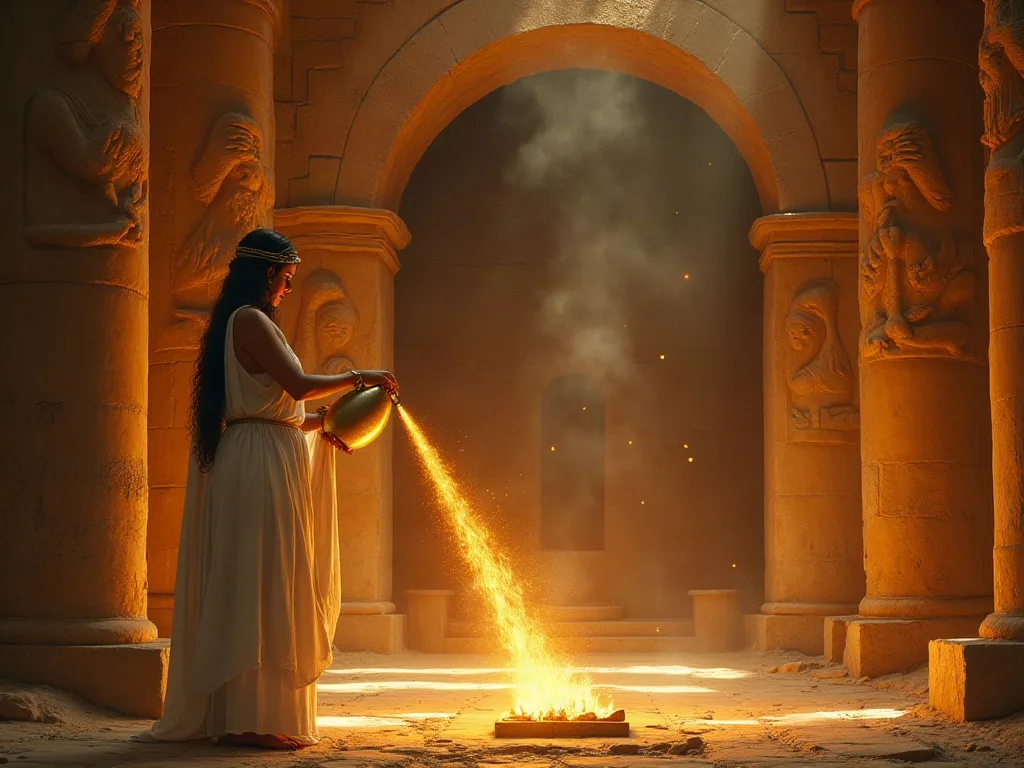
The Royal Cult and Imperial Patronage
The Achaemenid emperors, who ruled Persia from roughly 550 to 330 BCE, elevated Anahita's worship to state religion. This was not mere populism but calculated theology. The kings positioned themselves as servants of Ahura Mazda and guardians of cosmic order. By sponsoring Anahita's cult, they demonstrated their commitment to the welfare of the land and its people.
Inscriptions from the reign of Artaxerxes II (404-358 BCE) reveal explicit royal devotion. Artaxerxes installed images of Anahita in temples across his empire and proclaimed himself her worshipper. This was revolutionary. Earlier Zoroastrian practice had been austere, opposed to idolatry. But Artaxerxes, perhaps influenced by Babylonian religious practice or responding to popular piety, transformed Anahita into an object of veneration in visual form.
The royal patronage created infrastructure. Temples dedicated to Anahita rose in major cities. Priests trained in her mysteries formed a priestly class. Sacrificial rituals became formalized. The worship that had been dispersed, local, and largely oral became systematized, monumental, and imperial.
Women, in particular, found agency within this framework. While Persian society remained patriarchal, the cult of Anahita created legitimate space for female religious expression. Women served as priestesses in her temples. They led ceremonies. They maintained the sacred fires. The goddess herself, being female, powerful, and sovereign, offered an alternative model of womanhood to the domestic sphere alone.
Anahita and the Greek World
When Alexander the Great's armies swept through Persia in the 330s BCE, they encountered Anahita's cult flourishing across the empire. The Greeks, pragmatic in such matters, did not destroy her worship but syncretized it. Anahita became identified with Artemis, the Greek virgin goddess of wilderness and hunting. This was a rough fit in many ways. Artemis is virgin and martial; Anahita is maternal and fertile. But both are powerful, female, and associated with nature's wild places.
The name Anaitis entered Greek sources and remained there. Strabo, the geographer writing in the first century BCE, mentions temples to Anaitis in Pontic Anatolia (modern-day Turkey). These temples became sites of pilgrimage, drawing worshippers from Greek, Persian, and local populations. The ritual practices described by Greek writers show a blend of Persian theology with Greek forms of worship and architecture.
The syncretism was not superficial. In Cappadocia and Pontus, regions straddling Persian and Greek worlds, women practiced mystery cults dedicated to Anaitis. These cults bore some structural similarity to the Mysteries of Eleusis, the great Greek religious ceremony, suggesting deep cultural borrowing. Initiates underwent purification rituals involving water, received secret teachings, and committed to ethical codes.
This transmission carried Anahita's worship far beyond the Persian heartland. As trade routes expanded and empires rose and fell, her cults traveled to Egypt, to Syria, to the Caucasus. Local adaptations occurred everywhere, but the core remained: a goddess of waters, fertility, and purification who demanded virtue from her worshippers.
The Zend Avesta and Her Divine Titles
The Avesta, though complex and multilayered in its composition, provides the richest textual account of Anahita. The Aban Yasht dedicates over a hundred verses to her, more than any other single yazata except Mithra, the yazata of covenants and solar justice.
The titles given to her in the Avesta reveal nested dimensions of her identity:
Aredvi Sura Anahita ("Moist Mighty Anahita") emphasizes her essential nature, the marriage of generative power and cosmic force.
Yazad of Conception addresses her role in fertility, the mysteries of birth and renewal.
Yazad of Victory in Battle recognizes her martial aspect, her protection of the righteous.
The Pure One affirms her role as source and guardian of purity, ritual cleanliness, and spiritual hygiene.
The Woman Warrior unites her feminine identity with her capacity for defense and even retribution.
Each title is not decorative but functional. In ritual, priests would invoke Anahita by specific titles depending on the occasion. A harvest festival called upon the fertility titles. A warrior's blessing sought the martial aspect. A initiation into mystery cults invoked the purity teachings. The multiplicity of names allowed worshippers to relate to different facets of a single, coherent divine reality.

Ritual Practice and Daily Life
For ordinary Zoroastrians, Anahita was not encountered only in temple festivals or royal inscriptions. She was present in daily ritual. Washing with water before prayer was not merely hygiene; it was communion with Anahita, invocation of her purifying presence. The water flowing over hands and face became her blessing.
Women's practices centered on her particularly. Before conceiving, women visited her shrines or sacred springs. They made vows of chastity and virtue, binding themselves before the goddess. After childbirth, they underwent purification rituals involving water. At certain times of the month, menstruating women avoided sacred fires and water sources, not from shame but from respect for purity codes that acknowledged the sacred power of blood and water both.
Priests maintained elaborate protocols around water. The Vendidad, the Zoroastrian book of laws, specifies which waters are pure and which have been defiled. A river into which a corpse has been placed becomes polluted and cannot be used for ritual until purification. This was not arbitrary superstition but a coherent theology: water is so sacred, so identified with Anahita and cosmic order, that its violation demands remediation.
Large ritual occasions saw communal worship. At Nowruz, the Persian new year, communities gathered at rivers or springs to honor Anahita. Water from these sacred places was drawn and distributed. Fire and water, the two great elements of Zoroastrian practice, mingled in ceremony. The yazata of fire and Anahita herself were invoked together, maintaining cosmic balance.
Sacrifice played a role, though Zoroastrian practice differed from traditions like Vedicism or ancient Greek religion. Rather than animal slaughter, Zoroastrians offered gifts: wine, milk, honey, grains, flowers. These were poured into water or burned before the sacred fire while prayers were recited. The god received not the material gift but the pious intention behind it.
The Transition Under Islam and Beyond
When Islam arrived in Persia in the seventh century CE, it brought monotheism and the prohibition of goddess worship. Anahita's temples were destroyed or converted. Her priesthood was dispersed. The public cult collapsed within generations.
Yet something survived. In Zoroastrian communities that endured in isolated regions and in later diaspora communities, particularly among the Parsis of India, the memory of Anahita persisted. She appeared in later Pahlavi texts, written commentaries on the Avesta, in a diminished but recognizable form. Some scholars argue that her function transformed into veneration of sacred waters themselves, a practice that required no idols and therefore could evade Islamic prohibition.
The scholarship remains lively here. Some sources suggest that Sufi mysticism, which developed within Islam, incorporated pre-Islamic Persian spiritual elements, including reverence for water and the sacred feminine. This is debated, but the possibility hints at how religious ideas refuse simple erasure.
In contemporary Zoroastrianism, practiced by roughly 100,000 to 200,000 believers worldwide, Anahita holds an ambiguous place. Conservative communities focus on the fire-centered practices and abstract yazata theology that survived Islamic pressure. Progressive communities reclaim her explicitly, honoring her in research, ritual reconstruction, and scholarly reclamation. She has become a symbol of Zoroastrian feminism and ecological spirituality, the goddess who teaches that the earth and waters are sacred trusts.
The Yazatas and Cosmic Hierarchy
Understanding Anahita requires grasping her position within the broader Zoroastrian pantheon. She was never supreme; that place belongs to Ahura Mazda alone. But she was elevated among the yazatas, those divine beings second only to the supreme god.
The yazatas are not gods in the Greek or Hindu sense. They are emanations of cosmic principle, beings whose existence maintains the order of creation. There are dozens of them, each governing specific domains: Mithra rules oaths and daylight; Haurvatat oversees wholeness and healing; Asha embodies truth itself. Anahita's power over water gave her influence over fertility, purification, and the cycle of seasons.
This hierarchy was not static but evolved across centuries. In early Zoroastrianism, Anahita may have held a more peripheral place. By the Achaemenid period, she had risen prominently. Some scholars suggest this reflected changing social values: as Persian society grew wealthier and more complex, the need for a goddess embodying abundance and female power became more pressing.
The yazatas were also understood as allies in the cosmic struggle. When a human performed righteous action, they aided the yazatas' struggle against demonic forces. When they performed evil, they weakened the forces of order. Prayer was not petition alone but alliance-building, a commitment to work alongside Anahita and her divine companions in maintaining creation.
Anahita's Sacred Animals and Symbols
The symbols attached to Anahita reveal layers of meaning. She was associated with certain animals. The lion and the eagle both appear in some texts as her companions or representatives. These predators are fierce, strong, uncompromising: they mirror her martial aspect. Some sources link her to the peacock, whose feathers shimmer like flowing water and whose presence suggests grace and majesty both.
Her sacred plant was reportedly the haoma, also known as soma, a ritually significant plant whose intoxicating properties were understood as conferring divine knowledge. The haoma was pressed, fermented, and consumed in ceremonies. Its connection to Anahita underscores her role in sacred inebriation, the altered states through which humans commune with the divine.
The color white was sacred to her. White horses, white flowers, white garments worn by priestesses. This reflected purity but also the clarity of water, the transparency through which light passes unchanged.
The star or celestial body associated with her was Sirius, the brightest star in the night sky. In Persian astronomy, Sirius held great significance. Its heliacal rising marked important dates in the calendar. Its constancy and brilliance made it a natural symbol for a goddess whose power was fundamental and dependable.
Frequently asked questions about Anahita?
Frequently asked questions
Was Anahita worshipped across all of Persia or only in certain regions?
Anahita's worship was widespread across the Persian Empire and beyond, but with variations. She was especially prominent in regions with significant water resources like the northern provinces and areas along major rivers. As Persian influence expanded, her cults spread to Anatolia, the Caucasus, and even Egypt. The Greek-speaking world knew her as Anaitis, particularly in Cappadocia and Pontus. Local adaptations occurred everywhere, but the core theology remained consistent.
How did Anahita compare to other ancient fertility goddesses like Ishtar or Aphrodite?
While Anahita shares some functions with Ishtar (Mesopotamian) and Aphrodite (Greek), her character is distinct. Ishtar is cosmic and chaotic, embodying sexuality and war in dramatic conflict. Aphrodite represents beauty and desire. Anahita is ordered, ethical, and explicitly connected to purity and truth. She is a warrior but not a figure of chaos. Her fertility is part of cosmic order, not its disruption. The closest parallel might be Hera as guardian of marriage and legitimate birth, but even this underestimates Anahita's martial and purificatory dimensions.
What are the oldest surviving texts about Anahita?
The Aban Yasht, part of the Younger Avesta, contains the most extensive early account. The Avesta itself was composed over centuries, with the oldest layers dating to around 1500-1000 BCE, though oral transmission predates written texts. Some scholars argue that Anahita may have originated in pre-Zoroastrian Indo-European traditions and was incorporated into Zoroastrianism. The Pahlavi texts, written commentaries from the Islamic period, preserve additional details about her worship and mythology.
How did Anahita's worship survive after the Islamic conquest of Persia?
Public worship largely ceased as temples were destroyed and the cult was forbidden. However, in Zoroastrian communities that survived in remote areas and in the Parsi diaspora to India, Anahita's memory persisted through oral tradition and preserved texts. Some scholars suggest that reverence for sacred waters themselves became a vehicle for her veneration. Contemporary Zoroastrian communities, particularly progressive movements, have explicitly reclaimed her as a symbol of their tradition's ancient power and spiritual depth.
Why did Artaxerxes II introduce images of Anahita if early Zoroastrianism opposed idolatry?
This likely reflects a shift in religious practice influenced by non-Zoroastrian traditions like Babylonian religion, which prominently featured divine images. Artaxerxes may have also responded to popular devotion, which had long associated Anahita with specific, tangible manifestations. Creating temples with images made her more accessible to common worshippers and allowed the state to ritualize and control the practice. Some scholars view this as a relaxation of earlier strictures, while others argue it was a reinterpretation of what idolatry meant within the Zoroastrian system.
Anahita in Modern Scholarship and Reclamation
Contemporary study of Anahita benefits from multiple disciplines converging. Religious historians trace her texts and cult practices. Archaeologists uncover temple remains and votive offerings. Linguists decode Avestan hymns. Feminist scholars reclaim her as a symbol of feminine power within ancient religion. The result is a richer, more complex portrait than earlier scholarship allowed.
One significant debate concerns her origins. Was Anahita primarily a Zoroastrian creation, or did she predate Zoroastrianism, incorporated into it from earlier Indo-European or local Persian traditions? Some scholars point to linguistic similarities between Aredvi Sura and elements of earlier water goddesses. Others argue that her emphasis on cosmic order and ethical purity is fundamentally Zoroastrian. The truth likely involves both: she may have roots in pre-Zoroastrian practice but was thoroughly integrated into and transformed by Zoroastrian theology.
Another rich area of study is the syncretism that occurred when Greek, Hellenistic, and later traditions encountered Anahita. How did priestesses in Cappadocian temples of Anaitis understand her? What did they preserve and what did they transform? The mystery cults suggest something deeper than simple equivalence with Artemis: perhaps a genuine spiritual transmission, carried through ritual and oral teaching.
Modern Zoroastrian communities continue to deepen this scholarship while also engaging in contemporary spiritual practice. Some have created new rituals honoring Anahita while respecting the core theology of fire worship. Others have written contemporary poetry and music celebrating her. The goddess who was silenced by conquest is finding new voice through the descendants of those who once worshipped her.
This reclamation matters not only for religious communities but for the broader study of religion itself. Anahita teaches that the sacred is not confined to written texts or monumental temples but lives in rivers, in ritual water, in the commitment to purity and truth. She demonstrates how a goddess can embody multiple dimensions: fertility and battle, compassion and justice, the material flow of water and the metaphysical flow of cosmic order. She shows that ancient religion was sophisticated, that women held real spiritual authority, and that the past still speaks to those who listen carefully.
Read the full book
Want the whole story?
The complete edition is an instant PDF download here, with a paperback on Amazon for selected titles.

Persian
The Persian Mythology Book: Ahura Mazda, Ahriman, Mithra, and the Cosmic Dualism That Shaped Three Religions
From the Avesta to Ferdowsi's Shahnameh
The Zoroastrian cosmos of light against darkness, the Amesha Spentas, the hero Rostam, and the Shahnameh epic that preserved pre-Islamic Iran in verse.
More from Persian
All articles
Persian
The Avesta: Sacred Texts of Zoroastrianism and Ancient Persian Religion
The Avesta is the religious scripture of Zoroastrianism, containing hymns, prayers, and law from ancient Persia. Discover how this 3,000-year-old text shaped Western religion and philosophy.

Persian
The Faravahar: The Winged Symbol of Zoroastrianism
The Faravahar appears across Zoroastrian art, temples, and personal devotion as a winged figure hovering between realms. This ancient Persian symbol encodes the faith's core belief: that each human spirit carries divine potential and cosmic choice. Discover what this icon reveals about the battle between good and evil.

Persian
Ahriman (Angra Mainyu): The Destructive Spirit of Persian Mythology
Ahriman (Angra Mainyu in Avestan) is the cosmic principle of destruction, decay, and evil in Persian Zoroastrianism. Eternal rival of Ahura Mazda, he embodies chaos itself and shapes the central spiritual conflict of humanity's purpose.

Persian
The Shahnameh: Iran's Epic Book of Kings
The Shahnameh is the world's longest poem and Iran's national epic, a 50,000-verse masterpiece written by Firdawsi around 1000 CE that weaves together mythology, legend, and history into a seamless narrative of Persian kingship across 3,000 years.