
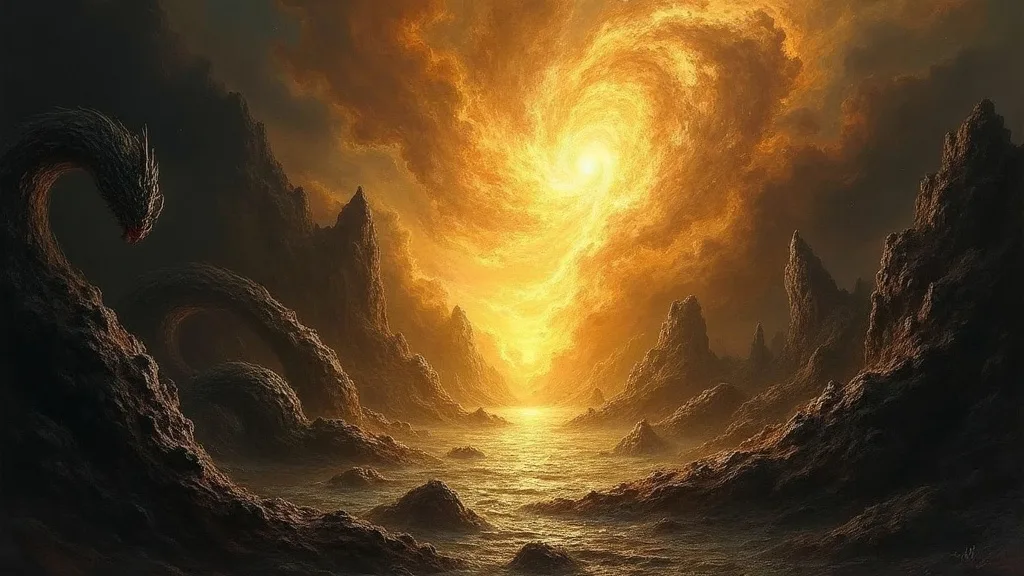
Ahriman (Angra Mainyu): The Destructive Spirit of Persian Mythology
Ahriman (Angra Mainyu in Avestan) is the cosmic principle of destruction, decay, and evil in Persian Zoroastrianism. Eternal rival of Ahura Mazda, he embodies chaos itself and shapes the central spiritual conflict of humanity's purpose.
Contents
The universe was not always divided between good and evil. In the beginning, before time itself, there existed a single, undifferentiated state. From this primordial condition emerged two opposing spirits: Ahura Mazda, the wise lord embodying light, order, and creation, and Ahriman (called Angra Mainyu in the ancient Avestan language), the destructive principle incarnate. This was not a fall from grace or a tale of rebellion. Rather, the Zoroastrian cosmos emerged as a dualism by nature; two powers locked in conflict from the very start, each necessary to define the other, each claiming dominion over existence itself.
Ahriman is perhaps the most misunderstood figure in Persian mythology. He is not merely a demon or a tempter in the manner of Satan, nor is he a god fallen from favour. He represents something far more primal: the principle of entropy, the force that corrupts and unmakes, the source of all harm, suffering, disease, and death. To understand Ahriman is to understand a worldview in which evil is not an accident or a moral failing, but a fundamental reality woven into the fabric of the cosmos, opposing creation itself at every moment. His story is written in the oldest texts of humanity; it shaped how millions thought about good, evil, and the struggle between them.
Origins of Ahriman in the Avesta
The earliest texts describing Ahriman appear in the Gathas (literally "songs"), a collection of hymns composed by the prophet Zoroaster himself, written in Avestan, an ancient Iranian language. The Gathas date to sometime between the 15th and 6th centuries BC, though scholars debate the exact period; what matters is that they represent some of the oldest attested religious literature in the world. In these hymns, Ahriman emerges not as a creation of Ahura Mazda but as a co-eternal presence, a parallel principle of existence.
The Avestan texts do not describe Ahriman as having an origin story in the way we might imagine a god's birth. Instead, he is posited as a fundamental reality. The Yasna, a liturgical text within the Avesta, declares that from the beginning there were two spirits: a beneficial one and a destructive one, each with its own will. This was called Spenta Mainyu (the Holy Spirit, identified with Ahura Mazda's creative essence) and Angra Mainyu (the Destructive Spirit, which came to be called Ahriman). Both existed; both chose their natures.
Later Zoroastrian theology, especially in texts written during the Sassanid Persian Empire (224-651 CE), elaborated on this cosmic duality. In works like the Bundahishn (the "Creation" text), scribes described a limited warfare lasting 12,000 years. Ahriman did not exist in a state of peaceful coexistence with Ahura Mazda. Rather, at some point (often dated to 3,000 years before the birth of Zoroaster in various mythological chronologies), Ahriman became aware of Ahura Mazda's existence and attacked creation out of jealousy and malice. This assault inaugurated the present age, an age of mingling in which good and evil intermix in the material world, in human bodies, in the very soil itself.
The Nature of Ahriman: Chaos and Corruption
To call Ahriman "the god of evil" is to miss what he truly is. He does not command evil as an abstract principle; he is the force that destroys, corrupts, decays, and unmakes. In the Zoroastrian worldview, Ahriman embodies the six major calamities: hunger, thirst, disease, pain, sorrow, and death. He is not tempting humans to sin from a distance; he is actively poisoning the world, introducing corruption into matter itself.
The texts describe Ahriman's assault on creation with visceral detail. When he attacked the pristine creation of Ahura Mazda, he brought demons (the daevas) into being, spirits of decay and malice. He corrupted the first ox, creating disease and weakness. He defiled the world-ox, symbol of life and fertility. He introduced serpents, scorpions, and noxious creatures into the earth. He brought winter into existence, shattering the eternal spring that had prevailed under Ahura Mazda's reign alone. Every plague, every withering season, every death in childbirth, every form of suffering finds its origin in Ahriman's intrusion into the material realm.
What makes Ahriman peculiar in world mythology is that he is not a being of pure malevolence with no power. He is genuinely dangerous. He has intelligence, will, and the ability to corrupt. He can see the future (though not perfectly). He seeks dominion. The conflict between Ahura Mazda and Ahriman is presented as an actual struggle, not a foregone conclusion. The good will ultimately prevail, but only through the combined effort of the wise lord, his creations, and humanity itself. No divine snap of the fingers resolves this; salvation requires work.
Ahriman's kingdom is darkness, the opposite of Ahura Mazda's realm of light. He dwells in the north and south (depending on the text), in the depths, in filth and stagnation. His followers are demons, deceivers, and corrupted humans who have chosen the path of lies and destruction. The druj (the "Lie") is his fundamental nature, the opposite of asha (truth or cosmic order), which Ahura Mazda upholds.
Ahriman's Demons and His Court
Ahriman does not act alone. He commands a host of demons, each representing a specific form of harm or corruption. These demons, often called the daevas or devs, are beings of malice who actively work to undermine creation. Some texts list them by name and function:
- Asto Vidatu, demon of putrefaction and decay
- Apaosha, demon of drought and aridity, who fights against Tishtrya, the star of rain
- Aka Manah, the demon of evil thought, who warps the human mind toward wickedness
- Indra, who causes violence and false judgment
- Saurva, source of pain and disease
- Spenta Armaiti's corrupted aspect, poisoning the earth itself
Each demon corresponds to a form of entropy or wickedness. They do not appear as separate from Ahriman so much as extensions of his destructive will. In later Persian folklore, these demons became the subject of elaborate tales, often depicted as grotesque and alien creatures, the very opposite of the beautiful creations of Ahura Mazda. The texts describe them as filthy, stinking, malformed, expressing in every detail their nature as corruptors.

Humanity's Role in the Cosmic Struggle
What sets the Zoroastrian cosmos apart from many other mythologies is the explicit role assigned to humans in the struggle between Ahriman and Ahura Mazda. This is not a war fought by gods alone. Humans are conscious agents, equipped with free will and the capacity to choose good or evil, truth or lie, light or darkness.
The Zoroastrian ethics that emerge from this cosmology are hence intensely engaged. To live rightly is not merely a matter of personal virtue; it is an act of cosmic participation. When a human chooses truth (asha) over falsehood (druj), performs good deeds, cultivates good thoughts, speaks good words, and maintains ritual purity, they are actively strengthening the forces of Ahura Mazda and pushing back against Ahriman's encroachment. Conversely, each lie, each act of cruelty, each moment of moral weakness is a victory for Ahriman, a surrender of territory in the cosmic struggle.
This explains the intense focus in Zoroastrian texts on ritual, purity, and ethical action. The daily prayers, the care for fire (seen as a manifestation of Ahura Mazda's divine light), the prohibition against defiling water or earth, the emphasis on honesty and just dealing, all of these practices are not merely arbitrary religious laws. They are weapons in the struggle against Ahriman. To neglect them is to allow destruction to advance.
The Zoroastrian worldview also includes a clear eschatology, a vision of how this struggle will end. At the end of time, a savior figure will be born (or in some accounts, three saviors at different epochs). This savior, called the Saoshyant, will lead the forces of good to final victory. Ahriman will be defeated, his demons destroyed, and the world will be renewed. Death itself will be undone. This final renewal is not earned by divine fiat alone; it is achieved through the moral choices of humanity and the work of the righteous. Yet Ahriman's end is certain. His defeat is written into the structure of existence, even though the moment of that defeat lies in the future.
Ahriman in Later Zoroastrian Theology
As Zoroastrianism developed over centuries, especially during the Sassanid period (224-651 CE), the concept of Ahriman became increasingly elaborate. The Bundahishn, a Middle Persian theological treatise composed centuries after the Avesta, provides the most detailed account of Ahriman's nature and the cosmic drama in which he plays a central role.
In these later texts, Ahriman is described with almost visceral detail. He is portrayed as unspeakably ugly, with a body shaped like a serpent. He emits a stench of decay. His presence brings despair and hopelessness. Yet he is also clever, cunning, and possessed of a terrible intelligence. He understands the workings of the world he has invaded. He knows the names and natures of many things. He can calculate and plan. He is not a stupid force of blind destruction but a directed malevolence.
The Bundahishn also describes a complex mythology in which Ahriman's assault on creation unfolded in stages. For 3,000 years, creation existed in pristine perfection under Ahura Mazda's reign alone. Ahriman, dwelling in the darkness of the abyss below the earth, was unaware of Ahura Mazda's creations above. When he discovered them, he leaped upward in a rage, seeking to destroy all that had been made. This assault marks the beginning of the present age, an age of mingling in which good and evil are interwoven in all things.
The later theologians also worked to reconcile the doctrine of cosmic dualism with a commitment to Ahura Mazda's ultimate supremacy. Some formulations held that Ahriman's power, though real and terrible, is inherently limited and temporary. Ahura Mazda, by contrast, is eternal, infinite, and necessarily victorious. Ahriman's destructiveness can delay the victory of good but cannot prevent it. Other texts emphasize that Ahriman's existence and malice are permitted by Ahura Mazda's wisdom, that even Ahriman's attacks serve ultimately to test and strengthen the righteous. This represents an attempt to preserve monotheistic themes (the ultimate unity and supremacy of the good principle) while maintaining the reality of an opposing force.
This theological development was not merely abstract. It had profound ethical and practical implications. If Ahriman's victory were truly possible, then despair might be justified. But if Ahura Mazda's triumph is assured, then the righteous can act with courage and confidence, knowing that their choices matter and that they are on the winning side of history.
Ahriman's Influence Beyond Zoroastrianism
The dualistic cosmology centered on the conflict between Ahriman and Ahura Mazda did not remain confined to the Persian world. As Zoroastrianism spread across the vast territories conquered by the Sassanid Empire, and as Zoroastrianism encountered other religious traditions, its influence rippled outward.
Some scholars have noted parallels and possible influences between Zoroastrian eschatology and the apocalyptic visions found in later Jewish and Christian texts. The concepts of a final cosmic battle, a savior figure who brings renewal, a last judgment in which the righteous are vindicated and the wicked punished, and a transformed world beyond history all appear in these traditions and bear some structural similarity to Zoroastrian thought. While the historical connections remain debated by scholars, the possibility of influence is taken seriously by historians of religion.
In the Islamic world, after the conquest of Persia in the 7th century CE, Zoroastrian cosmology influenced Islamic theology and philosophy, particularly in Sufi thought. The dualistic framework, while ultimately rejected by orthodox Islamic monotheism, left marks on how some Muslim thinkers conceived of the struggle between divine will and cosmic disorder.
Within Persian culture itself, Ahriman remained a potent figure long after the formal decline of Zoroastrianism as the dominant religion. In Persian poetry, in folk tales, in the mystical traditions of Sufism, the figure of the cosmic adversary, the principle of destruction and darkness, echoed through centuries. The poet Firdawsi, who composed the great epic Shahnameh (the "Book of Kings") in the 10th century CE, drew on ancient Persian mythology while working within an Islamic context. The tensions and dualities he depicted owe something to the Zoroastrian framework in which evil is not marginal but central to the cosmos.

The Problem of Ahriman: Evil as Cosmic Principle
The figure of Ahriman raises a question that has occupied theologians and philosophers for centuries: How should we think about evil? Is it a privation, an absence of good, a mere shadow cast by creation? Or is it a positive force, a reality in its own right with power and agency?
The Zoroastrian answer places Ahriman firmly in the latter category. Evil is real. It is not a mistake, not a failure of creation, not something that slipped into the world through negligence. It is a positive, destructive force, ancient and powerful, with its own will and agenda. This answer has the virtue of taking evil seriously, of refusing to minimize suffering or to treat wickedness as illusion.
Yet it also raises challenges. If Ahriman is co-eternal with Ahura Mazda, does this not suggest a kind of ultimate dualism in which neither principle is truly supreme? How can there be a God of absolute goodness if there exists an eternal, co-equal force of absolute evil? Later Zoroastrian theologians grappled with these questions, ultimately asserting that while Ahriman is real and powerful, Ahura Mazda is by nature superior, being associated with infinity, omniscience, and eternality, while Ahriman is finite and doomed.
This tension between cosmological dualism and theological monotheism remains unresolved in Zoroastrian texts and continues to be debated by scholars. It reflects a fundamental problem: how to account for the existence of radical, seemingly pointless evil in a world created by a wise and benevolent power. Zoroastrianism does not solve this problem so much as acknowledge it fully, place the problem at the center of its cosmology, and invite humans to participate in its resolution through right action.
Ahriman in Modern Scholarship and Culture
Modern scholarship on Ahriman has moved beyond earlier interpretations that read him as simply "Satan" or that viewed Zoroastrianism as the ancestor of monotheistic religions' conceptions of evil. Scholars like Mary Boyce, an Oxford-based authority on Zoroastrianism, have shown that Ahriman is best understood on his own terms, as a figure embedded in a distinctive dualistic worldview that emerged in ancient Iran.
The rediscovery and study of Zoroastrian texts, particularly since the 19th century, has allowed modern readers to encounter Ahriman in his original context rather than through the interpretive lenses of later religions. This has deepened our understanding of Persian religion and revealed how sophisticated and rigorous ancient Zoroastrian theology actually was.
In contemporary culture, references to Ahriman and Zoroastrian dualism appear in literature, philosophy, and even popular culture. The concept of an eternal cosmic struggle between opposing forces has proven generative and resonant across many different contexts. While popular understanding often oversimplifies the theology, the figure of Ahriman continues to exert imaginative power as a symbol of opposition, darkness, and the principle of destruction.
Frequently asked questions about Ahriman and Persian mythology
Frequently asked questions
Is Ahriman the same as Satan or the Devil in Western religions?
Ahriman is often compared to Satan, but they are not identical. Satan in Christianity and Judaism is typically understood as a fallen angel or created being who rebelled against God. Ahriman, by contrast, is co-eternal with Ahura Mazda, not a creation who fell. Ahriman represents a cosmic principle of destruction woven into existence from the beginning, whereas Satan emerges within a monotheistic framework as a rebellious creature. That said, Zoroastrian dualism may have influenced later Western religious thought about evil and cosmic struggle.
Did Zoroastrianism influence Judaism, Christianity, and Islam?
Historians of religion note structural similarities between Zoroastrian eschatology and concepts found in later Jewish, Christian, and Islamic texts, including ideas of final judgment, a savior figure, cosmic renewal, and a battle between divine and destructive forces. Whether these represent direct influence remains debated. What is clear is that Zoroastrianism flourished in the Near East and Mediterranean world for centuries, creating opportunities for contact and exchange. However, all three monotheistic religions rejected explicit dualism, ultimately asserting the supremacy of a single, all-powerful deity.
What happens to Ahriman at the end of time in Zoroastrian mythology?
At the end of the 12,000-year cosmic cycle, a savior figure called the Saoshyant will be born. This figure will lead the forces of good to final victory. Ahriman and his demons will be defeated and destroyed. The dead will be resurrected, and the world will be renewed in a state of perfection and eternal peace. This final renewal is not brought about by Ahura Mazda's power alone but through the combined moral effort of humanity and the righteous. Death itself will be undone, and time as we know it will end.
Can humans defeat Ahriman in Zoroastrianism, or is his defeat solely Ahura Mazda's responsibility?
Humans play an essential role in the struggle against Ahriman. Every act of goodness, truthfulness, and moral courage is a blow against Ahriman's influence. Prayer, ritual purity, just dealing, and honest words are not merely personal virtues but cosmic actions. The final victory of Ahura Mazda is assured, but it is achieved through the combined actions of the wise lord, his divine creations, and righteous humans. Humanity's participation is not optional; it is central to the resolution of the cosmic drama.
Why did Zoroastrianism develop a dualistic theology when most ancient religions were polytheistic or monotheistic?
Zoroastrianism emerged in ancient Iran, a region where the cosmic struggle between order and chaos, light and darkness, fertility and drought had deep cultural resonance. The dualism may reflect genuine theological reflection on the problem of evil and suffering. It is also possible that it arose from reflection on the human experience of genuine opposition: winter and summer, drought and rain, health and sickness. Unlike monotheistic religions, which must explain evil as a departure from divine intention, Zoroastrianism places opposition at the foundation of existence, acknowledging the realness and power of destruction while still affirming the victory of good.
The Enduring Power of Cosmic Opposition
The figure of Ahriman reminds us that not all ancient peoples conceived of evil as secondary or illusory. The Zoroastrians took destruction, suffering, and malice seriously enough to place them at the cosmic center, opposite an equally powerful principle of creation and wisdom. This was not pessimism but realism, paired with an unshakeable confidence in the ultimate victory of the good and the necessity of human participation in that victory.
In the modern world, where ancient mythologies are often read as quaint or superseded by science, Ahriman's story carries a different kind of power. It asks us: What do we do with the reality of suffering and malevolence? Do we minimize them, treat them as illusions, or accidents? Or do we acknowledge them as fundamental, take them seriously, and organize our lives around resisting them? The Zoroastrian answer was to make that resistance sacred, a participation in cosmic renewal. That answer retains its challenge and relevance across centuries.
Read the full book
Want the whole story?
The complete edition is an instant PDF download here, with a paperback on Amazon for selected titles.
Persian
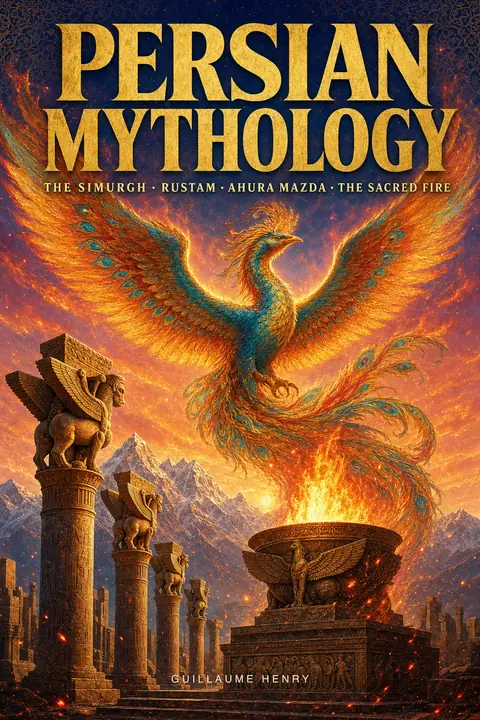
The Persian Mythology Book: Ahura Mazda, Ahriman, Mithra, and the Cosmic Dualism That Shaped Three Religions
From the Avesta to Ferdowsi's Shahnameh
The Zoroastrian cosmos of light against darkness, the Amesha Spentas, the hero Rostam, and the Shahnameh epic that preserved pre-Islamic Iran in verse.
More from Persian
All articles
Persian
Anahita: The Persian Goddess of Waters and Fertility
Anahita, the Persian goddess of waters and fertility, ruled over rivers, healing, and the cycle of life itself. Revered for millennia across the Zoroastrian world, her story reveals how water became sacred, and how a goddess shaped the spiritual landscape of Persia, Anatolia, and beyond.

Persian
The Avesta: Sacred Texts of Zoroastrianism and Ancient Persian Religion
The Avesta is the religious scripture of Zoroastrianism, containing hymns, prayers, and law from ancient Persia. Discover how this 3,000-year-old text shaped Western religion and philosophy.

Persian
The Faravahar: The Winged Symbol of Zoroastrianism
The Faravahar appears across Zoroastrian art, temples, and personal devotion as a winged figure hovering between realms. This ancient Persian symbol encodes the faith's core belief: that each human spirit carries divine potential and cosmic choice. Discover what this icon reveals about the battle between good and evil.

Persian
The Shahnameh: Iran's Epic Book of Kings
The Shahnameh is the world's longest poem and Iran's national epic, a 50,000-verse masterpiece written by Firdawsi around 1000 CE that weaves together mythology, legend, and history into a seamless narrative of Persian kingship across 3,000 years.