
The Simurgh: The Benevolent Phoenix of Persian Legend
The Simurgh is Persia's great mythic bird: ancient, all-knowing, and forever perched at the edge of time. Learn what makes this creature unlike any other in world mythology.
Contents
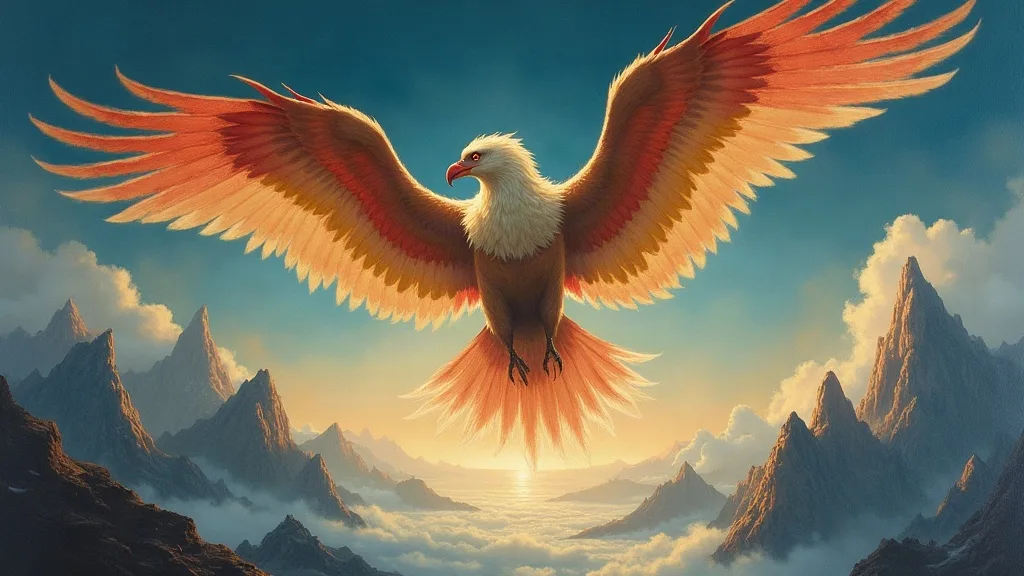
High on the peak of Mount Qaf, where the world's rim bends into sky and no road of men has ever reached, a bird the size of a continent rests its wings. It has watched thirty cycles of cosmic history burn and cool. Every secret that ever passed between the earth and heaven has fallen, at some point, like a feather from its body. The Persians called it the Simurgh, and they never made it a monster.
That choice matters. Across the ancient world, enormous birds tend toward terror: they snatch heroes, block out the sun, serve as instruments of divine punishment. The Simurgh went the other direction. It heals. It nurses abandoned royal children back to health. It carries its knowledge freely, if the seeker is willing to climb. The Zoroastrian sacred text, the Avesta, names its ancestor the Saena bird, a figure already ancient when the text was composed, probably before 600 BC. By the time the poet Ferdowsi finished the Shahnameh (the "Book of Kings") around 1010 AD, the Simurgh had accumulated a thousand years of layered meaning and become one of the most nuanced symbols in world literature.
The Roots of the Simurgh: From the Avestan Saena to the Shahnameh
The oldest clear ancestor of the Simurgh appears in the Avesta, Zoroastrianism's sacred scripture, under the name Saena meregha, meaning "the Saena bird." The root saena probably links to the Sanskrit syena, meaning "eagle" or "hawk," and the connection is not accidental: both traditions drew from a shared Proto-Indo-Iranian well, the same cultural source that gave Hindu mythology the great eagle Garuda. The Saena perched in the Avesta on a sacred tree, the Gaokerena, or Tree of Life, which grew in the middle of a cosmic sea. When it spread its wings, it scattered the seeds of all medicinal plants across the world.
That early image is already generous. The Saena bird does not guard the seeds; it gives them away.
By the time of the Bundahishn, a Middle Persian encyclopedic text compiled around the 9th century AD from older Zoroastrian material, the bird had grown in stature. The Bundahishn calls it the Simurgh (from Middle Persian Senmurv or Senmurw) and describes it as nesting in the Tree of Many Seeds. Every time it takes flight, a thousand branches break and scatter their fruit. Every time it lands, a thousand new shoots spring up. The bird itself is neither male nor female in some accounts, or both at once in others, a creature that transcends the categories it inhabits.

The Arabic-speaking scholars who encountered Persian lore translated the Simurgh into their own tradition as the 'Anqa (sometimes spelled Anqa or Anka), a great bird of the far horizon, so rare it has become functionally invisible. The two figures share the idea of extreme antiquity and impossible size but split on temperament: the 'Anqa tends toward neutrality or ambiguity, while the Simurgh in Persian hands stays warm. It helps. That warmth is the defining quality.
Zal and the Simurgh: The Myth That Shapes Everything
No single story reveals the Simurgh's character more completely than its relationship with Zal, one of the Shahnameh's early heroes. Ferdowsi sets it up with brutal directness: a great warrior named Sam fathers a son, but the child is born with white hair. In the culture Ferdowsi depicts, white hair on a newborn is a mark of evil or ill omen. Sam, terrified by what his peers and king will think, abandons the infant on Mount Qaf.
The Simurgh finds the child. It does not eat him. It carries him to its nest at the summit, feeds him alongside its own chicks, and raises him over the years into a man of enormous strength and skill. What Ferdowsi gives the reader here is not a supernatural guardian acting on divine orders, but something closer to a parent, an ancient being choosing, without obligation, to care.
When Sam eventually repents and seeks his son, the Simurgh gives Zal back willingly. It speaks to the young man directly: it has watched his father's grief, it understands the human world better than any human, and it wishes Zal well in it. Before Zal descends from the mountain, the Simurgh pulls three feathers from its own breast and tells him: burn one in any moment of desperate need, and the Simurgh will come.
That promise becomes the pivot of the Shahnameh's next generation. Zal marries Rudabeh, and when Rudabeh goes into a catastrophically difficult labor trying to give birth to the hero Rostam, the midwives cannot help her. Zal burns a feather. The Simurgh appears instantly, walks the healers through the procedure for what Ferdowsi describes in terms that scholars have read as a kind of Caesarean section, one of the earliest descriptions of such an operation in world literature. Rudabeh lives. Rostam, who will become Persia's greatest champion, is born.
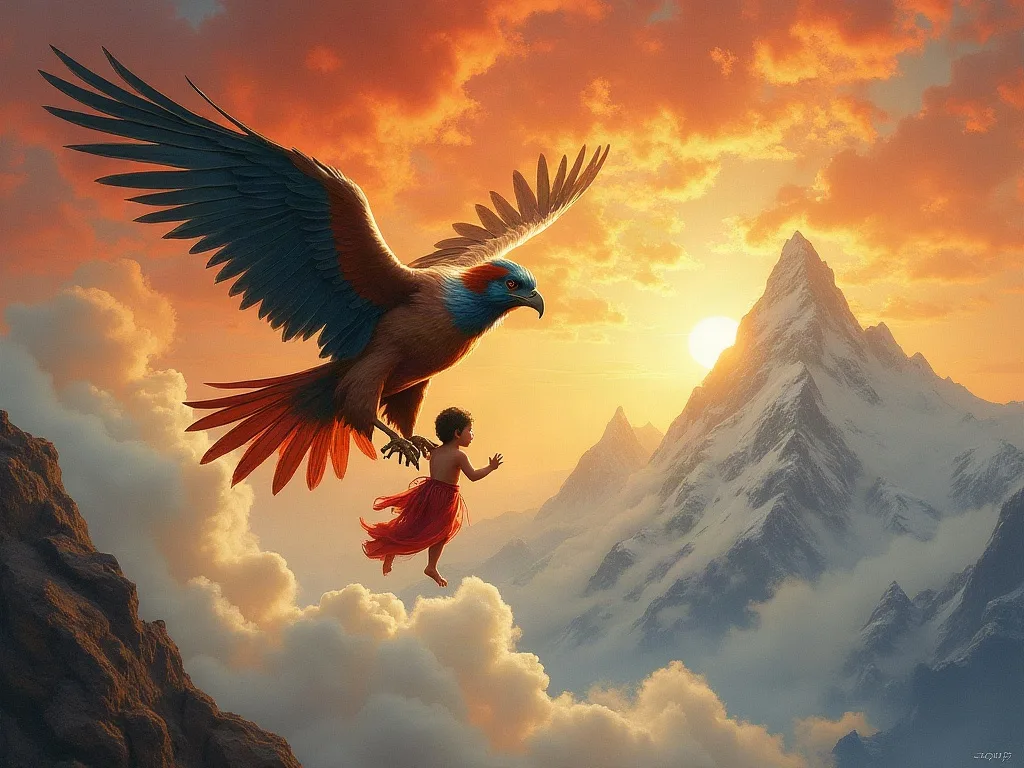
The Simurgh then vanishes again, its role complete. It asks for nothing in return. This pattern: appearing when genuinely needed, dispensing what it alone can give, then retreating, runs through every Simurgh story and defines the bird's character as clearly as any physical description.
What the Simurgh Looks Like: A Body Built from Every Bird
Persian miniature painting from the 12th century onward gives the Simurgh a consistent visual vocabulary, though never a rigid one. It is typically enormous, often depicted in flight over mountain ranges. Its body is covered in multi-colored feathers, usually red, gold, and deep blue. Its face is sometimes human, sometimes canine, sometimes purely avian. Many depictions give it a peacock's tail, a griffin's chest, a lion's claws.
The Bundahishn adds that the Simurgh's body is so large that when it flies over the sea, its shadow covers the entire surface. The 12th-century poet Nizami Ganjavi, in his epic Makhzan al-Asrar ("Treasury of Mysteries"), describes the bird as carrying within its plumage the accumulated knowledge of three thousand years of continuous conscious life.
The Simurgh (Persian)
Ancient beyond reckoning, the Simurgh does not die and is not reborn. It nests on the cosmic Tree of Life, raises human children, heals the sick, and carries practical wisdom. Its relationship to humanity is fundamentally nurturing and reciprocal. Sources: the Avesta, the Shahnameh, the Bundahishn.
The Phoenix (Greco-Roman)
The Phoenix of classical antiquity (first described by Herodotus around 440 BC) lives 500 years, then burns and rises reborn from its own ashes. It is a symbol of cyclical renewal and immortality, but it does not interact with humans, nurse their children, or share its knowledge. It is a spectacle, not a guide.
The visual complexity of the Simurgh is intentional. Medieval Persian commentators read the composite body as a sign that the bird contained all of creation within itself. The 12th-century mystic poet Farid ud-Din Attar, whose work shaped how later generations understood the Simurgh most profoundly, wrote that the Simurgh's feathers held the patterns of every living thing, every language spoken, every secret written.
Attar's Conference of the Birds: The Simurgh as Spiritual Destination
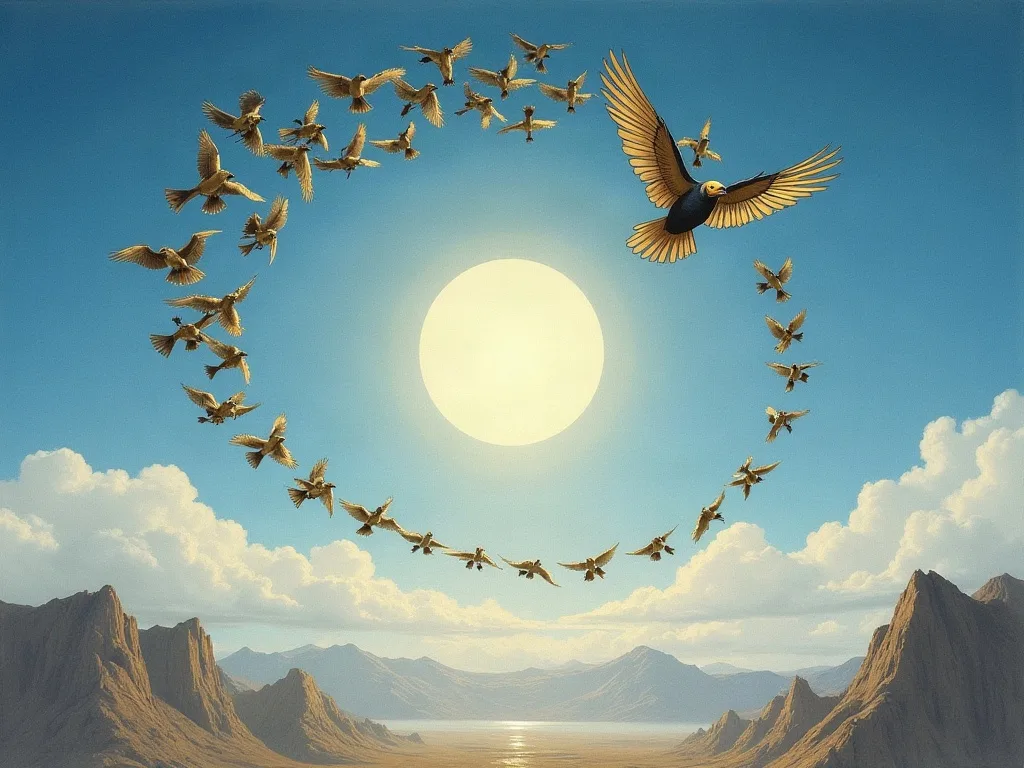
The most celebrated use of the Simurgh in all of Persian literature is the Mantiq al-Tayr, or "Conference of the Birds," written by the Sufi poet Farid ud-Din Attar around 1177 AD. The poem is a pilgrimage narrative of a particular kind: thirty birds, led by the hoopoe, decide to seek their king, the Simurgh, who lives beyond the mountain ranges at the world's edge. The journey crosses seven valleys: the Valley of the Quest, the Valley of Love, the Valley of Understanding, the Valley of Detachment, the Valley of Unity, the Valley of Wonder, and the Valley of Poverty and Annihilation.
Most birds give up. They offer excuses, fear the next valley, mourn what they would lose. Each excuse, Attar makes clear, represents a spiritual failure: attachment to comfort, fear of dissolution, inability to release the self. Only thirty birds complete the journey and reach the Simurgh's palace.
Then comes one of the most elegant literary reversals in all of world poetry. The thirty birds look at the Simurgh, and they see themselves. In Persian, si means "thirty" and murgh means "bird." The Simurgh is thirty birds. The birds are the Simurgh. The seeker and the destination were never separate.
Attar frames this not as a trick but as the logical end of the journey: if you strip away everything that is not essential, what remains is identical to the divine. The Simurgh here is not a creature to find outside yourself; it is what you discover when you stop looking outside.
This reading electrified the Sufi tradition. Scholars including Annemarie Schimmel, in her landmark study Mystical Dimensions of Islam (1975), argue that Attar's use of the Simurgh created a template for mystical goal-setting that influenced Persian, Turkish, and South Asian Sufi thought for centuries. The bird stopped being only a creature of legend and became a philosophical category.
The Simurgh's Healing Powers and the Royal Lineage
Beyond Attar's allegory, the Simurgh's connection to medicine and kingship runs deep in the older mythological tradition. In the Shahnameh, the feathers the Simurgh gives Zal are not purely emergency tools: one passage suggests that a single feather, passed through flame, can cure wounds that no physician can touch. This places the Simurgh inside a very old Indo-Iranian idea about sacred birds as carriers of khvarenah, the divine radiance or "royal glory" that legitimizes kingship and protects its holder.
Zal's son Rostam carries traces of Simurgh blood, metaphorically if not literally: he was literally brought into the world through the Simurgh's guidance, and throughout the Shahnameh he displays not just physical power but a kind of providential luck that scholars link to the khvarenah concept. The Simurgh, by choosing to nurse Zal, injected that radiance into the royal bloodline.
This is consistent with how Persian mythology tends to work. Divine beings do not simply grant power: they choose a lineage, invest it with something, and step back. The Simurgh's choice of Zal is as much a political act as a compassionate one. It makes Rostam possible.
The Simurgh Across Borders: Turkic, Chinese, and Kabbalistic Echoes
The Simurgh did not stay inside Persian borders. The figure migrated in multiple directions across the medieval world.
The Turkic tradition absorbed it as the Zümrüd-ü Anka or simply Zümrüdüanka, a magical bird that appears in Ottoman folk tales and eventually in the prose tradition of writers like Evliya Celebi. In this version the bird remains vast and knowledgeable, but sometimes takes on a more adversarial edge, reflecting the Turkic heroic tradition's tendency toward conflict between human and supernatural.
Some scholars, including the 20th-century mythographer Rene Grousset, have pointed to structural similarities between the Simurgh and the Chinese Fenghuang (the "Chinese phoenix"), both birds of composite beauty, extreme longevity, and auspicious character. The parallel likely reflects shared Central Asian cultural channels rather than direct borrowing, but the similarity is striking.
The most surprising migration goes westward: medieval Jewish Kabbalistic texts, particularly those composed in Persia and the Levant, reference the Ziz, a great cosmic bird that lives at the boundary of heaven and earth and contains all of creation. Scholars like Shaul Shaked have noted the likely Persian influence on this figure, tracing how Zoroastrian cosmological ideas moved into Jewish mystical thought through centuries of Persian Jewish cohabitation.
The Simurgh in Modern Persian Culture and Art
The Simurgh's life did not end with the classical period. Iranian modernist literature returned to it repeatedly in the 20th century as a symbol of national identity, spiritual aspiration, and the longing for something irreducibly whole.
The novelist Sadeq Hedayat referenced Simurgh imagery in his surrealist fiction. The poet Forough Farrokhzad, one of the great voices of 20th-century Persian literature, used images that scholars read as Simurgh-adjacent: the bird of knowing that watches but cannot be caught. Contemporary Iranian visual artists have incorporated the Simurgh into paintings, sculptures, and public murals, often explicitly as a counterweight to both colonial cultural erasure and political repression: a bird that cannot be killed because it never dies.
Outside Iran, the Simurgh has found its way into Western fantasy literature. The author Jorge Luis Borges devoted an entry to it in his Book of Imaginary Beings (1969), calling the Simurgh one of the most intellectually audacious mythological figures he had encountered: a creature that turns out to be the sum of its seekers. Ursula K. Le Guin, who read widely in Persian literature, embedded Simurgh-like birds of cosmic knowledge into several of her fantasy works, though always transformed into her own idiom.
The figure sits today at a crossroads. It is ancient enough to have pre-Islamic roots in Zoroastrian scripture. It is central enough to Persian literary tradition to appear in the national epic. It is flexible enough philosophically to carry Sufi mysticism, Iranian nationalism, and postmodern literary theory simultaneously. Few mythological creatures manage all three.
Frequently Asked Questions About the Simurgh in Persian Mythology
Frequently asked questions
Is the Simurgh the same as the phoenix?
They share some surface features, particularly great size and vivid plumage, but they are fundamentally different. The Greek and Roman phoenix (described by Herodotus, Ovid, and Pliny) dies by fire and is reborn, making it a symbol of cyclical renewal. The Simurgh does not die at all. Persian sources consistently describe it as eternal and accumulating wisdom rather than resetting. The Simurgh also interacts directly with humans in ways the phoenix never does: it raises children, heals the sick, and teaches.
What is the Simurgh's connection to Sufism?
Farid ud-Din Attar's 12th-century poem Mantiq al-Tayr ("Conference of the Birds") made the Simurgh the central symbol of the Sufi spiritual journey. In Attar's allegory, thirty birds travel through seven valleys of increasing spiritual difficulty to reach the Simurgh, only to discover that si murgh (thirty birds) is the Simurgh itself. The destination and the seekers are one. This non-dual conclusion shaped Sufi thought in Persia, Turkey, and South Asia for centuries and is still discussed in Islamic mystical philosophy today.
What are the primary sources for the Simurgh's mythology?
The oldest sources are Zoroastrian: the Avesta (pre-600 BC) mentions the Saena bird, and the Bundahishn (compiled 9th century AD from older material) names and describes the Simurgh more fully. Ferdowsi's Shahnameh (completed around 1010 AD) contains the most detailed narrative involving the Simurgh, particularly the story of Zal. Attar's Mantiq al-Tayr (around 1177 AD) transforms the bird into a mystical symbol. Later Persian poets including Rumi also reference it in their own frameworks.
Why does the Simurgh choose to raise the abandoned child Zal?
Ferdowsi does not give the Simurgh an explicit divine mandate for this choice. The bird simply acts. Most Persian literary scholars read this as deliberate: the Simurgh's compassion requires no theological justification because the bird's nature is to nurture. Some scholars, including Jerome Clinton in his studies of the Shahnameh, read the act as the Simurgh recognizing khvarenah (divine radiance) in Zal's bloodline and choosing to protect it for the sake of Iran's future. The ambiguity itself is meaningful, the story works whether the Simurgh acts from feeling or from cosmic foresight.
How does the Simurgh relate to other great birds in world mythology?
The Simurgh shares its Proto-Indo-Iranian roots with the Hindu Garuda, both descend from the Saena / Syena bird of ancient Vedic and Avestan tradition. Structural parallels exist with the Turkic Zümrüdüanka, the Chinese Fenghuang, and possibly the Jewish Ziz, though direct borrowing is debated. The Simurgh is closest in spirit to the Hindu Garuda in terms of divine connection to a sacred order, but it differs sharply in temperament: Garuda serves as Vishnu's vehicle and is a warrior, while the Simurgh is a healer and teacher who serves no master.
The Unresolved Simurgh: What Scholars Still Debate
The most active scholarly debate around the Simurgh concerns the exact nature of its pre-Islamic origins and whether the Senmurv of Sasanian-era Persian art (coins, metalwork, and textiles from roughly 224-651 AD depict a dog-bird hybrid) is truly the same figure as the Saena of the Avesta and the Simurgh of the Islamic-period poets.
Mary Boyce, whose multi-volume History of Zoroastrianism remains the standard reference in English, argues for strong continuity: the Senmurv, the Saena, and the Simurgh are stages of a single evolving figure. Other scholars, including Frantz Grenet, point to the Senmurv's canine features (a dog-bird rather than a pure bird) as evidence of a more complex origin, possibly incorporating Central Asian animal-composite traditions from the Scythian or Sogdian cultures that surrounded the Iranian plateau.
What neither side disputes is the figure's staying power. The Simurgh survived Zoroastrianism's displacement by Islam in the 7th century, the Mongol invasions of the 13th century, and every subsequent political upheaval in Iran's long history. It did so by being useful in multiple registers at once: it could be a literal creature in a hero's story, a mystical symbol in a Sufi poem, a national emblem on a government seal, or a metaphor in a novelist's hand.
The Simurgh persists because it was built to hold contradiction. It is ancient and always present. It is other and somehow familiar. It carries the seeds of everything and demands nothing in return. That combination has not gone out of style.
Read the full book
Want the whole story?
The complete edition is an instant PDF download here, with a paperback on Amazon for selected titles.
Persian
The Persian Mythology Book: Ahura Mazda, Ahriman, Mithra, and the Cosmic Dualism That Shaped Three Religions
From the Avesta to Ferdowsi's Shahnameh
The Zoroastrian cosmos of light against darkness, the Amesha Spentas, the hero Rostam, and the Shahnameh epic that preserved pre-Islamic Iran in verse.
More from Persian
All articles
Persian
Anahita: The Persian Goddess of Waters and Fertility
Anahita, the Persian goddess of waters and fertility, ruled over rivers, healing, and the cycle of life itself. Revered for millennia across the Zoroastrian world, her story reveals how water became sacred, and how a goddess shaped the spiritual landscape of Persia, Anatolia, and beyond.

Persian
The Avesta: Sacred Texts of Zoroastrianism and Ancient Persian Religion
The Avesta is the religious scripture of Zoroastrianism, containing hymns, prayers, and law from ancient Persia. Discover how this 3,000-year-old text shaped Western religion and philosophy.
Persian
The Faravahar: The Winged Symbol of Zoroastrianism
The Faravahar appears across Zoroastrian art, temples, and personal devotion as a winged figure hovering between realms. This ancient Persian symbol encodes the faith's core belief: that each human spirit carries divine potential and cosmic choice. Discover what this icon reveals about the battle between good and evil.
Persian
Ahriman (Angra Mainyu): The Destructive Spirit of Persian Mythology
Ahriman (Angra Mainyu in Avestan) is the cosmic principle of destruction, decay, and evil in Persian Zoroastrianism. Eternal rival of Ahura Mazda, he embodies chaos itself and shapes the central spiritual conflict of humanity's purpose.