
Nowruz: The Persian New Year and Ancient Spring Festival
Nowruz marks the Persian New Year at the spring equinox, a living ritual over 3,000 years old. Unpack its mythic roots, Zoroastrian soul, and why 300 million people still celebrate it.
Contents
The fire is lit before dawn. Across Iran, Afghanistan, Kurdistan, and a dozen other lands, families gather around a spread of seven symbolic items, each one beginning with the Persian letter sin. Outside, bonfires crackle in the streets. Children jump over the flames, laughing, shouting the old words: "Give me your red color, take back my yellow." The yellow is sickness, weakness, the cold weight of winter. The red is warmth, life, the pulse of the new season.
This is Nowruz: the Persian New Year and ancient spring festival, and it arrives every year at the exact moment the sun crosses the celestial equator, making day and night equal. That moment, called the vernal equinox, falls around March 20 or 21. Every year, an astronomer in Tehran announces the precise second. People pause mid-conversation, mid-breath, and wait for it.
More than 300 million people across Central Asia, the Middle East, and the wider Persian diaspora celebrate Nowruz today. The United Nations recognized it as an international day in 2010. UNESCO added it to its Intangible Cultural Heritage list in 2009. But no international body created it. Nowruz is old enough to predate the Persian Empire itself.
The Mythic Origin: Jamshid and the Throne of Light
Every culture that tells time also tells stories about who invented it. In Persian mythology, Nowruz belongs to Jamshid, a legendary king whose name appears in the oldest layers of Iranian sacred literature.
The Shahnameh, the Persian "Book of Kings" composed by the poet Ferdowsi around 1010 CE, tells the story in full. Jamshid was a king of the Pishdadian dynasty, the mythic first rulers of the world. He taught humanity the arts of civilization: weaving cloth, forging iron, building ships, curing sickness. Under his reign, death and disease vanished. The earth stretched its capacity to hold more people, so Jamshid stamped his foot and commanded the ground to expand three times.
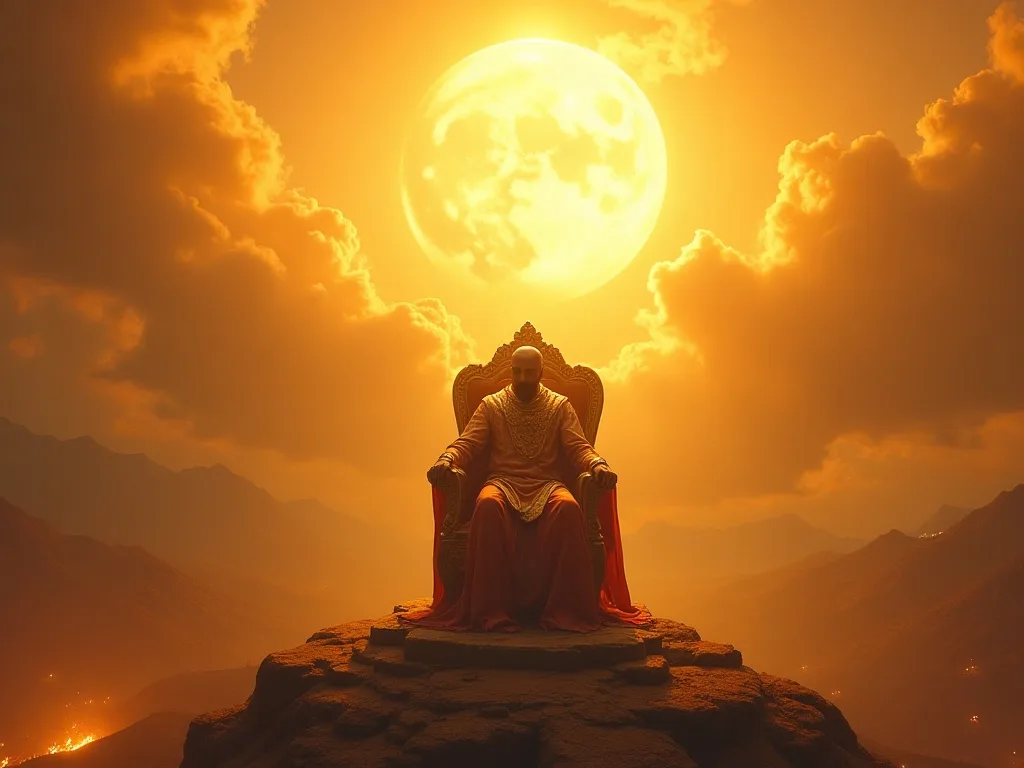
Then came the greatest moment of his reign. Jamshid ordered a jeweled throne to be built. On the day of the spring equinox, he seated himself upon it, dressed in robes that shone like the sun. The devs, the demonic forces of chaos that he had enslaved, lifted the throne into the sky. The people of the earth watched their king blaze across the heavens like a second sun. They called that day Nowruz: "New Day."
Ferdowsi's account places Jamshid's glory at the pivot between winter and spring deliberately. The king's light-bearing throne is a solar image: the sun regaining its full power after the darkness of winter, the world beginning again. The Shahnameh says the people spread a great feast, brought out the best wine, and declared the day a festival. They have not stopped since.
There is a shadow in this story. Jamshid grew proud. He began to believe that his power came from himself alone, forgetting the divine force, called farr in Old Persian, the royal glory that Heaven had granted him. The moment pride replaced humility, the farr departed. The monstrous tyrant Zahhak rose, overthrew Jamshid, and sawed him in half. But the festival he founded survived his fall. The myth teaches that Nowruz is larger than any one king. It belongs to the renewal of the world itself.
Nowruz in Zoroastrian Sacred Time
To understand why Nowruz endures with such intensity, you have to understand Zoroastrianism, the ancient Iranian religion founded by the prophet Zarathustra (known in Greek as Zoroaster), probably somewhere between 1500 and 600 BCE. Scholars still debate the dates, but the religion's core ideas are clear: the universe is a battlefield between Ahura Mazda, the wise lord of light and truth, and Angra Mainyu, the destructive spirit of darkness and lies.
Time itself, in Zoroastrian theology, is a weapon against darkness. The year is structured as a series of sacred moments when light advances and evil retreats. The spring equinox is the most powerful of these: the precise day when light overtakes darkness, when the sun's domain begins to grow again. Celebrating Nowruz was not merely a cultural habit. It was a cosmic act of alignment with Ahura Mazda's victory.
The Zoroastrian sacred calendar divided the year into months and days, each named for a divine being or concept. The first day of the first month, Farvardin, belonged to Ahura Mazda himself. The month of Farvardin honored the Fravashis, the guardian spirits of the dead and the righteous. Nowruz fell at the threshold of this month. During the last ten days before the new year, the Fravashis were believed to return to the world of the living, visiting their families, blessing the homes that had prepared for them.
This is why Nowruz preparation begins long before the equinox. The house must be clean for the returning spirits. Fresh clothes must be ready. The haft-sin table must be laid. The living honor the dead, and in return, the dead bless the living with health and abundance for the coming year.
Zarathustra and the Zoroastrian cosmos shaped not only Nowruz but the entire Persian mythological tradition. The tension between light and darkness runs through every festival, every ritual fire, every prayer spoken at dawn.
The Haft-Sin Table: Seven Objects, Seven Meanings
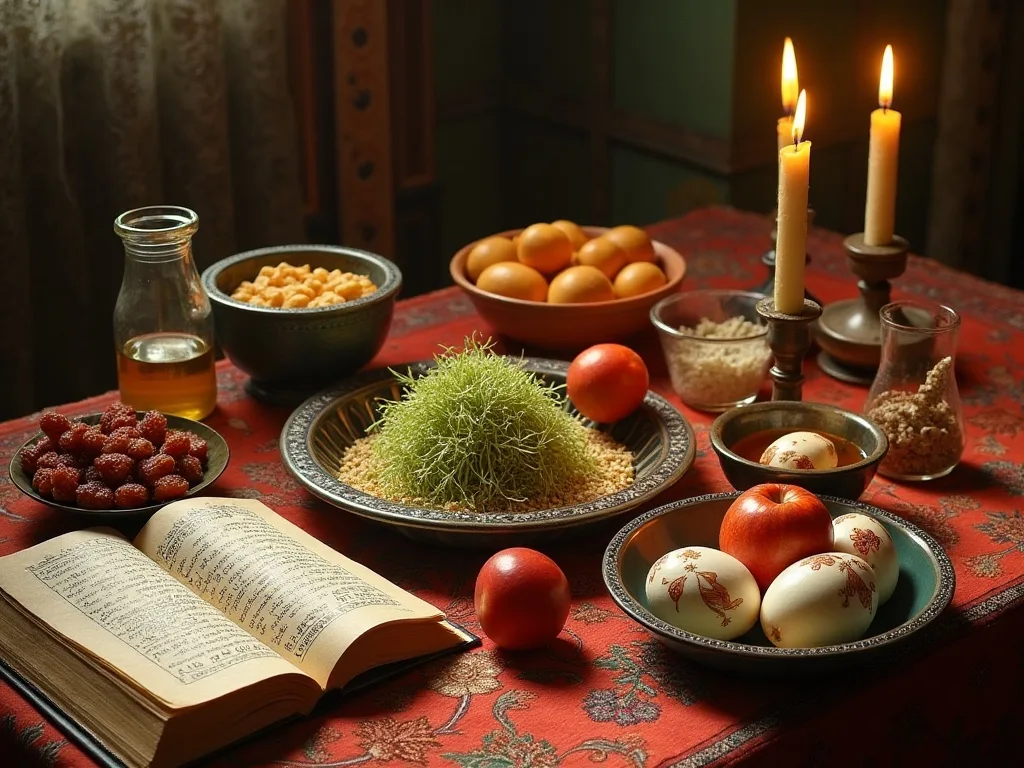
The centerpiece of any Nowruz home is the haft-sin, literally "seven S's," a ritual table set with seven items whose names all begin with the Persian letter sin. Each object carries a specific meaning, and together they form a cosmogram: a map of what the new year should bring.
The seven traditional items are:
- Sabzeh (sabzeh, sprouted wheat or lentils): rebirth and renewal. Families grow these sprouts in the weeks before Nowruz, watching green life push up from the seed.
- Samanu (samanu, a sweet wheat pudding): abundance and fertility.
- Senjed (senjed, dried oleaster fruit): love and wisdom.
- Sir (sir, garlic): health and protection against illness.
- Sib (sib, apples): beauty and health.
- Somaq (somaq, sumac berries): the color of the sunrise, the triumph of light over darkness.
- Serkeh (serkeh, vinegar): patience and the wisdom that comes with age.
Many families add a Quran or a Shahnameh, or both. Goldfish in a bowl represent life and the movement of the heavens. Painted eggs, one for each family member, represent fertility. Candles are lit for each child. A mirror reflects the light back, doubling it.
The table is prepared with care over several days. It is not a casual arrangement. Each object is placed with intention. When the moment of the new year arrives, the family gathers around this table, holds hands or touches one another, and together marks the passage of the old year into the new.
What makes the haft-sin remarkable is its layering of pre-Islamic, Zoroastrian, and Islamic symbolic language, all folded into a single domestic ritual that every family performs in its own way. Scholars like Mary Boyce, who spent decades studying Zoroastrian living communities, noted how deeply agricultural and cosmological symbols merged in Persian ritual practice. The sprouting wheat on the table is simultaneously a seed, a prayer, and a proof that life continues.
Fire Tuesday: Chaharshanbe Suri
The Tuesday before Nowruz brings one of the most vivid pre-holiday rituals: Chaharshanbe Suri, the Festival of Fire. The name comes from chahar (four) and shanbe (Wednesday), with suri meaning "red" or "festive." By Tuesday evening, bonfires are burning in streets and courtyards across Iran and wherever Iranians live.
The act is ancient. Fire, in Zoroastrian practice, is the most visible symbol of Ahura Mazda's presence in the physical world. Temple fires burned continuously in Zoroastrian sanctuaries for centuries, some of them for over a thousand years. The fire of Chaharshanbe Suri carries that same sacred charge into the neighborhood.
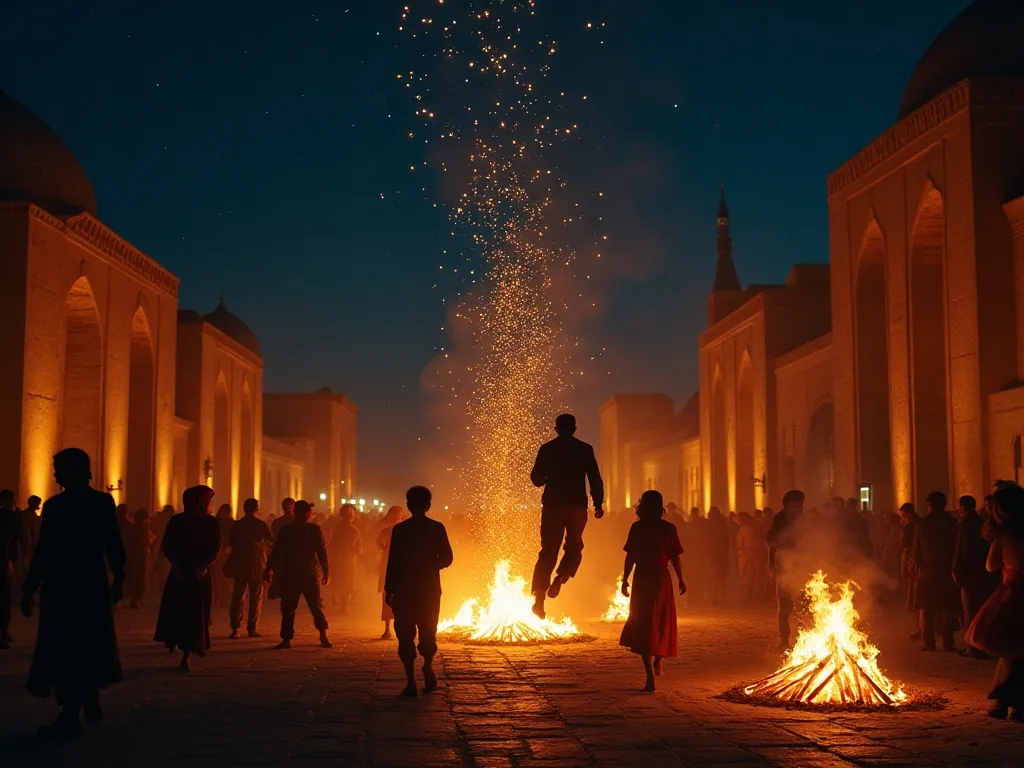
Jumping the fire is the core ritual. Each person leaps over the flames and recites a phrase that translates loosely as "Your fiery redness to me, my pale yellowness to you." The fire consumes weakness, illness, and bad luck. The jumper absorbs the fire's vitality. It is an exchange: human vulnerability traded for solar energy.
The night also includes spoon-banging (qashoq-zani), where people, usually young women and children, go from door to door wrapped in scarves, banging spoons on metal bowls, collecting sweets from neighbors. The disguise is important: trouble and fortune both travel in the dark before the new year, and the scarf shields the visitor's identity. The practice echoes older traditions of masked ritual visits that appear across Eurasian folk religion.
Sizdah Bedar: The Thirteenth Day Outside
The celebration does not end at the equinox. Nowruz extends for thirteen full days, and the last of them, the thirteenth of Farvardin, carries its own distinctive ritual: Sizdah Bedar, "Thirteen-Out," the day when everyone leaves the house and goes outdoors.
The number thirteen, in Persian tradition, is associated with chaos and bad luck. Staying inside on the thirteenth day traps bad fortune in the home. The solution is to go outside: into parks, forests, riversides, anywhere the open sky and fresh earth can absorb the ill omen.
Families spread blankets on the grass and cook outdoors. Young unmarried women tie knots in grass blades and make wishes for love and marriage before untying them. The sabzeh, the sprouted wheat that sat on the haft-sin table through the thirteen days, is brought outside and thrown into running water. The sprouts have absorbed the old year's misfortune and must be returned to nature, not kept in the house.
Sizdah Bedar is one of the most joyful days of the entire Nowruz season. The outdoor gathering, the food, the kite-flying, the singing mark a collective exhale: the new year is fully open now, the old one properly closed.
Nowruz Across Empires: From Achaemenids to Safavids
The historical record for Nowruz begins in earnest with the Achaemenid Empire (550-330 BCE), the dynasty founded by Cyrus the Great. The ceremonial capital Persepolis, built by Darius I and Xerxes, was almost certainly designed around Nowruz celebrations. Archaeologists have pointed to the staircases of the Apadana, the great audience hall, where carved reliefs show delegations from across the empire bringing tribute. Many scholars, including Pierre Briant in his landmark study of the Achaemenid world, argue these reliefs depict Nowruz tribute processions. The king received the world at the new year.
After Alexander the Great destroyed Persepolis in 330 BCE, the Iranian new year survived. The Parthians kept it. The Sassanid Empire (224-651 CE) elaborated it into a major state festival spanning five days. Sassanid kings distributed gifts of gold, held audiences with the nobility, and performed rituals at the sacred fire temples. The court poet recited verses praising the king's farr, the divine glory, as a guarantee that light would continue to overcome darkness through his reign.
When Arab armies conquered Persia in the 7th century CE and Islam became the dominant religion, Nowruz did not disappear. It bent. Some early Islamic scholars opposed it as a pre-Islamic practice. Others accommodated it. The Abbasid caliphs in Baghdad, many of whom had Persian administrators and cultural advisors, celebrated Nowruz openly. The 10th-century scholar al-Biruni, one of the great polymath scholars of the medieval Islamic world, documented Nowruz in detail in his Kitab al-Athar al-Baqiya, describing its myths, its rituals, and its agricultural roots with genuine respect.
The Safavid dynasty (1501-1736), which made Twelver Shia Islam the state religion of Iran, wove Nowruz into the Persian imperial identity so tightly that any attempt to remove it would have unraveled something fundamental. They did not try. Nowruz was Persian, and Persia was now Safavid. The festival continued.
Nowruz Beyond Persia: A Shared Central Asian Heritage
One of the most telling facts about Nowruz is its geographic spread. It is not simply an Iranian holiday. It is the new year of Afghans, Tajiks, Uzbeks, Azerbaijanis, Kurds in Turkey, Iraq, and Syria, Kazakhs, Kyrgyz communities, Georgian communities, and significant diaspora populations in North America, Europe, and Australia.
Each culture has adapted the festival's core. In Afghanistan, the city of Mazar-i-Sharif hosts the Janda Bala, the raising of a sacred pole at the shrine of Ali ibn Abi Talib, which draws hundreds of thousands of pilgrims. The event merges Islamic devotion with the pre-Islamic spring ritual in a way that would have puzzled theologians of both traditions but would have been immediately legible to ordinary Afghans for whom both layers are real.
Kurdish communities call the festival Newroz and tie it to the myth of Kawa the Blacksmith, a story parallel to the Persian Jamshid narrative. In the Kurdish version, the tyrant Zahhak rules with snakes growing from his shoulders, a detail also found in the Shahnameh. The snakes demand to be fed human brains each day. Kawa, a blacksmith whose children are being taken for the tyrant's table, rebels, slays Zahhak, and lights a fire on the mountaintop to signal liberation. The fire of Nowruz, in Kurdish tradition, is explicitly that signal fire: freedom from oppression, the beginning of a new world.
The UN declaration of Nowruz as an international day in 2010 acknowledged this supranational character. No single country owns it. It belongs to the spring, and the spring belongs to everyone who lives through winter.
The Astronomical Precision of the New Year Moment
What separates Nowruz from most other new year celebrations is its relationship to astronomical fact. The celebration does not occur on a fixed calendar date chosen by human convention, like January 1. It occurs at the tahvil, the precise moment of the vernal equinox, calculated to the second.
Iranian astronomers have tracked this moment since at least the Sassanid period. The great astronomer and mathematician Omar Khayyam, best known in the West for his Rubaiyat, spent much of his career refining the Persian solar calendar. In 1079 CE, he led a team commissioned by the Seljuk sultan Malik Shah to reform the calendar. The result, called the Jalali calendar, was more accurate than the Julian calendar in use across Europe at the same time, and comparable in precision to the Gregorian calendar adopted by Europe five centuries later.
Khayyam's calendar is still the basis of the official Iranian calendar today. The new year begins at the tahvil, which changes time and date from year to year because the solar year is not a round number of days. In 2026, the tahvil falls on March 20 at a specific minute and second. Iranian state television broadcasts the countdown live. Families sit together around the haft-sin table and watch the clock.
This is a new year celebration that requires no arbitrary human agreement. It is anchored in the movement of the earth around the sun. Spring begins when it begins, and Nowruz begins with it.
Spring Equinox Parallels in World Mythology
The spring equinox is a threshold moment across dozens of mythological traditions, and Nowruz sits in productive comparison with several of them.
Ostara, the Norse spring festival, also celebrated the equinox with themes of rebirth and fertility. The Germanic goddess whose name some scholars believe gives us the word "Easter" presided over hares and eggs, symbols that echo Nowruz's own painted eggs and the sprout of the sabzeh.
In Mesopotamia, the Babylonian new year festival Akitu also fell in spring and involved a symbolic combat between the god Marduk and the forces of chaos, resolved each year in Marduk's favor. The cosmic battle between order and chaos, light and darkness, that underlies Akitu is structurally identical to the Zoroastrian framework that shapes Nowruz. Some scholars of ancient Near Eastern religion, including Thorkild Jacobsen, have explored how these mythological frameworks spread and transformed across the ancient Iranian plateau and Mesopotamian river valleys.
Holi, the Hindu spring festival, shares with Nowruz its bonfires, its colors, its association with the defeat of a demonic figure, and its sense that the new season requires a collective ritual act to properly begin. The geographic proximity of the Iranian plateau and the Indian subcontinent meant these traditions developed in conversation, even when that conversation was indirect.
None of these parallels diminish Nowruz. They locate it in the widest possible human story: the story of people who watched the seasons turn and decided that the return of light was worth celebrating together.
Frequently asked questions about Nowruz
Frequently asked questions
How old is Nowruz, and what are its earliest documented sources?
Nowruz is at least 3,000 years old, with roots in ancient Iranian religion that predate the Achaemenid Empire (550-330 BCE). The Achaemenid capital Persepolis appears to have been architecturally organized around Nowruz ceremonies. The 10th-century scholar al-Biruni documented the festival's myths and customs in his Kitab al-Athar al-Baqiya, and the Shahnameh (c. 1010 CE) preserves the full mythological account of Jamshid founding the festival. Zoroastrian texts connect it to the sacred calendar of Ahura Mazda's year.
Is Nowruz a religious or a secular celebration?
Both, depending on who observes it. Zoroastrians celebrate it as a profoundly sacred moment aligned with Ahura Mazda's cosmic calendar. Many Muslim communities in Iran, Afghanistan, and Central Asia celebrate it as a cultural festival, sometimes blending Islamic prayers with the haft-sin table. Kurdish communities tie it to a political and national identity narrative. For diaspora communities worldwide, it is often primarily a family and cultural reunion. The festival's strength is precisely that it holds all these meanings without contradiction.
What is the haft-sin, and why does it have seven items?
The haft-sin is a ritual table set with seven items whose names begin with the Persian letter sin. The seven items traditionally include sprouted wheat (sabzeh), sweet wheat pudding (samanu), dried oleaster fruit (senjed), garlic (sir), apples (sib), sumac (somaq), and vinegar (serkeh). The number seven is sacred across Iranian and Zoroastrian cosmology, appearing in the seven divine beings (Amesha Spentas) who serve Ahura Mazda. The table is a domestic cosmogram: placing these seven objects together maps the ideal qualities of the year to come.
Why do people jump over fire at Chaharshanbe Suri?
The fire ritual on the Tuesday before Nowruz has its roots in Zoroastrian fire veneration. Fire is the visible presence of Ahura Mazda's light in the physical world. Jumping over the fire and reciting the formula "your redness to me, my yellowness to you" is an exchange ritual: the person gives weakness and illness to the fire, which burns them away, and takes back vitality. The practice survived Islamization because it resonated too deeply to disappear, and because the symbolic logic of fire as purifier is legible across both traditions.
Which countries celebrate Nowruz officially?
Nowruz is an official public holiday in Iran, Afghanistan, Tajikistan, Uzbekistan, Kyrgyzstan, Kazakhstan, Azerbaijan, and the Kurdistan Region of Iraq. It is also widely celebrated, though not always an official holiday, in Turkey, Georgia, parts of Pakistan, and among large diaspora communities in North America, Europe, and Australia. In 2010, the United Nations General Assembly designated March 21 as the International Day of Nowruz, acknowledging its shared heritage across more than a dozen nations.
What is the connection between Nowruz and Omar Khayyam?
Omar Khayyam (1048-1131 CE), the Persian mathematician and poet, played a direct role in shaping the calendar that determines Nowruz today. In 1079 CE, he led an astronomical commission under the Seljuk sultan Malik Shah to reform the Persian solar calendar. The resulting Jalali calendar was among the most accurate solar calendars in the medieval world, more precise than the Julian calendar used in Europe at the time. The modern Iranian calendar, which still determines the exact moment of Nowruz each year, is based on Khayyam's work.
Nowruz in 2026: A Living Myth Still Changing
The spring equinox of 2026 will bring the tahvil on March 20. Families from Tehran to Toronto will set their haft-sin tables. Bonfires will burn in the streets of Sanandaj and Stockholm. Someone will scatter sabzeh into the Los Angeles River. A child in Kabul will jump over fire for the first time and feel the heat on her legs and laugh.
What is happening in those moments is not nostalgia. The scholars who study living traditions, including the anthropologist Shahla Haeri and historians like Richard Foltz in his work on Iranian religion, have noted consistently that Nowruz is not a museum piece maintained out of obligation. People genuinely love it. It belongs to the body, not only to the mind. The fire is real heat. The sprouts on the table actually grew. The food was actually cooked. The new year actually began at the second it was supposed to.
This is what mythology at its most alive looks like. The story of Jamshid on his blazing throne is not believed literally by most people who celebrate Nowruz. But it is felt. The king rising into the sky on the first day of spring, the world below him flooded with light, is an image that captures something true about what the equinox feels like after a long winter. The myth is a precise instrument for holding an experience that factual language handles less well.
Nowruz also keeps evolving. Iranian-Americans have developed new hybrid traditions around the haft-sin table. Afghan refugees in Germany bring the festival to cities where no one outside their community has heard of it, and then their neighbors learn, and then the neighbors sometimes join. Kurdish activists in Turkey have fought, sometimes at serious personal cost, for the right to publicly light the Newroz fires. The festival's survival is not passive. Each generation actively chooses it.
The Persian mythological tradition runs deep beneath Nowruz, but the festival's roots go deeper still, down into the moment when a human being first stood outside in late winter, noticed the light lasting a little longer, and felt something shift. That shift has been celebrated for as long as people have had fire to mark it with. It will be celebrated again in 2026, at the exact second the sun crosses the equator, with the same urgency, the same relief, and the same fire.
Read the full book
Want the whole story?
The complete edition is an instant PDF download here, with a paperback on Amazon for selected titles.
Persian
The Persian Mythology Book: Ahura Mazda, Ahriman, Mithra, and the Cosmic Dualism That Shaped Three Religions
From the Avesta to Ferdowsi's Shahnameh
The Zoroastrian cosmos of light against darkness, the Amesha Spentas, the hero Rostam, and the Shahnameh epic that preserved pre-Islamic Iran in verse.
More from Persian
All articles
Persian
Anahita: The Persian Goddess of Waters and Fertility
Anahita, the Persian goddess of waters and fertility, ruled over rivers, healing, and the cycle of life itself. Revered for millennia across the Zoroastrian world, her story reveals how water became sacred, and how a goddess shaped the spiritual landscape of Persia, Anatolia, and beyond.

Persian
The Avesta: Sacred Texts of Zoroastrianism and Ancient Persian Religion
The Avesta is the religious scripture of Zoroastrianism, containing hymns, prayers, and law from ancient Persia. Discover how this 3,000-year-old text shaped Western religion and philosophy.
Persian
The Faravahar: The Winged Symbol of Zoroastrianism
The Faravahar appears across Zoroastrian art, temples, and personal devotion as a winged figure hovering between realms. This ancient Persian symbol encodes the faith's core belief: that each human spirit carries divine potential and cosmic choice. Discover what this icon reveals about the battle between good and evil.
Persian
Ahriman (Angra Mainyu): The Destructive Spirit of Persian Mythology
Ahriman (Angra Mainyu in Avestan) is the cosmic principle of destruction, decay, and evil in Persian Zoroastrianism. Eternal rival of Ahura Mazda, he embodies chaos itself and shapes the central spiritual conflict of humanity's purpose.