
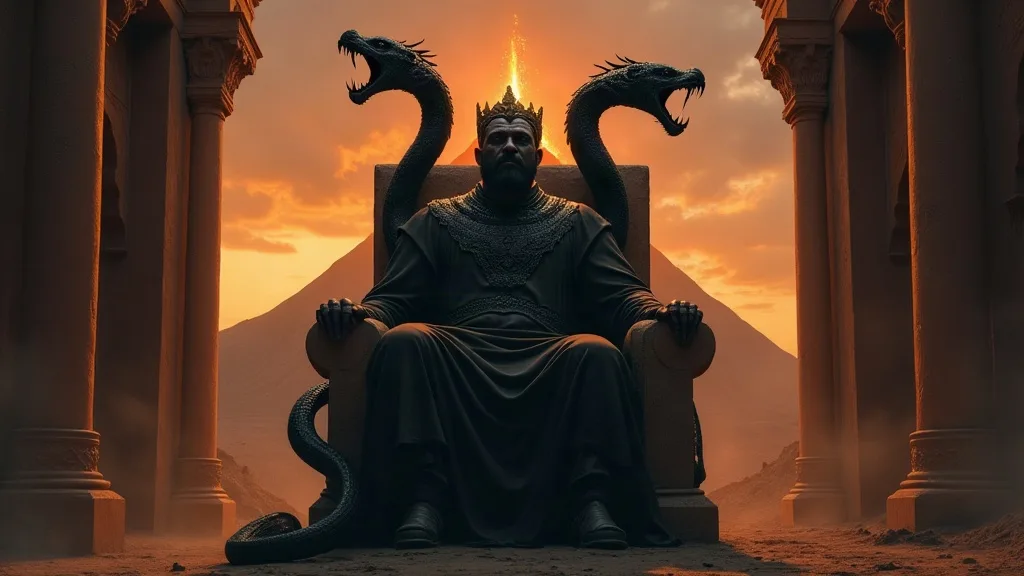
Zahhak: The Serpent King and Tyrant of Iranian Myth
Zahhak, the serpent-shouldered tyrant of Persian myth, ruled for a thousand years on human brains. His story from the Shahnameh is one of history's great parables of power corrupted.
Contents
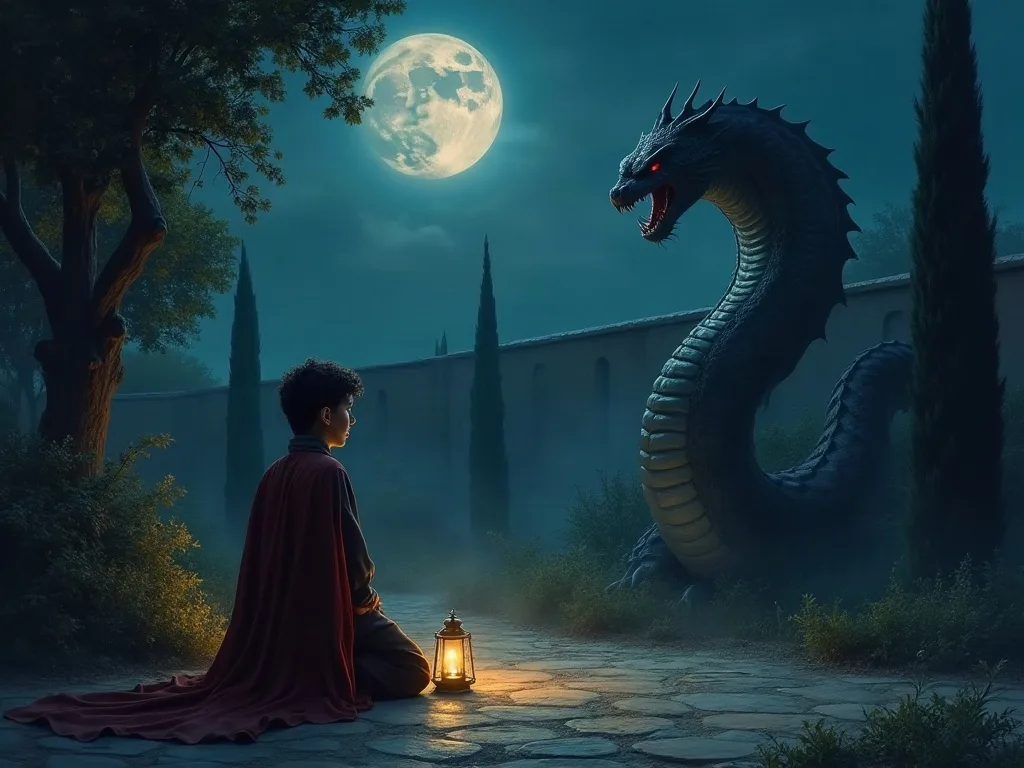
A young prince kneels in a garden. The ground opens. From the earth rises a figure that calls itself a friend, a counselor, a guide. It asks for one kiss on each of the prince's shoulders. The prince agrees. And from those two shoulders, two black serpents grow, writhing, hungry, impossible to remove.
That is how Zahhak, the great tyrant of Persian mythology, receives his curse. Not through violence. Not through war. Through pride, through the slow seduction of a beautiful lie, through one foolish deal with a devil in disguise. The serpents will never leave him. They will eat human brains every night until the end of his thousand-year reign. And all of Iran will bleed for it.
The myth of Zahhak, the Serpent King, is one of the oldest and most psychologically rich stories in Iranian tradition. It sits at the center of the Shahnameh (the "Book of Kings"), the epic poem composed by the poet Ferdowsi around 1010 CE that gathered Persian myth, legend, and history into a single monumental narrative. But the roots of Zahhak go far deeper, into ancient Avestan scripture and the religious cosmology of Zoroastrianism. This is not a simple monster story. It is a study of how power corrupts, how tyranny takes root, and how ordinary people survive under kings who have lost their humanity.
From Blessed Prince to Devil's Instrument: Zahhak's Origins
Zahhak does not begin as a monster. The Shahnameh introduces him as Mardas's son, a young Arab nobleman called Mardas (or Mehrdad in some variants), born into a good family, possessing courage and a certain natural generosity. Ferdowsi takes care to show us the man before the curse.
The devil, named Iblis in the Islamic-inflected retelling within the Shahnameh but rooted in the older Zoroastrian figure of Ahriman (the supreme principle of evil and chaos), comes to Zahhak in disguise. First he flatters. Then he engineers the murder of Zahhak's virtuous father, Mardas, a man so pious he rose every dawn to pray. Iblis persuades Zahhak to dig a pit in the garden where his father walked each morning. Mardas falls in and dies.
That first sin opens the door to the second. Iblis returns, now posing as a gifted cook. He prepares elaborate, beautiful meals for Zahhak over several days, gradually introducing meat into what had been a purely plant-based royal diet, corrupting the king's tastes by degrees. It is a detail that reads almost clinically: the way moral drift works incrementally, each step small enough to seem harmless.
When Zahhak offers Iblis any gift he chooses, the devil asks only to kiss both his shoulders. The kiss plants something. Two serpents burst from the skin. Every physician who tries to remove them fails. Every solution that seems clever makes things worse. Iblis appears once more, this time as a doctor, and gives the one piece of advice that seals Iran's fate: the serpents can only be quieted by feeding them the fresh brains of young men, two per night.
Zahhak does not refuse. He cannot refuse. The serpents are part of him now.
A Thousand-Year Reign of Terror: The Shape of Zahhak's Tyranny
What follows in the Shahnameh is a portrait of long, grinding oppression rather than spectacular violence. Ferdowsi is careful here. Zahhak's tyranny does not announce itself with thunderclaps. It settles in slowly, the way cold does.
Two young men are taken from their families every night. Their brains are served to the serpents. Occasionally, compassionate royal servants substitute sheep brains for human, and smuggle the spared boys out to hide in the mountains. The Shahnameh says that from these hidden survivors, the Kurdish people descended, a claim that modern readers read as mythological origin-making rather than history, but which shows how the story was woven into Iranian ethnic memory.
Zahhak sits on the throne of Iran for one thousand years. He is depicted as physically powerful, not without intelligence, and capable of a kind of personal charisma. He is not a screaming brute. He is something more unsettling: a ruler who has handed his agency to an external evil and now simply maintains a system that perpetuates horror.
In the older Avestan texts, especially the Vendidad (one of the sacred books of Zoroastrianism, concerned with purity laws and the forces of darkness), Zahhak appears under his Avestan name Azi Dahaka, meaning roughly "the biting serpent." The Azi root links him directly to the serpentine: he is, at his origin, a dragon-king, a creature of the lie (Druj in Avestan, the cosmic principle opposed to truth). The Zoroastrian texts frame him not primarily as a human corrupted but as one of Ahriman's key agents across cosmic history.
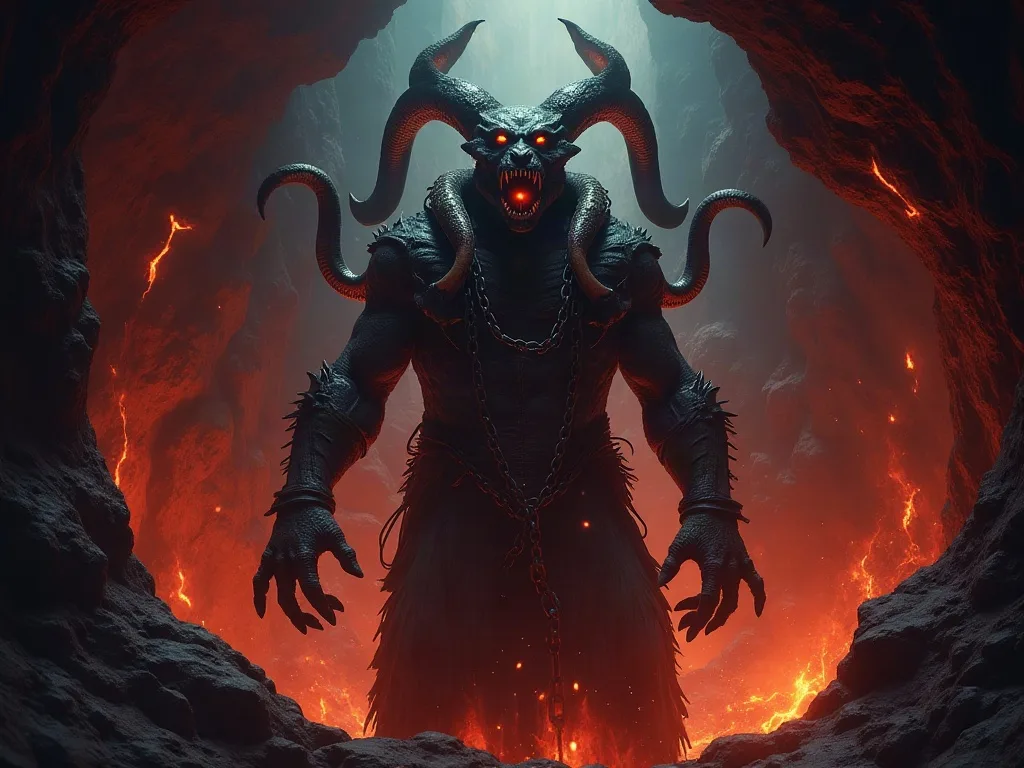
The Bundahishn, a Zoroastrian cosmological text compiled in the 9th century CE from much older oral traditions, adds a further layer: Azi Dahaka was chained rather than killed at the end of his reign, imprisoned inside the volcanic mountain Damavand in northern Iran, where he still writhes, and where he will one day break free at the end of time, before being finally slain.
Kaveh the Blacksmith: When Ordinary People Refuse to Break
The story's moral heart is not Zahhak himself. It belongs to Kaveh the Blacksmith, one of the most vivid and beloved figures in all of Persian mythology.
Kaveh is not a hero-king. He is not a warrior or a priest. He is a craftsman. When his sons are taken to feed the serpents, he does what no one else has dared: he walks into Zahhak's court and speaks. He shouts, actually. He complains publicly, in the presence of the king's courtiers, that his children have been taken unjustly. He does not bow and negotiate. He protests.
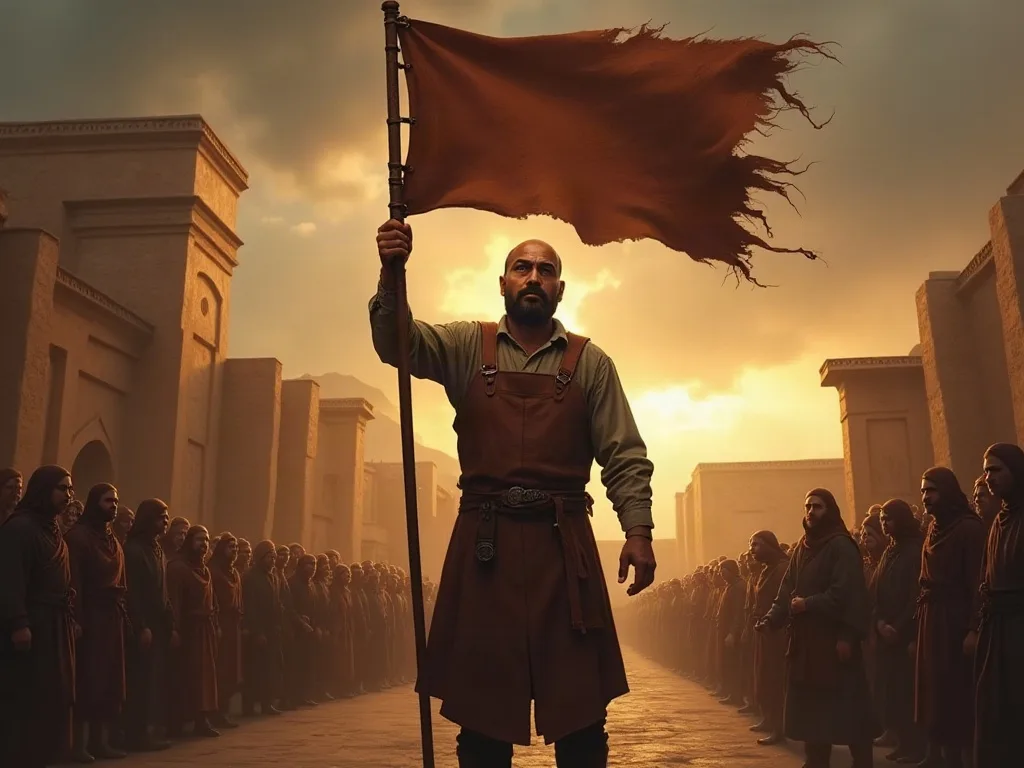
Zahhak, perhaps startled, perhaps playing some game of public image, releases Kaveh's sons. He then asks Kaveh to sign a document declaring that the king's rule is just and good. Kaveh signs under coercion. Then he walks out of the palace, tears the paper to pieces, ties his leather apron to a pole, and raises it as a battle standard.
That apron on a pole becomes Derafsh Kaviani, the "Banner of Kaveh," which will later be elaborated in the Shahnameh into a magnificent jeweled standard that serves as the royal flag of all just kings of Iran. It is a stunning image: a working man's work-stained leather, the ordinary material of daily labor, transformed into the symbol of legitimate authority over a thousand years of imperial mythology.
Kaveh marches to find Fereydun, the young prince who is Zahhak's destined defeater, hidden in the mountains and raised in secret since birth because prophecy had marked him for this purpose. The detail is deliberate. Fereydun needs a popular uprising to legitimize him. Kaveh provides it.
Read about comparable figures of divine opposition in Norse mythology
Fereydun and the Defeat That Is Not a Death
Fereydun is one of the most important royal figures in the Persian legendary cycle. He represents the khvarenah, the divine royal glory (a Zoroastrian concept meaning the sacred aura of legitimate kingship), temporarily stolen from Iran by Zahhak's usurpation and now returning.
His campaign against Zahhak is deliberately presented as almost cosmically inevitable. Fereydun is guided by angels, trained in secret, backed by the righteous anger of ordinary people. When the two forces finally meet, Zahhak is defeated not through spectacular magic but through a combination of military force and the accumulated moral weight of a thousand years of injustice.
Here the Shahnameh makes a crucial choice. Ferdowsi does not kill Zahhak. Fereydun chains him inside Mount Damavand, the great volcanic peak visible from Tehran, which stands at 5,610 meters and remains the highest peak in the Middle East. The mountain becomes a prison.
Why not execute him? The Shahnameh gives a direct answer: an angel appears to Fereydun mid-battle and tells him not to shed Zahhak's blood on the earth, lest the pollution spread. But the mythological logic runs deeper. Zahhak cannot die because the evil he represents cannot be permanently destroyed, only contained. He is chained, not killed. And the mountain shudders.
This is where the Bundahishn and later Zoroastrian eschatology pick up the thread: at the end of the final cosmic age, when Ahriman makes his last assault on creation, Zahhak will break free from Damavand, devour one third of humanity's livestock and one third of humanity itself before being finally slain by the hero Garshasp or, in some versions, by Sam or Tur. The serpent-king is a wound in the world that keeps reopening.
Explore the myth of cosmic evil in Zoroastrian tradition
The Serpents as Symbol: What Zahhak's Shoulders Mean
The two serpents growing from the shoulders of Zahhak have attracted centuries of interpretation. They are not random imagery. In Iranian mythological vocabulary, the serpent is deeply ambivalent. Certain serpent figures are protective, associated with fravashi (guardian spirits). The serpents of Zahhak are specifically and repeatedly linked to the lie, to Druj, to the cosmic enemy of truth.
Several symbolic readings coexist naturally:
- Political corruption as physical deformity. The serpents make visible what tyranny does to a ruler internally. A king who feeds on his people literally grows predators from his body.
- Appetite that cannot be satisfied. Two serpents, two brains per night, an appetite that grows rather than diminishing. The myth models addiction and compulsion with uncomfortable precision.
- The body overtaken by external will. Zahhak does not control the serpents. They control him. He is not their master but their host. This is how the Shahnameh depicts the relationship between a weak individual and the evil that inhabits them.
- Duality of destructive forces. Some scholars, including Mary Boyce in her foundational work on Zoroastrianism, have noted that the two serpents may echo the dualistic structure of Zoroastrian theology itself: two forces, one for truth and one for the lie, locked in permanent tension.
The image is ancient enough that parallels have been traced to Mesopotamian iconography of dragon-kings and to the Vedic Ahi Budhnya, a deep-water serpent figure in early Hindu cosmology. The connection is not accidental. Iranian and Vedic traditions share Indo-Iranian roots, and serpent-kings appear across that entire cultural band.
Compare serpent symbolism in Hindu cosmology with figures like Vritra
Azi Dahaka in the Avestan Sources: Older Than the Shahnameh
The Shahnameh version of Zahhak is already a synthesis. Ferdowsi was drawing on centuries of older oral tradition and written Zoroastrian scripture when he composed his poem around 1010 CE. The older sources show a creature even more elemental.
In the Avesta (the collected sacred texts of Zoroastrianism, the oldest portions of which may date to 1200-1000 BCE), Azi Dahaka appears in the Yasht hymns, particularly Zamyad Yasht (Yasht 19), which catalogs the beings who sought the divine glory, khvarenah, and failed to seize it. Azi Dahaka is among those who chase and cannot catch the glory, because legitimate kingship cannot be held by the corrupt.
The Vendidad, specifically Fargard 2, describes how Yima (the mythological first great king of Iran, roughly equivalent in structure to the Norse Ymir or the Vedic Yama) loses the divine glory through a single act of falsehood, and the age of misrule that follows is associated with Azi Dahaka's ascent. Yima's fall and Azi Dahaka's rise are two movements of the same catastrophe.
The Bundahishn, compiled in Middle Persian around the 9th century CE but transmitting much older material, specifies that Azi Dahaka (under the Middle Persian form Azdahag) was created by Ahriman specifically to destroy good creation. He has three heads in some versions of this cosmology, an image shared with dragons across Eurasian tradition, from the Slavic Zmey to the Greek Hydra.
The three-headed form does not dominate the Shahnameh, where Ferdowsi focuses instead on the two serpents as the more psychologically nuanced image. But the older three-headed Azi Dahaka tells us something important: before he became a literary figure of political tyranny, he was a cosmic monster, a force of universal destruction.
Zahhak in Persian Art, Poetry, and Living Memory
The figure of Zahhak never settled into pure antiquity. He remained an active cultural reference across Iranian history.
Miniature paintings from the Timurid and Safavid periods (roughly 14th through 17th centuries CE) frequently illustrated Shahnameh manuscripts with images of Zahhak enthroned, the serpents vivid and coiling, the court around him frozen in the specific horror of normalised atrocity. The finest of these manuscripts are now held in institutions including the Freer Gallery in Washington DC, the Bodleian Library in Oxford, and the British Library in London.
Persian poets after Ferdowsi returned repeatedly to Zahhak as a byword for unjust rule. When Iranian writers and poets needed a shorthand for a king who had surrendered his humanity to feed an insatiable appetite for power, the name Zahhak arrived automatically, without need for explanation.
In more recent Iranian history, the image acquired specific political charge during the 20th century. Scholars and critics have noted that during periods of authoritarian rule, Iranian intellectuals invoked Zahhak in literature, poetry, and theater as a permitted way of criticizing illegitimate power. The myth functioned as protective code: everyone understood, the censors could not easily prosecute an author for citing a 1000-year-old poem.
Mount Damavand itself, the volcano where Zahhak sleeps, remains central to Iranian national imagery. The mountain appears on the 10,000 rial banknote and in countless poems and paintings. It is impossible to look at Damavand and not think, in Iranian cultural memory, of what sleeps inside it.
Frequently asked questions about Zahhak and Iranian serpent mythology
Frequently asked questions
What is the original source for the myth of Zahhak?
The most complete literary version appears in Ferdowsi's Shahnameh, completed around 1010 CE. But Zahhak's origins are much older, traceable to the Avestan figure of Azi Dahaka in Zoroastrian scripture, including the Vendidad and the Zamyad Yasht, texts whose oral roots may reach back to 1200-1000 BCE.
Why do serpents grow from Zahhak's shoulders?
Iblis, the devil figure in the Shahnameh, plants the serpents through a kiss on each shoulder after Zahhak agrees to the bargain. The serpents symbolize the corruption Zahhak has already invited through patricide and moral compromise. They are externalized evil, now literally embedded in his body and controlling his actions.
Who defeats Zahhak and how?
The hero Fereydun, supported by the popular uprising led by Kaveh the Blacksmith, defeats Zahhak in battle. Crucially, Fereydun does not kill him. An angel warns against spilling Zahhak's blood on the earth. Instead, Fereydun chains Zahhak inside Mount Damavand, the great volcanic peak in northern Iran, where according to Zoroastrian eschatology he remains imprisoned until the end of time.
Is Zahhak connected to any real historical figure?
No direct historical identification has been established. Some early 20th-century scholars proposed connections to foreign rulers who dominated Iran in prehistory, but modern Iranian studies scholarship does not support a specific historical identification. Zahhak functions as a mythological archetype of tyranny rather than a disguised biography.
What role does Kaveh the Blacksmith play in the story?
Kaveh is the ordinary citizen who refuses to accept tyranny as normal. When his sons are taken to feed Zahhak's serpents, he protests publicly in the royal court, tears up the document endorsing the king's rule, and raises his leather apron as a battle standard. That apron becomes the Derafsh Kaviani, the legendary banner of legitimate Persian kingship. Kaveh represents the moral authority that common people hold over corrupt rulers.
Does Zahhak appear in Zoroastrian end-times prophecy?
Yes. The Bundahishn and related Zoroastrian eschatological texts describe Zahhak (as Azdahag) breaking free from Damavand at the end of the final cosmic age, wreaking massive destruction before being slain by a hero. He is one of Ahriman's key weapons in the last assault on creation, which makes his imprisonment inside the mountain a cosmic holding action rather than a permanent solution.
The Wound That Does Not Close: Zahhak's Place in Living Myth
Mount Damavand has not erupted in recorded history, though volcanologists classify it as dormant rather than extinct. Its fumaroles still release sulfurous gases. Iranians living near it have always known that something stirs beneath the summit.
The Shahnameh closes the Zahhak episode by restoring righteous kingship under Fereydun, and later under Kay Khusrow and the other great kings of the legendary cycle. But Ferdowsi does not claim the problem is solved. Zahhak is chained, not destroyed. The evil that he embodies, the seduction of comfortable compromise, the appetite that grows as it is fed, the willingness to accept atrocity as routine administration, none of that disappears from the human world when Fereydun wins.
Scholars including Shahrokh Meskoob, in his influential essays on Iranian national identity, have argued that Zahhak is the Shahnameh's most enduring figure precisely because he is the most honest. He shows what happens when a society normalizes injustice one small step at a time, when court officials sign documents endorsing what they know to be false, when parents learn to hide their children from the state. The myth does not require a supernatural frame to land hard.
The serpents on Zahhak's shoulders have been painted, carved, woven into carpets, and written into political pamphlets across fourteen centuries of Iranian cultural production. They appeared in Safavid miniatures, in 20th-century prison poems, in contemporary graphic novels published in Tehran. The image keeps finding new hosts because the problem it names keeps finding new forms.
Ferdowsi understood this. He wrote the Shahnameh during a period of political instability and foreign pressure on Iranian cultural identity. Zahhak, the Arab-born king who destroys Iran's golden age, carried specific resonances for a 10th-century Persian audience. But Ferdowsi was too careful a poet to reduce the myth to polemic. Zahhak starts as one of us. He is seduced. He compromises. He feeds the hunger that grows from his own body. The monster does not arrive from outside. It grows in.
That is why the mountain keeps its prisoner. And why the fumaroles still smoke.
Read the full book
Want the whole story?
The complete edition is an instant PDF download here, with a paperback on Amazon for selected titles.
Persian
The Persian Mythology Book: Ahura Mazda, Ahriman, Mithra, and the Cosmic Dualism That Shaped Three Religions
From the Avesta to Ferdowsi's Shahnameh
The Zoroastrian cosmos of light against darkness, the Amesha Spentas, the hero Rostam, and the Shahnameh epic that preserved pre-Islamic Iran in verse.
More from Persian
All articles
Persian
Anahita: The Persian Goddess of Waters and Fertility
Anahita, the Persian goddess of waters and fertility, ruled over rivers, healing, and the cycle of life itself. Revered for millennia across the Zoroastrian world, her story reveals how water became sacred, and how a goddess shaped the spiritual landscape of Persia, Anatolia, and beyond.

Persian
The Avesta: Sacred Texts of Zoroastrianism and Ancient Persian Religion
The Avesta is the religious scripture of Zoroastrianism, containing hymns, prayers, and law from ancient Persia. Discover how this 3,000-year-old text shaped Western religion and philosophy.
Persian
The Faravahar: The Winged Symbol of Zoroastrianism
The Faravahar appears across Zoroastrian art, temples, and personal devotion as a winged figure hovering between realms. This ancient Persian symbol encodes the faith's core belief: that each human spirit carries divine potential and cosmic choice. Discover what this icon reveals about the battle between good and evil.
Persian
Ahriman (Angra Mainyu): The Destructive Spirit of Persian Mythology
Ahriman (Angra Mainyu in Avestan) is the cosmic principle of destruction, decay, and evil in Persian Zoroastrianism. Eternal rival of Ahura Mazda, he embodies chaos itself and shapes the central spiritual conflict of humanity's purpose.