
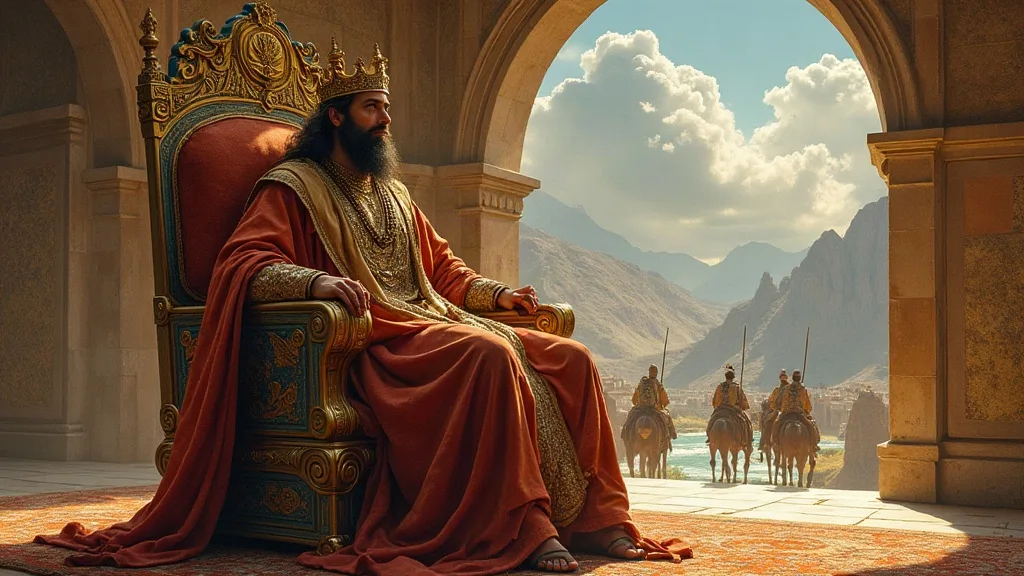
The Shahnameh: Iran's Epic Book of Kings
The Shahnameh is the world's longest poem and Iran's national epic, a 50,000-verse masterpiece written by Firdawsi around 1000 CE that weaves together mythology, legend, and history into a seamless narrative of Persian kingship across 3,000 years.
Contents
Firdawsi sat in a library in Tus, a city in northeastern Persia, and began to write. He was an old man by then, possibly over seventy, and he had committed himself to a task that would consume the last decades of his life: to tell the story of Persian kings from the creation of the world until the Arab conquest of the 7th century CE. He would write in the Persian language, not in Arabic, and he would make that language sing. The result, completed around 1010 CE, became the Shahnameh, or "Book of Kings," the longest poem ever written in any language and the spiritual foundation of Persian culture.
For over a thousand years, the Shahnameh has stood at the center of how Iranians understand themselves. It is mythology, history, and poetry woven so tightly that no reader can separate them. Kings become legendary heroes; demons and sorcerers test the virtue of men; gods and mortals walk the same earth. The epic names kings and battles, traces the descent of royal lines, records the rise and fall of dynasties. Yet it also speaks of love, honor, friendship, betrayal, and the weight of duty that crushes even the greatest men.
The Poet and His Ambition
Firdawsi was not the first to dream of composing a complete history of Persian kings. Prose versions existed. A Sassanid (ancient Persian) text called the Khvatay-namak, meaning "Book of Kings," had been translated from Pahlavi into Arabic. When Firdawsi's patron, the Turkic ruler Mahmud of Ghazni, asked him to create a poem based on these sources, Firdawsi saw his chance to do something no one had done: to write the entire chronicle in verse, in the Persian tongue, with such artistry that it would outlive all prose versions.
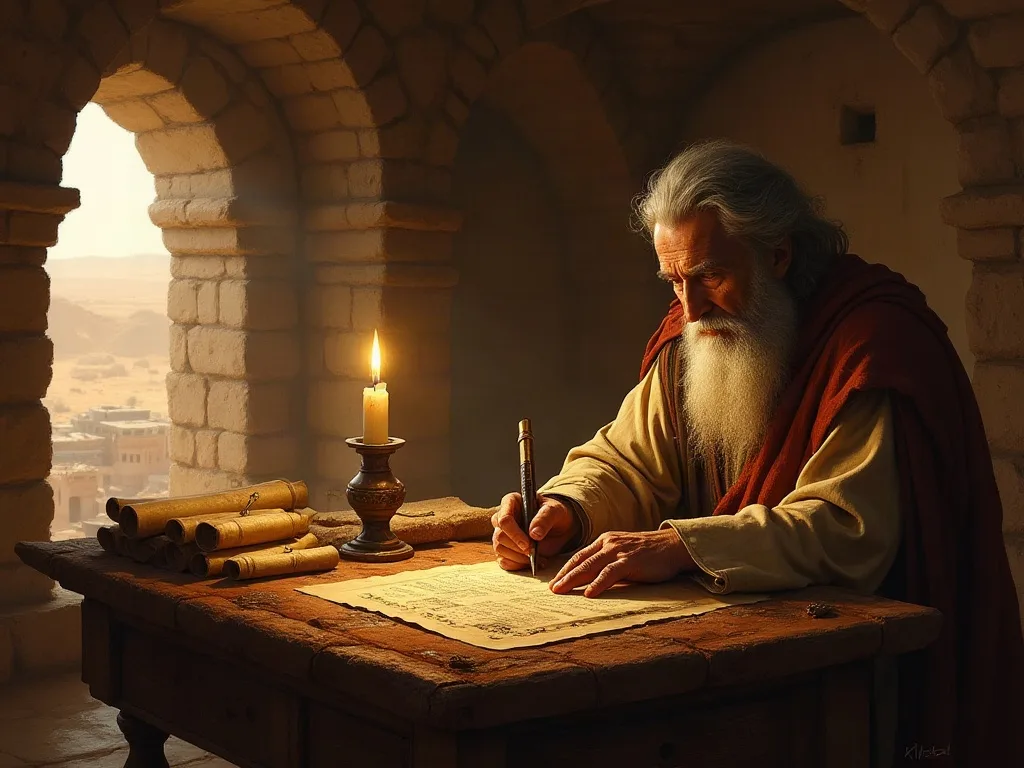
The ambition was staggering. The Shahnameh contains roughly 50,000 verses (called couplets, or bayt in Persian, each line a self-contained unit). To put that in scale: Homer's Iliad is about 15,500 verses. The Odyssey is roughly 12,000. Dante's Divine Comedy is around 14,000. Firdawsi's epic is three times longer than either Homer. He composed in a musical meter called mutaqarib, which moves like a heartbeat, two long syllables followed by one short, over and over. Readers did not just read the Shahnameh; they chanted it, and its rhythm became embedded in the Persian soul the way Shakespeare's lines live in English ears.
Firdawsi worked for decades. Court historians argue over the exact timeline, but most place his labor between roughly 975 and 1010 CE. He was supported financially by Mahmud, though the relationship grew complex and eventually fractious. The poet died around 1020 CE, and his tomb in Tus became a pilgrimage site. Centuries later, Iranians still visit it. For them, Firdawsi is not a dead writer; he is the man who saved Persian identity when the empire fell.
The Three Ages: Mythical, Legendary, and Historical
The Shahnameh divides into three broad movements, each with its own tone and world. Understanding this structure is key to grasping why the epic has mattered so deeply to Iranians.
The Mythical Age: Gods, Giants, and the First Kings
The poem opens not with a king but with the creation itself. Firdawsi inherited a version of Zoroastrian cosmology, the ancient Persian religion that sees the universe as a battleground between Ahura Mazda, the wise god of light, and Ahriman, the destructive spirit of darkness. But he softens the theology into myth. The world is created; the first humans emerge; the great spirit Spenta Mainyu (Beneficial Spirit) watches over them.
The first age is populated by figures who are half-divine, half-human. Gayomarth (Gaya Maretan in Zoroastrian texts) is the first man, a figure of such radiance that light streams from his body. When he dies, a plant grows from his body from which emerge the first human couple, Mashya and Mashyana. They eat the fruit of the haoma plant (in Persian lore, a sacred plant of immortality) and lose their innocence; the poem's first sexual shame, the first fall into human limitation.
Then come the kings of the mythical age. Hushyar rules with justice. Tahmurath tames the divs, the demons and giants who plague the land, and learns the secrets of sorcery from them. Jamshid, the most glorious of all the early kings, builds cities, invents the crafts, and becomes so powerful that he declares himself divine. For this hubris, he falls. A tyrant named Zahhak, a demon-king with snakes growing from his shoulders that must be fed human brains each day, conquers him. The Persian hero Feridun eventually defeats Zahhak, divides the empire among his three sons, and restores order.
This mythical section unfolds like a dream. Time is not measured in years but in the reign of princes. Geography is vast and symbolic. Mountains tower; deserts stretch; rivers run through the land like the lifeblood of civilization. The Shahnameh never quite tells us how long Jamshid ruled or how old he was when he died. What matters is that he ruled well, then grew arrogant, then fell. The moral cycle repeats.
The Legendary Age: The Kaianid Dynasty and the Great Heroes
From the mythical age emerges the legendary age, and with it the most beloved section of the Shahnameh: the Kaianid dynasty and the cycle of wars between Persia and Turan (the lands to the north, often identified with the Steppe peoples or Turkic tribes).
The rivalry between Persia (Iran) and Turan forms the emotional heart of the epic. It is not merely a political conflict; it is a clash between civilization and chaos, between order and wildness. The great Persian kings of this age are Kay Kavus, Kay Khosrow, and most famously, the warrior-king Rustam, who fights for Persia across generations.
Rustam is the superhero of the Shahnameh. He is born the son of Zal, a human king, and a magical demon-princess, which gives him supernatural strength. His father Zal was himself raised by the Simurgh, a mythical bird-creature of enormous wisdom and power, who appears throughout the epic as a guardian and healer. Rustam grows into a warrior of such prowess that he defeats legendary adversaries single-handedly: demons, kings, monsters.
The most celebrated episode is Rustam's battle with Afrasyab, the king of Turan. Their armies clash in vast battles that devastate the land. Rustam cuts down Afrasyab's champions one by one. In another famous cycle, he must complete seven labors (echoing the Heracles legend from Greek mythology) to rescue Kay Khosrow, the rightful Persian king, from the land of demons. Each labor is a trial: he fights a white demon, a black lion, a sorcerer's daughter, a dragon, a terrible wind, and more.
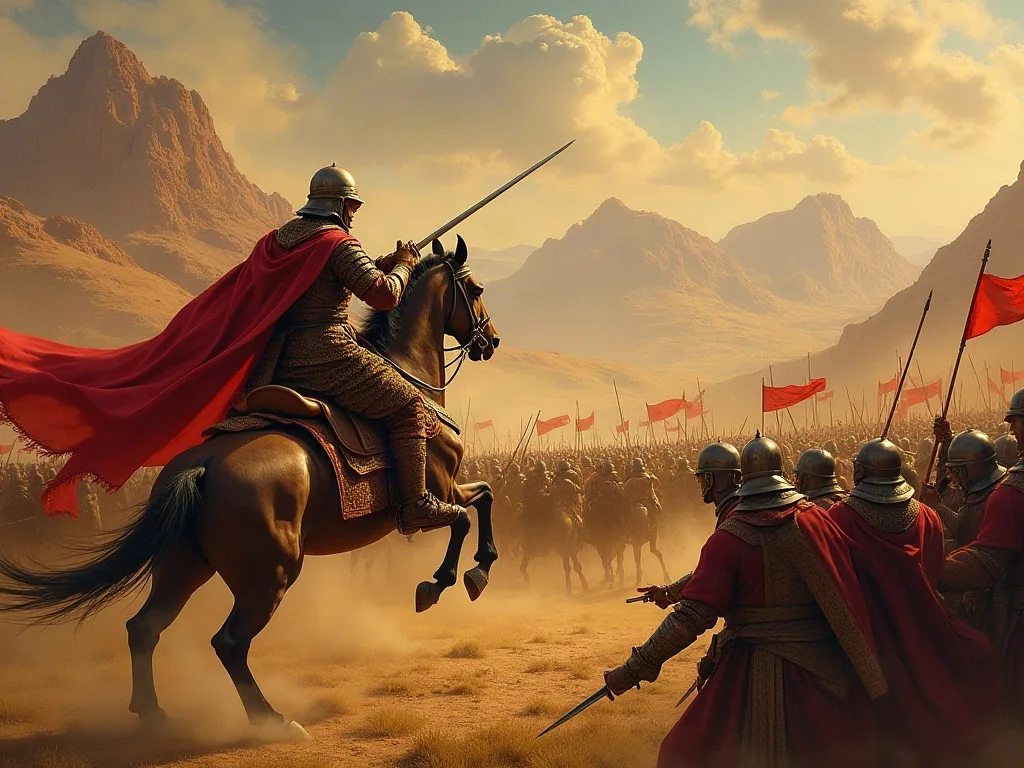
But the Shahnameh is not a simple tale of heroes winning. Rustam's greatest achievement also brings him his deepest sorrow. He has a son named Sohrab by a princess of Turan. Separated by war, Rustam does not know his own son exists. When Sohrab grows to manhood and leads a Turanian army against Persia, Rustam meets him in single combat. The two fight to exhaustion, and Rustam finally strikes the killing blow. Only then does Sohrab reveal his identity. Rustam, grief-stricken, carries his dying son's body off the battlefield. The episode is one of the great tragedies of world literature: a man's own hand brings down his own bloodline. It is a portrait of the cost of war that feels contemporary even today.
The legendary age is filled with such moments: glory and collapse intertwined. Kings fall in love with mortal women or demon-princesses and produce heroes and monsters. Friendship bonds (like the famous love between the warriors Giv and Gudarz) are tested by loyalty to dynasty. Magic and realism blur. A king's dream foretells his doom; a magical ring grants wishes; sorcerers wage war alongside armies; the Simurgh heals wounds that should be fatal.
The Historical Age: The Sassanid Kings and the Arab Conquest
As the Shahnameh progresses, the mythical fades and the historical grows stronger. The later Kaianid kings give way to the Ashkanid and then the Sassanid dynasties (roughly 247 BCE to 651 CE in real history, though the epic compresses and idealizes them). The later sections of the poem read more like chronicle, though they retain the elevated language and occasional magical episodes of the earlier parts.
The final chapters of the Shahnameh recount the fall of the last Sassanid king, Yazdegerd III, to the Arab conquest in the 7th century CE. For Firdawsi's audience, this was not ancient history; it was the trauma that had ended their empire and brought Islamic rule. The poet handles it with dignity and sorrow. Yazdegerd fights bravely but is defeated. His generals, including the legendary Rostam Farrokhzad (descendant of the ancient Rustam), make their last stands. In the end, the Arab armies sweep across Persia, and the Sassanid state collapses.
Firdawsi does not portray this as simple tragedy, nor does he demonize the Arabs. Rather, he presents it as the inevitable end of a cycle. Kings rise and fall. Dynasties have their time and then pass. The Shahnameh is fundamentally about the wheel of fate turning, about how even the mightiest empires are subject to time's flow.
The Living Language of the Poem
What makes the Shahnameh extraordinary is not just its scope but its language. Firdawsi wrote in Middle Persian (the vernacular Persian of his time, called Farsi), deliberately choosing not to write in Arabic, which was the prestige language of the Islamic courts. This was a political act. By writing in Persian, Firdawsi asserted that Persian culture was alive, that the Persian language could express everything Greek or Arabic could express, and that the memory of pre-Islamic Persia was worth preserving.
His vocabulary draws from older Persian sources but makes them vivid and immediate. He uses metaphor and simile constantly. Armies are described as seas or deserts in motion. Kings glow like suns. Demons are black as night or red as blood. A moment of grief is rendered in just a few lines: a parent learns that their child has fallen in battle, and the response is not elaborate mourning but a stunning silence, then a question: "Who will rule now?"
The Shahnameh was designed to be chanted aloud. Courts would hire professional reciters (meddahs) to perform sections of the poem over the course of evenings or days. A single episode might take hours to chant. The rhythm of the verse, the music of the rhymes, the way one couplet builds on the last: all of this made the poem memorable, quotable, embedded in memory.
Mythology, History, and the Blurred Line
One of the great questions about the Shahnameh is: how much of it is myth, and how much is history? The honest answer is that Firdawsi himself did not see a clear line.
The mythical kings (Jamshid, Feridun, Zahhak) are figures from Zoroastrian and oral Persian tradition, with no surviving independent historical evidence. Yet Firdawsi presents them as real kings who ruled real kingdoms. The legendary age with Rustam and the wars against Turan blends genuine historical memory (the Sassanid-Parthian conflicts with steppe peoples) with literary invention and folklore. The historical age with the Sassanid kings is rooted in real history, though Firdawsi compresses centuries, invents speeches, and amplifies the drama.
Modern historians treat the Shahnameh as a literary work first, a historical source second. Its value lies not in precise chronology but in how it shows Iranians understood their own past. It preserves Zoroastrian cosmology, pre-Islamic Iranian values (honor, loyalty, kingship), and cultural memory that would otherwise have been lost after the Arab conquest and the slow shift to Islam.
What is certain is that Firdawsi was not making things up from thin air. He worked from prose sources, most notably the Khvatay-namak. He consulted historians and scholars. He reshaped and elevated his sources into poetry, but he did not invent entirely new stories. His genius was in synthesis, organization, and the transformation of prose into unforgettable verse.
The Moral Universe of the Shahnameh
Beneath the battles and the plots, the Shahnameh is guided by a consistent moral philosophy. It is not explicitly religious (though Zoroastrian influence runs through it), but it is deeply ethical.
The poem values justice (dadegi in Persian, related to Ahura Mazda's attribute of wisdom). A king's primary duty is to rule justly, to protect the weak, and to defend the realm from chaos. When a king grows arrogant or unjust, he falls. Jamshid declares himself a god and is dethroned. Another king becomes a tyrant and is overthrown. The pattern never changes.
The poem also values courage and loyalty. Warriors fight to the death rather than flee in shame. Friendships are sacred; betraying a friend is among the worst sins. Yet the poem is not naive about virtue. Heroes make terrible mistakes. Rustam slays his own son. Good men are betrayed by those they trust. The Shahnameh shows that virtue does not guarantee happiness, nor does courage protect against fate. What it does guarantee is honor in the eyes of history and in the memory of those who come after.
There is also a deep vein of melancholy running through the poem. No victory is final. No king's reign is eternal. Even the greatest heroes age and die. Rustam, after decades of defending Persia, is finally killed in his old age by a trick. The message is not nihilistic, but it is clear: life is transient, empires fall, and the best one can hope for is to live with courage and leave a legacy of deeds that will be remembered.
The Shahnameh in Islam and After
When the Shahnameh was completed in the early 11th century, Persia had been under Islamic rule for over three centuries. The poem's celebration of pre-Islamic Persian civilization, its preservation of Zoroastrian ideas, and its use of the Persian language rather than Arabic might have made it controversial. Yet it was accepted, even celebrated, by Islamic courts and scholars.
Several factors explain this. First, Firdawsi's portrayal of the Arab conquest is respectful, not resentful. The poem acknowledges the historical reality without dwelling on it as a catastrophe. Second, the poem's values (justice, kingship, heroism) are universal enough that they could be appreciated by Islamic courts. Muslim kings and courtiers could read the Shahnameh and see models of kingship that applied to their own reigns. Third, and perhaps most important, the poem was seen as a preservation of cultural heritage, not a challenge to Islamic faith. Iranians under Islamic rule could be good Muslims and still take pride in their pre-Islamic past through the Shahnameh.
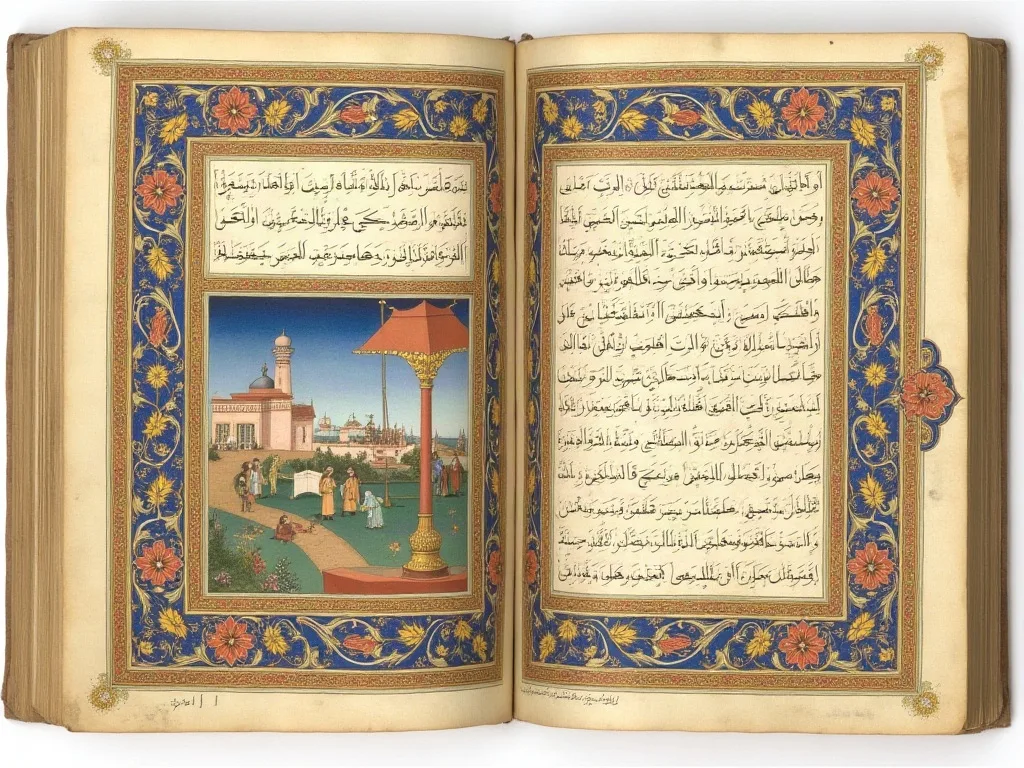
The poem was copied and recopied. Illuminated manuscripts were commissioned by wealthy patrons. In the 14th and 15th centuries, during the Timurid and Safavid periods, some of the most beautiful illustrated manuscripts were created, with miniature paintings depicting scenes from the epic. These manuscripts, many of which survive today, are masterpieces of Persian art.
The Shahnameh was also translated. It spread beyond Persia. Turkish translations appeared. Arabic summaries circulated. In the 19th century, Western scholars discovered it. Jules Mohl translated it into French in the 1870s. Gradually, it became known to European and American audiences, though it never achieved the household-name status of Homer or Dante in the West.
In modern Iran, the Shahnameh remains a work of supreme cultural importance. Children learn about Rustam in school. Politicians and poets quote from it. After the 1979 Islamic Revolution, when many pre-Islamic symbols were treated cautiously, the Shahnameh retained its place as a fundamental text because it is so deeply embedded in Iranian identity that no ideology can displace it. It belongs to Iran the way the Bible belongs to the Christian West, or the Mahabharata to India.
The Epic's Structure and Narrative Technique
Firdawsi organized the Shahnameh into a series of self-contained episodes while maintaining an overall chronological arc from creation to the fall of the Sassanid empire. Each episode (the reign of a king, the cycle of a hero, a war) has its own narrative logic, its own heroes and villains, its own rise and fall. Yet each episode also feeds into the next. A hero's actions have consequences that ripple forward. A king's virtue or vice shapes the fate of his children and grandchildren.
The poem uses a technique of interlocking stories. Within the main narrative of a king's reign, Firdawsi will insert a subordinate tale: a king encounters a stranger and hears the tale of his adventures; a prince is separated from his father and must search for him, meeting many characters along the way who each tell their own stories. This Russian-doll structure keeps the poem moving and allows Firdawsi to explore different themes in different contexts.
The language also shifts subtly depending on context. Battle scenes use shorter, punchier couplets. Moments of reflection or sorrow use longer, more meditative lines. Dialogue can be brisk and witty or elaborate and formal. Firdawsi had perfect control of his meter and used it like a composer uses orchestration.
Echoes in Later Literature and Culture
The Shahnameh influenced literature far beyond Persia. Turkish poets borrowed from it. Indian courts commissioned translations and adaptations. Its stories became part of Islamic literary culture even as they preserved pre-Islamic memories.
In the 19th and 20th centuries, as nationalism grew in Iran, the Shahnameh became a symbol of Iranian identity separate from Islam, or at least as a dimension of Iranian identity that predated Islam. This made it politically important. It was taught in schools as a national epic in the way the Odyssey is taught in Greece or the Divine Comedy in Italy.
The poem has also influenced modern Iranian writers and filmmakers. It appears in contemporary literature, in stage adaptations, in films. The character of Rustam, in particular, has become a figure of modern artistic interest, explored in novels and plays that interrogate what heroism means in the modern world.
The Shahnameh also influenced how Iranians understood themselves after the 1953 CIA-backed coup, after the 1979 revolution, and through the Iran-Iraq War. During times of national trauma, Iranians have returned to the poem to find models of endurance and dignity in the face of historical forces beyond individual control.
Surviving Manuscripts and Textual History
The original manuscript of the Shahnameh written by Firdawsi is lost. However, numerous copies were made over the centuries, and about a thousand manuscripts survive today, ranging from early copies (some from the 11th and 12th centuries) to lavish illuminated versions from the 15th and 16th centuries.
The challenge for modern editors has been to determine which version is closest to what Firdawsi originally wrote. Early manuscripts sometimes differ in the number of verses (ranging from about 35,000 to 60,000 depending on which episodes are included), in the wording of passages, and in which episodes are emphasized. The "standard" version published by the Indian scholar Djalal Shervani in the 1880s-1920s became the reference text for most modern editions, though scholars continue to compare manuscripts and refine their understanding of the original.
Modern Persian, English, and other language translations exist. The most scholarly English translation is by Dick Davis, published in three volumes (2006-2009), which balances fidelity to the original verse structure with readability for modern readers. Others exist as well, each with different strengths in terms of literalness, poetic beauty, or accessibility.
The Shahnameh and Comparative World Epics
When we set the Shahnameh alongside other great epics of the world, it stands out in several ways. Like the Mahabharata of India (which is even longer), it blends mythology, legend, and history into a single narrative. Like Homer's Iliad and Odyssey, it centers on heroic deeds and war, but covers a much longer historical span. Like Dante's Divine Comedy, it is organized around a vision of cosmic order.
What is unique about the Shahnameh is its specific fusion of Persian cosmology, Zoroastrian values, and historical memory into a work that was consciously designed to preserve a culture's sense of itself across a civilizational rupture (the Arab conquest and the shift to Islam). In that way, it is a more overtly political work than Homer, even as it never loses sight of the human and mythological dimensions of its story.
Frequently Asked Questions About the Shahnameh
Frequently asked questions
Who was Firdawsi and why did he write the Shahnameh?
Firdawsi was a Persian poet born around 940 CE in Tus, in northeastern Iran (Khorasan). His patron, the Turkic ruler Mahmud of Ghazni, commissioned him to compose a poetic history of Persian kings based on earlier prose sources. Firdawsi undertook the task to preserve Persian cultural memory and elevate the Persian language itself, writing in the vernacular Persian tongue rather than in Arabic, which was the language of prestige in his era. He spent roughly three decades on the work and died around 1020 CE.
Is the Shahnameh based on real history or is it pure fiction?
It is both and neither in the modern sense. Firdawsi worked from earlier prose sources, including the Khvatay-namak (Book of Kings), which blended historical memory with legend and mythological material. The earliest kings (Jamshid, Feridun, Zahhak) are mythological figures from Zoroastrian and Persian oral tradition. The legendary age with figures like Rustam blends real historical conflicts (Persian-Steppe wars) with folklore and literary invention. The later Sassanid sections are rooted in actual history but compressed and dramatized by Firdawsi. Modern historians treat it as a literary-cultural document more than a reliable historical chronicle, valuable for understanding how Iranians remembered their past rather than for precise facts.
What is the story of Rustam, and why is he so important in Persian culture?
Rustam is the greatest warrior-hero of the Shahnameh, born of a mortal king and a magical princess, and raised by the Simurgh (a mythical bird-creature of wisdom). He spends his long life defending Persia against enemies, completing seven legendary labors, and fighting monsters and demons. His most famous tragedy is his battle with his own son Sohrab, whom he kills in single combat without knowing his identity. The grief of this act defines Rustam's character: he is invincible in battle but not protected against the sorrows of life. Rustam embodies the Persian ideal of the hero: brave, loyal, skilled, but ultimately subject to fate and the limitations of being human. He appears in Persian poetry, art, and culture as the model of heroic virtue.
How long is the Shahnameh and how long does it take to read?
The Shahnameh contains roughly 50,000 couplets (verses), making it the longest poem ever written. In English translation, it typically runs to 3,000-4,000 pages across multiple volumes. Reading it continuously would take weeks; most readers encounter it in selections or chapters. Historically, professional reciters (meddahs) would chant portions over the course of many evenings, and courts would commission the full recitation as a major cultural event. Modern readers typically approach it selectively, reading favorite episodes or complete translations broken into multiple volumes.
What happened to the Shahnameh after the Arab conquest of Persia?
Despite celebrating pre-Islamic Persian civilization and preserving Zoroastrian ideas, the Shahnameh was accepted and celebrated within Islamic Persian culture. The poem treats the Arab conquest with dignity rather than bitterness, its values of justice and kingship were appreciated by Muslim rulers, and it came to be seen as a preservation of cultural heritage rather than a challenge to faith. Over centuries, it was copied and illuminated in beautiful manuscripts, translated into Turkish and other languages, and became the supreme cultural symbol of Persian identity. In modern Iran, it remains a foundational text taught in schools and revered as an expression of the national spirit, transcending religious boundaries.
Are there different versions of the Shahnameh?
Yes. Firdawsi's original manuscript is lost, but about a thousand surviving copies exist from various periods, with some early manuscripts dating to the 11th-12th centuries. These manuscripts vary in length (some with as few as 35,000 verses, others with 60,000+), wording, and which episodes they emphasize. Modern editors have sought to reconstruct the most authentic version based on comparing manuscripts. The standard reference is based on 19th-century scholarship, though modern editors continue to refine understanding. English translations by Dick Davis and others provide modern access, though each translation makes different choices about how to render the poetry and style.
The Shahnameh's Place in Our World
Over a thousand years after Firdawsi completed his work, the Shahnameh remains alive. Every year, Iranians gather on Nowruz (the Persian New Year, around March 21) to celebrate the arrival of spring, and the stories of the Shahnameh are woven into those celebrations. The poem speaks to modern readers not because it describes modern life, but because it explores timeless human questions: What does it mean to be brave? How do we bear the weight of duty? What legacy do we leave? How do we endure when fate turns against us?
The poem also speaks to contemporary Iran in ways that Western epics do not speak to their cultures. The Shahnameh is a document of cultural continuity across rupture. It is a record of a civilization that faced conquest and transformation, and yet persisted in its sense of itself through memory and language. For Iranians, especially those scattered across the diaspora, the Shahnameh is a connection to a past that cannot be taken away, a proof that Persian civilization endured through empires and ideologies, a treasure house of stories and values that remain relevant.
In the West, the Shahnameh is still less well-known than Homer or Dante, but its reputation has grown. Scholars recognize it as one of the great achievements of world literature. Artists, writers, and filmmakers draw from it. And readers who discover it often find themselves captured by its narrative power, its beauty, and its profound meditation on the nature of human life in the face of time's relentless passage.
The Shahnameh is proof that a poem written in the early 11th century by an aging man in a provincial city, working from prose sources, using a meter designed to be chanted aloud, could become immortal. It survived the centuries not because of institutions or academic study, but because people loved it, memorized it, passed it on, cherished it as their own. That is the deepest form of immortality any work can achieve.
Read the full book
Want the whole story?
The complete edition is an instant PDF download here, with a paperback on Amazon for selected titles.
Persian
The Persian Mythology Book: Ahura Mazda, Ahriman, Mithra, and the Cosmic Dualism That Shaped Three Religions
From the Avesta to Ferdowsi's Shahnameh
The Zoroastrian cosmos of light against darkness, the Amesha Spentas, the hero Rostam, and the Shahnameh epic that preserved pre-Islamic Iran in verse.
More from Persian
All articles
Persian
Anahita: The Persian Goddess of Waters and Fertility
Anahita, the Persian goddess of waters and fertility, ruled over rivers, healing, and the cycle of life itself. Revered for millennia across the Zoroastrian world, her story reveals how water became sacred, and how a goddess shaped the spiritual landscape of Persia, Anatolia, and beyond.

Persian
The Avesta: Sacred Texts of Zoroastrianism and Ancient Persian Religion
The Avesta is the religious scripture of Zoroastrianism, containing hymns, prayers, and law from ancient Persia. Discover how this 3,000-year-old text shaped Western religion and philosophy.
Persian
The Faravahar: The Winged Symbol of Zoroastrianism
The Faravahar appears across Zoroastrian art, temples, and personal devotion as a winged figure hovering between realms. This ancient Persian symbol encodes the faith's core belief: that each human spirit carries divine potential and cosmic choice. Discover what this icon reveals about the battle between good and evil.
Persian
Ahriman (Angra Mainyu): The Destructive Spirit of Persian Mythology
Ahriman (Angra Mainyu in Avestan) is the cosmic principle of destruction, decay, and evil in Persian Zoroastrianism. Eternal rival of Ahura Mazda, he embodies chaos itself and shapes the central spiritual conflict of humanity's purpose.