
Ahura Mazda: The Wise Lord and Supreme Deity of Zoroastrianism
Ahura Mazda, the "Wise Lord" of ancient Iran, stands at the center of one of humanity's oldest monotheistic traditions. His conflict with Angra Mainyu shaped Persian cosmology, ethics, and the fate of the soul.
Contents
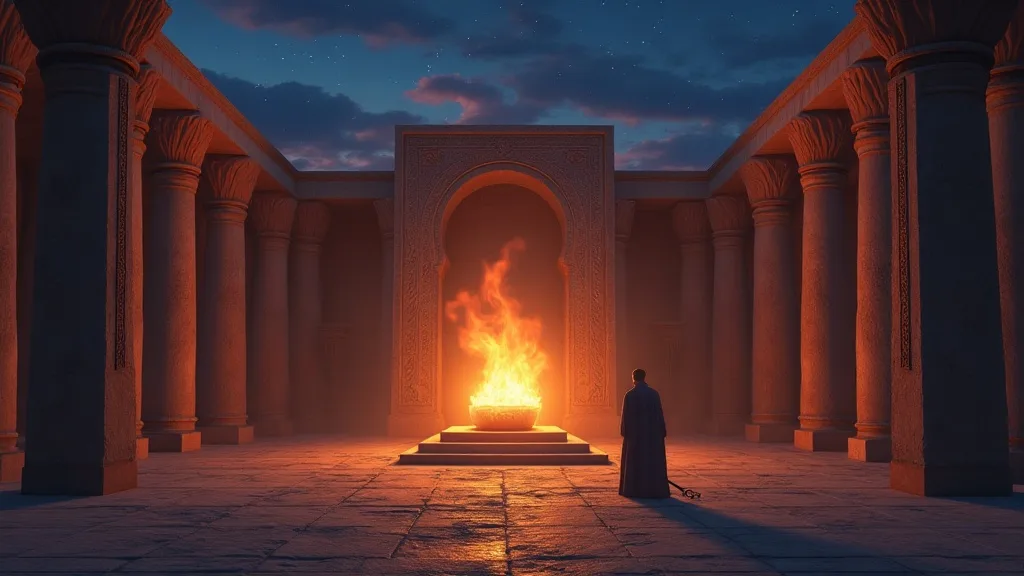
The fire burns without consuming itself. That image, tended in temples across ancient Iran for more than three millennia, points directly to Ahura Mazda - not as a figure of myth alone, but as an active force of truth, light, and moral order pressing against a universe that could, at any moment, slide into chaos.
Zoroaster, the prophet of ancient Iran, heard the voice of the Wise Lord somewhere on the steppe, probably around 1500-1000 BCE by conservative scholarly consensus. He walked away from that encounter with a message so radical it would eventually shape Judaism, Christianity, and Islam in ways those traditions rarely acknowledge. One supreme god. One adversary. A cosmos racing toward a final renovation. The bones of half the world's religious imagination rest inside that framework.
The Name, the Nature, and the First Gathas
Ahura and Mazda are Old Avestan. Ahura means "Lord" and shares a root with the Vedic Sanskrit asura, once a term for a powerful divine being. Mazda means "wisdom" or "mindfulness," from the Proto-Indo-European root connected to Latin mens and English "mind." Put them together and you get "Lord of Wisdom" or "Wise Lord," a name that functions as both a title and a statement of theology.
The oldest texts that mention him are the Gathas, seventeen hymns written in Old Avestan that most scholars attribute directly to Zoroaster himself. In these hymns, Ahura Mazda is addressed as a father, a builder, a craftsman. Zoroaster asks him direct questions: "Who established the path of the sun and of the stars? Who makes the moon wax and wane?" The answers are always the same deity. He holds everything: asha (truth, order, righteousness), vohu mana (good mind), and xshathra (divine power). These are not abstract ideals floating in the cosmos. They are the Amesha Spentas, the six "Holy Immortals" who act as emanations or close attendants of the Wise Lord, each governing a domain of creation.
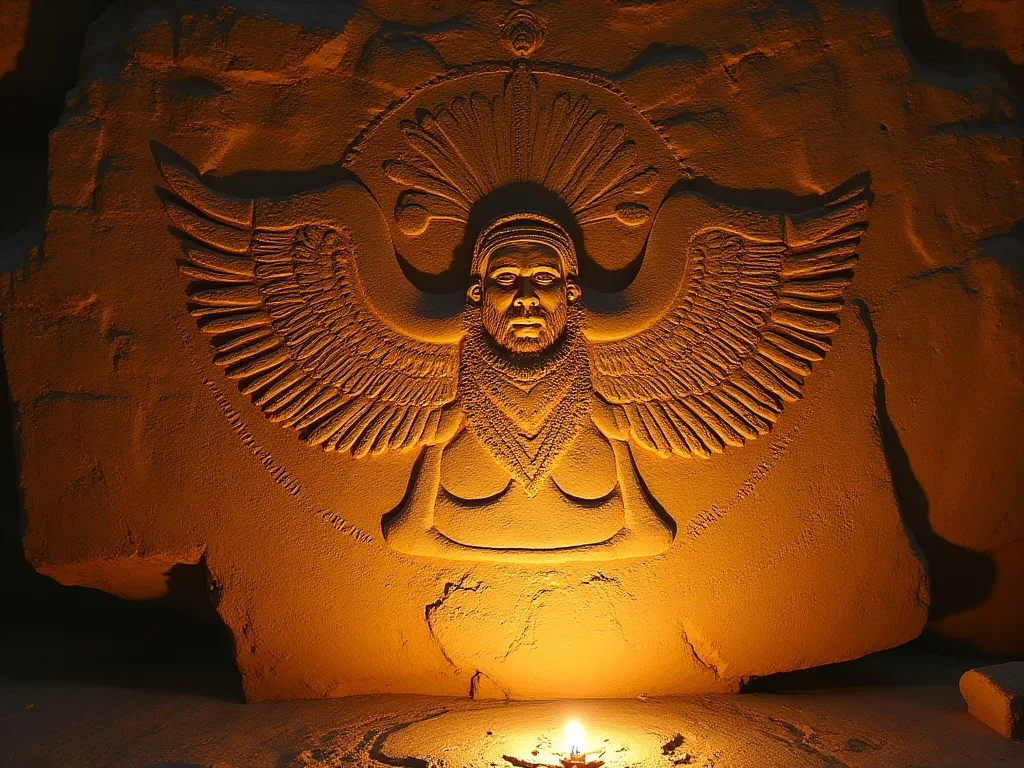
The Younger Avesta, composed centuries after the Gathas, elaborates this portrait. Here Ahura Mazda has a visible symbol: the farohar or faravahar, the winged disc with a bearded male figure at its center. That image was carved into the cliff face at Persepolis, stamped onto the seals of Achaemenid kings, and today still marks Zoroastrian gravesites worldwide.
Ahura Mazda vs. Angra Mainyu: The Cosmic Duel
No portrait of the Wise Lord is complete without his adversary. Angra Mainyu (later called Ahriman in Middle Persian) is the Destructive Spirit, the source of druj - falsehood, corruption, death. The Bundahishn, a ninth-century CE Pahlavi text that systematises earlier oral cosmology, explains the structure of their conflict with almost architectural precision.
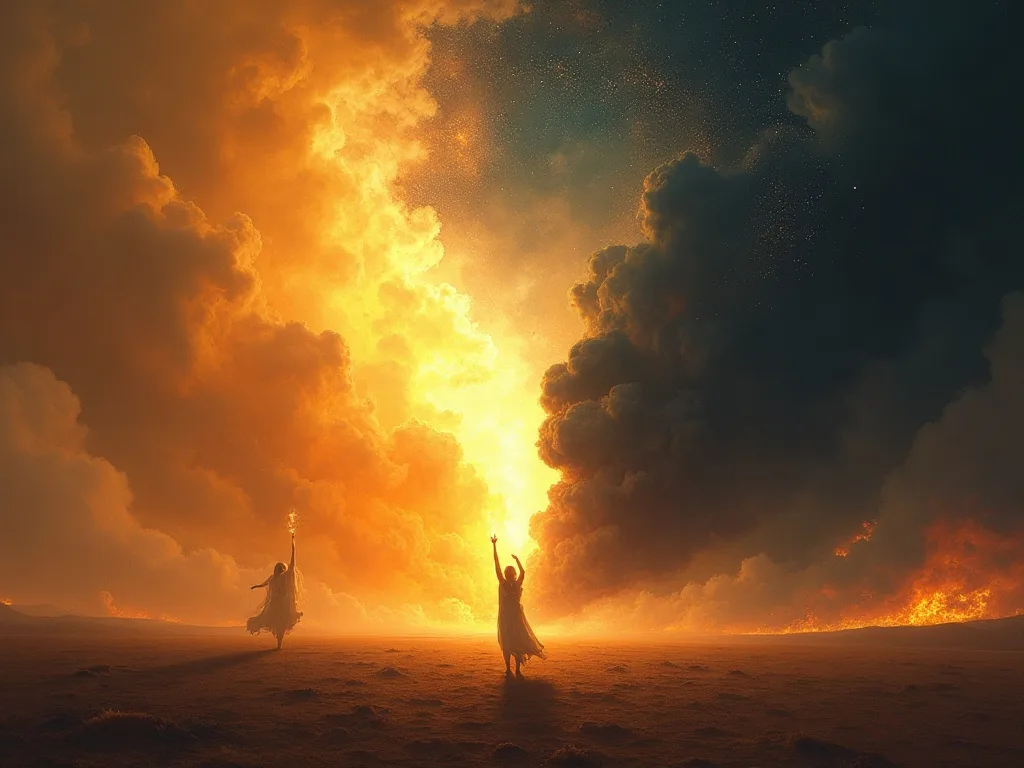
At the beginning, Ahura Mazda and Angra Mainyu both existed. They were not co-equal eternals in most Zoroastrian schools of thought: the Wise Lord preceded, and his adversary arose as a counter-choice, a refusal of truth. The cosmos was created specifically as a battlefield. Ahura Mazda fashioned the sky as an egg of stone, filled it with water, earth, plants, animals, and finally the first human - Gayomartan (Gayomard in later texts). Angra Mainyu attacked each in turn, introducing death, drought, disease, and moral confusion.
Ahura Mazda
- Source of asha: truth, order, cosmic law
- Creator of life, light, and the six Amesha Spentas
- Omniscient; foreknew the outcome of the cosmic conflict
- Associated with fire, the sun, and sacred cattle
- Worshipped through the five daily prayers (Yasna)
- His "weapon" is vohu mana (Good Mind) given to humans
Angra Mainyu
- Source of druj: falsehood, destruction, chaos
- Creator of illness, winter, venomous creatures, and death
- Shortsighted; did not foresee his own defeat
- Associated with darkness, filth, and the daeva demons
- Sustained by lies, violence, and abandonment of ritual
- His "weapon" is doubt and the corruption of thought
The cosmic duel runs across a finite span: nine thousand years, by the reckoning of the Bundahishn, divided into three eras of three thousand years each. The third era is now. At its end comes Frashokereti (Frashegird), the renovation of the universe: evil burns away, the dead resurrect, and Ahura Mazda's creation emerges perfected. This is not an eternal war. The Wise Lord already knows how it ends.
The Amesha Spentas: Ahura Mazda's Six Holy Aspects
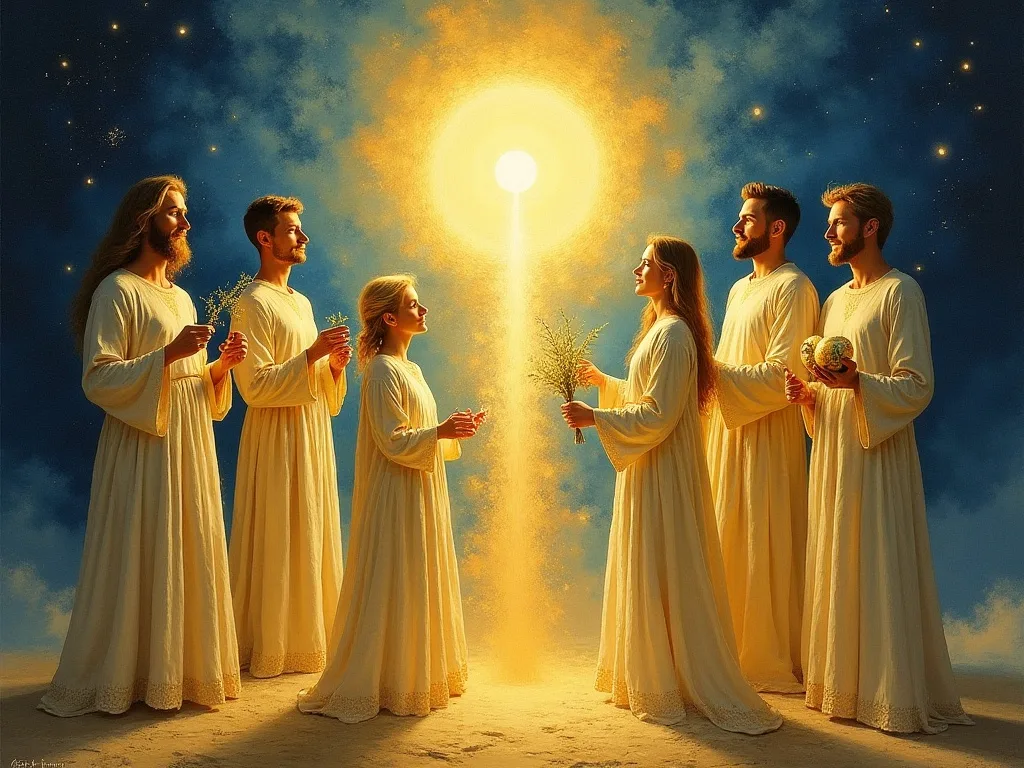
The six Amesha Spentas are the clearest expression of how Ahura Mazda's nature unfolds into the world. Each is both an abstract virtue and a guardian of a specific element of creation.
- Vohu Mana (Good Mind) - guardian of cattle, associated with January
- Asha Vahishta (Best Truth) - guardian of fire, the central ritual element
- Xshathra Vairya (Desirable Dominion) - guardian of metals and sky
- Spenta Armaiti (Holy Devotion) - guardian of earth, feminine in character
- Haurvatat (Wholeness) - guardian of water
- Ameretat (Immortality) - guardian of plants
These six, with Ahura Mazda at their center as a seventh, form a heptad. That number would echo through later Semitic traditions: the seven archangels of Second Temple Judaism carry a structural resemblance scholars such as Mary Boyce and Anders Hultgard have traced directly to this Persian source. The Wise Lord's nature is, in this reading, not simply worshipped from outside but carried inside creation itself, woven into water, fire, soil, and the minds of living creatures.
Ahura Mazda in Achaemenid Royal Theology
The first Persian Empire, the Achaemenid dynasty founded by Cyrus the Great around 550 BCE, adopted Ahura Mazda as its patron deity with a political clarity that still reads sharply in stone. At Behistun, Darius I carved the longest Old Persian inscription in history. It opens: "A great god is Ahura Mazda, who created this earth, who created yonder sky, who created man, who created happiness for man." Darius names the Wise Lord over seventy times across the trilingual monument.
This was not decoration. Darius framed every military campaign, every suppression of revolt, every administrative decision as an act done by the grace of Ahura Mazda. The king was not himself divine in the Egyptian sense, but he was chosen, legitimated, and sustained by the Wise Lord. Lie and rebellion were, in this royal theology, literally the weapons of Angra Mainyu. To rebel against the righteous king was to side with druj.
The symbol carved above Darius at Behistun, the winged disc of the faravahar, became the emblem of the entire Achaemenid house. Whether every Achaemenid king was a devout Zoroastrian in the strict sense remains a scholarly debate, Artaxerxes II notably invoked Anahita and Mithra alongside Ahura Mazda, but the Wise Lord was always first, always the anchor of imperial legitimacy.
Fire, Truth, and the Ritual Logic of Worship
Zoroastrian worship does not worship fire as a god. That is a common confusion worth correcting with precision: fire is the symbol of Ahura Mazda's light and truth, the visible, purifying presence of asha in the material world. The atash (sacred fire) in a Zoroastrian temple is fed sandalwood and frankincense five times daily, corresponding to the five Gahs (divisions of the day), each with its own prayers from the Yasna liturgy.
The Yasna ceremony, still performed by Zoroastrian priests today, takes between two and four hours. At its core is the consecration of haoma (the Avestan cognate of Vedic soma), a sacred plant whose exact botanical identity scholars continue to debate, with candidates ranging from ephedra to harmala. The priest pounds the haoma, mixes it with milk and water, and offers it to Ahura Mazda in a ritual act that mirrors Zoroaster's own hymns. This is Zoroastrian devotion to Ahura Mazda at its most ancient and unbroken: a line of practice stretching back possibly three thousand years.
The sacred flame at the Udwada Atash Behram temple in Gujarat, India, where the Parsi community settled after fleeing Islamic Iran in the seventh century CE, has reportedly burned continuously since the ninth century CE. It is tended by priests who wear a padan (mouth-veil) so that human breath does not pollute the flame.
The Soul's Journey: Ahura Mazda and Zoroastrian Eschatology
The Zoroastrian theology of Ahura Mazda is inseparable from what happens after death. Three days after the body dies, the soul crosses the Chinvat Bridge (the Bridge of the Separator). For the righteous, it widens into a road; for the wicked, it narrows to a blade. At the bridge stands Rashnu, the divine judge, weighing deeds on perfectly balanced scales. The good enter Garo Demana, the "House of Song," Ahura Mazda's presence. The wicked descend to the realm of Angra Mainyu.
But this is not permanent. At Frashokereti, the final renovation, even those in hell are purified. A river of molten metal flows across the earth; the righteous wade through it as if through warm milk, the wicked are burned clean. Then Ahura Mazda's creation reaches its final state: perfect, incorruptible, and reunited with its creator. The Wise Lord does not punish forever. He renovates. That theological difference from later Christian notions of eternal damnation is structurally significant and worth sitting with: the entire cosmos, including those who chose wrongly, eventually returns home.
This idea of a final renovation influencing apocalyptic literature is not speculative. Scholars including Shaul Shaked, Philippe Gignoux, and John Hinnells have documented the textual pathways by which Zoroastrian eschatology entered Second Temple Jewish thought during the Babylonian Exile, when Jews lived under Persian rule and had direct contact with Zoroastrian priests. The resurrection of the dead, the final judgment, the renovation of the world: all appear in Jewish apocalyptic texts after the Persian period that are largely absent before it.
Ahura Mazda and the Monotheism Debate
Is Zoroastrianism monotheistic? The question seems simple. It is not. Ahura Mazda is supreme and uncreated, which sounds monotheistic. But Angra Mainyu is a real, powerful adversary, which sounds dualistic. And the Amesha Spentas, the yazatas (lesser divine beings), and figures like Mithra and Anahita are genuinely worshipped, which complicates the picture further.
Most scholars today use the term "ethical monotheism with dualistic cosmology" or simply "Zoroastrian monotheism" with qualifications. The key point is that Ahura Mazda has no equals and no rivals within the divine order: Angra Mainyu is not a second god but a second principle, a force that will be annihilated at the end of time. The yazatas serve Ahura Mazda, they do not compete with him. Mary Boyce, whose three-volume "A History of Zoroastrianism" remains the standard reference, argued that the earliest Gathas present a rigorous monotheism, with later traditions layering back in older polytheistic elements that Zoroaster had deliberately excised.
The monotheism debate matters beyond academic theology. If Zoroastrianism is indeed the earliest clearly articulated monotheism on record, then Ahura Mazda is not just the god of an ancient Iranian minority but the prototype that shaped the God of Abraham. That is an enormous claim. It is also one that serious scholars take seriously.
Ahura Mazda's Echo in Modern Zoroastrianism
Roughly 110,000 to 120,000 Zoroastrians exist worldwide as of the mid-2020s, concentrated in India (the Parsi community), Iran, and diaspora communities in North America, Britain, and Australia. They call Ahura Mazda by his Middle Persian name, Ohrmazd, in many prayers, though the Avestan original appears in formal liturgy. The Nowruz festival, the Persian New Year celebrated at the spring equinox, carries Zoroastrian roots even among the millions of secular Iranians who observe it today without religious affiliation.
The Avesta, the complete Zoroastrian scripture, survives in roughly one-quarter of what ancient sources suggest once existed. The rest was destroyed during Alexander the Great's invasion in 330 BCE and subsequent disruptions. What remains, preserved by Zoroastrian priests through the Sassanid period (224-651 CE) and then carried to India in the ninth century CE, still transmits the voice of those original Gathas with startling directness.
Zoroaster himself described the Wise Lord as a friend: "As a friend I address you, Ahura Mazda," he writes in Yasna 44. That intimacy, a single human speaking frankly to the supreme intelligence of the universe, asking hard questions about suffering and justice, distinguishes the Zoroastrian tradition from every cult of divine terror that surrounded it in the ancient Near East. The Wise Lord answers not with thunderbolts but with asha: truth, offered freely, to those who choose to listen.
Unresolved Threads: Scholarly Debates Still Burning
The date of Zoroaster's life remains genuinely unresolved. Classical Greek sources place him six thousand years before Plato, which modern scholars read as mythological inflation. Linguistic analysis of the Old Avestan Gathas suggests a date between 1500 and 1000 BCE, making Zoroaster roughly contemporary with the composers of the Rigveda. Some Iranian scholars push for a date as late as 600 BCE. The debate matters because it changes how we read the relationship between Zoroastrianism and the early Hebrew prophets: a 600 BCE Zoroaster might be influenced by Israelite monotheism, while a 1200 BCE Zoroaster is almost certainly the upstream source.
The identity of the haoma plant, used in the central Yasna ritual offered to Ahura Mazda, is similarly open. Martin Haug in the nineteenth century proposed ephedra. Victor Sarianidi's archaeological work at Bactrian sites uncovered vessels containing ephedra, poppy, and cannabis residue, suggesting a complex botanical preparation. The ritual continues without botanical certainty, using a plant that contemporary Parsi priests call haoma and which some communities source from ephedra, while others use pomegranate.
Most provocative of all is the question of what Ahura Mazda's worship looked like before Zoroaster. The daeva whom Zoroaster demoted to demonic status were almost certainly older Iranian gods, cognates of the Vedic deva. The pre-Zoroastrian Iranians likely worshipped them alongside the ahuras. Zoroaster's revolution was to invert that hierarchy: elevate the ahuras, suppress the daevas. Ahura Mazda, the greatest of the ahuras, became the sole legitimate object of worship. That theological revolution, quietly performed somewhere on the Iranian steppe three or more millennia ago, is still reverberating.
Frequently asked questions about Ahura Mazda
Frequently asked questions
What is the difference between Ahura Mazda and Angra Mainyu?
Ahura Mazda is the uncreated Wise Lord, the source of truth (asha), light, and all good creation. Angra Mainyu (also called Ahriman) is the Destructive Spirit, the force of druj (falsehood and corruption). They are not equal eternals: most Zoroastrian theology holds that Angra Mainyu arose as a refusal of truth and will be destroyed at the end of time during Frashokereti, the cosmic renovation.
Is Zoroastrianism a monotheistic religion?
Most scholars describe it as a form of ethical monotheism with dualistic cosmology. Ahura Mazda is supreme and uncreated, but Angra Mainyu is a genuine adversarial force, not merely a symbolic evil. Lesser divine beings (the yazatas, the Amesha Spentas) serve Ahura Mazda rather than competing with him. Mary Boyce argued the earliest Gathas present strict monotheism, with polytheistic elements re-entering in later layers of tradition.
How did Ahura Mazda influence Jewish, Christian, and Islamic theology?
During the Babylonian Exile (sixth century BCE), Jews lived under Persian Achaemenid rule and had sustained contact with Zoroastrian thought. Concepts including bodily resurrection, a final judgment, a renovation of the world, cosmic dualism (good vs. evil), and the figure of an adversary (later called Satan) appear in Jewish apocalyptic texts after this contact and are largely absent in pre-exilic Hebrew scripture. Scholars including Shaul Shaked and John Hinnells have traced these pathways in detail.
What is the faravahar and what does it represent?
The faravahar (also spelled farohar) is a winged disc with a bearded male figure at its center, the arms of which reach outward holding a ring. It functioned as the royal symbol of the Achaemenid kings and is widely associated with Ahura Mazda, though some scholars interpret it as representing the fravashi (the divine spirit or guardian soul) rather than the deity directly. Today it is the most recognised symbol of Zoroastrianism worldwide.
Do Zoroastrians worship fire?
No. Fire is the visible symbol of Ahura Mazda's light and truth (asha) in the material world, not an object of worship in itself. Sacred fires in Zoroastrian temples are tended with ritual care as a focus of prayer and a reminder of the divine presence, but the worship is directed to Ahura Mazda. The confusion arises partly from ancient Greek accounts that misread Zoroastrian fire ritual as fire-worship.
When did Zoroaster live, and does the date affect our understanding of Ahura Mazda?
The date is genuinely unresolved. Linguistic analysis of the Gathas points to roughly 1500-1000 BCE; some scholars prefer 600 BCE. The date matters enormously for intellectual history: an early Zoroaster places the theology of Ahura Mazda upstream of early Hebrew monotheism; a late Zoroaster puts those traditions in rough contemporaneity and opens the question of mutual influence rather than one-directional borrowing.
Read the full book
Want the whole story?
The complete edition is an instant PDF download here, with a paperback on Amazon for selected titles.
Persian
The Persian Mythology Book: Ahura Mazda, Ahriman, Mithra, and the Cosmic Dualism That Shaped Three Religions
From the Avesta to Ferdowsi's Shahnameh
The Zoroastrian cosmos of light against darkness, the Amesha Spentas, the hero Rostam, and the Shahnameh epic that preserved pre-Islamic Iran in verse.
More from Persian
All articles
Persian
Anahita: The Persian Goddess of Waters and Fertility
Anahita, the Persian goddess of waters and fertility, ruled over rivers, healing, and the cycle of life itself. Revered for millennia across the Zoroastrian world, her story reveals how water became sacred, and how a goddess shaped the spiritual landscape of Persia, Anatolia, and beyond.

Persian
The Avesta: Sacred Texts of Zoroastrianism and Ancient Persian Religion
The Avesta is the religious scripture of Zoroastrianism, containing hymns, prayers, and law from ancient Persia. Discover how this 3,000-year-old text shaped Western religion and philosophy.
Persian
The Faravahar: The Winged Symbol of Zoroastrianism
The Faravahar appears across Zoroastrian art, temples, and personal devotion as a winged figure hovering between realms. This ancient Persian symbol encodes the faith's core belief: that each human spirit carries divine potential and cosmic choice. Discover what this icon reveals about the battle between good and evil.
Persian
Ahriman (Angra Mainyu): The Destructive Spirit of Persian Mythology
Ahriman (Angra Mainyu in Avestan) is the cosmic principle of destruction, decay, and evil in Persian Zoroastrianism. Eternal rival of Ahura Mazda, he embodies chaos itself and shapes the central spiritual conflict of humanity's purpose.