

Mithra: The Ancient Persian God of Covenant and Light
Mithra stands at the heart of Persian religion as the guardian of oaths, contracts, and the cosmic order. Explore how this ancient god shaped Zoroastrianism and influenced religions across the Mediterranean world.
Contents
A warrior emerges from the mountains at dawn. His horses are white. His chariot gleams gold. Around him, the sky splits open: a thousand eyes watch from the light itself. This is Mithra, the ancient Persian god who commands the sun's passage, witnesses every sworn oath, and holds the cosmic contract that keeps chaos at bay.
Long before he crossed into Greek mystery cults, long before his image traveled to Rome and inspired temples from the Danube to North Africa, Mithra was already ancient in Persia itself. He belonged to a pantheon that predated even the great religious reformer Zoroaster. The Avesta, the sacred text of Zoroastrianism compiled over centuries, names him as one of the yazatas, the immortal beings worthy of worship. Yet unlike other gods who faded into abstraction, Mithra remained stubbornly concrete: a presence at every contract, every oath, every moment when one human being's word mattered more than gold.
The God Before Zoroaster: Mithra's Ancient Roots
The Mithra who appears in the Avesta is already centuries old. Scholars trace his lineage back into the Indo-Iranian religious world, shared among peoples who spoke related languages and herded cattle across the steppes. In this older layer, Mithra was not simply a god but a principle: the binding force that made agreement possible. When two chieftains swore an oath, Mithra stood between them. When a shepherd and a merchant struck a deal, Mithra was witness and guarantor both.
The Vedas, the oldest religious texts of India (composed around the same period as the earliest Avestan hymns, roughly 1500-1200 BC), preserve a cognate figure: Mitra, spelled differently but rooted in the same ancient name. In the Rigveda, Mitra often appears paired with Varuna, another god of cosmic order. Varuna enforces the law through punishment and dread; Mitra binds through partnership and mutual obligation. The two together hold the world together.
But Mithra in the Persian tradition grew something distinct. He was not merely abstract law. He was a warrior god with a thousand eyes, a god of sunlight and contracts alike. The Avesta describes him as exceptionally powerful: "Ahura Mazda created Mithra, the yazata, mightier even than other yazatas." He presided over daylight hours; he was patron of soldiers and kings. He demanded loyalty from his followers in return for victory. This was not passive witness. This was active, radiant force.
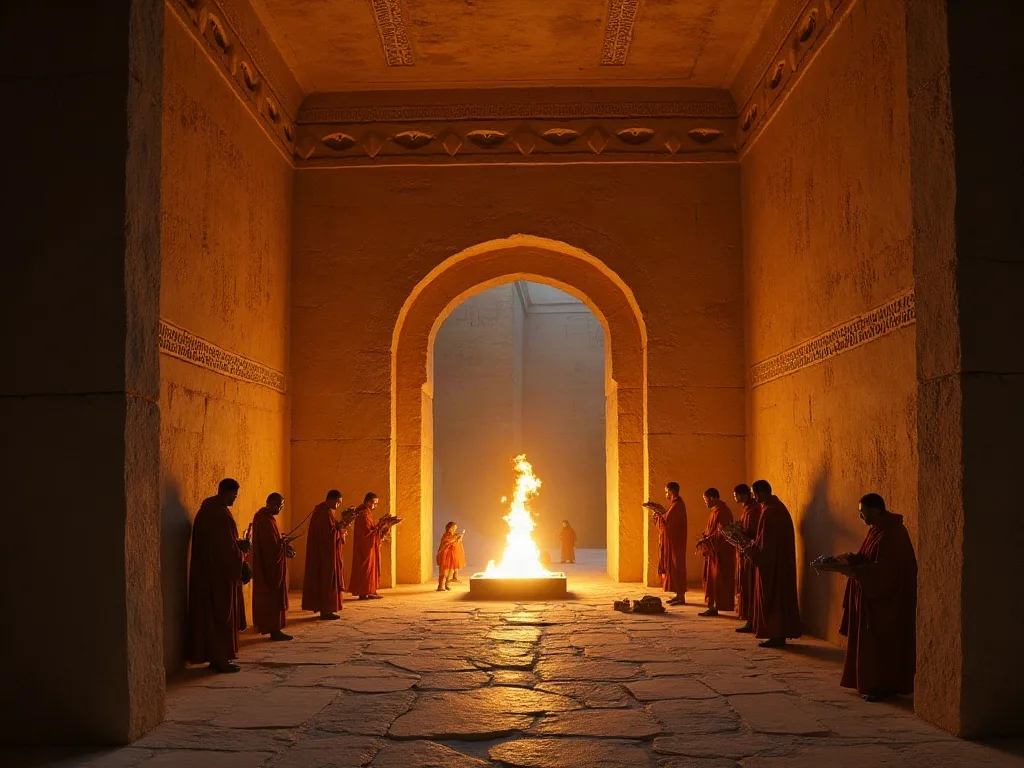
The ancient Persians called the contracts they made "mithraic bonds." A man's word given under Mithra's gaze was sacred. Broken oaths brought not just shame but cosmic consequence: the oath-breaker invited chaos, drew the attention of the demonic forces that Zoroastrianism recognized as real and hungry. This is why Mithra was feared as much as loved. To break faith with Mithra was to make an enemy of an ancient power who saw all and forgave nothing.
Mithra in Zoroastrianism: The Integration of the Old God
The religious reformer Zoroaster, if he was a historical figure (scholars debate the dates; most place him sometime between 600 and 400 BC, though some argue for earlier), did something remarkable: he did not destroy the older gods. Instead, he subordinated them. In Zoroastrianism, Ahura Mazda, the "Wise Lord," stands at the top as supreme. The older yazatas become his agents and servants, ranked in a celestial hierarchy.
Mithra in this new system becomes even more present, more active. He is no longer simply a principle invoked at oaths; he is a full divine personality, with complex duties and vast scope. The Avesta gives him dominion over:
- Contracts, covenants, and mutual bonds
- The sunlight and the day (he guards daylight from darkness)
- Loyalty between rulers and ruled
- The honest dealing of merchants and craftsmen
- Victory in righteous war
This last domain is crucial. Mithra grants victory only to those who keep faith, whose cause is just, whose oath is clean. A army marching under a broken covenant would face Mithra's opposition. This made him the divine guarantor not just of commerce but of justice in warfare.
In the Zoroastrian calendar, Mithra received his own month: Mehregan (still celebrated in some communities today as a fall festival). The word mehr, meaning "kindness," "love," and "covenant," derives from his name. To show mercy, to honor a contract, to show loyalty: these are mehr, Mithra-like qualities. The god's essence seeped into the language itself.
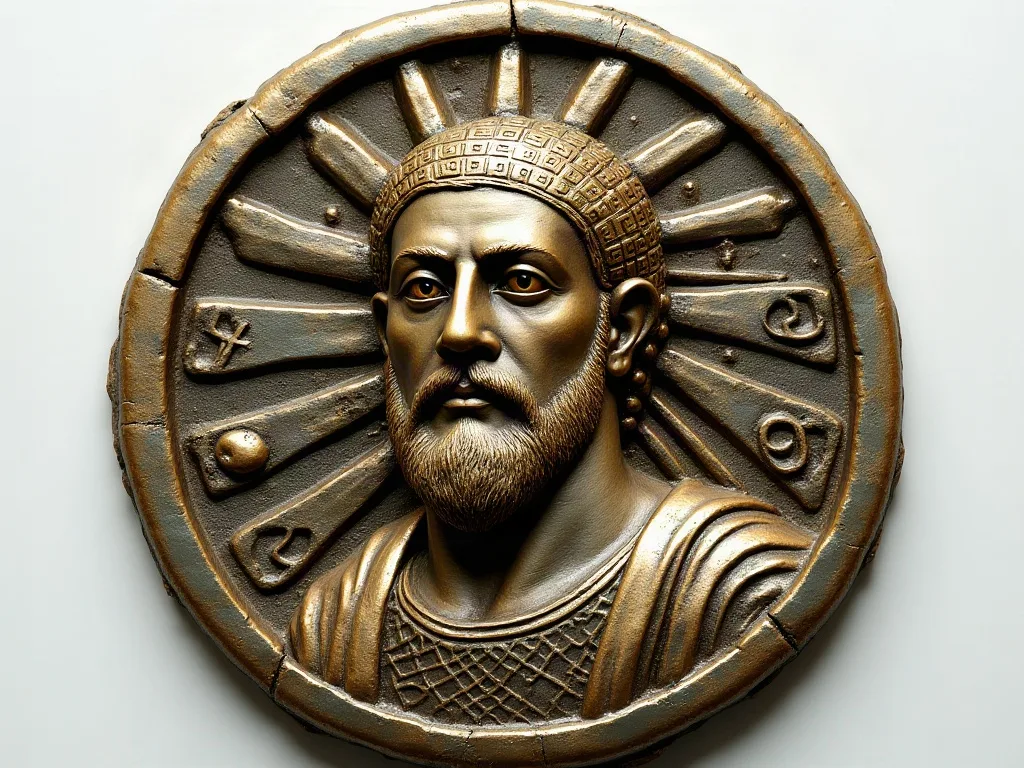
As Zoroastrianism spread across the Persian empires (the Achaemenid empire, then the Parthian and Sassanid periods), Mithra remained constant. Kings invoked his name in their inscriptions. Merchants called on him to witness their deals. Soldiers prayed to him before battle. He was accessible in a way that the remote Ahura Mazda sometimes was not: present, active, demanding right conduct but offering tangible reward.
The Hidden War: Mithra and Ahriman
In Zoroastrian theology, the cosmos is a battleground. Ahura Mazda, the good creator, faces Ahriman (or Angra Mainyu), the destructive spirit. This dualism is not absolute chaos versus absolute order; it is more subtle. Ahriman is the principle of corruption, lies, broken bonds, and chaos. Mithra stands directly opposed to him in this cosmic struggle.
When a human being keeps faith, honors a contract, tells the truth, Mithra grows stronger and Ahriman weakens. The bonds that hold civilization together are literally threads in the garment of cosmic order. A broken oath tears at that fabric. Dishonesty, betrayal, treachery: these are the weapons Ahriman wields, and Mithra's counter is the simple, fierce power of truth and loyalty.
This explains why Mithra was not a god for the weak or the wavering. His followers needed to be firm. Oaths sworn in his name were irrevocable. A king who broke faith with Mithra would face not just human rebellion but cosmic consequence: drought, plague, the withdrawal of Mithra's protective sight. The god could forgive much, but not faithlessness.
The Sassanid emperors (224-651 AD), the last great Persian dynasty before Islam, kept Mithra at the center of their religious life. Coins bore his image. Temples raised in his honor showed him as a beautiful, bearded man, sometimes riding a white horse, eyes alert to detect all falsehood. The state itself was understood as a Mithraic bond: the king bound to protect his people, the people bound to obey a just king. When that contract fractured, the kingdom fell.
The Strange Journey West: Mithra and Mithras in the Roman World
Somewhere around the first century BC, merchants and soldiers from the Eastern Mediterranean began encountering Persian worship of Mithra. The exact mechanics of transmission are debated, but the result is startling: a mystery cult devoted to a god called Mithras spread across the Roman empire, from Britain to the Black Sea, reaching its peak in the second and third centuries AD.
This is where scholars must tread carefully. The Mithras of Rome and the Mediterranean is not identical to the Persian Mithra. The mystery religion that took root in the West took the name and some aspects of the god (his connection to light, to cosmic order, to military virtue) but transformed them in profound ways.
The Roman Mithras became a god of initiation. Worshippers underwent secret rituals, passing through degrees of knowledge, descending into caves (mithras-temples were called mithraea) to experience divine light. The most famous image shows Mithras slaying a cosmic bull (Taurus), releasing the vital forces of creation. This imagery has no clear precedent in the Persian sources; it appears to be a Greco-Roman invention, possibly drawing on Mesopotamian or Egyptian symbolic language.
Yet the core remained: Mithras as guardian of cosmic order, as a god to whom soldiers and merchants prayed, as a power who demanded loyalty and promised reward. Roman soldiers especially adopted the cult. A legionary swearing into Mithras' mysteries was re-swearing the oath that bound him to Rome, the empire, and the chain of command. The god's Persian nature as keeper of covenants translated perfectly into Roman military hierarchy.
This Western cult nearly became Christianity's greatest rival. At one point, Mithraism boasted millions of adherents and temples in every major city. But Mithraism remained a mystery religion: restricted, esoteric, without the missionary impulse that Christianity possessed. When Constantine favored Christianity in the fourth century, Mithraism faded. By the fifth century, the god and his mysteries had largely vanished from the Roman world.
Symbolism and Cosmic Function: The Eyes of Mithra
The most striking symbol in Mithra-worship is the gaze itself. The Avesta returns again and again to his thousand eyes, his all-seeing nature. In art, he is depicted with multiple eyes, or simply as a face that never sleeps, never looks away. This is not merely poetic. It reflects a core theological idea: nothing escapes Mithra's notice. No broken oath, no hidden treachery, no lie can remain concealed.
This connects him to light itself. The eye requires light; light is the medium of sight. Mithra commands the passage of the sun, not out of cosmic mechanics (that duty belonged to other powers) but because daylight is his realm of perception. In darkness, he cannot see; thus he must banish darkness from his domain. The sun is his instrument of watchfulness.
For those who kept faith, this was reassuring. Mithra sees your loyalty, your sacrifice, your honesty. He will remember. For oath-breakers and liars, the gaze became a threat: you cannot hide from Mithra's eyes. The god will remember your treachery.
A related symbol is the haoma, the sacred plant or ritual drink of Zoroastrianism. Haoma was offered to Mithra as a sacrifice; it appears in ritual contexts throughout the Avesta. Some scholars suggest it may have been psychoactive, inducing visions or trance states. Whether literal or metaphorical, the offering of haoma to Mithra was an act of covenant: the worshipper binding themselves to the god, asking for his presence and his judgment.
The Theological Question: Monotheism and the Many Yazatas
A genuine tension runs through Zoroastrian theology, particularly as it developed over centuries. If Ahura Mazda is the supreme God, the creator of all, why do the yazatas like Mithra remain objects of worship and prayer? Are they truly gods, or subordinate beings?
Different Zoroastrian communities answered differently. Some theologians argued that the yazatas are not divine in themselves but manifestations of Ahura Mazda's qualities. Mithra is Ahura Mazda's justice, his covenant-keeping nature, given form. Others treated them as genuinely distinct beings, powerful spirits or angels created by Ahura Mazda to manage the cosmos. Mithra in this view is a person, a willing agent of the supreme God, not merely an abstract quality.
This ambiguity allowed Zoroastrianism to absorb older polytheistic traditions without complete rupture. The older gods survived, repositioned, but intact. When Zoroastrianism encountered Greek philosophy (particularly during the Hellenistic period after Alexander's conquest), some scholars tried to harmonize the yazatas with Platonic forms or Stoic cosmic principles. Mithra became less a god and more a logos, a rational principle of justice and light woven into the universe's fabric.
What remains consistent across these debates is Mithra's essential function: he holds the world together through contracts, through oaths, through the binding force of mutual obligation. Whether he is God himself, a manifestation of God, an angel, or a cosmic principle, his role is unchanging. He is the bridge between two beings' will, the sacred guarantee that a promise means something.
Mithra's Afterlife: From Zoroastrianism to Islam and Beyond
When Islam swept across Persia in the seventh century, the old gods fell silent. Zoroastrianism shrank to small communities; temples were abandoned or destroyed. Yet Mithra did not vanish entirely. His influence seeped into Islamic mysticism, particularly Sufism, where the concept of divine covenant and the sacred gaze of God on the faithful echoed Mithra's ancient role.
The word mehr (loving-kindness, covenant) remains embedded in Persian language and culture. Mehregan, the festival associated with Mithra, continues to be celebrated in autumn by Zoroastrians and others who honor Persian tradition. In modern Iran, Mithra is a figure of cultural memory and pride, a god who showed that justice and loyalty matter, that human words can be sacred.
Western esotericism and comparative mythology have also kept Mithra alive. Scholars since the nineteenth century have debated the relationship between Mithras and Christ, asking whether Christianity borrowed from earlier mystery religions. The evidence is mixed: some themes overlap (a god of light, sacrifice, initiation), but the two religions evolved very differently. Still, Mithra represents an ancient path to the divine through truth and loyalty, a path that competed with Christianity and nearly won.
In the modern period, Zoroastrians themselves have worked to reclaim Mithra from centuries of obscurity. Organizations devoted to Zoroastrianism emphasize that their faith is not dead but alive, and that figures like Mithra speak to timeless human needs: the need for trust, for binding agreements, for a power that cares about truth. As the world grows more complex and contractual, as digital commerce and global agreements dominate human life, Mithra's ancient domain remains strangely relevant.
Frequently asked questions about Mithra, the ancient Persian god of covenant and light?
Frequently asked questions
Is Mithra the same as the Roman god Mithras?
Not quite. Mithra is the Persian original; Mithras is the Greco-Roman adaptation. The name and some attributes (light, order, military virtue) carried over, but the Roman mystery religion developed its own practices, myths (like the bull-slaying), and theology. It is better to think of Mithras as Mithra transformed by a different culture than as a direct copy.
What did breaking an oath to Mithra mean in ancient Persia?
It was treated as a cosmic violation, not merely a social breach. Breaking an oath sworn before Mithra invited divine punishment and weakened the bonds holding reality together. The oath-breaker could expect misfortune, illness, defeat in battle, or loss of divine favor. Mithra's all-seeing nature meant the violation could not remain hidden or forgiven lightly.
How did Mithra fit into Zoroaster's reforms?
Rather than abolishing older gods like Mithra, Zoroaster (or his followers) subordinated them to Ahura Mazda, the supreme creator. Mithra became one of the yazatas, divine agents serving the supreme God's will. This allowed the new religion to absorb the old tradition without completely rejecting it, making conversion easier for communities already devoted to Mithra's worship.
Why did Mithras worship nearly overtake Christianity in Rome?
Mithraism offered mystery, initiation, a secret knowledge granted to the worthy, appeal to soldiers and merchants, and a god of justice and cosmic order. It was perfectly suited to Roman values and the military culture. Christianity eventually won because it was more accessible (open to all, not just initiates), more missionary, and secured imperial backing under Constantine. By then, Mithraism had peaked.
Are there Zoroastrians who still worship Mithra today?
Yes. Modern Zoroastrian communities, concentrated in Iran and India (the Parsi tradition), continue to honor Mithra through prayer and the Mehregan festival. Mithra is not abandoned but recognized as a yazata who remains relevant: a guardian of truth, loyalty, and justice. Some scholars and mystics argue that Mithra's ancient function speaks to modern concerns about trust and binding agreements.
The Eternal Witness: Mithra's Unbroken Presence
What makes Mithra survive when so many other ancient gods fade is his refusal to become purely abstract. He is not memory. He is not a metaphor for justice or a poetic name for the sun. He is a presence, a witness, a power who cares whether you keep your word.
In an age of contracts, digital agreements, and fluid loyalties, Mithra seems almost prophetic. His ancient domain remains contested ground: who watches the contract? Who judges if both parties kept faith? In the modern world, lawyers and courts have assumed this role, but something essential has been lost. The sacred dimension of oath-taking, the sense that the universe itself cares about your truthfulness, has atrophied.
Mithra reminds us that for centuries, perhaps millennia, humans understood contracts as cosmic events. A promise made in the sight of Mithra was not merely a social arrangement; it was a binding of one's soul, a stake in the cosmic order. To break faith was to rip at reality itself. This may sound strange to modern ears, but it also carries a quiet authority: if we took our promises that seriously today, would the world not be different?
The god's journey from ancient Persia to Rome to Sassanid temples to scattered Zoroastrian communities to modern scholarly rediscovery is itself a kind of covenant. Each generation keeps Mithra alive by remembering him, by invoking his name, by recognizing that loyalty and truth matter. The eyes that saw all treachery in ancient times still watch. The warrior riding white horses at dawn still guards the contract that holds civilization together. Mithra endures because the need for trustworthy covenant never fades.
Read the full book
Want the whole story?
The complete edition is an instant PDF download here, with a paperback on Amazon for selected titles.
Persian
The Persian Mythology Book: Ahura Mazda, Ahriman, Mithra, and the Cosmic Dualism That Shaped Three Religions
From the Avesta to Ferdowsi's Shahnameh
The Zoroastrian cosmos of light against darkness, the Amesha Spentas, the hero Rostam, and the Shahnameh epic that preserved pre-Islamic Iran in verse.
More from Persian
All articles
Persian
Anahita: The Persian Goddess of Waters and Fertility
Anahita, the Persian goddess of waters and fertility, ruled over rivers, healing, and the cycle of life itself. Revered for millennia across the Zoroastrian world, her story reveals how water became sacred, and how a goddess shaped the spiritual landscape of Persia, Anatolia, and beyond.

Persian
The Avesta: Sacred Texts of Zoroastrianism and Ancient Persian Religion
The Avesta is the religious scripture of Zoroastrianism, containing hymns, prayers, and law from ancient Persia. Discover how this 3,000-year-old text shaped Western religion and philosophy.
Persian
The Faravahar: The Winged Symbol of Zoroastrianism
The Faravahar appears across Zoroastrian art, temples, and personal devotion as a winged figure hovering between realms. This ancient Persian symbol encodes the faith's core belief: that each human spirit carries divine potential and cosmic choice. Discover what this icon reveals about the battle between good and evil.

Persian
Ahriman (Angra Mainyu): The Destructive Spirit of Persian Mythology
Ahriman (Angra Mainyu in Avestan) is the cosmic principle of destruction, decay, and evil in Persian Zoroastrianism. Eternal rival of Ahura Mazda, he embodies chaos itself and shapes the central spiritual conflict of humanity's purpose.