
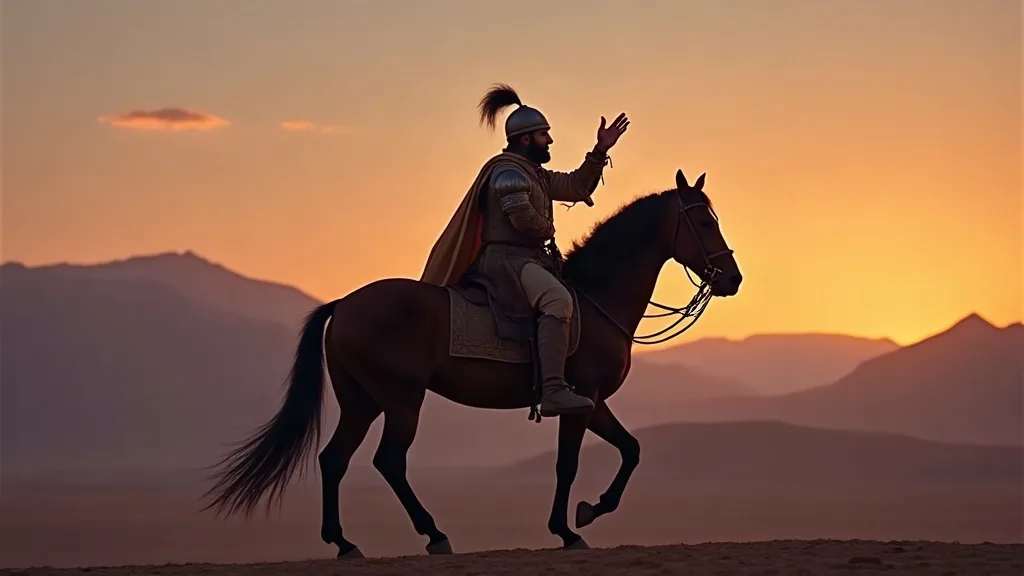
Rostam: The Greatest Hero of Persian Epic
Rostam stands as the mightiest warrior in the Shahnameh, the 10th-century Persian epic that shaped an entire civilization's sense of heroism. His strength was legendary, his loyalty tested, and his fate tragic. Here is the story of the man who defeated demons and kings but could not escape destiny.
Contents
A young warrior rides alone across the deserts of Persia, searching for his own father whom he has never met. His horse is named Rakhsh, and both beast and rider possess a strength that no ordinary enemy can match. The warrior's name is Rostam, and within days of his solitary quest, he will battle a white demon in a cavern, wrestle a sorcerer-king, and restore a kingdom to its rightful throne. This is how Rostam begins his legendary life, as told in the Shahnameh, the "Book of Kings" compiled by the Persian poet Firdawsi around 1010 CE.
The Shahnameh is a narrative epic of over 50,000 verses that recounts the mythical and historical history of Persia from creation to the Islamic conquest. Within its vast tapestry, no figure commands more narrative space, more admiration, and more tragic weight than Rostam. He is warrior, father, son, and ultimately a man broken by fate. For over a thousand years, Persian, Turkic, and Kurdish audiences have listened to tales of his exploits, and his legend shaped not only literature but the very idea of heroism across the Islamic world and Central Asia.
The Birth of a Titan
Rostam is born to Zal, a man abandoned at birth because his father thought him cursed, and Rudabeh, a princess from the enemy kingdom of Kabul. This union violates every law of geography, kinship, and politics. Zal's father, the great king Sam, had cast him out in infancy; Rudabeh is forbidden to him by blood and by war. Yet they meet in secret, fall in love, and their son becomes the product of two worlds that should never merge. The Shahnameh describes Rostam's birth in deliberate, almost medical detail: he is so large, so powerful even as a newborn, that his mother nearly dies bringing him into the world. The physicians must be called, the king must intervene, and only then does the child emerge alive, already showing the superhuman nature that will define him.
Rostam grows with extraordinary speed. By childhood, he possesses the strength of ten men. His father Zal teaches him the arts of war: archery, swordsmanship, horsemanship, wrestling. But his true teacher is necessity itself. When Zal falls ill, it is the young Rostam who must act. He travels to distant lands seeking a cure, and on this first journey alone, he meets the obstacles that will become his signature: battles with demons, sorcerers, and wild creatures that no ordinary man could survive.
The Seven Labors of Rostam
The Shahnameh organizes much of Rostam's early career around a sequence of seven trials, often called his "Seven Labors." These labors echo the hero quests of many mythologies, but the Persian version is distinct: Rostam does not journey seeking glory for its own sake. He travels because he must, because others depend on him, because the world is broken and needs fixing. This is his burden, not his ambition.
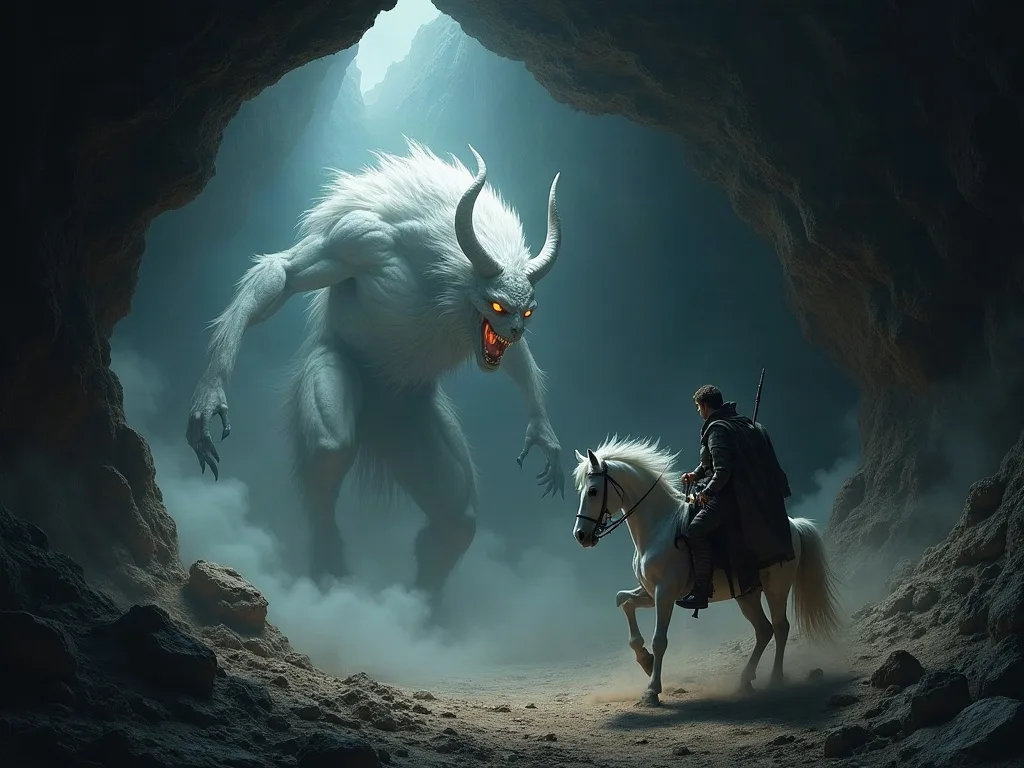
The first labor: a white demon rises from a mountain cave, terrorizing the countryside. Rostam enters the cavern at night, finds the creature sleeping, and kills it with a sword blow, though the struggle nearly costs him his life. The second labor sends him against a black sorcerer-king who has enslaved a city. Rostam defeats him through cunning and strength combined, learning that brute force alone is not enough. The third labor pits him against a dragon-like creature, the third labor against a sorcerer who practices dark magic, and so on. Each trial deepens his skill and his weariness.
What distinguishes Rostam's labors from other hero cycles is their refusal of redemption. Rostam does not return home celebrated, retire to a kingdom, or achieve lasting peace. Each victory leads only to the next crisis. The Shahnameh treats him with profound sympathy, not as a conquering hero but as a man compelled by duty to a work that will never end.
Rakhsh: The Divine Horse
No account of Rostam is complete without his horse, Rakhsh. In the Shahnameh, Rakhsh is not merely a steed; he is Rostam's closest companion, his moral equal, and often his savior. According to the poem, Rakhsh is descended from the divine stables of the mythological king Jamshid, carrying bloodlines that make him no ordinary animal. He is described as bay-colored, with a black mane and tail, faster than the wind, with the strength to carry Rostam's armor and weight across deserts where ordinary horses would perish.
In many episodes, Rakhsh's intelligence and ferocity match Rostam's own. When Rostam sleeps unguarded in enemy territory, Rakhsh stands watch and has killed attacking lions. When a sorcerer tries to bewitch Rostam, it is Rakhsh who senses the danger and warns his rider. The bond between man and horse grows so close that at Rostam's death, Rakhsh dies of grief. For Persian audiences, the relationship between Rostam and Rakhsh represents loyalty that transcends the boundary between human and animal, a theme that would echo through Islamic literature for centuries.
The Tragedy of Sohrab
The most famous episode of Rostam's life is also the most heartbreaking. It is the story of Sohrab, and it stands as one of the great tragic tales of world literature, equal in emotional weight to the deaths of Hector or Achilles in the Greek epics.
Rostam, in his youth, has a secret love affair with a woman named Tahmineh, a princess from the distant land of Samangan. From this union, a son is born. But Rostam never knows of the child's existence. Tahmineh raises the boy in secret, knowing that Rostam would never accept a son born outside marriage, and fearing that Rostam's enemies would hunt the child to destroy the warrior's bloodline.
The boy is named Sohrab, and he grows with strength almost equal to his father's. Raised among warriors, believing himself the greatest fighter alive, Sohrab decides to seek out his father and prove himself worthy of Rostam's name. He gathers an army, crosses into Persia, and defeats every Iranian warrior sent against him. Finally, the king realizes that only Rostam can stop this mysterious invader.
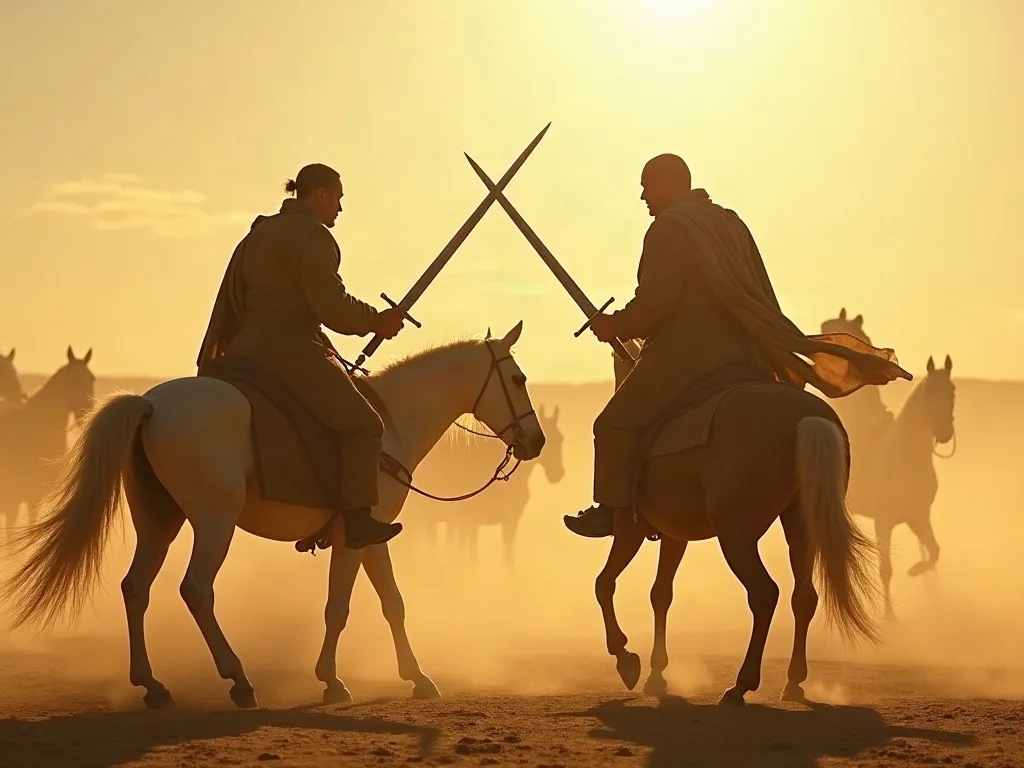
Rostam and Sohrab meet in single combat, neither knowing who the other truly is. The fight lasts for hours. They grapple, they strike with swords, and gradually Rostam, though aging, gains the upper hand. He pins Sohrab and kills him with a dagger. Only then does Sohrab, dying, reveal his true name. Only then does Rostam understand that he has killed his own son.
The Shahnameh's account of Rostam's grief is unflinching. He calls out to God, he tears his armor, he wishes for death. The woman who told him of Sohrab's existence, believing that knowledge might prevent the tragedy, arrives too late. The poem offers no redemption, no hidden miracle that will restore Sohrab to life. The greatest warrior in Persia is powerless against the very fate he most dreaded. This episode has been retold, reinterpreted, and wept over for a thousand years because it speaks to something universal: the knowledge that strength and heroism cannot protect us from the deepest wounds.
Rostam at the Court of Kings
Though Rostam is not a king, he is perhaps more powerful than any king in the Shahnameh. He serves as the supreme general and protector of the Iranian throne across generations, defending realm and dynasty against invaders, demons, and internal threats. His relationship with the kings he serves is complex: they depend on him absolutely, yet they fear and resent that dependence. He is the shield, but the king must be the crown.
Rostam lives and operates in a world of strict codes. The Shahnameh, like much Persian literature influenced by the pre-Islamic Zoroastrian tradition, emphasizes honor, loyalty, and the proper order of society. Rostam adheres to these codes rigidly. When he gives his word, he keeps it. When he swears an oath, he would die before breaking it. When duty calls, he answers, even when the duty conflicts with his personal desires or safety.
This code defines his relationship with King Kay Khosrow, a wise and just ruler with whom Rostam allies. Together they defend Persia against the Turanians, a hostile power from Central Asia led by the sorcerer-king Afrasiyab. The Rostam-Kay Khosrow partnership represents the ideal relationship between warrior and monarch: trust, mutual respect, and a shared vision of justice. Yet even this noble partnership contains the seeds of conflict, for Rostam serves the realm, not the king, and sometimes these are not the same thing.
Rostam and the Shadow of Destiny
As Rostam ages, his legend only grows. Enemies speak his name with fear. Allies invoke him with hope. Kings court his favor. Yet the Shahnameh insists that Rostam, despite his power, cannot escape the arc of his own fate. This theme, inherited from older Persian and Zoroastrian traditions, runs through the entire epic: destiny is woven at birth, and no amount of strength can overcome it.
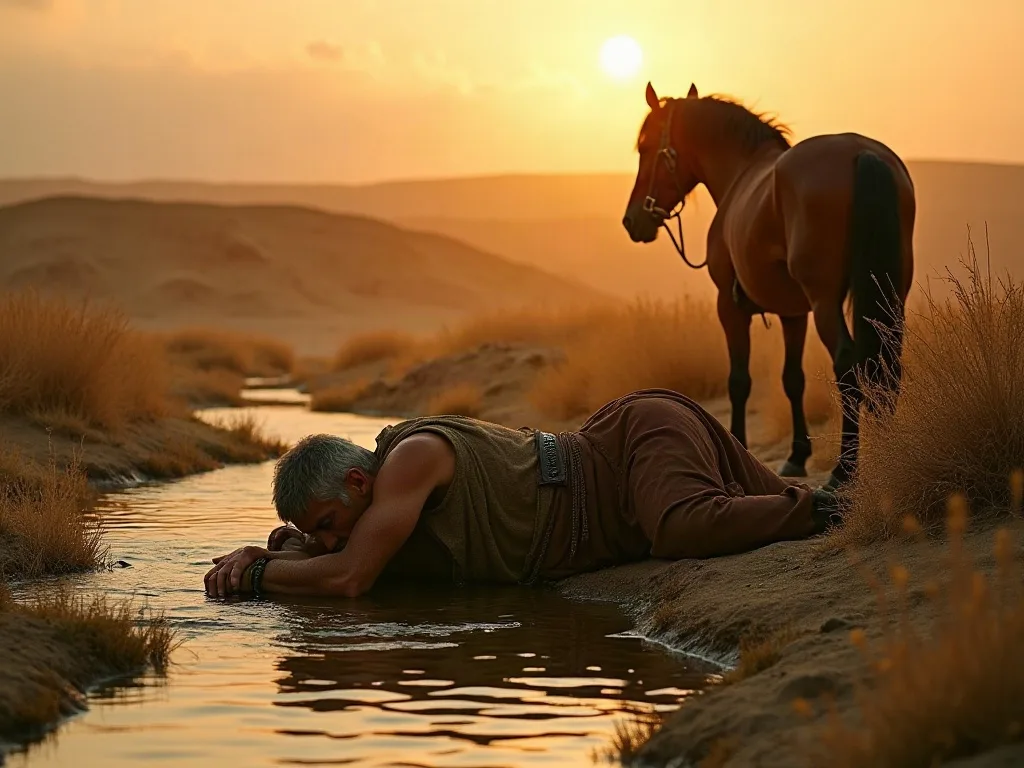
This plays out in Rostam's final days. He defeats a demon named Esfandiyar, the mightiest Turanian champion, through cunning and a magic arrow. But before his death, Esfandiyar curses Rostam: his corpse will cause Rostam's own destruction. Later, fleeing from enemies, Rostam is forced into a region covered with sharp stakes hidden beneath soil. Rakhsh steps onto one of the stakes and falls. Rostam, thrown from his horse and mortally wounded, realizes what is happening. He crawls to a stream, drinks, and dies. His death is not glorious; it is the fulfillment of a curse and the consequence of riding through a place his companion tried to warn him against.
This ending, profoundly unsatisfying by modern storytelling standards, is precisely the Shahnameh's point. Rostam does not ride off into sunset. He does not retire honored. He does not achieve final peace. His strength, which defined his entire life, proves useless against time, fate, and the consequences of choices made long ago. Persian audiences understood this not as a flaw in the narrative but as its deepest wisdom: greatness and tragedy are intertwined, and the mightiest hero is still human.
Rostam's Influence Across Cultures
The figure of Rostam did not remain confined to Persian literature. As the Shahnameh was translated into Arabic, Turkish, Kurdish, and eventually European languages, Rostam's legend traveled across the Islamic world and beyond. Turkish and Kurdish oral traditions adopted him as a hero of their own, sometimes resituating his stories in local geographies. Sufi mystics read his struggles as spiritual allegories. Painters across Persia, the Ottoman Empire, and Mughal India illustrated his exploits in illuminated manuscripts, creating a visual tradition that lasted centuries.
In the Islamic world, Rostam became an archetype of the noble warrior: strong, loyal, just, but ultimately subject to divine will. Unlike European heroes who might rebel against fate, Rostam accepts it with dignity. His combination of superhuman strength and moral humility made him a model for both warrior classes and religious teachers. Sufis particularly admired his discipline and his renunciation of pride despite his power.
The medieval European romances of Charlemagne and other heroes were influenced, directly or indirectly, by Persian epic traditions. Some scholars have traced thematic parallels between Rostam and figures like Roland or Beowulf: the aging champion, the loyal companion, the tragic end. Whether through direct transmission or coincident cultural patterns, Rostam's story type resonated across civilizations, suggesting something universal in how humans process the conflict between individual power and inevitable fate.
The Shahnameh's Preservation of an Ancient Voice
The Shahnameh was compiled in its final form by Firdawsi, a poet working in Khorasan in northeastern Persia around 1000 CE, more than three centuries after the Islamic conquest of Persia. Firdawsi drew on oral traditions, older written sources, and court chronicles to create the epic. His achievement was extraordinary: he wrote in Persian, not in Arabic, the language of the Islamic empire's elite. By doing so, he preserved a voice and a cultural memory that might otherwise have been absorbed entirely into Arabic literary tradition.
Rostam, in Firdawsi's hands, becomes a figure who bridges pre-Islamic and Islamic Persia. The Shahnameh never ignores Islamic theology; characters invoke God, align themselves with justice in Islamic terms, and acknowledge the sovereignty of Allah. Yet the values Rostam embodies, the code he follows, the tragic resignation he accepts, are recognizably rooted in an older Persian, Scythian, and Indo-European warrior culture. In this way, Rostam is a living fossil of Persian identity, preserving within Islamic literature the memory of what Persia was before the conquest.
Rostam in the Modern World
For Iranians and Persians worldwide, Rostam remains a central figure in cultural identity. He appears in modern Iranian cinema, literature, and political rhetoric. During the Iranian Revolution of 1979, revolutionaries invoked Rostam's defense of the realm and his willingness to sacrifice himself. In the Iran-Iraq War of the 1980s, Rostam's name circulated as a symbol of national resilience.
Beyond the Persian-speaking world, Rostam has entered the awareness of fantasy and epic literature readers globally. Scholars of Joseph Campbell and comparative mythology recognize Rostam's monomyth structure: the hero's journey, the trials, the supernatural companions, the tragic flaw. Yet scholars also note that Rostam disrupts certain Western expectations. He is not an underdog; he never doubts his own strength. His tragedy is not that he fails to achieve his goal but that his goal's achievement cannot protect him from fate. This inversion of the Western hero narrative gives Rostam a distinctiveness that continues to intrigue writers, readers, and mythologists.
Frequently Asked Questions About Rostam: The Greatest Hero of Persian Epic
Frequently asked questions
Is Rostam a historical person or a purely mythological figure?
Rostam is almost certainly mythological, though the Shahnameh contains both legendary and historical elements. Some scholars have speculated that Rostam might be inspired by a real Scythian or Persian warrior, but no historical record confirms this. What matters is that the Shahnameh, compiled around 1000 CE, treated Rostam as a legendary hero from Persia's pre-Islamic past, whether or not a historical figure lay behind the name. His influence as a cultural memory is real and profound, even if his sword strokes never happened.
How does Rostam compare to other great epic heroes like Achilles or Heracles?
Rostam shares the superhuman strength and martial prowess of Heracles and Achilles, but his narrative arc is distinct. Unlike Achilles, Rostam does not die in glorious battle with a worthy opponent. Unlike Heracles, he does not achieve a final peace or ascension. Instead, Rostam is undone by fate and consequences, aging into a world that still demands his strength. His death is accidental and inglorious, reflecting a more pessimistic view of heroism that contrasts with Greek epic optimism. Yet like all three, Rostam's greatest defeats are personal: the killing of Sohrab, the betrayal of trust, the inability to escape destiny.
What was Rostam's role in pre-Islamic Persian beliefs?
The Rostam legend carries echoes of older Zoroastrian and Indo-Persian warrior traditions. Zoroastrianism, Persia's pre-Islamic faith, emphasized cosmic struggle between good and evil, and heroes who fought in defense of divine order. Rostam embodies this warrior code: loyalty to the throne, defense of the realm, acceptance of divine will, and the belief that a man's actions ripple forward across generations. When Firdawsi incorporated Rostam into the Islamic-era Shahnameh, he preserved this older voice while adapting it to Islamic theology, creating a bridge between Persia's pre- and post-conquest identities.
Why is the death of Sohrab considered one of literature's great tragedies?
The Sohrab episode is tragic because it is the one thing Rostam's strength cannot prevent. A man who has defeated demons, sorcerers, and armies is powerless to save his own son because he does not know who the son is. The tragedy is not one of external defeat but of ignorance, miscommunication, and the cruelty of fate. For Rostam, the revelation comes too late. He achieves victory in the combat but loses everything that mattered. Audiences across cultures recognize in this story the universal human fear that our greatest strengths might make us blind to our deepest needs.
How has Rostam influenced Islamic literature and culture?
Rostam became an archetype of the Islamic hero: noble, loyal, just, and ultimately subject to God's will. Turkish, Kurdish, and Arab poets retold his stories, reinterpreting them for their own contexts. Sufi mystics read his struggles as spiritual allegories of the soul's journey toward God. Artists across the Islamic world illustrated his exploits in illuminated manuscripts. His influence extended to chivalric codes and ideals of nobility that shaped Islamic warrior culture. In this way, a pre-Islamic legend became one of the most powerful symbols of Islamic cultural identity, preserving Persian memory within a broader Islamic framework.
What does the Shahnameh tell us about Persian values and worldview?
The Shahnameh, through figures like Rostam, reveals a culture that valued honor, loyalty, justice, and the acceptance of fate. It shows a world where individual strength matters but cannot exempt one from consequences. It emphasizes the king's role as administrator of justice and the warrior's role as protector, not conqueror. The prominence of Rostam across generations suggests that Persians saw heroism not as a moment of triumph but as a lifelong burden, a refusal to abandon duty despite exhaustion and loss. This worldview, rooted in pre-Islamic Zoroastrian traditions but adapted to Islamic theology, shaped how Persia understood itself across a thousand years.
Rostam's Unfinished Legacy
More than a thousand years after Firdawsi wrote the Shahnameh, Rostam remains alive in the imagination. New translations appear regularly in English and other languages. Modern Iranian filmmakers return to his story. Writers of fantasy and epic continue to discover in him a model of heroism that runs deeper than mere strength, because it is rooted in duty, sacrifice, and the tragic knowledge that even the greatest cannot escape the consequences of their own past.
What keeps Rostam's legend vital is not just the wonder of his deeds but the depth of his humanity. Yes, he defeats white demons and kills sorcerer-kings. But he also grieves for his son, grows weary with age, and dies in a place he was warned not to go. He is simultaneously superhuman and utterly, painfully human. In that contradiction lies the source of his power as a literary figure and his importance to cultures that have told and retold his story.
The Shahnameh insists that destiny is woven at birth, that no strength can overcome it, and that accepting this truth with dignity is the highest form of heroism. Rostam is the perfect vessel for this message. He does not rage against fate; he does not seek to escape it; he simply lives with honor until fate catches him. In a world that often celebrates triumph and victory, Rostam's acceptance of inevitable defeat offers a different kind of heroism, one that perhaps resonates more deeply the older we grow and the more we understand that some struggles cannot be won, only endured.
Read the full book
Want the whole story?
The complete edition is an instant PDF download here, with a paperback on Amazon for selected titles.
Persian
The Persian Mythology Book: Ahura Mazda, Ahriman, Mithra, and the Cosmic Dualism That Shaped Three Religions
From the Avesta to Ferdowsi's Shahnameh
The Zoroastrian cosmos of light against darkness, the Amesha Spentas, the hero Rostam, and the Shahnameh epic that preserved pre-Islamic Iran in verse.
More from Persian
All articles
Persian
Anahita: The Persian Goddess of Waters and Fertility
Anahita, the Persian goddess of waters and fertility, ruled over rivers, healing, and the cycle of life itself. Revered for millennia across the Zoroastrian world, her story reveals how water became sacred, and how a goddess shaped the spiritual landscape of Persia, Anatolia, and beyond.

Persian
The Avesta: Sacred Texts of Zoroastrianism and Ancient Persian Religion
The Avesta is the religious scripture of Zoroastrianism, containing hymns, prayers, and law from ancient Persia. Discover how this 3,000-year-old text shaped Western religion and philosophy.
Persian
The Faravahar: The Winged Symbol of Zoroastrianism
The Faravahar appears across Zoroastrian art, temples, and personal devotion as a winged figure hovering between realms. This ancient Persian symbol encodes the faith's core belief: that each human spirit carries divine potential and cosmic choice. Discover what this icon reveals about the battle between good and evil.
Persian
Ahriman (Angra Mainyu): The Destructive Spirit of Persian Mythology
Ahriman (Angra Mainyu in Avestan) is the cosmic principle of destruction, decay, and evil in Persian Zoroastrianism. Eternal rival of Ahura Mazda, he embodies chaos itself and shapes the central spiritual conflict of humanity's purpose.