

The Chinvat Bridge: The Bridge of Judgment in Zoroastrian Eschatology
The Chinvat Bridge decides every soul's fate in Zoroastrian belief: a razor-thin span over the abyss that widens for the righteous and narrows for the wicked. Learn what awaits on the other side.
Contents
Three days. That is how long a soul lingers near the body after death, according to the Avesta, the ancient sacred scripture of Zoroastrianism. It sits by the head, trembling, recounting every word spoken and every deed done across a lifetime. On the dawn of the fourth day, two paths open before it. One leads upward, into light. The other plunges downward, into a darkness so absolute the texts describe it as something you can touch with your hands.
Between the living world and whatever lies beyond stands a single span of impossible architecture. The Chinvat Bridge - called Cinvato Peretav in the Avestan language, meaning roughly "the bridge of the separator" or "the bridge of the gatherer" - stretches from the peak of a cosmic mountain, Mount Harā, across the void that divides the mortal realm from the realm of souls. Every human being who has ever died must cross it. What happens on that bridge is the central act of Zoroastrian judgment, older than heaven and hell as most Western readers know them, and arguably the first fully developed afterlife judgment system in the history of religion.
The bridge does not care about ritual. It does not care about ethnicity, social rank, or the number of prayers memorised. It measures one thing: the balance of asha (righteous truth and order) against druj (falsehood, chaos, corruption) in a person's life. That balance makes the bridge either a wide, comfortable road bathed in fragrant air, or a blade so thin a soul cannot stand on it at all.
The Cosmic Geography: Where the Bridge Stands
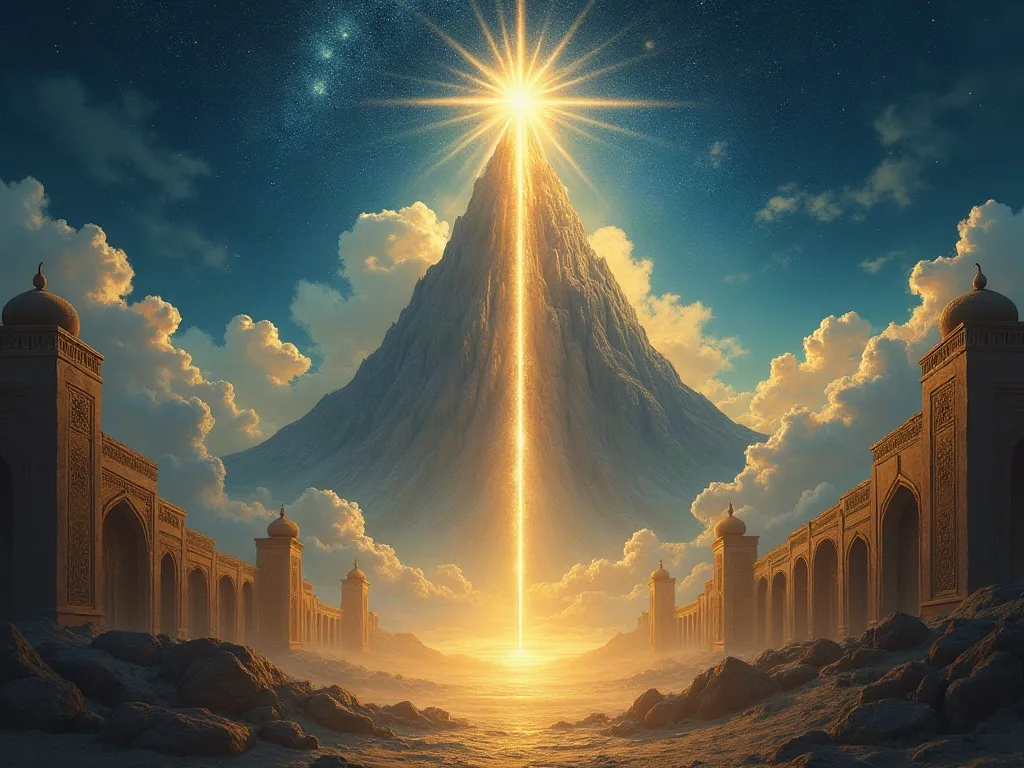
Zoroastrian cosmology is precise in a way that surprises modern readers expecting vague spiritual metaphors. The universe is a battleground, clearly mapped, with the forces of Ahura Mazda (the Wise Lord, the supreme deity of good) arrayed against Angra Mainyu (the Destructive Spirit, the source of all evil). Physical space reflects moral reality: the further up you go, the closer you are to truth; the further down, the deeper into lie and darkness.
Mount Harā, known in the texts as Harā Bərəzaitī - "the High Harā" - is the axis of this world. It stands at the center of existence, rising so high its peak touches the vault of heaven. Some scholars link it to a real geographic imagination centered on the Alborz mountain range in what is now northern Iran, though in the sacred texts it is clearly mythological in scale. The sun, moon, and stars circle it each night. The waters of the world flow from its roots.
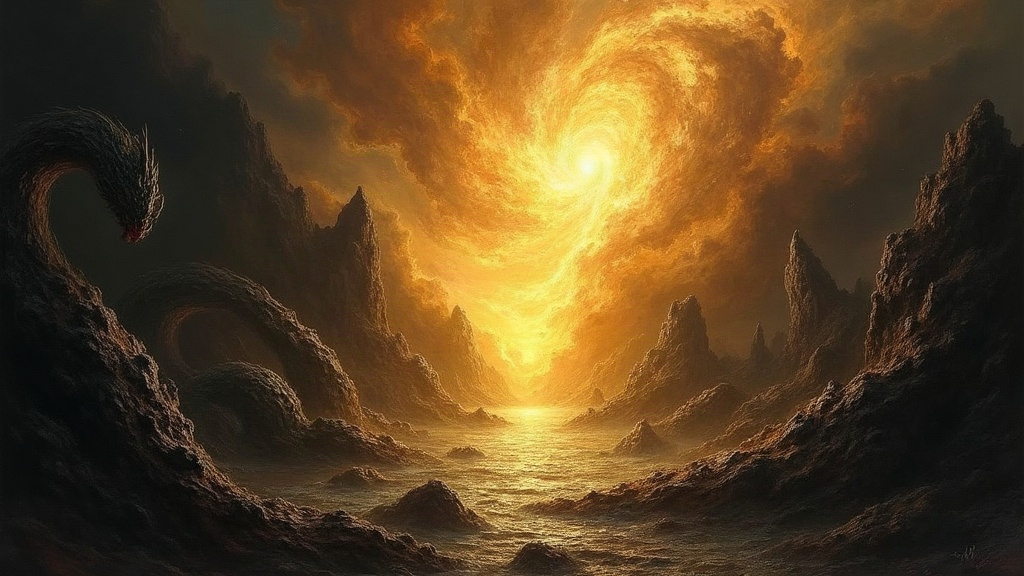
The Chinvat Bridge begins at this peak and arcs outward over the void. In the Bundahishn, a Middle Persian cosmological text compiled around the 9th century AD but drawing on much older oral tradition, the bridge is described as having a width that varies according to the soul crossing it. For a person whose good deeds outweigh the bad, it stretches nine javelin-lengths wide, a broad and pleasant road. For a person whose evil deeds tip the scale, it narrows to a razor's edge, a single hair's breadth, and then it tilts, depositing the soul directly into the gulf below.
This is not symbolic poetry dressed as geography. For the Zoroastrian tradition, the bridge is a real structure in a real cosmological space. The Denkard, another Middle Persian compilation of Zoroastrian lore, refers to it with the same matter-of-fact tone that other texts use to describe temples and fire altars.
Daena: The Soul Meets Itself on the Bridge
What meets you at the foot of the Chinvat Bridge is, by any measure, one of the most arresting images in world religion. It is you - or rather, the embodiment of everything you chose to be.
The soul's encounter at the bridge is described in the Hadokht Nask, a text from the wider Avestan canon (the Hadokht Nask survives only in fragments, but its account of the soul's first three days after death is one of the most vivid pieces of eschatological literature from the ancient world). As the soul approaches, a figure walks toward it on the bridge. That figure is the Daena, sometimes translated as "conscience" but more accurately understood as the totality of a person's moral character made visible.
For a person who lived righteously, the Daena appears as a beautiful young woman, radiant, fragrant, clothed in light. She tells the soul: "I am your own good conscience. Your good thoughts, your good words, your good deeds have made me." She leads the soul across the bridge and upward.
For a person who lived in falsehood, the Daena appears as a hideous old woman, foul-smelling, dressed in rags, screaming. She is the accumulated weight of every lie, every cruelty, every moment of cowardice given form. She grapples with the soul, and together they fall.
This is not a judge handing down a sentence from above. The soul judges itself, through the mirror of what it has become. No divine tribunal is needed: the evidence is written on the face of the conscience itself.

Rashnu, Mithra, and Sraosha: The Three Weighers
The bridge is not unmanned. Three divine beings stand at the crossing, and each plays a distinct role in the moment of judgment.
Mithra, one of the oldest gods in the Iranian pantheon and the deity of covenant, contract, and light, watches the approach. In the Mihr Yasht (Yasht 10), one of the most beautiful hymns in the Avestan canon, Mithra is described as having ten thousand eyes. Nothing done in secret escapes him. He has observed the soul's entire life, cataloguing every promise made, every oath kept or broken. He is the witness.
Sraosha - the divine embodiment of "hearkening" or obedience to the sacred word - accompanies the soul as a kind of advocate. He has been present throughout the person's life whenever they listened to righteous teaching, whenever they aligned themselves with the sacred order. He speaks for what was good.
Rashnu, whose name means "justice," holds the scales. These are not theatrical props. Rashnu weighs every thought, word, and action with absolute precision, assigning each its true moral weight. The Yasna (the primary liturgical text of Zoroastrianism) is explicit that Rashnu cannot be bribed, cannot be swayed by grief or pleading, and makes no exceptions for rank or lineage. The scales tip, and the bridge responds.
This triad is important: judgment in Zoroastrian eschatology is not singular or arbitrary. It is collective, precise, and built on observation across an entire lifetime. The soul cannot claim ignorance or argue that a single moment of conversion cancels a lifetime of harm.
What Waits on the Other Side
The Chinvat Bridge leads in two directions, and both destinations are described with striking vividness in the texts.
For those whose good deeds outweigh the bad, the bridge opens into three ascending realms: humata (good thoughts), hukhta (good words), hvarshta (good deeds) - the three-part ethical formula that runs like a spine through all of Zoroastrian moral teaching. Beyond these ascending stations lies Garōdmān, "the House of Song," the Zoroastrian paradise. The Gathas describe Garōdmān as the dwelling place of Ahura Mazda himself, filled with hymns, light, and the fragrance of flowers. The soul rests here in a state of conscious joy, aware of its own goodness, until the final renovation of the world.
For those whose evil outweighs the good, the fall from the Chinvat Bridge leads to Drujō Demāna, "the House of the Lie" or "the House of Worst Purpose" - the Zoroastrian realm of punishment. The texts describe it as dark, foul-smelling, narrow, and utterly silent except for the sounds of torment. It is not an eternal damnation: Zoroastrian eschatology holds that at the end of time, even those souls in Drujō Demāna will be purified and restored. The punishment is reformative, not infinite. That is a remarkable distinction from the eternal hell that later Abrahamic traditions would develop.
There is also a middle realm for souls whose deeds balance almost exactly: Hamistagan, a kind of limbo, neither reward nor punishment, where the soul waits in mild discomfort for the end of time.
The Gathas: Zarathustra Speaks of the Bridge
The oldest layer of evidence for the Chinvat Bridge comes from the prophet Zarathustra himself. In Yasna 46.10-11, he writes with urgency about souls approaching the bridge: "He who does not give anything to the righteous, he who has not submitted to the good mind - his own Daena shall meet him in that passage, even as his evil deeds are his." The language is direct, personal, almost confrontational.
In Yasna 51.13, the bridge is invoked as the place where the fate of the wicked is sealed, where druj (the lie) is finally separated from asha (truth). This is not pastoral comfort poetry. Zarathustra wrote in an environment of real moral crisis, preaching to pastoral communities beset by cattle raiders and violent tribal conflict. The bridge was a cosmic guarantee: no injustice survives it.
The Gathas are linguistically close to the oldest portions of the Rig Veda, the sacred hymns of early Vedic religion in South Asia, placing Zarathustra's composition somewhere between 1500 and 1000 BC. When you read his words about the Chinvat Bridge, you are reading one of the oldest first-person accounts of an afterlife judgment system in recorded human history.
The Chinvat Bridge Across Traditions: Echoes and Parallels
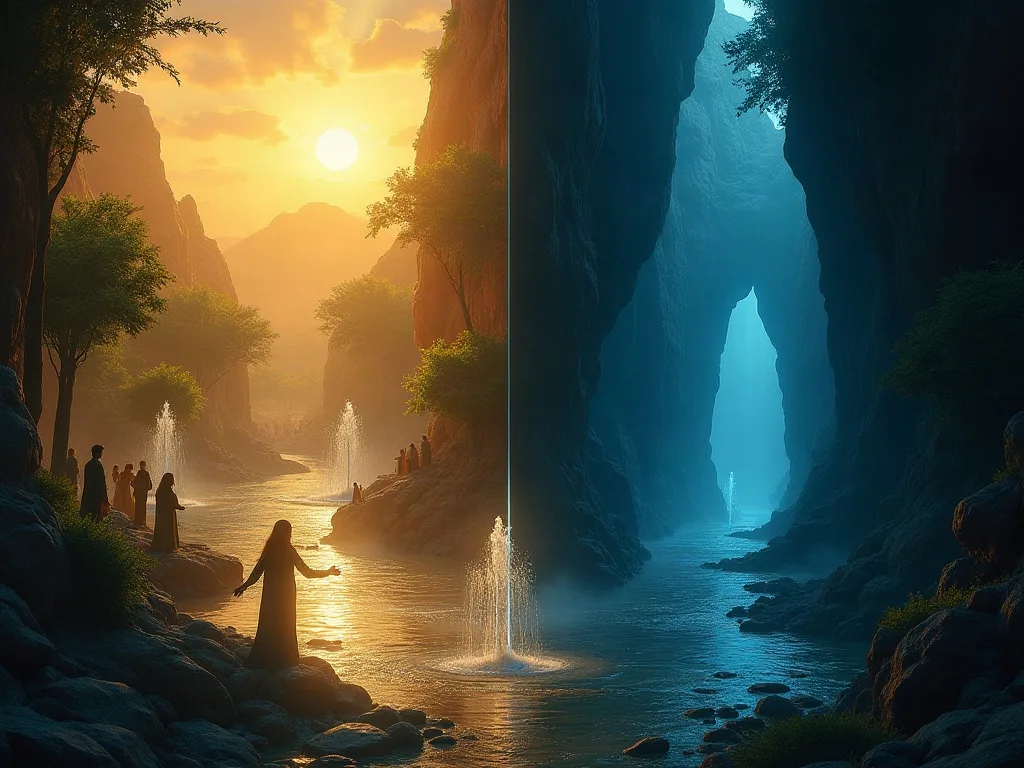
Ideas this powerful rarely stay inside one tradition. Scholars of comparative religion have traced the influence of Zoroastrian eschatology - and the Chinvat Bridge in particular - through several later traditions.
The most discussed parallel is with Islamic eschatology. The Sirat bridge in Islamic tradition is a span over hellfire, thinner than a hair and sharper than a sword, that every soul must cross on the Day of Judgment. The righteous cross easily; the wicked fall. The structural and moral logic is almost identical to the Chinvat Bridge, and given Persia's deep integration into the Islamic world after the 7th century AD, direct influence is at minimum plausible and widely argued by scholars including Mary Boyce, whose foundational work on Zoroastrianism remains the standard reference.
The parallel with the Norse tradition is less direct but worth noting. Gjallarbru, the bridge in Norse cosmology that spans the river Gjöll on the road to Hel, shares the basic architecture of a liminal span between worlds. The soul of Baldr passes over it in the Prose Edda. Whether this reflects direct contact or parallel mythological thinking remains open.
The Egyptian judgment of the dead, in which the heart is weighed against the feather of Ma'at, shares the same moral logic: objective measurement of a lifetime's choices, with immediate cosmic consequence. The weighing instrument differs, but the principle that moral weight determines cosmic fate is strikingly convergent. Mary Boyce and other scholars have debated whether there was actual cultural transmission between ancient Iran and Egypt, or whether this is convergent mythological evolution.
The Christian tradition absorbed Zoroastrian eschatological ideas in complex ways during the Second Temple Jewish period, when Persian rule over Judea (538-333 BC) created direct theological contact. Concepts of individual resurrection, a final judgment, heaven and hell as moral destinations, and an adversarial figure opposed to God all entered Jewish and then Christian thought during this period. The Chinvat Bridge does not appear by name in any Biblical text, but its moral architecture is present in the judgment scene of Matthew 25 and in the apocalyptic imagery of the Book of Revelation.
Hamestagan and the Zoroastrian Refusal of Eternal Damnation
One of the most theologically distinctive features of the Chinvat Bridge's logic is what it implies about justice and time. Most traditions that imagine a judgment bridge or a weighing of souls also imagine a permanent verdict: you cross, you stay, the outcome is fixed forever.
Zoroastrianism does not. The Chinvat Bridge delivers you to a temporary station. The punishments in Drujō Demāna are real and painful, but they are corrective. At the end of cosmic time - at the moment called Frashokereti, the "making wonderful" or final renovation of the universe - Ahura Mazda purifies all creation. A river of molten metal flows across the earth, burning away impurity. Every soul passes through it. For the righteous, it feels like warm milk. For those in the House of the Lie, it burns away the accumulated corruption of their moral failures, and they emerge clean.
After Frashokereti, death itself ceases to exist. Bodies are reunited with souls. The earth becomes a paradise. Even Angra Mainyu is defeated and eliminated, not eternally imprisoned in a cosmic dualism, but genuinely overcome.
This eschatological optimism is unusual. The universe in Zoroastrian thought is not a place where evil ultimately wins or even draws a permanent stalemate. It is a place where evil is a temporary problem with a guaranteed resolution. The Chinvat Bridge is the moral checkpoint inside that larger story: precise, fair, terrifying if you have earned terror, welcoming if you have earned welcome, but never the final word on a soul's ultimate fate.
The Bridge in Living Practice: Zoroastrian Communities Today
The Chinvat Bridge is not a relic locked inside ancient texts. Zoroastrianism survives as a living religion, practised primarily by two communities: the Parsis of India (numbering roughly 50,000-60,000, concentrated in Mumbai) and the Zoroastrians of Iran itself, who call themselves Zartoshtis.
In both communities, the three days following death remain ritually significant. Prayers are recited continuously during this period, specifically the Srosh Baj prayers honoring Sraosha, the divine being who accompanies the soul to the bridge. Mourners know that somewhere in that three-day window, the soul is preparing for what meets it at the Cinvato Peretav.
The broader Persian mythological world that surrounds the bridge - the fire temples, the yazatas (divine beings), the sacred texts of the Avesta - forms a living religious culture that stretches back at least three thousand years. Zoroastrian ideas about truth, light, moral choice, and cosmic time remain among the most coherent and influential theological systems ever developed, even if the tradition itself is numerically small today.
For readers interested in tracing how these ideas shaped the great Western religions and the mythological imagination of the ancient Near East, the Persian mythology hub offers a broader map of this tradition, including figures like Ahura Mazda and the cosmic adversary Angra Mainyu.
Frequently Asked Questions About the Chinvat Bridge
Frequently asked questions
What is the Chinvat Bridge and where does it appear in Zoroastrian scripture?
The Chinvat Bridge (Cinvato Peretav in Avestan) is the cosmic span that every soul must cross after death in Zoroastrian belief. Its clearest descriptions appear in the Gathas (hymns attributed to the prophet Zarathustra, dating to roughly 1500-1000 BC), the Hadokht Nask (a fragmentary Avestan text describing the soul's journey after death), and the Bundahishn (a 9th-century AD Middle Persian cosmological compilation). All three sources agree on its basic function: the bridge widens for the righteous and narrows for the wicked.
Who judges the soul at the Chinvat Bridge?
Three divine beings oversee the crossing. Mithra serves as the all-seeing witness who has observed the soul's entire life. Sraosha acts as an advocate for the soul's good deeds. Rashnu, the deity of justice, holds the scales and weighs every thought, word, and action with perfect objectivity. Beyond these three, the soul also encounters its own Daena, the embodiment of its moral character, which appears either as a beautiful young woman or a hideous old woman depending on how the person lived.
Is the Chinvat Bridge the origin of the Islamic Sirat bridge?
Most scholars of comparative religion consider direct Zoroastrian influence on Islamic eschatology to be highly likely, though unprovable in a strict historical sense. The Sirat bridge in Islamic tradition shares the same basic structure: a span over the abyss, thinner than a hair and sharper than a sword, that the righteous cross safely while the wicked fall. Mary Boyce, the foremost Western scholar of Zoroastrianism in the 20th century, argued for this transmission in her multi-volume "A History of Zoroastrianism." Persian culture was deeply integrated into the early Islamic world, making theological borrowing plausible.
Does Zoroastrianism believe in eternal punishment?
No. This is one of the most distinctive features of Zoroastrian eschatology. The punishments in Drujō Demāna (the House of the Lie) are real and painful, but they are temporary. At the end of cosmic time, during the event called Frashokereti (the final renovation of the world), all souls are purified, even those who fell from the Chinvat Bridge. A river of molten metal purges accumulated moral corruption, and every soul ultimately joins the restored, perfected creation. The Chinvat Bridge delivers a temporary verdict; it does not seal an eternal fate.
What happens to souls whose good and bad deeds are equal?
Souls whose moral record is almost perfectly balanced are assigned to Hamestagan, a middle realm that functions similarly to the concept of purgatory in later Catholic theology. Hamestagan is neither paradise nor punishment: the soul exists there in mild discomfort, neither the warmth and light of Garōdmān nor the darkness of Drujō Demāna. These souls wait in Hamestagan until Frashokereti, the final renovation, when they too are purified and restored.
How old is the concept of the Chinvat Bridge?
The Gathas of Zarathustra, which contain the earliest explicit references to the bridge, are linguistically close to the oldest portions of the Vedic Rig Veda. Most scholars date them to between 1500 and 1000 BC, making the Chinvat Bridge one of the oldest afterlife judgment concepts in recorded history, predating classical Greek ideas about Hades and the judgment of the dead, and predating the Jewish development of detailed afterlife theology by several centuries.
Frashokereti and the Bridge as a Step, Not a Destination
The Chinvat Bridge is, in the end, a threshold rather than a final verdict. That distinction matters enormously. Most readers encountering it for the first time assume it functions like a courtroom where the gavel falls once and the sentence is permanent. But in Zoroastrian cosmology, the bridge is a checkpoint inside a much longer story, one that ends not with judgment but with transformation.
Frashokereti, the making wonderful, reframes everything the bridge means. It means that every soul who fell from that narrow edge, every conscience that met its owner as a screaming hag, every thought and word and deed weighed and found wanting - all of it is ultimately included in the final restoration. Angra Mainyu will be defeated. The lie will be unmade. The House of Song will hold every soul that ever lived.
The bridge is terrifying because truth is terrifying. Stand at its edge with the full account of your life, measured by what you actually did rather than what you intended, and the width of the span tells you everything. But the same theology that built that bridge also built Frashokereti, the guarantee that the cosmos is oriented toward repair, not punishment.
That combination - rigorous moral accountability now, ultimate cosmic restoration later - is the most ambitious claim in Zoroastrian eschatology, and possibly the most hopeful one in the ancient world. Three thousand years after Zarathustra sang those first Gathas on the edge of the Iranian steppe, the bridge still stands in the cosmological imagination of every tradition it touched. Razor-thin for those who deserve it. Wide as a road for those who do not.
Read the full book
Want the whole story?
The complete edition is an instant PDF download here, with a paperback on Amazon for selected titles.
Persian
The Persian Mythology Book: Ahura Mazda, Ahriman, Mithra, and the Cosmic Dualism That Shaped Three Religions
From the Avesta to Ferdowsi's Shahnameh
The Zoroastrian cosmos of light against darkness, the Amesha Spentas, the hero Rostam, and the Shahnameh epic that preserved pre-Islamic Iran in verse.
More from Persian
All articles
Persian
Anahita: The Persian Goddess of Waters and Fertility
Anahita, the Persian goddess of waters and fertility, ruled over rivers, healing, and the cycle of life itself. Revered for millennia across the Zoroastrian world, her story reveals how water became sacred, and how a goddess shaped the spiritual landscape of Persia, Anatolia, and beyond.

Persian
The Avesta: Sacred Texts of Zoroastrianism and Ancient Persian Religion
The Avesta is the religious scripture of Zoroastrianism, containing hymns, prayers, and law from ancient Persia. Discover how this 3,000-year-old text shaped Western religion and philosophy.
Persian
The Faravahar: The Winged Symbol of Zoroastrianism
The Faravahar appears across Zoroastrian art, temples, and personal devotion as a winged figure hovering between realms. This ancient Persian symbol encodes the faith's core belief: that each human spirit carries divine potential and cosmic choice. Discover what this icon reveals about the battle between good and evil.
Persian
Ahriman (Angra Mainyu): The Destructive Spirit of Persian Mythology
Ahriman (Angra Mainyu in Avestan) is the cosmic principle of destruction, decay, and evil in Persian Zoroastrianism. Eternal rival of Ahura Mazda, he embodies chaos itself and shapes the central spiritual conflict of humanity's purpose.