
Enlil: Lord of the Wind and King of the Gods
Enlil ruled the air between heaven and earth, held the Tablet of Destinies, and could unmake the world with a word. Meet the most powerful god in the Sumerian pantheon.
Contents
The storm came first. Before the floodwaters, before the great cities of Sumer rose along the Euphrates, there was the wind. Invisible, irresistible, the breath that separated the sky from the earth and made room for everything that lives. The Sumerians gave that wind a name: Enlil, Lord of the Wind and King of the Gods.
He is not the easiest deity to picture. He carries no thunderbolt in a raised fist, sits on no throne carved from a single myth. His power is the air itself, and the air is everywhere. Ancient hymns describe him walking across the land like a storm front, each footstep a decision about who eats and who starves, who fights and who surrenders. The Nippur Lament, a cuneiform text composed around 2000 BC, calls him "the wind whose force no one can oppose."
And yet Enlil is more than raw force. He holds the Dup Shimati, the Tablet of Destinies, the divine ledger that records the fate of every god and mortal. To hold that tablet is to hold the universe. Enlil kept it pressed against his chest, and the whole cosmos answered to him.
Enlil's Place in the Sumerian Cosmos
The Sumerians imagined the universe in layers. An (heaven) was on top, Ki (earth) was below, and Lil (wind, air, spirit) filled the space between. Enlil was the embodiment of that middle layer, the breath that gave the cosmos volume.
The Sumerian word lil is worth pausing on. It does not mean simply "wind" in the meteorological sense. It suggests something closer to "that which is invisible and yet shapes everything it touches." Later Akkadian speakers, who absorbed Sumerian religion after roughly 2300 BC, called Enlil Bel, meaning "Lord," a title that would echo down through Babylon and eventually into the Hebrew word Baal.
Enlil's city was Nippur, and his temple there, the Ekur ("house of the mountain"), was the religious heart of Sumer for centuries. Control of Nippur meant theological legitimacy. No king of Sumer or Akkad could truly claim authority without first receiving Enlil's blessing at the Ekur. The historian Thorkild Jacobsen, writing in his 1976 study The Treasures of Darkness, described Enlil as "the executive power of the universe," the god who converted divine will into reality.
The Birth That Bent the Rules
The origin of Enlil appears in a poem scholars call Enlil and Ninlil, preserved on clay tablets found at Nippur and dated to the Ur III period, roughly 2100-2000 BC. It is one of the strangest divine birth stories in the ancient world, and one of the most honest.
Young Ninlil, goddess of grain and the south wind, is warned by her mother not to bathe in the pure canal. The water is cold. Young men are watching. Enlil is watching. She bathes anyway. Enlil approaches, desires her, and forces himself on her. The divine assembly is appalled. They banish Enlil to the underworld.
What happens next is theologically remarkable. Ninlil follows him. She is pregnant with the moon god Nanna (also called Sin), and she will not let the child be born in the land of the dead. So Enlil, still in the underworld, disguises himself three times as different gatekeepers and conceives three more children with Ninlil. These children become underworld deities, substitutes who allow Nanna to be born in the light above.
The poem does not excuse Enlil's violence. The banishment is real, the shame is real. But the Sumerians were not building a mythology of perfect gods. They were building one that explained the world as it actually was: powerful forces that create and destroy without clean moral resolution. The moon still rises because of what happened in that canal.
The Tablet of Destinies and the Limits of Power
Enlil held the Dup Shimati, the Tablet of Destinies, and this tablet was not a symbolic honour. In Sumerian theology, writing was reality. To inscribe a fate was to make it happen. The tablet was the mechanism by which the ordered world stayed ordered.
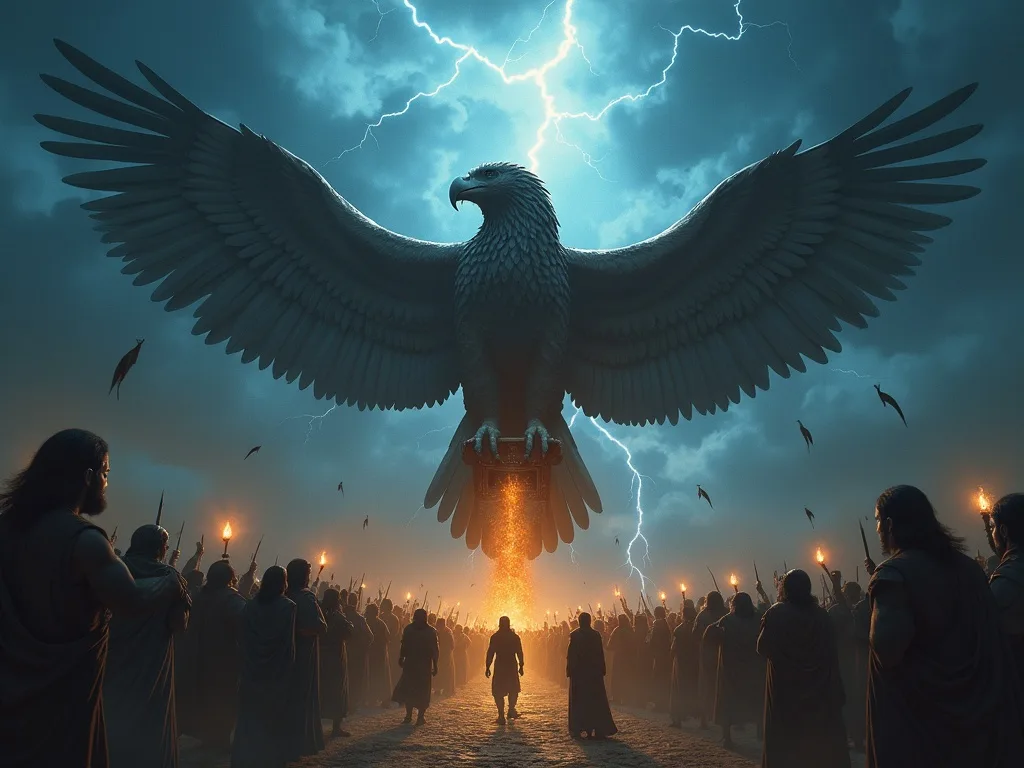
This made it the single most dangerous object in the cosmos. In the myth of Anzû, a divine bird of terrifying size (sometimes described as lion-headed, sometimes simply as a storm cloud that thinks), the Anzû steals the Tablet of Destinies directly from Enlil's chest while Enlil bathes. The moment it is taken, the universe freezes. Commands stop working. Natural processes halt. The gods panic.
The myth of Anzû is preserved in both Sumerian and Akkadian versions, the Akkadian text running to three tablets and dating from the second millennium BC. The hero who eventually retrieves the tablet is the warrior god Ninurta, Enlil's own son. There is a bitter irony here: Enlil's lapse in vigilance nearly unmakes everything he governs, and only his child can fix it.
It is a story about authority and its fragility. The most powerful being in the cosmos is still vulnerable in the moment he sets his power down.
Enlil and the Great Flood
Nothing in Enlil's mythology is more debated, or more consequential for the history of religion, than his decision to drown humanity.
The story appears in its fullest Sumerian form in the Atrahasis Epic, composed in Akkadian around 1700 BC but drawing on older Sumerian material. Humanity has grown loud. The noise of the human population rises to the heavens and disturbs Enlil's sleep. He tries lesser punishments first: drought, then plague, then famine. Each time, the wise god Enki quietly warns a mortal named Atrahasis ("He of Great Wisdom"), who rallies his people to pray and appease the responsible deity, and the punishment ends.
Enlil, furious at Enki's interference, finally demands total silence: a flood that will wipe every human from the face of the earth. He swears the other gods to secrecy. Enki finds a loophole. He cannot tell Atrahasis directly, but he can whisper the plan to a reed wall, knowing Atrahasis is on the other side. Atrahasis builds a boat. He loads it with his family and "the living creatures of the field." The flood comes. Humanity survives by a single act of divine defiance.
When Enlil sees the boat after the waters recede, he is not relieved. He is enraged that the plan failed. It is Enki who brokers peace, pointing out that total annihilation was excessive, that disease and infant mortality can trim human numbers without cosmic catastrophe. Enlil, finally, accepts this. He blesses Atrahasis and his wife with immortality.
The parallels with the later Hebrew flood narrative in Genesis are close enough that scholars since the nineteenth century have argued for direct textual borrowing, likely transmitted through Babylonian versions like the Epic of Gilgamesh, where the flood survivor is called Utnapishtim. The Sumerians got there first by at least a thousand years.
Enlil as a God of Civilization
The floods and the banishments can make Enlil seem like a god of pure destruction. That is only half the picture. Enlil is also, in Sumerian theology, the god who made civilization possible.
A hymn known as Enlil in the E-kur (translated by the Assyriologist Thorkild Jacobsen among others) praises him not for storms but for the order he maintains:
"Without Enlil, no city would be built, no settlement founded. No stall would be built, no sheepfold established."
The air between heaven and earth is not just weather. It is the medium through which all divine commands pass, the space in which human life becomes possible. Enlil decreed the me, the sacred laws and cultural gifts that structured Sumerian society: kingship, priesthood, the craft of the smith, the art of music, the practice of law.
In the myth of Enlil and the Pickaxe, preserved in Sumerian on tablets from Nippur, Enlil himself invents the pickaxe. He strikes the earth with it at a place called the Dur-an-ki, "the bond of heaven and earth," and from that wound in the soil the first humans sprout like grain. It is a creation story embedded in a labour story. Humans are made to dig, to farm, to build, so that the gods do not have to. The invention of agriculture and the invention of humanity are the same event.
Inanna, who later becomes the city goddess of Uruk and one of the most vivid figures in the entire tradition, is said in several texts to have stolen the me from Enki's hall, but it was Enlil who first distributed them. His authority underwrites the whole structure.
Enlil, Enki, and the Theology of Power
The relationship between Enlil and Enki is one of the great theological fault lines in Sumerian religion. Both are supreme. Both are creative. But they operate by completely different logics.
Enlil
Enlil rules by decree. His word is law because he holds the Tablet of Destinies. He commands through the air, through force, through the weight of his position. His power is vertical: orders come down, obedience goes up. When he decides on the flood, the other gods obey, even reluctantly.
Enki
Enki rules by intelligence. He holds the abzu, the underground freshwater ocean, and he controls magic, craft, and the me. He commands through cleverness, through loopholes, through the precise construction of language. When Enlil commands the flood, Enki does not defy the decree directly. He whispers to a wall. He finds the gap.
Together they represent two models of divine authority that appear across world mythology: the sovereign who commands and the craftsman who creates, the thunder and the word, the king and the vizier. In Mesopotamian political thought, the best ruler combined both. In practice, no one did.
Enlil's authority also sat above the sky god An, at least in practical terms. An was older, the father of many gods, the ultimate source of sovereignty. But by the time the great Sumerian hymns were written, An had become remote, a background presence. Enlil was the active king, the one who showed up, who decided, who acted. Scholars sometimes describe An as the nominal king and Enlil as the functional one. The distinction matters: Enlil does not merely inherit power, he exercises it.
Enlil Across Cultures: From Nippur to the Iron Age
Enlil's influence did not stop at the borders of Sumer. As Akkadian culture absorbed and transformed Sumerian religion after the rise of the Akkadian Empire under Sargon of Akkad around 2334 BC, Enlil became Bel, "the Lord." This title became so associated with supreme divine power that later Babylonian texts sometimes apply it to the god Marduk, Babylon's patron deity, as Marduk rose to replace Enlil as the theological center of Mesopotamian religion.
The Enuma Elish, the Babylonian creation epic composed around 1100 BC, reframes the cosmos with Marduk at the top. But even there, Enlil's shadow is present. Marduk inherits Enlil's fifty names, his role as executive of the divine assembly, and his function as holder of the Tablet of Destinies. The power did not vanish; it was relabeled.
Further west, the Hurrian and Hittite traditions absorbed Enlil as well, where he appears as a member of the divine council alongside the storm god Teshub. The Canaanite El, chief god of the pantheon and father of the gods, shares enough structural and etymological ground with Enlil that several scholars, including Mark S. Smith in The Origins of Biblical Monotheism (2001), have explored their relationship carefully. The Hebrew El Shaddai, sometimes translated as "God of the Mountain," carries echoes of the Ekur, Enlil's mountain temple in Nippur.
These are not claims of straight-line descent. Religious ideas travel in networks, not pipelines. But Enlil was one of the great originating nodes in that network.
Frequently Asked Questions About Enlil
Frequently asked questions
What exactly did Enlil rule over in Sumerian religion?
Enlil ruled the space between heaven (An) and earth (Ki), which the Sumerians called lil. This included the air, the wind, storms, and breath, but also the invisible medium through which all divine commands traveled. He held the Tablet of Destinies, which gave him authority over the fates of both gods and mortals. In practical terms, he was the executive power of the Sumerian divine assembly: the one who issued binding decrees.
Why did Enlil send the flood, and how does this compare to the biblical story?
In the Atrahasis Epic (around 1700 BC), Enlil sent the flood because the noise of humanity disturbed his sleep. He had tried plague, drought, and famine first. The Sumerian flood survivor is Atrahasis; in the later Epic of Gilgamesh, he appears as Utnapishtim. Scholars widely agree that the Genesis flood narrative was influenced by these Mesopotamian sources, transmitted through Babylonian literary culture. The key structural differences are theological: the Sumerian flood is triggered by nuisance, not moral failure, and is resisted by Enki rather than freely permitted by all gods.
What is the Tablet of Destinies and why was it so important?
The Dup Shimati (Tablet of Destinies) was a divine object inscribed with the fates of all gods and mortals. In Sumerian theology, writing had creative power: to inscribe something was to make it real. Enlil wore it pressed against his chest. When the divine bird Anzû stole it, natural processes stopped and the cosmic order collapsed, which is why retrieving it required the hero god Ninurta. The tablet is essentially a metaphor for the mechanism of divine authority: whoever holds it controls reality itself.
How did Enlil's role change as Mesopotamian culture evolved?
As Akkadian and then Babylonian culture absorbed Sumerian traditions after 2300 BC, Enlil's functions were progressively taken over by Marduk, Babylon's patron deity. In the Babylonian creation epic Enuma Elish (around 1100 BC), Marduk inherits Enlil's fifty titles and his role as holder of the Tablet of Destinies. Enlil did not disappear; he remained a major god in the Babylonian and Assyrian pantheons, but he was no longer the unchallenged supreme ruler. His title Bel ("Lord") became a generic term for great gods.
Is there a connection between Enlil and later Semitic gods like El or Baal?
Scholars debate this. The title Bel (Enlil's Akkadian name) is cognate with Canaanite Baal ("Lord"), and both function as storm-associated chief deities. Canaanite El, the father of the gods, shares structural parallels with Enlil as well: both preside over divine assemblies, both live on sacred mountains, both are associated with the source of rivers. Mark S. Smith and other comparative Semitists treat these as convergent evolutions within shared cultural networks, not direct borrowings, though Mesopotamian influence on Canaanite religion is well documented.
What primary sources survive about Enlil?
Enlil appears in a substantial body of Sumerian cuneiform literature. Key texts include Enlil in the E-kur (a major hymn from the Nippur scribal tradition), Enlil and Ninlil (the myth of his union with the grain goddess), Enlil and the Pickaxe (a creation myth), and the Atrahasis Epic (the flood narrative, in Akkadian). The Anzû myth in both Sumerian and Akkadian versions is central to understanding his relationship with the Tablet of Destinies. Most of these texts were translated and analyzed by Samuel Noah Kramer, whose 1963 book The Sumerians: Their History, Culture, and Character remains a foundational reference.
Enlil in the Modern Imagination and Unresolved Questions
Enlil, Lord of the Wind and King of the Gods, has attracted renewed scholarly attention in the twenty-first century, partly because of the flood narrative and its well-publicized relationship to biblical texts, and partly because Mesopotamian religion as a whole is finally receiving the kind of popular attention it deserves after centuries of being overshadowed by Greek and Norse traditions.
Some writers in ancient astronaut circles have attempted to read Enlil as evidence of extraterrestrial visitation, a claim that has no basis in the primary texts and that the academic community unanimously rejects. The Sumerians did not need outside help to imagine a god of storms and commands; every agrarian society that has ever faced drought and flood has done the same.
The genuinely open scholarly questions are more interesting. Exactly how the Sumerian Enlil theology was transmitted into Canaanite and early Hebrew religious thought remains a live debate. The degree to which the Atrahasis flood story directly shaped Genesis, versus both drawing on a common ancient Near Eastern flood tradition, is still being worked out through comparative textual analysis. Andrew George's 2003 critical edition of the Epic of Gilgamesh reopened several of these questions.
There is also the question of Enlil's moral character. He is not a villain. He is not a hero. He is the wind, which is to say he is the universe's indifference shaped into a personality. He floods the world because the noise bothers him. He is exiled for sexual violence and follows his wife into the underworld. He creates humanity with a pickaxe blow and later tries to destroy it. He is contradictory because the forces he represents are contradictory.
That may be the most honest thing the Sumerians ever wrote about power: it does not have a clean face. It creates cities and levels them. It fills the air with the breath of life and empties it with the breath of storms. The god who holds the Tablet of Destinies is the same god who puts it down to wash his hands, and in that moment of inattention, the whole world nearly falls apart.
Enlil is old, older than almost any written theology on earth. He deserves to be read with the same seriousness we bring to Zeus or Odin. Not as a curiosity from a dead civilization, but as a serious attempt by serious people to understand why the sky sometimes roars and sometimes goes quiet, and what kind of mind might sit behind that silence.
Read the full book
Want the whole story?
The complete edition is an instant PDF download here, with a paperback on Amazon for selected titles.
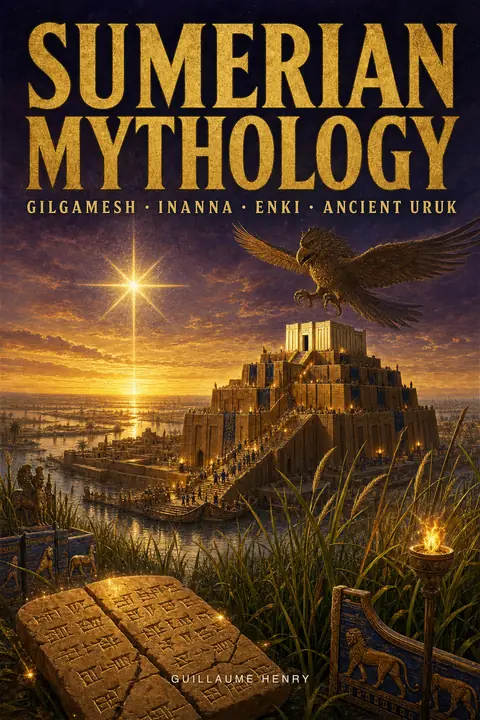
Sumerian
The Sumerian Mythology Book: Gilgamesh, Inanna, Enki, and the World's Oldest Sacred Stories
Gilgamesh, Inanna, and the world's oldest written myths
The earliest written myths on earth, preserved on clay tablets four thousand years ago. Gilgamesh seeking immortality, Inanna descending to the underworld, Enki shaping the cosmos. Here is what survived.
More from Sumerian
All articles
Sumerian
Enki: God of Wisdom, Water, and Creation
Enki shaped human intelligence and filled the rivers with life. This Sumerian god of wisdom, water, and cunning stands at the heart of creation itself, bending the rules when justice demands it. Meet the architect of civilization.
Sumerian
Inanna: Goddess of Love, War, and the Planet Venus
Inanna commands both ecstasy and carnage: a Sumerian goddess who embodied love, war, and the morning star. Her descent to the underworld remains literature's oldest recorded myth of transformation and return.
Sumerian
Eridu: The First City and Sacred Center of Sumerian Civilization
Eridu was the oldest city on Earth, where the Sumerians believed civilization itself began. Archaeologists have found temples, artifacts, and evidence of the world's first urban settlement here, where gods and humans first mingled.
Sumerian
The Me: Divine Powers and Cosmic Order in Sumerian Mythology
The Me were not objects but fundamental laws of existence itself. Sumerian texts reveal how goddesses stole them, gods hoarded them, and the whole universe bent to their will.