
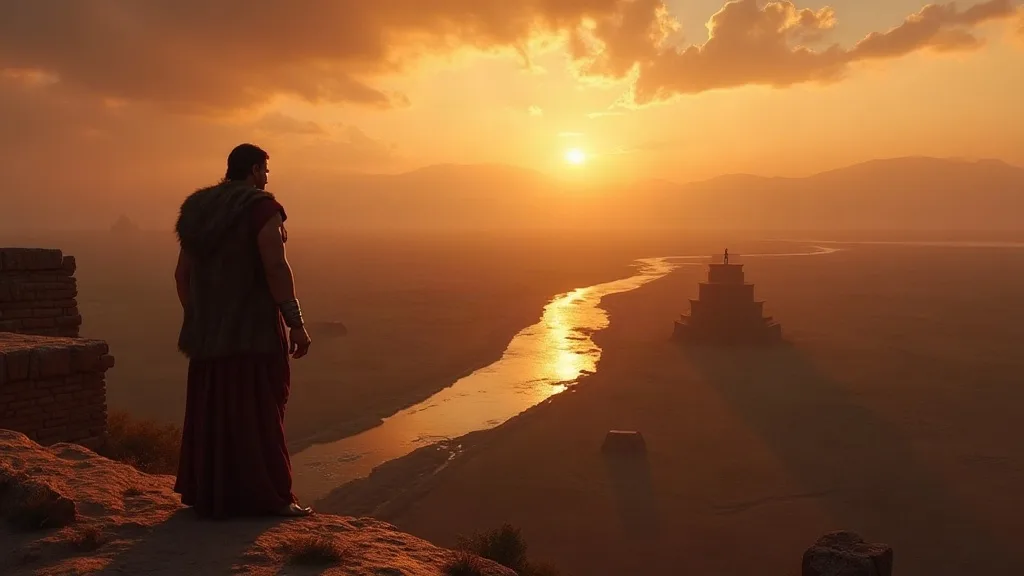
Gilgamesh: The Historical King and Mythic Hero
Gilgamesh ruled Uruk around 2700 BC and became the first named hero in world literature. His Epic asks what any life is worth when death cannot be outrun.
Contents
The walls of Uruk rose thirty feet above the flood plain of southern Mesopotamia, made of baked mud-brick so dense that travelers three thousand years later would still marvel at them. Behind those walls lived a king whose name would outlast every dynasty between his age and ours. His exploits were pressed into wet clay in a script we call cuneiform, the world's earliest writing system, and the stories spread across an entire civilization for nearly two millennia before being buried and forgotten. Rediscovered in the 1840s from the ruins of a royal library, they returned to human memory with a force that knocked scholars sideways. Nothing like them had ever been found.
Gilgamesh: the historical king and mythic hero of ancient Sumer is a figure who straddles two kinds of reality at once. He was almost certainly a real man, a ruler who built and governed. He was also transformed, within a century or two of his death, into something larger: a demigod who wrestled a wildman, cut down a cosmic cedar forest, refused a goddess, watched his best friend die, and crossed the sea at the edge of the world in search of a way not to die. No other figure from the ancient Near East carries that double weight so completely.
The story matters now for reasons its first audience could not have imagined. It is the oldest surviving long narrative in human history, older than Homer by fifteen centuries. It asks questions that have not aged: What does friendship cost? What do you do with grief you cannot fix? Is there any honor in a life that ends? The king from Uruk never answered those questions cleanly. That is precisely why he still compels.
The Real King Behind the Legend
Gilgamesh appears in the Sumerian King List, a document compiled around 2100 BC that records the rulers of Mesopotamian city-states going back to before the great flood. He is listed as the fifth king of Uruk's first dynasty, son of the high priestess Ninsun and a mortal father named Lugalbanda (himself a legendary king). His reign is placed conventionally around 2700-2600 BC, during the Early Dynastic period of Sumer.
The archaeological record provides thin but real confirmation. Inscriptions from the kings who ruled Uruk in the centuries after Gilgamesh refer back to him as an ancestor and a founding figure. The city's great defensive wall, celebrated in the opening of the Epic, is genuine: surveys of the site of ancient Uruk (modern Warka, in southern Iraq) have identified a massive mudbrick circuit dating to the late third millennium BC. The Epic itself boasts that Gilgamesh built it, and while royal building projects were standard propaganda, the wall clearly existed.
By around 2100 BC, three separate Sumerian poems about Gilgamesh were circulating in the scribal schools of Mesopotamia. These poems, now called Gilgamesh and Agga, Gilgamesh and Huwawa, and Gilgamesh and the Bull of Heaven, were teaching texts. Boys memorizing cuneiform copied them out on practice tablets. That is partly why they survived: school assignments are the least glamorous but most durable form of archive.
The transformation from city-king to mythic hero was not unusual in Mesopotamia. The god-lists of Sumer include several figures who began as historical rulers before being absorbed into the divine or semi-divine register. What made Gilgamesh unique was the ambition and philosophical weight of the stories that gathered around him.
Enkidu: The Friend Who Made the King Human
No part of the Gilgamesh tradition is more original, or more emotionally powerful, than the figure of Enkidu. He enters the story not from a city or a family but from the steppe, created by the goddess Aruru from a lump of clay, running wild with the animals, pulling up hunters' traps, drinking at waterholes alongside gazelles. He is the anti-Gilgamesh: raw nature against built civilization, the unnamed against the named, the free body against the restless mind.
Gilgamesh, at this point in the story, is a bad king. The Standard Babylonian version, written in Akkadian and assembled by a scholar-priest named Sin-leqi-unninni around 1200 BC, is blunt about it: he exhausts the young men of Uruk in endless tests of strength, and he sleeps with the brides of his city before their husbands do. The people cry out to the gods. The gods respond not with punishment but with a solution: they create Enkidu as a counterweight.
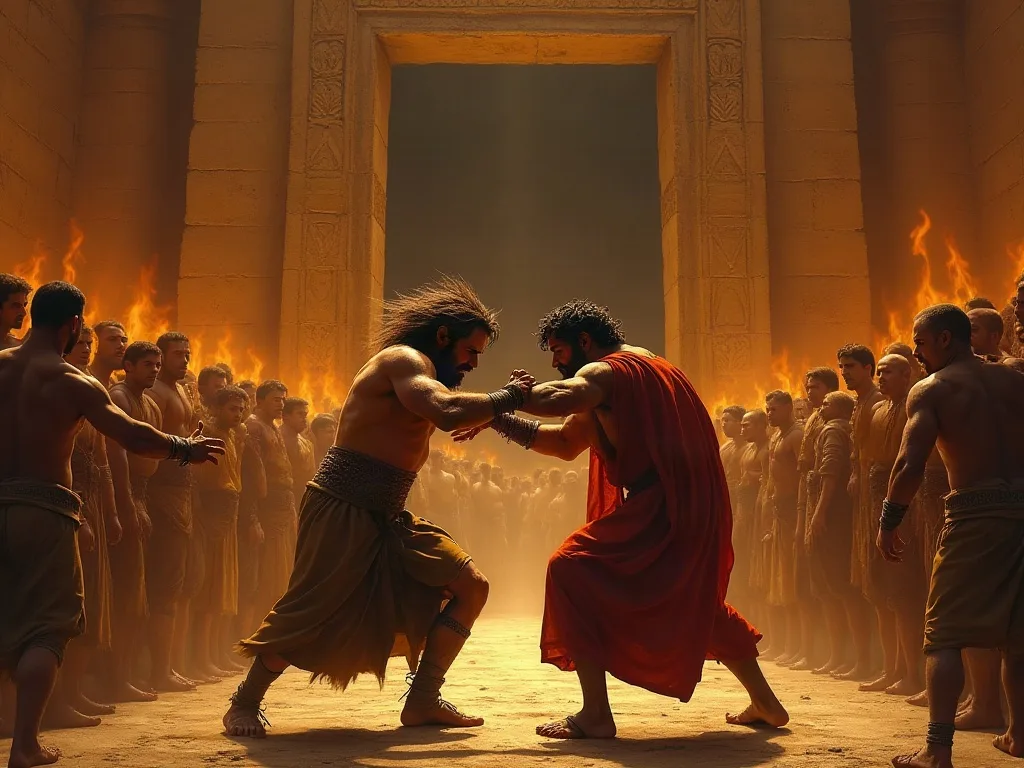
The two men meet after Enkidu is introduced to human life by a temple priestess named Shamhat, whose role was ritual and sacred in the Mesopotamian understanding rather than disreputable. She gives him bread, beer, oil, and clothing. He comes to the city. He blocks Gilgamesh at a doorway. They wrestle with a fury that shakes the doorposts, and when it is over, they embrace. They love each other from that moment in the text's own language, with a clarity and completeness the narrative never feels the need to explain or qualify.
What the friendship does to Gilgamesh is the point. The reckless, oppressive king becomes a companion, an adventurer, a man capable of care. Together they travel west to the great Cedar Forest, guarded by the monster Huwawa (called Humbaba in the Babylonian version), appointed as its warden by the god Enlil. They kill Huwawa. They kill the Bull of Heaven sent against them by the goddess Inanna after Gilgamesh refuses her offer of love, a refusal delivered in one of the most stinging speeches in ancient literature. For all this, Enkidu is chosen by the gods to die.
The Death of Enkidu and the Birth of a Different Man
Enkidu falls ill. The illness is slow. The twelve-day death scene in the Standard Babylonian version is among the oldest extended deathbed narratives in existence, and it is not comfortable. Enkidu curses the doorway he passed through into civilization. He curses Shamhat for bringing him out of the wild. Then the sun god Shamash speaks from heaven and reminds him of everything he received: the friendship, the feasts, the glory. Enkidu withdraws his curses. He blesses Shamhat instead. Then he dies.
Gilgamesh falls apart. He refuses to believe it for three days, hoping Enkidu will wake. When a maggot drops from his friend's nostril, he accepts it. He orders the craftsmen of Uruk to build a statue of Enkidu out of gold and lapis lazuli, a Mesopotamian stone the color of night sky, mined in the mountains of what is now Afghanistan and traded across the ancient world. Then he leaves. He cannot stay inside the walls he built.
What he is fleeing is not only grief but the knowledge that arrived with Enkidu's death: he will die too. Gilgamesh the man was already aware of death. Gilgamesh the king, who destroyed monsters and scorned a goddess, had perhaps not really believed in it for himself. He goes into the wild wearing lion skins and wandering, because wandering is the only activity left that feels honest.
His destination is Utanapishtim, the one man in Mesopotamian myth who survived the great flood and was given immortality by the gods. Utanapishtim lives at the mouth of the rivers, past the twin mountains that hold up the sky, past the sea of death. If anyone knows where to find permanent life, it is him.
Crossing the Waters of Death
The journey to Utanapishtim is structured like a sequence of impossible gates. Gilgamesh passes the Mashu mountains, guarded by scorpion-people who stand twelve cubits tall (roughly eighteen feet, if you take the ancient measurement literally) and whose heads touch the sky while their lower halves anchor in the underworld. They warn him that no mortal has ever passed this road. He passes anyway.
He crosses the garden of the gods, described in some versions as a grove where the vines bear gemstones instead of grapes. He finds a tavern-keeper named Siduri, a woman sitting by the sea. She also warns him. She delivers the speech that scholars sometimes call the Mesopotamian carpe diem: "When the gods created mankind, they allotted death to mankind, but life they retained in their own keeping." She tells him to eat, drink, dress himself in clean clothes, hold a child's hand, let his wife delight in his embrace. It is not consolation. It is the clearest statement the tradition ever makes about what a human life is for.
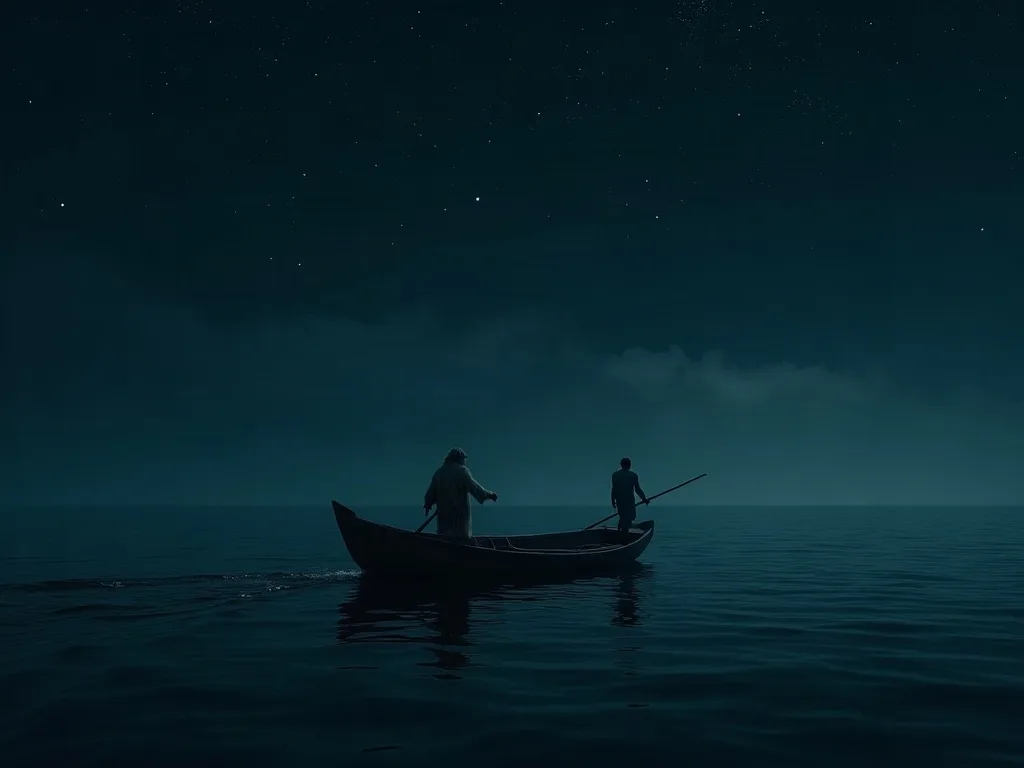
Gilgamesh is not ready to hear it. He finds the boatman Urshanabi, whose boat is the only vessel that can cross the Waters of Death. He crosses. He reaches Utanapishtim on the far shore.
The conversation between the two is remarkable for its directness. Utanapishtim does not give Gilgamesh what he wants. Instead he tells him the full story of the flood, a narrative so close in structure to the later story of Noah in Genesis that scholars have been studying the relationship since the 1870s. The Mesopotamian flood story, predating the biblical version by centuries, describes how the god Enlil decided to destroy humanity with water, while the god Ea secretly warned Utanapishtim to build a great boat and save the seed of all living things. Utanapishtim survived. The gods, regretting the destruction, rewarded him with immortality. But that was a one-time decision. It cannot be repeated.
Utanapishtim offers Gilgamesh a test: stay awake for seven days, and perhaps the matter of immortality can be reconsidered. Gilgamesh immediately falls asleep. He sleeps for seven days. He fails the only test he was given. Utanapishtim's wife bakes a loaf of bread for each day he sleeps, so that when he wakes and protests that he only dozed for a moment, seven loaves in various stages of decay prove the seven days. The humor is quiet and devastating.
The Plant That Slipped Away
Utanapishtim, taking pity, tells Gilgamesh about a plant that grows at the bottom of the sea. It will not give immortality, but it will restore youth. Gilgamesh ties stones to his feet, dives to the ocean floor, finds the plant, and brings it up. He names it "Old Man Grown Young Again." He plans to take it back to Uruk and test it on the elders of his city before he uses it himself. The gesture is notable: even here, exhausted and heartbroken, he thinks of his people first.
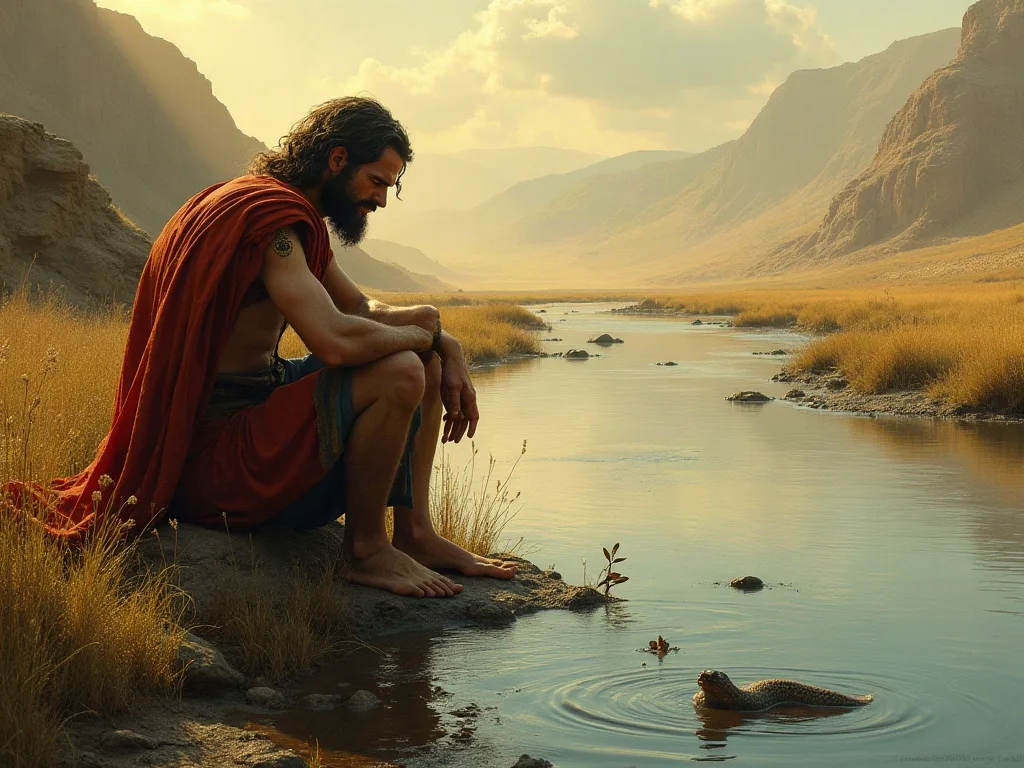
He never gets the chance. At a pool on the journey back, he stops to bathe. A snake smells the plant's fragrance, rises from the water, and takes it. The snake sheds its skin as it retreats, the Mesopotamian explanation for why snakes can renew themselves while humans cannot. Gilgamesh sits down on the bank and weeps.
Then he gets up. He walks back to Uruk. The Epic ends with Gilgamesh showing the boatman Urshanabi the city's walls: the baked-brick construction, the foundation, the orchards, the clay pits. Look at these walls. Look at what I built. The walls are not a consolation prize; they are the answer the poem had been building toward all along. The life you leave behind in stone and story is the only permanence available. It is enough, or it has to be.
Inanna's Refusal and What It Reveals
The episode where Gilgamesh rejects the goddess Inanna is one of the most philosophically dense passages in the entire Epic, and it is sometimes read too quickly. Inanna, the goddess of love and war, the most powerful deity in the Sumerian pantheon, looks at Gilgamesh after he and Enkidu return from killing Huwawa and offers herself as his lover. In any other ancient Near Eastern myth, a hero who received the love of such a goddess would accept immediately.
Gilgamesh refuses. He recites a list of her previous lovers: Tammuz the shepherd, who now weeps in the underworld. The allallu-bird, whose wing she broke. The lion, trapped in pits. The horse, driven and broken by the bit. Each love affair ended in destruction for the beloved. Inanna, he argues, is an oven that goes cold in winter and a door that keeps out neither wind nor storm. The speech is brilliant and reckless and arguably suicidal.
Inanna responds by sending the Bull of Heaven to destroy Uruk. The bull snorts and opens pits in the earth that swallow hundreds of Uruk's warriors. Gilgamesh and Enkidu kill the bull together. Enkidu tears off its thigh and throws it in Inanna's face. The gods convene and decide one of the two must die for what they have done. They choose Enkidu. The refusal costs Gilgamesh everything he loves.
This sequence is not a simple warning against disrespecting goddesses. Read alongside the Sumerian hymns to Inanna, which describe her as the one who "overturns the established order" and who "turns man into woman and woman into man," the encounter reads as something more complex: a moment where a king's pride in his own human achievement collides with the divine order, and the divine order does not flinch.
The Flood, the Bible, and the Scholars
When the British Assyrologist George Smith announced in 1872 that he had found a Babylonian flood story on a cuneiform tablet from Nineveh, he reportedly stood up, ran around the room, and began removing his clothes in excitement. The account is probably exaggerated, but it reflects the genuine shock of the discovery. Here was a flood narrative with a boat, a storm, a dove sent to find land, a landing on a mountain, and a sacrifice to the gods, all written down centuries before any biblical text in its current form.
The relationship between the Gilgamesh flood account and the Genesis flood remains one of the most discussed questions in comparative mythology and biblical scholarship. Most scholars now view both as drawing from a common Mesopotamian literary tradition rather than one copying the other directly. The Atrahasis Epic, another Mesopotamian text older than the Standard Babylonian Gilgamesh, contains a flood story that is in some ways even closer to Genesis, which suggests a shared regional template rather than a straight borrowing.
The discovery mattered because it forced the first serious scholarly reckoning with the idea that biblical narratives had ancient Near Eastern precursors and literary relatives. That reckoning is still ongoing. The Gilgamesh flood is not evidence against the Genesis account or for it; it is evidence that flood narratives were the common property of a whole cultural world, and that Mesopotamian storytellers were working with that material for a very long time before anyone pressed Hebrew letters into the tradition.
Gilgamesh Flood (Babylon)
- Flood sent by Enlil to destroy noisy humanity
- Utanapishtim warned secretly by the god Ea
- Boat built to save family and animals
- Dove, swallow, and raven sent to test the waters
- Boat lands on Mount Nimush
- Gods smell the sacrifice and gather like flies
- Utanapishtim granted immortality as reward
Noah's Flood (Genesis)
- Flood sent by God to punish human wickedness
- Noah warned directly by God
- Ark built to save family and animals
- Dove and raven sent to test the waters
- Ark rests on Mount Ararat
- God smells the pleasing aroma of the sacrifice
- Noah's covenant: no second flood, the rainbow as sign
Gilgamesh in Sumer, Babylon, and Beyond
The Epic did not stay in one version or one language. The oldest fragments are in Sumerian, dating to around 2100-2000 BC. The Old Babylonian version, written in Akkadian around 1700 BC, is more polished and introduces Siduri's speech in a more developed form. The Standard Babylonian version by Sin-leqi-unninni, compiled around 1200 BC, adds a twelfth tablet that is actually a translation of part of a separate Sumerian poem about the underworld, appended to make the cycle feel complete.
Fragments of the Gilgamesh tradition have been found in Hittite and Hurrian translations from Anatolia (modern Turkey), showing the Epic was read and adapted across the ancient Near East by at least 1400 BC. A small fragment was found at Megiddo, in modern Israel, dating to the fourteenth century BC, which means the Epic was circulating in Canaan around the time of the events described in parts of the Hebrew Bible.
The Library of Ashurbanipal at Nineveh, the great Neo-Assyrian royal collection destroyed when Nineveh fell in 612 BC, preserved the Standard Babylonian tablets that George Smith and his colleagues would excavate in the nineteenth century. Without that library and its destruction-preservation cycle (fire baked the clay harder, making the tablets more durable), the Epic would not exist for us today. The irony is perfect: the burning of a city saved the world's oldest story.
Gilgamesh's Legacy in Modern Literature and Thought
The Epic re-entered the literary conversation in the twentieth century with a force that has not diminished. Rainer Maria Rilke read an early translation and called it "the epic of the fear of death." David Ferry's 1992 verse translation became a bestseller. Stephen Mitchell's 2004 rendering sold widely in both academic and general markets. The Epic has been translated into more than a hundred languages.
Its influence on literature is traceable but not always acknowledged. The "wild man" archetype that Enkidu embodies recurs in the figure of Caliban in Shakespeare's The Tempest and in Tarzan a century later. The hero who crosses the waters at the edge of the world in search of immortality echoes in Odysseus's journey to the underworld and in Dante's Ulysses reaching for the forbidden mountain. The specific motif of the snake stealing the plant of life has been read as a structural parallel to the serpent and the fruit in Genesis 3.
The grief at the heart of the Epic is perhaps its most contemporary quality. Gilgamesh loses someone irreplaceable and cannot be argued out of his loss by theological consolations or philosophical distance. He has to walk through the grief, literally, across deserts and oceans and the darkness under the mountains. Modern readers recognize that motion. They have made the same trip.
The walls of Uruk still stand, buried under the alluvial soil of Iraq. Satellite images show their outline clearly. Gilgamesh built them, or so the poem says. The clay tablets that carry his name are in museums in London, Baghdad, Istanbul, Philadelphia, and Berlin. He is, by any measure, the most durably documented hero of the ancient world: not as a god, not exactly as a man, but as the oldest written proof that humans have always needed stories about what happens when we refuse to accept the terms of our own mortality.
Frequently Asked Questions About Gilgamesh
Frequently asked questions
Was Gilgamesh a real historical person?
Almost certainly yes, at least in outline. The Sumerian King List, compiled around 2100 BC, places Gilgamesh as the fifth king of Uruk's first dynasty, with a reign dated conventionally to around 2700-2600 BC. Later Mesopotamian kings referenced him as an ancestor and a founder, and the great defensive walls of Uruk that the Epic celebrates have been confirmed archaeologically at the site of modern Warka in Iraq. None of this proves the legends; it does confirm a real king behind them.
What is the oldest version of the Gilgamesh story?
The oldest surviving texts are five separate Sumerian poems dating to roughly 2100-2000 BC, found on tablets from the scribal schools of Nippur and other Mesopotamian cities. These include "Gilgamesh and Huwawa" and "Gilgamesh and the Bull of Heaven." They predate the unified Akkadian Epic, which reached its most complete form around 1200 BC in the version attributed to Sin-leqi-unninni.
How closely related is the Gilgamesh flood story to the biblical flood?
The structural parallels are very close: a divinely warned hero, a great boat carrying animals, birds sent to test receding waters, a landing on a mountain, a sacrifice afterward. Most scholars today view both narratives as descendants of a shared Mesopotamian literary tradition rather than one copying the other directly. The even older Atrahasis Epic from around 1700 BC contains a similar flood account, suggesting the motif was deeply embedded in Mesopotamian culture long before it entered Hebrew tradition.
Why does Gilgamesh refuse the goddess Inanna?
Gilgamesh lists Inanna's former lovers, each of whom came to ruin after her attention turned: Tammuz condemned to the underworld, a bird with its wing broken, a lion trapped. His refusal is a claim that divine love, for a mortal, is not a gift but a sentence. The speech reveals his pride in his own human autonomy, an autonomy the gods will punish through Enkidu's death. Inanna's role here also connects to the broader Sumerian understanding of her as the goddess who dissolves fixed categories.
What does the plant of immortality represent in the Epic?
The plant Gilgamesh retrieves from the ocean floor is called "Old Man Grown Young Again" in the text. It does not grant immortality outright, only rejuvenation, which is itself a telling limitation. Gilgamesh plans to test it on Uruk's elders before using it himself, a small act of kingship inside his grief. The snake's theft of the plant gives Mesopotamians an origin story for why snakes shed their skin and renew themselves. For Gilgamesh, the loss collapses the final hope. His response, returning to Uruk and describing its walls, frames the city and its legacy as the human answer to the death the gods withhold.
Who translated the Gilgamesh Epic and when was it rediscovered?
George Smith, a self-taught Assyriologist working at the British Museum, made the first major translation announcement in 1872 after identifying the flood tablet among material excavated from Nineveh by Austen Henry Layard in the 1840s and 1850s. Smith recognized parallels to the biblical flood story and published his findings, causing an international sensation. The Standard Babylonian tablets he worked from are now held primarily in the British Museum. Key modern translations include those by Andrew George (Penguin, 2000), David Ferry (1992), and Stephen Mitchell (2004).
The Walls That Outlasted the King
The last lines of the Standard Babylonian Epic are almost identical to the opening lines. Gilgamesh shows Urshanabi the walls of Uruk: their circumference, their foundation of fired brick, the orchards, the clay pits, the temple precinct of Inanna. This circular structure is deliberate. The answer to the fear of death was already there before the journey began; the journey was necessary to see it.
Scholars debate what the Epic finally argues. Andrew George, whose 2003 critical edition for Penguin Classics remains the standard scholarly reference in English, reads the ending as genuinely consolatory: the city and its culture are a form of survival that a king can actually achieve, as opposed to the biological immortality he cannot. Other scholars, including Martin West in his comparative study The East Face of Helicon, argue the ending is darker: Gilgamesh is left with the same walls, the same city, the same death waiting, and the journey has changed nothing except his willingness to look at what he already had.
Both readings are honest. The poem holds them both, which is part of why it keeps generating commentary three thousand years after the last scribe pressed the last wedge into the last tablet. A story that delivers clean answers tends to exhaust itself. A story that leaves the question standing, visible and undefeated, keeps working on you.
What the Epic of Gilgamesh ultimately gives its readers is not a lesson but a companion: a king who built walls, lost his friend, walked to the edge of the world, failed the only test that mattered, and came home anyway. That is not triumph. It is something more useful, a model for the specific kind of courage required to continue after the thing you feared most has already happened.
Read the full book
Want the whole story?
The complete edition is an instant PDF download here, with a paperback on Amazon for selected titles.
Sumerian
The Sumerian Mythology Book: Gilgamesh, Inanna, Enki, and the World's Oldest Sacred Stories
Gilgamesh, Inanna, and the world's oldest written myths
The earliest written myths on earth, preserved on clay tablets four thousand years ago. Gilgamesh seeking immortality, Inanna descending to the underworld, Enki shaping the cosmos. Here is what survived.
More from Sumerian
All articles
Sumerian
Enki: God of Wisdom, Water, and Creation
Enki shaped human intelligence and filled the rivers with life. This Sumerian god of wisdom, water, and cunning stands at the heart of creation itself, bending the rules when justice demands it. Meet the architect of civilization.
Sumerian
Inanna: Goddess of Love, War, and the Planet Venus
Inanna commands both ecstasy and carnage: a Sumerian goddess who embodied love, war, and the morning star. Her descent to the underworld remains literature's oldest recorded myth of transformation and return.
Sumerian
Eridu: The First City and Sacred Center of Sumerian Civilization
Eridu was the oldest city on Earth, where the Sumerians believed civilization itself began. Archaeologists have found temples, artifacts, and evidence of the world's first urban settlement here, where gods and humans first mingled.
Sumerian
The Me: Divine Powers and Cosmic Order in Sumerian Mythology
The Me were not objects but fundamental laws of existence itself. Sumerian texts reveal how goddesses stole them, gods hoarded them, and the whole universe bent to their will.