
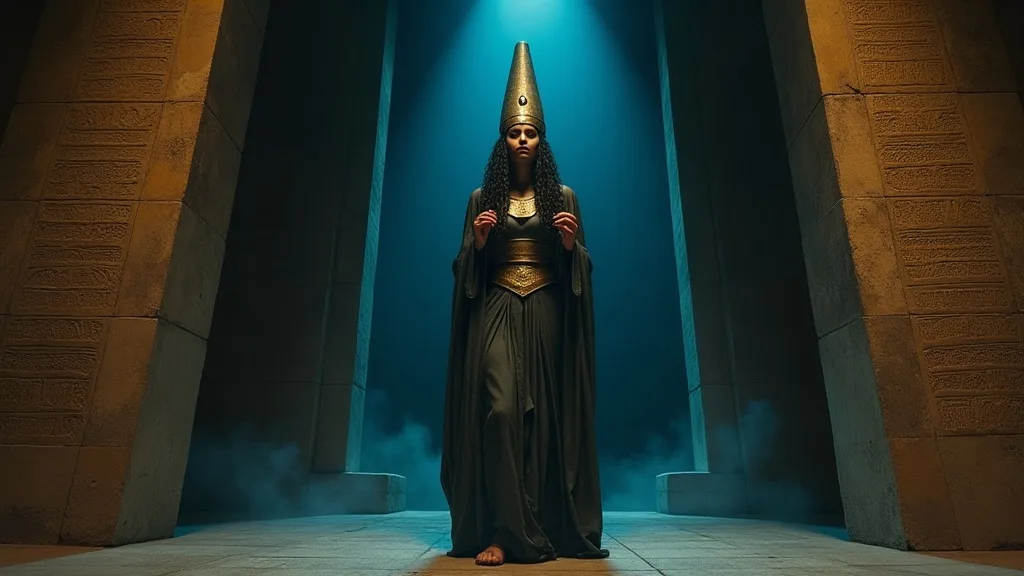
The Descent of Inanna to the Underworld: Death, Power, and Return in Sumerian Myth
Inanna walked into the land of no return and came back. The Descent of Inanna is Sumer's greatest myth: a raw, layered story of death, grief, and the price of resurrection.
Contents
She arrived at the first gate wearing a crown. By the seventh, she was naked. Then she died.
The Descent of Inanna to the Underworld is one of the oldest complete narratives in human history, inscribed on clay tablets in ancient Sumer around 1900-1600 BC, though the oral tradition behind it stretches back centuries further. It tells the story of Inanna, queen of heaven, goddess of love and war, who abandons her temples and her cities and walks, deliberately, into the realm of the dead. Nobody does that. Nobody comes back. Inanna does both, but not without cost.
The poem survives in Sumerian, the world's first written literary language, and was pieced together from dozens of fragmented tablets housed today in museums across Philadelphia, Istanbul, and Oxford. Scholar Samuel Noah Kramer spent much of the mid-twentieth century reconstructing it, publishing the now-standard scholarly edition with Diane Wolkstein in 1983. The result is a text that reads less like theology and more like drama: tense, strange, and psychologically sharp. Every line earns its place.
Why Inanna Goes Down: The Mystery at the Heart of the Myth
No single reason satisfies. The text opens with Inanna "setting her ear to the great below," a phrase the Sumerians used for fixing one's mind on something with total resolve. She hears the call of Kur, the Sumerian word for both "mountain" and "underworld," the land beneath the earth where the dead drink dust and eat clay.
One reading is political. Ereshkigal, the queen of the underworld, is Inanna's older sister. She rules Kur alone, in grief, after her husband Gugalanna, the Bull of Heaven, has died. Some scholars read Inanna's descent as an attempt to seize that kingdom too: she already holds the me (pronounced "may"), the sacred laws that govern civilisation above, and perhaps she wants dominion below as well. The text never confirms this. Inanna's motivations stay deliberately opaque, and that ambiguity is part of the poem's power.
A second reading is one of grief and solidarity. Ereshkigal is mourning. Inanna, as a goddess bound to all human experience, might descend out of something like compassion, or curiosity. A third reading, popular in Jungian circles, treats the descent as psychological: a voluntary dismantling of the self, a death of the ego before a deeper self can be born.
The text does not choose. It holds all three at once.
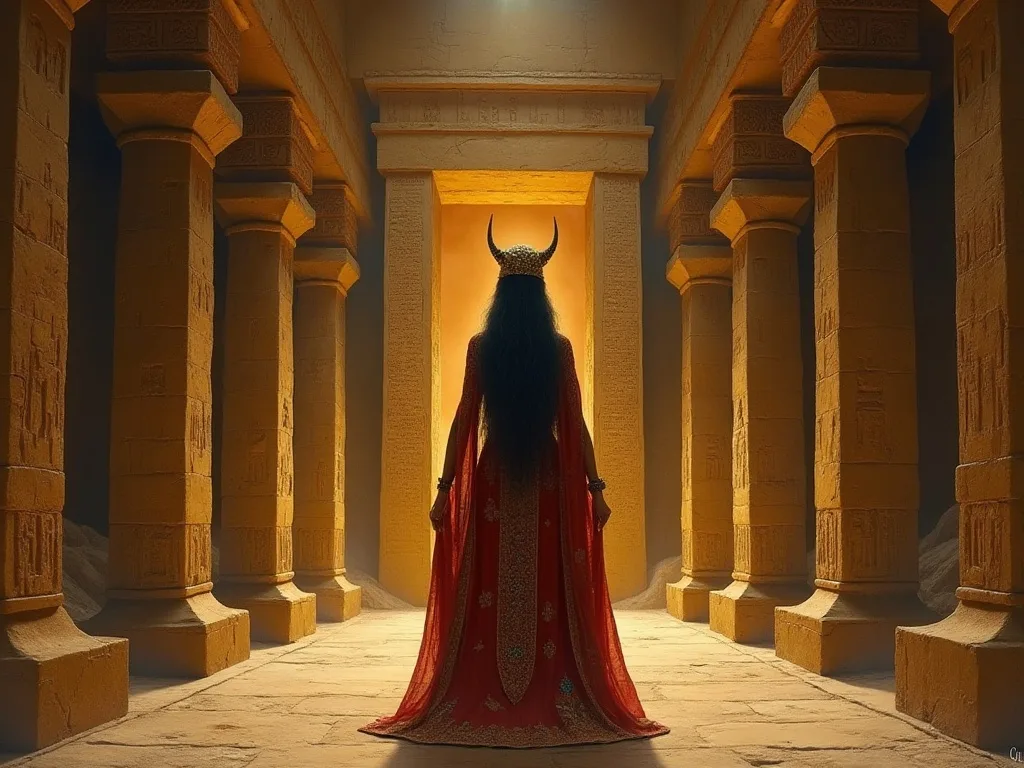
The Seven Gates: Stripping a Goddess Down to Nothing
Before entering, Inanna prepares with extraordinary care. She puts on the seven me of heaven, each one a physical object that encodes divine power:
- The shugurra crown on her head
- Lapis lazuli beads at her throat
- A golden ring on her wrist
- A breastplate called "come, man, come"
- A robe of ladyship
- Kohl applied to her eyes, named "let him come, let him come"
- A measuring rod and line in her hand
These are not decorations. They are sovereignty itself made material. She also instructs her servant Ninshubur to wait three days, and if she has not returned, to go to every god in heaven and weep until someone agrees to rescue her.
At the first gate of the underworld, the gatekeeper Neti stops her. He goes to Ereshkigal and reports the arrival. Ereshkigal's reaction is telling: she slaps her thigh (a Sumerian gesture of distress) and bites her lip. She knows what her sister's arrival means. She orders Neti to bolt every lock, open each gate only a crack, and strip Inanna of one divine attribute at each threshold.
Gate one: the crown removed. Gate two: the lapis beads. Gate three: the golden ring. Gate four: the breastplate. Gate five: the robe. Gate six: the kohl. Gate seven: the measuring rod and line.
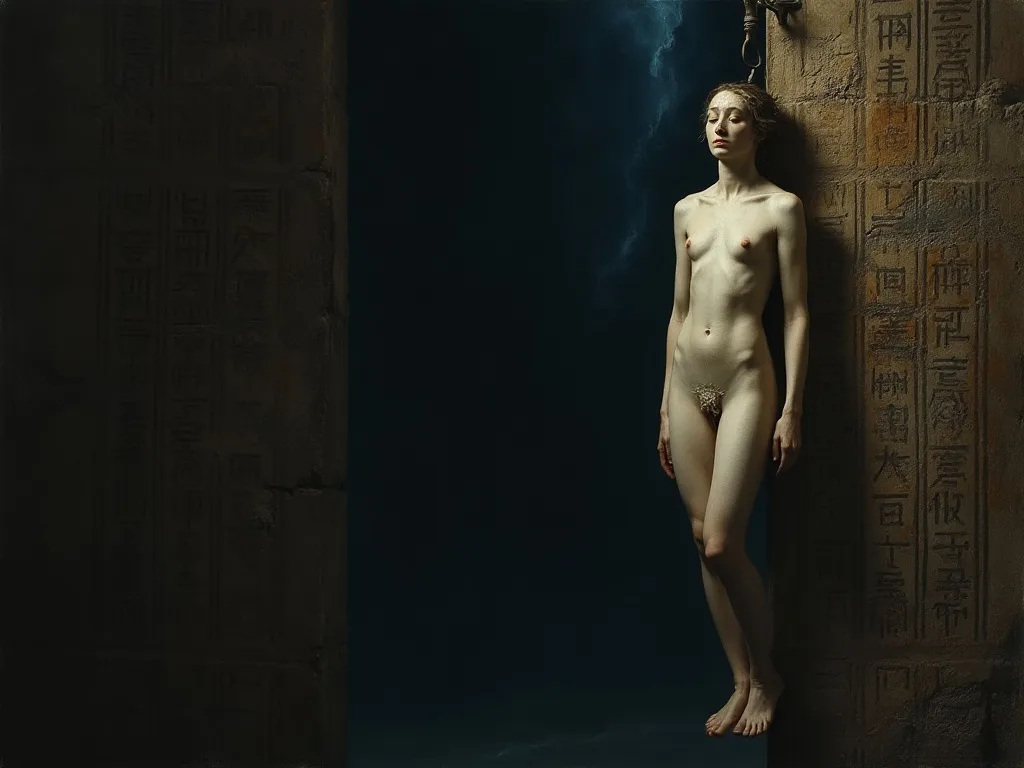
At each gate, Inanna protests. Neti answers the same way every time: "Quiet, Inanna. The ways of the underworld are perfect. They may not be questioned." By the time she passes the seventh gate, she stands bare and bowed. When she finally reaches Ereshkigal on her throne, the judges of the dead, the Anunnaki, pass sentence. They fix their eyes on her. The eye of death. Inanna is turned into a corpse and hung on a hook on the wall.
There is no drama in that moment. The poem is flat and plain about it. She is meat on a peg. That plainness is more disturbing than any elaborate description could be.
Ninshubur's Grief and the Gods Who Refuse
Three days and three nights pass. Ninshubur, faithful, begins to mourn. She tears her clothes, beats a drum, and goes first to Enlil, the father of the gods. He refuses. He says Inanna went to the underworld chasing things that should not be chased, and this is the result. Nanna, the moon god and Inanna's own father, refuses for the same reasons.
Then Ninshubur goes to Enki, god of wisdom and fresh water, and he does not refuse. He grieves. He takes the dirt from under his fingernail and shapes two small beings: the kurgarra and the galatur, creatures that exist between categories, neither male nor female, neither living nor dead. He gives them the food of life and the water of life and sends them down.
Their mission is not combat. It is empathy. Enki instructs them to find Ereshkigal, who is moaning in the anguish of a woman giving birth, and simply to moan with her. When she cries "Oh my belly!" they cry "Oh your belly!" When she cries "Oh my back!" they cry "Oh your back!" Ereshkigal is so moved by this pure witnessing, by being seen in her pain, that she offers them any gift they name. They ask for the corpse on the hook. She gives it. They sprinkle it with the food and water of life, and Inanna rises.
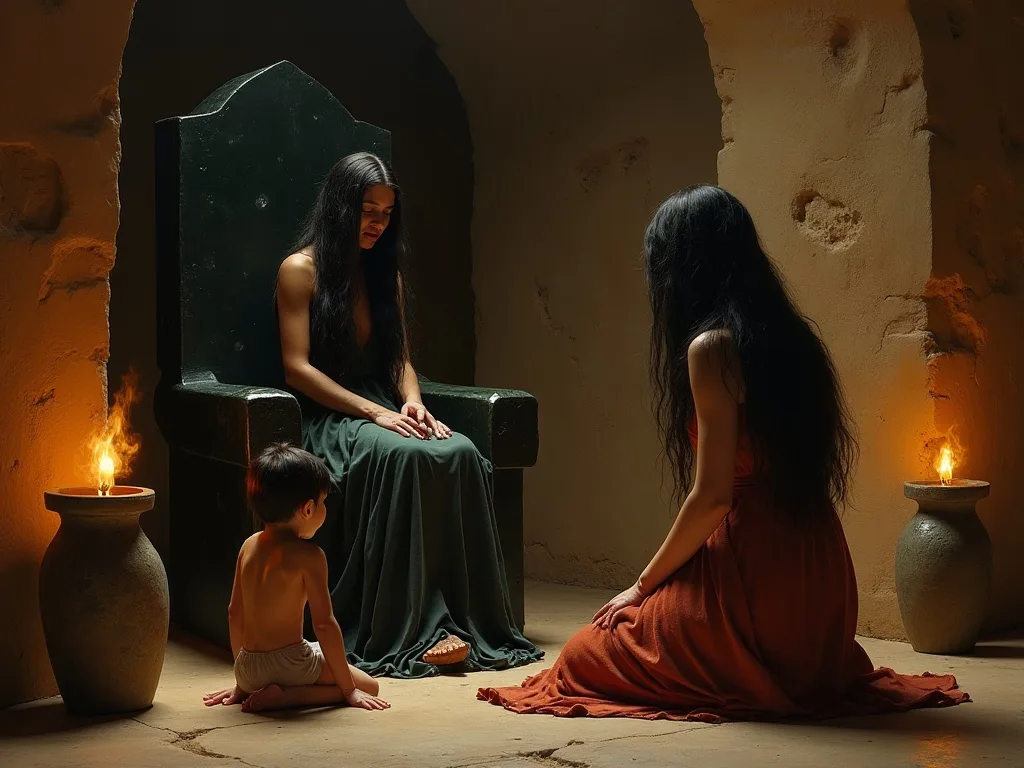
The Price: A Substitute Must Go Down
The Anunnaki allow the return, but they do not let go cheaply. No one leaves Kur without leaving something behind. Inanna walks back up through all seven gates, collecting her me one by one, but she travels with an escort of galla, underworld demons whose job is to claim her substitute. They follow like shadows. They cannot be bribed or moved. They are the underworld's receipt.
Ninshubur meets her at the gate, in torn clothes, weeping. The demons want to take her. Inanna refuses: Ninshubur was loyal. The same happens at the next stop with Shara and Lulal, two minor figures who also mourned.
Then they arrive at the great apple tree of Shukalletuda, where Dumuzi, Inanna's husband, the shepherd-king, sits on a throne, dressed in splendor, having used her absence to enjoy his own elevation. He is not mourning. He is not even worried.
Inanna looks at him. She "fastens the eye of death upon him." She gives him to the demons.
The decision is cold and precise. Dumuzi panics and flees, calling on the sun god Utu to transform him. Utu, his brother-in-law, changes Dumuzi into a snake, a gazelle, a fly. The demons catch him anyway. But Dumuzi's sister Geshtinanna offers to share the burden: she will go below for half the year if Dumuzi can spend the other half above. Inanna agrees. This is the arrangement that stands.
Ereshkigal: The Other Queen
Ereshkigal does not appear in many myths outside the Descent, but every appearance is charged. She is Inanna's shadow, the part of the divine feminine that civilisation tries to wall off underground. Where Inanna moves through feasts, wars, and love affairs in the world above, Ereshkigal sits alone, grieving, ruling a kingdom of the dead with iron sovereignty.
The Akkadian version of the myth, called the Descent of Ishtar (Ishtar being the Akkadian equivalent of Inanna), strips most of this psychological complexity out. Ishtar descends, the world dries up and fertility dies, the gods panic and rescue her quickly. The Sumerian version is longer, stranger, and far more interested in what happens inside the underworld. Ereshkigal is given her grief. The kurgarra and galatur witness it. The resolution comes not through force or divine decree but through compassion.
That is unusual in ancient myth. A goddess of death softened not by a hero's strength but by two small beings who listen.
Sumerian Inanna
Inanna's descent is personal and ambiguous: she sets her ear to the great below, prepares elaborate ritual objects, and instructs her servant to mourn and lobby for her. Her motive is never fully explained. The poem spends significant attention on Ereshkigal's grief, on the curious non-gendered beings Enki creates, and on Inanna's cold punishment of Dumuzi. It is psychologically dense and resistant to simple allegory.
Akkadian Ishtar
Ishtar's descent in the Akkadian version reads more like a cosmic event with political stakes: fertility ceases on earth, the gods must act, and the rescue is handled through divine negotiation. Ereshkigal's inner life receives little attention. The Dumuzi substitute plot is condensed to a single line. The Akkadian version is shorter, more action-focused, and sits within a broader Near Eastern tradition of seasonal myth that later influenced Greek accounts of Persephone.
The Seven Me: What Inanna Actually Loses at Each Gate
The me are one of the most distinctive ideas in Sumerian religion. They are the fundamental rules and properties of civilised life, not abstract laws but concrete divine powers that can be held, stolen, lost, or given. Inanna possesses a vast list of them, catalogued in another Sumerian poem called the Huluppu-tree and the Inanna and the God of Wisdom.
At the seven gates, each item she surrenders encodes a specific power:
- The shugurra crown: sovereignty over the land
- Lapis beads: sexual attractiveness and reproductive power
- The golden ring: divine authority in ritual contexts
- The breastplate: martial power, the force that wins wars
- The robe: the dignity of queenship, social authority
- The kohl: perception, the ability to see and judge
- The measuring rod and line: the capacity to organise, to measure, to govern
By the seventh gate, she has surrendered not just clothing but every function that makes her who she is. She enters the throne room of Ereshkigal as nothing. It is the most radical act of vulnerability in ancient Near Eastern literature, and it is entirely voluntary.
Cross-Cultural Echoes: Persephone, Osiris, Christ
The structural pattern of the Descent of Inanna to the Underworld appears across dozens of traditions, which tells you something important: the story is answering a question so fundamental that cultures keep asking it independently.
Persephone descends into the Greek underworld, spends part of the year below, and her return coincides with spring. The seasonal reading is clear. But where Persephone is taken, Inanna walks in. That single difference changes everything about what the myth means.
Osiris in Egyptian religion dies, is dismembered, and is reassembled by Isis: the resurrection follows a death, and the restored god rules the dead rather than the living. In the Egyptian tradition, death is not overcome; it is given a new domain.
The Orphic myths of Greece, the Babylonian Epic of Gilgamesh (in which Gilgamesh witnesses the underworld after losing Enkidu), and much later the Christian narrative of the Harrowing of Hell, in which Christ descends into the land of the dead between crucifixion and resurrection, all echo the same grammar: a being of power goes below, faces death or something close to it, and returns changed.
What distinguishes the Inanna version is that the returning goddess is not triumphant. She comes back with demons at her heels and a sentence to carry out. She condemns her husband. The return costs her something she cannot name, and the poem ends not with celebration but with a liturgy, a list of who should mourn for Dumuzi and when. Complicated. Human. True.
Primary Sources and the Scholars Who Reassembled Them
The tablets that carry the Descent story were written in Sumerian cuneiform and come from sites across ancient Mesopotamia, the region now mostly in southern Iraq. The best-preserved copies date to the Old Babylonian period, roughly 1900-1600 BC, though most specialists believe the poem was composed earlier, during the Third Dynasty of Ur, around 2100-2000 BC.
Samuel Noah Kramer, working at the University of Pennsylvania Museum in the 1930s and onward, identified and translated key tablets. His 1961 book Sumerian Mythology brought the Inanna texts to a broad audience. The 1983 collaboration with poet Diane Wolkstein, titled Inanna: Queen of Heaven and Earth, remains the most widely read version in English. It pairs close translation with literary commentary and is honest about what is reconstructed versus what is certain.
More recent scholarship, including work by Thorkild Jacobsen in The Treasures of Darkness (1976) and Betty De Shong Meador's Inanna: Lady of Largest Heart (2000), which focuses on the Sumerian hymns of the priestess Enheduanna, adds layers of ritual and political context that pure literary reading misses. Enheduanna, daughter of Sargon of Akkad and high priestess of the moon god Nanna at Ur around 2285-2250 BC, wrote hymns to Inanna that are the oldest attributed literary works in history, predating the Descent tablets but part of the same living tradition.
Why the Descent Still Matters in 2026
The myth continues to be read, staged, set to music, and written about at a rate that has only grown since Wolkstein and Kramer's 1983 edition. Jungian analysts use it to map the psychology of grief. Feminist theologians use it to recover pre-patriarchal goddess traditions. Poets, notably Anne Carson and Ursula K. Le Guin, have engaged it directly. The opera Inanna by composer Tod Machover premiered at MIT in 2021 as a fully immersive virtual-reality work.
Why does a 4,000-year-old Sumerian poem have this kind of reach?
One answer is structural. The story of a sovereign being who strips off every marker of power and walks naked into death, then returns at a price, maps cleanly onto experiences that repeat in every life: illness, loss, the collapse of an identity, the slow return afterward. The gates are concrete. The stripping is real. Inanna does not cheat death. She meets it, becomes it for three days, and then negotiates.
A second answer is that Ereshkigal is given her grief. Ancient myth does not always do this. The underworld queen is not a villain; she is a sister in pain, and the resolution of the myth hinges not on a hero overpowering her but on two small beings simply staying with her in that pain. In a culture increasingly aware of how much grief goes unwitnessed, that image carries weight.
The poem ends with a line that has no parallel in the ancient world: "Holy Ereshkigal! Great is your renown. Holy Ereshkigal, I sing your praises." The underworld queen, the goddess of death, receives a hymn. Not a defeat. Not a condemnation. A song.
Frequently Asked Questions About the Descent of Inanna to the Underworld
Frequently asked questions
What are the seven gates of the underworld in the Inanna myth?
The seven gates are the thresholds of Kur, the Sumerian underworld. At each one, the gatekeeper Neti removes one of Inanna's divine attributes: her crown, lapis beads, golden ring, breastplate, robe, kohl, and measuring rod. Scholars read these gates as a symbolic stripping of all social, political, and divine identity. The number seven is significant throughout Mesopotamian cosmology, appearing in astral theology, ritual structures, and the organisation of the heavens.
Why does Inanna condemn Dumuzi at the end of the myth?
When Inanna returns from the underworld, the galla demons demand a substitute to take her place. She finds her husband Dumuzi sitting on a throne in splendor, apparently unbothered by her absence and death. This lack of mourning is his offence. Inanna fixes "the eye of death" on him and hands him over. Some scholars read this as a ritual myth explaining the death of the year-king; others read it as a genuine portrayal of Inanna's cold justice. Dumuzi's sister Geshtinanna eventually negotiates a six-months-on, six-months-below arrangement.
How old is the Descent of Inanna, and where were the tablets found?
The surviving tablets date to roughly 1900-1600 BC (the Old Babylonian period), but most Assyriologists believe the poem was composed during the Third Dynasty of Ur, around 2100-2000 BC. Tablets have been found at sites including Nippur and Ur in modern Iraq, and are held in collections at the University of Pennsylvania Museum, the Istanbul Archaeological Museums, and the Ashmolean in Oxford.
What is the difference between Inanna and Ishtar?
Inanna is the Sumerian name; Ishtar is the Akkadian equivalent. Both are goddesses of love, war, and the planet Venus. The Akkadian Descent of Ishtar is a shorter, later adaptation of the Sumerian myth that focuses more on the cosmic consequences of the descent (fertility stops, animals stop mating) and less on the inner lives of Inanna and Ereshkigal. The Sumerian version is longer, psychologically richer, and includes the full Ninshubur subplot and the Dumuzi condemnation.
Who was Enheduanna, and how does she relate to the Inanna myths?
Enheduanna was the daughter of Sargon of Akkad and served as high priestess of the moon god Nanna at Ur, around 2285-2250 BC. She wrote a series of hymns to Inanna, including the Hymn to Inanna and The Exaltation of Inanna, which are the oldest attributed literary works in history, predating even the Descent tablets as we have them. Her hymns shaped how Inanna was understood as a cosmic force, establishing her as supreme among the gods.
Is the Descent of Inanna connected to the myth of Persephone?
The structural parallels are real: a goddess descends to the underworld, fertility on earth halts, and her return marks a seasonal renewal. However, direct borrowing has not been demonstrated. The Inanna myth is at least a thousand years older than the Greek Persephone tradition. Most scholars treat them as independent developments of a widespread ancient pattern, not as proof of direct transmission, though cultural contact between the Near East and Greece certainly existed by the first millennium BC.
Read the full book
Want the whole story?
The complete edition is an instant PDF download here, with a paperback on Amazon for selected titles.
Sumerian
The Sumerian Mythology Book: Gilgamesh, Inanna, Enki, and the World's Oldest Sacred Stories
Gilgamesh, Inanna, and the world's oldest written myths
The earliest written myths on earth, preserved on clay tablets four thousand years ago. Gilgamesh seeking immortality, Inanna descending to the underworld, Enki shaping the cosmos. Here is what survived.
More from Sumerian
All articles
Sumerian
Enki: God of Wisdom, Water, and Creation
Enki shaped human intelligence and filled the rivers with life. This Sumerian god of wisdom, water, and cunning stands at the heart of creation itself, bending the rules when justice demands it. Meet the architect of civilization.
Sumerian
Inanna: Goddess of Love, War, and the Planet Venus
Inanna commands both ecstasy and carnage: a Sumerian goddess who embodied love, war, and the morning star. Her descent to the underworld remains literature's oldest recorded myth of transformation and return.
Sumerian
Eridu: The First City and Sacred Center of Sumerian Civilization
Eridu was the oldest city on Earth, where the Sumerians believed civilization itself began. Archaeologists have found temples, artifacts, and evidence of the world's first urban settlement here, where gods and humans first mingled.
Sumerian
The Me: Divine Powers and Cosmic Order in Sumerian Mythology
The Me were not objects but fundamental laws of existence itself. Sumerian texts reveal how goddesses stole them, gods hoarded them, and the whole universe bent to their will.