
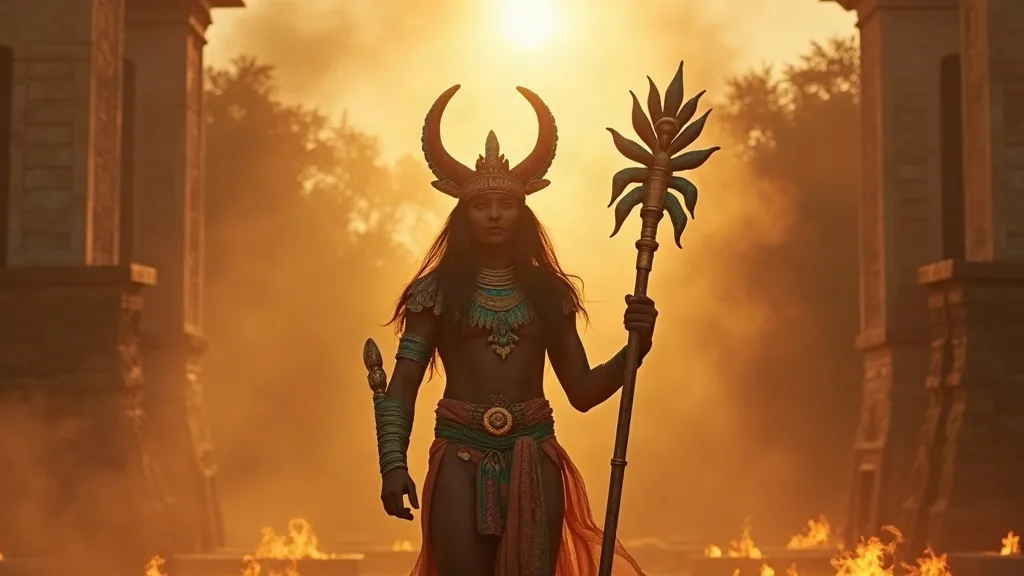
Huitzilopochtli: God of War and the Sun
Huitzilopochtli, the Aztec god of war, sun, and human sacrifice, emerged from his mother's womb fully armed to battle the darkness. His myth shaped the empire's entire worldview: conquest, cosmic duty, and survival itself.
Contents
In the beginning, there was no sun. Only chaos. Only night.
The Aztec gods gathered in darkness at a sacred place called Teotihuacan (the place where the gods were made). They needed light. They needed a sun to mark the passage of time, to warm the earth, to make crops grow. Two gods stepped forward. One was the proud and handsome god. The other was weak and covered in pustules. The gods lit a great fire. The handsome god hesitated. The weak one leapt in without fear.
But nothing happened. Both burned in silence. Both refused to rise into the sky.
Then a humble little bird flew over the flames. "Why do you just sit there?" it demanded of the gods. "Why don't you sacrifice yourselves too?" The gods understood. A great, jeweled deity called Huitzilopochtli stepped to the fire. He jumped in fully armed, holding his serpent-staff, ready for war. From the flames, the sun rose for the first time. The Aztec world could begin.
This is not how the Huitzilopochtli myth ends. It is how it demands to be told: not as origin story alone, but as the foundational act of cosmic duty that would define the entire Aztec state.
The Birth of a Warrior God
Huitzilopochtli did not enter existence as an adult. He had to fight for it.
His mother was Coatlicue (she of the serpent skirt), an old earth goddess who lived on a mountain. One day, while sweeping a temple, she found a ball of hummingbird feathers floating in the air. She tucked the feathers into her belt. From that act, she became pregnant.
Her other children, the four hundred Centzonhuitznahua (the four hundred southern stars), were horrified. Shame fell on the family. They decided to murder their mother. Her daughter Coyolxauhqui (she of the golden bells) led them up the mountain to kill her.
But Huitzilopochtli heard his mother's distress from inside her womb. He heard the approaching footsteps. He heard the rage of his siblings. At that moment, he was born fully armed: he burst from Coatlicue's body carrying a shield, a turquoise serpent-staff called the xiuhcoatl, and a light that blazed like the sun. His body was already painted in the blue and yellow of a warrior god.
He did not cry. He did not ask for milk. He attacked.
In a single moment of divine violence, Huitzilopochtli slew his sister Coyolxauhqui, tearing her body apart and flinging her corpse down the mountainside. Her limbs scattered across the valley. He chased down his four hundred siblings and killed many of them. The southern stars were defeated at dawn, scattered by the rising sun.
This was not a myth about peace. This was a myth about necessity. Light must triumph over darkness, or nothing survives. Order must be imposed through force, or chaos returns. The Aztec understood this. It was not cruelty. It was the way the universe worked.
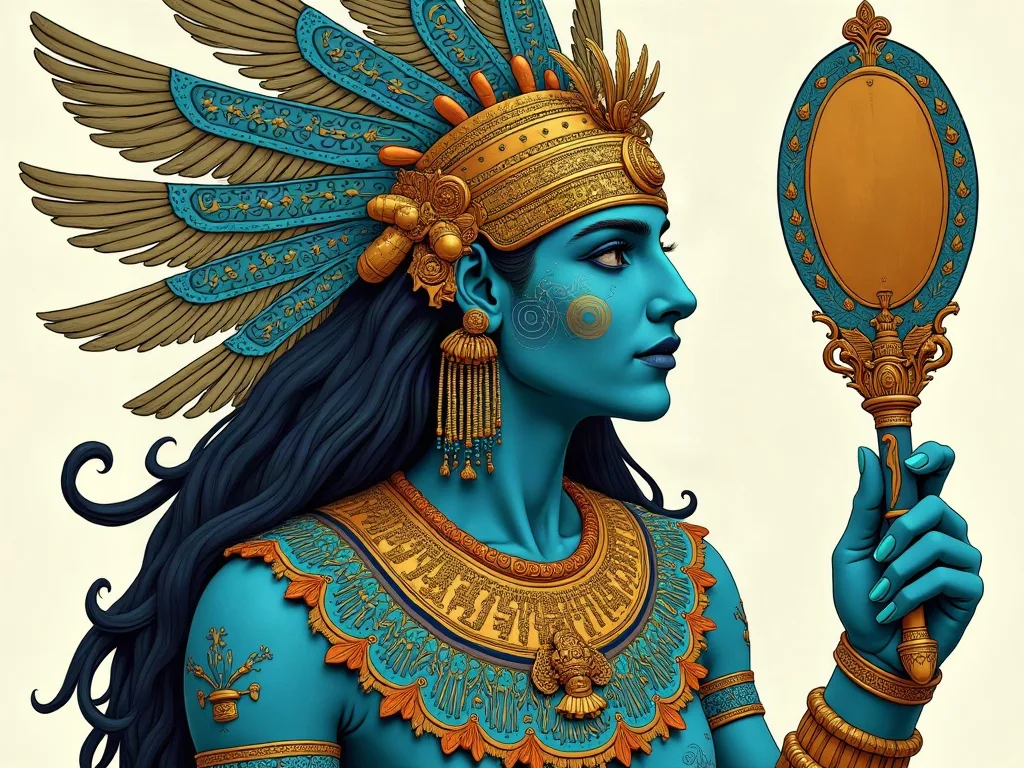
The Serpent Staff and the Sun's Daily Battle
Every morning, the same war happened again.
The Aztec believed that Huitzilopochtli was the sun itself, or at least the sun's warrior-soul. Each night, he died. The sun sank below the western horizon and entered Mictlan, the underworld, the place of the dead. There, in absolute darkness, Huitzilopochtli had to fight again. He had to battle through nine layers of the underworld, facing demons and trials, carrying his serpent-staff like a weapon against extinction.
But always, without fail, he won.
The sun rose in the east, and Huitzilopochtli was reborn. Every dawn was a victory. Every sunrise was proof that the universe had not collapsed. The Aztec stood on their pyramid temples in the predawn darkness and waited for him. They watched the eastern sky. They knew that if Huitzilopochtli failed even once, if he was truly conquered in the underworld, the sun would never rise again. All life would end.
This is why human sacrifice mattered so deeply to the Aztec. It was not malice. It was fuel. The sun was not automatic. It did not owe them anything. The god who held the sun in his fists each night and carried it back to life each dawn did this out of duty, not mercy. The Aztec owed him everything in return.
When a human heart was offered to Huitzilopochtli on a pyramid temple, the Aztec believed they were feeding him strength for his next battle. Blood, the precious water (nextlaolli), was the most powerful gift a human could give. It kept the sun rising. It kept the world alive.
From Legend to Empire
The founding myth of the Aztec capital, Tenochtitlan, placed Huitzilopochtli at the center of political destiny.
The Aztec (or Mexica, as they called themselves) were a wandering people until the 14th century. Huitzilopochtli spoke to them through priests and dreams. He told them to march south until they found a place: an island in a lake, where an eagle perched on a cactus, with a serpent in its mouth. When they found that place, Huitzilopochtli said, they would build their great city, and his name would be known across all the world.
In 1325 CE, they found it. They built Tenochtitlan on that island, in what is now Mexico City. They drained and dammed the lake. They built pyramids and temples. And at the heart of the city stood the Templo Mayor, the great temple, a twin pyramid with two shrines at the top: one dedicated to the rain god Tlaloc (for agriculture), and one dedicated to Huitzilopochtli (for warfare and the sun).
The political message was clear: we are here because Huitzilopochtli chose us. Our conquest is his will. Our empire is his temple.
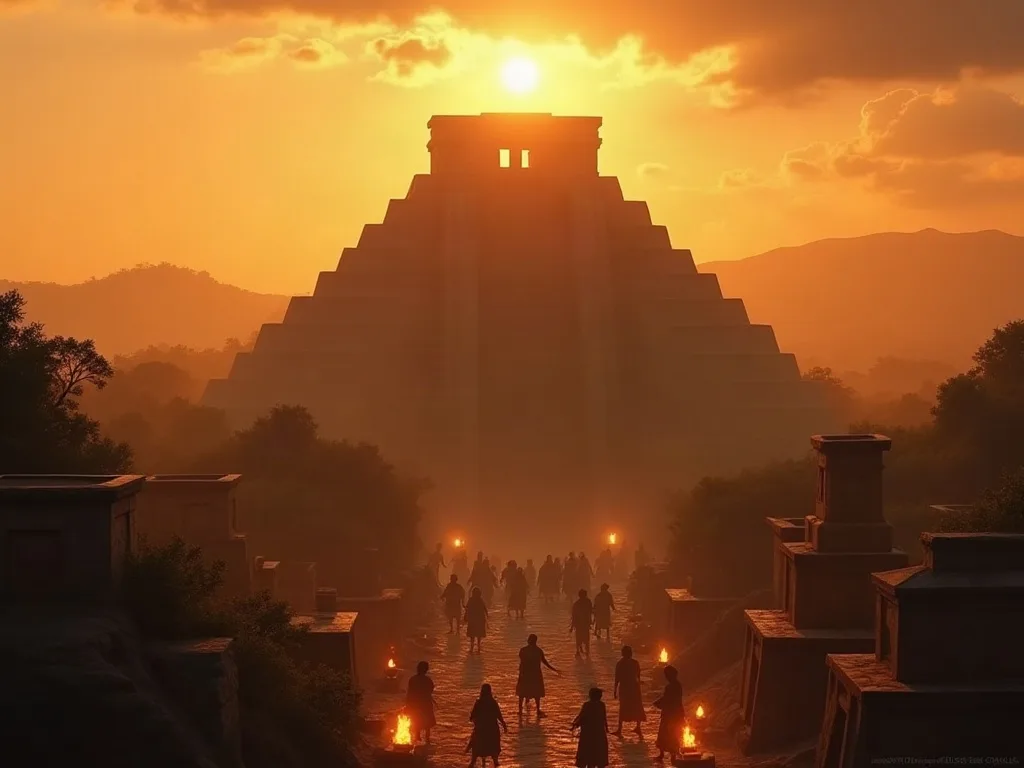
Huitzilopochtli and the Fifth Sun
The Aztec cosmology divided time into ages called "Suns." The Fifth Sun, the age they lived in, was the age of Huitzilopochtli.
The creation myths, recorded in Nahuatl texts like the Popol Vuh parallels and the Codex Borbonicus, tell of earlier ages: the First Sun ended in jaguars. The Second Sun ended in wind. The Third Sun ended in fire and rain. The Fourth Sun ended in flood. Now, in the Fifth Sun, time itself had become unstable. This age would not last forever.
The gods gathered again at Teotihuacan after the Fourth Sun had drowned the world. The sun would not rise again unless the gods sacrificed themselves. Huitzilopochtli was among them, but so was Nanahuatzin, the pimpled god, humble and poor. When the fire was lit, Nanahuatzin leapt in first. The sun rose from him. But it moved slowly, creeping across the sky with no force.
"It is not enough," said the gods. "The sun does not have the strength to move properly."
The gods realized what had to be done. One by one, they offered themselves to the sun. They cut their own hearts out and let the blood flow. This sacrifice gave the sun speed and power. The sun began to race across the sky properly. And Huitzilopochtli, having already jumped into the fire once at Teotihuacan, was reborn as the sun's warrior-guardian.
But there was a terrible knowledge in this myth. The Fifth Sun, like all the others, would eventually end. The Aztec did not expect their world to last forever. They lived in constant awareness that apocalypse was possible, even probable. Comets and earthquakes were omens. The world felt fragile.
This is why Huitzilopochtli was so central to their understanding of time itself. He was not a god of permanence. He was a god of struggle and renewal, of fighting through darkness to maintain the impossible gift of another day.
The Warrior's Regalia and Sacred Symbols
In Aztec art, Huitzilopochtli appears in distinctive form. His skin is blue and gold, the colors of precious turquoise and corn. His head wears a helmet shaped like a hummingbird (huitzilin), with the bird's curved beak jutting from his forehead. This is where his name comes from: huitzilin (hummingbird) and opochtli (southern).
But "southern" here is not geography. In Aztec thought, the south was the direction of battle, the direction of blood, the hot and fierce direction. A hummingbird in the south was a warrior small but fierce, darting and precise, unstoppable.
His chief weapon was the xiuhcoatl, the "turquoise serpent" or "fire serpent." This was no earthly serpent. It was a stick that burst with flame and light. In ceremonial art, it appears as a staff topped with a serpent's head, curved and fierce. The Aztec kings carried versions of this staff as symbols of royal power.
Huitzilopochtli also carried a shield called chimalli. On Aztec codices, his shield bears intricate designs, often circles or spirals representing the sun, or obsidian mirrors reflecting cosmic truth.
In some depictions, he wears a banner of hummingbird feathers on his back. In others, he carries the scalps of enemies. These were not mere decoration. They were trophies of cosmic function. Each enemy killed in battle was understood as a contribution to the eternal sun-war. The Aztec were not murderers; they were participants in the universe's survival.
Huitzilopochtli
Huitzilopochtli embodies the sun itself in combat form. His warfare is cosmic necessity; he fights to keep the sun rising every dawn. He is tied to time, light, and the empire's expansion as a religious duty. His symbol is the hummingbird, small but ferocious, and the turquoise serpent. He demands human sacrifice as fuel for the cosmic battle.
Other War Gods
Aztec Huitzilopochtli differs from Greek Ares (brutal and often cruel) and Norse Tyr (honorable but stern). While Ares delights in carnage for its own sake, Huitzilopochtli fights for a purpose: the survival of the universe. While Tyr judges oaths, Huitzilopochtli is the embodiment of cosmic urgency itself. He does not give warriors the choice to avoid battle; he makes the battle inevitable.
The Templo Mayor and Ritual Performance
When Spanish conquistadors arrived in 1519, they were stunned by the scale of Tenochtitlan. The city had perhaps 200,000 inhabitants. At its center stood the Templo Mayor, a pyramid more than 60 meters tall, dedicated jointly to Huitzilopochtli and Tlaloc.
The Templo Mayor was not a place of quiet prayer. It was a stage for the Aztec understanding of cosmic necessity. On the festival days dedicated to Huitzilopochtli, called Panquetzaliztli (the raising of banners), the Aztec conducted elaborate rituals.
Captives taken in war were brought to the temple. Priests, wearing the skin of previous sacrificial victims, sang and danced. The sacrifices took place at dawn, with Huitzilopochtli's shrine facing east, toward the rising sun. The hearts were cut from the bodies and offered to the god. The blood was painted on his statue. The bodies were sometimes flayed, and priests wore the skin as a sacred costume for days afterward, embodying the god.
From the perspective of the Spanish, this was horror. From the perspective of the Aztec, it was work. It was labor on behalf of the cosmos. The victims were enemy warriors, generally. Their deaths were understood as both punishment and honor: punishment for being enemies of the empire that Huitzilopochtli had chosen, but honor because they were fed to the sun-god himself.
The Templo Mayor's twin shrines reflected Aztec balance. Huitzilopochtli (war and sun, dry and hot) sat next to Tlaloc (rain and agriculture, wet and cool). The empire needed both: warriors to expand and hold territory, and rain to make crops grow. The Aztec did not see these as opposing forces. They were complementary, like the Yin-Yang of Chinese philosophy.
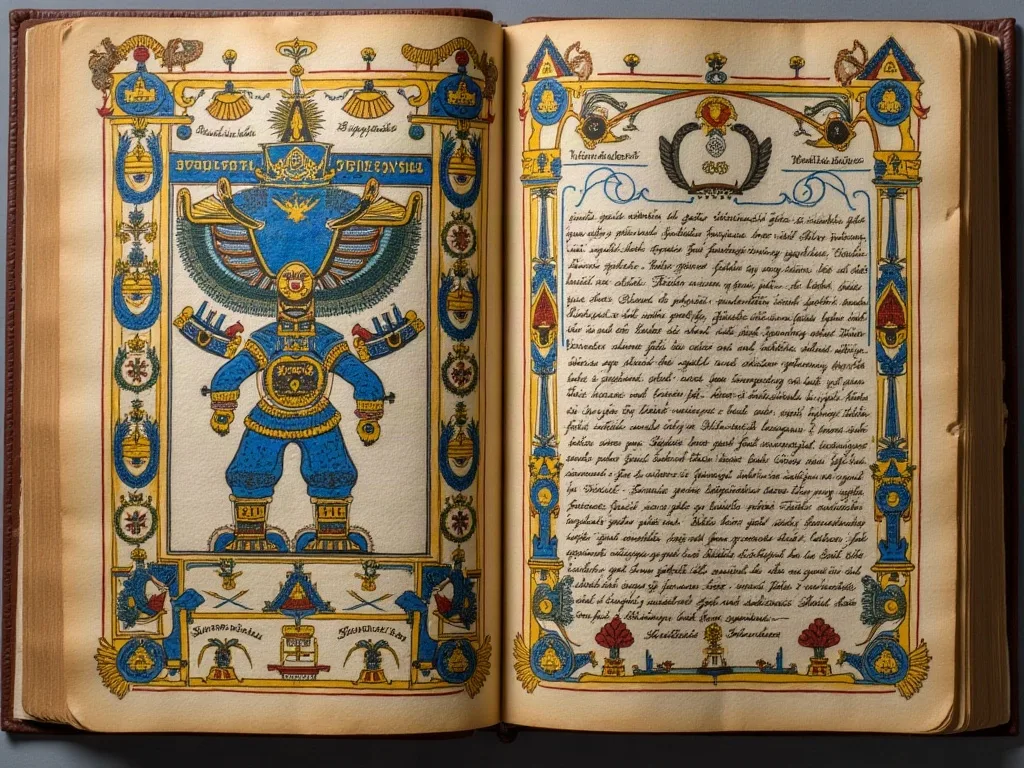
Huitzilopochtli in the Codices
The Aztec recorded their mythology in visual form, on amate paper, in books called codices. The Codex Borbonicus shows Huitzilopochtli in his characteristic pose: armed, alert, surrounded by symbols of fire and the sun. The Codex Templo Mayor (carved into the temple stones themselves) depicts his birth-myth in stone, with Coatlicue at the center and her children arrayed around her.
These visual records are precious because they preserve the Aztec view of their own god, not the Spanish interpretation. When we look at Huitzilopochtli in the codices, we are looking at how the Aztec saw divinity: not as abstract, but as vivid, colored, specific, armed, present in the landscape and the calendar.
The codices show that Huitzilopochtli was not a god for scholars to debate. He was a god to be, to embody, to feed, to fight for. He appeared on the calendar (the tonalpohualli, a 260-day ritual cycle) on specific days. He appeared in the seasonal calendar (xiuhpohualli, a 365-day agricultural cycle) on the days that marked war campaigns and temple rituals.
In other words, Huitzilopochtli was not myth alone. He was integrated into the texture of daily Aztec life. You could not live as an Aztec without encountering him.
The Aztec Worldview: Cosmic Duty, Not Destiny
Modern readers sometimes struggle with Aztec cosmology because we often see sacrifice as cruelty. But the Aztec lived inside a different universe, one with different rules.
In European thought (shaped by Christianity), the universe is fixed. God created it once, and it stays created. Time moves forward. Progress is possible. The future is open.
In Aztec thought, the universe was fragile. It had been created and destroyed multiple times already. The Fifth Sun was not guaranteed to last. Without constant effort, without sacrifice, without the willingness to feed the gods with blood, the sun might not rise tomorrow. The Aztec lived in a universe that required them.
Huitzilopochtli represented this necessity. He was not gentle or forgiving. He did not promise an afterlife of peace. He simply demanded. He demanded war, blood, and constant effort. In return, he provided the sun. The Aztec understood this as a fair exchange: our blood for light. Our effort for survival.
This is not an excuse for the violence of the Aztec empire. But it is an explanation. The Aztec were not sadists. They were people trying to keep the universe alive using the tools and understanding they possessed.
Huitzilopochtli in the Colonial Aftermath
When the Spanish conquered Tenochtitlan in 1521, the first thing they did was destroy the Templo Mayor. They tore down Huitzilopochtli's shrine. They melted down the gold and silver. They built a Christian cathedral on the same site, using the very stones of the destroyed temple.
This was not accident. It was theology. The Spanish understood what they were doing: they were replacing one god with another, one worldview with another. Huitzilopochtli was the enemy of Christ, from their perspective. He had to be destroyed.
But Huitzilopochtli did not disappear. He survived in memory, in stories, in the codices that survived conquest. When indigenous Mexicans encountered Catholic saints, they sometimes syncretized them with Huitzilopochtli. The Virgin of Guadalupe, a dark-skinned Mary with powerful protective force, held echoes of Coatlicue, Huitzilopochtli's mother. Santiago Matamoros (St. James the Moor-Killer), a warrior saint on horseback, carried the energy of Huitzilopochtli the warrior.
Huitzilopochtli could not be fully erased because he was too deeply woven into the Aztec sense of self. To be Aztec was to live under his gaze.
In modern Mexico, Huitzilopochtli has become a symbol of indigenous pride and resistance. His image appears on the Mexican coat of arms: the eagle perched on a cactus with a serpent in its mouth, the sign that told the Aztec to found Tenochtitlan. He is a reminder that the valley of Mexico, before Spanish arrival, was home to one of the world's great empires, with its own gods, its own understanding of the cosmos, its own way of making meaning.
Huitzilopochtli and the Modern Study of Mythology
Scholars of Mesoamerican mythology have long debated what Huitzilopochtli represents. Was he originally a historical figure, a great warrior-king, who was later deified? Or was he always a god, and stories of his deeds were projected backward onto the Aztec past?
The truth is probably both and neither. The Aztec did not make the distinction we make between history and myth. Huitzilopochtli was real, in the sense that he acted in the world, shaped history, demanded obedience. Whether he was born to Coatlicue as a divine infant or emerged from the consciousness of a tribal people trying to make sense of their place in the world is a question that assumes a split between myth and reality that the Aztec themselves did not recognize.
What is clear from the sources is that Huitzilopochtli represented something central to Aztec identity: the belief that they were a chosen people, that their violence was justified by cosmic necessity, that they lived under the eye of a god who demanded everything and promised only the next sunrise.
In the modern world, we might find that troubling. But understanding Huitzilopochtli means understanding how the Aztec saw themselves: not as conquistadors driven by greed (though greed played its part), but as priests of a cosmic system. They believed they were keeping the sun alive. That belief shaped every war, every sacrifice, every stone laid in Tenochtitlan.
Frequently asked questions about Huitzilopochtli: God of War and the Sun
Frequently asked questions
Was Huitzilopochtli an Aztec god or did he exist before the Aztec empire?
Huitzilopochtli appears to have evolved over time. Elements of sun-warrior deities existed in earlier Mesoamerican cultures (the Olmec, the Maya, the Toltec). But the specific form he took, and the strong connection between him and Aztec imperial destiny, developed within the Aztec civilization itself. By the time the Aztec founded Tenochtitlan in 1325 CE, Huitzilopochtli had become central to their identity and their understanding of why they were a chosen people destined to rule.
Why did the Aztec practice human sacrifice to Huitzilopochtli?
The Aztec believed that Huitzilopochtli fought nightly in the underworld to bring the sun back each dawn. This cosmic battle required energy. Human blood (nextlaolli, the precious water) was understood as the most potent fuel for keeping the sun alive. Without sacrifice, they believed, the sun would fail to rise. This was not sadism but a form of cosmic duty: the Aztec saw themselves as essential workers in the survival of the universe itself.
How is Huitzilopochtli depicted in Aztec art?
Huitzilopochtli appears in Aztec codices with distinctive features: blue and gold coloring, a hummingbird helmet on his head, and he carries the xiuhcoatl (turquoise or fire serpent staff). His shield often bears solar symbols. He is shown armed and alert, ready for combat. His regalia emphasizes his dual nature: he is both the sun itself and its warrior-guardian, fierce and beautiful, necessary and dangerous.
What happened to worship of Huitzilopochtli after the Spanish conquest?
The Spanish destroyed the Templo Mayor and banned Aztec ritual practices. Huitzilopochtli worship ended as an official state religion. However, elements of his symbolism and energy survived in indigenous memory and in syncretic religious practices that blended Catholicism with Aztec beliefs. Today, Huitzilopochtli survives as a symbol of pre-Columbian civilization and indigenous Mexican identity, notably in the eagle-and-serpent image on the Mexican national coat of arms.
How did the Aztec understand the difference between history and mythology for Huitzilopochtli?
The Aztec did not draw a clear boundary between myth and history as modern readers do. Huitzilopochtli was real in the sense that he acted in the world, inspired warriors, and shaped the empire's choices. Whether he was a historical figure later deified or a god who inhabited history from the beginning is a modern question. For the Aztec, he was an active presence in their present world, not a story confined to a distant past.
What is the relationship between Huitzilopochtli and Tenochtitlan's founding?
According to Aztec legend, Huitzilopochtli guided his people (the Mexica) in a long migration south. He promised them they would build a great city when they found an island in a lake where an eagle perched on a cactus with a serpent in its mouth. They found that place in 1325 CE and founded Tenochtitlan there. This story made Huitzilopochtli the patron god of the empire, the one who chose the Aztec as his people and destined them to rule.
The Hummingbird That Changed History
The name Huitzilopochtli lives on today in Mexico, in the shape of a bird, in the stones of the Templo Mayor (excavated and studied since 1978), and in the coat of arms of the Mexican nation. The eagle and serpent image, the sign he gave to his people, remains a symbol of indigenous pride and Mexican identity.
But the god himself, as the Aztec understood him, is gone. No priest wears his skin. No captive heart is offered on his shrine. The Fifth Sun, which the Aztec believed would eventually end, continues to rise in the east without him.
What remains is the myth: the image of a divine warrior bursting fully armed from his mother's womb, armed with a turquoise serpent-staff, ready to fight the darkness. A god who demanded everything from his people, who promised nothing but the next sunrise, who made the Aztec feel that their violence was necessary, their empire was cosmic destiny, their blood belonged to something greater than themselves.
This is the power of Huitzilopochtli: not that he was real in the historical sense, but that he was real enough to shape how millions of people understood their place in the universe. He made the Aztec see themselves as essential. He made them believe that without them, the sun would fail. Few gods have ever wielded that kind of psychological and political power. Few have demanded so much, or been given so much in return.
Read the full book
Want the whole story?
The complete edition is an instant PDF download here, with a paperback on Amazon for selected titles.
Aztec
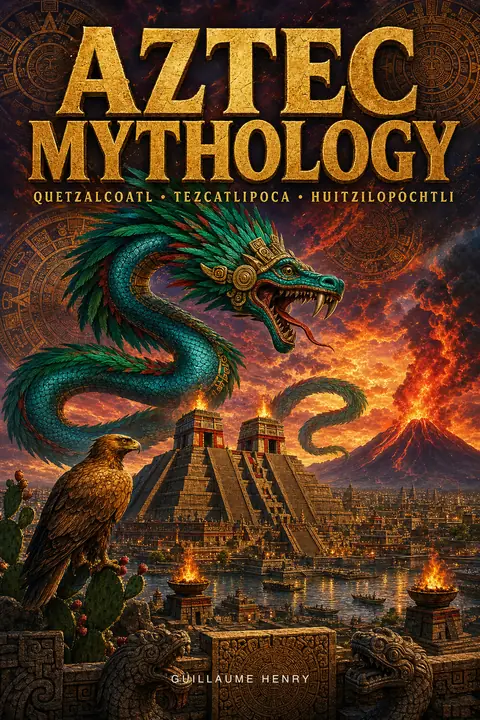
The Aztec Mythology Book: Quetzalcoatl, Huitzilopochtli, Tezcatlipoca, and the Five Suns of the Mexica
Blood, Feathered Serpents, and the Cosmic Engine of Tenochtitlan
The gods, heroes, and sacred calendar of the Mexica civilization. From the feathered serpent Quetzalcoatl to the five world ages, the complete mythology of Tenochtitlan.
More from Aztec
All articles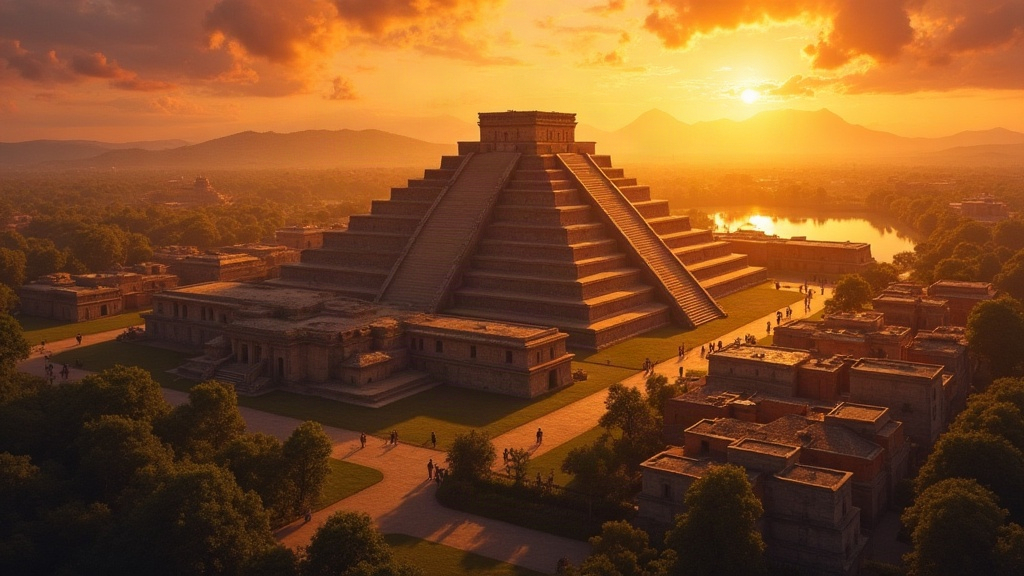
Aztec
Tenochtitlan: The Sacred Aztec Capital
Tenochtitlan rose from an island in Lake Texcoco as the Mexica people's promised homeland, guided by their god Huitzilopochtli. Discover how this sacred city became the center of the Aztec Empire and why its temples, waterways, and ceremonial heart shaped an entire civilization.
Aztec
The Legend of the Fifth Sun: Why the Aztecs Believed Humanity Required Divine Blood
The Aztecs lived under a cosmological clock. They believed the world had been created and destroyed four times before. The fifth world, their world, could only survive if the gods received constant nourishment: human blood. Discover how mythology, astronomy, and ritual wove together in one of history's most misunderstood civilizations.

Aztec
Coatlicue: Mother of Gods and the Aztec Pantheon
Coatlicue, the serpent-skirted mother, bore the sun god and ruled over fertility, childbirth, and death in Aztec belief. Discover how the Aztecs honoured her as the generative force behind their entire pantheon and cosmos.

Aztec
Tlaloc: God of Rain and Fertility in Aztec Mythology
Tlaloc brought water to the Aztec world, but his gifts came with terror. Discover how the rain god shaped Mesoamerican religion, from mountain shrines to the sacred cenotes where thousands sought his blessing.