

Tenochtitlan: The Sacred Aztec Capital
Tenochtitlan rose from an island in Lake Texcoco as the Mexica people's promised homeland, guided by their god Huitzilopochtli. Discover how this sacred city became the center of the Aztec Empire and why its temples, waterways, and ceremonial heart shaped an entire civilization.
Contents
The island shimmered in Lake Texcoco, ringed by shallow waters and marshy shore. By the time the Mexica people arrived there in the 1300s, they had wandered for generations searching for a sign from their god. Huitzilopochtli had promised them a homeland where they would find an eagle perched on a cactus, and when that moment came, they were to build their great city. The eagle appeared on that island. The Mexica did not hesitate. Within a few centuries, what rose from that swampy foundation became Tenochtitlan: the sacred Aztec capital, one of the largest and most architecturally audacious cities the world had ever known.
Tenochtitlan was never just a place. It was a living mandala, a cosmological center where the Aztec sacred calendar, their gods, and their empire intersected in stone and water. The city channeled divine order into human form. For the Mexica, to live in Tenochtitlan was to live at the axis mundi, the center of the universe itself.
The Foundation: A Divine Directive
The Mexica arrived in the Valley of Mexico as outsiders, a northern tribe with no land and few allies. They served neighboring city-states as mercenaries and servants. According to the Codex Mendoza, a 16th-century Aztec manuscript that documented the empire's founding, Huitzilopochtli, the god of war and the sun, had commanded them: find the place where an eagle devours a serpent on a cactus, and there build your capital.
This was no ordinary migration tale. The Mexica understood the sign as a cosmological instruction. Huitzilopochtli was guiding them to their destined place in the universe, the place where their god's will would be manifest in architecture and ritual. When scouts spotted the eagle on a small island in Lake Texcoco around 1345 CE, the Mexica recognized destiny fulfilled. They began dredging foundations and piling stone.
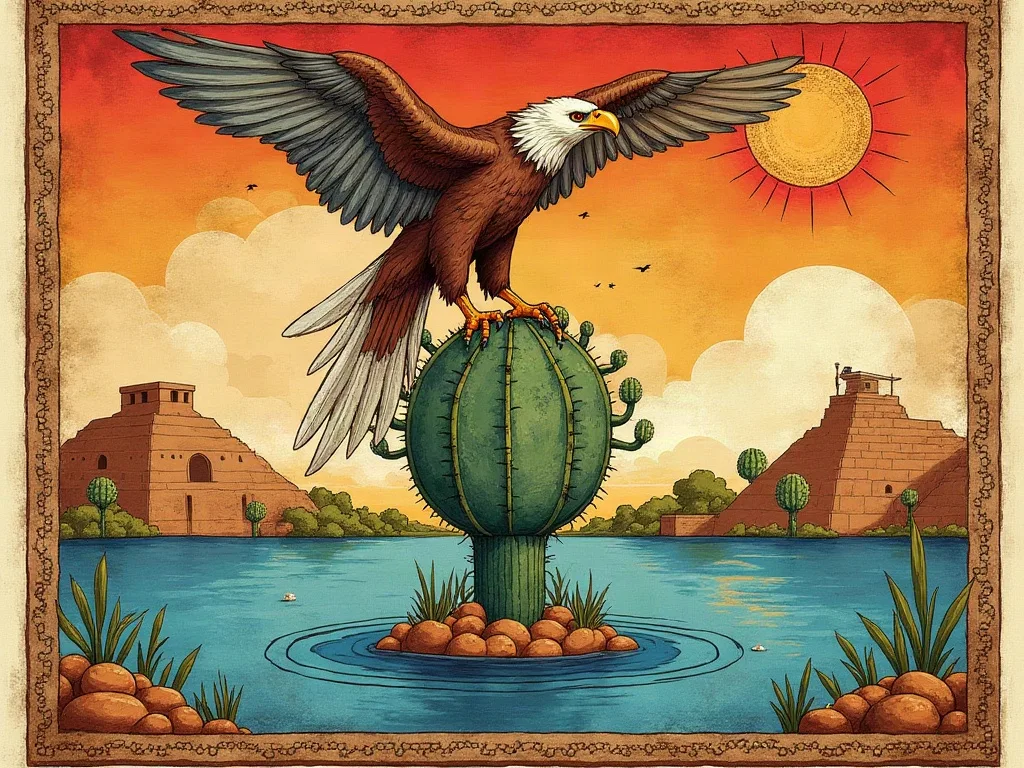
The island itself became sacred. The Mexica called their new settlement Tenochtitlan, which likely derives from "Tetl" (stone) and "nochtli" (prickly pear cactus), meaning "the place of the prickly pear cactus on stone." Some scholars interpret it as "place where the cactus stands on stone." The name encoded the prophecy into the city's very identity.
Tenochtitlan was not built on firm ground. The swampland required constant engineering: causeway construction, dike systems, and the famous floating gardens called chinampa, narrow plots of vegetation that rose from the lake bed. These gardens were extraordinarily productive; a single chinampa could yield seven harvests per year. The Mexica transformed ecological liability into agricultural abundance. This engineering genius kept the city fed and allowed its population to soar to perhaps 200,000 or more by the early 1500s, rivaling or exceeding London at the same period.
The City as Cosmological Map
Tenochtitlan was organized as a sacred geometry, not mere urban sprawl. The city was divided into four quarters, each aligned to a cardinal direction, each associated with a Aztec god and a color. The Great Temple (the Templo Mayor in Spanish) stood at the absolute center, the axis mundi, the point where the upper heavens, the earthly realm, and the underworld intersected.
The Great Temple itself was a doubled pyramid structure, housing sanctuaries to both Tlaloc, god of rain and water, and Huitzilopochtli, god of war and the sun. The two deities occupied the summit as a pair, representing the duality that the Mexica saw woven through all existence: water and fire, rain and drought, the day god and the night god. When Spanish chronicler Bernal Diaz saw the temple in 1519, he was astonished. The structure rose some 60 to 70 meters into the air (roughly equivalent to a 20-story building), its twin sanctuaries visible from across the lake.
The urban landscape radiated from this center. Four main avenues led from the Great Temple toward the four quarters of the city and toward the edges of the island, where causeways connected to the mainland. These pathways were more than traffic routes; they were sacred lines, the cardinal directions made manifest in stone. To walk through Tenochtitlan was to move through the cosmos itself.
The Great Temple required constant rebuilding. The Aztecs practiced ritual superposition: they would construct a new outer layer over the old pyramid every 52 years, at the end of each calendar cycle. This practice reflected their religious conviction that the world itself required renewal. Each rebuilding was an act of cosmic maintenance, a way of ensuring the sun would continue to rise.

Tlatelolco and the Great Market
Just north of the city lay Tlatelolco, originally a sister city that was absorbed into Tenochtitlan's political orbit around 1473 CE. Tlatelolco held its own temple and had once rivaled Tenochtitlan for dominance in the Valley of Mexico, but after a series of internal conflicts and military defeats, the Mexica consolidated power. Rather than destroy Tlatelolco, they made it the center of commerce.
The market of Tlatelolco became legendary. Tlatelolco's marketplace was one of the largest trading grounds in the Americas, drawing merchants and goods from across the Aztec Empire and beyond. The Spanish conquistadors, accustomed to European markets, were struck by its scale and organization. It could accommodate 60,000 vendors on a typical day, according to Bernal Diaz. Merchants (called pochteca) traded jade, cacao, obsidian, cotton, ceramic vessels, and all manner of tribute goods. The market was so large that it had separate sections: spice traders in one area, cloth merchants in another, animal vendors in yet another. It was not mere commerce; it was an expression of Aztec power and abundance, a stage where the empire displayed its reach and wealth.
The pochteca themselves held a special place in Aztec society. They were more than traders; they served as spies and diplomatic agents for the emperor, traveling to distant lands and reporting back on potential threats or opportunities for conquest. A successful pochteca could become wealthy and respected, sometimes approaching the status of nobility.
Water, Causeways, and the City's Relationship to Lake Texcoco
Tenochtitlan was an island city built on discipline and hydraulic engineering. Because the island sat in a brackish lake, freshwater was a constant challenge. The Aztecs built aqueducts, some stretching several kilometers, to bring potable water from springs on the mainland. The most famous was constructed at the order of Ahuitzotl, an emperor (or tlatoani) who ruled in the late 1400s.
The city was linked to the shore by three great causeways, each broad enough for multiple lines of foot traffic and canoe passage. At intervals along these causeways were gates and guardhouses, control points through which the flow of people and goods could be managed. These causeways were also psychological boundaries: they marked the threshold between Tenochtitlan's ordered, sacred space and the outer world.
The dikes and canal systems that threaded through the city served multiple purposes. They were transportation routes; Aztec merchants and nobles traveled by canoe as much as on foot. They were defensive features; in times of conflict, the dikes could be breached to flood approaching enemies or could be controlled to prevent passage. They were also ritual spaces. During certain ceremonies, the Aztecs would pour offerings into the canal waters, feeding the lakes and the supernatural forces that sustained the city.
Palaces, Temples, and the Ceremonial Heart
The tlatoani (the emperor or speaker) ruled from his palace, a vast compound said to contain some 100 courtyards. The palace housed administrative officials, military commanders, tribute collectors, and artists. It was both seat of power and nexus of cultural production. Inside its walls, scribes recorded codices, artists crafted mosaics and sculptures, and nobles conducted diplomacy.
Surrounding the central precinct were dozens of temples, each dedicated to a different deity or aspect of the divine. There was a shrine to Quetzalcoatl, the feathered serpent god of wind and civilization. Temples honored Tezcatlipoca, the smoking mirror god of fate and night. Tlaloc, the rain god, had his own sanctuary where priests made offerings to ensure seasonal rains.
Ritual sacrifice was woven into the city's spiritual life. The Aztecs practiced human sacrifice on a massive scale, particularly at the Great Temple, where thousands of captives from conquered territories were killed to feed the gods. Modern sensibilities recoil from this practice, but the Aztecs understood it differently: sacrifice was the price of cosmic stability. The sun would not move across the sky unless fed with nextlaoaliztli, the debt payment of blood. The world would not continue. This was not cruelty born of sadism, but theology realized in brutal form.
The Four Quarters and Social Organization
The city's four quarters (called calpulli, wards or neighborhoods) each had their own temple, school, and local administration. Each quarter housed different occupational groups: craftspeople, warriors, merchants, and farmers. The calpulli system allowed the Aztecs to maintain order in a rapidly growing urban center. Each ward was responsible for collecting tributes, organizing labor for public works, and ensuring young men trained for warfare.
Cauhtémoc, the last Aztec emperor (or tlatoani), inherited this complex urban organism. By the early 1500s, Tenochtitlan was at its height: a city of temples, pyramids, aqueducts, markets, and canals, populated by hundreds of thousands of people speaking Nahuatl and worshipping the Aztec pantheon. It seemed eternal, unassailable.
The Spanish Encounter and the City's Transformation
When Hernán Cortés and his Spanish expedition entered Tenochtitlan in 1519, they marveled at what they saw. Bernal Diaz, one of the conquistadors, wrote accounts that describe a city of such grandeur that he compared it to Venice, the greatest European city he knew. The causeways, the temples, the organized markets, the aqueducts, the floating gardens: all struck the Spanish as marvels of engineering and culture.
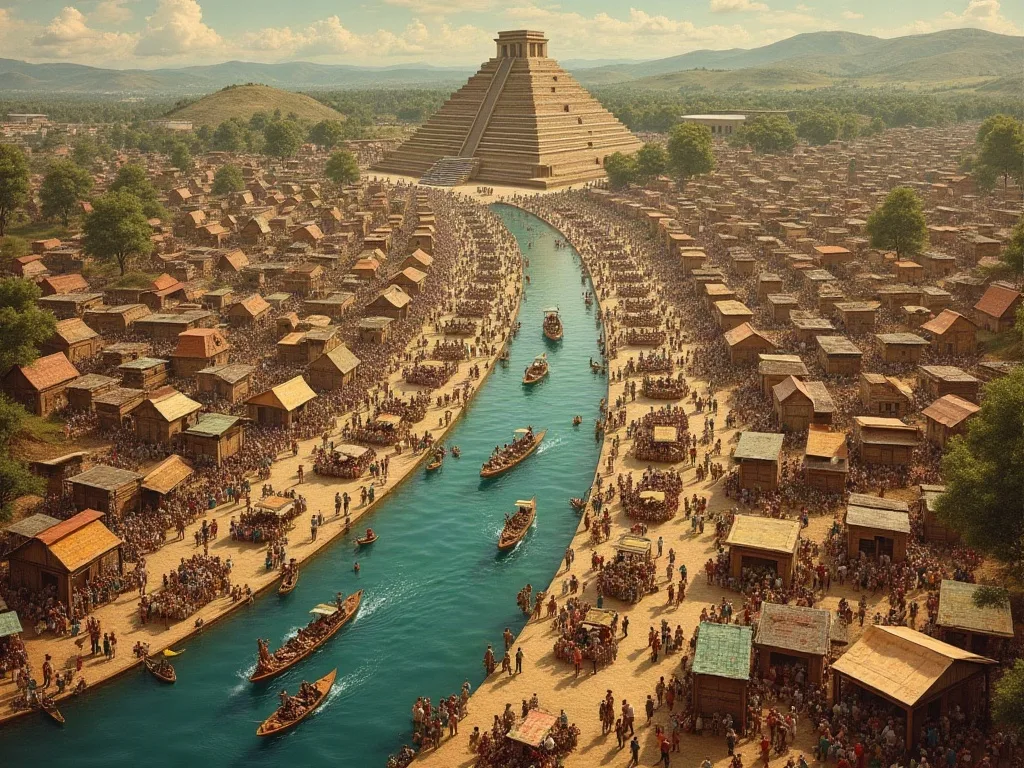
Yet that same wonder did not translate to respect. The Spanish saw the city's wealth and power as targets for conquest, the religious practices as pagan superstitions worthy of eradication. Within two years, in 1521, Tenochtitlan fell. Cortés and his allies, joined by tens of thousands of indigenous warriors from city-states that resented Aztec tributary demands, besieged the city. The Spanish used brigantines (small armed boats) to control the lake, cutting off escape and resupply. After months of fighting, starvation, and disease, Tenochtitlan surrendered.
The Spanish systematically dismantled the city, razing temples to build Christian churches and colonial administrative buildings atop them. The Great Temple was destroyed, though parts of its foundation survive and have been partially excavated by modern archaeology. Lake Texcoco was drained over subsequent centuries, transforming the island into dry land. The Spanish built Mexico City on top of Tenochtitlan's ruins, literally building over the sacred center.
Rediscovery and Modern Understanding
In the late 20th century, Mexican archaeologists began to unearth Tenochtitlan's past. In 1978, workers digging near the Mexico City Metropolitan Cathedral accidentally uncovered a massive carved stone disk depicting the Aztec moon goddess Coyolxauhqui. This discovery sparked a systematic excavation that revealed not only sculptures and architectural fragments but also the city's urban layout and spiritual organization.
The Templo Mayor excavation, led by archaeologist Eduardo Matos Moctezuma, has been ongoing for decades. The digs have revealed offerings left by the Aztecs: jade figurines, shells, obsidian blades, and human remains, all carefully arranged in ritual deposits. These discoveries have allowed modern scholars to reconstruct the religious life of Tenochtitlan with far greater precision than the Spanish conquest accounts alone permitted.
The archaeological work has also challenged certain oversimplifications. While sacrifice was indeed central to Aztec religion, the Spanish accounts often exaggerated its scale for propaganda purposes. Modern excavation and native codices suggest a more nuanced picture of Aztec spirituality: sacrifice was important, but so were other rituals, art, music, poetry, and the intimate relationship between human communities and the divine forces of water, earth, sun, and maize.
Today, Tenochtitlan exists as a palimpsest: layers of Aztec stone and water systems lie beneath Spanish colonial architecture, which lies beneath modern Mexico City. The Templo Mayor excavation site is one of Mexico City's principal archaeological museums, open to visitors who want to walk through reconstructed walls and see the objects that the Aztec priests buried as offerings. The city that was destroyed remains present, not quite erased, waiting to be read.
Tenochtitlan in Aztec Cosmology and Identity
For the Mexica, Tenochtitlan was not just their home; it was the proof of divine favor, the manifestation of Huitzilopochtli's promise. The city's very existence validated their right to rule the Valley of Mexico and, eventually, to build an empire. As tribute flowed in from conquered territories, Tenochtitlan grew richer and more magnificent, and each new temple, palace, or aqueduct seemed to confirm that the Aztecs were the chosen people of the sun god.
The city's cosmological significance cannot be overstated. In Aztec thought, the present world age (called the Fifth Sun, or Nahui Ollin) would not last forever. Doomsday would come at the end of a 52-year calendar cycle, and the sun itself might cease to rise. Only through proper ritual observance, sacrifice, and the maintenance of sacred order could the world be renewed. Tenochtitlan was the place where this renewal happened most intensely, where the priests sang and danced and spilled blood to keep the cosmos turning.
The city encoded Aztec theology in its very stones. The doubled pyramid of the Great Temple embodied the union of Tlaloc (water, the earth below) and Huitzilopochtli (fire, the sun above). The four quarters oriented the inhabitants toward the cardinal directions, reminding them of the cosmos's structure. The causeways were the cardinal directions made solid. The chinampa gardens were acts of creation, bringing fertility from water and mud. Every element of the city's design expressed a spiritual conviction: that order was fragile, that it required constant maintenance, and that Tenochtitlan was the place where such maintenance happened.
The City's Echo in Mesoamerican Identity Today
Tenochtitlan remains central to Mexican identity and to indigenous pride throughout Mesoamerica. The eagle and serpent motif that legend says guided the Aztecs to their island appears on the Mexican national flag. The site of the Templo Mayor, located in the heart of Mexico City, is a place of pilgrimage and pride, where Mexicans and visitors encounter the visual and material proof of indigenous sophistication and power before the conquest.
For indigenous peoples in Mexico and Central America, Tenochtitlan represents a vanished world of indigenous authority, artistic achievement, and spiritual depth. It was a city that rivaled any European metropolis of its time in size, complexity, and beauty. Its destruction by European conquest remains a wound in the historical consciousness, a reminder of what was lost. Yet its rediscovery through archaeology has also allowed contemporary indigenous peoples to reclaim and celebrate their ancestors' achievements on their own terms, independent of Spanish narratives.
Frequently asked questions about Tenochtitlan
Frequently asked questions
What made Tenochtitlan so successful as an island city?
The Mexica engineered solutions to the challenges of island life. They built aqueducts to bring fresh water, created the chinampa (floating gardens) system to generate surplus food, constructed three causeways to connect the island to the mainland, and developed a dike and canal network that allowed them to control flooding and transport goods. These innovations allowed a population exceeding 200,000 to thrive on an unlikely site.
Why was the Great Temple built with two sanctuaries?
The dual sanctuaries honored Tlaloc (god of rain and water) and Huitzilopochtli (god of war and the sun). This pairing reflected the Aztec understanding of cosmic duality: water and fire, earth and sky, rain and drought, night and day. The two deities together maintained the balance upon which all existence depended. Keeping them honored ensured the cosmos would remain in equilibrium.
What happened to Tenochtitlan after the Spanish conquest?
The Spanish systematically dismantled the city, razing temples to build churches and colonial administrative buildings. Lake Texcoco was drained over subsequent centuries. Mexico City was built on top of Tenochtitlan's ruins. However, excavations beginning in the 1970s have revealed the city's layout and artifacts, allowing modern reconstruction of Aztec urban life and spirituality.
Did the Aztecs really practice human sacrifice on the scale the Spanish described?
The Spanish accounts exaggerated the scale of Aztec sacrifice for propaganda purposes, but archaeological evidence and native codices confirm that human sacrifice was a significant ritual practice, particularly at the Great Temple. However, Aztec religion was more multifaceted than Spanish accounts suggested. Sacrifice was one component of a complex spiritual system that also included art, poetry, music, and intimate relationships with divine forces.
How did the prophecy of the eagle and cactus guide the Mexica to Tenochtitlan?
According to Aztec tradition recorded in codices like the Codex Mendoza, Huitzilopochtli commanded the Mexica to build their city where they found an eagle perched on a cactus. This prophecy served as both a cosmological directive and a validation of Aztec divine favor. When scouts found the eagle on the island in Lake Texcoco around 1345 CE, the Mexica recognized it as proof that they had reached their destined homeland, the axis mundi where their empire would rise.
What is the Templo Mayor excavation, and what has it revealed?
The Templo Mayor excavation, begun after the accidental discovery of the Coyolxauhqui stone disk in 1978, has systematically unearthed the Great Temple's remains beneath Mexico City. Archaeologists have found sculptures, ritual offerings (jade, obsidian, shells, human remains), and architectural fragments that reveal the temple's structure, the religious practices that animated it, and the urban layout of the city's sacred precinct. The site is now an open-air museum in central Mexico City.
Tenochtitlan and the Modern World
The ruins of Tenochtitlan lie beneath Mexico City's streets, a constant reminder that civilization is built in layers. Modern Mexicans walk daily over the remains of a city that their ancestors built on prophecy and hydraulic genius. The Templo Mayor site draws hundreds of thousands of visitors annually, from curious tourists to indigenous pilgrims seeking connection with their heritage.
Tenochtitlan's story resists a single narrative. It was a marvel of engineering and urban planning, a seat of imperial power and religious devotion, a cosmological center where the sacred and the material intersected. It was also a site of violence, where thousands were sacrificed in rituals that modern sensibilities find disturbing. It was destroyed by European conquest, its temples razed, its people decimated by disease and warfare. Yet it also endures, not as a living city but as an idea: proof that indigenous peoples of the Americas built civilizations of sophistication and grandeur, that their theological systems and architectural innovations rival anything the Old World produced, and that their legacy remains woven into the identity of modern Mexico and the pride of indigenous communities throughout Mesoamerica.
Read the full book
Want the whole story?
The complete edition is an instant PDF download here, with a paperback on Amazon for selected titles.
Aztec
The Aztec Mythology Book: Quetzalcoatl, Huitzilopochtli, Tezcatlipoca, and the Five Suns of the Mexica
Blood, Feathered Serpents, and the Cosmic Engine of Tenochtitlan
The gods, heroes, and sacred calendar of the Mexica civilization. From the feathered serpent Quetzalcoatl to the five world ages, the complete mythology of Tenochtitlan.
More from Aztec
All articles
Aztec
The Legend of the Fifth Sun: Why the Aztecs Believed Humanity Required Divine Blood
The Aztecs lived under a cosmological clock. They believed the world had been created and destroyed four times before. The fifth world, their world, could only survive if the gods received constant nourishment: human blood. Discover how mythology, astronomy, and ritual wove together in one of history's most misunderstood civilizations.

Aztec
Coatlicue: Mother of Gods and the Aztec Pantheon
Coatlicue, the serpent-skirted mother, bore the sun god and ruled over fertility, childbirth, and death in Aztec belief. Discover how the Aztecs honoured her as the generative force behind their entire pantheon and cosmos.

Aztec
Tlaloc: God of Rain and Fertility in Aztec Mythology
Tlaloc brought water to the Aztec world, but his gifts came with terror. Discover how the rain god shaped Mesoamerican religion, from mountain shrines to the sacred cenotes where thousands sought his blessing.
Aztec
Huitzilopochtli: God of War and the Sun
Huitzilopochtli, the Aztec god of war, sun, and human sacrifice, emerged from his mother's womb fully armed to battle the darkness. His myth shaped the empire's entire worldview: conquest, cosmic duty, and survival itself.