

Tlaloc: God of Rain and Fertility in Aztec Mythology
Tlaloc brought water to the Aztec world, but his gifts came with terror. Discover how the rain god shaped Mesoamerican religion, from mountain shrines to the sacred cenotes where thousands sought his blessing.
Contents
Storm clouds gather above the Valley of Mexico. The Aztecs watch the sky, waiting. If Tlaloc, the god of rain and fertility, smiles upon them, crops will grow and the empire will flourish. If he turns his face away, drought will crack the earth and famine will come. In Aztec hands, water itself becomes a prayer.
Tlaloc was not a gentle deity. His image appears on codices with bulging serpent eyes, prominent teeth like fangs, and a mouth that might have been grinning or grimacing. The Aztecs saw him as both savior and destroyer. A downpour meant survival; a deluge brought death. To understand Tlaloc: the god of rain and fertility, you have to understand that the Aztecs lived in a landscape where every drop of water mattered, where mountains held reservoirs of divine power, and where a god could heal or kill with the same storm.
The Origin and Realm of Tlaloc
Tlaloc belongs to the oldest layer of Mesoamerican religion. Archaeologists have found rain god imagery in Olmec ruins dating back over 2,000 years. The Aztecs inherited and transformed this ancient figure, making him central to their cosmology and state religion.
In Aztec mythology, Tlaloc dwelt on Tlalocan, a realm beyond the mountains, often depicted as a mountainous island floating in the cosmic waters. This was not the afterlife reserved for nobles and warriors who died in battle. Tlalocan was the paradise granted to those who died by water: the drowned, those who fell in the sea, those struck by lightning, and anyone who succumbed to water-related illnesses. There, in Tlaloc's domain, the blessed would live in eternal spring, surrounded by maize that never withered, flowers that never faded, and the perpetual hum of flowing water.
The god ruled over rain, springs, fountains, and mountain lakes. His province was fresh water itself, that precious resource without which civilization could not survive in the Valley of Mexico. The Aztecs built their capital, Tenochtitlan, on an island in Lake Texcoco, and water defined every aspect of their urban design. Canals, aqueducts, chinampas (floating gardens) all depended on the seasonal rains that Tlaloc commanded.

Tlaloc's Appearance and Symbols
When the Aztecs painted or carved Tlaloc, they reached for the most memorable features nature could teach them. The god's face became iconic: two large, circular eyes that bulged like those of a snake or a goggle-eyed creature. A line ran down from his nose, often depicted as a serpent, which gave him the alternate name Tlaloc Ixquimilli, "Tlaloc of the Mask."
His mouth was ringed with shell ornaments and sharp fangs. Sometimes these fangs were tusks curving downward, giving him an appearance both fierce and almost melancholy. The Aztecs often adorned him with a crown of reeds or feathers and placed him wearing a cape that resembled rain itself, dotted with water lilies and droplets.
The serpent motif was deliberate. In Mesoamerican symbolism, serpents were creatures of duality: they lived between earth and sky, could move through water and land. The serpent's ability to shed its skin connected it to renewal and agricultural cycles. Tlaloc's serpent nose was therefore not ornamental; it was theological. It marked him as a being who moved between realms, carrying rain from the sky realm into the earthly domain.
His sacred animals were the frog and the salamander, creatures of wetness and transformation. His color was a deep blue, the blue of water and storm clouds. Jade was sacred to him, a stone the Aztecs associated with water and life itself. When they carved Tlaloc figurines, they often chose jade, turquoise, or obsidian, materials that held power.
The Cosmological Role of Tlaloc
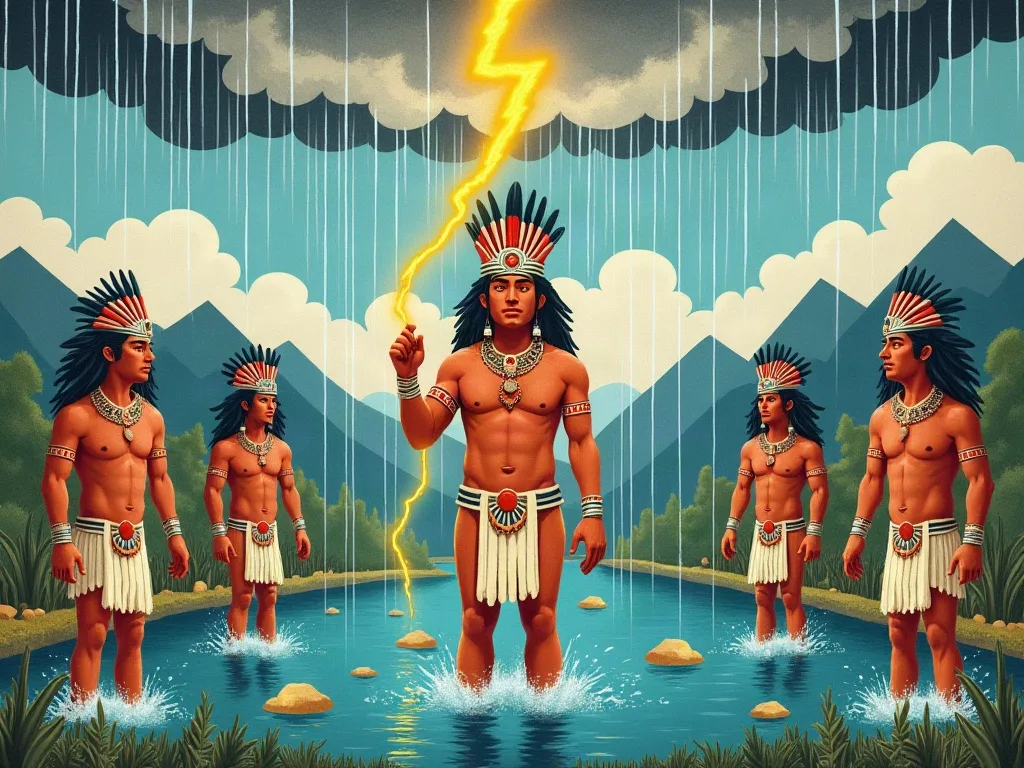
The Aztecs understood their world as cyclical. Four suns had already risen and fallen; they lived in the Fifth Sun, the age destined to end in earthquakes and destruction. Tlaloc played a crucial role in this cosmic drama. He had destroyed the Fourth Sun by water, sending a great flood that consumed all life. In the myths, only a handful of people survived by becoming fish or taking refuge in a cypress tree.
The Aztecs were acutely aware that Tlaloc could bring the same destruction upon them. This was not merely theological speculation; it was lived reality. The Valley of Mexico experienced both droughts so severe that crops failed and rains so violent that harvests were destroyed. The unpredictability of water made Tlaloc a god who demanded constant appeasement and respect.
In the Aztec calendar, certain days belonged to Tlaloc. The month Quetzalxochitl (parts of February and March in the Spanish calendar) was dedicated to him. During this period, the Aztecs held major festivals with elaborate ceremonies meant to ensure his favor for the coming rainy season. The stakes were absolute: without rain, the empire could not feed itself.
Tlaloc also controlled hail, lightning, and thunder. Each was a different manifestation of his power. Lightning was his weapon, a divine spear that he hurled from the sky. The sound of thunder was his voice, speaking across the mountains. When a person was struck by lightning, the Aztecs believed Tlaloc had chosen them directly, calling them to his service or his judgment. Such a person was often considered sacred, marked by the god's hand.
Tlaloc's Relationship with Other Gods
Tlaloc was not isolated in the Aztec pantheon. He had a complex relationship with Huitzilopochtli, the god of war and the patron deity of the Aztec people. While Huitzilopochtli represented the aggressive, expansionist impulse of the empire, Tlaloc represented its dependence on natural forces beyond its control. Together, they were honored as complementary powers.
The god had a consort or feminine aspect, sometimes called Chalchiuhtlicue, the goddess of running water, rivers, and springs. She represented the gentler, more flowing aspect of water, while Tlaloc embodied its raw, destructive potential. This pairing reflected the Aztec understanding that all natural forces contained both nurturing and dangerous dimensions.
Tlaloc also had four servants or aspects, called the Tlaloques. These lesser rain deities were stationed at the four cardinal directions, each responsible for different types of rain or weather phenomena. Together, they formed a divine administrative structure; Tlaloc was the sovereign, and the Tlaloques were his functionaries.
The Rituals and Sacrifices for Tlaloc
The Aztecs did not leave Tlaloc's favor to chance. Every year, especially as the dry season approached its end, they performed ceremonies designed to awaken him and draw his attention to their needs.
The festival Tozoztontli (which fell in March-April) was a major occasion. Young children, especially those with blue eyes (thought to be especially sacred to Tlaloc), were sometimes sacrificed on mountaintops. This sounds horrific to modern ears, and it was. But to the Aztecs, it was the highest honor; these children were believed to go directly to Tlalocan, the god's paradise, where they would live in eternal joy. The sacrifice was an attempt to create a sympathetic connection with Tlaloc, to show him that the people valued what he valued: the water of life, represented by the water that flowed from the bodies of victims.
Mountain sanctuaries were particularly important. Tlaloc had shrines on the highest peaks of the Valley of Mexico, where priests would climb in the night and leave offerings of maize, incense, precious stones, and sometimes animals or humans. The elevation brought them closer to the realm where Tlaloc dwelt, that cloudy region where rain was born. The sight of mist rolling down from those mountains became a visible sign of his presence.
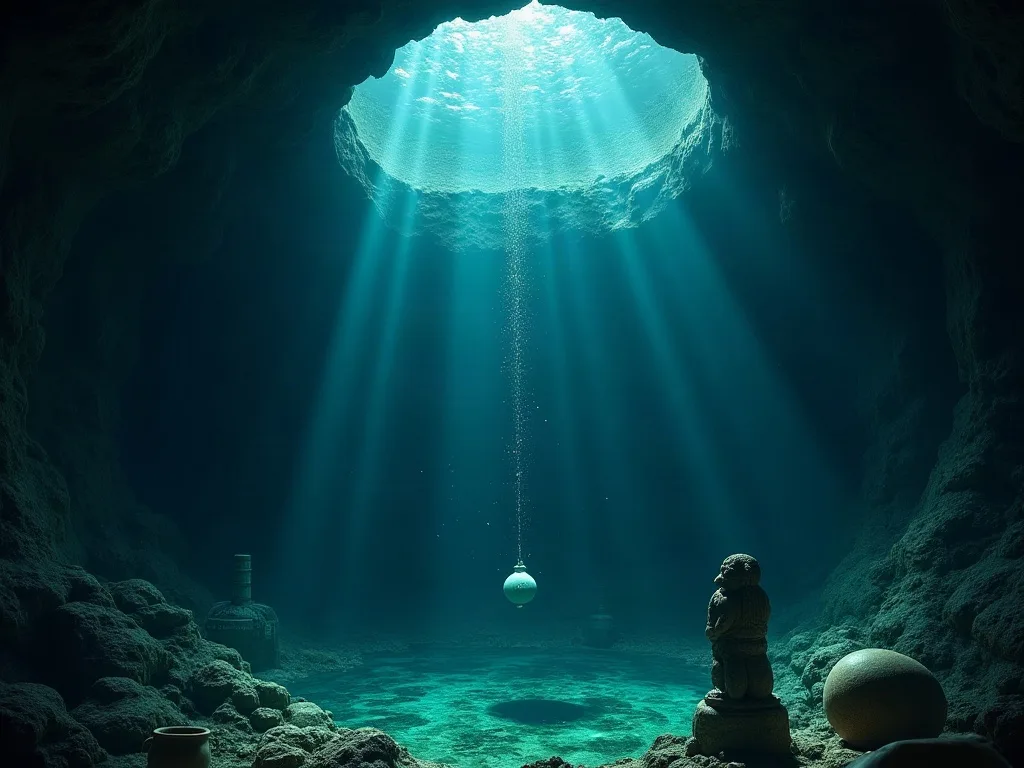
The Aztecs also performed rituals at cenotes, the natural sinkholes that dot the Yucatan Peninsula and beyond. These were openings to the underworld, but they were also reservoirs of Tlaloc's power, places where humans could directly access the god's realm. Offerings were cast into these waters: jade, gold, pottery, and occasionally human victims. The objects disappeared into the depths, a transaction between the human and divine worlds.
Fasting, bloodletting (the ritual pricking of ears, tongues, and genitals to offer one's own blood), and abstinence from sexual relations were common practices leading up to Tlaloc festivals. The Aztecs understood sacrifice not just as the killing of a victim, but as the offering of precious things, including the body's own fluids. Blood was the most precious fluid of all, and it was given to all the gods; Tlaloc was no exception.
Tlaloc in the Codices and Sacred Texts
The Aztecs recorded Tlaloc's image and stories in codices, pre-Columbian books made of amatl paper or deerskin. The most important surviving source is the Codex Florentinus, compiled after the Spanish conquest by the Nahua scholar Bernardino de Sahagun and Nahua informants. This text provides the most detailed account of Tlaloc's nature and worship.
In the Codex Florentinus, Tlaloc is described as a god with four servants standing at the four world-directions. Each is responsible for a different type of rain: gentle rain necessary for crops, hail that destroys them, rain that falls at the wrong time, and rain that brings drought when held back. This explains why the Aztecs experienced Tlaloc as an ambivalent god. He was not consistently benevolent or malevolent; his power was morally neutral, dependent on timing and circumstance.
The codices also depict Tlaloc in scenes of cosmic significance. In the Codex Vaticanus, he appears in the creation narrative, present as the world is formed and destroyed in successive ages. His appearance signals transition, the movement from one era to another, often through water and upheaval.
Tlaloc's Transformation and Survival
When the Spanish conquistadors arrived and conquered Tenochtitlan in 1521, they systematically destroyed temples and codices. Yet Tlaloc did not disappear. The god's association with essential functions (rain, fertility, water) meant that indigenous peoples could not simply abandon him. Instead, Tlaloc was absorbed and transformed.
In many regions of Mexico, Tlaloc merged with Catholic saints associated with rain and water. In some communities, San Isidro Labrador, the Catholic saint of farmers, inherited attributes and ceremonies that had once belonged to Tlaloc. The rituals changed in form but retained their purpose: appeasing the forces of nature, ensuring rain, protecting crops.
In indigenous communities today, especially in the highlands of Mexico and Guatemala, pre-Columbian rain gods survive under different names, incorporated into Christian frameworks. The structure of belief persists: a deity who controls water, who must be honored and propitiated, who brings both blessing and danger. Tlaloc may no longer appear on mountaintop shrines, but his role in the relationship between humans and the natural world remains encoded in the religious practices of Mesoamerican peoples.
Modern scholarly study has recovered much of what was lost. Archaeologists excavating the Templo Mayor in Mexico City have uncovered thousands of offerings left at Tlaloc's shrine alongside those for Huitzilopochtli. These artifacts, from pieces of jade to ceramic vessels to human remains, tell the story of a god who was honored and feared for centuries.
Tlaloc's Legacy in Mesoamerican Art and Thought
Tlaloc's influence extended far beyond the Aztec empire. Centuries before the Aztecs rose to power, other Mesoamerican peoples had revered rain gods with similar features. In Teotihuacan, the great city that flourished centuries before the Aztecs, murals show a deity with the characteristic bulging eyes and fangs of Tlaloc. The Maya peoples had their own rain god, Chaac, whose visual representation mirrors Tlaloc's in significant ways.
This tells us something crucial about Mesoamerica: the landscape itself shaped religious thought. In a region where water was scarce, irregular, and life-determining, rain gods became central figures in every major civilization. The specific features that make Tlaloc recognizable, the goggle eyes, the serpent nose, the fanged mouth, these were not arbitrary choices. They were visual expressions of a truth the Aztecs understood intimately: that water was a force that could see all, pierce all, consume all.
Frequently asked questions about Tlaloc
Frequently asked questions
Why did the Aztecs sacrifice children to Tlaloc?
The Aztecs believed that children who died by water (drowning, or in this case, sacrifice on Tlaloc's mountain altars) went directly to Tlalocan, his paradise, where they would experience eternal joy. To the Aztec mind, this was not cruelty but honor and mercy. They were also creating a sympathetic transaction with the god: offering what he valued (water, the life force represented by flowing blood) to ensure he would send rain to sustain the empire. Modern readers find this abhorrent, but it reflects a fundamentally different worldview in which sacrifice was a sacred obligation and communication with the divine.
Did Tlaloc have a rival or enemy among the gods?
Not exactly a rival, but Tlaloc and Huitzilopochtli represented opposing forces. Huitzilopochtli embodied the Aztec will to conquer and dominate; Tlaloc represented the natural forces that no empire could fully control. Together, they balanced each other in Aztec theology. The great temple at Tenochtitlan had shrines to both gods, side by side, acknowledging that survival required both military power and respect for natural limits.
Is Tlaloc still worshipped today?
Tlaloc in his original form is no longer actively worshipped, but his attributes and functions persist in Mesoamerican indigenous religions, often merged with Catholic saints. In Mexico City, where the Aztec capital once stood, Tlaloc remains a powerful symbol of the city's water crisis and its ancient relationship with the sacred. His image appears in murals, literature, and contemporary indigenous spiritual practices. He has also become a symbol of environmental consciousness and indigenous resistance to colonialism.
What does Tlalocan mean, and who else lived there?
Tlalocan is often translated as "the place of Tlaloc." According to Nahua texts, those who died by water, drowning, or water-related illness went to Tlaloc's paradise. The Codex Florentinus describes it as a land of eternal spring, with maize that never withered, flowers in perpetual bloom, and the sound of flowing water everywhere. It was a paradise for the common people and farmers; the warrior's paradise (where those who died in battle went to join the sun god Huitzilopochtli) was distinct and separate.
How do we know about Tlaloc today?
Most of our detailed knowledge comes from the Codex Florentinus, a post-conquest compilation of Nahua religious and historical knowledge collected by the Spanish friar Bernardino de Sahagun and his indigenous collaborators. Archaeological evidence from the Templo Mayor excavations in Mexico City, discovered in the 1980s, has provided thousands of artifacts and offerings that confirm and expand what the codices tell us. Surviving indigenous traditions in Mexico and Central America also preserve echoes of Tlaloc's worship and cosmological role.
The Blue God and the Future of Water
In 2026, as Mexico City faces unprecedented water scarcity, Tlaloc has returned to the consciousness of the city as a historical and philosophical touchstone. The god who once demanded mountains of offerings in exchange for rain now seems almost prophetic: a warning about what happens when humans forget their dependence on natural forces beyond their control.
The Aztecs lived with an acute awareness that their empire was fragile, that the gods could withdraw their favor at any moment. Drought was not merely an inconvenience; it was catastrophe. The cycles of rain and dry season shaped the rhythm of religious life, the calendar, the state budget, and the psychology of millions. Tlaloc embodied this reality: not as a comfortable guarantor of abundance, but as a powerful force that had to be understood, respected, and negotiated with constantly.
This relationship between humans and water, between the need for rain and the fear of flood, remains as relevant in 2026 as it was in 1400. Tlaloc: the god of rain and fertility represents an older way of thinking about resources, about power, and about humanity's place in a living cosmos. Whether or not anyone prays to him now, his presence lingers in the mountains above Mexico City, in the ancient wells where offerings were once left, and in the memory of a civilization that understood, in their bones, that water was sacred.
Read the full book
Want the whole story?
The complete edition is an instant PDF download here, with a paperback on Amazon for selected titles.
Aztec
The Aztec Mythology Book: Quetzalcoatl, Huitzilopochtli, Tezcatlipoca, and the Five Suns of the Mexica
Blood, Feathered Serpents, and the Cosmic Engine of Tenochtitlan
The gods, heroes, and sacred calendar of the Mexica civilization. From the feathered serpent Quetzalcoatl to the five world ages, the complete mythology of Tenochtitlan.
More from Aztec
All articles
Aztec
Tenochtitlan: The Sacred Aztec Capital
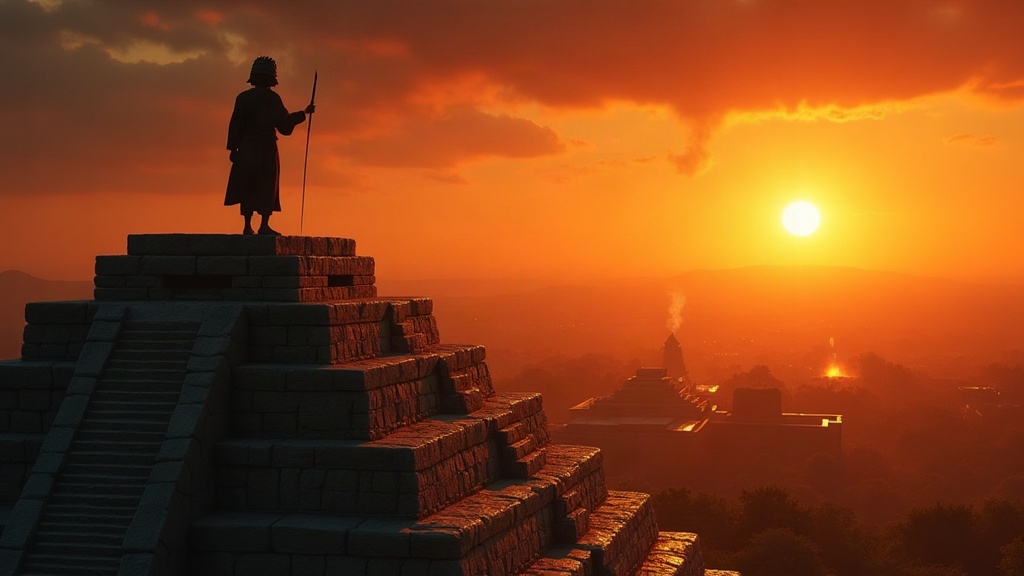
Tenochtitlan rose from an island in Lake Texcoco as the Mexica people's promised homeland, guided by their god Huitzilopochtli. Discover how this sacred city became the center of the Aztec Empire and why its temples, waterways, and ceremonial heart shaped an entire civilization.
Aztec
The Legend of the Fifth Sun: Why the Aztecs Believed Humanity Required Divine Blood
The Aztecs lived under a cosmological clock. They believed the world had been created and destroyed four times before. The fifth world, their world, could only survive if the gods received constant nourishment: human blood. Discover how mythology, astronomy, and ritual wove together in one of history's most misunderstood civilizations.

Aztec
Coatlicue: Mother of Gods and the Aztec Pantheon
Coatlicue, the serpent-skirted mother, bore the sun god and ruled over fertility, childbirth, and death in Aztec belief. Discover how the Aztecs honoured her as the generative force behind their entire pantheon and cosmos.
Aztec
Huitzilopochtli: God of War and the Sun
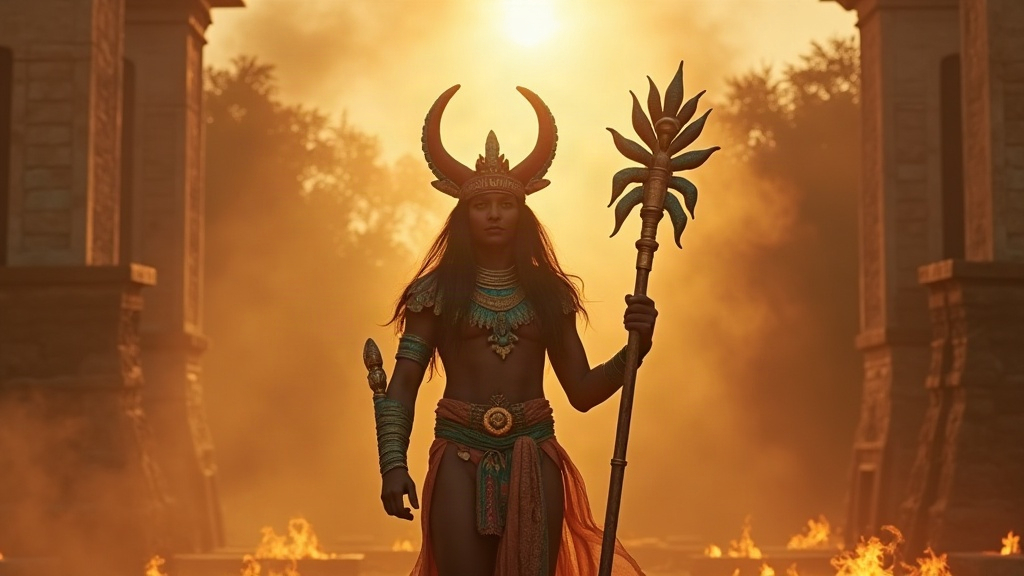
Huitzilopochtli, the Aztec god of war, sun, and human sacrifice, emerged from his mother's womb fully armed to battle the darkness. His myth shaped the empire's entire worldview: conquest, cosmic duty, and survival itself.