
The Legend of the Fifth Sun: Why the Aztecs Believed Humanity Required Divine Blood
The Aztecs lived under a cosmological clock. They believed the world had been created and destroyed four times before. The fifth world, their world, could only survive if the gods received constant nourishment: human blood. Discover how mythology, astronomy, and ritual wove together in one of history's most misunderstood civilizations.
Contents
The Aztecs called their world the Fifth Sun. It was not a promise of permanence. It was a warning.
According to their mythology, the universe had collapsed catastrophically four times. Each world had its own sun, its own age, and its own ending. The first world was destroyed by jaguars. Water swallowed the second. Fire consumed the third. Wind razed the fourth. Each destruction had been total. Each sun had fallen.
Now, in the fifth age, the gods themselves had made a pact with the sun god Huitzilopochtli, the god of war and the sun. That pact was written in blood. The sun would rise each morning only if it received an offering: human sacrifice. Without the nextlaoaliztli, the debt payment, the sun would stop. The world would go dark. Time itself would cease.
This was not mythology detached from belief. The Aztecs acted on this cosmology every single day. They waged war partly to capture prisoners for sacrifice. They built the greatest pyramid in Mesoamerica, the Templo Mayor, with a blood-soaked altar at its peak. Tens of thousands died each year in ceremonies designed to keep the cosmos in motion. And when Spanish conquistadors arrived in 1519, they found an empire whose religion and politics were inseparable from ritual killing.
The question that haunts modern readers is not whether the Aztecs performed human sacrifice. They did. The question is: how did they arrive at a cosmology where sacrificing their own people was not madness or cruelty, but the only way to prevent the end of everything?
The Four Worlds Before This One
The Aztecs inherited a cosmological vision shared across Mesoamerica. The most complete written version comes from the Popol Vuh, the K'iche' Maya creation epic, but the Aztec version appears in sources like the Codex Chimalpopoca and the History of the Mexicans as Told by Their Gods, Spanish transcriptions of oral traditions recorded after the conquest.
The first creation was not a success. The gods tried to make humans from clay. These beings could not stand upright. They crumbled and dissolved. The world lasted only until the sun rose, then jaguars descended from the sky and devoured everything.
In the second world, the gods used wood. The wooden people could move and reproduce, but they were soulless, without understanding or speech. A great flood rose and drowned them. Some survived and became animals and birds, witnesses to the disaster.
The third sun brought fire. For 364 days, the world burned. The sun fell into the sky like a stone. Ash covered everything. Rocks exploded. Only the mountains survived.
The fourth sun presided over wind. For 364 days, the wind blew so fiercely that it carried away everything: trees, water, houses, humans. The survivors became monkeys.
Each destruction left the gods frustrated and exhausted. They had tried again and again to create a stable world, stable humans, a cosmos that would endure. Each attempt ended in ruins.
Then came the Fifth Sun, our sun, our world. And this time, the creation required something the earlier attempts had not: sacrifice from the beginning.
How the Fifth Sun Was Born: The Divine Debt
The creation of the Fifth Sun happened at the sacred place called Teotihuacan, the "place where the gods became gods," a ruined city that the Aztecs believed was the residence of the original divine beings. In desperation, the gods gathered there in darkness and decided to create a world that would last.
Nanahuatzin, the god of syphilis and boils, a humble and scarred deity, was the first to leap into the fire that would transform him into the sun. His sacrifice was willing, deliberate. He became the sun that would light the fifth world.
But there was a problem. The sun rose on the horizon and stopped. It did not move. It hung in the sky, cold and immobile. Without momentum, without energy, without nourishment, the Fifth Sun could not advance. The world was locked in a moment between dawn and noon.
The other gods realized what had to be done. Quetzalcoatl, the feathered serpent god of wind and civilization, looked at the trapped sun and spoke a terrible truth: a god would have to die to give it movement. Not one god. All the other gods present had to sacrifice themselves.
One after another, the divine beings threw themselves into the fire at Teotihuacan. They burned. They gave their blood, their essence, their life energy. Only then did the sun move. Only then did it climb across the sky. Only then did time resume.
This was the original debt. The sun owed its motion, its existence, its power to divine sacrifice. That debt now passed to the world below. If the gods had to die to keep the sun moving, then humans, made in the image of the gods, must pay that price every day.
The Sun's Hunger: The Cosmic Necessity of Nextlaoaliztli
The Aztecs called the act of blood offering nextlaoaliztli, which translates roughly as "debt payment" or "that which is owed." The sun was not a distant, benevolent force. It was a hungry god, Huitzilopochtli, the god of war, the southern direction, the day, and the tribal protector of the Mexica people who built the Aztec Empire.
Every morning, Huitzilopochtli was born anew from the goddess Coatlicue. Every evening, he died in the west. Every night, he battled the forces of darkness and chaos to be reborn. This cycle was not guaranteed. It required fuel. It required chalchiuhatl, precious water (the Aztec metaphor for blood).
The sun's journey across the sky was a battle. The night forces, the stars, the gods of death and cold, all conspired to prevent the sun's return. If the sun did not receive enough blood offerings, it would weaken. The night forces would overcome it. The world would fall into permanent darkness and cold.
This was not abstract theology. The Aztecs tracked the sun's strength through observation. They noted that the sun seemed weaker in winter, when the days were shorter. They understood that the sun appeared to struggle at certain times of year. The solution was to intensify blood sacrifice during these dangerous periods, to give the sun extra strength when it needed it most.
The Templo Mayor, the great pyramid temple that dominated the Aztec capital of Tenochtitlan, embodied this belief in stone. At the summit, two temple shrines faced the sunrise. One was dedicated to Huitzilopochtli, the sun god. The other was dedicated to Tlaloc, the god of rain and water. The right side of the temple (south) was associated with Huitzilopochtli and the sun. The left side was associated with Tlaloc and the night. The building itself was a representation of the cosmic struggle.
Priests would lead captives, usually prisoners taken in war, to the top of the pyramid. At the summit altar dedicated to Huitzilopochtli, a sacrificial stone (the techcatl) was placed. The victim would be stretched backward across it, their chest exposed. The priest would use an obsidian knife (the itztli), a blade so sharp it could cut through bone, to open the chest and remove the still-beating heart. The heart was offered to the sun. The body was often allowed to tumble down the steep pyramid stairs, a final return to the earth.
The Aztecs believed that the most powerful blood, the most potent nourishment for the sun, was nextlaoaliztli, the precious debt payment of a human life. A warrior taken in battle was the ideal offering, because warriors embodied the sun's own energy and courage. The sacrifice was not viewed as murder. It was viewed as feeding the cosmos itself.
The Cosmic War: Why Captives Were Essential
The Aztec empire was not built on conquest alone. It was built on a system of ritualized warfare designed to generate a constant supply of sacrificial captives. The Aztecs called these ceremonial wars xochiyaoyotl, "flowery wars," or "wars of flowers."
These were prearranged military conflicts with neighboring city-states. The goal was not to conquer territory or destroy the enemy. The goal was to capture warriors alive so they could be brought back to the temple and offered to the sun. The enemy city-state participated in this system willingly, in a strange and alien form of mutual obligation.
The logic was clear: every city-state served a sun god who was hungry. Every city-state needed to feed that sun with blood offerings from their enemies. The flowery wars ensured that every combatant, whether victor or vanquished, participated in maintaining the cosmos. The captive warrior became a conduit between the human world and the divine. Their death fed the sun. Their blood paid the debt.
Captive warriors were often kept alive for months or even years before sacrifice. They were sometimes married to priestesses. They were honored and fed. The night before sacrifice, there were festivals and songs. The captive was not viewed as a condemned criminal. They were viewed as a human representative of the sun itself, about to be transformed into divine essence through the ultimate offering.
Estimates suggest that the Aztec Empire performed somewhere between 10,000 and 80,000 human sacrifices per year (scholars debate the exact number). Some years, during major festivals tied to the Aztec calendar and the sun's apparent struggles, the number was much higher. At the dedication of the Templo Mayor around 1487, some sources claim that 80,000 people were sacrificed over the course of four days.
The Aztec Calendar: Keeping Track of the Fifth Sun
The Aztecs developed one of the most sophisticated astronomical and calendrical systems in the ancient world. The need to maintain balance with the sun drove much of this precision.
The Aztec calendar was actually two calendars working simultaneously. The xiuhpohualli, the "year count," was 365 days long, divided into 18 months of 20 days plus 5 extra "useless" days at the year's end. The tonalpohualli, the "day count," was 260 days long, a sacred calendar tied to ritual and divination.
These two calendars intersected every 52 years in a moment of extreme cosmic anxiety called the xiuhmolpilli, the "new fire ceremony" or "binding of the years." After 52 years, the two calendars completed a full cycle and aligned again. The Aztecs believed that this moment was supremely dangerous. The world might not renew. The sun might not rise. The Fifth Sun might end, just as the previous four had ended.
To ensure renewal, the Aztecs performed the most elaborate ceremony of their religious year. All fires in the city were extinguished. All pottery was broken. The city fell into darkness and silence. Then, at the precise moment when the constellation Pleiades reached the zenith in the night sky, priests would kindle a new fire by friction in the chest of a sacrificial victim. That fire was then carried throughout the city, and all hearths and temples were relit from this one sacred flame.
The ceremony announced to the cosmos: we have made the payment. We have fed the sun. Time continues. The Fifth Sun endures.
This was not a one-time event. The ceremony happened every 52 years, and the belief system that underlay it structured daily Aztec life. Every sunrise was a small renewal. Every sacrifice was a small payment on the cosmic debt. The entire civilization was organized around the idea that the sun would stop if the payments ceased.
Human Sacrifice and Spirituality: The Aztec Perspective
Modern readers often approach Aztec sacrifice with horror and incomprehension. But to the Aztecs, sacrifice was not cruelty; it was spirituality, cosmology, and practical necessity woven together.
The Nahua word nextlaoaliztli, "debt payment," reveals the Aztec mindset. The universe was not a gift. It was a loan. The cosmos functioned because gods had already paid the ultimate price at Teotihuacan. That act of divine self-sacrifice created an obligation. The debt had to be repaid daily. Failure to pay meant collapse.
Sacrificial victims were often called nextlao, "those who owe the debt," but also "those who pay the debt." They were not viewed as victims in the way modern Western sensibility understands that word. They were viewed as priests, as intermediaries, as warriors chosen to perform the most sacred act: feeding the sun.
A captured warrior was considered blessed and honored. He would be ritually bathed, clothed in fine garments, and given titles. The night before his sacrifice, there would be music, dancing, and feasting. His role was understood as elevated, essential, transformative. He was becoming part of the sun itself.
The Aztec calendar tied sacrifice to specific deities and specific times. Huitzilopochtli's festival required warriors. Tlaloc's festival required children, whose tears would call down rain. Xipe Totec's festival required prisoners who would be flayed, their skin worn by priests to represent new growth and renewal. Each deity had a form of sacrifice appropriate to their domain.
This was not atheism. It was not ignorance. The Aztecs had developed a complete theological system in which sacrifice was a form of prayer, an act of cosmic maintenance, a way of keeping the Fifth Sun alive.
Why Conquistadors Misunderstood: The Weight of Translation
When Hernán Cortés and his Spanish conquistadors entered Tenochtitlan in 1519, they witnessed ceremonies that appalled them. Spanish chroniclers like Bernal Díaz del Castillo described pyramids slick with blood. They described priests with matted hair stiff with dried sacrificial blood. They described the sounds of drums and the sight of hearts torn from living chests.
The Spanish interpreted what they saw through the lens of Christian theology. They saw barbarism, devil worship, proof that the Aztecs were damned and needed to be conquered and converted. They did not see a cosmology. They did not understand the concept of nextlaoaliztli. They did not grasp that the Aztecs believed the Fifth Sun would stop without these payments.
The Spanish also had a vested interest in portraying the Aztecs as savages. Conquistadors were soldiers, not scholars. They had been authorized to conquer by the Spanish Crown, but they needed justification. Descriptions of human sacrifice provided that justification. The Aztecs were portrayed as subhuman, their religion as demonic, their entire civilization as deserving destruction.
What was lost in this translation was nuance. The Aztecs were not unique in practicing human sacrifice. The Maya performed it. Cultures across Mesoamerica, North America, and beyond engaged in ritual killing. Even European and Mediterranean cultures, including pre-Christian Europe, had performed human sacrifice (the Romans had gladiatorial games; Germanic peoples made sacrifices to Odin). The Aztecs' innovation was not the practice itself, but its scale and integration into a systematic cosmology.
The Spanish conquest disrupted the Aztec religious system almost immediately. By the 1520s, Spanish priests were destroying temples and forbidding sacrifice. The Templo Mayor was dismantled. The Aztec calendar was suppressed. The rituals that had structured Aztec life for centuries were criminalized.
But the spiritual logic did not disappear entirely. Scholars have noted that indigenous peoples of Mexico later integrated Catholic saints and Catholic ritual with older cosmological concepts. The Day of the Dead, celebrated across Mexico today, carries echoes of the Aztec understanding of death as transformation and renewal. The sacrifice of Christ in Christian theology found resonance with the older concept of cosmic debt repayment. The two worldviews were not entirely compatible, but they were not entirely foreign to each other either.
Scholarly Debates: How Much Sacrifice Was Real?
Modern scholars continue to debate the extent of Aztec human sacrifice. The numbers are difficult to verify. Some sources, written by Spanish missionaries in the decades after conquest, claimed to cite eyewitness accounts. But these accounts were often filtered through translators, through cultural misunderstanding, and through the Spanish need to justify conquest.
Scholars in the 20th century, particularly the archaeologist Michael Harner, proposed that Aztec sacrifice served a practical function: it provided a form of protein distribution in a civilization without large domesticated animals. Human flesh was consumed in some ceremonies. This hypothesis has become controversial. Most scholars now reject the idea that protein scarcity was the driving force, but it remains true that some rituals involved ritual cannibalism (nextlacualiztli, the eating of the flesh of the debtor).
The scale of sacrifice is also debated. Some scholars, like David Carrasco, argue that while sacrifice was central to Aztec ideology and theology, the actual numbers performed were lower than Spanish chroniclers suggested. The numbers might have been in the low thousands per year rather than tens of thousands. Others, like Inga Clendinnen, argue that the Spanish chroniclers, despite their bias, were essentially reporting what they witnessed: a civilization that had integrated mass sacrifice into its ritual calendar.
Archaeological evidence is limited. Mass graves have been found at the Templo Mayor. Sculptures of sacrificial stones have been discovered. But the written sources remain the most detailed evidence we have, and they are all from after the conquest.
What is clear is that sacrifice was not marginal to Aztec ideology. It was central. Even if the actual numbers were lower than Spanish chroniclers claimed, the belief system that drove sacrifice was total. The Aztecs believed the sun would stop without it. The civilization was organized around that belief. And the Spanish destruction of the temples and the suppression of the rituals was, to the Aztecs, an abandonment of the most fundamental cosmic obligation.
The Fifth Sun and the End of an Empire
The irony of the Fifth Sun mythology is that the Aztec Empire did end, and in the minds of many Aztecs, it ended because the proper sacrifices could no longer be made.
When Cortés arrived, some Aztecs initially believed he might be Quetzalcoatl, the feathered serpent god who had promised to return. But Cortés was not a god. He was a conquistador with horses, steel, and Spanish disease. Within a few years of initial contact, the Aztec Empire collapsed.
The fall was not due to Aztec weakness or the superiority of Spanish technology alone. It was due to disease (which devastated the Aztec population far more than military force), Spanish alliances with rival city-states eager to break free from Aztec dominance, and the shock of the conquest itself.
But in Aztec perception, the fall had a cosmological dimension. The temples had been destroyed. The priests had been killed or converted. The rituals could not be performed. The sun was no longer receiving the nextlaoaliztli. The debt was going unpaid. The Fifth Sun was weakening. Time itself was coming to an end.
This interpretation was not incorrect from a theological standpoint. The Aztec cosmos did end. The civilization that had been built on the belief that daily sacrifice would keep the sun moving was destroyed precisely when those sacrifices ceased. The correlation was exact. The prophecy was fulfilled, though not in the way the Aztecs expected.
The Fifth Sun's Echo in Modern Mexico
The mythology of the Fifth Sun never completely disappeared. It was suppressed, yes. It was overlaid with Catholic theology, yes. But it remained alive in indigenous communities and in the cultural memory of Mexico.
The Day of the Dead, celebrated on November 1st and 2nd, echoes the Aztec understanding of death as a transformation rather than an ending. The holiday involves altars with flowers, food, and photographs of the deceased. The tone is celebratory rather than mournful. This is not entirely Christian. It retains elements of the older Mesoamerican cosmology in which death feeds the living world.
The myth of the Fifth Sun has also experienced a modern revival. In 1987, a planetary alignment occurred that was described by some New Age interpreters as the "Harmonic Convergence." Some of these interpretations drew on Aztec cosmology, claiming that the Fifth Sun was approaching its prophesied end and that a new era would begin. The 2012 winter solstice was similarly interpreted by some as the end of a Mayan calendar cycle and the approach of the Fifth Sun's conclusion.
These modern interpretations are problematic. They often misrepresent the original mythology. They turn the Aztec belief system into a tool for Western spirituality movements. But they do indicate that the Fifth Sun mythology continues to resonate, that the image of a cosmos held together by sacrifice and obligation and constant renewal has not lost its power.
The Aztecs themselves left us a cosmology that is strange and difficult and deeply disturbing to modern sensibilities. But it is also coherent and profound. They imagined a world in which nothing is permanent, in which every day the sun must be reborn, in which survival requires constant engagement with the sacred. That vision did not survive the conquest, but it did not disappear either. It lives on in the mythology, in the memory, and in the spiritual intuitions of Mexico itself.
Frequently asked questions about the Legend of the Fifth Sun and Aztec human sacrifice?
Frequently asked questions
Why did the Aztecs believe the sun would stop without human sacrifice?
The Aztecs inherited a creation myth in which the sun god Huitzilopochtli was born from divine sacrifice at Teotihuacan. The gods threw themselves into fire to give the sun movement and energy. This original debt created an obligation: the sun would only continue to move if that sacrifice was repeated daily through human blood offerings. The sun was not a distant force; it was a hungry god who battled darkness each night and needed nourishment to be reborn each morning.
Were captives for sacrifice prisoners of war, or were they specially chosen?
Most sacrificial victims were prisoners of war, taken during the ritualized "flowery wars" that the Aztecs fought with neighboring city-states. These wars were partly designed to generate a supply of captives. However, sacrifice could also include slaves, criminals, or in some ceremonies, children or women dedicated to specific deities. The ideal victim was a warrior, whose blood was thought to be particularly potent because warriors embodied the sun god's courage and strength.
Did the Aztecs believe the Fifth Sun would eventually end, like the previous four suns?
Yes. The Aztecs knew their world was not permanent. The xiuhmolpilli, the 52-year renewal ceremony, expressed the anxiety that the Fifth Sun might not complete another cycle. Some sources suggest the Aztecs believed the Fifth Sun would eventually end, as all previous suns had, but they also believed that by maintaining the proper sacrifices and rituals, they could delay that ending indefinitely. The conquest disrupted this system, and many Aztecs interpreted the fall of their empire as confirmation that the Fifth Sun was indeed weakening.
How many people were actually sacrificed each year in the Aztec Empire?
Estimates vary widely, from 10,000 to 80,000 per year, with significant disagreement among scholars about which figures are reliable. Spanish chroniclers wrote accounts in the decades after conquest, and their numbers may have been exaggerated to justify the conquest itself. Archaeological evidence is limited, though excavations at the Templo Mayor have confirmed that mass sacrifice did occur. Most scholars now believe the number was likely in the lower thousands per year rather than the tens of thousands Spanish sources claimed, but sacrifice was nonetheless central to Aztec religious life.
How did the Aztec understanding of sacrifice differ from other Mesoamerican peoples?
Human sacrifice was not unique to the Aztecs; the Maya, Olmec, and many other Mesoamerican cultures practiced it. The Aztec innovation was the scale and the systematic integration of sacrifice into a cosmological vision. The Aztecs elaborated the mythology, tied sacrifice to their astronomical observations and calendar, and made it the structural foundation of their empire. Under the Aztecs, sacrifice became not a rare or exceptional ritual, but a daily, organized system tied to maintaining cosmic order.
The Fifth Sun in Contemporary Memory
The Aztec belief in the Fifth Sun reveals something profound about how civilizations construct meaning around the most fundamental questions: Why is there light? Why does the world continue? What obligation do we owe to the cosmos?
The Spanish conquest destroyed the temples where the sun was fed. It scattered the priests who understood the rituals. It suppressed the calendar that tracked the cosmic debt. But it did not erase the mythological vision that had generated these practices. That vision remains embedded in the cultural memory of Mexico, in the Day of the Dead celebrations, in indigenous communities that maintained elements of the older spirituality despite centuries of suppression, and in the continuing fascination with Aztec cosmology.
Modern readers often project modern values onto ancient myths. We want the Aztecs to have been wrong, to have been deluded, to have been primitively ignorant. But the Aztecs were not wrong within their own cosmological framework. They were not ignorant. They developed a sophisticated astronomical system, a complex theological vision, and a stable civilization that lasted centuries. Their mistake was not in their cosmology; it was in underestimating the power of Spanish disease and Spanish violence.
The Fifth Sun mythology asks us to imagine a world in which the survival of light itself is in question every single day. It asks us to consider what obligations that would create. It asks us to feel the weight of a cosmology in which nothing is guaranteed, in which constant engagement with the sacred is not optional but necessary. For the Aztecs, that was not mythology. That was reality. And that reality shaped every aspect of their civilization.
The Fifth Sun has set. The Aztec Empire is gone. But the mythology endures, a window into a vision of the cosmos that was radically different from our own, and yet powerful enough to organize an entire civilization.
Read the full book
Want the whole story?
The complete edition is an instant PDF download here, with a paperback on Amazon for selected titles.
Aztec
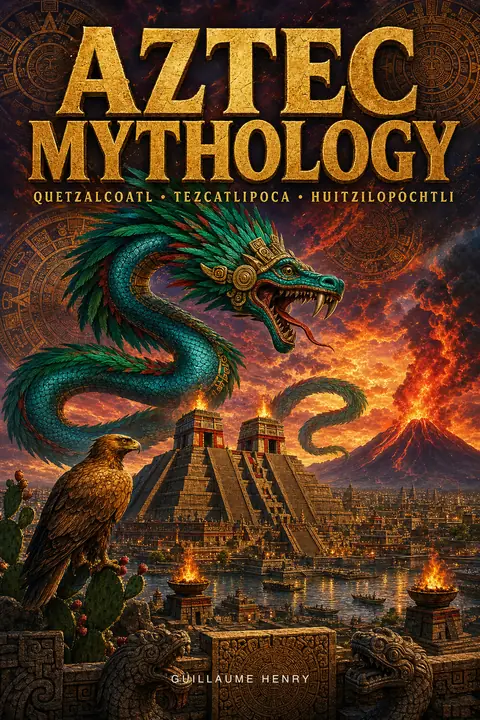
The Aztec Mythology Book: Quetzalcoatl, Huitzilopochtli, Tezcatlipoca, and the Five Suns of the Mexica
Blood, Feathered Serpents, and the Cosmic Engine of Tenochtitlan
The gods, heroes, and sacred calendar of the Mexica civilization. From the feathered serpent Quetzalcoatl to the five world ages, the complete mythology of Tenochtitlan.
More from Aztec
All articles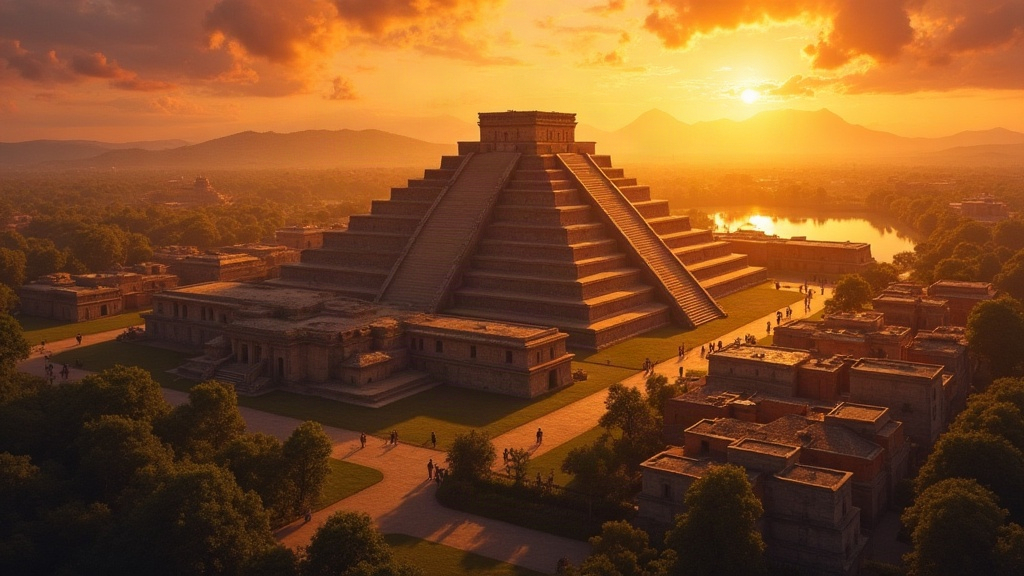
Aztec
Tenochtitlan: The Sacred Aztec Capital
Tenochtitlan rose from an island in Lake Texcoco as the Mexica people's promised homeland, guided by their god Huitzilopochtli. Discover how this sacred city became the center of the Aztec Empire and why its temples, waterways, and ceremonial heart shaped an entire civilization.

Aztec
Coatlicue: Mother of Gods and the Aztec Pantheon
Coatlicue, the serpent-skirted mother, bore the sun god and ruled over fertility, childbirth, and death in Aztec belief. Discover how the Aztecs honoured her as the generative force behind their entire pantheon and cosmos.

Aztec
Tlaloc: God of Rain and Fertility in Aztec Mythology
Tlaloc brought water to the Aztec world, but his gifts came with terror. Discover how the rain god shaped Mesoamerican religion, from mountain shrines to the sacred cenotes where thousands sought his blessing.
Aztec
Huitzilopochtli: God of War and the Sun
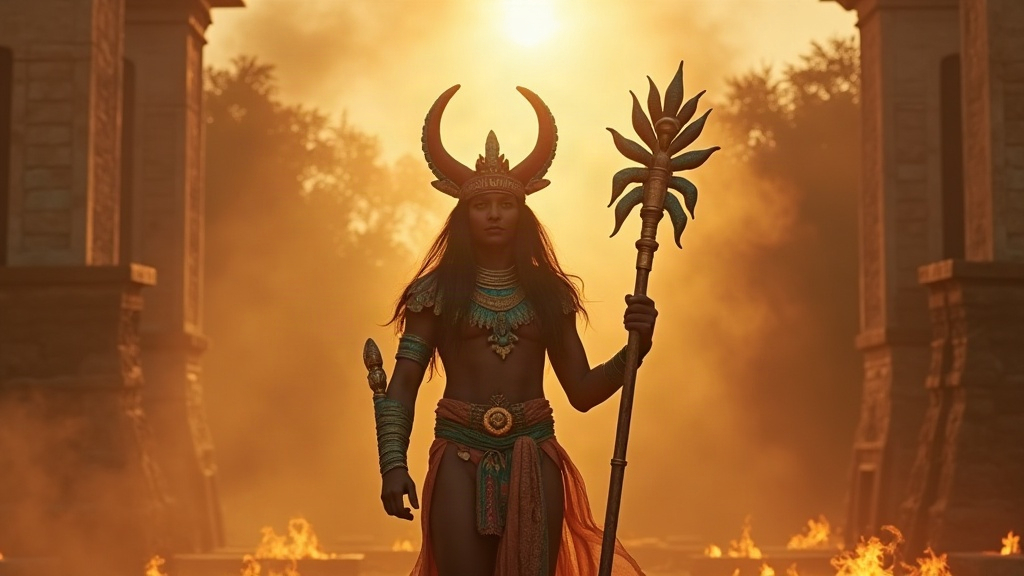
Huitzilopochtli, the Aztec god of war, sun, and human sacrifice, emerged from his mother's womb fully armed to battle the darkness. His myth shaped the empire's entire worldview: conquest, cosmic duty, and survival itself.