
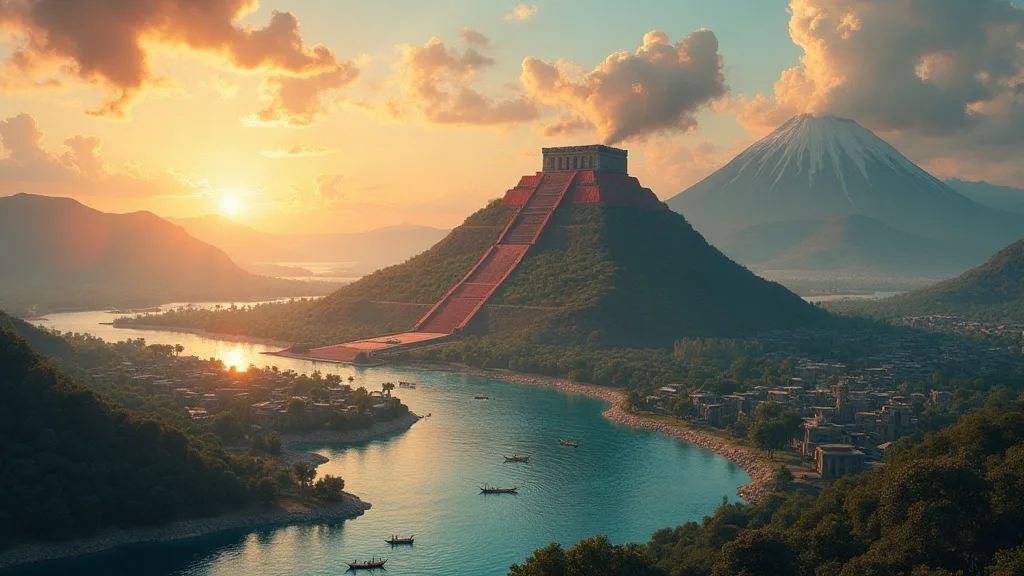
Tenochtitlan: The Aztec Capital Built on Water and Sacred Fire
Tenochtitlan, the Aztec capital, rose from a lake as a city of gods and warriors. Discover its mythic founding, sacred geography, and the cosmic vision behind its streets.
Contents
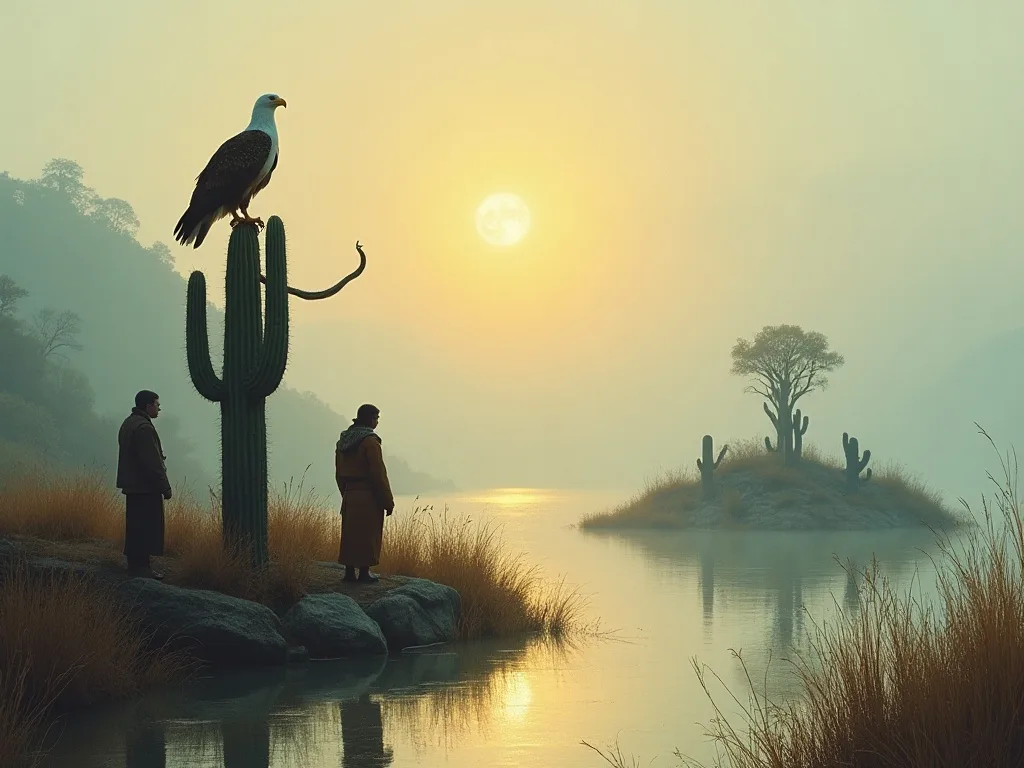
An eagle lands on a cactus growing from a rock in the middle of a lake. In its talons, a serpent writhes. The Mexica people, exhausted after more than a century of wandering through unknown lands, recognize the sign their patron god Huitzilopochtli promised them. They stop. They begin to build.
That moment, placed by later Aztec historians around 1325 CE, marks the birth of Tenochtitlan, the city that would grow into the largest metropolis in the pre-Columbian Americas. Within two centuries it held somewhere between 200,000 and 300,000 people, a population larger than contemporary London or Rome. Spanish conquistadors entering it in 1519 compared it to Venice, to a dream, to something they had no words for.
The city was not simply a political capital. Every street, every canal, every temple pointed at something cosmic. Tenochtitlan the Aztec capital was, in the Mexica understanding, the navel of the universe itself, the place where the current age of humanity had been set in motion.
The Prophecy That Founded a City
The founding story of Tenochtitlan does not begin at a lake. It begins with a god whispering into the ears of a wandering people.
The Mexica were latecomers to central Mexico. Their own traditions, recorded in documents like the Mexica Migration accounts and the Crónica Mexicayotl compiled by Hernando Alvarado Tezozomoc in the early seventeenth century, describe their origin as the island of Aztlan, a mythic northern homeland whose exact location no scholar has pinpointed with certainty. From Aztlan they carried an effigy of Huitzilopochtli, the hummingbird god of the sun and war, who spoke to his priests through oracles. His instruction was simple and merciless: keep walking south until you see the eagle on the cactus on the rock. Only then stop.
The journey lasted generations. The Mexica served as mercenaries for established city-states, were enslaved, were driven out of good land. They arrived at Lake Texcoco, the great saline basin in the Valley of Mexico, as landless outsiders. The surrounding powers occupied every desirable shore. The Mexica received, or simply took, the swampy uninhabited islands at the lake's center. Most observers saw nothing there worth having.
The eagle appeared on one of those islands. Huitzilopochtli's promise was fulfilled not with a paradise but with a marsh. That detail is important. The Mexica did not find a ready city. They built one, literally raising solid ground from shallow water, and the effort itself became part of their theology: their capital was not given, it was made.
Sacred Geography: The City as a Cosmic Map
Once the first temple was raised, Tenochtitlan grew according to a plan that doubled as a diagram of the universe. The city was divided into four great quarters, called calpulli districts in their organizational form, radiating outward from the central ceremonial precinct. Four quadrants, four directions, four aspects of time - the same fourfold structure that organized the Aztec calendar, the human body, and the cosmos in Mesoamerican thought.
At the exact center stood the Templo Mayor, the Great Temple. It was not merely a religious building. It was, according to Mexica belief, the precise spot where the earth was pierced vertically: the axis linking the thirteen heavens above to the nine underworld levels below. The Florentine Codex, the encyclopedic Nahuatl-Spanish record compiled by the Franciscan friar Bernardino de Sahagún and indigenous scholars in the 1570s, describes the Templo Mayor as the symbolic mountain Coatepec, the Hill of the Serpent, where Huitzilopochtli was miraculously born and defeated his four hundred siblings in a primordial battle.
The temple itself expressed that duality architecturally. Its double staircase rose to two shrines at the summit. The southern shrine, painted red, belonged to Huitzilopochtli, the solar warrior. The northern shrine, painted blue, belonged to Tlaloc, the rain god who governed water, agriculture, and the fertility of the earth. War and rain. Fire and water. The two forces any agrarian warrior state needed, placed side by side at the roof of the world.
Three great causeways connected the island city to the mainland shores: one running north to Tepeyac, one running south to Iztapalapa, one running west to Tlacopan. These were not just roads. They oriented Tenochtitlan along the sacred axes of the Mesoamerican worldview, linking the island to the four cardinal points where, in Aztec cosmology, the four world trees held the sky aloft.
Huitzilopochtli and the Sun That Needed Feeding
No account of Tenochtitlan makes sense without understanding what the Mexica believed they were doing at the top of the Templo Mayor. The current age of the world, which they called the Fifth Sun, had been created at Teotihuacan, a much older city to the northeast, when the god Nanahuatzin threw himself into a fire and became the sun. But that sun moved only because it was fed.
Human blood, specifically the living heart torn from a living chest, carried the energy tonalli, the solar force, that kept the Fifth Sun rising each morning. Without that offering the sun would stop. Darkness would return. The monsters of the previous four world ages would devour humanity. Sacrifice was not cruelty in the Mexica framework. It was maintenance - the keeping of a cosmic bargain struck before human time began.
Tenochtitlan's role as capital made it the primary site of that maintenance. The city's ritual calendar coordinated eighteen twenty-day months, each with its own sacrificial festivals, its own patron deity, its own prescribed ceremonies. The Templo Mayor's sacrificial stone stood at the top of Huitzilopochtli's staircase so that the blood ran down the temple's face and the dying sun received its due at the highest point of the city, the point closest to the sky.
Scholars today, including the archaeologist Eduardo Matos Moctezuma who led the Templo Mayor excavations from 1978 onward, have recovered thousands of ritual deposits beneath the temple's successive construction phases. Seven major rebuilding campaigns enlarged the Templo Mayor over roughly two centuries, each new shell encasing the previous one, the way a Russian doll operates. Every expansion accompanied the accession of a new ruler or a major military victory. The city and its cosmic function grew together.
Water, Canals, and the Engineering of the Sacred Lake
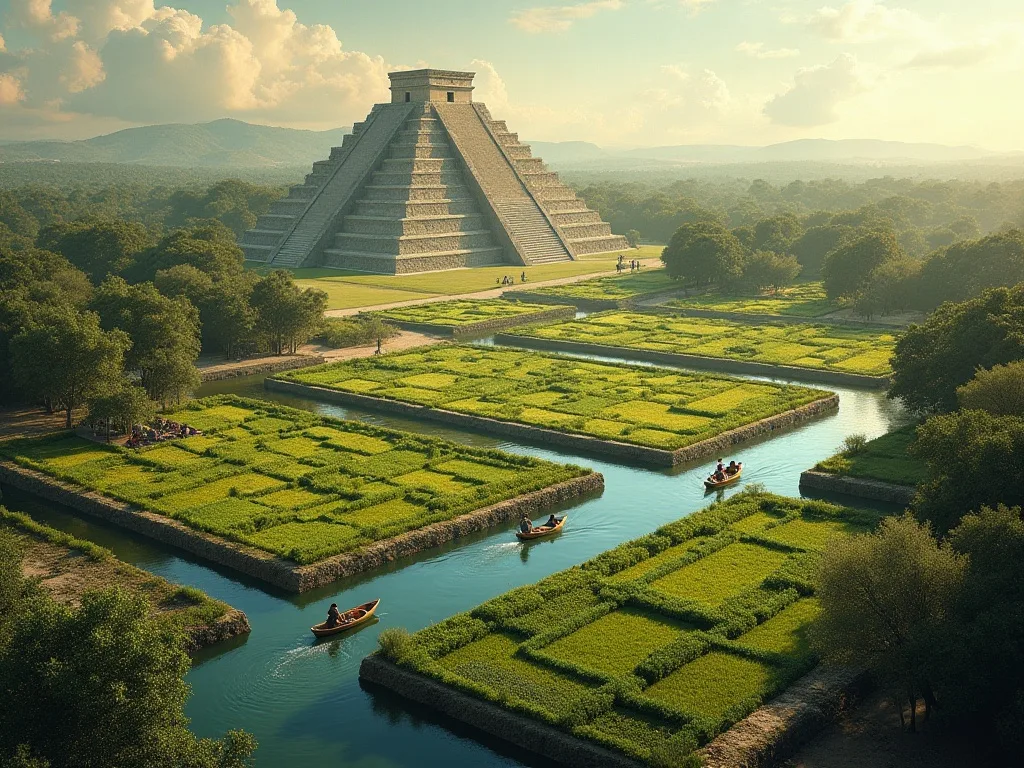
The physical achievement of Tenochtitlan is staggering even without its mythological frame. The Mexica transformed approximately 13 square kilometers of shallow lake into a functional city using chinampas, narrow rectangular platforms built up from layers of aquatic vegetation, mud, and staked earth. The chinampa system turned the lake into a grid of fertile garden plots separated by navigable canals, producing multiple harvests per year and feeding a population that no local dryland agriculture could have sustained.
A dual aqueduct system brought fresh water from the springs of Chapultepec on the mainland. One pipe supplied the city while the other was cleaned or repaired: an engineering redundancy that anticipates modern infrastructure logic. Dikes controlled salinity, separating the brackish eastern waters from the fresher western portion of the lake.
The canals also carried the city's spiritual life. Festivals moved by canoe. Tribute goods arrived by water. Bodies were transported for burial. The god Chalchiuhtlicue, "She of the Jade Skirt," goddess of flowing water, lakes, and rivers, presided over these channels. Her presence in the water network meant that the city's arteries were also sacred, that the canoe rounding a corner carried offerings across ground that was already consecrated.
The Spanish chronicler Bernal Díaz del Castillo, who entered Tenochtitlan with Hernán Cortés in November 1519, wrote in his Historia Verdadera de la Conquista de la Nueva España that the sight left him without words. He mentions towers, temples, and buildings rising from the water, flowers everywhere, markets of unimaginable abundance. His account is eyewitness testimony, not myth, yet it reads like the description of a dream city because the city itself was built to look like one.
The Market of Tlatelolco and the City's Human Scale
Tenochtitlan was twin to another island settlement, Tlatelolco, which sat immediately to its north and shared the same island. Tlatelolco housed the tianguis, the great market, which Díaz del Castillo estimated at twice the size of the market at Salamanca in Spain, with every conceivable good organized by product and policed by appointed judges who settled disputes on the spot.
Cacao beans served as currency. Merchants called pochteca formed a distinct social class, worshipping their own patron deity Yacatecutli, the Lord of the Vanguard, god of travel and trade. The pochteca ranged far beyond the Valley of Mexico, reaching the Gulf Coast, Oaxaca, and areas of the Maya lowlands. What they brought back, turquoise, quetzal feathers, jaguar pelts, cacao, entered the market at Tlatelolco and from there flowed into the tribute system that sustained the Aztec Triple Alliance.
The market was not separate from the sacred geography of the capital. The Mexica understood commerce, like war and farming, as part of the cosmic order that Tenochtitlan expressed. The pochteca set out on journeys calibrated to the ritual calendar. They returned on days of good omen. Trade, too, was feeding the world's engine.
The Ruler at the Center: Tlatoani and Cosmic Kingship
The political structure of Tenochtitlan organized itself around the same center-and-four-directions logic as its streets. The huey tlatoani, the "great speaker" or supreme ruler, was not simply a king in the European sense. He was the living embodiment of the sun's champion on earth, the human axis around which the city's ritual life turned.
Moctezuma II, the ninth tlatoani, who ruled from 1502 until his death during the Spanish siege in 1520, intensified the divine aspect of the office to its most extreme form. He was carried on a litter. His feet did not touch the ground in public. Only the highest nobles could look directly at him. His palace, by Díaz del Castillo's account, contained gardens, aviaries, zoos, and arsenals, a universe in miniature placed at the city's center.
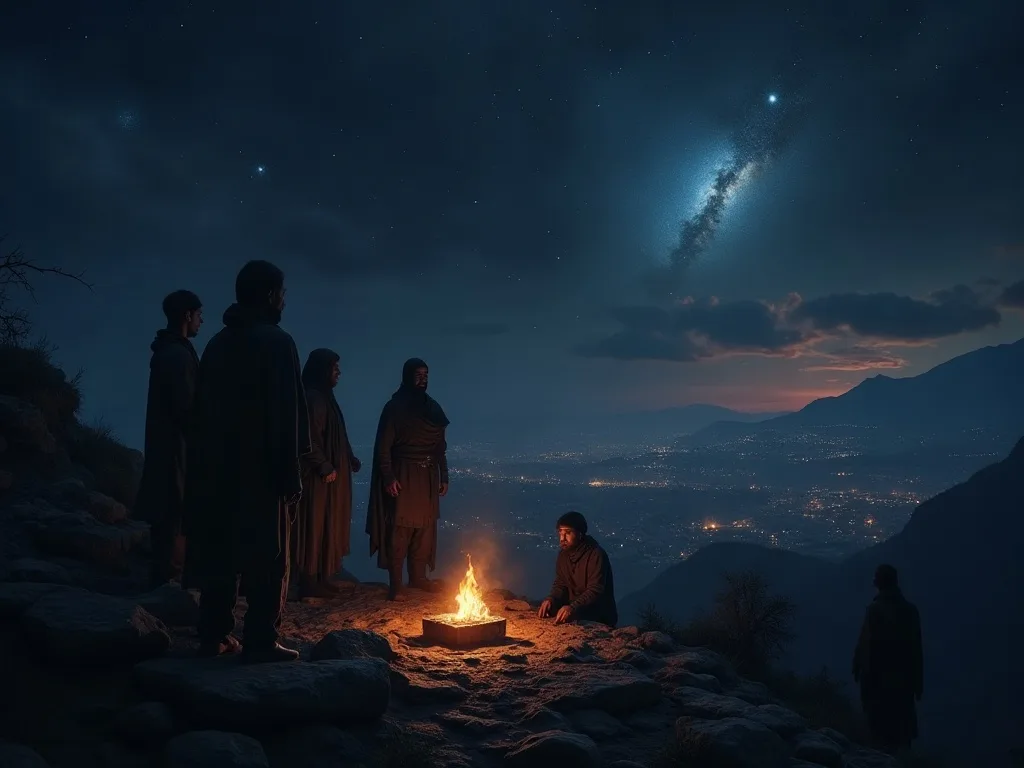
The tlatoani performed his most critical cosmic function during the New Fire Ceremony, held every 52 years when the 365-day solar calendar and the 260-day ritual calendar tonalpohualli completed a full cycle together. At that moment all fires in the empire were extinguished. The people waited in darkness on their rooftops. Priests climbed the Hill of the Star south of the city and watched the Pleiades. If the star cluster passed its zenith without incident, a new fire was drilled on the chest of a sacrificial victim. Runners carried the flame to every hearth in Tenochtitlan and then outward to every corner of the empire. The world had survived another cycle. The city had earned another fifty-two years.
The Fall and the Myth That Outlasted the Stones
In 1521 Hernán Cortés and his allies, a coalition that included tens of thousands of indigenous warriors from peoples subjugated by or hostile to the Mexica, besieged Tenochtitlan for seventy-five days. The city fought back with everything it had. The last tlatoani, Cuauhtémoc, was captured on August 13, 1521. The siege destroyed most of the physical city, and the Spanish colonial capital of Mexico City was built directly over its ruins, using the rubble of Aztec temples as foundations for churches and palaces.
The Templo Mayor lay buried under the streets of the colonial center for more than 450 years. In February 1978, workers from the Mexico City electrical company struck a massive carved stone disc 2.5 meters across, depicting the goddess Coyolxauhqui, Huitzilopochtli's sister whom he dismembered at Coatepec in the birth myth. That discovery reopened the ground. The Templo Mayor Project, directed by Matos Moctezuma, has since excavated more than 7,000 objects from the site's ritual deposits: coral, obsidian blades, crocodile skeletons, jade masks, miniature representations of entire Mesoamerican cosmologies packed into clay vessels and sealed with volcanic stone.
The physical city is gone. The sacred geometry it encoded has not disappeared. The founding eagle, the serpent, the cactus on the rock: they cover every Mexican peso and sit at the center of the national flag, an unbroken line from a divine oracle heard eight centuries ago to a living republic today.
Frequently Asked Questions About Tenochtitlan, the Aztec Capital
Frequently asked questions
Where exactly was Tenochtitlan located, and what stands there now?
Tenochtitlan occupied an island in the western portion of Lake Texcoco in the Valley of Mexico, at roughly 2,240 meters above sea level. The lake was progressively drained by Spanish and later Mexican authorities over four centuries. Mexico City's historic center, particularly the Zócalo plaza and the streets immediately surrounding it, sits directly atop the ancient island. The Templo Mayor ruins are open to visitors at the corner of Seminario and República de Guatemala streets, just northeast of the Zócalo.
How large was Tenochtitlan compared to other cities of its era?
Estimates based on archaeological surveys and early colonial census data place Tenochtitlan's population between 200,000 and 300,000 in 1519, with the broader lake-basin urban zone reaching perhaps 500,000 to one million people. London at the same date held roughly 50,000 inhabitants. Only Constantinople and perhaps Beijing were comparable in size. It was the largest city in the pre-Columbian Americas without question.
What did the name Tenochtitlan mean in Nahuatl?
The name derives from Nahuatl: tetl (rock or stone), nochtli (prickly pear cactus), and the locative suffix -tlan (place of). The full meaning is approximately "place of the prickly pear cactus on the rock," a direct reference to the founding vision of the eagle perched on a cactus growing from a stone in the lake. The imagery encodes the founding prophecy directly into the city's name.
What primary sources describe Tenochtitlan before its fall?
Several major sources survive. Hernán Cortés sent five detailed letters to the Spanish Crown between 1519 and 1526, the Cartas de Relación, which include descriptions of the city's layout, markets, and temples. Bernal Díaz del Castillo's eyewitness Historia Verdadera (written decades later but based on direct experience) provides the most vivid street-level account. On the indigenous side, the Florentine Codex compiled by Sahagún with Nahua scholars from the 1550s to 1570s preserves Mexica ritual, cosmology, and social organization in meticulous detail. The Crónica Mexicayotl by Tezozomoc covers the founding traditions.
Why did the Mexica choose to build on a lake island rather than on dry land?
Practicality played a role: the surrounding shores were controlled by established, hostile city-states, and the island offered defensible isolation. But the Mexica theology reframed that constraint as divine election. Huitzilopochtli's oracle had always promised an island, and the eagle sign confirmed it. Building on water also became a theological statement: the Mexica had not simply occupied land, they had created a world, mirroring the Aztec creation myths in which the earth itself was formed from the body of the primordial sea monster Cipactli pulled up from the waters.
Is the eagle-serpent-cactus symbol on the Mexican flag directly derived from the founding myth?
Yes, and the connection is deliberate. The Mexican coat of arms, codified in its current form in 1968 though rooted in imagery used from the early independence period (1821 onward), reproduces the founding vision described in Mexica migration histories. The eagle on the cactus on the rock was already a canonical image in pre-Columbian pictographic manuscripts such as the Codex Mendoza (compiled around 1541). Mexican nation-builders consciously adopted it to claim continuity with a pre-colonial past, making the Mexica founding moment the symbolic origin of the Mexican state.
Tenochtitlan's Living Inheritance in Modern Scholarship and Memory
The physical excavation of the Templo Mayor is ongoing. Each new construction project in central Mexico City risks, and sometimes yields, new finds. In 2015, archaeologists discovered a circular stone platform beneath a colonial building near the Zócalo that may be the base of the huey tzompantli, the great skull rack where sacrificial skulls were displayed. In 2020 and 2021, additional skulls, hundreds of them, were confirmed within that structure, revising earlier estimates of its scale.
These discoveries keep reopening a question that has no clean answer: how should contemporary Mexicans, many of them descendants of both Mexica and Spanish ancestors, relate to the city buried under their streets? The debate is alive in Mexican archaeology, literature, and politics. Writers like Carlos Fuentes placed Tenochtitlan at the center of Mexican identity in books like El Espejo Enterrado (1992). Historians argue about whether the Spanish siege represented conquest, catastrophe, or a more complicated multi-ethnic alliance war that the Mexica ultimately lost.
What the buried city keeps returning to the surface is not a simple story of empire and ruin. It is a record of an extraordinarily specific vision of how the human world fit into the cosmos, built in stone and water and fire, dismantled in 75 days of siege, and now slowly reassembled by shovels and brushes one artifact at a time. The eagle on the cactus keeps its eyes open.
Read the full book
Want the whole story?
The complete edition is an instant PDF download here, with a paperback on Amazon for selected titles.
Aztec
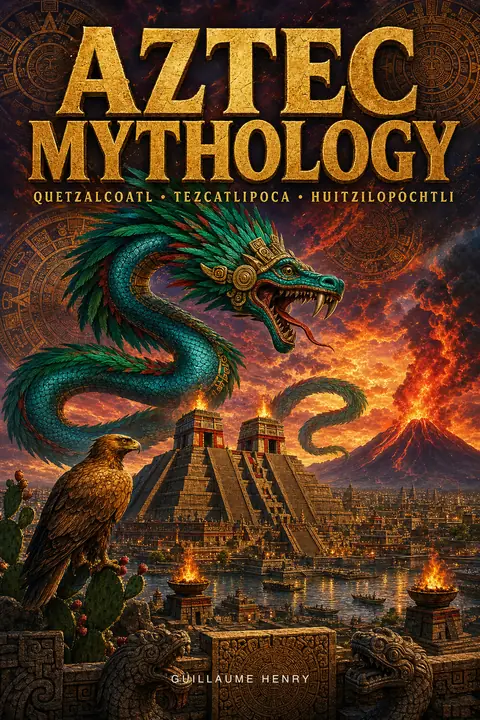
The Aztec Mythology Book: Quetzalcoatl, Huitzilopochtli, Tezcatlipoca, and the Five Suns of the Mexica
Blood, Feathered Serpents, and the Cosmic Engine of Tenochtitlan
The gods, heroes, and sacred calendar of the Mexica civilization. From the feathered serpent Quetzalcoatl to the five world ages, the complete mythology of Tenochtitlan.
More from Aztec
All articles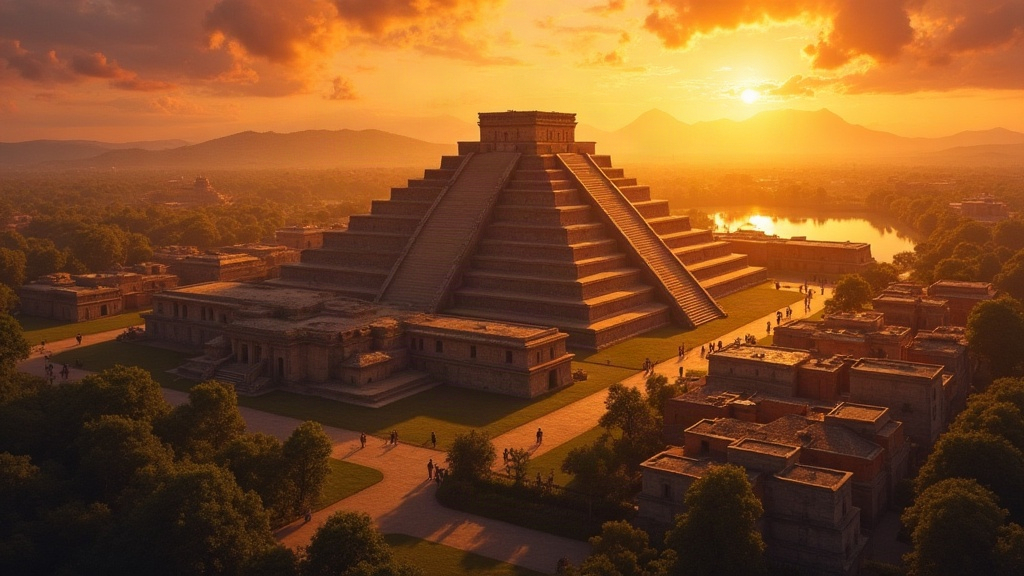
Aztec
Tenochtitlan: The Sacred Aztec Capital
Tenochtitlan rose from an island in Lake Texcoco as the Mexica people's promised homeland, guided by their god Huitzilopochtli. Discover how this sacred city became the center of the Aztec Empire and why its temples, waterways, and ceremonial heart shaped an entire civilization.
Aztec
The Legend of the Fifth Sun: Why the Aztecs Believed Humanity Required Divine Blood
The Aztecs lived under a cosmological clock. They believed the world had been created and destroyed four times before. The fifth world, their world, could only survive if the gods received constant nourishment: human blood. Discover how mythology, astronomy, and ritual wove together in one of history's most misunderstood civilizations.

Aztec
Coatlicue: Mother of Gods and the Aztec Pantheon
Coatlicue, the serpent-skirted mother, bore the sun god and ruled over fertility, childbirth, and death in Aztec belief. Discover how the Aztecs honoured her as the generative force behind their entire pantheon and cosmos.

Aztec
Tlaloc: God of Rain and Fertility in Aztec Mythology
Tlaloc brought water to the Aztec world, but his gifts came with terror. Discover how the rain god shaped Mesoamerican religion, from mountain shrines to the sacred cenotes where thousands sought his blessing.