
The New Fire Ceremony: Aztec Calendar Renewal Ritual
Every 52 years, the Aztecs believed the world might end. The New Fire Ceremony, their most sacred ritual, renewed cosmic order by extinguishing all fires and reigniting them in a night of terror and hope. Discover how a calendar's turn became civilization's survival.
Contents
At midnight on a particular night in late autumn, the Aztec capital fell into complete darkness. Every fire in every home, temple, and marketplace had been extinguished. Priests and people waited on rooftops, holding their breath. The world had ended before. It could end again. And if the ritual failed, all light would cease forever.
This moment, called the New Fire Ceremony, happened once every 52 years. It was not a festival of celebration, though celebration came afterward. It was an act of cosmic maintenance: a night when the Aztec priesthood and populace believed they were literally holding back the chaos, renewing the sun's vow to rise, restarting time itself. For one night, civilization hung in the balance.
The 52-Year Cycle and the Fear of Cosmic Endings
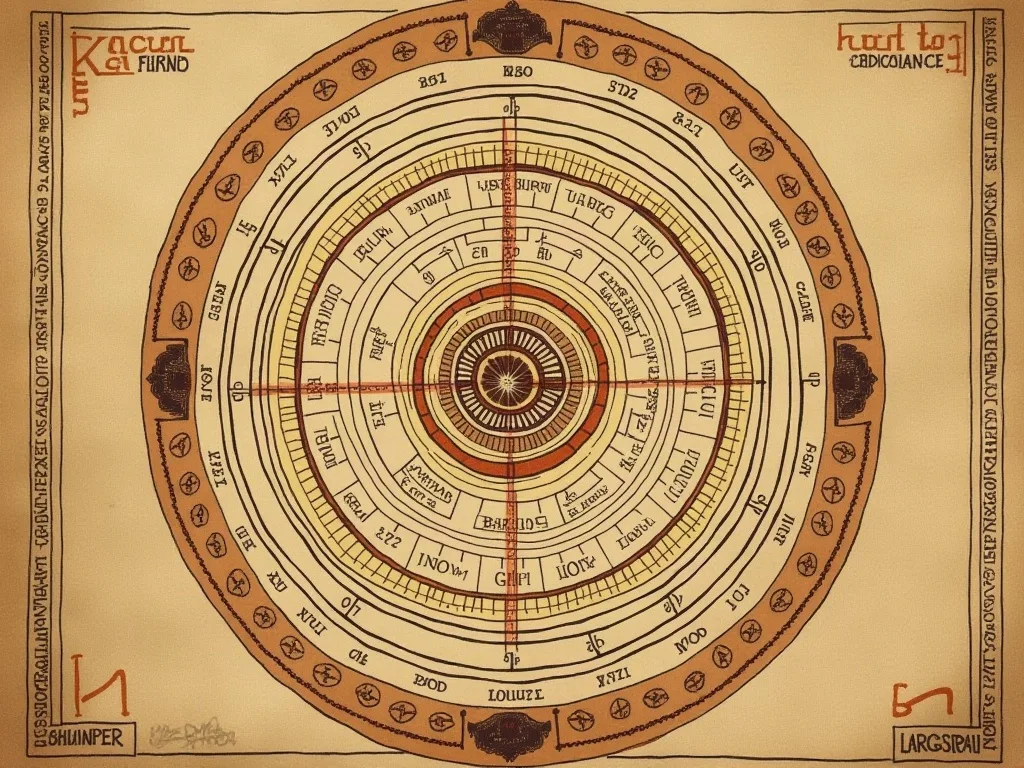
The Aztecs possessed one of history's most sophisticated calendars. They tracked two systems at once: a 365-day solar year (xiuhpohualli) and a 260-day ritual cycle (tonalpohualli). These two calendars aligned every 52 years, a moment they called the xiuhmolpilli, meaning "the binding of years."
Why fear? Because the Aztecs held a profound conviction: the world had ended before, not once but four times. In their cosmology, preserved in texts like the Legend of the Suns, five eras of creation had passed. Four ages had ended in disaster: one by jaguars devouring humanity, another by wind, another by rain and flood, another by fire. The Aztecs lived in the fifth and final world, the Nahui Ollin or "Four Motion" age. This age would not last forever. On the completion of each 52-year cycle, the sun itself could choose not to rise.
A 52-year span was a human lifetime for most people. Few Aztecs lived long enough to witness two New Fire Ceremonies. This made it an event of overwhelming spiritual weight. If the ritual succeeded, time would begin again. If it failed, the entire cosmos would crumble into darkness.
The Ritual Night: Preparation and the Journey to the Mountain
Preparation began weeks in advance. The date was fixed: the night when the Pleiades (called Tianquiztli, the marketplace stars) crossed the meridian. This astronomical observation anchored the ritual in precise natural timing.
In the days before the ceremony, the Aztecs performed acts of purification. They threw away old household goods. They anointed their bodies with nextlaoaliztli, a ritual oil. Rulers fasted. Priests gathered at the great Templo Mayor and prepared themselves for hours of ritual singing and bloodletting.
As darkness fell on the chosen night, no fires burned anywhere in the Valley of Mexico. No torches lit the streets of Tenochtitlan. The people extinguished even the sacred flames in temples. Mothers held their children indoors, afraid that without fire, evil spirits might descend. Some sources suggest the people believed that if the ceremony failed, Tzitzimitl (the demons of the stars) would descend and devour humanity.
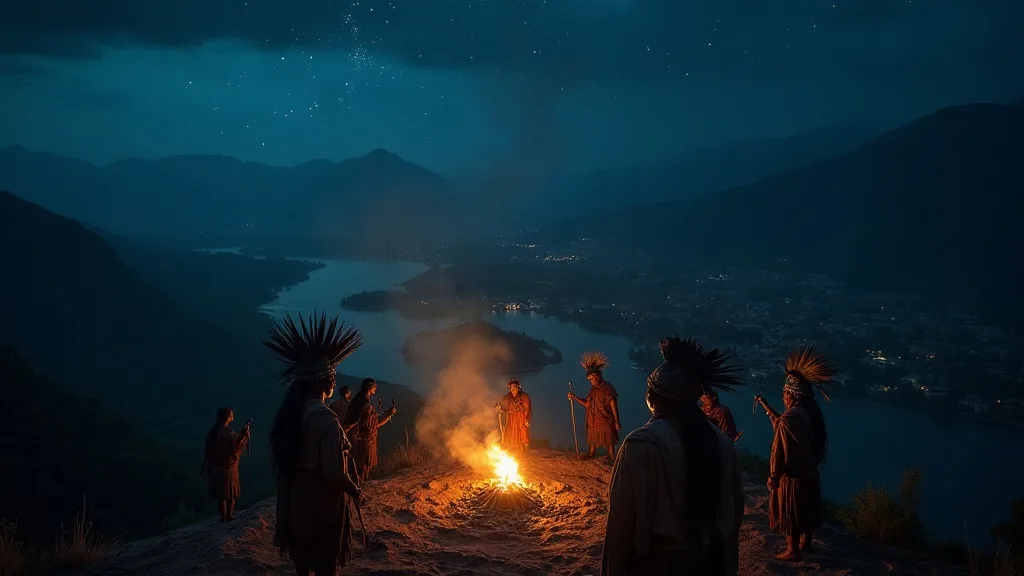
The crucial moment belonged to the priesthood. High priests and their attendants climbed into the darkness toward Huixachtlan, a small hill near Culhuacan, on the southern shore of Lake Texcoco. They carried with them an obsidian knife, kindling wood, and an image or symbolic vessel of the fire-god Xiuhtecuhtli, the turquoise lord of the year.
The Moment of Ignition: Capturing the New Fire
The priests reached the summit of the hill in darkness. They waited. Around them, the entire population of the Valley of Mexico waited, holding their breath.
When the Pleiades reached the exact point in the sky (often called the "center of the heavens"), the high priest produced fire using friction. This was not a spontaneous lighting of wood; it was a deliberate act, performed with sacred intent. The new fire was caught in the prepared kindling or in a wooden frame shaped to honor Xiuhtecuhtli.
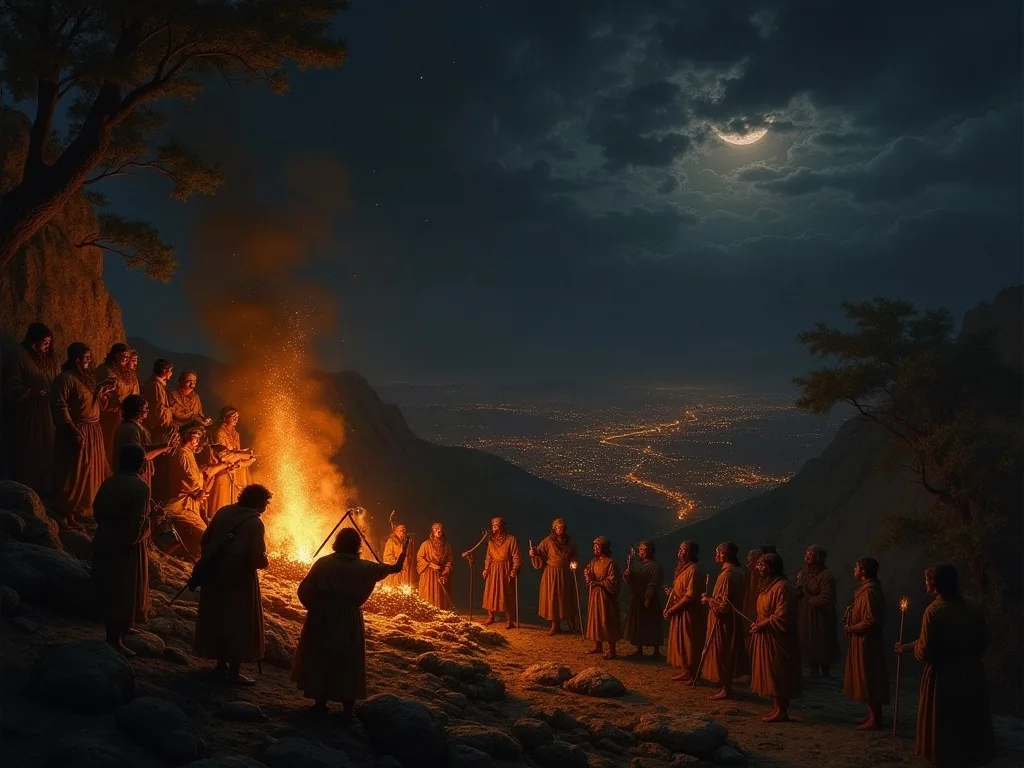
The moment the flame ignited, the night erupted. Messengers carried torches down from the mountain at extraordinary speed, racing toward the capital. Priests and runners passed the flame from fire to fire, hand to hand, temple to temple. Within hours, every sacred fire in Tenochtitlan had been relit. From the temples, citizens came forward with torches to receive the new flame and carry it home.
This moment marked the absolute spiritual center of the Aztec calendar. The sun had not abandoned the world. Time would continue. The world had been renewed.
What Happened on the Night After
The ritual itself lasted one night. But what followed was extraordinary.
For four days after the new fire was lit, the Aztecs performed what was called xiuhmomoztli, the "binding" or "wrapping" of the year. New clothes were distributed. Debts were forgiven. Captives destined for sacrifice were sometimes pardoned. The Aztecs treated these days as a reset of the social order itself. The old time was dead. The new time demanded a reckoning.
Fire was deeply sacred in Aztec thought. Xiuhtecuhtli, the fire-god, was the oldest of all deities, the keeper of life and time itself. When Cortés and the Spanish conquistadors later destroyed the Aztec temples, one of their gravest acts was extinguishing the sacred fires and preventing the New Fire Ceremony from taking place. The Aztec priesthood understood this as catastrophic: not just a political defeat, but the halting of time itself.
Sacrificial offerings accompanied the ritual. The Aztecs performed bloodletting on a massive scale at the temples during the ceremony, and some sources suggest that war captives were killed at this moment, their blood offered to the sun to renew its strength. This violence was not separate from the ritual's meaning; it was integral. The spilling of nextlaoaliztli (the precious water, the Nahuatl metaphor for blood) was understood as necessary payment to keep the cosmos in motion.
Calendar, Cosmology, and the New Fire Ceremony
The New Fire Ceremony sits at the intersection of Aztec mathematics, astronomy, and theology. It reveals how the Aztecs saw time itself.
Unlike the linear time of modern Western thought, the Aztec experience of time was cyclical. Ages came and went. Years bound themselves in groups of 52. Days had personalities and destinies built into them. The tonalpohualli, the 260-day ritual calendar, assigned each day a number (1-13) and a name glyph (twenty names repeated throughout the cycle). A person born on a particular day was believed to inherit that day's character.
The 52-year cycle was the largest repeating unit in Aztec timekeeping. After 52 years, the solar year and the ritual calendar aligned again. For the Aztecs, this moment of alignment felt cosmically fragile. All systems were resetting. The world could end. Only the ceremonial action of the priesthood, the bloodletting, the new fire lit on the mountain, could ensure renewal.
Modern scholars have debated whether the Aztecs literally believed the world would end if the ceremony was not performed, or whether it functioned more as a profound metaphor for the need to renew society and cosmic order. The answer seems to be both. The Aztecs held a genuine cosmological belief in cyclical ages and true endings. And they used that belief to perform a ritual that, practically speaking, bound society together, reset social hierarchies, and reaffirmed the priesthood's role as the intermediaries between the human and divine worlds.
The Ceremony in Primary Sources and Scholarly Reconstruction
What we know of the New Fire Ceremony comes from multiple sources, each offering pieces of the larger picture.
The most detailed Spanish-language account comes from Sahagún's Historia General de las Cosas de Nueva España (General History of the Things of New Spain), compiled in the mid-1500s from interviews with Nahua speakers who had witnessed or whose parents had witnessed the ceremony before the Spanish conquest. Sahagún's account describes the journey to Huixachtlan, the lighting of the fire, the distribution of the new flame, and the subsequent four days of rest and redistribution.
Nahua codices, particularly the Codex Borbonicus, contain visual records of the ceremony, showing priests in specific postures, the mountain of Huixachtlan, the fire-drilling implement, and the symbolic exchange of fire. These images, though stylized according to Mesoamerican conventions, corroborate and expand on the written accounts.
Scholars like Alfredo López Austin and David Carrasco have reconstructed the ceremony's theological significance, emphasizing its function as a renewal of the cosmic covenant between humanity and the divine. The ceremony was not a one-time event in Aztec history; records suggest that New Fire Ceremonies took place in the year 1403 (in the Aztec calendar), 1455, 1507, and were scheduled again for 1559, though by that date Spanish colonial rule prevented the ceremony from being performed in its traditional form.
The last fully documented New Fire Ceremony in Tenochtitlan took place in 1507, thirteen years before Cortés arrived. Indigenous sources describe it as particularly significant, and some scholars suggest that the Aztecs may have sensed impending change. The next ceremony was never performed in the traditional way.
The New Fire Ceremony's Afterlife and Suppression
After the Spanish conquest, the New Fire Ceremony was effectively forbidden. Spanish Catholic authorities saw it as pagan superstition at best, demonic ritual at worst. The fact that it involved human sacrifice made suppression a priority.
Yet the ceremony's symbolic power did not entirely disappear. Some communities preserved the ritual's essence in oral tradition. In certain regions of Mexico, adapted fire-lighting ceremonies were incorporated into Catholic celebrations or performed secretly among indigenous populations. The belief that fire itself holds sacred, renewing power persisted.
In modern Mexico, scholarly and cultural interest in the New Fire Ceremony has resurged. It is studied as one of the world's most sophisticated pre-Columbian rituals, a window into how the Aztecs understood cosmology, timekeeping, and collective religious action. Museums in Mexico City now display artifacts associated with the ceremony, including stone sculptures and codex pages depicting the ritual.
The ceremony also influenced how modern Mesoamericanists understand the relationship between ritual action and political power. The New Fire Ceremony was not separate from governance; it was a moment when the ruler's legitimacy was literally renewed, when the priesthood's mediation with the divine was reaffirmed, and when the entire social order underwent symbolic rebirth.
Cross-Cultural Echoes: Fire Renewal and Cyclical Time
The Aztec New Fire Ceremony is not unique in world mythology and ritual practice, though its scale and cosmological sophistication are distinctive.
Many cultures have fire-renewal rituals. In ancient Persia, the Zoroastrian tradition emphasized fire as sacred and eternal; the keeping of sacred fires was a priestly duty. In Vedic India, the agnihotra, a daily fire ritual, was considered essential to maintaining cosmic order; larger ritual cycles like the soma sacrifice renewed the relationship between humanity and the divine. In Celtic tradition, Beltane and Samhain involved ritual fires believed to mark transitions in the year and to open passages between worlds.
The cyclical understanding of time, central to the Aztec worldview, also echoes in Hindu cosmology, where the universe passes through vast ages (yugas) of increasing darkness before being destroyed and renewed. The fear of cosmic ending, the need for ritual action to sustain the world, and the role of a priesthood in mediating that sustenance appear across multiple traditions.
What distinguishes the Aztec ceremony is its mathematical precision (the 52-year cycle), its astronomical observation (the Pleiades crossing), its integration into a dual-calendar system, and its function as a singular moment when the entire empire paused and performed the same ritual simultaneously. This coordination of a vast population around a moment of cosmic renewal is a sign of extraordinary religious organization and shared cosmological conviction.
Frequently asked questions about the New Fire Ceremony
Frequently asked questions
What would have happened if the fire did not ignite on the night of the ceremony?
The Aztecs believed that failure to ignite the new fire would result in the end of the world. The sun would not rise. The demons of the stars would descend and devour humanity. In practice, we have no record of the ritual failing, but the possibility of failure was deeply real in Aztec thought and may have driven the intense psychological and spiritual preparation that preceded each ceremony. The fear was existential, not metaphorical.
How often did the Aztecs perform the New Fire Ceremony?
Once every 52 years, at the moment when the 365-day solar calendar and the 260-day ritual calendar realigned. A 52-year span represented a complete cycle in Aztec timekeeping. Over the course of the Aztec Empire's history (roughly 1370 to 1521), the ceremony would have been performed only a handful of times. This rarity increased its power and significance.
Did Spanish colonizers allow the Aztecs to continue the New Fire Ceremony after the conquest?
No. Spanish Catholic authorities saw the ceremony as idolatrous and associated it with human sacrifice. The last fully traditional New Fire Ceremony was in 1507, thirteen years before Cortés arrived. Spanish suppression of indigenous rituals was systematic, and the priesthood that had maintained the ceremony's secrets was either killed or converted. The complete suppression of the ceremony represents one of the most significant losses of pre-Columbian Mesoamerican religious practice.
What role did the fire-god Xiuhtecuhtli play in the ceremony?
Xiuhtecuhtli, the turquoise lord and god of fire and the year, was the deity most directly invoked in the New Fire Ceremony. He embodied time itself and the life-force that kept the cosmos in motion. The new fire lit on the mountain was understood as a manifestation of Xiuhtecuhtli's eternal presence. By reigniting this sacred flame, the Aztecs were renewing their covenant with the deity who held time and creation in his hands.
How do modern scholars know so much about a ceremony that stopped being performed 500 years ago?
Detailed accounts were recorded by Spanish friars like Sahagún, who interviewed indigenous people who had witnessed the ceremony. Nahua codices (pictorial records) depict the ritual visually. Indigenous historical records and oral tradition preserved knowledge of the ceremony. Archaeology has uncovered artifacts and architectural remains connected to the ceremonial site. By combining these sources, scholars have reconstructed the ceremony's sequence, meaning, and cosmological context with considerable confidence.
The New Fire Ceremony as a Mirror of Aztec Civilization
The New Fire Ceremony reveals the Aztec world in miniature. It shows a civilization that understood time as cyclical and fragile, that believed in the power of ritual to sustain the cosmos, that organized itself around a shared religious duty, and that saw the priesthood as essential to the survival of all people. It demonstrates mathematical sophistication, astronomical knowledge, and a cosmological vision as complex as any in the pre-Columbian world.
The ceremony also reveals the relationship between religion and politics in Aztec life. Every 52 years, the ruler's authority was renewed. The priesthood's mediation with the divine was reaffirmed. The empire's unity was tested and remade. This was not ceremony separated from power; it was power made visible through ritual.
For all these reasons, the suppression of the New Fire Ceremony after the Spanish conquest represents not merely the loss of a religious practice, but a disruption of Aztec time itself. When the ceremony could no longer be performed, the Aztecs lost their most profound way of asserting their collective presence in the cosmos. The world did not end in 1521, as Moctezuma II may have feared when Cortés arrived. But the end of the world the Aztecs had known did come, and with it, the silencing of the ritual that had for centuries held that world together.
Read the full book
Want the whole story?
The complete edition is an instant PDF download here, with a paperback on Amazon for selected titles.
Aztec
The Aztec Mythology Book: Quetzalcoatl, Huitzilopochtli, Tezcatlipoca, and the Five Suns of the Mexica
Blood, Feathered Serpents, and the Cosmic Engine of Tenochtitlan
The gods, heroes, and sacred calendar of the Mexica civilization. From the feathered serpent Quetzalcoatl to the five world ages, the complete mythology of Tenochtitlan.
More from Aztec
All articles
Aztec
Tenochtitlan: The Sacred Aztec Capital
Tenochtitlan rose from an island in Lake Texcoco as the Mexica people's promised homeland, guided by their god Huitzilopochtli. Discover how this sacred city became the center of the Aztec Empire and why its temples, waterways, and ceremonial heart shaped an entire civilization.
Aztec
The Legend of the Fifth Sun: Why the Aztecs Believed Humanity Required Divine Blood
The Aztecs lived under a cosmological clock. They believed the world had been created and destroyed four times before. The fifth world, their world, could only survive if the gods received constant nourishment: human blood. Discover how mythology, astronomy, and ritual wove together in one of history's most misunderstood civilizations.

Aztec
Coatlicue: Mother of Gods and the Aztec Pantheon
Coatlicue, the serpent-skirted mother, bore the sun god and ruled over fertility, childbirth, and death in Aztec belief. Discover how the Aztecs honoured her as the generative force behind their entire pantheon and cosmos.

Aztec
Tlaloc: God of Rain and Fertility in Aztec Mythology
Tlaloc brought water to the Aztec world, but his gifts came with terror. Discover how the rain god shaped Mesoamerican religion, from mountain shrines to the sacred cenotes where thousands sought his blessing.