

Exu: The Divine Messenger and Guardian of Crossroads
Exu stands at every crossroads in Candomblé: first to be called, last to leave, and the only one who can carry your words to the orixás. His story is far older and stranger than the devil myth invented to silence him.
Contents
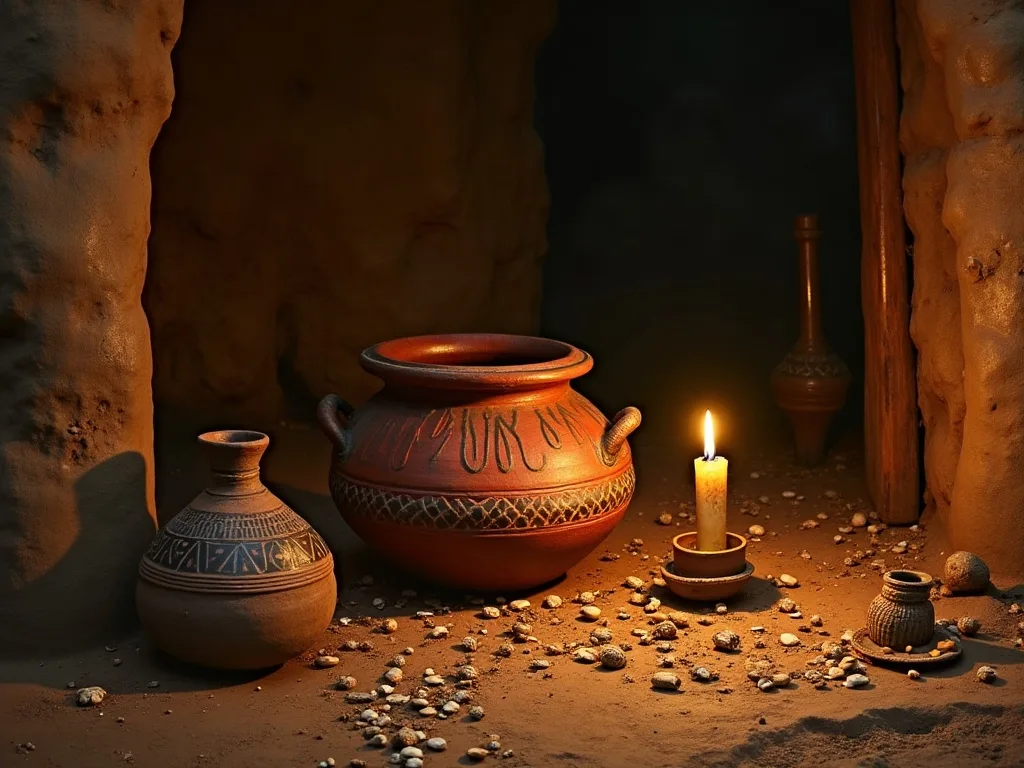
The ritual begins before anyone speaks a single prayer. A small clay pot sits by the door, smeared with palm oil, peppers, and dark earth. Inside it lives Exu: the Divine Messenger and Guardian of Crossroads. No ceremony in Candomblé can start until Exu has been fed, acknowledged, and asked to open the paths. Without him, nothing moves. Not a word reaches the orixás (the sacred powers of the Yoruba and Afro-Brazilian traditions). Not a healing begins. Not a road clears.
He is the first and the youngest, the ancient and the trickster, the keeper of every threshold. His number is seven. His colors are red and black. He lives where paths cross, where choices fork, where the known world meets everything beyond it. For centuries, colonial missionaries looked at Exu and called him the devil. That misreading shaped how millions of people understood him. It also completely missed the point.
The real Exu is one of the most layered, philosophically rich figures in any living religious tradition on earth.
The Yoruba Roots: Elegba and the Birth of Exu
Exu did not begin in Brazil. His roots reach back to the Yoruba-speaking peoples of West Africa, particularly in what is now Nigeria and the Republic of Benin. In the Yoruba tradition, he is called Eshu or Elegba (sometimes Elegbara, meaning "the powerful owner of the crossroads"). He is one of the orixás, the divine forces that govern every aspect of the natural and human world.
The Yoruba Ifa corpus, one of the richest bodies of oral sacred literature in existence, describes Eshu as the first being created by Olodumare (the supreme God above all gods). Eshu was given a specific task: to serve as the divine messenger, carrying sacrifices, prayers, and intentions between the human world and the realm of the orixás. Nothing in the cosmos could be set in motion without him.
In the Ifa texts, Eshu is present at every divination. The diviner (a babalawo, or "father of secrets") always salutes Eshu before casting the divining palm nuts, because the reading itself is a form of communication. Eshu owns communication. He owns language, roads, doors, markets, and chance. He is also deeply associated with sexuality, fertility, and creative energy, because all of these involve threshold moments, the crossing from one state into another.
When enslaved Yoruba people were transported to Brazil beginning in the sixteenth century, they carried their religion with them. Over the following centuries, it adapted, merged with Indigenous Brazilian and Catholic elements, and became Candomblé. Eshu became Exu, but his essential nature survived the crossing.
Exu in Candomblé: The One Who Opens All Roads
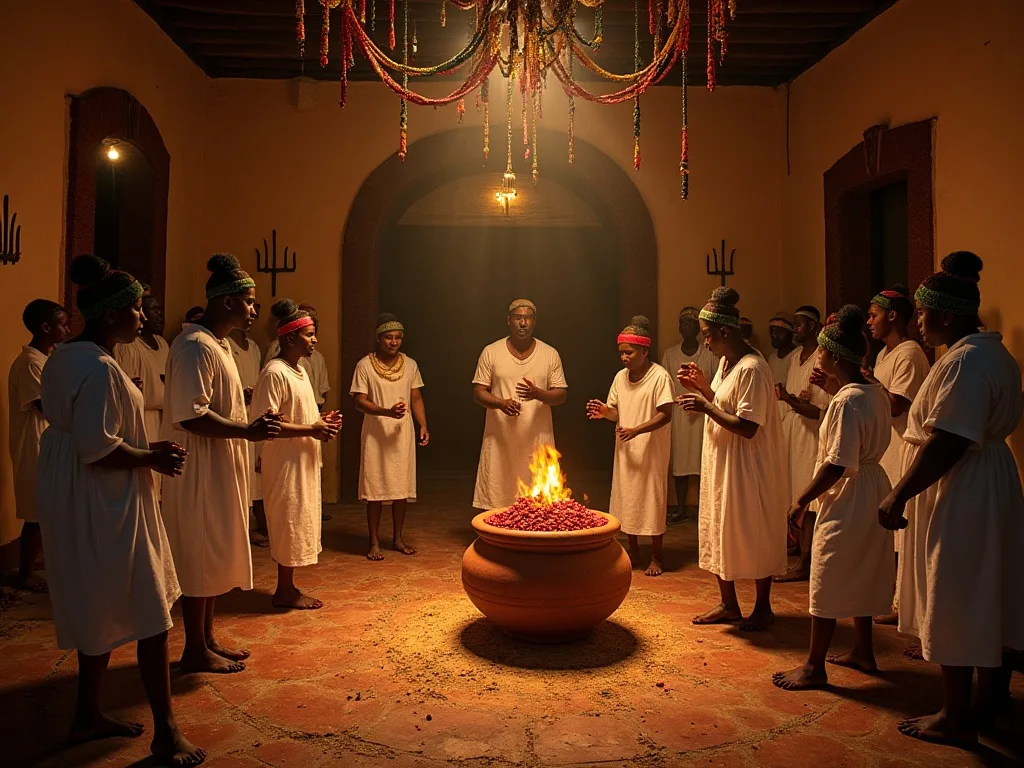
In Candomblé as practiced today, especially in the Nagô-Ketu tradition centered in Bahia, Exu holds a structural position that no other orixá occupies. Every ceremony begins with his padê (pronounced pah-DAY), a specific offering ritual performed outside the main ceremonial space. The padê typically involves palm oil, cachaça (Brazilian sugar-cane spirit), roasted corn, and sometimes smoked fish or shrimp. Exu receives his portion first, always.
The logic is practical and theological at once. Exu controls the roads. If you want your prayers to travel from this world to the realm of the orixás, the road must be open. If Exu is not fed, if he is not respected, the road can be blocked, diverted, or turned back on the sender. This is not a punishment. It is simply the nature of communication: you cannot bypass the messenger.
His ilê (house, or altar) usually sits near the entrance of a terreiro (a Candomblé temple space). It is physically apart from the main altar cluster of the other orixás. In some terreiros, his pot-shaped altar called an ota de Exu stands at a crossroads nearby, often at night, away from the community's sleeping areas. He is "outside" because he mediates between inside and outside. That spatial position is a theology.
Exu also has a strong personal dimension. Each devotee has their own Exu, a specific aspect of the orixá tied to their individual destiny and character. Some people's Exu is fiery and aggressive; others are playful, or measured. The orixá's energy takes a shape that fits the person. In this sense, Exu is both a cosmic principle and a deeply personal companion.
Ogum, the orixá of iron and war, is often invoked alongside Exu at the beginning of ceremonies, because both are associated with clearing paths. But where Ogum cuts through obstacles with iron force, Exu moves through them with intelligence, speed, and wit.
The Many Faces of Exu: The Pombagiras and the Exu Spirits
One of the most striking aspects of Exu in practice is his capacity for multiplicity. In Candomblé and its related tradition Umbanda (a twentieth-century Afro-Brazilian religion that blends Candomblé, Spiritism, and popular Catholicism), Exu is not one being but a vast family of spirits.
In Umbanda especially, the Exu spirits are understood as entities who once lived human lives, learning the roads and the shadows of the world before they died and joined Exu's spiritual family. These entities work at the crossroads between the living and the dead. They are invoked for practical matters: opening blocked paths, protecting travelers, cutting through deception, healing relational wounds.
The Pombagiras (singular: Pombagira) deserve special mention. They are the female counterpart to the Exu spirits, and they are as important as their male counterparts. Pombagira governs female sexuality, independence, and the crossroads specifically as experienced by women in a patriarchal society. She is often depicted as a beautiful woman dressed in red and black, standing at a T-shaped crossroads at midnight. She is fierce, irreverent, and immensely powerful. She has become one of the most beloved spiritual figures in Brazilian popular religion.
The most famous Pombagira is Maria Padilha, associated with roses, champagne, and the crossroads of romantic love and desire. She is invoked by people seeking justice in relationships, protection from violent partners, and the courage to leave situations that diminish them. She is not a demon. She is a guardian for those whom other guardians have overlooked.

The Colonial Distortion: How Exu Became the Devil
No aspect of Exu's history is more important, or more damaging, than the deliberate identification of this orixá with the Christian devil. This process began in earnest during the sixteenth and seventeenth centuries, as Portuguese Catholic missionaries encountered Yoruba and Fon religious practice in both Africa and Brazil.
The missionaries saw a figure associated with crossroads (a site of demonic meeting in European folklore), with sex and fertility, with trickery and unpredictability. They reached for the nearest available label: Satan. This identification served a colonial function. It branded African religion as devil worship, justifying its suppression and the continued subjugation of enslaved Africans and their descendants.
The results were catastrophic. Brazilian law criminalized Candomblé ceremonies well into the twentieth century. Police raids on terreiros were common through the 1960s and even beyond. Practitioners were arrested, sacred objects were destroyed, and entire communities were forced underground. The stigma created by the "Exu equals devil" myth persists in some Brazilian evangelical communities today, and it is a direct legacy of that colonial violence.
Scholars of religion, including the Brazilian anthropologist Reginaldo Prandi and the American historian J. Lorand Matory, have documented how this distortion worked and why it was so effective. Prandi's work "Mitologia dos Orixás" (2001) is one of the most comprehensive modern sources for Candomblé mythology, collecting hundreds of patakis (sacred narratives) that show Exu in his actual theological complexity.
The Yoruba concept of Exu has no equivalent to the Christian devil. He is not a rebel against God. He does not tempt humans toward damnation. He is not the enemy of the sacred. He is, in fact, the sacred's most active servant: the one who ensures the divine and the human remain in contact.
Exu's Patakis: The Myths That Reveal His Character
The patakis are the sacred stories of Candomblé and Yoruba religion, closer to parables than myths in the Western sense. They show the orixás acting in specific situations, and they teach practitioners how to understand the orixá's nature. The patakis of Exu are numerous and varied, but several themes return again and again.
The story of the two farmers is one of the most widely known. Two friends, who farmed neighboring plots on either side of a path, swore eternal friendship. Exu walked down the path between them wearing a hat that was red on one side and black on the other. Each farmer saw only one side. By the end of the day, they were arguing about what color the stranger's hat had been, certain the other was lying. Their friendship shattered. Exu, watching from the crossroads, did not laugh with cruelty. He taught: the same truth looks different depending on where you stand. Truth is plural. Perspective is real. This is not malice. It is a lesson about the nature of reality that no other orixá could have delivered.
The story of Exu and Ogum describes how these two orixás were once in conflict over a path. Exu blocked the road; Ogum tried to cut through with his machete. Neither won. Eventually they negotiated: Exu would always receive offerings before Ogum, and in return he would keep the roads clear for the warrior's passage. This pataki explains the ritual order of Candomblé ceremonies and frames Exu's power as structural, not adversarial.
The story of Exu and Orunmilá (the orixá of wisdom and divination) reveals Exu as a loyal ally. Orunmilá taught Exu to read the Ifa oracle. In return, Exu carried Orunmilá's messages with perfect fidelity. The two became inseparable: no divination without Exu's presence, no message without his delivery.
These stories, preserved orally across generations and now documented by scholars like Pierre Fatumbi Verger (whose photographs and ethnographic work from the 1950s onward remain foundational), show an orixá of enormous moral and intellectual complexity.
Iemanjá, the orixá of the sea and mother of many orixás, appears in several patakis alongside Exu, often as a mediating force when his crossroads energy becomes too turbulent. Their dynamic shows how the orixás operate as a system, each checking and complementing the others.
Exu's Symbols, Colors, and Sacred Numbers
Every orixá in Candomblé has a constellation of material attributes that anchor their presence in the physical world. For Exu, these symbols are precise and meaningful.
Colors: red and black. Red is the color of vital force, blood, fire, and the crossroads at dawn. Black is the color of night, mystery, the space between the known and unknown. Together, they mark the threshold where Exu operates.
Number: seven. Seven roads, seven keys, seven crossroads. In Candomblé numerology, seven is the number of dynamic movement and transformation. It is never a number of rest.
Sacred tools: The ogó (a carved wooden phallus representing creative and generative power), the trident (borrowed in part through syncretism with Saint Anthony in some regions), and the key (the key that opens every road). In terreiros, his altar often holds iron implements, coins, and offerings of pepper and palm oil.
Day and time: Monday is Exu's day. Midnight is his hour, the liminal moment when one day ends and another begins. Crossroads, particularly T-shaped or X-shaped intersections, are his sacred spaces in the physical world.
Catholic syncretism: During centuries of persecution, Candomblé practitioners adopted Catholic saint imagery as a protective cover. Exu was syncretically associated with the Anima Sola (the "lonely soul" of Catholic purgatory iconography) and in some regions with the child saint Anthony. This pairing confused outsiders further, but it also preserved Exu's worship through periods when open practice would have meant imprisonment.
Exu and the Living Tradition: Candomblé in the Twenty-First Century
Candomblé today is a legally recognized religion in Brazil, though it still faces persecution, particularly from some evangelical Protestant communities. The terreiros of Salvador da Bahia, the city most closely associated with Candomblé's history, have been recognized by UNESCO as cultural heritage sites. Scholars, artists, and practitioners worldwide have begun to reclaim Exu from centuries of colonial distortion.
The Brazilian philosopher and writer Luiz Rufino has written extensively about Exu as a figure of what he calls pedagogia das encruzilhadas, the "pedagogy of the crossroads." In Rufino's reading, Exu is a philosophical model for thinking about knowledge, encounter, and transformation in societies marked by colonial violence. This academic turn has given the orixá new visibility in universities and cultural institutions.
Meanwhile, in the terreiros, the padê is still performed every day. The clay pot still sits by the door. Palm oil still darkens the earth around the crossroads altar. The prayers still open with his name.
Xangô, the orixá of thunder and justice, is one of the most popular orixás in Candomblé, but even Xangô's ceremonies cannot begin without Exu's door being opened first. The whole system depends on the messenger. That dependence is not weakness. It is the recognition that without communication, without the capacity to cross from one place to another, nothing sacred can enter the world.
Exu: the Divine Messenger and Guardian of Crossroads is not a figure to be feared. He is one to be known, respected, and fed.
Frequently Asked Questions About Exu in Candomblé
Frequently asked questions
Is Exu the same as the devil in Candomblé?
No. The identification of Exu with the Christian devil was a colonial imposition, documented by scholars including Reginaldo Prandi and J. Lorand Matory. In Yoruba theology and Candomblé, Exu is the orixá of communication, movement, and crossroads. He has no role as an adversary of God or a tempter of souls. The confusion arose because Portuguese missionaries mapped African religious figures onto the nearest European category, and the category they chose was deliberately stigmatizing.
Why is Exu always the first orixá to be invoked?
Exu controls all roads, including the paths along which prayers and offerings travel between the human world and the realm of the orixás. If Exu is not acknowledged first, those paths can remain blocked. Every Candomblé ceremony therefore opens with his padê ritual. This is not about appeasement; it is about the correct order of the cosmos. Communication comes before everything else.
What is the difference between Exu and the Pombagira?
The Pombagiras are the female counterpart to the Exu spirit family, most prominent in Umbanda. Where Exu spirits are associated with roads, markets, and physical crossings, Pombagira governs the crossroads of female experience: sexuality, independence, romantic and relational power. The most famous is Maria Padilha. Both Exu and Pombagira spirits work at the boundary between the living and the dead, and both are consulted for practical, earthly matters.
What are the primary sacred texts or sources for Exu's mythology?
The Yoruba Ifa corpus, transmitted orally by babalawos (Ifa diviners) and now partially documented in written form, is the oldest source. In Brazil, the patakis of Candomblé have been collected and published by scholars including Pierre Fatumbi Verger ("Orixás," 1981) and Reginaldo Prandi ("Mitologia dos Orixás," 2001). These works compile hundreds of sacred narratives and remain the most reliable printed sources in the field.
Can Exu be worshipped outside of Brazil?
Yes. Candomblé and Umbanda have spread to Europe, North America, Japan, and West Africa itself, partly through the Brazilian diaspora and partly through growing global interest in Afro-Brazilian traditions. Exu is also closely related to Eshu-Elegba, who is actively worshipped in Yoruba communities in Nigeria, Benin, Cuba (as Eleggua in Lucumí/Santería), Haiti (as Papa Legba in Vodou), and Trinidad. The crossroads deity appears, under different names, across almost every tradition rooted in Yoruba religion.
What does Exu teach us philosophically?
The hat story (wearing a hat red on one side and black on the other, causing two friends to argue about its color) is the clearest example. Exu teaches that truth is perspectival, that position determines what you see. He also embodies the idea that boundaries and thresholds are not obstacles but the places where transformation happens. Brazilian philosopher Luiz Rufino has developed this into a full pedagogical theory, arguing that Exu represents a model for knowledge and encounter that is more honest about power and difference than many Western philosophical frameworks.
Exu Beyond Brazil: The Crossroads Deity Across the Atlantic World
The story of Exu does not end at any single border. When the Yoruba slave trade scattered people across the Atlantic, Eshu-Elegba traveled with them, and each new community built him a slightly different altar.
In Cuba, he became Eleggua in the Lucumí (or Santería/Regla de Ocha) tradition. Eleggua is a child-like deity, playful and mischievous, represented by a cement head with cowrie shell eyes left behind doors. He shares Exu's role as the first to be greeted in ceremony and the guardian of roads. Cuban practitioners call him "the owner of the roads" (el dueño de los caminos).
In Haiti and the wider Haitian Vodou tradition, the crossroads deity is Papa Legba, an old man walking with a cane, accompanied by a dog. He opens the poteau mitan (the central post of the Vodou temple, the axis along which the lwa spirits descend). Without Papa Legba opening the gate, no other spirit can arrive. The American blues musician Robert Johnson's famous crossroads deal with the devil is almost certainly a garbled folk memory of Legba's crossroads theology, refracted through centuries of cultural mixing in the American South.
In Trinidad and Tobago, the Orisha (Shango) tradition maintains a figure called Eshu whose attributes are nearly identical to the Yoruba original.
Across all of these traditions, the same theological core persists: the crossroads is sacred because it is the place of choice, of meeting, of transformation. The deity who lives there is not evil. He is the condition for all movement. He is Exu, and the roads he opens stretch from the terreiros of Bahia to every place on earth where people stand at a threshold and ask which way to go.
Read the full book
Want the whole story?
The complete edition is an instant PDF download here, with a paperback on Amazon for selected titles.
Candomblé
The Candomblé Book: The Orixás, Xangô, Yemanjá, and the Living Religion of Brazil
The Orixás: Xangô, Yemanjá, and Oxalá
The faith the enslaved carried across the ocean and refused to lose: the orixás of West Africa reborn in Brazil. Xangô of thunder, Yemanjá of the sea, Oxalá the creator, and the drums, foods, and colors that call them down. A living religion.
More from Candomblé
All articles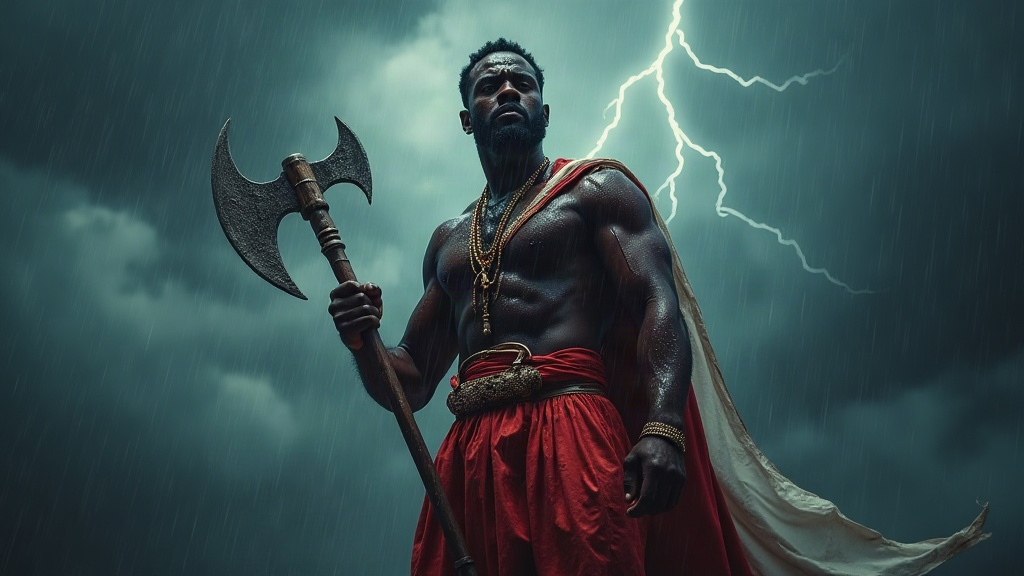
Candomblé
Xangô: The Thunder King and God of Justice
Xangô commands thunder and lightning, wielding a double axe as an instrument of divine justice. This Candomblé orisha embodies the warrior spirit, passion, and the power to strike down falsehood with sacred fire.

Candomblé
Oxóssi: Hunter God of the Forest
Oxóssi is the Candomblé deity of the hunt, forest abundance, and spiritual provision. His arrows strike with precision through the veil between worlds. Learn how this Yoruba orisha shapes African-Brazilian spirituality and why devotees invoke him for sustenance, clarity, and protection.

Candomblé
Oxum: Goddess of Fresh Waters, Love, and Fertility
Oxum rules the rivers and the human heart in Candomble. She is generosity itself: golden, sensual, protective of mothers and children. Learn how this Yoruba orisha became the most beloved goddess in Brazil and what her mythology reveals about devotion, abundance, and desire.

Candomblé
Iansã: Goddess of Winds, Storms, and the Dead
Iansã commands lightning and tempests, guards the edge between life and death, and embodies the fierce, unbounded energy of nature. In Candomblé, she is one of the most powerful and beloved orixás, syncretized with Santa Bárbara.