

Oxóssi: Hunter God of the Forest
Oxóssi is the Candomblé deity of the hunt, forest abundance, and spiritual provision. His arrows strike with precision through the veil between worlds. Learn how this Yoruba orisha shapes African-Brazilian spirituality and why devotees invoke him for sustenance, clarity, and protection.
Contents
The arrow whistles through the canopy. A hunter steps into the dappled light of the forest, bow drawn tight, eyes tracking movement only he can see. He is not merely a man. He is Oxóssi, the hunter god of the forest, and in Candomblé tradition, he moves between the visible world and the realm of spirits with the grace of a predator who knows every branch, every shadow, every heartbeat in the dark.
Oxóssi appears first in Yoruba cosmology, where he was revered by the Ketu people of what is now Nigeria and Benin. When enslaved Yoruba peoples arrived in Brazil, they carried him in memory and prayer. In the terreiros, the temples of Candomblé, Oxóssi became one of the central orishas, the divine forces that mediate between the human and the sacred. His story is not one of conquest or supernatural spectacle; it is a story of provision, precision, and the sacred geometry of the hunt.
In the forest and in the city, Oxóssi remains the god who provides. He is the hunter, the tracker, the one who sees what others cannot see.
The Orisha of Abundance and Foresight
In Yoruba tradition, Oxóssi rules the forest and the hunt. His domain is not aggression; it is abundance. A skilled hunter does not kill randomly. He studies his prey, understands the land, reads signs invisible to the untrained eye. This is Oxóssi's gift to humanity: the ability to see clearly, to plan precisely, and to find what sustains life in a world full of scarcity.
The Yoruba understood hunting as sacred labor. It required ritual preparation, spiritual alignment, and respect for the animal that would die to feed the community. Oxóssi presides over this sacred contract. He is the orisha who teaches survival not through violence, but through intelligence, patience, and intimate knowledge of one's environment.
In Candomblé, Oxóssi is syncretic ally associated with Saint George in Brazil, though this link is itself complex. Saint George on horseback, spear raised, became a cipher through which Yoruba believers could honor Oxóssi in societies that forbade African practice. But Oxóssi is no warrior deity in the European mold. He is a hunter, a tracker, a provider.
Oxóssi and His Sacred Tools
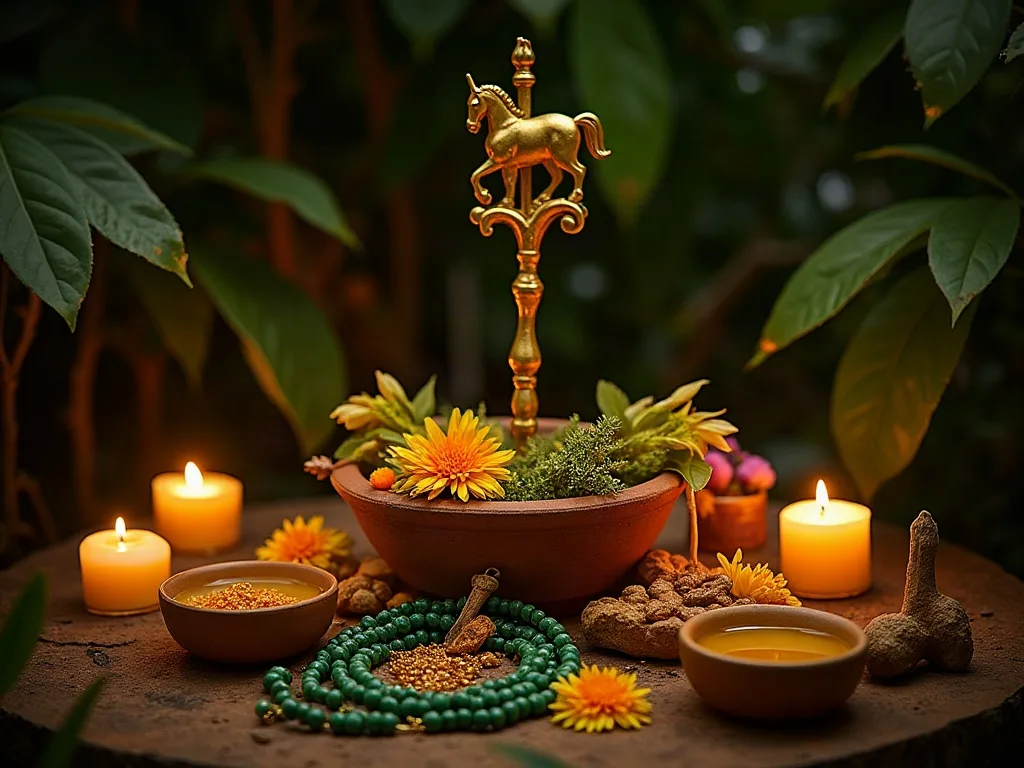
The bow and arrow are Oxóssi's signature. But these are not symbols of war. In the hands of a skilled archer, the bow is an instrument of precision, of intention, of knowledge made manifest. Each arrow flies according to law: gravity, wind, the archer's breath and stance. Oxóssi's arrows never miss their target because they are aimed with perfect knowledge.
In ritual, Oxóssi is invoked with words in Yoruba that mean "the hunter who hunts for the community." His followers carry opé, a curved horn or staff topped with a golden horse, which represents both his swiftness and his sovereignty over the forest paths.
The colors sacred to Oxóssi are green and yellow-gold, colors of forest and precious metal, of life and wealth. Candles lit in his honor burn these hues. Beads strung for his ileke, the sacred necklace worn by his children, follow this pattern: green and gold alternating, a visual rhythm that calls his attention and presence.
His animals include the deer, the porcupine, and the antelope: swift, alert, creatures that survive through vigilance and knowledge of terrain. Cattle are also sacred to him, symbols of prosperity and provision.
The Hunter's Oath and Community Care
Oxóssi is profoundly bound to his community. His hunt provides for the collective, not the individual. This distinction matters. In Candomblé theology, Oxóssi represents the orisha who works not for personal glory but for the survival and flourishing of his people. He is the antithesis of greed.
Stories in the oral tradition describe Oxóssi feeding the poor, hunting only what the village needs, refusing to slaughter wastefully. When a hunter becomes corrupt, when he kills for profit or pride, Oxóssi withdraws his blessing. The arrows fall wide. The forest closes its secrets. This is not punishment; it is the natural consequence of breaking covenant.
Devotees of Oxóssi often find themselves drawn to work that serves others: healing, teaching, community organizing, any labor that provides sustenance or insight. Many iyalorixás and babalorixás, the priestesses and priests of Candomblé, maintain strong relationships with Oxóssi because his precision and foresight are essential to spiritual guidance.

The Forest as Temple
In Candomblé cosmology, the forest itself is sacred. This is not metaphor. The forest is Oxóssi's church, his altar, his dwelling place. When Brazilian terreiros practice, they maintain relationships with actual forests, groves, and wild places. These are not recreational spaces. They are temples where offerings are made, where communication with Oxóssi and other orishas happens directly.
This practice carries profound ecological implications. Candomblé communities have historically protected Brazilian forests and biodiversity. The reverence for the forest as a living sacred entity, embodied in Oxóssi's presence, has motivated conservation long before environmental activism entered mainstream discourse.
Devotees of Oxóssi make pilgrimages to forests and waterfalls. They leave offerings of honey, corn, fruits, and grains. They speak prayers in Yoruba and Portuguese. They listen for the response in the rustle of leaves, the cry of a bird, the sudden clarity that floods the mind when Oxóssi's presence becomes palpable.
Syncretism and Saint George: A Complicated Story
When Portuguese colonizers brought Christianity to Brazil, they forbade African religions. Candomblé practitioners needed cover. Saint George, the soldier-saint on horseback, became the visible face behind which Oxóssi could be worshipped. The connection was not random: both figures hold the bow or spear, both represent protection and provision, both serve the community.
But this syncretism was always a disguise, not a merger. The saint and the orisha remained distinct in the minds of practitioners. When Candomblé was sufficiently established, many terreiros gradually dropped the saint imagery, returning to explicit African forms. The saint's feast day, however, still coincides in some terreiros with celebrations of Oxóssi.
This history matters because it shows how African spirituality persisted despite systematic oppression. The hunter god survived slavery, colonialism, and religious prohibition by adapting form while preserving essence. This resilience is itself part of Oxóssi's legacy.
Oxóssi and Divination
In the divinatory system of Ifá, which runs parallel to Candomblé practice, Oxóssi appears in multiple configurations. The odu, the sacred verses of Ifá, describe scenarios where the hunter's wisdom becomes prophetic wisdom. When an ifa priest casts the divinatory chain and Oxóssi's presence emerges, the reading often points toward clarity of vision, the need to gather information before acting, or the counsel to pursue a goal with patience and skill.
Devotees consult with Oxóssi through various means: the oracle of the sixteen cowries, conversations with priests, dreams, and sudden insight. The orisha communicates through the symbols and language he knows: the forest, animals, the hunt, the bow, the swift and certain path.
Oxóssi in Modern Practice
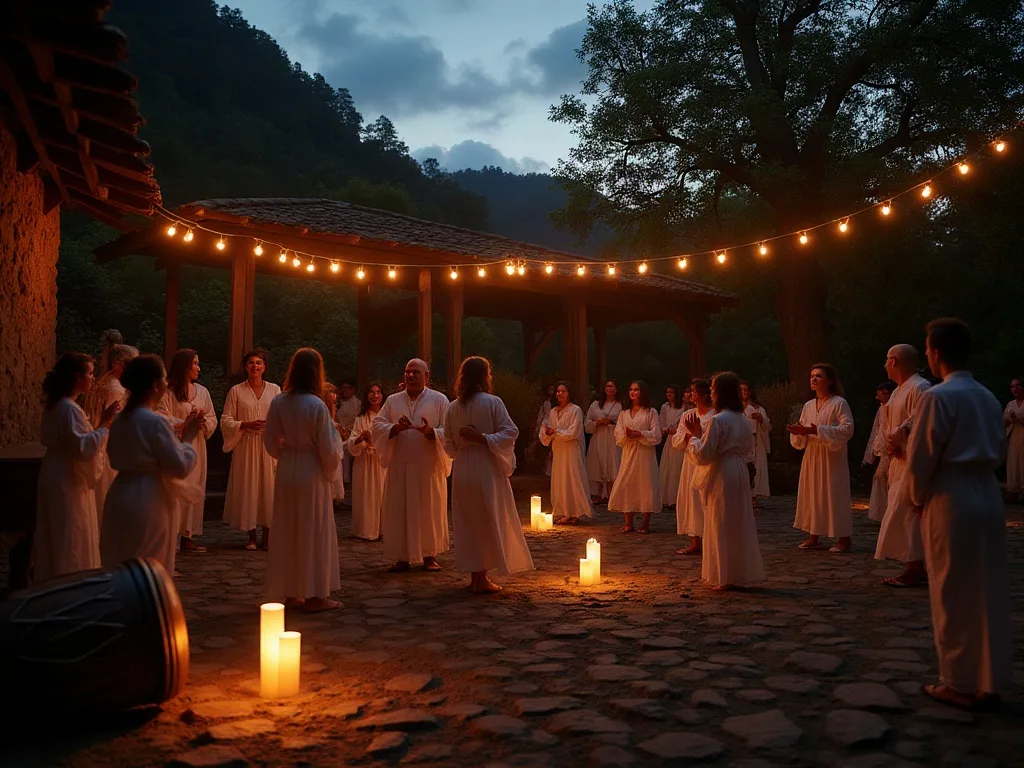
In contemporary Brazil and throughout the African diaspora, Oxóssi remains vital. His feast days are celebrated with music, dance, and elaborate ritual. In São Paulo, Rio de Janeiro, and cities across the Caribbean and North America, terreiros honor him with specific ceremonies and offerings.
Young people entering Candomblé often develop strong connections to Oxóssi. His attributes speak to modern life: the need for clarity in a confusing world, the importance of precise action, the value of providing for one's community rather than accumulating personal wealth. His association with the forest has made him a patron of environmental activism and indigenous rights movements.
The Orixá and the Shadow
Like all complex deities, Oxóssi contains shadow. The hunter can become predatory. The eye that sees clearly can become calculating. The arrow that provides can wound. In Candomblé teaching, the orishas are not purely good or evil; they are forces of nature, complex and whole. Oxóssi's children are taught to honor his power while acknowledging the potential for his gifts to become corrupted.
Stories in the oral tradition describe Oxóssi confronting other orishas, defending his territory in the forest, or refusing to aid those who do not respect natural law. These narratives remind practitioners that the orisha is sovereign, that his blessing cannot be coerced, and that the relationship with Oxóssi requires genuine alignment with his values and his law.
Oxóssi and the Crossroads of Spirituality
Oxóssi exists at the intersection of several traditions. He is rooted in Yoruba religion, transformed by the crucible of slavery and diaspora, sustained by Candomblé practice, connected to indigenous Brazilian spirituality through shared reverence for the forest, and increasingly recognized in global conversations about religious pluralism and spiritual ecology. He shows how African religions not only survived dispossession but continued to evolve, to teach, and to provide meaning and power to those who approach them with respect.
The hunter god remains contemporary because his truths are perennial: that vision requires stillness, that provision requires skill, that community matters more than individual accumulation, that the forest is sacred, and that the boundary between the visible and invisible worlds is permeable to those who know how to cross it.
Frequently asked questions about Oxóssi?
Frequently asked questions
Who was Oxóssi before Candomblé, and where did he come from?
Oxóssi originated in Yoruba religion among the Ketu people of West Africa (present-day Nigeria and Benin). He was a hunter deity revered for his provision and spiritual sight. When Yoruba peoples were enslaved and brought to Brazil, they carried Oxóssi's memory and practice, integrating him into Candomblé as one of the central orishas. He represents continuity between African and African-Brazilian spirituality.
Why is Oxóssi associated with Saint George in some Candomblé houses?
During colonial Brazil, African religions were forbidden. Candomblé practitioners disguised Oxóssi worship by linking him to Saint George, the Christian soldier-saint on horseback, because both figures represent protection and provision. This syncretism was a survival strategy. Many contemporary terreiros have dropped the Catholic imagery and worship Oxóssi explicitly, though some houses maintain the dual tradition.
What colors and offerings are sacred to Oxóssi?
Green and yellow-gold are Oxóssi's colors, representing the forest and precious metal. Offerings include honey, corn, fresh fruits, and grains left in the forest or at altars. His sacred necklace, the ileke, alternates green and gold beads. Prayers and songs in Yoruba are also forms of offering. Some terreiros make offerings specifically on Thursdays, considered Oxóssi's day.
How do modern Candomblé practitioners relate to Oxóssi today?
Oxóssi remains central in contemporary terreiros across Brazil, the Caribbean, and the diaspora. His attributes resonate with modern concerns: clarity, precision, community provision, and environmental stewardship. His association with the forest has made him relevant to ecological activism. Young people entering Candomblé often develop strong devotions to Oxóssi, seeing in him a teacher for navigating complexity and uncertainty.
Is Oxóssi a war god or a hunter god, and what is the difference?
Oxóssi is fundamentally a hunter, not a warrior. The distinction is crucial. Hunters provide for communities; they study their environment, act with precision and respect for life. Warriors conquer and dominate. Oxóssi's arrows strike their target because he sees clearly and acts with knowledge, not because he seeks victory over others. This emphasis on provision and sight distinguishes him from martial deities in other traditions.
Oxóssi and the Future of Candomblé in a Global World
The power of Oxóssi: hunter god of the forest lies not in historical nostalgia but in his continued ability to teach. As climate change threatens forests, as communities face unprecedented uncertainty, and as people search for spiritual frameworks that honor both human flourishing and ecological integrity, Oxóssi's message becomes more urgent: see clearly, act with precision, provide for your community, and remember that the forest is sacred.
Candomblé itself is experiencing a renaissance. No longer confined to Brazil, it has established roots in the United States, Europe, Africa, and beyond. Each terreiro adapts the tradition to its local context while maintaining core practices and principles. Oxóssi appears in all of them, the hunter who never loses the scent, the god who provides, the orisha who reminds humanity that skill, knowledge, and respect for natural law remain the foundation of survival and spiritual power.
Read the full book
Want the whole story?
The complete edition is an instant PDF download here, with a paperback on Amazon for selected titles.
Candomblé
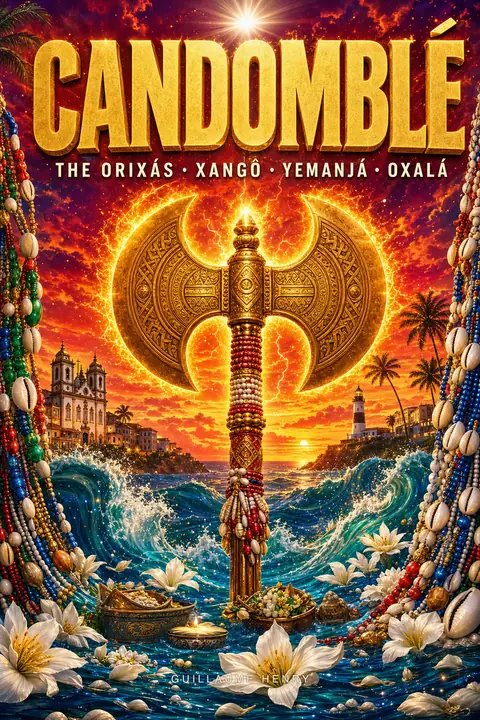
The Candomblé Book: The Orixás, Xangô, Yemanjá, and the Living Religion of Brazil
The Orixás: Xangô, Yemanjá, and Oxalá
The faith the enslaved carried across the ocean and refused to lose: the orixás of West Africa reborn in Brazil. Xangô of thunder, Yemanjá of the sea, Oxalá the creator, and the drums, foods, and colors that call them down. A living religion.
More from Candomblé
All articles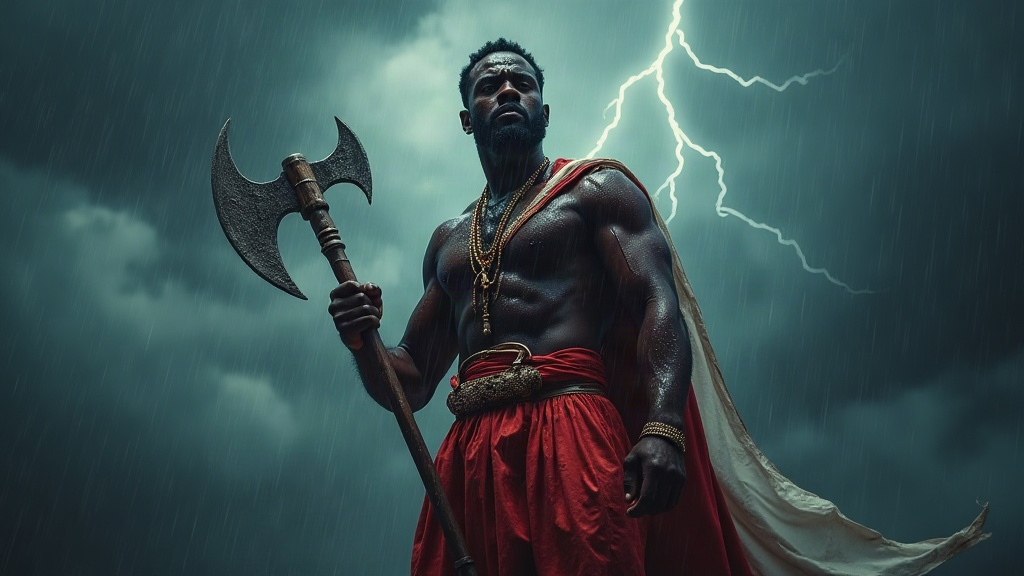
Candomblé
Xangô: The Thunder King and God of Justice
Xangô commands thunder and lightning, wielding a double axe as an instrument of divine justice. This Candomblé orisha embodies the warrior spirit, passion, and the power to strike down falsehood with sacred fire.

Candomblé
Oxum: Goddess of Fresh Waters, Love, and Fertility
Oxum rules the rivers and the human heart in Candomble. She is generosity itself: golden, sensual, protective of mothers and children. Learn how this Yoruba orisha became the most beloved goddess in Brazil and what her mythology reveals about devotion, abundance, and desire.

Candomblé
Iansã: Goddess of Winds, Storms, and the Dead
Iansã commands lightning and tempests, guards the edge between life and death, and embodies the fierce, unbounded energy of nature. In Candomblé, she is one of the most powerful and beloved orixás, syncretized with Santa Bárbara.

Candomblé
Axé: The Sacred Life Force in Candomblé
Axé is the vital energy that flows through all life in Candomblé, from the orisha deities to the human body. Discover how this West African concept became the beating heart of Brazil's most influential African diaspora religion.