

Oxum: Goddess of Fresh Waters, Love, and Fertility
Oxum rules the rivers and the human heart in Candomble. She is generosity itself: golden, sensual, protective of mothers and children. Learn how this Yoruba orisha became the most beloved goddess in Brazil and what her mythology reveals about devotion, abundance, and desire.
Contents
A woman bathes in a river at dawn, her skin gleaming in the half-light. The water carries her prayers downstream. She touches the smooth stones beneath her feet, feels the current wrap around her legs, and whispers the name of the goddess who hears every word spoken near fresh water: Oxum.
In the traditions of Candomble, the African-derived religion born in Brazil from the meeting of Yoruba ancestors and enslaved people's resilience, Oxum (also spelled Oshun) is not distant or severe. She is intimacy itself. She presides over rivers, streams, and waterfalls. She rules love, beauty, fertility, and motherhood. She adorns herself with gold and honey. She is playful, proud, generous to those who honor her, and merciless to those who disrespect her gifts. Her mythology teaches that sweetness and power are not opposites; they flow together like a river.
Oxum's story is woven into the larger tapestry of Yoruba cosmology, transformed by the crucible of the Middle Passage and reconstructed in the sacred spaces of Bahia, Rio, and across Brazil. To understand her is to understand how African gods survived diaspora, how enslaved people kept their souls intact, and how a goddess of water became a force of liberation.
The Yoruba Origins of Oxum
Oxum comes from the Yoruba people of present-day Nigeria, Ghana, and Benin. The Yoruba were a sophisticated civilization with a rich spiritual system centered on the orishas, spiritual forces that govern everything from lightning to the forge, from the sea to fresh water. These orishas are not abstract concepts; they are personalities, characters with desires, rivalries, and stories. The Yoruba recognized that divinity lived in the natural world and in human emotion. Every river had an orisha. Every storm was a god's mood.
In traditional Yoruba belief, before the orishas came to be remembered as they are today, they existed as eledua, divine principles that once walked the earth. Oxum was one of these. She was a woman of extraordinary beauty, the daughter of Yemoja (goddess of the ocean) in some tellings. Her essential nature never changed: she embodied the generative power of fresh water, the sweetness that makes life possible, and the irresistible pull of attraction between human beings.
The Yoruba recognized Oxum through the rivers themselves. Every waterfall, every gentle stream, was a place where her presence could be felt. Women who wished to conceive would visit her shrines along the riverbank. Girls entering womanhood would be blessed by priestesses at her sacred waters. In Yoruba society, Oxum's domain extended into the intimate: she governed not just love but sexuality, sensuality, luxury, and the bonds between mother and child. She was the keeper of the uterus, the guardian of childbirth.

The Yoruba also recognized that Oxum could be dangerous. A river in flood is not gentle. A woman scorned turns fierce. In the myths, Oxum punishes those who betray her or take her gifts for granted. She withholds fertility from villages that forget her. She can render a woman barren, a marriage loveless, a river dry. This is not cruelty but sovereignty. Oxum demands respect, and her power lies in the fact that she cannot be coerced or manipulated.
Oxum and the Diaspora: Survival Through Syncretism
When the Portuguese slave trade began in earnest in the 16th century, it forcibly transported millions of Yoruba and other West African peoples across the Atlantic. The vast majority were enslaved in Brazil. Brazil's brutal sugar plantations, mines, and urban centers became home to more African captives than anywhere else in the Americas. The numbers are staggering: nearly five million Africans arrived in Brazil before slavery ended in 1888, more than forty percent of all enslaved Africans brought to the New World.
These millions of people carried their gods with them in memory, in prayer, in song. The slave-holding Catholic Church permitted no African religion; Christianity alone was imposed as the official faith. Enslavers believed that conversion would make Africans docile, obedient. But Africans would not let their gods die. They performed an act of spiritual genius: they hid their orishas inside Catholic saints.
Oxum was sheltered beneath the image of Our Lady of Conception (Nossa Senhora da Conceição), a virgin saint associated with purity and motherhood. The parallel was not perfect, but it was enough. When a slave woman lit a candle to Our Lady, everyone assumed she was praying to a Catholic saint. In truth, she was calling to Oxum. The orishas survived the Middle Passage not through direct worship but through this concealment, this sacred trickery born of desperation and faith.
By the 18th century, particularly in Bahia, Brazil, Africans and their descendants began to consolidate these fragmented practices into organized systems. They built the first true Candomble terreiros (temples, sacred compounds). Candomble means "to honor through dance and music," and it became the word for the entire religion. Unlike some other African diaspora traditions, Candomble remained closely tied to Yoruba cosmology and ritual. It did not abandon its roots; it adapted them. The orishas were not syncretized away; they were protected by the saints and later openly worshipped as Candomble gained cultural space, especially after Brazil's abolition in 1888.
In Candomble, Oxum reclaimed her full identity. She was no longer hidden behind a saint's name. She was Oxum, goddess of the sweet waters, the Yoruba orisha who had traveled the Middle Passage in the hearts of enslaved women and had emerged in Brazil transformed but unbroken.
The Mythology of Oxum: Stories of Love, Vanity, and Power
The myths surrounding Oxum in Candomble reveal the complexity of her character. Unlike the distant, unchanging gods of some religions, the orishas of Yoruba and Candomble tradition are alive with human emotion. They fall in love, quarrel, make mistakes, and learn lessons. Oxum is no exception.
One of the most beloved stories tells of Oxum and her relationship with Shango, the god of thunder and lightning, a warrior orishas of passionate intensity. In many tellings, Oxum and Shango are lovers, sometimes husband and wife. Their relationship is marked by intense passion and equally intense conflict. Shango is volatile, prone to jealousy and anger. Oxum is proud and will not tolerate disrespect. The mythology captures something true about the nature of love itself: the way desire and anger can live side by side, the way intimacy and distance are always negotiating with each other.
In one account, Oxum once grew so angry with Shango that she refused to use her powers to protect his kingdom from drought. Without the rivers to provide water, the land withered. The people suffered. Shango, humbled, had to approach Oxum with genuine respect and apology. Only then did she restore the waters. The story teaches a profound lesson: that feminine power cannot be taken for granted, that sweetness is not weakness, and that even the gods must learn to honor what they receive.
Another cycle of myths describes Oxum's relationships with other orishas. She has a complex, often contentious relationship with Oya, the goddess of storms and the boundary between life and death. Some stories present them as rivals. Others show them as allies. In some accounts, Oxum is the junior wife of Oba, goddess of marriage and domestic life, while Oya is the second wife. Tensions arise: Oxum's sensuality and independence chafe against Oba's emphasis on duty and obedience. Yet all three remain part of the divine community, their conflicts enriching rather than fracturing the whole.

The myths also emphasize Oxum's role as a protective mother. She is said to watch over women in childbirth, easing pain and ensuring safe delivery. Women invoke her protection during pregnancy. Barren women pray to her for the gift of children. Mothers make offerings to her on behalf of their sons and daughters. In Candomble practice, children who survive difficult births are often initiated into Oxum's service as a form of gratitude. This dimension of her mythology speaks to a deep human need: the need for divine protection in moments of vulnerability and transformation.
Oxum is also known for her vanity, her love of beauty, gold, and adornment. This is not presented as a flaw but as a natural expression of her divine nature. She loves mirrors, fine fabrics, perfumes, and jewelry. In Candomble rituals, Oxum is offered honey (her favorite food), gold coins, yellow flowers, and fresh water. The offerings are not mere symbols; they are genuine honors offered to a goddess who deserves them. When devotees dance for Oxum in Candomble ceremonies, they move with sensuality and grace, their bodies adorned with gold and yellow cloth, embodying her beauty and power.
Oxum in Candomble Ritual and Practice
In Candomble, Oxum occupies a central place in both private devotion and public ceremony. Unlike formal Christianity with its emphasis on doctrine and moral law, Candomble is a religion of relationship. One develops a personal bond with one's patron orisha. Many Candomble practitioners have Oxum as their guiding force, their orisha de cabeca (orisha of the head), the divine being who watches over their life and destiny.
Initiates of Oxum undergo formal rituals of consecration. In the most elaborate form, called feitura de santo (making of a saint), a person undergoes weeks or months of seclusion, instruction, and ritual. They learn the secrets of Oxum: her songs, her prayers in the Yoruba language, the proper ways to invoke her and offer to her. They learn that Oxum is not a distant deity but a presence to be cultivated through relationship and respect. The initiate emerges from seclusion reborn, marked by sacred marks, dressed in Oxum's colors (gold and white or pale yellow), and understood to carry her protection and blessing.
Candomble ceremonies honoring Oxum typically occur in late August and early November, though devotees make offerings throughout the year. The most important date, in many terreiros, is December 8, the Catholic feast of the Conception of Mary, the saint under whom Oxum was hidden for centuries. On this day and surrounding days, thousands of devotees gather at rivers, waterfalls, and beaches across Brazil. They wade into the water, make offerings of flowers (especially roses), honey, and coins, and pray to Oxum. The water receives these gifts as if Oxum herself accepts them.

In the sacred dance of Candomble, the priest or priestess who is possessed by Oxum moves with distinctive grace and sensuality. The possessed dancer becomes Oxum: graceful, demanding, regal. She may flirt with observers, demand gifts and attention, move with the fluidity of water. Those who witness this possession report a sense of genuine presence, as if the goddess herself has entered the dancer's body. Whether understood as literal possession or as a profound psychological and spiritual state, the experience carries real power for believers.
The languages of Candomble ritual further embed Oxum in daily practice. Devotees greet each other with Yoruba-language blessings. Many learn key prayers and invocations in Yoruba, the ancestral language, even if they speak only Portuguese in everyday life. This language use is itself an act of resistance and cultural preservation. By speaking to the orishas in Yoruba, practitioners honor the ancestors who brought the religion across the Middle Passage. Oxum's name itself is Yoruba, and by speaking it, one participates in a lineage stretching back to precolonial West Africa.
Oxum and the Sacred Feminine in Candomble
Candomble's theology assigns enormous power to feminine principle. The orishas are not uniformly male; indeed, some of the most powerful and complex orishas are female. Yemoja, the mother of the ocean and the orishas themselves, is the ultimate source of fertility and protection. Oya governs transformation, death, and the liminal spaces where change occurs. Nana Buruku, the eldest orisha, is associated with ancestors and the earth itself. And Oxum rules the sweetest, most intimate aspects of existence: desire, conception, childbirth, and the bonds between people.
In the broader context of Candomble cosmology, these female orishas are not subordinate to male ones. They hold their own domains, command their own followers, and cannot be overruled or diminished. This stands in sharp contrast to the patriarchal structure of Christianity and mainstream European culture. For enslaved and formerly enslaved Africans and their descendants in Brazil, Candomble offered a spiritual world in which women could be powerful, central, and fully realized.
The priestesses of Candomble, called iyalorixas (mothers of the saints), occupy positions of considerable authority and spiritual power. They lead terreiros, make decisions about initiation and ritual, counsel devotees, and maintain the connection between the human and divine worlds. Many of the most important and influential terreiros in Brazil's history have been led by women, particularly by iyalorixas devoted to Oxum and other female orishas. These women were often formerly enslaved or the daughters of enslaved people. They rose to prominence through spiritual gifts and commitment, proving that liberation could be spiritual as well as physical.
Oxum and the Emergence of Candomble in Modern Brazil
As Brazil transitioned from slavery to a formally free society in the late 19th and early 20th centuries, Candomble moved from hidden practice to increasingly visible religion. The terreiros, once secret, began to operate more openly. Scholars and anthropologists became interested in Candomble as a object of study. Literature and music incorporated Candomble themes and language. By the mid-20th century, Candomble was recognized as a major religious tradition in Brazil, one that claimed millions of practitioners.
Throughout this process, Oxum remained the most beloved and widely worshipped orisha, at least in terms of popular devotion. Her sweetness, her association with motherhood and protection, her vanity and sensuality, and her fundamental association with the beauty of nature made her accessible to people from many walks of life. Street vendors, domestic workers, artists, businesspeople, and intellectuals all found reason to honor her. Candomble terreiros dedicated to Oxum proliferated, particularly in cities like Salvador, Rio de Janeiro, and later Sao Paulo.
The religious practice of Candomble was also intertwined with African diaspora culture more broadly. Samba, the music and dance form that became Brazil's most recognizable export, drew heavily on Candomble themes and cosmology. Carnival celebrations incorporated orisha symbolism. When people danced to samba or participated in Carnival, they were sometimes unknowingly participating in Candomble-inflected spirituality. This cultural diffusion meant that even non-practitioners absorbed Candomble imagery and language into their everyday understanding of Brazilian identity.
By the late 20th century, Candomble had achieved a degree of social acceptance and legal recognition. In 2007, the Brazilian government formally recognized Candomble as a religion with rights equal to Christianity. Today, millions of Brazilians identify as Candomble practitioners, and the religion has spread to other Portuguese-speaking countries, to parts of Africa, and to diaspora communities in North America and Europe.
Oxum in Comparative Perspective: The Orisha of Fresh Waters Across Traditions
Oxum's identity as a goddess of fresh waters, love, and fertility connects her to a broader family of goddesses found across human religions and mythologies. In the Yoruba tradition itself, before diaspora and Candomble, Oxum represented a particular expression of these principles: the power of fresh water as opposed to the salt water ruled by Yemoja, the power of seduction and intimate connection, the power to give or withhold fertility.
Other African traditions also recognize goddesses of water, love, and fertility. In Haitian Vodou, which shares significant overlap with Candomble and also preserves Yoruba cosmology, the equivalent figure is Erzulie, a goddess of love, luxury, and beauty who is at once giving and demanding, capable of blessing or cursing those who approach her. In Santeria, the Cuban religion also descended from Yoruba tradition, Oxum (called Oshun) holds a similar position of prominence.
Outside the African diaspora, many world traditions feature goddesses with comparable attributes. In Hindu tradition, Lakshmi represents wealth, beauty, and good fortune; she also demands respect and will withdraw her favor from those who dishonor her. In ancient Greek religion, Aphrodite governed love and desire, though the Greek goddess was often portrayed as more frivolous and dangerous than Oxum. In Slavic tradition, water goddesses like the rusalki inhabited rivers and could be both generous and deadly.
Yet Oxum remains unique. Her mythology emerged from specific historical conditions: the meeting of Yoruba civilization with the brutality of slavery, the forced migration across the Atlantic, the reconstruction of African religion in the Americas. Her worship was not merely about acknowledging a principle of nature or human emotion; it was an act of cultural survival and resistance. When a woman made an offering to Oxum in a Brazilian river in the 18th or 19th century, she was not only honoring a goddess; she was maintaining connection to a homeland she would never see, keeping alive the language and knowledge of ancestors, and asserting that her humanity and spirituality could not be erased by enslavement.
The Symbols and Sacred Objects of Oxum
In Candomble practice, Oxum is invoked and honored through specific symbols and sacred objects. Understanding these symbols illuminates her nature and the relationship between devotees and goddess.
Gold is perhaps the most important symbol of Oxum. In Candomble, gold represents purity, value, and divine radiance. Many ritual objects dedicated to Oxum incorporate gold or are gold-colored. Devotees wear gold jewelry as a sign of connection to Oxum and as a form of self-adornment that pleases her. Offerings of gold coins are placed in rivers or brought to terreiros as gifts to the goddess. The association of gold with Oxum is not arbitrary; gold is precious, beautiful, and imperishable, qualities that Oxum embodies.
Honey and sweet foods are also sacred to Oxum. In rituals, honey is offered alone or mixed with other foods. Devotees make honey cakes and leave them at the riverbank or in terreiros. This association draws on the symbolism of sweetness: love is sweet, fertility is sweet, the flow of life's pleasures is sweet. But there is also an element of genuine reciprocity; the offerings are gifts that bring pleasure, not mere symbols. Oxum is portrayed as one who enjoys these gifts, who appreciates beauty and luxury and takes pleasure in them.
Water itself is Oxum's most essential symbol. Specifically, fresh running water: rivers, streams, waterfalls, fountains. In Candomble, water from a river is collected and used in rituals. Devotees bathe in rivers sacred to Oxum. Many terreiros keep vessels of river water as sacred objects. When practitioners pray to Oxum, they often do so near water or with water present. The water carries her presence and her blessing.
Mirrors are also sacred to Oxum, reflecting her beauty and her capacity for self-knowledge. Mirrors appear on Oxum's altars in many terreiros. In ritual, a devotee possessed by Oxum may look into a mirror, admiring herself as the goddess would, celebrating beauty and presence. This is not narcissism but a form of spiritual self-affirmation; in a culture that has often diminished and devalued the beauty of Black women, the veneration of Oxum includes veneration of the self.
Yellow and white are Oxum's colors, appearing in the cloth worn by devotees, in the flowers offered to her (pale yellow flowers, white flowers), and in the decorations of her altars. These colors are associated with purity, light, and spiritual elevation. Yellow especially carries associations with gold, sun, and warmth. When a terreiro celebrates Oxum with these colors adorning the space and the people within it, the entire environment becomes a statement of devotion.
Oxum in Contemporary Brazilian Culture and Beyond
Today, Oxum is not only a figure of religious devotion but a cultural icon in Brazil and beyond. She appears in literature, film, music, and visual art. Contemporary Brazilian authors have written novels in which Oxum appears as a character or guiding presence. Brazilian cinema has explored Candomble themes, often centering on Oxum or other female orishas. The visual artists have depicted Oxum in paintings and sculptures that combine traditional imagery with modern aesthetics.
In music, Oxum's presence is pervasive. Samba composers write songs that invoke her. Axe music, a contemporary Brazilian genre rooted in Bahian culture and Candomble cosmology, frequently references Oxum by name and imagery. When audiences hear these songs in clubs, at Carnival, or on the radio, they are encountering Oxum as a living cultural force, one that continues to shape how Brazilians understand beauty, femininity, power, and spirituality.
Beyond Brazil, Oxum has become known to a global audience through the spread of Candomble communities, through academic interest in African diaspora religions, and through the growing visibility of African-derived spiritual traditions in the Americas. In cities with significant Brazilian immigrant populations, in African diaspora communities in the United States and Europe, and among those interested in comparative religion and world spirituality, Oxum is increasingly recognized and honored.
The spread of Oxum's veneration outside Candomble's original context raises questions about cultural appropriation and authentic practice. Some argue that Candomble is a living religion with specific lineages, initiatory requirements, and sacred knowledge that should not be treated as a generic spiritual supermarket from which anyone can pick and choose. Others point out that Candomble itself is a syncretic tradition, born of cultural meeting and adaptation, and that it has always incorporated new members and evolved in response to changing circumstances. The debate is ongoing and reflects genuine tensions between the desire to protect sacred traditions from dilution and the reality of diaspora and cultural fluidity.
The Unanswered Questions: Oxum and Scholarly Interpretation
Despite growing academic interest in Candomble, significant questions about Oxum and her mythology remain contested among scholars. One ongoing debate concerns the precise relationship between Yoruba tradition and Candomble. How much did enslaved Yoruba people remember or transmit of their original religion? How much did Candomble innovate or reimagine? The answers vary depending on which terreiro, which lineage, and which period one examines. Scholars like Ruth Landes, who conducted fieldwork among Bahian terreiros in the 1930s, collected accounts suggesting that much of the Yoruba cosmology survived relatively intact. Others argue that Candomble is fundamentally a new creation, a syncretic religion that preserves elements of Yoruba tradition but is ultimately a Brazilian phenomenon.
Another question concerns the gender dimensions of Candomble and Oxum's role in it. Some feminist scholars have emphasized Candomble as a religion that centers feminine power and sexuality in ways that Christianity and Islam do not. They point to the prominence of female priestesses and the centrality of orishas like Oxum as evidence of a more egalitarian spiritual system. Other scholars question this interpretation, noting that even within Candomble, gender relations can be hierarchical and that not all practitioners understand the religion in feminist terms. The question of whether Candomble represents liberation or merely a different form of constraint remains open.
A third area of scholarly interest concerns the relationship between Candomble and African religions in Africa today. Some have suggested that Candomble should be understood as a form of African religion in diaspora, one that has maintained living connection to African traditions. Others argue that Candomble is so transformed by its Brazilian context that drawing direct continuity lines to Africa is misleading. Still others propose that Candomble represents not a preservation of African religion but a creative reimagining of it, one shaped by slavery, Catholicism, and Brazilian society. The truth likely involves elements of all these perspectives.
Frequently asked questions about Oxum, goddess of fresh waters, love, and fertility
Frequently asked questions
Is Oxum worshipped outside of Brazil?
Yes. Oxum (Oshun) is honored in Santeria, the Cuban religion derived from Yoruba tradition. She is also venerated in Haitian Vodou and in Candomble communities that have spread to the United States, Europe, and other countries. Academic interest and growing awareness of African diaspora religions have made her known to practitioners and curious people worldwide. However, formal initiation and serious practice typically require connection to an established terreiro or ilé (house) in an unbroken lineage.
What is the difference between Oxum and Yemoja?
Both are female orishas associated with water, motherhood, and fertility, but they govern different waters and different aspects of these domains. Yemoja rules the ocean, the vast salt waters, and is often seen as the ultimate mother of all the orishas. Oxum governs fresh water, rivers, and streams. Oxum is more directly associated with romantic love, sensuality, and beauty, while Yemoja emphasizes protection, abundance, and maternal care. The two are sometimes portrayed as sisters or as aspects of a single feminine principle, but they are distinct entities with their own myths, followers, and characteristics.
Can someone who is not of African descent practice Candomble and honor Oxum?
This is contested. Many Candomble practitioners and leaders say that the orishas welcome all sincere devotees, regardless of race or ethnicity. Others emphasize that Candomble is an African religion, that it emerged from the specific history of African people in diaspora, and that non-African participation risks appropriation and dilution. Most agree that serious practice requires initiation and long-term commitment to a specific terreiro, rather than casual or individualistic worship. The ethical and spiritual dimensions of this question are debated both within and outside Candomble communities.
How did Oxum survive the Middle Passage if African religions were suppressed?
Enslaved Africans used syncretism to protect their gods. By identifying Oxum with Our Lady of Conception, a Catholic saint, practitioners could venerate Oxum under the guise of Christian devotion. The slave-holding authorities and the Catholic Church, assuming that Africans were converting to Christianity, did not recognize that the saints were being used as masks for orishas. This syncretism was not a watering-down of the tradition but an act of spiritual resistance and genius, one that allowed African religion to survive and eventually to reclaim its original identity once the power to openly practice it became possible.
What are the main offerings made to Oxum in Candomble practice?
Honey and honey-based foods are central offerings, as are flowers (especially pale yellow roses and other delicate flowers), fresh water from a river, and gold coins. Devotees may also offer fine fabrics, perfumes, jewelry, and other beautiful objects that reflect Oxum's love of beauty and luxury. Offerings are typically made at rivers, waterfalls, or fountains on days dedicated to Oxum, or on the individual's personal dates of significance. The practice emphasizes reciprocity: devotees offer respect and gifts to Oxum in exchange for her blessing, protection, and favor.
Why is Oxum called a goddess of fertility if she is also said to withhold fertility as punishment?
This reflects the complexity of Oxum's character. She is not a one-dimensional symbol of abundance but a full person with agency, power, and the right to grant or deny. Her capacity to withhold fertility is precisely what makes her capacity to grant it meaningful. The myths teach that fertility, love, and beauty are not universal gifts but are earned through respect, proper behavior, and genuine devotion. Oxum is generous to her followers, but she demands honor. This dynamic makes her a more realistic and nuanced figure than a deity portrayed as endlessly giving without discernment.
Oxum's Continuing Resonance: Why She Matters Now
The enduring power of Oxum in contemporary Brazil and in African diaspora communities speaks to something deep in human experience. In a world increasingly disconnected from nature, she reminds us that divinity lives in rivers, in water, in the cycles of life that sustain us. In a world that often diminishes feminine sexuality and beauty, she reclaims both as sources of power. In a world shaped by the lasting legacies of slavery and colonialism, she represents cultural memory and resistance, a goddess who survived the worst that history could inflict because people loved her enough to carry her across an ocean in their hearts.
The study of Oxum also illuminates how religion works in human life. She is not worshipped because she is distant, abstract, or makes people feel small and guilty. She is worshipped because she is close, personal, and makes people feel seen, valued, and powerful. She demands that we respect nature, that we honor femininity, that we value beauty and pleasure alongside duty and sacrifice. In Candomble, the sacred is not separate from daily life but woven into it: in the river you bathe in, the flowers you wear, the songs you sing, the mirror you look into.
Oxum's mythology and worship also demonstrate a central truth about religions in diaspora: they are not static preservations of the past but living, evolving traditions that adapt to new circumstances while maintaining connection to ancestral roots. Candomble is neither purely African nor purely Brazilian but something new created from both, and Oxum sits at the heart of that creation. Her story is the story of how a people preserved their humanity and their gods in the face of attempted erasure, how they reimagined their religion to survive, and how they have built, over centuries, a spiritual tradition of profound beauty and power.
In the rivers of Brazil, in the hearts of her devotees, in the rituals of terreiros that continue to thrive today, Oxum remains alive, demanding respect, offering blessing, embodying the eternal power of fresh water, love, and the feminine creative force that sustains all life.
Read the full book
Want the whole story?
The complete edition is an instant PDF download here, with a paperback on Amazon for selected titles.
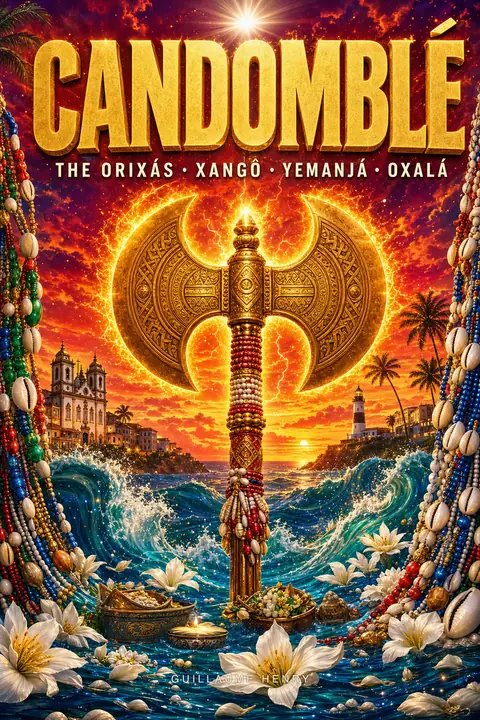
Candomblé
The Candomblé Book: The Orixás, Xangô, Yemanjá, and the Living Religion of Brazil
The Orixás: Xangô, Yemanjá, and Oxalá
The faith the enslaved carried across the ocean and refused to lose: the orixás of West Africa reborn in Brazil. Xangô of thunder, Yemanjá of the sea, Oxalá the creator, and the drums, foods, and colors that call them down. A living religion.
More from Candomblé
All articles
Candomblé
Xangô: The Thunder King and God of Justice
Xangô commands thunder and lightning, wielding a double axe as an instrument of divine justice. This Candomblé orisha embodies the warrior spirit, passion, and the power to strike down falsehood with sacred fire.

Candomblé
Oxóssi: Hunter God of the Forest
Oxóssi is the Candomblé deity of the hunt, forest abundance, and spiritual provision. His arrows strike with precision through the veil between worlds. Learn how this Yoruba orisha shapes African-Brazilian spirituality and why devotees invoke him for sustenance, clarity, and protection.

Candomblé
Iansã: Goddess of Winds, Storms, and the Dead
Iansã commands lightning and tempests, guards the edge between life and death, and embodies the fierce, unbounded energy of nature. In Candomblé, she is one of the most powerful and beloved orixás, syncretized with Santa Bárbara.

Candomblé
Axé: The Sacred Life Force in Candomblé
Axé is the vital energy that flows through all life in Candomblé, from the orisha deities to the human body. Discover how this West African concept became the beating heart of Brazil's most influential African diaspora religion.