
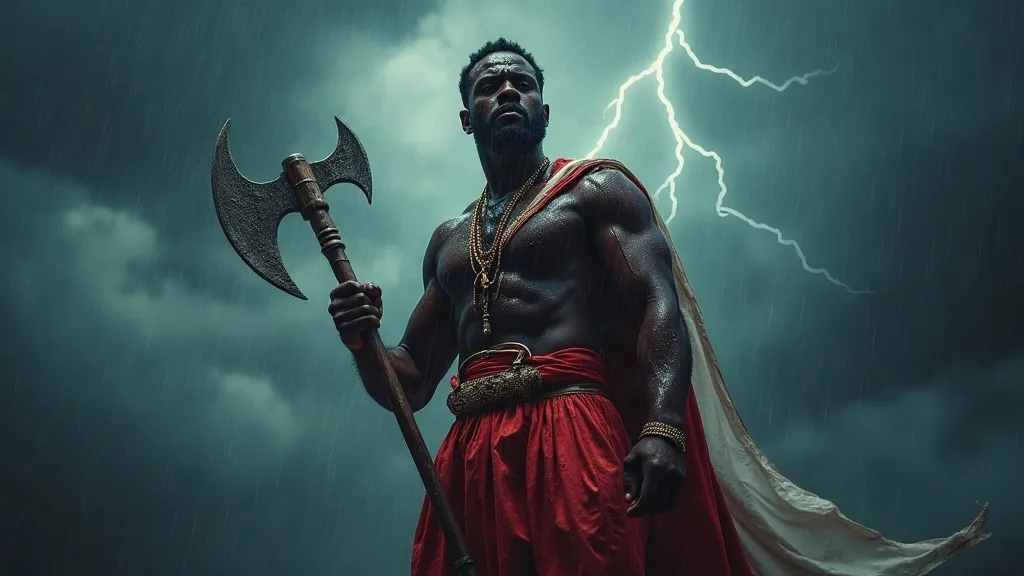
Xangô: The Thunder King and God of Justice
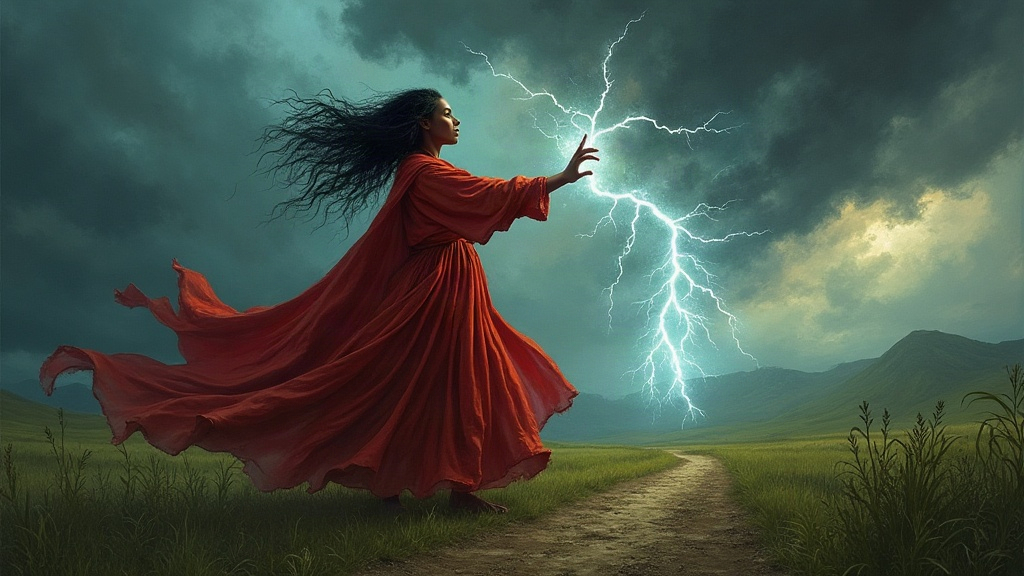
Xangô commands thunder and lightning, wielding a double axe as an instrument of divine justice. This Candomblé orisha embodies the warrior spirit, passion, and the power to strike down falsehood with sacred fire.
Contents
Red and white. The clap of thunder. The sharp smell of lightning striking rain-soaked earth. When a Candomblé devotee calls to Xangô, they invoke a presence that moves like a storm across the sky: fierce, unavoidable, cleansing. He is not a god who whispers. He announces himself with a roar.
Xangô is the thunder king and god of justice in the Candomblé tradition, one of the most revered and vital spirits of this African-Brazilian faith. He commands the heavens when they rage. He wields a double axe called the oxé (pronounced oh-sheh), and that blade cuts through lies, hypocrisy, and disorder. For more than four centuries, Candomblé communities across Brazil have understood that when injustice flourishes and truth is buried, Xangô does not remain silent.
His story is braided from multiple strands: the warrior kings of the Yoruba people in West Africa, the traditions carried by enslaved people to Brazil, and the living worship that continues today. To know Xangô is to understand how a god can be simultaneously an ancient king, a force of nature, and a present voice in the lives of millions.
The Yoruba King Who Became a God
In the oral traditions of the Yoruba people of Nigeria, Xangô (Shango in English scholarship) was first a human king. He ruled in the city of Oyo, one of the great kingdoms of the Yoruba world, sometime around the 15th century, though oral histories rarely fix exact dates with the precision that written records demand.
The stories say he was a man of terrible power and beauty. Warriors feared him. Women desired him. He could summon lightning to destroy his enemies; the thunder itself answered to his name. He had two wives who loved him fiercely: Oshun, the river goddess, and Oya, the tempestuous orisha of wind and storms. Some versions say he had three; Candomblé houses vary in their recitation of these bonds, and the variation is itself part of the living tradition, not a flaw in it.
As a king, Xangô was just but volatile. He punished those who broke the law with swift judgment. He was not a god who tolerated disrespect. One day, according to the narratives preserved in Candomblé, Xangô used magic to invoke lightning during a battle, and that lightning struck not only his enemies but also some of his own followers. Stricken by grief and shame, he withdrew from the city. Some say he hanged himself from a tree. Others say he ascended to the sky on chains and became immortal. The exact manner of his transformation matters less than the fact that the Yoruba people recognized in his death the birth of a god: Xangô the ancestor became Xangô the orisha, a force that could never be contained by mortality.
The Orisha of Thunder, Fire, and Sacred Judgment
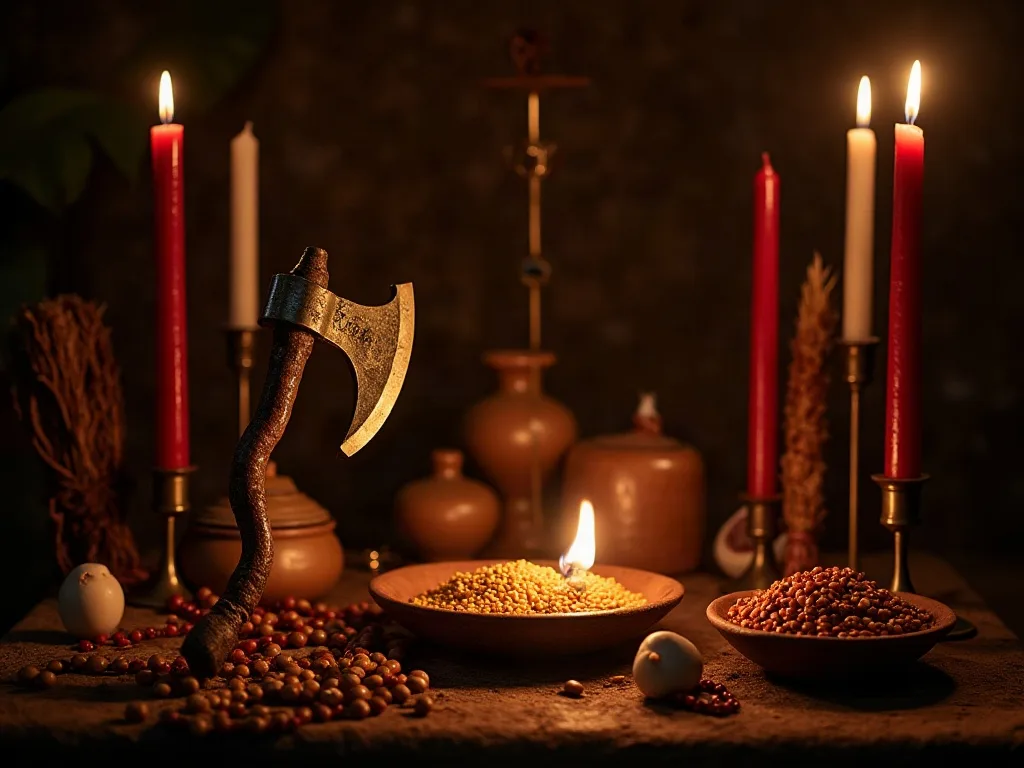
In Candomblé theology, Xangô occupies a space that Western Christianity might call the overlap between judgment, power, and purification. He is associated with thunder and lightning, yes, but also with fire, with passion, with righteous anger. When a Candomblé altar is built for Xangô, it is red and white: red for his warrior nature, for blood and vitality; white for clarity, truth, and the purity of justice executed without corruption.
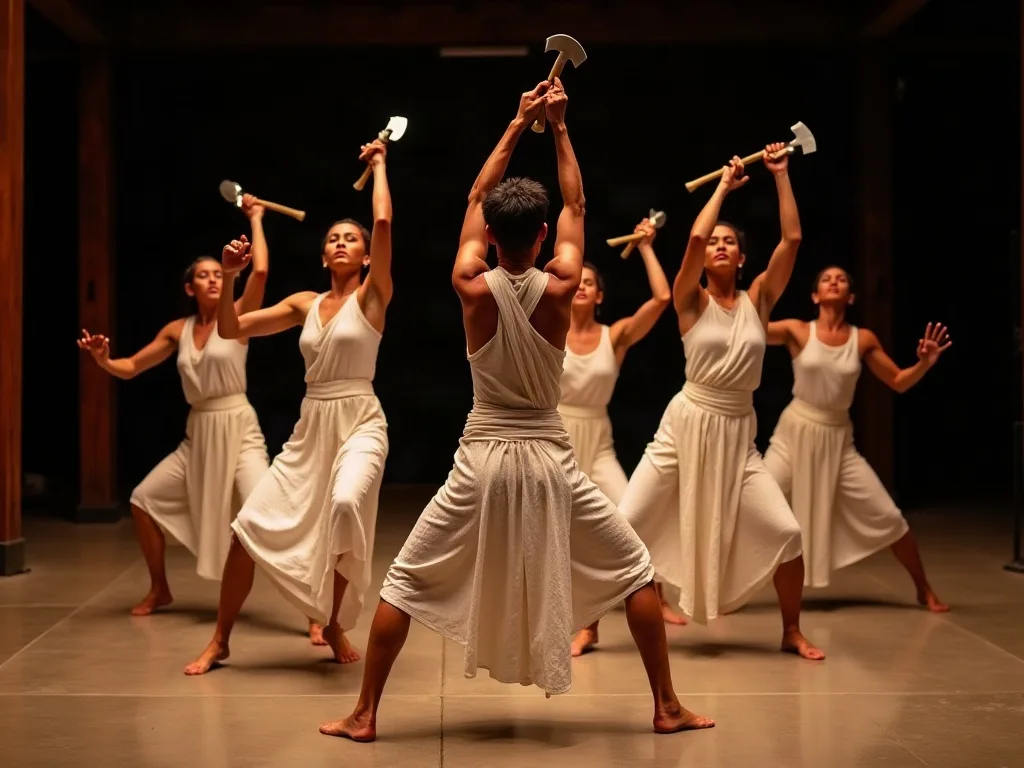
The oxé, his double-bladed axe, is not merely a weapon. It is a symbol of the kind of justice Xangô represents: swift, unavoidable, cutting cleanly between right and wrong. In Candomblé ceremonies, the double axe is danced. Devotees who have been initiated into the mysteries of Xangô move with sharp, percussive motions that mirror the strike of lightning. Their bodies become thunder.
He is a god who demands respect and reciprocal relationship. This is not the Christian God who forgives endlessly. This is an orisha who remembers insult, who notices when you lie under oath, who sees when you harm someone weaker than yourself. Those who invoke Xangô for protection against injustice must themselves live with integrity, or his anger will fall on them as well. The thunder does not distinguish between the guilty and the disrespectful who call it down falsely.
Xangô and His Wives: Passion, Transformation, and Complexity
The relationships between Xangô and other orishas are not footnotes to his myth; they are central to his character. He is entangled most intimately with Oshun, the orisha of honey, rivers, sexuality, and sweetness. In some narratives, Oshun brings out Xangô's tenderness; she is his beloved, the one who can calm the storm. But Xangô also left her, in some versions of the tale, and that abandonment is woven into Oshun's own complexity as an orisha.
Oya, the orisha of winds, storms, and transformation, is another of his great loves. Where Xangô is thunder, Oya is the wind that precedes and follows the storm. She is the keeper of change, the guardian of the cemetery where old things go to die. Some accounts describe their union as a partnership of raw power; others suggest tension and drama. In Candomblé houses, the relationship between Xangô and Oya is interpreted differently depending on the terreiro's lineage and the particular mysteries being taught.
These are not simple domestic arrangements. They reflect a deeper truth: that the orishas are not perfect beings but complex forces, capable of love and rage, generosity and callousness, depending on circumstance and the nature of those who approach them. This complexity is part of why Candomblé theology is so alive; the orishas are not cardboard saints but living, challenging powers.
The Journey to Brazil and the Candomblé Tradition
Beginning in the 16th century, the Portuguese slave trade began to tear millions of Yoruba and other West African people from their homes and force them into bondage in Brazil. With them came their gods. The orishas could not be left behind because they lived in the minds, in the rituals, in the songs and dances of the people themselves.
But slavery imposed a terrible pressure. Brazilian colonial law and Catholic orthodoxy forbade African religious practices. To survive, Candomblé adherents performed an act of profound spiritual survival: they identified the orishas with Catholic saints. Xangô, the warrior god of justice, was mapped onto Saint George, the soldier-saint who slayed the dragon. The feast day of Saint George became a day to honor Xangô publicly under the cover of Catholic observance. The statue in the church, the saint's attributes (the sword, the warrior bearing), created a space where the old gods could be called by a new name.
This was not simple disguise; it was theological negotiation. Candomblé practitioners understood that the orishas were older and deeper than any saint. The Catholic frame was a protective shell, a way to speak and worship in public without immediate violence. In the terreiros, the houses of Candomblé, the full complexity and power of Xangô remained known and honored.
The Rituals and Mysteries of Xangô
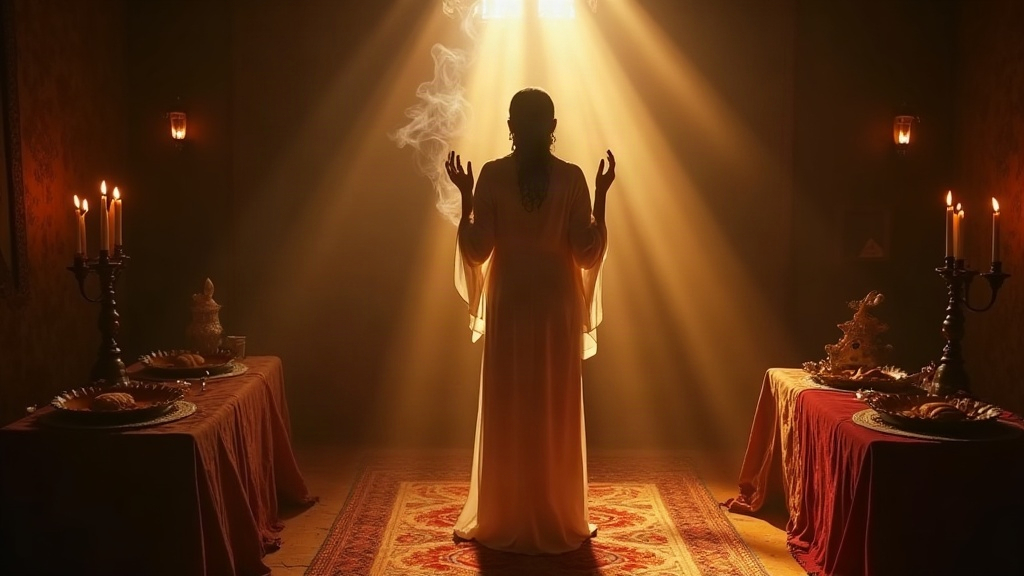
In a Candomblé house, the initiation into the mysteries of Xangô is an intense and demanding process. Those who are "made" to Xangô, who become iyawos (initiates) of this orisha, undergo ceremonies that can last weeks. They are secluded, taught songs and dances in Yoruba, their heads are shaved, and they learn the secrets (the awos) specific to Xangô: the foods that please him, the objects that embody his power, the prayers and invocations that summon his presence.
Xangô demands certain offerings. Beef is traditional; so is palm oil, red wine, corn, and corn products. These are not tributes to a distant god but gifts of relationship, ways of saying: "I honor you, I know you, I feed you." In return, Xangô offers protection against injustice, strength to face persecution, clarity to see through deception.
The dances of Xangô in Candomblé are unmistakable. They are sharp, angular, full of sudden cuts and high-velocity movements. The dancer's arms strike the air as if wielding the double axe. The feet pound the earth. The whole body becomes a vehicle for Xangô's presence; in the most charged moments of the ceremony, initiates may be fully possessed, their consciousness stepped aside while the orisha moves in their flesh. This is not theatrical performance; it is a direct encounter with a divine force.
The Odu Ifa (the divination poetry of the Yoruba system called Ifa, which Candomblé preserves) contains many references to Xangô. These verses encode wisdom about when Xangô's energy is beneficial, when it must be appeased, what his current demands are for a specific person or situation. A Candomblé diviner, called a babalawo (father of secrets), reads these verses and interprets them, connecting the ancient wisdom to the living moment.

Xangô the Deliverer of Justice in Black Brazilian History
It would be incomplete to speak of Xangô without acknowledging his significance in the lived history of Black Brazilians. For people denied justice by slavery and racism, Xangô represented something that the Catholic God, as presented by their oppressors, seemed unable or unwilling to provide: immediate, recognizable, violent retribution against wrongdoing.
In Candomblé, justice is not abstract. It is not something that happens in a distant heaven after death. Xangô strikes in this world, in this life. Lightning falls. The unjust are exposed. The person who has been wronged can call on Xangô knowing that this orisha remembers, sees, and will act. This is not mere fantasy; it is spiritual psychology, a way of maintaining agency and dignity in a system designed to strip both away.
There are stories, passed down in Candomblé communities, of masters who mistreated enslaved people and were struck by lightning, or who suffered inexplicable madness, or whose houses burned. Whether these events occurred as described, the stories matter because they kept alive the possibility that the oppressor could be challenged, that justice operated on a plane beyond the master's authority. Xangô was the name of that possibility.
Xangô in Modern Candomblé and Diaspora Religion
Today, Xangô remains one of the most popular and actively worshipped orishas in Candomblé. His feast day is celebrated on December 4th (Saint George's Day, June 23rd, is also honored in some houses). Candomblé communities in Brazil, particularly in Bahia, the spiritual heartland of the tradition, maintain terreiros dedicated to Xangô with as much energy as their ancestors did.
But Xangô has also traveled. As Brazilians and other diaspora communities have moved around the world, Candomblé has spread. In the United States, in Europe, in Africa itself, people are initiating into Xangô and calling on his power. Each terreiro interprets him slightly differently, but the essential character remains: he is the thunder, the warrior, the judge. He demands truth. He protects those who are vulnerable. He will not tolerate hypocrisy.
Contemporary Candomblé houses also integrate older Yoruba priesthoods, like Ifa, more consciously than perhaps some earlier Brazilian terreiros did. This creates a richer textual foundation for understanding Xangô. Scholars like Ruth Landes, Roger Bastide, and more recently David Apter and others have documented how the orishas function in Candomblé theology and practice, bringing rigorous attention to what was long treated as exotic folklore by outsiders.
The Scholarly Debate: History and Mythology
Scholars still debate exactly how much of Xangô's narrative derives from an actual historical king and how much is mythic elaboration. The 15th-century dating is not certain; some argue for earlier or later periods. What is clear is that the Yoruba preserved the memory of a figure whose power was associated with thunder and lightning, whose kingship was remembered as just but terrible, and whose death or transformation was understood as apotheosis.
This ambiguity is not a problem. All mythology operates in the space between history and spirit, between what happened and what it means. The question "Did Xangô really exist as a human king?" is less interesting than "What does the story of Xangô reveal about how the Yoruba understood power, justice, and the relationship between mortality and divinity?" The Candomblé tradition answers that question every time a devotee dances the thunder, calls on Xangô for protection against injustice, or pours palm wine on his altar.
Xangô and the Global Orishas
The orishas have become part of global conversation about African-descended religion and the survival of African spirituality in the Americas. Xangô features alongside Oshun, Elegba, and others in literature, film, music, and spiritual practice far beyond Brazil. Writers like Toni Morrison and Ayana Mathis have woven orishas into their fiction. Musicians have invoked his name. Academics studying African diaspora religion now recognize Candomblé not as a quaint survival but as a sophisticated theological system that deserves study alongside any world religion.
This visibility brings both gifts and challenges. Some non-Black people have attempted to initiate into Candomblé without respecting its cultural and racial foundations. Some practitioners worry that commercialization or casual adoption will dilute the tradition. Others see the spread of knowledge about Xangô and the orishas as overdue recognition of African genius and spiritual sophistication.
What remains constant is that Xangô the thunder king and god of justice demands respect. He is not a cultural curiosity. He is not a tool for self-improvement. He is a living orisha, present in the ceremonies of thousands of people today, answering prayers, striking down hypocrisy, protecting the vulnerable. To know him is to know something true about how power, justice, and divinity move through the world.
Frequently asked questions about Xangô
Frequently asked questions
How did Xangô become an orisha if he was originally a human king?
In Yoruba and Candomblé theology, the boundary between ancestor and divine being is permeable. When Xangô died (or ascended, depending on the account), his power did not diminish; it was transformed. The Yoruba recognized that some ancestors achieve a state of such spiritual power and influence that they become indistinguishable from orishas. Xangô's warriors, it is said, continued to call on him after his death, and he answered. Over generations, that relationship solidified into worship, and he became an orisha in his own right.
Why is Xangô associated with both thunder and justice specifically?
Thunder is instant, unavoidable, and demands respect. When Xangô strikes, there is no negotiation, no appeal. Justice, in Candomblé theology, should function the same way: it should not wait, it should not be corrupted by influence or wealth, and it should be absolute. Lightning does not favor the strong over the weak; it strikes where it strikes. This metaphor made Xangô the orisha of justice for communities who experienced legal systems that were corrupt or simply unavailable to them.
What is the significance of the oxé, Xangô's double axe?
The oxé is both a tool and a symbol. As a tool, it was a weapon of Yoruba warriors and a practical implement for splitting wood. As a symbol, the double blade represents the dual nature of Xangô's justice: it cuts both ways, reaching those on the left and right of a dispute. The axe also embodies the meeting of two forces (the two blades), which in Yoruba cosmology represents power and balance. In Candomblé ceremonies, the oxé is danced and honored as a sacred object; to touch it without proper initiation is considered transgression.
How did Xangô survive the suppression of Candomblé in colonial and imperial Brazil?
Through the identification of Xangô with Saint George, practitioners could worship openly under the cover of Catholicism. A colonial official seeing a statue of Saint George in a chapel saw only Christian devotion. But the Candomblé house knew the truth. Additionally, Candomblé's decentralized structure (each terreiro maintains its own traditions and autonomy) meant that if one house was discovered or shut down, others could continue. The tradition also embedded itself deeply in community life, particularly in Bahia, where it became culturally normalized even as it was legally forbidden.
Is Xangô still actively worshipped today, and outside of Brazil?
Yes, absolutely. Candomblé remains alive in Brazil and has spread to other countries, including the United States, parts of Europe, and Africa. Thousands of people are initiated into Xangô each year. Beyond formal Candomblé, the orishas have influenced other African diaspora religions like Santería (in Cuba and elsewhere) and Ifá, where Xangô appears under slightly different names and attributes but remains recognizable. His worship is not historical reenactment; it is living practice.
How do historians and scholars distinguish between the mythic Xangô and the historical person?
This is an ongoing scholarly debate. Some researchers have identified Xangô with Oba ƐFɔ̀n, a 15th-century Oyo king, though the dating and identification are not certain. What is clear from Yoruba historical sources is that the Oyo Empire did produce celebrated warrior-kings associated with military power and divine favor. The mythic elaboration of Xangô likely drew on memories of one or several such figures, combined with religious concepts about the relationship between kingship and divinity. Rather than viewing myth and history as opposed, scholars increasingly understand them as interwoven narratives that together reveal how a people understood their past and their sacred world.
Xangô's Legacy in Contemporary Black Spirituality and Resistance
The thunder still speaks. In churches, in community spaces, in the homes of people seeking justice and protection, Xangô remains a presence. His image, his story, his power as the god who refuses corruption and demands truth, have become part of how Black communities imagine and enact resistance against systemic injustice.
This is not metaphorical alone. When a person facing persecution goes to a Candomblé house to invoke Xangô, they are participating in a tradition that has sustained Black people through slavery, colonialism, and ongoing racism. They are saying: my oppressors may control the courts and the law, but there is a justice that moves in the sky. There is a power that sees what has been hidden and will strike it down. The god answers.
Xangô the thunder king and god of justice embodies a vision of divine power that is not abstract, distant, or forgiving of injustice. He is a god who moves through the world like lightning: visible, undeniable, and unapologetic about his force. To know him is to know that in the Candomblé tradition, the sacred is not separate from the political, the spiritual is not divorced from justice, and the gods are not indifferent to human suffering.
Read the full book
Want the whole story?
The complete edition is an instant PDF download here, with a paperback on Amazon for selected titles.
Candomblé
The Candomblé Book: The Orixás, Xangô, Yemanjá, and the Living Religion of Brazil
The Orixás: Xangô, Yemanjá, and Oxalá
The faith the enslaved carried across the ocean and refused to lose: the orixás of West Africa reborn in Brazil. Xangô of thunder, Yemanjá of the sea, Oxalá the creator, and the drums, foods, and colors that call them down. A living religion.
More from Candomblé
All articles
Candomblé
Oxóssi: Hunter God of the Forest
Oxóssi is the Candomblé deity of the hunt, forest abundance, and spiritual provision. His arrows strike with precision through the veil between worlds. Learn how this Yoruba orisha shapes African-Brazilian spirituality and why devotees invoke him for sustenance, clarity, and protection.

Candomblé
Oxum: Goddess of Fresh Waters, Love, and Fertility
Oxum rules the rivers and the human heart in Candomble. She is generosity itself: golden, sensual, protective of mothers and children. Learn how this Yoruba orisha became the most beloved goddess in Brazil and what her mythology reveals about devotion, abundance, and desire.
Candomblé
Iansã: Goddess of Winds, Storms, and the Dead
Iansã commands lightning and tempests, guards the edge between life and death, and embodies the fierce, unbounded energy of nature. In Candomblé, she is one of the most powerful and beloved orixás, syncretized with Santa Bárbara.
Candomblé
Axé: The Sacred Life Force in Candomblé
Axé is the vital energy that flows through all life in Candomblé, from the orisha deities to the human body. Discover how this West African concept became the beating heart of Brazil's most influential African diaspora religion.