

Ogum: Warrior God of Iron and Technology
Ogum rules iron, war, and every blade ever forged. From West African Yoruba roots to Brazilian Candomblé terreiros, his story reshapes how people understand divine power and modern craft.
Contents
The machete arrives first. Before Ogum speaks, before he dances, before the drums find their tempo, the machete is already cutting a path through the forest. That is how the Yoruba oral tradition introduces him: not with a throne room, not with a genealogy, but with a blade moving through undergrowth, opening the way for every god that follows.
Ogum: Warrior God of Iron and Technology is one of the most widely honored orixás in the Candomblé tradition, the Afro-Brazilian religion that survived the Atlantic crossing through the courage of enslaved Yoruba-speaking peoples who reached Brazil from the sixteenth century onward. His presence did not weaken in transit. It sharpened. Today Ogum is invoked in Salvador, Lagos, Havana, and Brooklyn, by blacksmiths and surgeons, soldiers and engineers, truck drivers and artisans. Few divine figures have crossed so many borders without losing a single edge.
Ogum's Yoruba Origins: Where the Story Begins
The Yoruba people of what is now southwestern Nigeria and Benin Republic have told stories about Ogun (the Yoruba spelling) for at least a thousand years, possibly much longer. He appears in the Odu Ifá, the vast corpus of sacred oral literature that forms the backbone of Yoruba religious thought. The Ifá corpus is organized into 256 major chapters called odu, and Ogun's character, conflicts, and rituals appear across several of them.
In Yoruba cosmology, Ogun is one of the senior orixás (also spelled orishas in Anglophone scholarship), divine forces that mediate between the supreme being Olodumare and the human world. He is the son of Odudua (sometimes Oduduwa), the founding ancestor-deity of the Yoruba, and his siblings include Shango, the thunder god, and Oxossi, the hunter. This family structure is not merely decorative. It maps a whole philosophy: iron (Ogun) makes farming possible, farming feeds the village, the village needs law and order (Shango), and the forest surrounding it feeds the people through the hunt (Oxossi). Each orixá is a piece of a working system.
Shango and Ogum are frequently portrayed as rivals in the oral tradition. Both are powerful, both are volatile, and their clashes read less like allegory and more like the real friction between force and fire, between the smith who makes the weapon and the storm that decides when to strike.
The Myth of the Burning Forest: Ogum Goes into Exile
The most famous story about Ogum begins with a catastrophe. After a great battle, Ogum returns to find that the world no longer respects him. The other orixás have grown comfortable. The people have forgotten what iron cost them. Disgusted, Ogum retreats into the deep forest and refuses to come out.
The world falls apart quickly. Without iron, there are no tools. Without tools, there is no harvest. Without harvest, people starve. The orixás try one by one to coax Ogum back. They send Yemanjá, the ocean goddess, with gifts. They send Oxossi with promises. Nothing works. Ogum stays in the forest, wrapped in mariwo, the dried fronds of the oil palm tree that become his signature garment, half-man and half-wild thing.
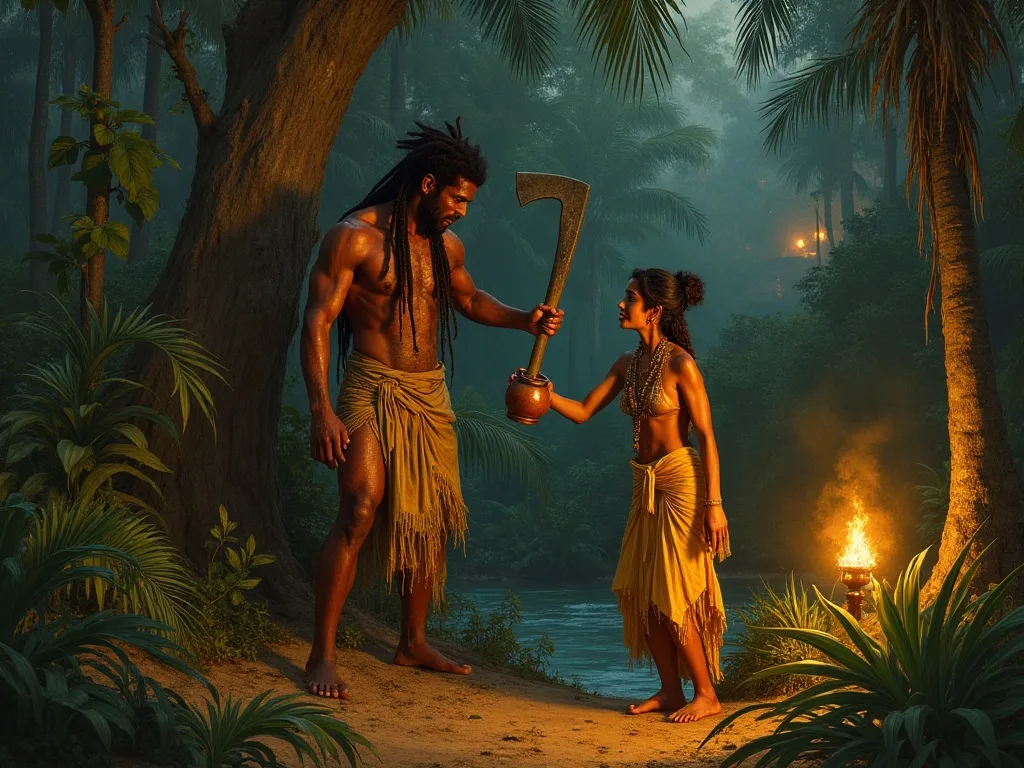
Then Oshun comes. The goddess of rivers and sweetness. She does not argue. She does not offer power or tribute. She brings palm wine sweetened with honey, starts to sing, and dances close enough to him that the sweetness reaches him before she does. Something in Ogum breaks open. He follows her out of the forest, still draped in his palm fronds, still holding the machete. The world starts again.
Scholars like Wande Abimbola, the foremost authority on Ifá literature, note that this myth encodes a precise theological idea: raw force alone cannot sustain civilization. Force needs beauty, sweetness, relationship, to remain oriented toward life rather than destruction. Ogum without Oshun is catastrophe. The two together are agriculture, craft, and community.
From Yorubaland to Brazil: How the Slave Trade Carried the Orixás
Between roughly 1550 and 1850, an estimated 4.9 million enslaved Africans were transported to Brazil, making it the largest single destination of the transatlantic slave trade. A significant portion came from Yoruba-speaking regions, particularly during the nineteenth century when political upheaval in the Oyo Empire drove large numbers of Yoruba captives into the trade routes. They arrived in ports like Salvador da Bahia carrying almost nothing except memory: the names of the orixás, the rhythms of the sacred drums, the herbs associated with each deity, and the ritual words.
The Catholic Church governed public religion in colonial Brazil. Enslaved people were required to be baptized and to display Catholic devotion. The response was sincretismo, the practice of mapping each orixá onto a Catholic saint whose attributes partially overlapped. Ogum was identified with Saint George, the armored knight who slays the dragon, and later in some regions with Saint Anthony of Padua or Saint Sebastian. The identification with Saint George is the most durable: both carry weapons, both are associated with courage and protection, and the image of the mounted knight fitted the idea of a warrior deity who clears the path.
This was not simple disguise. Candomblé scholars, including Reginaldo Prandi of the University of São Paulo, have argued that syncretism allowed the tradition to survive while also genuinely reshaping both sides of the equation: the saints absorbed some of the orixás' energy, and the orixás absorbed some of the saints' iconography. By the nineteenth century, Candomblé had built a distinct Afro-Brazilian theological identity, not merely a survival strategy.
Ogum in the Candomblé Terreiro: Ritual, Colors, and Ceremony
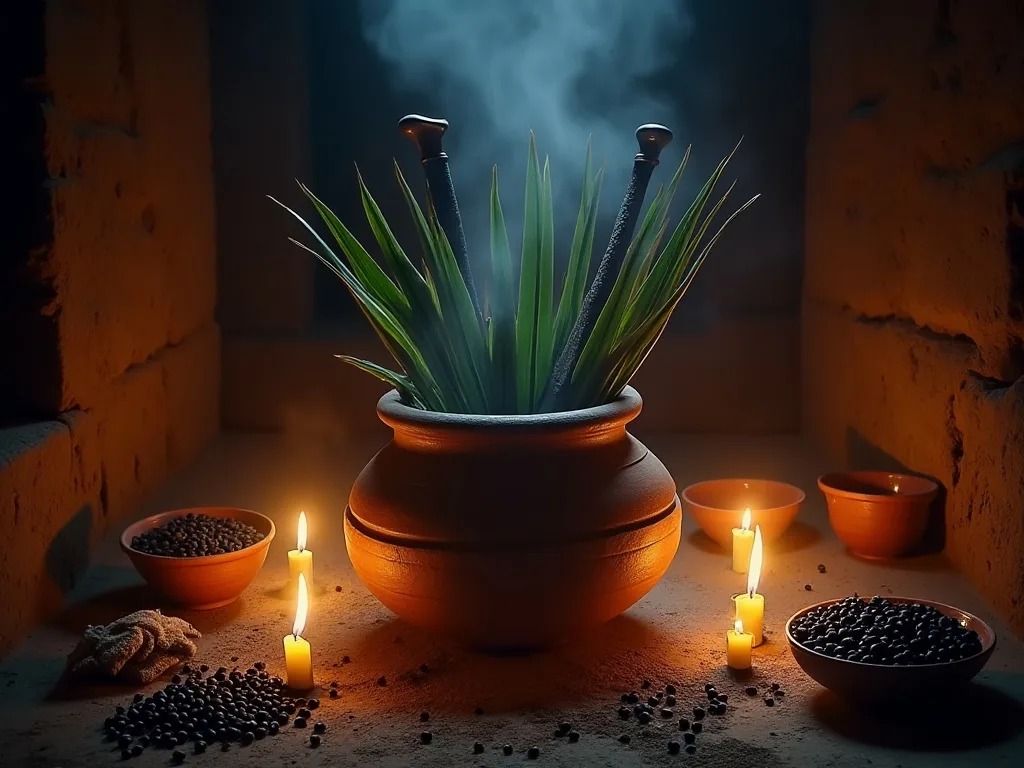
Walk into a terreiro (the sacred house where Candomblé ceremonies take place) when Ogum is being honored, and the visual code is immediate. His colors are deep green and dark blue, sometimes black in certain nações (nations, the regional lineages of Candomblé practice). His symbols are iron tools: the short sword called an espada, the machete, a set of iron implements shaped like miniature farming tools. These are not decorations. They sit in a clay pot called an assentamento, the physical seat of his presence, charged through offerings and ritual attention.
His sacred foods include black-eyed peas, roasted corn, acarajé (the fried bean fritter that is itself a sacred food in Salvador's street culture), and above all palm oil. The number seven is Ogum's number. Seven tools in the assentamento, seven cuts of food at a feast, seven days of the week mapped across the orixás with Monday frequently given to him in popular Brazilian practice.
The iniciação (initiation) of a person whose head is "of Ogum," meaning the orixá who governs their spiritual destiny, involves a rigorous process that Lydia Cabrera, the Cuban ethnographer who documented Afro-Caribbean religion across decades of fieldwork, described as "a second birth." The initiate's head is shaved and marked with sacred substances. They spend time in seclusion. They emerge wearing Ogum's colors, carrying the weight of his character as part of their own.
Oxossi, the hunter god is among the orixás most closely associated with Ogum in the ritual calendar. The two share forest connections and often appear together in ceremonial sequences.
The Ironworker's Domain: Technology, Surgery, and the Modern World
One of the most striking qualities of Candomblé theology is its refusal to freeze the sacred in the past. When iron technology changed, Ogum's domain changed with it. He started as the god of blades and hunting weapons. He absorbed the plow when agriculture intensified. He absorbed the forge when metalworking became central to Yoruba economy. In Brazil, he absorbed the railroad when the first lines crossed the interior of Bahia and São Paulo in the nineteenth century. Today he covers car engines, factory equipment, and operating theaters.
Ogum as the patron of surgery is a particularly vivid example of how this works. A surgeon's scalpel is iron. It cuts to heal, not to kill. The intent is what matters. Brazilians who are about to undergo surgery frequently make a small offering or say a prayer to Ogum, even those who are not practicing Candomblé members. The protection of iron in its most precise, most life-giving form is seen as squarely within his power.
This elasticity is not accidental. It reflects a theological principle that the orixás are not historical figures tied to a specific century, but living forces whose expressions shift with the needs of the people who honor them. The scholars Patrícia Birman and David Lehmann, writing on Brazilian religious pluralism, both observe that this adaptability helps explain why Candomblé and its diaspora cousins (Santería in Cuba, Trinidad's Orisha tradition, Candomblé's own regional variants like Umbanda) have grown rather than contracted in the modern period.
Ogum and His Siblings: Family Politics Among the Orixás
Family dynamics in the Candomblé pantheon are serious theological business. The relationships between orixás encode rules about how different forces interact in the world, and Ogum's family position is complicated in the most productive way.
His fraternal rivalry with Shango shows up in multiple Ifá stories. In one well-known narrative, both Ogum and Shango love the same woman, Oya (called Iansã in Brazil), the fierce goddess of wind and storms. She eventually chooses Shango, but not before a confrontation that leaves both men scorched. The story is often read as a map of elemental conflict: iron conducts electricity, but fire melts iron if it burns long enough. Neither one fully wins.
His relationship with Oxum (Oshun) carries the opposite charge. She is the one who pulled him out of the forest. In some lineages, she is described as his first wife. In others, she is more like a diplomat who understands him better than anyone. Either way, the dynamic between Ogum and Oxum represents the balance between raw force and tender intelligence, and it appears in ceremonies where both are honored on the same night.
Exu, the trickster and messenger orixá, holds a unique position relative to Ogum. Exu is always propitiated first in any ceremony, before Ogum or any other orixá is called, because without Exu opening the crossroads, no communication between the human and divine worlds is possible. In some cosmological schemas, Ogum comes second, clearing the physical path after Exu has cleared the metaphysical one.
Ogum Across the Diaspora: Ogun in Cuba, Haiti, and the Americas
The forced migrations of the slave trade scattered Yoruba religious practice across a vast geography, and Ogun/Ogum took different shapes in different places without losing his essential character.
In Cuba's Lucumí tradition (more widely known as Santería or Regla de Ocha), he is called Ogún and is syncretized primarily with Saint Peter, the keeper of keys, or sometimes Saint John the Baptist. He rules iron, war, and labor just as he does in Brazil. His ritual implement is a machete kept in an iron cauldron along with railroad spikes, chains, and miniature tools. His ritual colors are green and black.
In Haitian Vodou, the corresponding figure is Ogou, but the Haitian tradition has elaborated an entire family of Ogou spirits: Ogou Feray (the warrior), Ogou Badagris (the diplomat-warrior), Ogou Balindjo (the healer). The Haitian scholar Leslie G. Desmangles, writing in "The Faces of the Gods," explains that this multiplication reflects the complexity of the war experience in Haitian history. For the enslaved people who fought and won the Haitian Revolution of 1791-1804, Ogou Feray was not an abstract deity. He was present at every machete raised against the colonial army.
The Trinidadian Orisha tradition, sometimes called Shango by outsiders though that name is imprecise, honors Ogun in ceremonies that blend Yoruba structure with Indian and Caribbean elements, a layering that reflects Trinidad's own complex demographic history.
What holds all of these versions together is iron. Wherever Ogun/Ogum/Ogou appears, iron is sacred, blades are ceremonial, and the god who owns the forge is also the god who makes roads through impossible places.
The Character of Ogum: Warrior, Hermit, Protector
Ogum is not easy company. The oral tradition is consistent about this: he is brave to the point of recklessness, honest to the point of brutality, and loyal to the point of obsession. He does not lie, partly because he lacks the patience for it. When he swears an oath on iron, he keeps it or the consequences are severe, because he cannot dishonor his own substance.
This makes him both a protector and a danger. In Candomblé, people who are "of Ogum" (whose ori, their personal destiny, is governed by him) are often described as intense, direct, prone to anger but also to fierce loyalty. The orixá's personality is understood to express itself through the character of his devotees, not as possession of their will but as a coloring of their essential nature.
His warrior identity is not glorified violence. The Yoruba ethical system embedded in the Ifá corpus consistently frames Ogum's cutting as purposeful: the surgeon's cut, the farmer's clearing of land, the warrior's defense of the community. Gratuitous violence is not Ogum's domain. It belongs to other, darker forces. When Ogum kills in the stories, there is always a reason, even if that reason sometimes looks excessive by modern standards.
The anthropologist Robert Farris Thompson, whose work "Flash of the Spirit" (1983) remains one of the most cited studies of African art and philosophy in the Americas, describes Ogum as "the god who turns iron into social good." That phrase captures something real: iron without Ogum's discipline is just a weapon. With it, iron becomes a plow, a scalpel, a bridge.
Frequently Asked Questions About Ogum
Frequently asked questions
What is Ogum the god of in Candomblé?
Ogum rules everything made of iron and every activity that depends on iron tools. This includes war, farming, surgery, engineering, transportation, and craftsmanship. In Candomblé theology, his domain has expanded over time to cover modern technology wherever metal is central: factories, railroads, automobiles, and operating rooms all carry his presence. He also governs roads and crossings in their physical form, the actual paths cleared through wilderness or city.
What is the difference between Ogun, Ogum, and Ogou?
These are regional names for the same divine figure across different branches of the African diaspora. Ogun is the Yoruba original, used in Nigeria and in some anglophone scholarship. Ogum is the Portuguese-language form used in Brazilian Candomblé. Ogou is the Haitian Creole name used in Vodou, where the figure has multiplied into an entire family of warrior spirits. Ogún appears in Cuban Lucumí (Santería). Despite the different names and the regional variations in ritual practice, all versions share iron as the sacred substance and the warrior-craftsman as the defining character.
Why is Ogum associated with Saint George in Brazil?
During the colonial period, Candomblé practitioners were forced to practice their religion under a Catholic surface. They identified each orixá with a Catholic saint whose visible characteristics overlapped with the orixá's own. Saint George, the armored knight who kills a dragon with a lance, matched Ogum's warrior identity and his mastery of metal weapons closely enough to serve as a workable public identity. The identification became deeply embedded: in Rio de Janeiro today, April 23rd, the feast day of Saint George, is a major popular holiday celebrated by Candomblé communities and the general Catholic population alike, with Ogum at the center of the devotion.
What offerings are made to Ogum in Candomblé?
The core offerings to Ogum are roasted or black-eyed peas, roasted corn, palm oil, and cachaça (Brazilian cane spirit). Palm fronds called mariwo, which are dried and sometimes fashioned into skirts worn during possession ceremonies, are his sacred plant. Offerings are typically placed at crossroads, in front of the iron assentamento in the terreiro, or at the base of railroad tracks and factory gates. The number seven structures most offerings: seven pieces of food, seven tools, seven repetitions of a prayer.
What primary sources describe Ogum in the Yoruba tradition?
The Odu Ifá corpus is the primary source. Wande Abimbola's "Ifá: An Exposition of Ifá Literary Corpus" (1976) translates and analyzes key sections where Ogun appears. Pierre Verger's "Orixás" (1981), based on decades of fieldwork in both West Africa and Brazil, is the most comprehensive visual and textual documentation of the orixá tradition in the diaspora. Robert Farris Thompson's "Flash of the Spirit" (1983) situates Ogun within broader West African artistic and philosophical traditions. For Haitian Vodou's Ogou, Leslie G. Desmangles' "The Faces of the Gods" (1992) is the standard scholarly reference.
Ogum's Presence in Contemporary Brazil and the Living Tradition
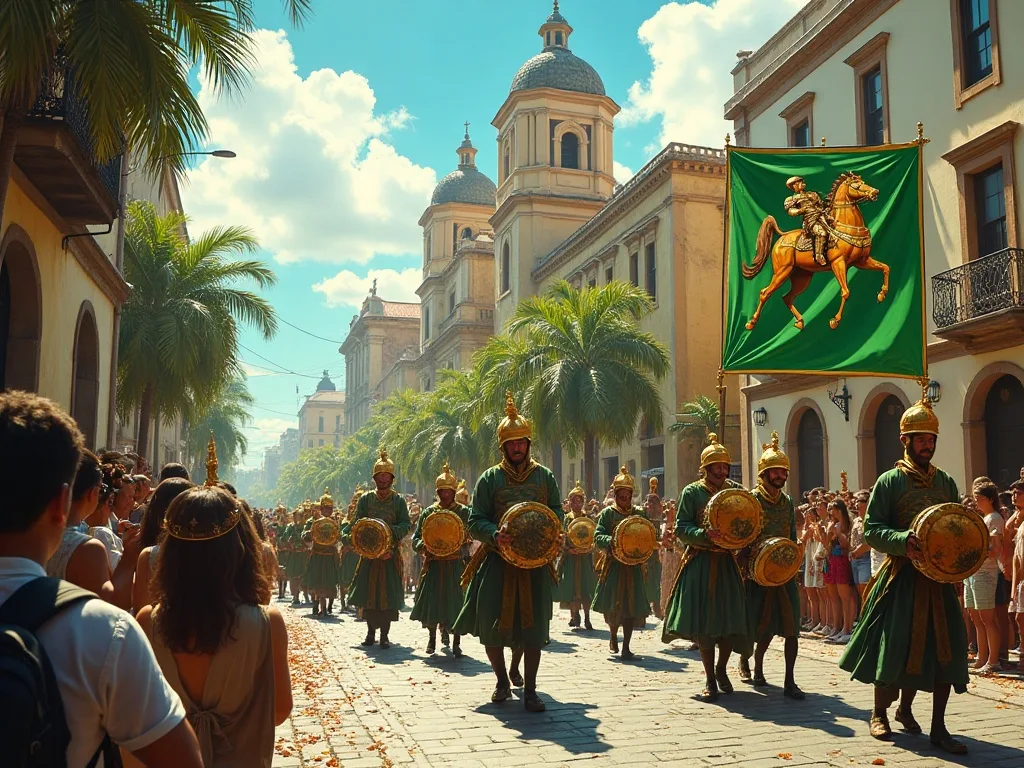
April 23rd in Rio de Janeiro is a telling spectacle. Thousands of people crowd the streets of the northern suburbs, many dressed in green and gold, carrying images of Saint George on horseback. Some are devout Catholics who know nothing about Candomblé. Some are Candomblé initiates honoring Ogum through the Catholic surface he has worn for four centuries. Many are simply Cariocas who feel something real in the celebration without being able to name exactly what tradition it belongs to. That ambiguity is, in a way, the point.
Brazilian popular culture has absorbed Ogum without always acknowledging it. The respect for iron trades, the almost ritualistic care that mechanics in São Paulo give to their tools, the way surgeons in Bahia will sometimes keep a small green thread tied to their instrument case: these are not formal religious practices. They are the residue of a theology that has been living inside Brazilian culture long enough to lose its label while keeping its meaning.
The academic field of Yoruba diaspora studies has grown substantially since the 1990s. Researchers at the University of Ibadan in Nigeria and at the University of São Paulo are comparing ritual texts, tracking how specific Ogum ceremonies in Salvador correspond to their Yoruba antecedents, and finding both remarkable fidelity and remarkable creativity. The orixá survived the Atlantic. The orixá adapted to modernity. And the orixá, by most measures, is more widely known in 2026 than at any point in the last two centuries.
The most recent wave of scholarly and popular interest comes partly from Brazil's growing Afro-Brazilian cultural pride movement, which has positioned Candomblé not as a marginal practice but as one of Brazil's foundational religious traditions, alongside Catholicism and Spiritism. Ogum, as the orixá whose domain covers both the oldest farming tools and the newest surgical robots, is a natural symbol for a tradition arguing that African knowledge systems were never primitive, never static, and never finished evolving.
His machete is still moving. The path is still being cut.
Read the full book
Want the whole story?
The complete edition is an instant PDF download here, with a paperback on Amazon for selected titles.
Candomblé
The Candomblé Book: The Orixás, Xangô, Yemanjá, and the Living Religion of Brazil
The Orixás: Xangô, Yemanjá, and Oxalá
The faith the enslaved carried across the ocean and refused to lose: the orixás of West Africa reborn in Brazil. Xangô of thunder, Yemanjá of the sea, Oxalá the creator, and the drums, foods, and colors that call them down. A living religion.
More from Candomblé
All articles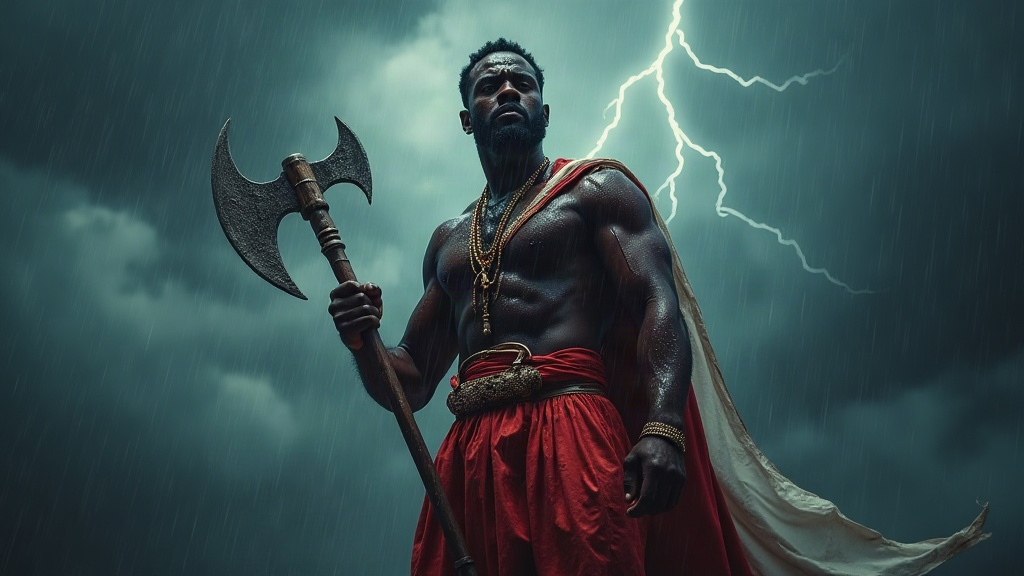
Candomblé
Xangô: The Thunder King and God of Justice
Xangô commands thunder and lightning, wielding a double axe as an instrument of divine justice. This Candomblé orisha embodies the warrior spirit, passion, and the power to strike down falsehood with sacred fire.

Candomblé
Oxóssi: Hunter God of the Forest
Oxóssi is the Candomblé deity of the hunt, forest abundance, and spiritual provision. His arrows strike with precision through the veil between worlds. Learn how this Yoruba orisha shapes African-Brazilian spirituality and why devotees invoke him for sustenance, clarity, and protection.

Candomblé
Oxum: Goddess of Fresh Waters, Love, and Fertility
Oxum rules the rivers and the human heart in Candomble. She is generosity itself: golden, sensual, protective of mothers and children. Learn how this Yoruba orisha became the most beloved goddess in Brazil and what her mythology reveals about devotion, abundance, and desire.

Candomblé
Iansã: Goddess of Winds, Storms, and the Dead
Iansã commands lightning and tempests, guards the edge between life and death, and embodies the fierce, unbounded energy of nature. In Candomblé, she is one of the most powerful and beloved orixás, syncretized with Santa Bárbara.