

The Trail Where They Cried: Mythology and Memory of Removal
The Trail of Tears reshaped Cherokee mythology itself. Discover how forced removal in 1838-1839 became a sacred narrative of survival, covenant, and the land's eternal connection to a people who refused to disappear.
Contents
On October 1838, the Cherokee nation began a forced march of 1,200 miles from their ancestral homeland in the Southeast to reservations in what is now Oklahoma. Of the 15,000 people forced westward, roughly 4,000 died during the journey. This is the event history calls the Trail of Tears. But for the Cherokee, the walk became something else: a mythological moment, a new sacred narrative woven into the fabric of who they are. The Trail did not erase Cherokee memory or identity. It deepened it, made it unforgettable, and transformed the very meaning of survival.
The removal was not accidental history. It was policy, backed by the Indian Removal Act of 1830 signed by President Andrew Jackson. The United States government wanted Cherokee land, coveted the fertile valleys and mineral wealth of Georgia, North Carolina, and Tennessee. The Cherokee nation had its own written constitution, a functioning republic, schools, and a printing press that produced a newspaper in the Sequoyah syllabary. None of that mattered. In December 1835, a small group of Cherokee men, not authorized to speak for the nation, signed the Treaty of New Echota. The federal government used that fraudulent treaty as justification to remove an entire people. The Cherokee nation's principal chief, John Ross, protested the treaty and fought its ratification for years. He lost. In the winter of 1838, soldiers came to Cherokee homes, burned their houses, and began herding families westward.
The Land That Held the Ancestors
Before removal, the Cherokee understood their world through an ancient cosmology rooted in place. The Southeast was not just where they lived; it was where the creator had placed them in the beginning. The four cardinal directions, the sacred fire, the seasonal ceremonies, the green corn festival called the Busk or Puskita - all of these were bound to the land itself. The mountains of Appalachia, the Tennessee and Hiwassee rivers, the valleys of the foothills were not empty stage sets for Cherokee life. They were alive with spiritual presence, inhabited by the ancestors, marked by the bones of generations.

The Cherokee creation story did not describe a people alien to their landscape. The emergence stories, told by elders in the gadugi (the Council House), spoke of the people rising up from the earth itself, born from the red clay of the southeastern mountains. Some versions recount how Kanati (the Hunter) and Selu (the Corn Mother) gave birth to the Cherokee way of life. Selu's corn sustained them. Kanati's hunting wisdom kept them alive. The land was not something the Cherokee possessed. They were part of it, woven into its being just as the rivers and mountains were woven into theirs.
The archaeologists and anthropologists who study Cherokee settlement in the East find evidence of occupation stretching back a thousand years or more. But the sacred stories go deeper than archaeology. They point to an understanding: this land made us, and we made this land through our ceremonies, our settlements, our stories. To be removed from it was to be severed from the source of meaning itself.
The Winter Journey: Suffering as Sacred Narrative
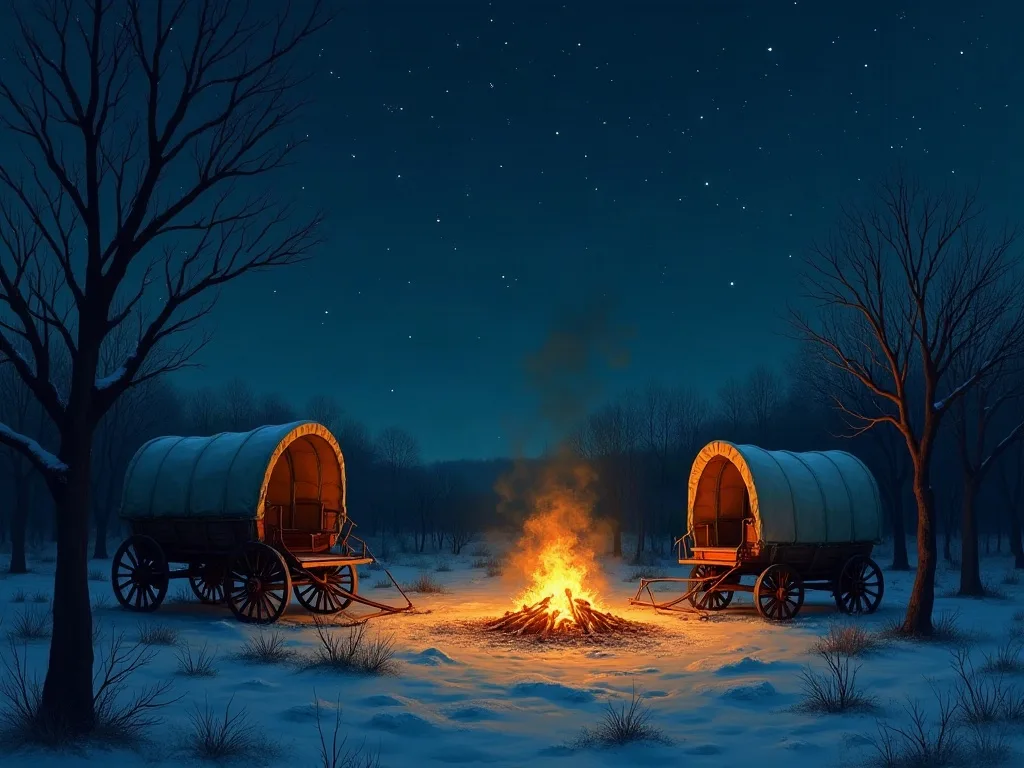
The physical reality of the Trail was brutal. Families traveled in open wagons or on foot during one of the harshest winters on record. Many Cherokee had minimal clothing. Food was scarce, often spoiled. Disease - dysentery, pneumonia, measles - spread through the camps. Burial details fell behind, unable to bury the dead fast enough. Children died. Elders died. Mothers gave birth on the Trail. The government agents responsible for the removal moved the people as quickly as possible to reduce costs.
Yet within this suffering, the Cherokee people maintained their ceremonies, their songs, their social structures. They told stories around the fires at night. They sang the old songs. They held council meetings to make decisions about the route, to care for the weak. Some groups, traveling different routes over different months, walked through Tennessee and Kentucky and Missouri and Arkansas before reaching the Indian Territory. The historian John Ross led one contingent of about 1,400 people on what is known as the "northern route," taking longer but avoiding some of the worst conditions of the southern route where other Cherokee traveled.
The mythology that emerged from the Trail drew on older Cherokee understandings of suffering and endurance. The Cherokee had survived wars with rival nations, had endured disease, had known loss before. The removal was not presented to future generations as a defeat, but as a test of faith, a trial of the people's resilience. In oral histories recorded in the 20th century, elders spoke of the Trail as something the people survived together, bound by a shared commitment to live, to remember, to carry forward.
This is not the same as saying suffering was good or redemptive in a Christian sense. Rather, the Cherokee reframed the removal within their own narrative logic. The Trail became an ordeal that revealed who the Cherokee people were and who they must become: a people who cannot be broken, who carry their ancestors with them even when torn from the land.
The Memory of Place in Diaspora
When the Cherokee arrived in Indian Territory, they were in a landscape utterly foreign. The forests of the Southeast, with their ancient hardwoods and regular moisture, gave way to prairie and sparse forests. The rivers were different. The seasons shifted differently. The soil was strange beneath their feet.
Yet the Cherokee rebuilt. They established new towns with names that echoed the old settlements. They built schools, newspapers, and a new government. They revived the ceremonies, adapting them to the new land. And they began to tell stories about the removal itself, embedding it into their understanding of who they were.
Some of these stories centered on leadership and survival. John Ross, who remained principal chief through the removal and beyond, became a figure of extraordinary significance in Cherokee memory. He did not possess the spiritual authority of a ceremonial leader or elder, but he embodied a kind of covenant responsibility: he moved through the removal with his people, his son dying on the Trail, his family suffering as Cherokee families suffered. In Cherokee narratives, Ross represented the principle that a leader carries the people's burden, that to lead is to suffer alongside those you lead.
The mythology of removal also addressed the spiritual dimension of displacement. Some Cherokee interpreted the removal as a rupture in the covenant between the people and the Creator. Had the people failed to keep the ceremonies? Had the sacred fires grown dim? These were real theological questions that Cherokee elders wrestled with. The answer that emerged, recorded in various oral traditions, was nuanced: the removal had not happened because the Creator abandoned the Cherokee. Rather, it was a trial, a test through fire and loss, like the trials that heroes endure in older stories.
Other narratives pointed to a different kind of covenant. The land itself, according to some traditions, had not abandoned the Cherokee. The spirits of the ancestors who died on the Trail would not allow the people to forget, would not allow them to become something other than Cherokee. The grief became sacred. The memory of loss became a kind of spiritual anchor.
Removal and the Mythological Memory of Other Southeastern Nations
The Trail of Tears was not unique to the Cherokee. The Creek nation, the Chickasaw, the Choctaw, and the Seminole nations all experienced forced removal under the Indian Removal Act. The Choctaw, removed in 1831-1832, experienced comparable mortality and suffering. The Creek removal (1834-1837) was equally devastating. The Seminole removal (1838-1842) extended even longer and sparked armed conflict.
Each nation developed its own narratives around removal, its own mythologies of survival and loss. Yet there was also a shared memory of removal that transcended individual nations. The very term "Trail of Tears," now applied most commonly to the Cherokee removal, originated as a phrase describing the Choctaw removal. The phrase entered English through the work of Choctaw-European historians and writers. Over time, it became a shared metaphor among Southeastern nations, a way of naming the common catastrophe that fractured their worlds.
The comparative mythology here is significant. Older stories of the Southeastern nations - of the Choctaw, of the Creek Confederacy - often spoke of migrations, of peoples finding new homes, of adapting to new lands. The removal narratives drew on these older templates but inverted them. The older migrations in mythology were often journeys of choice, guided by signs or messages. The removal was a forced march, driven by federal soldiers and the logic of ethnic cleansing. Yet in the oral histories, the Cherokee found ways to connect even this horror to older patterns of resilience and adaptation. The people had migrated before. They had survived. They would survive again.
The Spirits on the Trail: Ancestral Presence in the Narrative
In oral histories and written testimonies collected from Cherokee elders in the 20th century, a recurring theme emerges: the presence of the ancestors on the Trail itself. Some accounts speak of people seeing the spirits of the dead who had been buried on the journey, returning to guide and protect the living. Others describe visions during the darkest nights, moments when elders or spiritual practitioners felt the presence of ancestors who had not yet been displaced, who were somehow still present in the land the people had lost.
These were not literal ghost stories in the European sense. Rather, they were narratives about continuity, about the unbreakable connection between the living and the dead, between the present generation and those who had come before. A Cherokee mother grieving a child lost on the Trail might speak of sensing that child's presence, guiding a younger sibling through a particularly difficult section of the journey. An elder might describe a vision of a long-dead Cherokee leader, calling out encouragement. These accounts, preserved in oral tradition and later in written form, expressed a fundamental Cherokee theological principle: the boundary between the living and the dead is porous. The ancestors are not absent. They are present in memory, in ceremony, and in the land.
This mythology of ancestral presence had deep roots in Cherokee cosmology. The ceremonies of the southeast had always involved placating and honoring the ancestors. The annual Busk, the green corn ceremony, included periods of purification and renewal that acknowledged the dead. The removal did not introduce ancestors into Cherokee spirituality. But it intensified the awareness of them. Every death on the Trail produced a kind of spiritual obligation. The living must remember. The living must carry forward. The ancestors were watching to see if their descendants would survive, whether the Cherokee way would persist.

Reconstruction and Mythological Renewal in Indian Territory
When the Cherokee arrived in what is now Oklahoma, they did not simply replicate their old society. They underwent a profound transformation. The nation was divided by questions of governance, by anger over the forced removal, by the trauma of loss. Some Cherokee who had arrived earlier, or who had voluntarily relocated, had already begun building settlements. The newcomers, exhausted and grieving, had to integrate into a landscape that bore no trace of their ancestral memory.
Yet the ceremonies continued. The elders who had preserved the sacred stories, the knowledge keepers who had memorized the songs and the words of power, carried them westward. In the decades after removal, the Cherokee nation rebuilt its schools, its government, and its ceremonial life. And they began to engage in a new kind of mythological work: the work of remembering the removal itself, of making sense of it, of integrating it into the Cherokee narrative.
The mythology that emerged from this period did not present removal as a punishment or as the end of the Cherokee way. Rather, it presented the Trail and the survival of it as evidence of the Cherokee people's unique covenant with the Creator. Other nations might be conquered and disappear. But the Cherokee would endure. This understanding was not naive or victorious in a conventional sense. It acknowledged the real losses, the real suffering. But it affirmed something deeper: that the Cherokee people possessed a kind of spiritual indestructibility, rooted in their commitment to each other and to the sacred stories that held them together.
Contemporary Echoes: The Trail in Modern Cherokee Consciousness
Today, more than 180 years after the forced march, the Trail of Tears remains central to Cherokee identity and mythology. The Cherokee nation, now headquartered in Tahlequah, Oklahoma, maintains the historical sites and commemorates the removal annually. But more importantly, the Trail has become a symbolic geography within Cherokee consciousness. When contemporary Cherokee speak of the Trail, they are not speaking only of a historical event. They are invoking a story of survival, sacrifice, and endurance that defines what it means to be Cherokee.
Contemporary Cherokee writers, artists, and musicians have engaged the mythology of the Trail in powerful ways. The novelist Thomas King, himself of Cherokee descent, has woven removal narratives into his literary work, exploring how trauma becomes embedded in story and how stories themselves become a form of survival. Contemporary Cherokee poets draw on the imagery of the Trail to speak to modern experiences of displacement and loss. The Trail has become a metaphor through which the Cherokee understand not only their own history but their ongoing relationship to sovereignty, identity, and place.
There is also a growing scholarly conversation about the Trail as a genocide, as an act of ethnic cleansing carried out by the United States government. This reframing, which centers indigenous voices and indigenous moral frameworks rather than settler colonial justifications, has become part of how the Cherokee understand their own history. The mythology does not change, but the context in which it is told and understood continues to evolve. The Trail, in this reading, becomes not just a story of the people's resilience but an indictment of the forces that sought to destroy them.
Unanswered Questions and Ongoing Debates
Scholars continue to wrestle with questions about the removal that touch on Cherokee mythology and memory. How much of what we know about Cherokee responses to removal comes from the oral traditions of survivors, and how much has been filtered through the written records of Euro-American observers? The primary sources about the removal include government documents, newspaper accounts, and the journals of military personnel. These sources describe the Cherokee, but they do not represent the Cherokee voice. Oral histories, collected decades later by scholars like James Mooney at the turn of the 20th century, provide different kinds of evidence. But oral traditions, by their nature, change and evolve with each retelling. The mythology of the Trail that we have access to now is already a product of more than a century of remembering and reinterpretation.
There are also ongoing conversations within the Cherokee nation itself about how to balance the commemoration of removal with the celebration of Cherokee culture and achievement. Some Cherokee argue that the focus on removal risk making Cherokee identity inseparable from victimhood. Others argue that forgetting or minimizing removal risks losing the very truths that the Cherokee fought to preserve. This is not a simple debate with clear sides. It is a living conversation about how a people hold grief and pride together, how they honor their ancestors while building toward the future.
Frequently asked questions about the Trail of Tears and Cherokee mythology
Frequently asked questions
What is the Trail of Tears and why did it happen?
The Trail of Tears was the forced removal of the Cherokee nation from their Southeast homeland to Indian Territory (now Oklahoma) between 1838 and 1839. The United States government, backed by the Indian Removal Act of 1830, wanted Cherokee land for settlement and mineral resources. The Cherokee nation opposed removal, but the government used a fraudulent treaty signed by a small group of unauthorized Cherokee leaders to justify the forced march. Roughly 15,000 Cherokee were removed, and approximately 4,000 died during the journey from disease, starvation, and harsh winter conditions.
How did the Cherokee incorporate the Trail into their mythology and identity?
The Trail of Tears became a sacred narrative within Cherokee tradition, understood as a test of the people's faith and resilience rather than as a final defeat. The removal, in Cherokee memory work, revealed the unbreakable spiritual bond between the Cherokee people and affirmed their covenant with the Creator. The mythology emphasized continuity with ancestral traditions of migration and survival while also creating space for grief and the honoring of those who died. Contemporary Cherokee understand the Trail as central to what it means to be Cherokee, a shared ordeal that defined the nation's character.
Were other Southeastern nations also removed?
Yes. The Creek, Choctaw, Chickasaw, and Seminole nations all experienced forced removal under the Indian Removal Act. The Choctaw removal (1831-1832) preceded the Cherokee removal. The Creek removal occurred between 1834 and 1837. The Seminole removal extended from 1838 to 1842 and sparked armed resistance. Each nation developed its own narratives of removal and survival, though the shared experience of forced displacement created common symbolic ground among Southeastern nations.
How do contemporary Cherokee understand and commemorate the Trail of Tears?
The Cherokee nation maintains historical sites and conducts annual commemorations. But more importantly, the Trail remains a living symbol in Cherokee consciousness, referenced by writers, artists, and leaders as a defining moment in Cherokee history. Contemporary understandings include growing emphasis on removal as genocide, an act of ethnic cleansing. The Trail serves both as a reminder of sacrifice and as evidence of the Cherokee people's extraordinary resilience and commitment to each other. It continues to shape how Cherokee understand their identity and their ongoing relationship to the United States.
What primary sources tell us about the Cherokee experience on the Trail?
Primary sources include government documents and military records that describe the removal from the perspective of federal agents and soldiers. Cherokee voices appear in oral histories collected later, particularly in the work of ethnographer James Mooney in the late 19th century. The Cherokee principal chief John Ross maintained correspondence and records. Eyewitness accounts by Cherokee survivors, though not always written down immediately, were preserved in oral tradition and later recorded by scholars. The challenge of studying the Trail is that much of what we know comes through colonial filters; the most direct Cherokee testimony often comes from oral traditions preserved generations after the removal itself.
The Trail as Sacred History
The Trail of Tears occupies a unique place in world mythology. It is not an ancient story passed down through centuries. It is a modern narrative, rooted in events that occurred within living memory, within the reach of eyewitnesses whose words were recorded. Yet it functions like a sacred story. It carries moral weight. It transmits values. It explains something fundamental about the Cherokee people and their place in the world.
What makes a story sacred is not its age but its function. The Trail explains why the Cherokee people possess their particular character. It justifies their commitment to survival, to ceremony, to community. It connects present-day Cherokee to their ancestors and to future generations. It makes suffering meaningful by embedding it within a narrative of resilience. In these ways, the Trail of Tears is as much a mythology as the older stories of creation and emergence that Cherokee elders have told for centuries.
The myth is also still being made. As Cherokee writers, scholars, and spiritual leaders continue to reflect on removal, they add new layers of meaning. They ask new questions. They connect the Trail to contemporary experiences of indigenous survival and sovereignty. The mythology is not closed, not finished. It remains open, alive, responsive to the needs and understandings of the people who carry it forward.
Read the full book
Want the whole story?
The complete edition is an instant PDF download here, with a paperback on Amazon for selected titles.
Cherokee
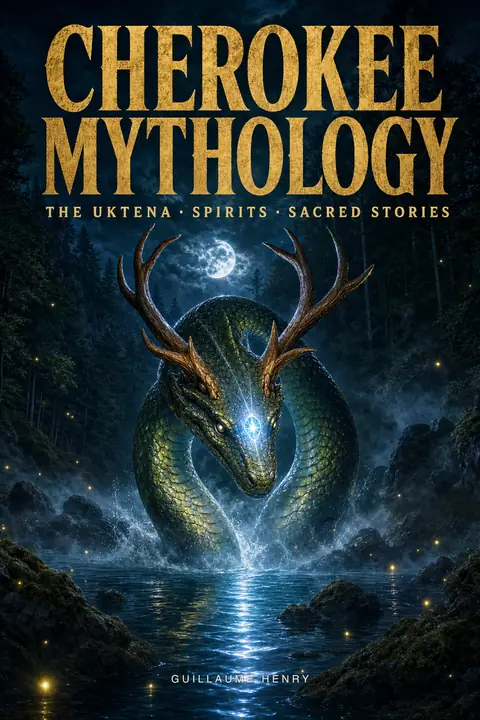
The Cherokee Mythology Book: The Uktena, the Spirits, and the Sacred Stories
The Uktena, the Spirits, and the Sacred Stories
The sacred stories of the Cherokee: how the world was made on the back of a water beetle, the horned serpent Uktena and its blazing crystal, the Little People who live inside the mountains, and the medicine that holds it all together. Recorded from the elders before it could be lost.
More from Cherokee
All articles
Cherokee
The Seven Clans: Cherokee Social and Spiritual Structure
The Cherokee nation organized itself through seven matrilineal clans, each with its own spiritual role, animal symbol, and responsibility to the people. Discover how this ancient system shaped Cherokee law, kinship, identity, and survival for centuries.
Cherokee
Sequoyah: Creator of the Cherokee Syllabary
Sequoyah invented a written system for the Cherokee language in just 12 years, transforming a spoken-only tradition into a literate nation. His genius was practical, not mystical: he saw that other peoples had captured their words on paper, and he figured out how.
Cherokee
The Green Corn Ceremony: Cherokee Harvest Renewal Ritual
The Green Corn Ceremony, or Iisgano'asdi in Cherokee, is the nation's most sacred annual gathering: a four-day harvest festival where the people renew their covenant with the Creator, cleanse themselves of past wrongs, and begin the year anew. Discover how a single ear of corn became the axis of Cherokee identity and spiritual restoration.

Cherokee
The Origin of Fire: How Water Spider Brought the Flame
Water Spider risked everything to steal fire from the other side of the world and bring it to the cold Cherokee people. Discover how a small creature's bravery shaped the dawn of Cherokee civilization.