
The Green Corn Ceremony: Cherokee Harvest Renewal Ritual
The Green Corn Ceremony, or Iisgano'asdi in Cherokee, is the nation's most sacred annual gathering: a four-day harvest festival where the people renew their covenant with the Creator, cleanse themselves of past wrongs, and begin the year anew. Discover how a single ear of corn became the axis of Cherokee identity and spiritual restoration.
Contents
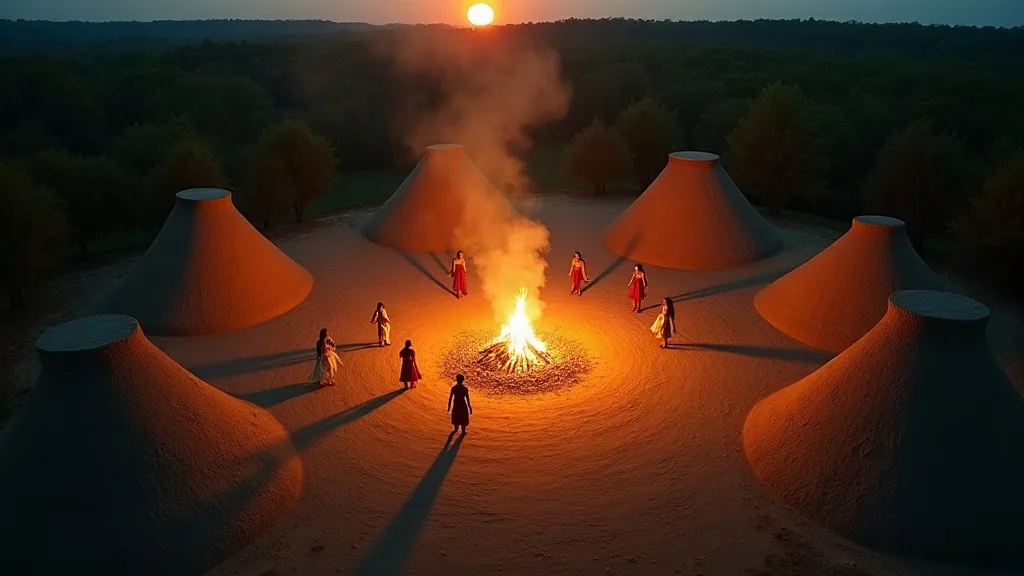
When the first ears of corn ripened in the fields each late summer, Cherokee towns emptied. Families left their homes and gathered at a central square ground, a sacred plaza marked by four mounds and a ceremonial fire that would not be quenched for four days and nights. This was no ordinary harvest. The Green Corn Ceremony, known in the Cherokee language as Iisgano'asdi (which translates roughly as "where the new food is"), was the moment when a nation renewed itself: spiritually, socially, and morally. Old debts were forgiven. Old grudges dissolved. The fire that burned in the square was kindled fresh from the sun itself, and families ignited new hearths from it, symbolically wiping clean the household fires of the past year. A community that had lived with anger, sickness, and breach stood upright again.
The ceremony belonged to no single person and no single priest. It required every capable body, every voice, every dance step. A Cherokee saying holds that a person without a town has no name; conversely, a town without the Green Corn Ceremony would lose its soul. For roughly three hundred years before removal, and continuing in Oklahoma and North Carolina to this day, the ceremony marked the boundary between the old year and the new, between chaos and order, between the debts owed and the slate wiped clean.
The Roots of Iisgano'asdi: Why Corn, and Why Ceremony
Corn did not grow wild in what is now the southeastern United States. Maize arrived from Mesoamerica, carried north by trade networks and hand-to-hand over centuries. By the time Cherokee oral history begins, corn had become indispensable. A family without corn stores faced starvation in winter. A town whose corn crop failed faced destitution. Corn was not merely food; it was security, it was survival, and therefore it became sacred.
The Cherokee recognized three sisters in their agriculture: corn, beans, and squash. These three plants grew together in the same mound, supporting each other. The tall corn stalk gave the bean vine something to climb. The squash leaves shaded the soil and held moisture. Together they were complete. Separately, each was vulnerable. This was not metaphor for the Cherokee; it was observable fact, encoded into their planting practice year after year. The relationship between the three sisters mirrored the relationship between a clan member, their family, and their town. You could not flourish alone.
When European diseases, warfare, and displacement began to tear at Cherokee society in the 1600s and 1700s, the Green Corn Ceremony took on new meaning. The ceremony became a moment when fractured communities could attempt to knit themselves back together. A person who had committed a serious crime (short of murder) could seek forgiveness and reintegration. A family in mourning could step back into normal social life. The new fire, kindled from the sun, represented a new chance for every soul present.
The Four Days: Ritual and Restoration
The ceremony unfolded over roughly four days, though the exact duration and sequence varied by town and era. Historians and anthropologists who recorded Cherokee accounts in the 19th and 20th centuries, including the ethnographer James Mooney, documented enough variation to show that no single script was followed, yet the underlying logic remained consistent.
The gathering began with purification. Men and women separated, drinking a strong herbal tea brewed from roots and plants. The drink was designed to cleanse the body from within, inducing vomiting and emptiness. This was not mere superstition; the ceremony enacted a literal and symbolic purge. You came as you were, carry ing the sickness and sin of the past year in your belly, and you left it behind. Women underwent their purification rites in one location, men in another. The physical act of emptying oneself was inseparable from the spiritual act of readiness.
On the second day, the great new fire was kindled. A priest (or, in some towns, a group of elders) struck flint and steel or, in older times, used friction methods to produce flame from the rising sun. This fire was lit in the center of the town square, at the axis where the cardinal directions met. It was not a practical fire meant to cook food; it was a sacramental fire, and from it every family would ignite their household hearth for the coming year. To take fire from the central square was to take a piece of the town's covenant into your home.
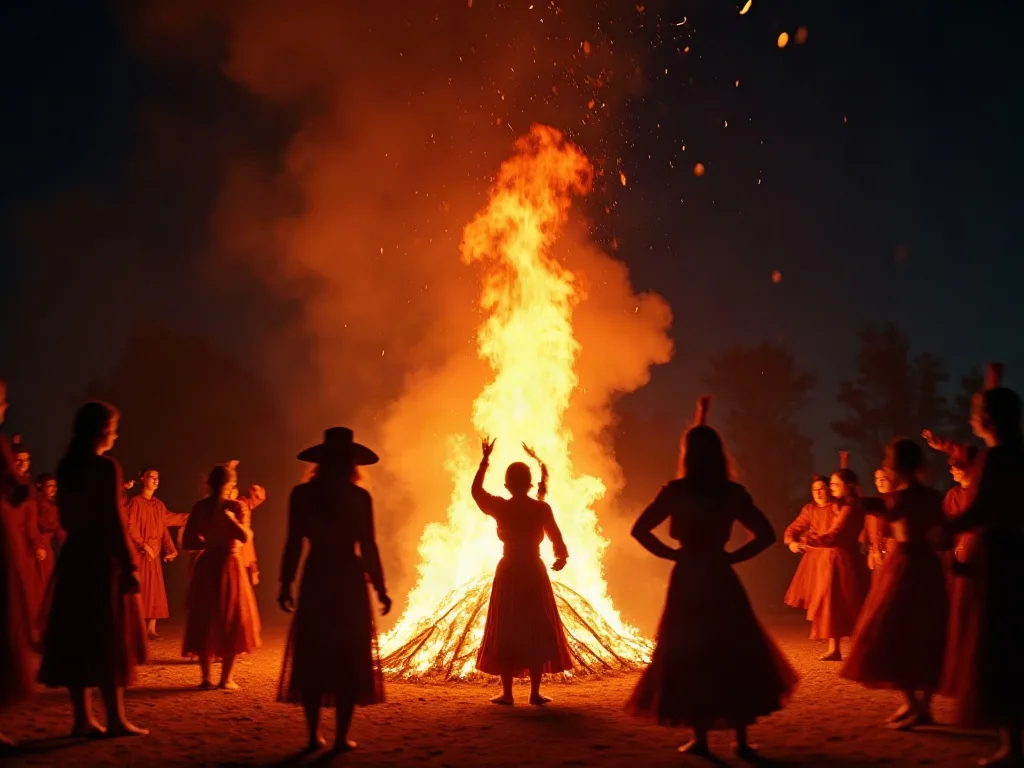
The night of the new fire was given to feasting and the Green Corn Dance. The first corn of the season, still green and tender, was prepared and shared. Deer meat, if successful hunters had made an offering, was roasted. Men and women danced in circles around the fire, their feet moving in patterns that followed the sun's path across the sky. The dance was not entertainment; it was a conversation with the powers that had made the corn grow. Every step was prayer. The rhythm of the drums, the songs in Cherokee, the turning bodies: these bound the community into a single organism, moving as one.
On the following days came the settlement of disputes. A man who owed another man something brought it forward and paid. A woman who had quarreled with her neighbor publicly embraced her. A clan that had taken revenge for a death was asked, for the sake of the ceremony, to set the matter aside. Forgiveness was not optional; it was the condition of returning home. You carried no debts into the new year. You carried no anger. To refuse reconciliation was to stand outside the community, to declare yourself unfit for renewal. Few chose that path.
The Green Corn Itself: Food and Theology
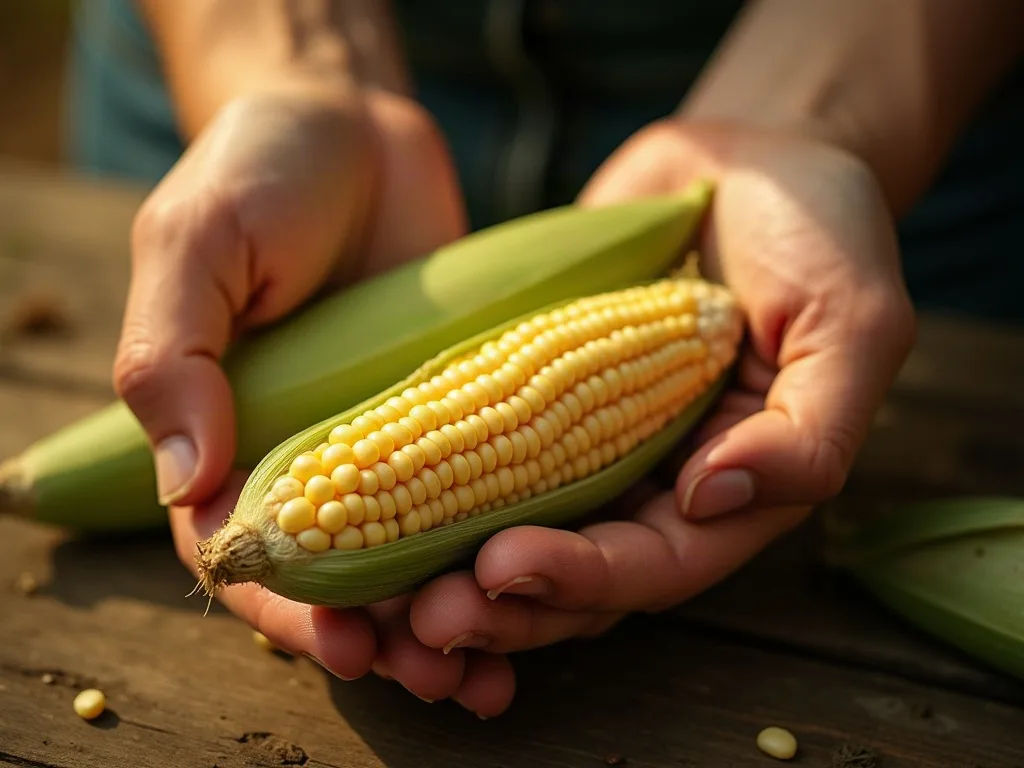
The ear of corn at the ceremony's heart was young, still in the milk stage, its kernels not yet hardened. This green corn, eaten fresh, was a delicacy and a rarity. Most of the year, the Cherokee ate corn that had been dried and stored, ground into meal, parched into kernels for travel. The appearance of fresh corn marked a threshold in the seasons, and the ceremony marked the moment the community could rightfully eat it.
There was theology embedded in this waiting. The corn belonged to the Creator first. The people did not own it; they were permitted to use it, and only after proper thanksgiving and purification. To eat the new corn before the ceremony was to steal from the powers above. It was a violation that could bring sickness or crop failure. Children were taught from early age that they must wait, must not sneak into the fields and eat an early ear. Restraint was a form of respect, and respect kept the cosmos in balance.
The Social Order Remade
The Green Corn Ceremony was also a moment of election and recognition. Towns often used the gathering to appoint or affirm their leadership for the coming year. A man whose counsel had proven wise, whose judgment had brought the town safely through conflict, might be formally recognized as a war chief or civil chief. Women who had borne and raised strong children, who had kept their households fed and their knowledge alive, were honored. The ceremony was a mirror in which the community saw itself and decided what it wanted to become.
Clans reasserted their roles. Among the Cherokee, a person belonged to their mother's clan, and clan identity shaped everything: whom you could marry (never within your clan), whom you must avenge if they were killed, what responsibilities you carried toward other clan members. The ceremony brought clans together while respecting these ancient divisions. A person might fast or take on special duties because of their clan role. The ritual architecture of the ceremony held the clan system in place, making it visible and reinforcing its power.
Iisgano'asdi Across Time and Distance
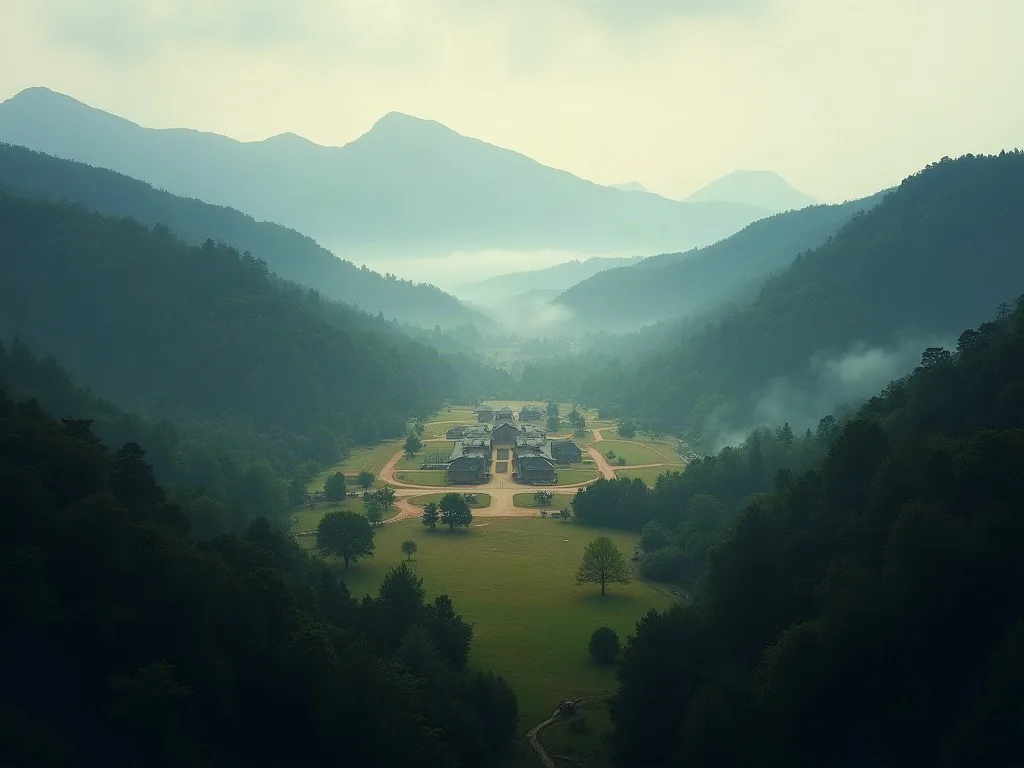
The Cherokee nation spanned dozens of towns before removal. Not every town had an identical ceremony, but the underlying logic was universal. The Kituwah town in what is now North Carolina was considered the oldest and most ceremonially significant. The town of Chota in Tennessee maintained strict protocols. When the nation was forcibly removed to Oklahoma in 1838-1839 on the Trail of Tears, many families had to abandon the ceremony for years. The land itself was gone. The ancestral towns were left behind.
Yet the ceremony persisted. In Oklahoma, Cherokee communities rebuilt. They established new towns. They rekindled the central fire and gathered again for the Green Corn. In North Carolina, where some Cherokee managed to remain or later return, the ceremony never fully ceased. Even when suppressed by federal authorities who saw indigenous rituals as obstacles to assimilation, families kept the knowledge alive, passed it to the next generation in whispers and private gatherings.
In the 20th century, especially after the Indian Reorganization Act of 1934 allowed indigenous nations more autonomy, Cherokee communities began to openly revive and document their ceremonies. Anthropologists and Cherokee scholars recorded accounts. Families who had kept the traditions internally began to teach them publicly again. Today, the Green Corn Ceremony continues in multiple Cherokee communities, particularly the Eastern Band of Cherokee Indians in North Carolina and various groups in Oklahoma. Each town or community adapts the basic structure to its own needs, but the core remains: four days, new fire, cleansing, forgiveness, feasting, dance, and the renewal of the people's covenant with the earth and sky.
The Cosmology Behind the Fire
The Cherokee worldview, as preserved in oral tradition and documented by scholars like James Mooney, James Kilpatrick, and more recently by Cherokee historians such as Duane King and Tom Belt, understood the cosmos as a layered reality. The Upper World was a place of order, clarity, and power. The Middle World was where humans lived, always in tension between order and chaos. The Lower World was a realm of danger, wildness, and transformation. The Green Corn Ceremony was an instrument to pull the Middle World upward, toward the clarity and power of the Upper World.
The new fire, kindled from the sun, was literally a piece of the Upper World brought into the town square. When families carried it home and lit their household fires from it, they were bringing order and blessing into their dwellings. The ceremonial dance imitated the movement of celestial bodies. The songs called out to the powers that sustained life. Nothing was accidental. Every gesture, every word, every meal was a deliberate act of maintaining harmony.
The Ceremony and Christian Arrival
When Christian missionaries arrived among the Cherokee in the late 1700s and early 1800s, they viewed the Green Corn Ceremony with suspicion. It was pagan. It involved sacred fire and dancing, both red flags to Protestant and Catholic missionaries. Some Cherokee leaders, especially those who had adopted Christian beliefs, stopped participating. Their absence created a generational rift.
Yet many Cherokee found ways to hold both traditions at once. They continued to attend the ceremony while also participating in Christian worship. The two faiths addressed different registers of meaning. The ceremony was embedded in the land and the seasonal cycles. Christianity offered salvation and moral instruction. A person could do both. In some Cherokee communities today, the opening of the ceremony includes a Christian prayer, followed by a blessing in Cherokee. The boundary between traditions has become permeable, even as the core logic of the ceremony remains distinctly Cherokee.
Frequently Asked Questions About the Green Corn Ceremony
Frequently asked questions
Is the Green Corn Ceremony still practiced today?
Yes. The Eastern Band of Cherokee Indians in North Carolina holds the ceremony in several communities each year, typically in late July or August. Various Cherokee groups in Oklahoma also maintain the tradition. Each community has adapted the format to modern circumstances (some run three days instead of four, for example), but the fundamental structure and purpose remain intact. The ceremony is open to enrolled Cherokee citizens and, in some communities, to other members of the Cherokee nation's wider diaspora.
What is the connection between the Green Corn Ceremony and other Native American harvest rituals?
Many southeastern and eastern Native American nations held harvest ceremonies with similar structures: the Chickasaw, Creek, Choctaw, and Seminole peoples all had corn-centered renewal ceremonies with roots in the same Mississippian and Mesoamerican cultural heritage. The underlying logic is shared: corn requires communal cooperation; the harvest marks a threshold; renewal of the people and renewal of the land are inseparable. However, each nation's specific ceremony reflects its own cosmology and history. The Cherokee version is distinct in its emphasis on the absolute purification of the individual and the community, and in the formal forgiveness and settlement of debts that characterizes the middle days.
Can non-Cherokee people participate in the Green Corn Ceremony?
In most Cherokee communities, the ceremony is reserved for Cherokee citizens, though policies vary by community. Some communities welcome family members married into the nation; others are strict about enrollment. It is important to respect the community's boundaries. However, many Cherokee communities have begun to document and share knowledge about the ceremony publicly, and some offer educational programs and talks about its meaning and history. A respectful approach is to ask a particular community about their policies rather than assume.
What happened to the ceremony during the Trail of Tears and the early years in Oklahoma?
The forced removal of 1838-1839 was catastrophic to Cherokee ceremonial life. Families were torn apart, large numbers died, and the ancestral lands and towns where the ceremony had always been held were abandoned. For roughly a decade, many Cherokee communities could not gather for the full ceremony. However, the practice resumed in Oklahoma as communities reorganized. Families who had fled to North Carolina and remained there also continued the ceremony in modified form. The resilience of the tradition is considered by Cherokee scholars to be a sign of its deep cultural significance and the commitment of families to maintain it despite tremendous hardship.
What role did women play in the Green Corn Ceremony?
Women had essential roles, though some scholars debate the exact degree of participation and leadership across different towns and eras. Women underwent separate purification rituals, prepared food, participated in dancing, and in some communities, held specific ceremonial offices or were recognized as keepers of particular knowledge. The ceremony was not patriarchal in the way Euro-American institutions typically were; instead, it reflected Cherokee clan structure, which was matrilineal. A woman's status and role were not subordinate but interdependent with men's roles, much like the three sisters of agriculture. Historical records are sometimes unclear on women's participation because early European observers often focused on male leadership, but evidence suggests women's presence and agency was central to the ceremony's power.
The Ceremony in Modern Scholarship and Revival
Since the 1980s, Cherokee communities have increasingly documented and studied their own traditions rather than relying solely on historical accounts recorded by outside observers. Scholars like Duane King, who worked with the Museum of the Cherokee Indian, and community historians have conducted interviews with elders, cross-referenced historical documents, and produced a richer, more nuanced understanding of how the ceremony actually functioned.
One finding is that the ceremony's structure adapted to circumstances. During times of warfare or hardship, the emphasis on forgiveness and the settling of disputes became even more pronounced. During times of relative peace, the ceremony might emphasize celebration and the blessing of new beginnings more. The ceremony was not a rigid liturgy; it was a framework flexible enough to serve the community's deepest needs.
Another insight is the role of music and dance. Recordings made in the mid-20th century preserve Cherokee songs associated with the Green Corn Ceremony. The melodies and rhythms, though documented in musical notation, lose something essential when translated to paper. To hear them sung in the Cherokee language, in the voices of elders who learned them from their grandmothers, is to hear the ceremony itself. Some Cherokee communities have made recordings available, and young people are increasingly learning these songs and dances as an act of cultural restoration.
The Unbroken Fire
To stand near the central fire during the Green Corn Ceremony, to smell the wood smoke and hear the drums, is to stand at a point that has been continuously inhabited by Cherokee people and their ancestors for centuries. The fire that burns is not the same fire that burned in 1700, yet it is lit from the same intention and the same prayer. A family that took coals from the ceremony square in 1750 and carried them home lit their hearth from those coals. Did their descendants, even after removal and diaspora, remember that continuity? Some certainly did. They spoke of it. They taught it.
The ceremony is not a museum piece, not a historical re-enactment. It is a living practice, undertaken each year by communities who understand it as essential to their survival and their identity. To witness it is to see a nation that has endured removal, poverty, systematic attempts to erase its culture, and still gathers four days each year to say: we are still here. We still remember. We still know how to make ourselves whole.
The new fire, kindled anew, is lit not to commemorate the past but to kindle the future.
Read the full book
Want the whole story?
The complete edition is an instant PDF download here, with a paperback on Amazon for selected titles.
Cherokee
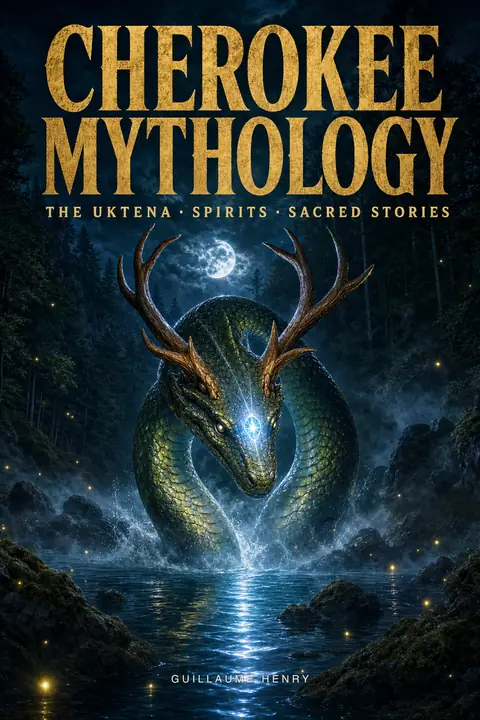
The Cherokee Mythology Book: The Uktena, the Spirits, and the Sacred Stories
The Uktena, the Spirits, and the Sacred Stories
The sacred stories of the Cherokee: how the world was made on the back of a water beetle, the horned serpent Uktena and its blazing crystal, the Little People who live inside the mountains, and the medicine that holds it all together. Recorded from the elders before it could be lost.
More from Cherokee
All articles
Cherokee
The Trail Where They Cried: Mythology and Memory of Removal
The Trail of Tears reshaped Cherokee mythology itself. Discover how forced removal in 1838-1839 became a sacred narrative of survival, covenant, and the land's eternal connection to a people who refused to disappear.

Cherokee
The Seven Clans: Cherokee Social and Spiritual Structure
The Cherokee nation organized itself through seven matrilineal clans, each with its own spiritual role, animal symbol, and responsibility to the people. Discover how this ancient system shaped Cherokee law, kinship, identity, and survival for centuries.
Cherokee
Sequoyah: Creator of the Cherokee Syllabary
Sequoyah invented a written system for the Cherokee language in just 12 years, transforming a spoken-only tradition into a literate nation. His genius was practical, not mystical: he saw that other peoples had captured their words on paper, and he figured out how.

Cherokee
The Origin of Fire: How Water Spider Brought the Flame
Water Spider risked everything to steal fire from the other side of the world and bring it to the cold Cherokee people. Discover how a small creature's bravery shaped the dawn of Cherokee civilization.