
The Origin of Fire: How Water Spider Brought the Flame
Water Spider risked everything to steal fire from the other side of the world and bring it to the cold Cherokee people. Discover how a small creature's bravery shaped the dawn of Cherokee civilization.
Contents
High in the Smoky Mountains, the first people shivered in the dark. No fire warmed their lodges. No flame cooked their meat. The world had only cold stone and the faint glow of lightning that danced across the sky but could never be caught or held.
Then Water Spider saw what needed to be done.
This was no ordinary spider. In the old stories, Water Spider was clever, resourceful, and fearless. She could walk on water as easily as we walk on earth, and she had a gift no other creature possessed: a body built to carry things, a web that could hold more than any sack woven by human hands.
Across the great water to the east, on an island that rose far from the land of the Cherokee, a fire burned eternally in a great hollow sycamore tree. The people there guarded it fiercely. The flames belonged to them alone. But Water Spider knew that fire was meant to warm all people, that cold was a wound that needed healing.
The Council of Creatures
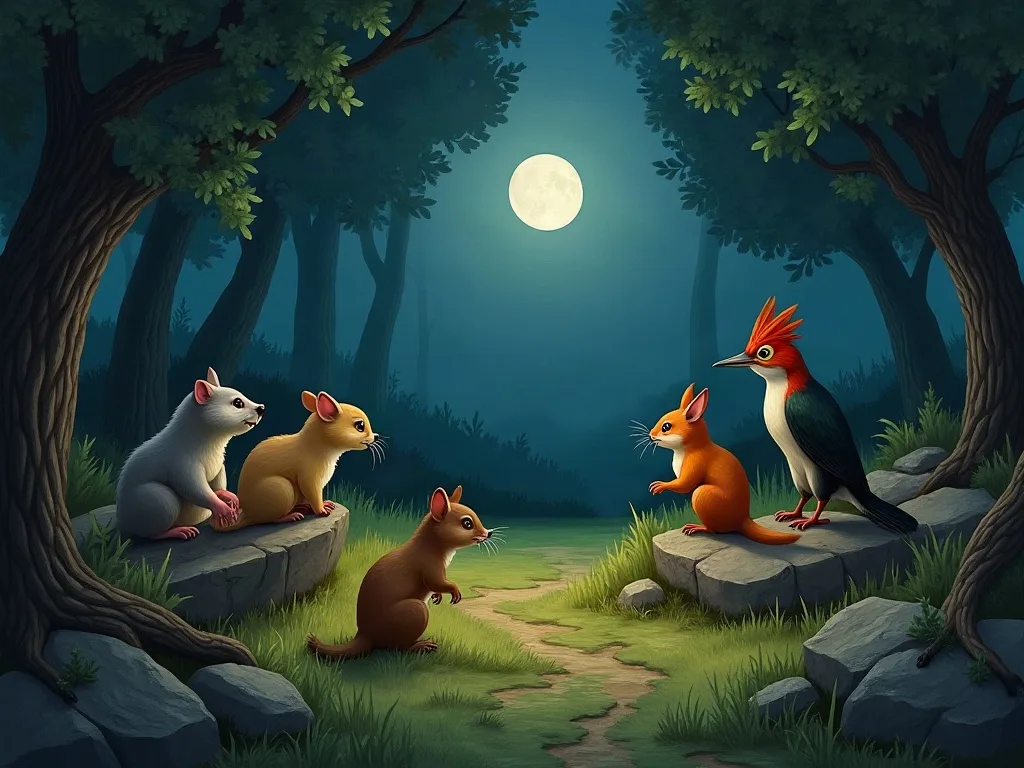
Before Water Spider could act, the matter had to be decided. The animals gathered in council to speak of the fire across the great water. Possum offered to help. His tail was full and fat and fluffy; surely it could hold coals. Possum swam through the night, slipping past the guardians of the distant island. He crept into the hollow sycamore where the fire burned bright and hot.
He grabbed a coal and stuffed it into his tail.
But the heat was unbearable. The coal burned through his fur and singed his skin. Possum screamed and ran. His tail caught flame. He dove into the river to escape the fire, and the coal sank to the bottom, lost. Possum's beautiful tail was never the same after that night. Some say it is still bare and thin, marked forever by that failed attempt to carry fire.
Squirrel tried next. He was fast and nimble. He could climb and leap where others could not. But when he grabbed a coal and tucked it behind his ear, the heat spread too quickly. Squirrel yelped and dropped it, and to this day, squirrels carry a black stripe down their backs, a scar from their ancestor's encounter with that ancient flame.
Many creatures attempted the journey. Woodpecker beat his strong wings across the water and snatched a coal, but held it so tightly that the heat burned his head crimson. That is why woodpeckers have red markings still. Opossum curled into a ball and tried to hide a coal inside. The fire consumed him before he could reach home.
Each failure taught the same lesson: fire was not meant to be carried by force or speed alone. It needed something different. It needed the creature who understood water, who moved with patience, who could weave and build and hold fast.
Water Spider Takes the Journey
Water Spider stepped forward in the council. She was small. Her voice was quiet. The other animals did not expect much from her. But she knew what she could do that they could not.
Water Spider could swim. More than that, she could move across water without sinking. Most creatures relied on speed or strength. Water Spider had woven her own way.
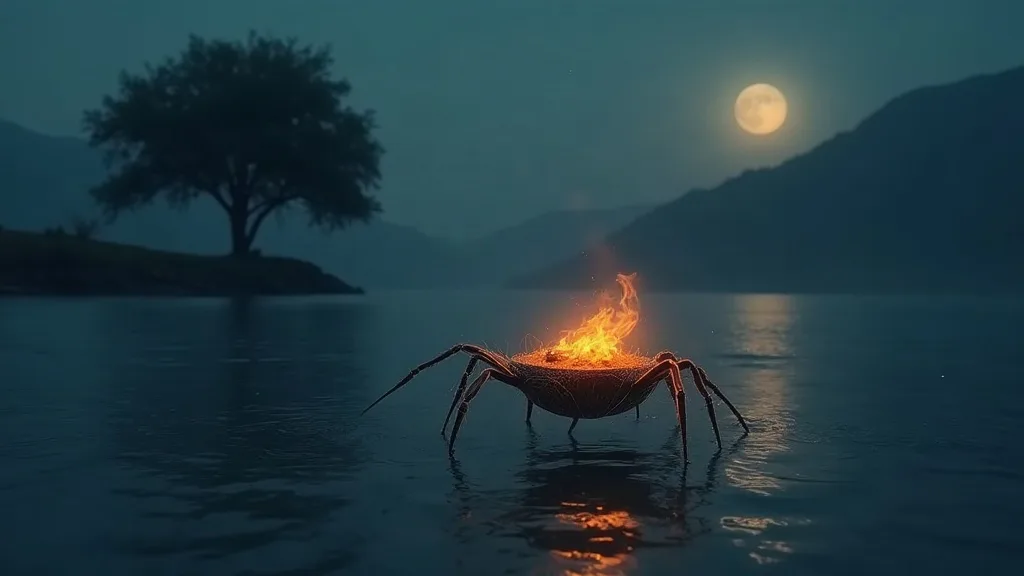
She began to weave. Her spinnerets worked swiftly, creating something new: a small, bowl-shaped web. It was delicate but firm, a vessel that had never existed before. In Cherokee stories, this is how things come into being that serve the people. A creature sees a need and imagines what does not yet exist, then makes it real through patience and skill.
The other animals did not believe the tiny web could hold fire, could survive the journey, could cross the vast waters. Water Spider did not wait for their approval. She took the small bowl of woven silk and set it on her back. Then she walked out onto the water as if it were solid ground, because in the way of myths, creatures move as their nature allows them to move.
The journey was long. The water was deep and cold. The guardians of the distant island did not notice the small spider approaching. She moved carefully, unseen. When she reached the hollow sycamore, she walked inside where the fire burned without end. She waited until the moment was right. Then she quickly placed a coal into her woven bowl.
The web did not tear. The silk did not burn. Water Spider had woven it with the same knowledge that lets her walk on water, the same understanding of how to make something strong from something small and flexible.
She turned and walked back across the water, steady and sure.

Fire Comes to the Cherokee Land
When Water Spider reached the home of the Cherokee, she did not keep the fire for herself. She placed it carefully on a piece of wood, in a place where the people could find it and learn to use it.
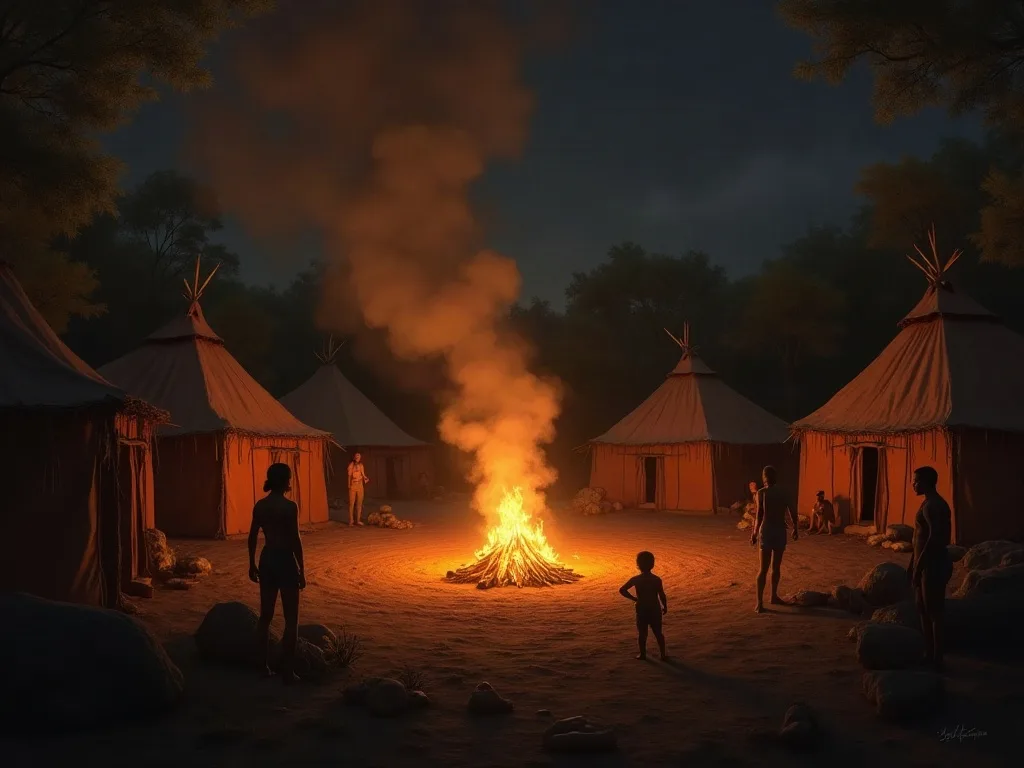
The Cherokee took the coal and began to feed it with dry kindling. The flame grew. It spread from lodge to lodge. Smoke rose into the cold night sky. For the first time, the people felt warmth at their hearths. For the first time, they could cook meat until it was nourished. For the first time, they could see each other's faces in the dark, could tell stories by firelight, could survive the long winters.
Fire had arrived. The age of cold had ended.
This is the origin story that Cherokee elders have told for countless generations. It is preserved in the oral tradition and in collections made by folklorists and Cherokee scholars in the 19th and 20th centuries, most notably in James Mooney's work with the Cherokee in the 1880s and 1890s.
Why This Story Matters to the Cherokee
The tale of Water Spider bringing fire is not merely an explanation of where fire came from. It is a teaching story, a reflection of Cherokee values and principles that have guided the people for centuries.
In many origin stories across the world, the hero who brings a vital gift is large, strong, or magical. Think of Prometheus in Greek myth stealing fire from the gods and paying a terrible price. But Water Spider is small. She is the kind of creature that humans might overlook, step on, brush away. Yet she is the one with the gift that saves everyone.
This teaches a truth that runs through Cherokee philosophy: that strength and worth are not measured by size or obvious power. A small person, a quiet voice, an overlooked individual, can accomplish what the proud and the celebrated cannot. Value lives in what you create with your hands, in your patience, in your willingness to take a risk for others.
The story also celebrates resourcefulness and imagination. Water Spider does not simply borrow a tool from someone stronger. She invents what she needs: the woven bowl. She uses what is already hers, her own web, her own ability to walk on water. This is the Cherokee value of self-reliance and creative problem-solving.
The repeated failures of the other creatures are not punishments. They are a record written into the bodies of the animals themselves. When Possum's tail was burned, it became a mark of his courage and his closeness to the fire. The same is true for Squirrel and Woodpecker and Opossum. In Cherokee stories, to be scarred by an attempt to help the people is an honor. These creatures bear marks that ancestors will recognize and remember.
The Fire Brought Other Gifts
Once the Cherokee had fire, other things became possible. Pottery could be fired into lasting form. Metals could be worked. Food could be preserved. The night became a time for gathering and learning, not just sleeping and hiding from the dark.
In many Cherokee traditions, the origin of fire is tightly connected to the origin of other knowledge. Some versions of the story suggest that once fire came to the people, the knowledge of how to use it, how to speak to it, how to keep it sacred, came as well. The fire was not just a physical element. It was a teacher and a bridge between the human world and the world of spirits.
Fire in Cherokee thinking is not just fuel. It is alive. It has personality and power. It must be treated with respect. Water Spider's gift was the gift of relationship with the living fire, not merely its possession.
Water Spider in the Wider Cherokee World
Water Spider does not fade from Cherokee tradition after bringing the fire. She appears in other stories as a wise figure, sometimes a helper, sometimes a guardian of water boundaries.
In some traditions, Water Spider is associated with the boundaries between worlds. Water itself is a boundary in Cherokee cosmology: between the land of humans and the underwater world of spirits. A creature that can walk on water without sinking, that exists between two worlds, carries symbolic weight that goes far beyond the single fire-bringing story.
Water Spider is also sometimes understood as feminine, though many oral traditions are subtle on this point. What is clear is that she is neither a male warrior figure nor a female figure defined only by nurturing. She is an agent, a doer, a problem-solver. She takes action in the world and changes its course.
Some Cherokee stories connect the origin of fire to the origin of the world itself, or to the moment when the Cherokee nation was established in its homeland. The fire that Water Spider brought is the fire that warms the first lodges, that cooks the first meals, that allows the first councils and ceremonies to take place. In this sense, she is a midwife to the Cherokee nation's emergence into full being.
How This Story Traveled and Changed
The Water Spider fire story has been preserved in several forms. The most widely known version comes from James Mooney's collections from the 1880s and 1890s, published as "Myths of the Cherokee" in the Nineteenth Annual Report of the Bureau of American Ethnology. Mooney recorded the story from Cherokee speakers and writers who shared their traditions with him.
Other versions have come down through Cherokee families directly, told in Cherokee language and kept alive in the communities of the Eastern Band of Cherokee Indians in North Carolina and the Cherokee Nation of Oklahoma. Each telling can vary slightly in details, but the core remains: a small, clever creature achieves what the strong cannot.
The story has also echoed in popular culture, in children's books, in educational materials about Native American myths. Not all of these retellings are careful or respectful. Some strip away the philosophical depth or flatten the characters into simple symbols. The best retellings, however, recognize that this is not a quaint folk tale from the distant past. It is a living story, still taught, still meaningful, still guiding how Cherokee people understand creativity, courage, and community.
The Global Pattern of Fire-Theft
The origin of fire appears in origin stories across cultures. The Prometheus myth from Greece shows a divine being stealing fire from the gods and bringing it to humans at great personal cost. In Hindu tradition, the Asuras and Devas compete for divine power and knowledge, and fire plays a crucial role in ritual and cosmic order. In Polynesian stories, Maui steals fire from the fire-keepers and brings it to human hands.
What is distinctive about the Cherokee version is that the hero is not divine, not cursed, not punished for the theft. Water Spider is simply a member of the animal community who solves a problem through her unique gifts. She does not rebel against authority or pay a price. She acts with the blessing of the council, and the theft is not a violation but a rescue.
This reflects a different understanding of power and ownership. In the Cherokee story, fire is not hoarded by gods who need to be defied. It is simply in the care of distant keepers, and the need of the near people is greater than the claim of distant possession. Water Spider does not take fire away from anyone who needs it. She shares it. She multiplies it. She brings abundance.
Living Fire: The Story in Modern Cherokee Life
For Cherokee people today, the Water Spider story is not historical curiosity. It is a story that lives, that teaches, that connects present people to ancestors and to the land.
In Cherokee communities, fire remains significant. Sacred fires are kindled for ceremonies and gatherings. The traditions around tending fire, around respect for fire, around the stories fire carries, are kept alive. When an elder tells the Water Spider story to children, they are not reciting ancient history. They are teaching how to think, how to be brave in small ways, how to use what you have, how to work for the benefit of all.
The story also speaks to contemporary questions. In a world where resources are unequally divided, where the powerful guard what they claim to own, where small voices are often dismissed, Water Spider's success carries weight. She did not ask permission. She did not wait for the powerful to agree. She saw what needed to be done, prepared herself with the best of her abilities, and acted. The result was transformation.
Frequently asked questions about the origin of fire in Cherokee tradition
Frequently asked questions
Was Water Spider a real creature in Cherokee tradition, or purely mythological?
In Cherokee thought, the boundary between "real" and "mythological" is not the same as in modern Western thinking. Water Spider is understood as a real creature, the actual spider, but also as a being with deeper significance and power. The story explains both how fire came to the people and who Water Spider was as a character. The spider you might see walking on a pond today is a descendant of that original Water Spider, and carries that heritage within it. Many Cherokee elders speak of the creatures in the stories as living examples of the principles they taught.
Why did the other animals fail to bring fire?
Each animal tried to use its own greatest gift: Possum used his tail, Squirrel used his speed, Woodpecker used his flight and strength. But fire required something none of them possessed as individuals. It required weaving, flexibility, the ability to move between two worlds (land and water), and the courage to work slowly and carefully instead of quickly and forcefully. The story teaches that different creatures have different gifts, and some tasks require gifts you do not naturally possess. You must think differently, create something new, and work in a way that suits the problem rather than just your own nature.
Is this story found in written sources, or only in oral tradition?
The most important written collection is James Mooney's "Myths of the Cherokee" from the 1890s, which recorded stories from Cherokee speakers and writers. Other versions appear in 20th-century ethnographic work and in collections by Cherokee scholars and storytellers. However, the truest form of this story is the oral tradition, still living in Cherokee families and communities. When an elder tells it, they are not reading from a book; they are passing it forward as it has been passed to them. The written versions are important records, but they capture only what can be captured in words.
How does Water Spider's bringing fire compare to Prometheus stealing fire in Greek mythology?
Both stories place a fire-bringer at the center of human progress. Prometheus is a Titan, divine and powerful, who defies Zeus and pays eternal punishment. Water Spider is small, clever, and creative, who solves a community problem with the blessing of the council of animals. Prometheus's gift comes at a terrible cost to himself; Water Spider acts swiftly and returns safely. The Greek story emphasizes human rebellion against divine authority. The Cherokee story emphasizes community problem-solving and the value of the overlooked. Both cultures recognized that humans did not create fire themselves, but needed a helper or hero to bring it into reach.
What does fire symbolize in Cherokee spirituality?
Fire is understood as a living force, a teacher, and a bridge between the physical and spiritual worlds. In Cherokee traditions, fire must be respected and spoken to, not merely used. It purifies, it heals, it lights the path. It is central to ceremonies and gatherings. The fire that Water Spider brought was not just a physical tool; it was the beginning of humanity's ability to transform the world, to cook, to warm, to light the dark. In this sense, it represents the power of creation itself, the ability to change raw materials into something that sustains life.
The Story Continues
The tale of Water Spider bringing fire is not a story locked in the past. It breathes. It teaches. It reminds Cherokee people, and anyone who hears it, that the most important changes often come not from the largest voice or the mightiest hand, but from the patient work of someone who understands their own gifts and is willing to use them for others.
In the mountains where this story began, fire still burns. In the hearts of Cherokee people, the memory of Water Spider's courage still moves them to small acts of bravery and clever solutions to hard problems. That is how myths live. They do not stay in books or in the distant past. They walk beside us, reminding us of who we are and what we might become if we are willing to risk, to create, and to carry light to others.
Read the full book
Want the whole story?
The complete edition is an instant PDF download here, with a paperback on Amazon for selected titles.
Cherokee
The Cherokee Mythology Book: The Uktena, the Spirits, and the Sacred Stories
The Uktena, the Spirits, and the Sacred Stories
The sacred stories of the Cherokee: how the world was made on the back of a water beetle, the horned serpent Uktena and its blazing crystal, the Little People who live inside the mountains, and the medicine that holds it all together. Recorded from the elders before it could be lost.
More from Cherokee
All articles
Cherokee
The Trail Where They Cried: Mythology and Memory of Removal
The Trail of Tears reshaped Cherokee mythology itself. Discover how forced removal in 1838-1839 became a sacred narrative of survival, covenant, and the land's eternal connection to a people who refused to disappear.

Cherokee
The Seven Clans: Cherokee Social and Spiritual Structure
The Cherokee nation organized itself through seven matrilineal clans, each with its own spiritual role, animal symbol, and responsibility to the people. Discover how this ancient system shaped Cherokee law, kinship, identity, and survival for centuries.
Cherokee
Sequoyah: Creator of the Cherokee Syllabary
Sequoyah invented a written system for the Cherokee language in just 12 years, transforming a spoken-only tradition into a literate nation. His genius was practical, not mystical: he saw that other peoples had captured their words on paper, and he figured out how.
Cherokee
The Green Corn Ceremony: Cherokee Harvest Renewal Ritual
The Green Corn Ceremony, or Iisgano'asdi in Cherokee, is the nation's most sacred annual gathering: a four-day harvest festival where the people renew their covenant with the Creator, cleanse themselves of past wrongs, and begin the year anew. Discover how a single ear of corn became the axis of Cherokee identity and spiritual restoration.